July 31, 2018
Employees should heed the warning provided by a federal grand jury’s indictment today charging a Walled Lake, Michigan restaurant owner with 24 counts of failing to account for and pay over employment taxes and one count of willful failure to file an income tax return, announced Principal Deputy Assistant Attorney General Richard E. Zuckerman of the Justice Department’s Tax Division.
According to the indictment, Johni Semma owned Bayside Sports Bar & Grill (“Bayside”), a restaurant, and The Coliseum, an adult entertainment business. As the owner of Bayside, Semma was allegedly responsible for collecting and paying over Bayside’s employment taxes. The indictment charges that during 2008 to 2015, Bayside accrued employment tax liabilities of more than $1 million and that Semma withheld those taxes from the pay of the restaurant’s employees. Semma then allegedly failed to fully pay over the amounts he withheld to the Internal Revenue Service (IRS).
The indictment further alleges that in 2012, Semma sold The Coliseum for more than $6 million with approximately $3.5 million of the purchase price paid during 2012. Despite receiving considerable income from the sale of The Coliseum and other sources, Semma allegedly did not file a 2012 income tax return.
If convicted, Semma faces a statutory maximum of five years in prison for each count of failure to pay over the employment taxes. He faces a statutory maximum of one year in prison for the one count of willful failure to file his income tax return. In addition, he faces a period of supervised release, restitution, and monetary penalties. An indictment is an accusation. A defendant is presumed innocent unless and until proven guilty.
Employers should recognize the indictment as a reminder to ensure they timely collect and deposit all employment taxes withheld in accordance with applicable law.
About The Author
A Fellow in the American College of Employee Benefit Counsel, the American Bar Foundation and the Texas Bar Foundation; Former Chair of the RPTE Employee Benefits and Compensation Committee, a current Co-Chair of the Committee, and the former Chair of its Welfare Benefit and its Defined Compensation Plan Committees and former RPTE Joint Committee on Employee Benefits Council (JCEB) Representative, Cynthia Marcotte Stamer is a Martindale-Hubble “AV-Preeminent” practicing attorney and management consultant, author, public policy advocate, author and lecturer repeatedly recognized for her 30 plus years’ of work and pragmatic thought leadership, publications and training on health, pension and other employee benefit, insurance, labor and employment, and health care fiduciary responsibility, payment, investment, contracting and other design, administration and compliance concerns as among the “Top Rated Labor & Employment Lawyers in Texas,” a “Legal Leader,” a “Top Woman Lawyer” and with other awards by LexisNexis® Martindale-Hubbell®; as among the “Best Lawyers In Dallas” for her work in the field of “Labor & Employment,” “Tax: ERISA & Employee Benefits,” “Health Care” and “Business and Commercial Law” by D Magazine, in International Who’s Who of Professionals and with numerous other awards and distinctions.
Highly valued for her ability to meld her extensive legal and industry knowledge and experience with her talents as an insightful innovator and pragmatic problem solver, Ms. Stamer advises, represents and defends employer, union, multi-employer, association and other employee benefit plan sponsors, insurers and managed care organizations, fiduciaries, plan administrators, technology and other service providers, government and community leaders and others about health and other employee benefit and insurance program and policy design and innovation, funding, documentation, administration, communication, data security and use, contracting, plan, public and regulatory reforms and enforcement, and other risk management, compliance and operations matters. Her experience encompasses leading and supporting the development and defense of innovative new policies, programs, practices and solutions; advising and representing clients on routine plan establishment, plan documentation and contract drafting and review, administration, change and other compliance and operations; crisis prevention and response, compliance and risk management audits and investigations, enforcement actions and other dealings with the US Congress, Departments of Labor, Treasury, Health & Human Services, Federal Trade Commission, Justice, Securities and Exchange Commission, Education and other federal agencies, state legislatures, attorneys general, insurance, labor, worker’s compensation, and other agencies and regulators, and various other foreign and domestic governmental bodies and agencies. She also provides strategic and other supports clients in defending litigation as lead strategy counsel, special counsel and as an expert witness. Alongside her extensive legal and operational experience, Ms. Stamer also is recognized for her work as a public and regulatory policy advocate and community leader with a gift for finding pragmatic solutions and helping to forge the common ground necessary to build consensus. Best known for her domestic public policy and community leadership on health care and insurance reform, Ms. Stamer’s lifelong public policy and community service involvement includes service as a lead consultant to the Government of Bolivia on its pension privatization project, as well as extensive legislative and regulatory reform, advocacy and input workforce, worker classification, employee benefit, public health and healthcare, social security and other disability and aging in place, education, migration reforms domestically and internationally throughout her adult life. In addition to her public and regulatory policy involvement, Ms. Stamer also contributes her service and leadership to a professional and civic organizations and efforts including her involvement as the Founder and Executive Director of the Coalition on Responsible Health Policy and its PROJECT COPE; Coalition on Patient Empowerment, a founding Board Member and past President of the Alliance for Healthcare Excellence; Vice Chair of the ABA Tort & Insurance Practice Section Employee Benefits Committee; Vice Chair, Policy for the Life Sciences Committee of the ABA International Section, Past Chair of the ABA Health Law Section Managed Care & Insurance Interest Group; current Fiduciary Responsibility Committee Co-Chair and Membership Committee member of the ABA RPTE Section; former RPTE Employee Benefits and Other Compensation Group Chair, former Chair and Co-Chair of its Welfare Plans Committee, and Defined Contribution Plans Committee; former RPTE Representative to ABA Joint Committee on Employee Benefits Council; former RPTE Representative to the ABA Health Law Coordinating Counsel; former Coordinator and a Vice-Chair of the Gulf Coast TEGE Council TE Division, past Chair of the Dallas Bar Association Employee Benefits & Executive Compensation Committee, former Board Member, Continuing Education Chair and Treasurer of the Southwest Benefits Association; Vice President of the North Texas Healthcare Compliance Professionals Association; past Board Member and Board Compliance Committee Chair for the National Kidney Foundation of North Texas; former Board President of the early childhood development intervention agency, The Richardson Development Center for Children; past Dallas World Affairs Council Board Member, and in leadership of many other professional, civic and community organizations. Ms. Stamer also is a highly popular lecturer, symposia chair and author, who publishes and speaks extensively on health and managed care industry, human resources, employment and other privacy, data security and other technology, regulatory and operational risk management for the American Bar Association, ALI-ABA, American Health Lawyers, Society of Human Resources Professionals, the Southwest Benefits Association, the Society of Employee Benefits Administrators, the American Law Institute, Lexis-Nexis, Atlantic Information Services, The Bureau of National Affairs (BNA), InsuranceThoughtLeaders.com, the Society of Professional Benefits Administrators, Benefits Magazine, Employee Benefit News, Texas CEO Magazine, HealthLeaders, the HCCA, ISSA, HIMSS, Modern Healthcare, Managed Healthcare, Institute of Internal Auditors, Society of CPAs, Business Insurance, Employee Benefits News, World At Work, Benefits Magazine, the Wall Street Journal, the Dallas Morning News, the Dallas Business Journal, the Houston Business Journal, and many other symposia and publications. She also has served as an Editorial Advisory Board Member for human resources, employee benefit and other management focused publications of BNA, HR.com, Employee Benefit News, InsuranceThoughtLeadership.com and many other prominent publications and speaks and conducts training for a broad range of professional organizations and for clients, serves on the faculty and planning committee of many workshops, seminars, and symposia, and on the Advisory Boards of InsuranceThoughtLeadership.com, HR.com, Employee Benefit News, and many other publications.
Beyond these involvements, Ms. Stamer also is active in the leadership of a broad range of other public policy advocacy and other professional and civic organizations and involvements. Through these and other involvements, she helps develop and build solutions, build consensus, garner funding and other resources, manage compliance and other operations, and take other actions to identify promote tangible improvements in health care and other policy and operational areas.
Before founding her current law firm, Cynthia Marcotte Stamer, P.C., Ms. Stamer practiced law as a partner with several prominent national and international law firms for more than 10 years before founding Cynthia Marcotte Stamer, P.C. to practice her unique brand of “Solutions law™” and to devote more time to the pragmatic policy and system reform, community education and innovation, and other health system improvement efforts of her PROJECT COPE: the Coalition on Patient Empowerment initiative.
About Solutions Law Press, Inc.™
Solutions Law Press, Inc.™ provides human resources and employee benefit and other business risk management, legal compliance, management effectiveness and other coaching, tools and other resources, training and education on leadership, governance, human resources, employee benefits, data security and privacy, insurance, health care and other key compliance, risk management, internal controls and operational concerns. If you find this of interest, you also be interested reviewing some of our other Solutions Law Press, Inc.™ resources at SolutionsLawPress.com such as the following
▪DOL Spending Reports Required As Taxpayer Tool Need Improvement
▪Check & Protect Health & Other Electronic Systems & Data Against New Security Threat
▪April 1 New Deadline To Update Benefit Plan Disability Determination Claims & Appeals Procesures; Hear More on 1/26
▪Arizona Proposal To Ban Sexual Harassment Confidentiality Agreements Sign Of Growing Employer Risks
▪$23M Penalty Small Part of 21st Century’s Data Breach Fallout; Offers Data Breach Lessons For Other Businesses
▪Take Care of Your Good People
▪Read Tax Cuts and Jobs Act Conference Report For Tax Reform From Source
▪Check How IRS 2018 Retirement & Saving Plan Limits and Amounts Cost Of Living Adjustments Impact Your HR & Retirement Plan Administration & Planning
▪IRS Prepares To Nail Employers Under Obamacare Mandate While Giving Some Individual Mandate Relief
▪Hiring & Retaining Workers Growing Business Challenge
If you or someone else you know would like to receive future updates about developments on these and other concerns, please provide your current contact information and preferences including your preferred e-mail by creating or updating your profile here.
NOTICE: These statements and materials are for general informational and purposes only. They do not establish an attorney-client relationship, are not legal advice, and do not serve as a substitute for legal advice. Readers are urged to engage competent legal counsel for consultation and representation in light of the specific facts and circumstances presented in their unique circumstance at any particular time. No comment or statement in this publication is to be construed as an admission. The author reserves the right to qualify or retract any of these statements at any time. Likewise, the content is not tailored to any particular situation and does not necessarily address all relevant issues. Because the law is rapidly evolving and rapidly evolving rules makes it highly likely that subsequent developments could impact the currency and completeness of this discussion. The presenter and the program sponsor disclaim, and have no responsibility to provide any update or otherwise notify any participant of any such change, limitation, or other condition that might affect the suitability of reliance upon these materials or information otherwise conveyed in connection with this program. Readers may not rely upon, are solely responsible for, and assume the risk and all liabilities resulting from their use of this publication.
Circular 230 Compliance. The following disclaimer is included to ensure that we comply with U.S. Treasury Department Regulations. Any statements contained herein are not intended or written by the writer to be used, and nothing contained herein can be used by you or any other person, for the purpose of (1) avoiding penalties that may be imposed under federal tax law, or (2) promoting, marketing or recommending to another party any tax-related transaction or matter addressed herein.
©2018 Cynthia Marcotte Stamer. Non-exclusive right to republish granted to Solutions Law Press, Inc.™ For information about republication, please contact the author directly. All other rights reserved.
 Comments Off on Employer’s Employment Tax Fraud Indictment Warns Employers To Properly Pay Withheld Employment Taxes |
  4980D, 4980H, 5000, 6039D, ACA, board of directors, Brokers, compensation, compliance, Corporate Compliance, corporate governance, directors, employee, Employee Benefits, Employer, Employers, Employment, Employment Tax, Executive Compensation, Uncategorized, Unemployment Benefits, Unemployment Insurance, Wage & Hour, Whistleblower |
  Permalink
 Posted by Cynthia Marcotte Stamer
July 14, 2018
A flurry of activity in the House Ways & Means Committee and other Congressional committees over the past few weeks signals the advisability of keeping a close eye on health care and health benefit reform proposals this Summer in anticipation of both the Fall health benefit enrollment and renewal season and the mid-term November Congressional elections.
Coupled with the Trump Administration’s recent rollout of its long promised association health plan, short-term coverage and other regulatory reforms and promises of more changes to come, the ongoing attention paid by the Administration and Congress to health insurance and health care reform raises a strong possibility that employer, association, and other health plan sponsors, fiduciaries and their vendors that they and their plan members should be on watch for late-breaking developments that may require or warrant last minute changes to health benefit plan designs, communications, contracts or other key decisions.
With President Trump continuing to push for a wide range of health care reforms and health care and health benefit issues recognized as key voter concerns for the upcoming mid-term elections in November, the continued emphasis of the Republican-led Congress and federal regulators talking about their health care reform legislative agenda is not surprising. What may be more surprising to many is the intensity of the ongoing efforts in Congress to try to pass reform over the summer when many members of the House and Senate face tightly contested races in November.
Certainly continued Congressional commitment to pursue reform is evident from the House Ways & Means Committee’s health care heavy agenda of hearings and votes that this week alone resulted in its voting in favor of 11 health care reform bills promising new flexibility for employers about how to design their health plans and American families more health care choices and choice about how to pay for it and what coverage to buy popular with many providers, patients and employer and other health plan sponsors. While it remains to be seen if the House and Senate can agree on any or all of these proposal, the bi-partisan sponsorship of many of these proposals and the intensity of the focus of the Committee and others in Congress reflects a strong interest in health care reform by both parties leading up to November that could impact health benefit and other health care choices for providers, employers and American families in the Fall annual enrollment season.
The legislation passed by the Ways & Means Committee this weeks include bills that would:
- Provide relief for employers relief from the Obamacare’s employer mandate and delay for an additional year the effective date of the widely disliked “Cadillac Tax;”
- Overrule the “Use it Or Lose It” requirement in current Internal Revenue Regulations for healthcare flexible spending arrangement plans (HFSAs) that currently forces employers sponsoring HFSAs to draft their plans to require employees to forfeit unused salary reduction contributions in their HFSA accounts at the end of the year;
- Offer individuals and families eligible for Obamacare created health premium subsidies more choice about where to obtain that coverage using their subsidies; and
- Expand expand the availability and usability of HSAs in a multitude of ways.
Furthermore, a review of the Committee’s schedule makes clear that it isn’t finished with health care reform. After holding hearings on health savings account reforms and passing a flurry of health care reform bills intended to give employers relief from two key Obamacare mandates, to allow Obamacare subsidy-eligible Americans the choice to use the subsidies to purchase health care coverage not offered by the Obamacare exchanges, and a host of bills that would expand availability and usability of health savings account (HSA) and health care flexible spending account (HFSA) programs this week, the House Ways and Means Committee will turn its attention to health care fraud oversight and reform next week by holding hearings Tuesday on those health concerns. Health care providers, employer and other health plan sponsors, individual Americans and their families, and others interested in health benefit and health care reform will want to keep a close eye on these and other developments as Congress continues to debate health care reform in the runup to the upcoming 2018 health benefit plan renewal and annual enrollment season and November’s mid-term elections.
Committee Approved 11 Health Care Reform Bills This Week
As a part of its health reform efforts this week, the Committee voted to advance 11 health care reform bills offering new flexibility for employers about how to design their health plans and American families more health care choices and choice about how to pay for it and what coverage to buy popular with many providers, patients and employer and other health plan sponsors.
Among the approved legislation is a bill that would provide key relief for employers from certain key Obamacare mandates that have been widely unpopular with employers. H.R. 4616, the “Employer Relief Act of 2018,” sponsored by Rep. Devin Nunes (R-CA) and Rep. Mike Kelly (R-PA), which would give employers sponsoring health plans for their employees retroactive relief from Obamacare’s onerous employer mandate and delay for an additional year the effective date of another Obamacare requirement that when effective, will forces employers to pay the 40 percent tax on amounts paid for employer sponsored health care coverage that exceeds cost limits specified in the Obamacare legislation commonly known as the “Cadillac Tax.” Relief from the Cadillac Tax is widely perceived as benefiting bother employers and their employees, as its provisions penalize employers for spending more for employee health coverage than limits specified in the Obamacare law. These provisions also are particularly viewed by many as unfair because rising health plan costs since Obamacare’s passage make it likely that many employers will incur the tax penalty simply by sponsoring relatively basic health plans meeting the Obamacare mandates.
In addition to H.R. 4616, the Committee also voted to approve H.R. 6313, the “Responsible Additions and Increases to Sustain Employee Health Benefits Act of 2018,” sponsored by Rep. Steve Stivers (R-OH), which would overrule the “Use it Or Lose It” requirement in current Internal Revenue Regulations for HFSAs. Currently, this rule forces employers sponsoring HFSAs to draft their plans to require employees to forfeit unused salary reduction contributions in their HFSA accounts at the end of the year. The bill would allow employers to eliminate this forfeiture requirement so that employees could carry over any remaining unused balances in their HFSAs at the end of the year to use in a later year.
The Committee also voted to advance legislation to offer individuals and families eligible for Obamacare created health premium subsidies more choice about where to obtain that coverage. H.R. 6311, the “Increasing Access to Lower Premium Plans Act of 2018,” sponsored by Chairman Peter Roskam (R-IL) and Rep. Michael C. Burgess, M.D. (R-TX), would provide individuals receiving subsidies to help purchase health care coverage through the Obamacare-created health insurance exchange the option to use their premium tax credit to purchase health care coverage from qualified plans offered outside of the exchanges. Currently, subsidies may only be used to purchase coverage from health plans offered through the exchange, which often are much more costly and offer substantially fewer coverage options and less provider choice. In addition, the bill would expand access to the lowest-premium plans available for all individuals purchasing coverage in the individual market and allows the premium tax credit to be used to offset the cost of such plans.
Along with these reforms, the Committee also voted to pass a host of bills that would expand the availability and usability of HSAs including:
- H.R. 6301, the “Promoting High-Value Health Care Through Flexibility for High Deductible Health Plans Act of 2018,” co-sponsored by Health Subcommittee Chairman Peter Roskam (R-IL) and Rep. Mike Thompson (D-CA), which seeks to expand access and enhance the utility of Health Savings Accounts (HSAs) by offering patients greater flexibility in designing their plan design while still being able to maintain their eligibility for HSA contributions.
- H.R. 6305, the “Bipartisan HSA Improvement Act of 2018,” sponsored by Rep. Mike Kelly (R-PA) and Rep. Earl Blumenauer (D-OR), which also would expand HSA access and utility by allowing spouses to also make contributions to HSAs is their spouse has an FSA and lets employers offer certain services to employees through on-site or retail clinics.
- H.R. 6317, the “Primary Care Enhancement Act of 2018,” co-sponsored by Rep. Erik Paulsen (R-MN) and Rep. Earl Blumenauer (D-OR), which seeks to protect HSA-eligible individuals who participate in a direct primary care (DPC) arrangement from losing their HSA-eligibility merely because of their participation in a DPC. In addition, it allows DPC provider fees to be covered with HSAs.
- H.R. 6312, the “Personal Health Investment Today (PHIT) Act,” sponsored by Rep. Jason Smith (R-MO) and Rep. Ron Kind (D-WI), which seeks to fight obesity and promote wellness by allowing taxpayers to use tax-preferred accounts to pay costs of gym membership or exercise classes, children’s school sports programs and certain other wellness programs and activities.
- H.R. 6309, the “Allowing Working Seniors to Keep Their Health Savings Accounts Act of 2018,” sponsored by Rep. Erik Paulsen (R-MN), which would expand HSA eligibility to include Medicare eligible seniors who are still in the workforce.
- H.R.6199, the “Restoring Access to Medication Act of 2018,” sponsored by Rep. Lynn Jenkins (R-KS) and Rep. Grace Meng (D-NY), which would reverse Obamacare’s prohibition on using tax-favored health accounts to purchase over-the-counter medical products and would add feminine products to the list of qualified medical expenses for the purposes of these tax-favored health accounts.
- H.R. 6306, the “Improve the Rules with Respect to Health Savings Accounts,” sponsored by Rep. Erik Paulsen (R-MN), which would increase the contribution limits for HSAs and further enhances flexibility in plans by allowing both spouses to contribute to make catch-up contributions to the same account and creating a new grace period for medical expenses incurred before the HSA was established.
- H.R. 6314, the “Health Savings Act of 2018,” sponsored by Rep. Burgess (R-TX) and Rep. Roskam (R-IL), would expand eligibility and access to HSAs by allowing plans categorized as “catastrophic” and “bronze” in the exchanges to qualify for HSA contributions.
Committee Considers Health Care Fraud Next Week
The Committee next week will turn its attention to health care fraud by holding two hearings on Tuesday.
Both hearings are scheduled to take place in Room 1100 Longworth and their proceedings will be live streamed on YouTube.
The Committee’s health care reform focus this week and next are reflective of the continued emphasis of members of Congress in both parties on health care reform legislation as they prepare for the impending mid-term elections in November. As a part of these efforts, the House and Senate already over the past several months have held a wide range of hearings in various committees and key votes on a multitude of reform proposals. Numerous other hearings and votes are planned over the next several months as Congressional leaders from both parties work to advance their health care agendas in anticipation of the upcoming elections.
Key health care and health benefit reform proposals that the Republican Majority has designated for priority consideration include:
- Prescription drug costs by checking perceived negative effects of health industry and health plan consolidations involving large health insurers, pharmacy benefit management companies (PBMs), pharmacy companies and other health industry and health insurance organizations on health care costs and patient, plan sponsor and plan sponsor choice and health care quality;
- Oversight and reform of existing STARK, anti-kickback and other federal health care rules and exemptions relied upon by PBMs and other health industry organizations;
- Efforts to understand and address health care treatment, health care and coverage costs and related social concerns associated with mental health and opioid and other substance abuse conditions and their treatment;
- Efforts promote health benefit and health care choice, affordability and coverage; improve patient and employer choice; promote broader health care access and quality; reduce counterproductive regulation; and other health insurance and care improvements through expanded availability of health savings accounts, direct primary care and other consumer directed health care options, association health plan and other program options, streamlining quality reporting and regulation, billing and coding, physician and other health care provider electronic billing and recordkeeping, and other provider, payer, employer, individual and other health insurance mandates and other federal health care and health plan rules; and
- More.
Evolving Legislative & Regulatory Warrant Vigilance & Change Readiness
While the recurrent stalling of past reform efforts over the past few years calls into question whether any or all of these proposals can make it through the highly politicized and divided Congress, bi-partisian sponsorship of most of the bills reported out this week at least raises the possibility that some of these proposals enjoy sufficient bi-partisan support to potentially pass before the elections. With both parties viewing health care reform as a key issue in the upcoming elections, voter feedback on these proposals could play a big role in determining the prospects for passage this Summer.
Along with the ongoing Congressional reform efforts, the Trump Administration also continues to move forward on a series of regulatory reforms that also could impact health care and health benefit decisions and responsibilities later this year. Beyond the Administration’s implementation of its long promised and recently finalized and released association health plan, short term coverage and other health benefit rules, the Administration’s continued consideration of changes to essential health benefits and other Obamacare regulations, ongoing mental health, substance abuse, and prescription drug reform projects, and other proposed regulatory and enforcement changes are likely to require health plans, their sponsors, insurers, administrators, members and even providers to adapt to changes in federal health plan rules between now and year end.
Amid this shifting legal landscape, employer and other health plan sponsors, their insurers, vendors, providers and participants will want to remain vigilant and work to preserve the flexibility to respond to new rules or guidance likely to rollout over the next several months.
Staying on top of proposed reforms as the Summer progresses is important:
- To provide timely input to Congress on proposed reforms of particular benefit or concern;
- To help plan for and deal with rules changes that could impact their options and choices during the upcoming health plan renewal and enrollment season this Fall and going forward; and
- To be prepared to make informed choices when voting in the upcoming mid-term Congressional elections in November.
Keeping informed about potential changes is only part of the challenge, however. Employer and other health plan sponsors, fiduciaries and service providers also generally should seek to negotiate vendor contracts that allow them the greatest possible flexibility to respond to changing rules, opportunities and requirements with minimum penalties and disruption when designing, negotiating and implementing vendor contracts, plan designs and plan enrollment and other processes and communications.
About the Author
Recognized by her peers as a Martindale-Hubble “AV-Preeminent” (Top 1%) and “Top Rated Lawyer” with special recognition LexisNexis® Martindale-Hubbell® as “LEGAL LEADER™ Texas Top Rated Lawyer” in Health Care Law and Labor and Employment Law; as among the “Best Lawyers In Dallas” for her work in the fields of “Labor & Employment,” “Tax: Erisa & Employee Benefits,” “Health Care” and “Business and Commercial Law” by D Magazine, Cynthia Marcotte Stamer is a practicing attorney board certified in labor and employment law by the Texas Board of Legal Specialization and management consultant, author, public policy advocate and lecturer widely known for 30+ years of health industry, health and other benefit and insurance, workforce and other management work, public policy leadership and advocacy, coaching, teachings, and publications.
Highly valued for her rare ability to find pragmatic client-centric solutions by combining her detailed legal and operational knowledge and experience with her talent for creative problem-solving, Ms. Stamer’s clients include employers and other workforce management organizations; employer, union, association, government and other insured and self-insured health and other employee benefit plan sponsors, benefit plans, fiduciaries, administrators, and other plan vendors; managed care organizations, insurers, self-insured health plans and other payers and their management; public and private, domestic and international hospitals, health care systems, clinics, skilled nursing, long term care, rehabilitation and other health care providers and facilities; medical staff, health care accreditation, peer review and quality committees and organizations; managed care organizations, insurers, third party administrative services organizations and other payer organizations; billing, utilization management, management services organizations; group purchasing organizations; pharmaceutical, pharmacy, and prescription benefit management and organizations; claims, billing and other health care and insurance technology and data service organizations; other health, employee benefit, insurance and financial services product and solutions consultants, developers and vendors; and other health, employee benefit, insurance, technology, government and other management clients.
A former lead consultant to the Government of Bolivia on its Pension Privatization Project with extensive domestic and international public policy concerns in pensions, healthcare, workforce, immigration, tax, education and other areas, Ms. Stamer has been extensively involved in U.S. federal, state and local health care and other legislative and regulatory reform impacting these concerns throughout her career. Her public policy and regulatory affairs experience encompassess advising and representing domestic and multinational private sector health, insurance, employee benefit, employer, staffing and other outsourced service providers, and other clients in dealings with Congress, state legislatures, and federal, state and local regulators and government entities, as well as providing advice and input to U.S. and foreign government leaders on these and other policy concerns.
Beyond her public policy and regulatory affairs involvement, Ms. Stamer also has extensive experience helping these and other clients to design, implement, document, administer and defend workforce, employee benefit, insurance and risk management, health and safety, and other programs, products and solutions, and practices; establish and administer compliance and risk management policies; comply with requirements, investigate and respond to government; accreditation and quality organizations; private litigation and other federal and state health care industry investigations and enforcement actions; evaluate and influence legislative and regulatory reforms and other regulatory and public policy advocacy; training and discipline; enforcement, and a host of other related concerns. Ms. Stamer’s experience in these matters includes supporting these organizations and their leaders on both a real-time, “on demand” basis with crisis preparedness, intervention and response as well as consulting and representing clients on ongoing compliance and risk management; plan and program design; vendor and employee credentialing, selection, contracting, performance management and other dealings; strategic planning; policy, program, product and services development and innovation; mergers, acquisitions, and change management; workforce and operations management, and other opportunities and challenges arising in the course of their operations.
Past Chair of the ABA Managed Care & Insurance Interest Group and, a Fellow in the American College of Employee Benefit Counsel, the American Bar Foundation and the Texas Bar Foundation, heavily involved in health benefit, health care, health, financial and other information technology, data and related process and systems development, policy and operations throughout her career, and scribe of the ABA JCEB annual Office of Civil Rights agency meeting, Ms. Stamer also is widely recognized for her extensive work and leadership on leading edge health care and benefit policy and operational issues. She regularly helps employer and other health benefit plan sponsors and vendors, health industry, insurers, health IT, life sciences and other health and insurance industry clients design, document and enforce plans, practices, policies, systems and solutions; manage regulatory, contractual and other legal and operational compliance; vendors and suppliers; deal with Medicare, Medicaid, CHIP, Medicare/Medicaid Advantage, ERISA, state insurance law and other private payer rules and requirements; contracting; licensing; terms of participation; medical billing, reimbursement, claims administration and coordination, and other provider-payer relations; reporting and disclosure, government investigations and enforcement, privacy and data security; and other compliance and enforcement; Form 990 and other nonprofit and tax-exemption; fundraising, investors, joint venture, and other business partners; quality and other performance measurement, management, discipline and reporting; physician and other workforce recruiting, performance management, peer review and other investigations and discipline, wage and hour, payroll, gain-sharing and other pay-for performance and other compensation, training, outsourcing and other human resources and workforce matters; board, medical staff and other governance; strategic planning, process and quality improvement; HIPAA administrative simplification, meaningful use, EMR, HIPAA and other technology, data security and breach and other health IT and data; STARK, antikickback, insurance, and other fraud prevention, investigation, defense and enforcement; audits, investigations, and enforcement actions; trade secrets and other intellectual property; crisis preparedness and response; internal, government and third-party licensure, credentialing, accreditation, HCQIA, HEDIS and other peer review and quality reporting, audits, investigations, enforcement and defense; patient relations and care; internal controls and regulatory compliance; payer-provider, provider-provider, vendor, patient, governmental and community relations; facilities, practice, products and other sales, mergers, acquisitions and other business and commercial transactions; government procurement and contracting; grants; tax-exemption and not-for-profit; 1557 and other Civil Rights; privacy and data security; training; risk and change management; regulatory affairs and public policy; process, product and service improvement, development and innovation, and other legal and operational compliance and risk management, government and regulatory affairs and operations concerns.
Ms. Stamer has extensive health care reimbursement and insurance experience advising and defending plan sponsors, administrators, insurance and managed care organizations, health care providers, payers, and others about Medicare, Medicaid, Medicare and Medicaid Advantage, Tri-Care, self-insured group, association, individual and employer and association group and other health benefit programs and coverages including but not limited to advising public and private payers about coverage and program design and documentation, advising and defending providers, payers and systems and billing services entities about systems and process design, audits, and other processes; provider credentialing, and contracting; providers and payer billing, reimbursement, claims audits, denials and appeals, coverage coordination, reporting, direct contracting, False Claims Act, Medicare & Medicaid, ERISA, state Prompt Pay, out-of-network and other nonpar insured, and other health care claims, prepayment, post-payment and other coverage, claims denials, appeals, billing and fraud investigations and actions and other reimbursement and payment related investigation, enforcement, litigation and actions. Scribe for the ABA JCEB annual agency meeting with HHS OCR, she also has worked extensively on health and health benefit coding, billing and claims, meaningful use and EMR, billing and reimbursement, quality measurement and reimbursement, HIPAA, FACTA, PCI, trade secret, physician and other medical, workforce, consumer financial and other data confidentiality and privacy, federal and state data security, data breach and mitigation, and other information privacy and data security concerns.
Author of leading works on a multitude of health care, health plan and other health industry matters, the American Bar Association (ABA) International Section Life Sciences Committee Vice Chair, a Scribe for the ABA Joint Committee on Employee Benefits (JCEB) Annual OCR Agency Meeting, former Vice President of the North Texas Health Care Compliance Professionals Association, past Chair of the ABA Health Law Section Managed Care & Insurance Section, past ABA JCEB Council Representative and CLE and Marketing Committee Chair, past Board President of Richardson Development Center (now Warren Center) for Children Early Childhood Intervention Agency, past North Texas United Way Long Range Planning Committee Member, and past Board Member and Compliance Chair of the National Kidney Foundation of North Texas, Ms. Stamer’s health industry clients include public health organizations; public and private hospitals, healthcare systems, clinics and other health care facilities; physicians, physician practices, medical staff, and other provider organizations; skilled nursing, long term care, assisted living, home health, ambulatory surgery, dialysis, telemedicine, DME, Pharma, clinics, and other health care providers; billing, management and other administrative services organizations; insured, self-insured, association and other health plans; PPOs, HMOs and other managed care organizations, insurance, claims administration, utilization management, and other health care payers; public and private peer review, quality assurance, accreditation and licensing; technology and other outsourcing; healthcare clearinghouse and other data; research; public and private social and community organizations; real estate, technology, clinical pathways, and other developers; investors, banks and financial institutions; audit, accounting, law firm; consulting; document management and recordkeeping, business associates, vendors, and service providers and other professional and other health industry organizations; academic medicine; trade associations; legislative and other law making bodies and others.
A popular lecturer and widely published author on health industry concerns, Ms. Stamer continuously advises health industry clients about compliance and internal controls, workforce and medical staff performance, quality, governance, reimbursement, privacy and data security, and other risk management and operational matters. Ms. Stamer also publishes and speaks extensively on health and managed care industry regulatory, staffing and human resources, compensation and benefits, technology, public policy, reimbursement and other operations and risk management concerns.
A Fellow in the American College of Employee Benefit Counsel, the American Bar Foundation and the Texas Bar Foundation, Ms. Stamer also shares her thought leadership, experience and advocacy on these and other related concerns by her service in the leadership of the Solutions Law Press, Inc. Coalition for Responsible Health Policy, its PROJECT COPE: Coalition on Patient Empowerment, and a broad range of other professional and civic organizations including North Texas Healthcare Compliance Association, a founding Board Member and past President of the Alliance for Healthcare Excellence, past Board Member and Board Compliance Committee Chair for the National Kidney Foundation of North Texas; former Board President of the early childhood development intervention agency, The Richardson Development Center for Children (now Warren Center For Children); current Vice Chair of the ABA Tort & Insurance Practice Section Employee Benefits Committee, current Vice Chair of Policy for the Life Sciences Committee of the ABA International Section, Past Chair of the ABA Health Law Section Managed Care & Insurance Section, a current Defined Contribution Plan Committee Co-Chair, former Group Chair and Co-Chair of the ABA RPTE Section Employee Benefits Group, past Representative and chair of various committees of ABA Joint Committee on Employee Benefits; a ABA Health Law Coordinating Council representative, former Coordinator and a Vice-Chair of the Gulf Coast TEGE Council TE Division, past Chair of the Dallas Bar Association Employee Benefits & Executive Compensation Committee, a former member of the Board of Directors of the Southwest Benefits Association and others.
For more information about Ms. Stamer or her health industry and other experience and involvements, see here or contact Ms. Stamer via telephone at (214) 452-8297 or via e-mail here.
About Solutions Law Press, Inc.™
Solutions Law Press, Inc.™ provides human resources and employee benefit and other business risk management, legal compliance, management effectiveness and other coaching, tools and other resources, training and education on leadership, governance, human resources, employee benefits, data security and privacy, insurance, health care and other key compliance, risk management, internal controls and operational concerns. If you find this of interest, you also be interested reviewing some of our other Solutions Law Press, Inc.™ resources here.
If you or someone else you know would like to receive future updates about developments on these and other concerns, please be sure that we have your current contact information including your preferred e-mail by creating your profile here.
NOTICE: These statements and materials are for general informational and purposes only. They do not establish an attorney-client relationship, are not legal advice or an offer or commitment to provide legal advice, and do not serve as a substitute for legal advice. Readers are urged to engage competent legal counsel for consultation and representation in light of the specific facts and circumstances presented in their unique circumstance at any particular time. No comment or statement in this publication is to be construed as legal advise or an admission. The author reserves the right to qualify or retract any of these statements at any time. Likewise, the content is not tailored to any particular situation and does not necessarily address all relevant issues. Because the law is rapidly evolving and rapidly evolving rules makes it highly likely that subsequent developments could impact the currency and completeness of this discussion. The presenter and the program sponsor disclaim, and have no responsibility to provide any update or otherwise notify any participant of any such change, limitation, or other condition that might affect the suitability of reliance upon these materials or information otherwise conveyed in connection with this program. Readers may not rely upon, are solely responsible for, and assume the risk and all liabilities resulting from their use of this publication.
Circular 230 Compliance. The following disclaimer is included to ensure that we comply with U.S. Treasury Department Regulations. Any statements contained herein are not intended or written by the writer to be used, and nothing contained herein can be used by you or any other person, for the purpose of (1) avoiding penalties that may be imposed under federal tax law, or (2) promoting, marketing or recommending to another party any tax-related transaction or matter addressed herein.
©2018 Cynthia Marcotte Stamer. Non-exclusive right to republish granted to Solutions Law Press, Inc.™ For information about republication, please contact the author directly. All other rights reserved.
Comments Off on Flurry of Reform Activity Sign Employers, Health Plans Should Prepare To Respond To Last Minute Health Reforms This Fall | 105(h), 4980D, 4980H, 6039D, ACA, Affordable Care Act, Appeals, Association Health Plan, board of directors, Brokers, Cafeteria Plans, Claims, Claims Administration, COBRA, compensation, compliance, Contraception, Corporate Compliance, Electronic Medical Record, employee, Employee Benefits, Employer, Employers, Employment, Employment Tax, EMR, ERISA, Excise Tax, Excise Taxes, Fiduciary Responsibility, health benefit, Health Benefits, health Care, health insurance, health insurance marketplace, health plan, Health Plans, health reform, HR, Human Resources, Insurance, insurers, Internal Controls, Internal Revenue Code, Mental Health, Mental Health Parity, MEWA, Obamacare, Patient Empowerment, Patient Protection & Affordable Care Act, Pay, Payroll Tax, Plan Admistrator, Prescription Drugs, preventive care, Professional Liability, Risk Management, Technology, Uncategorized, Union, Wellness, Worker Classification | Permalink
Posted by Cynthia Marcotte Stamer
May 18, 2018
Today the U.S. Department of Labor issued a press release about the publication of a new OFCCP Directive extending the enforcement moratorium relating to the affirmative obligations of TRICARE providers for two years. This moratorium has been in effect for four years, and will now expire on May 7, 2021; it will also now apply to Veterans Affairs Health Benefits Program providers.
This extension will provide OFCCP time to receive feedback from stakeholders, relieve uncertainty, and give OFCCP an opportunity to evaluate and address legislation that may be enacted on this issue.
About The Author
A Fellow in the American College of Employee Benefit Counsel, the American Bar Foundation and the Texas Bar Foundation; Former Chair of the RPTE Employee Benefits and Compensation Committee, a current Co-Chair of the Committee, and the former Chair of its Welfare Benefit and its Defined Compensation Plan Committees and former RPTE Joint Committee on Employee Benefits Council (JCEB) Representative, Cynthia Marcotte Stamer is a Martindale-Hubble “AV-Preeminent” practicing attorney and management consultant, author, public policy advocate, author and lecturer repeatedly recognized for her 30 plus years’ of work and pragmatic thought leadership, publications and training on health, pension and other employee benefit, insurance, labor and employment, and health care fiduciary responsibility, payment, investment, contracting and other design, administration and compliance concerns as among the “Top Rated Labor & Employment Lawyers in Texas,” a “Legal Leader,” a “Top Woman Lawyer” and with other awards by LexisNexis® Martindale-Hubbell®; as among the “Best Lawyers In Dallas” for her work in the field of “Labor & Employment,” “Tax: ERISA & Employee Benefits,” “Health Care” and “Business and Commercial Law” by D Magazine, in International Who’s Who of Professionals and with numerous other awards and distinctions.
Highly valued for her ability to meld her extensive legal and industry knowledge and experience with her talents as an insightful innovator and pragmatic problem solver, Ms. Stamer advises, represents and defends employer, union, multi-employer, association and other employee benefit plan sponsors, insurers and managed care organizations, fiduciaries, plan administrators, technology and other service providers, government and community leaders and others about health and other employee benefit and insurance program and policy design and innovation, funding, documentation, administration, communication, data security and use, contracting, plan, public and regulatory reforms and enforcement, and other risk management, compliance and operations matters. Her experience encompasses leading and supporting the development and defense of innovative new policies, programs, practices and solutions; advising and representing clients on routine plan establishment, plan documentation and contract drafting and review, administration, change and other compliance and operations; crisis prevention and response, compliance and risk management audits and investigations, enforcement actions and other dealings with the US Congress, Departments of Labor, Treasury, Health & Human Services, Federal Trade Commission, Justice, Securities and Exchange Commission, Education and other federal agencies, state legislatures, attorneys general, insurance, labor, worker’s compensation, and other agencies and regulators, and various other foreign and domestic governmental bodies and agencies. She also provides strategic and other supports clients in defending litigation as lead strategy counsel, special counsel and as an expert witness. Alongside her extensive legal and operational experience, Ms. Stamer also is recognized for her work as a public and regulatory policy advocate and community leader with a gift for finding pragmatic solutions and helping to forge the common ground necessary to build consensus. Best known for her domestic public policy and community leadership on health care and insurance reform, Ms. Stamer’s lifelong public policy and community service involvement includes service as a lead consultant to the Government of Bolivia on its pension privatization project, as well as extensive legislative and regulatory reform, advocacy and input workforce, worker classification, employee benefit, public health and healthcare, social security and other disability and aging in place, education, migration reforms domestically and internationally throughout her adult life. In addition to her public and regulatory policy involvement, Ms. Stamer also contributes her service and leadership to a professional and civic organizations and efforts including her involvement as the Founder and Executive Director of the Coalition on Responsible Health Policy and its PROJECT COPE; Coalition on Patient Empowerment, a founding Board Member and past President of the Alliance for Healthcare Excellence; Vice Chair of the ABA Tort & Insurance Practice Section Employee Benefits Committee; Vice Chair, Policy for the Life Sciences Committee of the ABA International Section, Past Chair of the ABA Health Law Section Managed Care & Insurance Interest Group; current Fiduciary Responsibility Committee Co-Chair and Membership Committee member of the ABA RPTE Section; former RPTE Employee Benefits and Other Compensation Group Chair, former Chair and Co-Chair of its Welfare Plans Committee, and Defined Contribution Plans Committee; former RPTE Representative to ABA Joint Committee on Employee Benefits Council; former RPTE Representative to the ABA Health Law Coordinating Counsel; former Coordinator and a Vice-Chair of the Gulf Coast TEGE Council TE Division, past Chair of the Dallas Bar Association Employee Benefits & Executive Compensation Committee, former Board Member, Continuing Education Chair and Treasurer of the Southwest Benefits Association; Vice President of the North Texas Healthcare Compliance Professionals Association; past Board Member and Board Compliance Committee Chair for the National Kidney Foundation of North Texas; former Board President of the early childhood development intervention agency, The Richardson Development Center for Children; past Dallas World Affairs Council Board Member, and in leadership of many other professional, civic and community organizations. Ms. Stamer also is a highly popular lecturer, symposia chair and author, who publishes and speaks extensively on health and managed care industry, human resources, employment and other privacy, data security and other technology, regulatory and operational risk management for the American Bar Association, ALI-ABA, American Health Lawyers, Society of Human Resources Professionals, the Southwest Benefits Association, the Society of Employee Benefits Administrators, the American Law Institute, Lexis-Nexis, Atlantic Information Services, The Bureau of National Affairs (BNA), InsuranceThoughtLeaders.com, the Society of Professional Benefits Administrators, Benefits Magazine, Employee Benefit News, Texas CEO Magazine, HealthLeaders, the HCCA, ISSA, HIMSS, Modern Healthcare, Managed Healthcare, Institute of Internal Auditors, Society of CPAs, Business Insurance, Employee Benefits News, World At Work, Benefits Magazine, the Wall Street Journal, the Dallas Morning News, the Dallas Business Journal, the Houston Business Journal, and many other symposia and publications. She also has served as an Editorial Advisory Board Member for human resources, employee benefit and other management focused publications of BNA, HR.com, Employee Benefit News, InsuranceThoughtLeadership.com and many other prominent publications and speaks and conducts training for a broad range of professional organizations and for clients, serves on the faculty and planning committee of many workshops, seminars, and symposia, and on the Advisory Boards of InsuranceThoughtLeadership.com, HR.com, Employee Benefit News, and many other publications.
Beyond these involvements, Ms. Stamer also is active in the leadership of a broad range of other public policy advocacy and other professional and civic organizations and involvements. Through these and other involvements, she helps develop and build solutions, build consensus, garner funding and other resources, manage compliance and other operations, and take other actions to identify promote tangible improvements in health care and other policy and operational areas.
Before founding her current law firm, Cynthia Marcotte Stamer, P.C., Ms. Stamer practiced law as a partner with several prominent national and international law firms for more than 10 years before founding Cynthia Marcotte Stamer, P.C. to practice her unique brand of “Solutions law™” and to devote more time to the pragmatic policy and system reform, community education and innovation, and other health system improvement efforts of her PROJECT COPE: the Coalition on Patient Empowerment initiative.
About Solutions Law Press, Inc.™
Solutions Law Press, Inc.™ provides human resources and employee benefit and other business risk management, legal compliance, management effectiveness and other coaching, tools and other resources, training and education on leadership, governance, human resources, employee benefits, data security and privacy, insurance, health care and other key compliance, risk management, internal controls and operational concerns. If you find this of interest, you also be interested reviewing some of our other Solutions Law Press, Inc.™ resources at SolutionsLawPress.com such as the following
▪DOL Spending Reports Required As Taxpayer Tool Need Improvement
▪Check & Protect Health & Other Electronic Systems & Data Against New Security Threat
▪April 1 New Deadline To Update Benefit Plan Disability Determination Claims & Appeals Procesures; Hear More on 1/26
▪Arizona Proposal To Ban Sexual Harassment Confidentiality Agreements Sign Of Growing Employer Risks
▪$23M Penalty Small Part of 21st Century’s Data Breach Fallout; Offers Data Breach Lessons For Other Businesses
▪Take Care of Your Good People
▪Read Tax Cuts and Jobs Act Conference Report For Tax Reform From Source
▪Check How IRS 2018 Retirement & Saving Plan Limits and Amounts Cost Of Living Adjustments Impact Your HR & Retirement Plan Administration & Planning
▪IRS Prepares To Nail Employers Under Obamacare Mandate While Giving Some Individual Mandate Relief
▪Hiring & Retaining Workers Growing Business Challenge
If you or someone else you know would like to receive future updates about developments on these and other concerns, please provide your current contact information and preferences including your preferred e-mail by creating or updating your profile here.
NOTICE: These statements and materials are for general informational and purposes only. They do not establish an attorney-client relationship, are not legal advice, and do not serve as a substitute for legal advice. Readers are urged to engage competent legal counsel for consultation and representation in light of the specific facts and circumstances presented in their unique circumstance at any particular time. No comment or statement in this publication is to be construed as an admission. The author reserves the right to qualify or retract any of these statements at any time. Likewise, the content is not tailored to any particular situation and does not necessarily address all relevant issues. Because the law is rapidly evolving and rapidly evolving rules makes it highly likely that subsequent developments could impact the currency and completeness of this discussion. The presenter and the program sponsor disclaim, and have no responsibility to provide any update or otherwise notify any participant of any such change, limitation, or other condition that might affect the suitability of reliance upon these materials or information otherwise conveyed in connection with this program. Readers may not rely upon, are solely responsible for, and assume the risk and all liabilities resulting from their use of this publication.
Circular 230 Compliance. The following disclaimer is included to ensure that we comply with U.S. Treasury Department Regulations. Any statements contained herein are not intended or written by the writer to be used, and nothing contained herein can be used by you or any other person, for the purpose of (1) avoiding penalties that may be imposed under federal tax law, or (2) promoting, marketing or recommending to another party any tax-related transaction or matter addressed herein.
©2018 Cynthia Marcotte Stamer. Non-exclusive right to republish granted to Solutions Law Press, Inc.™ For information about republication, please contact the author directly. All other rights reserved.
Comments Off on OFCCP Extends TRICARE Affirmative Action Morotorium | Affirmative Action, Civil Rights, compliance, Corporate Compliance, corporate governance, Disability, Disability Discrimination, Discrimination, EEOC, EEOC, Employee Benefits, Employer, Employers, OFCCP, Uncategorized, veterans, VEVRAA | Permalink
Posted by Cynthia Marcotte Stamer
May 11, 2018
The 2018 maximum deductible Health Savings Account (HSA) contribution for individuals with family coverage under a high deductible health plan (HDHP) is $6,900, rather than the lower $$6850 limitation that the Internal Revenue Service (IRS) and Department of Treasury originally identified as the 2018 maximum deduction amount last March.
The mid-year change in the 2018 annual limit that Internal Revenue Code § 223(b)(2)(B) sets for the maximum deductible HSA contribution for individuals with family coverage under a HDHP announced in Revenue Procedure 2018-27 on April 26 corrects a mistake in the amount of the 2018 annual limit amount that the Treasury Department and the IRS previously announced in Rev. Proc. 2018-18 on March 2, 2018. Revenue Procedure does not change any other annual limitation or any other requirement under section 223 for calendar year 2018.
Before Revenue Procedure 2018-27, the annual limitation on deductions under section 223(b)(2)(B) for an individual with family coverage under an HDHP at $6,850 for 2018 – a $50 reduction in the amount of the 2018 limit amount set in Revenue Procedure 2018-18, which reduced the originally announced 2018 limit amount of $6,900 that the Treasury Department and IRS previously had announced in May 4, 2017 in Revenue Procedure 2017-37. After publishing the original $6,900 limit in Revenue Procedure 2017-37, Congress changed the rules on inflation adjustments as part of “An Act to Provide for Reconciliation Pursuant to Titles II and V of the Concurrent Resolution on the Budget for Fiscal Year 2018” (the Act), Pub. L. 115–97, 131 Stat. 2504, enacted December 22, 2017. Consequently, on March 2, 2018, the Treasury Department and the IRS released Rev. Proc. 2018-18, announcing the reduction of the 2018 limit to $6,850 to reflect the statutory amendments to the inflation adjustments under the Act. However, IRS and Treasury say that the recently announced change in the 2018 annual limitation resulted after stakeholders informed the Treasury Department and the IRS that implementing the $50 reduction to the limitation on deductions for individuals with family coverage would impose numerous unanticipated administrative and financial burdens. Specifically, stakeholders informed the Treasury Department and the IRS that the costs of modifying the various systems to reflect the reduced maximum, as well as the costs associated with distributing a $50 excess contribution (and earnings), would be significantly greater than any tax benefit associated with an unreduced HSA contribution (and in some instances may exceed $50). Some stakeholders also pointed to section 223(g)(1), which requires annual inflation adjustments for HSAs to be published by June 1 of the preceding calendar year, as another indication that a current year change would be unduly burdensome.
In response to these concerns, the Treasury Department and the IRS have determined that it is in the best interest of sound and efficient tax administration to allow taxpayers to treat the $6,900 annual limitation originally published in Rev. Proc. 2017-37 as the 2018 inflation adjusted limitation on HSA contributions for eligible individuals with family coverage under an HDHP. Accordingly, $6,900 now is the annual limitation on deductions under section 223(b)(2)(B) for an individual with family coverage under an HDHP for calendar year 2018.
Before this announced change, some individuals may have received distributions of HSA contribution amounts that were treated as in excess of the annual contribution limit amount before publication of Revenue Procedure 2018-27. Revenue Procedure 2018-27 outlines two alternatives for dealing with these distributions.
Under the first alternative, an individual who receives a distribution from an HSA of an excess contribution (with earnings) based on the $6,850 deduction limit published in Rev. Proc. 2018-18 may repay the distribution to the HSA and treat the distribution as the result of a mistake of fact due to reasonable cause under Q&A-37 of Notice 2004-50. The portion of a distribution (including earnings) that an individual repays to an HSA by April 15, 2019, is not included in the individual’s gross income under section 223(f)(2) or subject to the 20 percent additional tax under section 223(f)(4). The repayment is not subject to the excise tax on excess contributions under section 4973(a)(5). Also, mistaken distributions that are repaid to an HSA are not required to be reported on Form 1099-SA or Form 8889 and are not required to be reported as additional HSA contributions. However, in accordance with Q&A-76 of Notice 2004-50, a trustee or custodian is not required to allow individuals to repay mistaken distributions.
Alternatively, Revenue Procedure 2018-27 states that an individual who receives a distribution from an HSA of an excess contribution (with earnings) based on the $6,850 deduction limit published in Rev. Proc. 2018-18 and does not repay the distribution to the HSA may treat the distribution in accordance with section 223(f)(3), which describes the treatment of excess contributions returned before the due date of return. Thus, the excess contribution generally would not be included in gross income under section 223(f)(2) or subject to the 20 percent additional tax under section 223(f)(4), provided the distribution is received on or before the last day prescribed by law (including extensions of time) for filing the individual’s 2018 tax return. However, Revenue Procedure 2018-27 adds that the tax treatment under this alternative does not apply to distributions from an HSA that are attributable to employer contributions (pursuant to a cafeteria plan election or otherwise) if the employer does not include any portion of the contributions in the employee’s wages because the employer treats $6,900 as the annual limitation on deductions under section 223(b)(2)(B). In that case, unless the distribution from the HSA is used to pay qualified medical expenses, the distribution is includible in the employee’s gross income under section 223(f)(2) and subject to the 20 percent additional tax under section 223(f)(4).
About The Author
Recognized by her peers as a Martindale-Hubble “AV-Preeminent” (Top 1%) and “Top Rated Lawyer” with special recognition LexisNexis® Martindale-Hubbell® as “LEGAL LEADER™ Texas Top Rated Lawyer” in Health Care Law and Labor and Employment Law; as among the “Best Lawyers In Dallas” for her work in the fields of “Labor & Employment,” “Tax: Erisa & Employee Benefits,” “Health Care” and “Business and Commercial Law” by D Magazine, Cynthia Marcotte Stamer is a practicing attorney board certified in labor and employment law by the Texas Board of Legal Specialization and management consultant, author, public policy advocate and lecturer widely known for management work, coaching, teachings, and publications.
Ms. Stamer works with businesses and their management, employee benefit plans, governments and other organizations deal with all aspects of human resources and workforce, internal controls and regulatory compliance, change management and other performance and operations management and compliance. Her day-to-day work encompasses both labor and employment issues, as well as independent contractor, outsourcing, employee leasing, management services and other nontraditional service relationships. She supports her clients both on a real-time, “on demand” basis and with longer term basis to deal with all aspects for workforce and human resources management, including, recruitment, hiring, firing, compensation and benefits, promotion, discipline, compliance, trade secret and confidentiality, noncompetition, privacy and data security, safety, daily performance and operations management, emerging crises, strategic planning, process improvement and change management, investigations, defending litigation, audits, investigations or other enforcement challenges, government affairs and public policy.
The author of the “Texas Payday Act,” and numerous other highly regarded publications on wage and hour and other human resources, employee benefits and compensation publications, Ms. Stamer is well-known for her 30 years of extensive wage and hour, compensation and other management advice and representation of restaurant and other hospitality, health, insurance, financial services, technology, energy, manufacturing, retail, governmental and other domestic and international businesses of all types and sizes.
A Fellow in the American College of Employee Benefit Counsel, the American Bar Foundation and the Texas Bar Foundation, Ms. Stamer also shares her thought leadership, experience and advocacy on these and other concerns by her service as a management consultant, business coach and consultant and policy strategist as well through her leadership participation in professional and civic organizations such her involvement as the Vice Chair of the North Texas Healthcare Compliance Association; Executive Director of the Coalition on Responsible Health Policy and its PROJECT COPE: Coalition on Patient Empowerment; former Board President of the early childhood development intervention agency, The Richardson Development Center for Children; former Gulf Coast TEGE Council Exempt Organization Coordinator; a founding Board Member and past President of the Alliance for Healthcare Excellence; former board member and Vice President of the Managed Care Association; past Board Member and Board Compliance Committee Chair for the National Kidney Foundation of North Texas; a member and policy adviser to the National Physicians’ Council for Healthcare Policy; current Vice Chair of the ABA Tort & Insurance Practice Section Employee Benefits Committee; current Vice Chair of Policy for the Life Sciences Committee of the ABA International Section; Past Chair of the ABA Health Law Section Managed Care & Insurance Section; ABA Real Property Probate and Trust (RPTE) Section former Employee Benefits Group Chair, immediate past RPTE Representative to ABA Joint Committee on Employee Benefits Council Representative, and Defined Contribution Committee Co-Chair, past Welfare Benefit Committee Chair and current Employee Benefits Group Fiduciary Responsibility Committee Co-Chair, Substantive and Group Committee member, Membership Committee member and RPTE Representative to the ABA Health Law Coordinating Council; past Chair of the Dallas Bar Association Employee Benefits & Executive Compensation Committee; a former member of the Board of Directors, Treasurer, Member and Continuing Education Chair of the Southwest Benefits Association and others.
Ms. Stamer also is a widely published author, highly popular lecturer, and serial symposia chair, who publishes and speaks extensively on human resources, labor and employment, employee benefits, compensation, occupational safety and health, and other leadership, performance, regulatory and operational risk management, public policy and community service concerns for the American Bar Association, ALI-ABA, American Health Lawyers, Society of Human Resources Professionals, the Southwest Benefits Association, the Society of Employee Benefits Administrators, the American Law Institute, Lexis-Nexis, Atlantic Information Services, The Bureau of National Affairs (BNA), InsuranceThoughtLeaders.com, Benefits Magazine, Employee Benefit News, Texas CEO Magazine, HealthLeaders, the HCCA, ISSA, HIMSS, Modern Healthcare, Managed Healthcare, Institute of Internal Auditors, Society of CPAs, Business Insurance, Employee Benefits News, World At Work, Benefits Magazine, the Wall Street Journal, the Dallas Morning News, the Dallas Business Journal, the Houston Business Journal, and many other symposia and publications. She also has served as an Editorial Advisory Board Member for human resources, employee benefit and other management focused publications of BNA, HR.com, Employee Benefit News, InsuranceThoughtLeadership.com and many other prominent publications and speaks and conducts training for a broad range of professional organizations and for clients on the Advisory Boards of InsuranceThoughtLeadership.com, HR.com, Employee Benefit News, and many other publications.
Want to know more? See here for details about the author of this update, attorney Cynthia Marcotte Stamer, e-mail her here or telephone Ms. Stamer at (469) 767-8872.
About Solutions Law Press, Inc.™
Solutions Law Press, Inc.™ provides human resources and employee benefit and other business risk management, legal compliance, management effectiveness and other coaching, tools and other resources, training and education on leadership, governance, human resources, employee benefits, data security and privacy, insurance, health care and other key compliance, risk management, internal controls and operational concerns. If you find this of interest, you also be interested reviewing some of our other Solutions Law Press, Inc.™ resources here including:
If you or someone else you know would like to receive future updates about developments on these and other concerns, please be sure that we have your current contact information including your preferred e-mail by creating your profile here.
NOTICE: These statements and materials are for general informational and purposes only. They do not establish an attorney-client relationship, are not legal advice or an offer or commitment to provide legal advice, and do not serve as a substitute for legal advice. Readers are urged to engage competent legal counsel for consultation and representation in light of the specific facts and circumstances presented in their unique circumstance at any particular time. No comment or statement in this publication is to be construed as legal advice or an admission. The author reserves the right to qualify or retract any of these statements at any time. Likewise, the content is not tailored to any particular situation and does not necessarily address all relevant issues. Because the law is rapidly evolving and rapidly evolving rules makes it highly likely that subsequent developments could impact the currency and completeness of this discussion. The presenter and the program sponsor disclaim, and have no responsibility to provide any update or otherwise notify any participant of any such change, limitation, or other condition that might affect the suitability of reliance upon these materials or information otherwise conveyed in connection with this program. Readers may not rely upon, are solely responsible for, and assume the risk and all liabilities resulting from their use of this publication.
Circular 230 Compliance. The following disclaimer is included to ensure that we comply with U.S. Treasury Department Regulations. Any statements contained herein are not intended or written by the writer to be used, and nothing contained herein can be used by you or any other person, for the purpose of (1) avoiding penalties that may be imposed under federal tax law, or (2) promoting, marketing or recommending to another party any tax-related transaction or matter addressed herein.
©2018 Cynthia Marcotte Stamer. Non-exclusive right to republish granted to Solutions Law Press, Inc.™ For information about republication, please contact the author directly. All other rights reserved.
Comments Off on 2018 Family HSA Deductible Contribution Limit Restored To $6,900 | 105(h), 401(k), 4980D, 4980H, 6039D, ACA, Cafeteria Plans, compensation, compliance, Corporate Compliance, corporate governance, employee, Employee Benefits, Employee Handbook, Employer, Employers, Employment, Employment Policies, Employment Tax, Excise Tax, Excise Taxes, Executive Compensation, health benefit, Health Benefits, health Care, health insurance, health plan, Health Plans, HR, HSA, Human Resources, Income Tax, Internal Revenue Code, Labor Management Relations, Management, Pay, Payroll Tax, Tax, Tax Qualification, Uncategorized | Tagged: High Deductible Health PLan, HSA | Permalink
Posted by Cynthia Marcotte Stamer
April 18, 2018
Employers should consider inviting their workers to conduct a Paycheck Checkup to review their withholding elections to confirm they have the right amount of tax deducted from their paychecks in response to tax law changes enacted by the Tax Cuts and Jobs Act (Trump Tax) and other recent legislation. Helping workers properly to take into account tax relief or other changes reducing their income tax liability can help boost workers’ take home pay, helping them to see more benefit from the wages paid by the employer at payday.
The amount of withholding that an employer withholds from an employee’s pay generally depends upon two factors:
- The amount the employee can earn; and
- The accuracy of the personal information the employee uses to complete the Form W-4 to notify the employer of his withholding elections; and
- The tax rules that decide how much tax the employee ultimately will owe when their personal income tax returns become due on April 15, 2018.
Although most employees don’t think about the potential need to re-evaluate the withholding elections on their current Form W-4 unless reminded by an employer or professional advisor, it’s generally a good idea for workers to periodically review and update their withholding elections since these often change from time to time. Encouraging workers to periodically review and update their W-4 elections can help workers maximize their take home pay while minimizing the risk of being surprised with an unexpected income tax or even under withholding penalty when they file their annual income tax return.
A number of recent events make it particularly likely that employees will benefit from re-evaluating their W-4 withholding now. For one thing, the Tax Cuts and Jobs Act recently changed the way income tax is calculated for most individual taxpayers. As many of these changes were enacted to provide individual tax relief for many taxpayers, workers qualifying for this relief that do not review and update their withholding elections likely are having the employer withhold more tax than necessary from their paychecks. Beyond these tax rule changes, many workers also may need to update their withholding elections in response to changes in their income, marital or other family status or other changes in their personal situation that also can affect the income tax withholding of the individual worker.
The Internal Revenue Service recently updated the Withholding Calculator the IRS provides on its website to help individuals estimate their annual income tax for purposes of deciding the withholding they should enter on their Form W-4 in light of the Tax Cuts and Jobs Act changes. Individuals can use the Withholding Calculator to estimate their 2018 and to compare their current tax withholding to help the individual decide if the individual needs to change his withholding with an employer.
More details about the Withholding Calculator and the new 2018 withholding tables can be found using the following internet links on the IRS’ Frequently Asked Question pages:
Employers should consider sending a reminder to workers to review their Form W-4 using these tools to determine if they can increase their take home pay by changing their withholding to take into account any potential income tax and withholding reductions they qualify for, if any, as a result of the Tax Cuts and Jobs Act or other changes in factors that impact their withholding and income tax liability or if other changes are warranted. Because most employees just completed their annual tax returns and likely have not considered the potential need to change their elections for tax reform or other changes, employees are likely to be particularly receptive and responsive to these reminders now. Employers and benefit plan administrators also may wish to consider helping employees remember to review and update their Form W-4 withholding when sending benefit enrollment packages, processing benefit enrollment elections when announcing pay increases or bonuses, in employee handbooks or payroll stuffers, at annual enrollment times or in response to mid-year election or beneficiary change notifications and at other times when the employer or their benefit plans deal with life event or benefit election events that could impact an employee’s withholding.
About The Author
Recognized by her peers as a Martindale-Hubble “AV-Preeminent” (Top 1%) and “Top Rated Lawyer” with special recognition LexisNexis® Martindale-Hubbell® as “LEGAL LEADER™ Texas Top Rated Lawyer” in Health Care Law and Labor and Employment Law; as among the “Best Lawyers In Dallas” for her work in the fields of “Labor & Employment,” “Tax: Erisa & Employee Benefits,” “Health Care” and “Business and Commercial Law” by D Magazine, Cynthia Marcotte Stamer is a practicing attorney board certified in labor and employment law by the Texas Board of Legal Specialization and management consultant, author, public policy advocate and lecturer widely known for management work, coaching, teachings, and publications.
Ms. Stamer works with businesses and their management, employee benefit plans, governments and other organizations deal with all aspects of human resources and workforce, internal controls and regulatory compliance, change management and other performance and operations management and compliance. Her day-to-day work encompasses both labor and employment issues, as well as independent contractor, outsourcing, employee leasing, management services and other nontraditional service relationships. She supports her clients both on a real-time, “on demand” basis and with longer term basis to deal with all aspects for workforce and human resources management, including, recruitment, hiring, firing, compensation and benefits, promotion, discipline, compliance, trade secret and confidentiality, noncompetition, privacy and data security, safety, daily performance and operations management, emerging crises, strategic planning, process improvement and change management, investigations, defending litigation, audits, investigations or other enforcement challenges, government affairs and public policy.
The author of the “Texas Payday Act,” and numerous other highly regarded publications on wage and hour and other human resources, employee benefits and compensation publications, Ms. Stamer is well-known for her 30 years of extensive wage and hour, compensation and other management advice and representation of restaurant and other hospitality, health, insurance, financial services, technology, energy, manufacturing, retail, governmental and other domestic and international businesses of all types and sizes.
A Fellow in the American College of Employee Benefit Counsel, the American Bar Foundation and the Texas Bar Foundation, Ms. Stamer also shares her thought leadership, experience and advocacy on these and other concerns by her service as a management consultant, business coach and consultant and policy strategist as well through her leadership participation in professional and civic organizations such her involvement as the Vice Chair of the North Texas Healthcare Compliance Association; Executive Director of the Coalition on Responsible Health Policy and its PROJECT COPE: Coalition on Patient Empowerment; former Board President of the early childhood development intervention agency, The Richardson Development Center for Children; former Gulf Coast TEGE Council Exempt Organization Coordinator; a founding Board Member and past President of the Alliance for Healthcare Excellence; former board member and Vice President of the Managed Care Association; past Board Member and Board Compliance Committee Chair for the National Kidney Foundation of North Texas; a member and policy adviser to the National Physicians’ Council for Healthcare Policy; current Vice Chair of the ABA Tort & Insurance Practice Section Employee Benefits Committee; current Vice Chair of Policy for the Life Sciences Committee of the ABA International Section; Past Chair of the ABA Health Law Section Managed Care & Insurance Section; ABA Real Property Probate and Trust (RPTE) Section former Employee Benefits Group Chair, immediate past RPTE Representative to ABA Joint Committee on Employee Benefits Council Representative, and Defined Contribution Committee Co-Chair, past Welfare Benefit Committee Chair and current Employee Benefits Group Fiduciary Responsibility Committee Co-Chair, Substantive and Group Committee member, Membership Committee member and RPTE Representative to the ABA Health Law Coordinating Council; past Chair of the Dallas Bar Association Employee Benefits & Executive Compensation Committee; a former member of the Board of Directors, Treasurer, Member and Continuing Education Chair of the Southwest Benefits Association and others.
Ms. Stamer also is a widely published author, highly popular lecturer, and serial symposia chair, who publishes and speaks extensively on human resources, labor and employment, employee benefits, compensation, occupational safety and health, and other leadership, performance, regulatory and operational risk management, public policy and community service concerns for the American Bar Association, ALI-ABA, American Health Lawyers, Society of Human Resources Professionals, the Southwest Benefits Association, the Society of Employee Benefits Administrators, the American Law Institute, Lexis-Nexis, Atlantic Information Services, The Bureau of National Affairs (BNA), InsuranceThoughtLeaders.com, Benefits Magazine, Employee Benefit News, Texas CEO Magazine, HealthLeaders, the HCCA, ISSA, HIMSS, Modern Healthcare, Managed Healthcare, Institute of Internal Auditors, Society of CPAs, Business Insurance, Employee Benefits News, World At Work, Benefits Magazine, the Wall Street Journal, the Dallas Morning News, the Dallas Business Journal, the Houston Business Journal, and many other symposia and publications. She also has served as an Editorial Advisory Board Member for human resources, employee benefit and other management focused publications of BNA, HR.com, Employee Benefit News, InsuranceThoughtLeadership.com and many other prominent publications and speaks and conducts training for a broad range of professional organizations and for clients on the Advisory Boards of InsuranceThoughtLeadership.com, HR.com, Employee Benefit News, and many other publications.
Want to know more? See here for details about the author of this update, attorney Cynthia Marcotte Stamer, e-mail her here or telephone Ms. Stamer at (469) 767-8872.
About Solutions Law Press, Inc.™
Solutions Law Press, Inc.™ provides human resources and employee benefit and other business risk management, legal compliance, management effectiveness and other coaching, tools and other resources, training and education on leadership, governance, human resources, employee benefits, data security and privacy, insurance, health care and other key compliance, risk management, internal controls and operational concerns. If you find this of interest, you also be interested reviewing some of our other Solutions Law Press, Inc.™ resources here including:
If you or someone else you know would like to receive future updates about developments on these and other concerns, please be sure that we have your current contact information including your preferred e-mail by creating your profile here.
NOTICE: These statements and materials are for general informational and purposes only. They do not establish an attorney-client relationship, are not legal advice or an offer or commitment to provide legal advice, and do not serve as a substitute for legal advice. Readers are urged to engage competent legal counsel for consultation and representation in light of the specific facts and circumstances presented in their unique circumstance at any particular time. No comment or statement in this publication is to be construed as legal advice or an admission. The author reserves the right to qualify or retract any of these statements at any time. Likewise, the content is not tailored to any particular situation and does not necessarily address all relevant issues. Because the law is rapidly evolving and rapidly evolving rules makes it highly likely that subsequent developments could impact the currency and completeness of this discussion. The presenter and the program sponsor disclaim, and have no responsibility to provide any update or otherwise notify any participant of any such change, limitation, or other condition that might affect the suitability of reliance upon these materials or information otherwise conveyed in connection with this program. Readers may not rely upon, are solely responsible for, and assume the risk and all liabilities resulting from their use of this publication.
Circular 230 Compliance. The following disclaimer is included to ensure that we comply with U.S. Treasury Department Regulations. Any statements contained herein are not intended or written by the writer to be used, and nothing contained herein can be used by you or any other person, for the purpose of (1) avoiding penalties that may be imposed under federal tax law, or (2) promoting, marketing or recommending to another party any tax-related transaction or matter addressed herein.
©2018 Cynthia Marcotte Stamer. Non-exclusive right to republish granted to Solutions Law Press, Inc.™ For information about republication, please contact the author directly. All other rights reserved.
Comments Off on Remind Employees To Update Withholding | 105(h), 401(k), 4980D, 4980H, 6039D, Cafeteria Plans, compensation, compliance, Corporate Compliance, corporate governance, defined benefit plan, Defined Benefit Plans, defined contribution plan, Defined Contribution Plans, Disability, employee, Employee Benefits, Employee Handbook, Employer, Employers, Employment, Employment Policies, Employment Tax, Excise Tax, Excise Taxes, Executive Compensation, health benefit, Health Benefits, health plan, Health Plans, HR, Human Resources, Income Tax, Internal Revenue Code, Labor Management Relations, Management, Pay, Payroll Tax, Tax, Tax Qualification, Uncategorized | Permalink
Posted by Cynthia Marcotte Stamer
April 12, 2018
With the Trump Administration U.S. Department of Labor Wage and Hour Division (WHD) continuing its aggressive investigation and enforcement of minimum wage, overtime and other Fair Labor Standards Act (FLSA) and other wage and hour laws it used to recover more than $1.2 billion in back pay for workers over the past five years, Agriculture, Amusement, Apparel Manufacturing, Auto Repair, Child Care Services, Construction, Food Services, Guard Services, Hair, Nail & Skin Care Services, Health Care, Hotels and Motels, Janitorial Services, Landscaping Services, Retail, and Temporary Help and other U.S. employers should evaluate their current and past potential liability exposures and consider using the new pilot WHD self-audit Payroll Audit Independent Determination (PAID) program announced by WHD on March 6 or other options to mitigate their liability for their own or temporary or other contract labor’s existing or past minimum wage and hour law violations.
About The Author
Recognized by her peers as a Martindale-Hubble “AV-Preeminent” (Top 1%) and “Top Rated Lawyer” with special recognition LexisNexis® Martindale-Hubbell® as “LEGAL LEADER™ Texas Top Rated Lawyer” in Health Care Law and Labor and Employment Law; as among the “Best Lawyers In Dallas” for her work in the fields of “Labor & Employment,” “Tax: Erisa & Employee Benefits,” “Health Care” and “Business and Commercial Law” by D Magazine, Cynthia Marcotte Stamer is a practicing attorney board certified in labor and employment law by the Texas Board of Legal Specialization and management consultant, author, public policy advocate and lecturer widely known for management work, coaching, teachings, and publications.
Ms. Stamer works with businesses and their management, employee benefit plans, governments and other organizations deal with all aspects of human resources and workforce, internal controls and regulatory compliance, change management and other performance and operations management and compliance. Her day-to-day work encompasses both labor and employment issues, as well as independent contractor, outsourcing, employee leasing, management services and other nontraditional service relationships. She supports her clients both on a real-time, “on demand” basis and with longer term basis to deal with all aspects for workforce and human resources management, including, recruitment, hiring, firing, compensation and benefits, promotion, discipline, compliance, trade secret and confidentiality, noncompetition, privacy and data security, safety, daily performance and operations management, emerging crises, strategic planning, process improvement and change management, investigations, defending litigation, audits, investigations or other enforcement challenges, government affairs and public policy.
The author of the “Texas Payday Act,” and numerous other highly regarded publications on wage and hour and other human resources, employee benefits and compensation publications, Ms. Stamer is well-known for her 30 years of extensive wage and hour, compensation and other management advice and representation of restaurant and other hospitality, health, insurance, financial services, technology, energy, manufacturing, retail, governmental and other domestic and international businesses of all types and sizes.
A Fellow in the American College of Employee Benefit Counsel, the American Bar Foundation and the Texas Bar Foundation, Ms. Stamer also shares her thought leadership, experience and advocacy on these and other concerns by her service as a management consultant, business coach and consultant and policy strategist as well through her leadership participation in professional and civic organizations such her involvement as the Vice Chair of the North Texas Healthcare Compliance Association; Executive Director of the Coalition on Responsible Health Policy and its PROJECT COPE: Coalition on Patient Empowerment; former Board President of the early childhood development intervention agency, The Richardson Development Center for Children; former Gulf Coast TEGE Council Exempt Organization Coordinator; a founding Board Member and past President of the Alliance for Healthcare Excellence; former board member and Vice President of the Managed Care Association; past Board Member and Board Compliance Committee Chair for the National Kidney Foundation of North Texas; a member and policy adviser to the National Physicians’ Council for Healthcare Policy; current Vice Chair of the ABA Tort & Insurance Practice Section Employee Benefits Committee; current Vice Chair of Policy for the Life Sciences Committee of the ABA International Section; Past Chair of the ABA Health Law Section Managed Care & Insurance Section; ABA Real Property Probate and Trust (RPTE) Section former Employee Benefits Group Chair, immediate past RPTE Representative to ABA Joint Committee on Employee Benefits Council Representative, and Defined Contribution Committee Co-Chair, past Welfare Benefit Committee Chair and current Employee Benefits Group Fiduciary Responsibility Committee Co-Chair, Substantive and Group Committee member, Membership Committee member and RPTE Representative to the ABA Health Law Coordinating Council; past Chair of the Dallas Bar Association Employee Benefits & Executive Compensation Committee; a former member of the Board of Directors, Treasurer, Member and Continuing Education Chair of the Southwest Benefits Association and others.
Ms. Stamer also is a widely published author, highly popular lecturer, and serial symposia chair, who publishes and speaks extensively on human resources, labor and employment, employee benefits, compensation, occupational safety and health, and other leadership, performance, regulatory and operational risk management, public policy and community service concerns for the American Bar Association, ALI-ABA, American Health Lawyers, Society of Human Resources Professionals, the Southwest Benefits Association, the Society of Employee Benefits Administrators, the American Law Institute, Lexis-Nexis, Atlantic Information Services, The Bureau of National Affairs (BNA), InsuranceThoughtLeaders.com, Benefits Magazine, Employee Benefit News, Texas CEO Magazine, HealthLeaders, the HCCA, ISSA, HIMSS, Modern Healthcare, Managed Healthcare, Institute of Internal Auditors, Society of CPAs, Business Insurance, Employee Benefits News, World At Work, Benefits Magazine, the Wall Street Journal, the Dallas Morning News, the Dallas Business Journal, the Houston Business Journal, and many other symposia and publications. She also has served as an Editorial Advisory Board Member for human resources, employee benefit and other management focused publications of BNA, HR.com, Employee Benefit News, InsuranceThoughtLeadership.com and many other prominent publications and speaks and conducts training for a broad range of professional organizations and for clients on the Advisory Boards of InsuranceThoughtLeadership.com, HR.com, Employee Benefit News, and many other publications.
Want to know more? See here for details about the author of this update, attorney Cynthia Marcotte Stamer, e-mail her here or telephone Ms. Stamer at (469) 767-8872.
About Solutions Law Press, Inc.™
Solutions Law Press, Inc.™ provides human resources and employee benefit and other business risk management, legal compliance, management effectiveness and other coaching, tools and other resources, training and education on leadership, governance, human resources, employee benefits, data security and privacy, insurance, health care and other key compliance, risk management, internal controls and operational concerns. If you find this of interest, you also be interested reviewing some of our other Solutions Law Press, Inc.™ resources here including:
If you or someone else you know would like to receive future updates about developments on these and other concerns, please be sure that we have your current contact information including your preferred e-mail by creating your profile here.
NOTICE: These statements and materials are for general informational and purposes only. They do not establish an attorney-client relationship, are not legal advice or an offer or commitment to provide legal advice, and do not serve as a substitute for legal advice. Readers are urged to engage competent legal counsel for consultation and representation in light of the specific facts and circumstances presented in their unique circumstance at any particular time. No comment or statement in this publication is to be construed as legal advice or an admission. The author reserves the right to qualify or retract any of these statements at any time. Likewise, the content is not tailored to any particular situation and does not necessarily address all relevant issues. Because the law is rapidly evolving and rapidly evolving rules makes it highly likely that subsequent developments could impact the currency and completeness of this discussion. The presenter and the program sponsor disclaim, and have no responsibility to provide any update or otherwise notify any participant of any such change, limitation, or other condition that might affect the suitability of reliance upon these materials or information otherwise conveyed in connection with this program. Readers may not rely upon, are solely responsible for, and assume the risk and all liabilities resulting from their use of this publication.
Circular 230 Compliance. The following disclaimer is included to ensure that we comply with U.S. Treasury Department Regulations. Any statements contained herein are not intended or written by the writer to be used, and nothing contained herein can be used by you or any other person, for the purpose of (1) avoiding penalties that may be imposed under federal tax law, or (2) promoting, marketing or recommending to another party any tax-related transaction or matter addressed herein.
©2018 Cynthia Marcotte Stamer. Non-exclusive right to republish granted to Solutions Law Press, Inc.™ For information about republication, please contact the author directly. All other rights reserved.
Comments Off on Employers Should Weigh New DOL PAID Program, Other Options To Manage Rising FLSA Minimum Wage & Overtime Risks | Attorney-Client Privilege, board of directors, Brokers, business travel, Child Labor, compensation, compliance, Construction, Corporate Compliance, corporate governance, employee, Employee Benefits, Employee Handbook, Employer, Employers, Employment, Employment Policies, enforcement, Executive Compensation, Exempt, Fair Labor Standards Act, FLSA, HR, Human Resources, Insurance, Internal Controls, Internal Investigations, Labor Management Relations, Management, Managment, officers, Overtime, Telecommuting, Uncategorized, Union, Workforce | Tagged: Employer, FLSA, wage, Wage & Hour | Permalink
Posted by Cynthia Marcotte Stamer
February 15, 2018
Health plans and insurers, their service providers that act as business associates within the meaning of the Health Insurance Portability & Accountability Act (HIPAA) and employer and other health plan sponsors, fiduciaries, and other management leaders should heed the warnings contained in the new Resolution Agreement (FileFax Resolution Agreement) with former HIPAA business associate FileFax, Inc. announced by the Department of Health & Human Services (HHS) Office of Civil Rights (OCR) about their own need to ensure that they and their business associates comply with HIPAA’s business associate and other Privacy, Security, Breach Notification rules as well as the advisability of tightening up their risk management and oversight of business associates that handle protected health information (PHI).
Significant for business associates as what appears to be the first announced resolution agreement with a business associate directly charged by OCR with violating HIPAA and the second resolution agreement pursued and reached with a HIPAA-regulated entity in bankruptcy, the FileFax, Inc. Resolution Agreement OCR announced February 13, 2018 also contains critical lessons for Covered Entities about their dealings with their own business associates when read in conjunction with the April, 2017 resolution agreement the Center for Children’s Digestive Health (CCDH) agreed to resolve OCR charges CCDC, as a Covered Entity, violated HIPAA by allowing FileFax, Inc. to act as its business associate without adequately complying with HIPAA’s business associate requirements.
With widespread media coverage over large scale breaches of health care and other sensitive information placing further pressure upon OCR and other governmental agencies to act to protect Americans’ privacy and data fueling even greater demands for OCR and other agencies to take meaningful action to enforce HIPAA and other privacy and data security requirements, health plans, health care providers, health care clearinghouses (Covered Entities) and their business associates can expect OCR and other agencies to continue to turn up the heat on investigation and enforcement of HIPAA compliance.
In the face of these developments, Covered Entities, their business associates and those responsible for their leadership and operations need to recognize and take the necessary steps both effectively to manage their own HIPAA compliance and risk management as well as to anticipate and make provision to deal with the likelihood that they may face HIPAA responsibilities, exposures and other fallout from their own or another business partner’s breach of PHI or other sensitive data or other HIPAA violations, bankruptcy or other business distress, or other compliance or business event.
HIPAA Privacy, Security & Breach Notification Rule Responsibilities & Risks
The Privacy Rule requires that health plans, health care providers, health care clearinghouses (Covered Entities) and their vendors that qualify as “business associates” under HIPAA comply with detailed requirements concerning the protection, use, access, destruction and disclosure of protected health information. As part of these requirements, Covered Entities and their business associates must adopt, administer and enforce detailed policies and practices, assess, monitor and maintain the security of electronic protected health information (ePHI) and other protected health information, provide notices of privacy practices and breaches of “unsecured” ePHI, afford individuals that are the subject of protected health information certain rights and comply with other requirements as specified by the Privacy, Security and Breach Notification Rules. In addition, Covered Entities and business associates also must enter into a written and signed business associate agreement that contains the elements specified in Privacy Rule § 164.504(e) before the business associate creates, uses, accesses or discloses PHI of the Covered Entity. Furthermore, the Privacy Rule includes extensive documentation and keeping requirements require that Covered Entities and BAs maintain copies of these BAAs for a minimum of six years and to provide that documentation to OCR upon demand.
Violations of the Privacy Rule can carry stiff civil monetary penalties or even criminal penalties. Pursuant to amendments to HIPAA enacted as part of the HITECH Act, civil penalties typically do not apply to violations punished under the criminal penalty rules of HIPAA set forth in Social Security Act , 42 U.S.C § 1320d-6 (Section 1177).
Resolution Agreements the just announced FileFax Resolution Agreement allow Covered Entities and business associates to resolve potentially substantially larger civil monetary penalty liabilities that OCR can impose under the civil enforcement provisions of HIPAA for HIPAA violations through a negotiated settlement process. As amended by the HITECH Act, the civil enforcement provisions of HIPAA empower OCR to impose Civil Monetary Penalties on both Covered Entities and BAs for violations of any of the requirements of the Privacy or Security Rules. The penalty ranges for civil violations depends upon the circumstances associated with the violations and are subject to upward adjustment for inflation. As most recently adjusted here effective September 6, 2016, the following currently are the progressively increasing Civil Monetary Penalty tiers:
- A minimum penalty of $100 and a maximum penalty of $50,000 per violation, for violations which the CE or BA “did not know, and by exercising reasonable diligence would not have known” about using “the business care and prudence expected from a person seeking to satisfy a legal requirement under similar circumstances;”
- A minimum penalty of $1,000 and a maximum penalty of $50,000 per violation, for violations for “reasonable cause” which do not rise to the level of “willful neglect” where “reasonable cause” means the “circumstances that would make it unreasonable for the Covered Entity, despite the exercise of ordinary business care and prudence, to comply with the violated Privacy Rule requirement;”
- A minimum penalty of $10,000 and a maximum penalty of $50,000 per violation, for violations attributed to “willful neglect,” defined as “the conscious, intentional failure or reckless indifference to the obligation to comply” with the requirement or prohibition; and
- A minimum penalty of $50,000 and a maximum penalty of $1.5 million per violation, for violations attributed to “willful neglect” not remedied within 30 days of the date that the Covered Entity or BA knew or should have known of the violation.
For continuing violations such as failing to implement a required BAA, OCR can treat each day of noncompliance as a separate violation. However, sanctions under each of these tiers generally are subject to a maximum penalty of $1,500,000 for violations of identical requirements or prohibitions during a calendar year. For violations such as the failure to implement and maintain a required BAA where more than one Covered Entity bears responsibility for the violation, OCR an impose Civil Monetary Penalties against each culpable party. OCR considers a variety of mitigating and aggravating facts and circumstances when arriving at the amount of the penalty within each of these applicable tiers to impose.
In addition to these potential civil liability exposures, Covered Entities, their business associates and other individuals or organizations that wrongfully use, access or disclose electronic or other protected health information also can face civil liability under various circumstances. The criminal enforcement provisions of HIPAA authorize the Justice Department to prosecute a person who knowingly in violation of the Privacy Rule (1) uses or causes to be used a unique health identifier; (2) obtains individually identifiable health information relating to an individual; or (3) discloses individually identifiable health information to another person, punishable by the following criminal sanctions and penalties:
- A fine of up to $50,000, imprisoned not more than 1 year, or both;
- If the offense is committed under false pretenses, a fine of up to $100,000, imprisonment of not more than 5 years, or both; and
- If the offense is committed with intent to sell, transfer, or use individually identifiable health information for commercial advantage, personal gain, or malicious harm, a fine of up to $250,000, imprisoned not more than 10 years, or both.
Because HIPAA Privacy Rule criminal violations are Class A Misdemeanors or felonies, Covered Entities and business associates should include HIPAA compliance in their Federal Sentencing Guideline Compliance Programs and practices and need to be concerned both about criminal exposure for their own direct violations, as well as imputed organizational liability for violations committed by their employees or agents under the Federal Sentencing Guidelines, particularly where their failure to implement or administer these required compliance policies and practices or failure to properly investigate or redress potential violations enables, perpetuates or covers up the criminal breach.
FileFax, Inc. Breach & Resolution Agreement
While Congress amended the Civil Monetary Penalty provisions of HIPAA enforced by OCR to make many of the requirements and Civil Monetary Penalty sanctions of HIPAA directly enforceable by OCR against business associates as part of the Health Information Technology for Economic and Clinical Health (HITECH) Act, enacted as part of the American Recovery and Reinvestment Act of 2009, the FileFax Resolution Agreement appears to be the first HIPAA resolution agreement with a business associate announced by OCR.
Indeed, OCR’s enforcement action that resulted in the FileFax Resolution Agreement would never have occurred had FileFax, Inc. not become involved in handling medical records containing PHI in the capacity of a business associate for Covered Entities.
Before filing for bankruptcy in 2016, FileFax, Inc. advertised it provided HIPAA-compliant storage, maintenance, and delivery of medical records for HIPAA Covered Entities including Illinois based health care provider CCDC, which entered into a resolution agreement with OCR in April, 2017 to resolve OCR charges that it violated HIPAA by allowing FileFax, Inc. to handle PHI without fulfilling HIPAA’s business associate agreement requirements.
Like the CCDC Resolution Agreement, the FileFax, Inc. Resolution Agreement resulted from an investigation of FileFax, Inc. that OCR began in response to a February 10, 2015 anonymous complaint filed with OCR about FileFax, Inc. about deficiencies in its delivery of these HIPAA services in its capacity as a business associate to Covered Entities. The complaint to OCR alleged that FileFax, Inc. violated these requirements because an individual transported medical records obtained from FileFax, Inc. to a shredding and recycling facility to sell on February 6 and 9, 2015.
OCR’s investigation of the complaint against FileFax, Inc. confirmed that an individual had left medical records of approximately 2,150 patients at the shredding and recycling facility, and that these medical records contained patients’ PHI. OCR’s investigation additionally found that between January 28, 2015, and February 14, 2015, FileFax, Inc. impermissibly disclosed the PHI of 2,150 individuals by leaving the PHI in an unlocked truck in the FileFax, Inc. parking lot, or by granting permission to an unauthorized person to remove the PHI from FileFax, Inc. and leaving the PHI unsecured outside the FileFax, Inc. facility.
After OCR commenced its investigation of the complaint, FileFax, Inc. was placed into bankruptcy and a receiver was appointed to liquidate FileFax, Inc.’s assets for distribution to creditors and others in 2016. Despite the bankruptcy, OCR continued to pursue enforcement against FileFax, Inc. for the HIPAA violations it found through its investigation. On February 13, 2018, OCR announced that that the receiver on behalf of FileFax, Inc. had agreed in the FileFax Resolution Agreement to pay a $100,000 monetary settlement out of the bankruptcy estate and to arrange to properly store and dispose of remaining medical records found at FileFax, Inc.’s facility in compliance with HIPAA to resolve OCR’s HIPAA charges against FileFax, Inc.
OCR Previously Sanctioned Covered Entity For Involvement With FileFax, Inc.
Beyond affirming the exposure business associates to OCR civil monetary penalties or other enforcement for violating HIPAA, the FileFax Resolution Agreement in conjunction with OCR’s previously announced April 20, 2017 resolution agreement (CCDC Resolution Agreement) with CCDC also demonstrates the need for Covered Entities to recognize that their organizations are likely to face HIPAA investigations or enforcement from HIPAA violations by or OCR audits or investigations of the conduct of their business associates.
In fact, this is exactly what happened to CCDC. A small, Illinois based Covered Entity, CCDC used FileFax, Inc. to store and dispose of medical records. As a consequence of the FileFax, Inc. investigation, OCR conducted a compliance review of CCDC. OCR reports that its compliance review revealed that while CCDC had disclosed to and allowed FileFax, Inc. to store records containing PHI for CCDC since in 2003, neither party could produce a signed business associate agreement (BAA) prior to October 12, 2015. As a consequence, OCR charged CCDC with violating HIPAA by disclosing PHI to FileFax, Inc. in violation of HIPAA’s business associate requirements.
To resolve its exposure to potentially much greater civil monetary penalties associated with this charge, CCDC agreed under the CCDC Resolution Agreement to pay OCR a $31,000 resolution payment and take a variety of corrective actions. Beyond requiring CCDC to implement and maintain written business associate agreements before allowing business associates to possess or access PHI, the corrective action plan imposed as part of the CCDC Resolution Agreement also expressly requires CCDC to promptly investigate information of a possible violation of its HIPAA policies and procedures by a “workforce member,” which the Privacy Rule defines to include a business associate, and if the investigation reveals a violation, to report the violation and corrective action taken to OCR.
OCR Enforces HIPAA Against Covered Entities & Business Associates In Bankruptcy
OCR’s announcement of the FileFax Resolution Agreement also is significant in its reaffirmation of OCR to its commitment to HIPAA enforcement, even if the HIPAA-violating Covered Entity or business associate goes bankruptcy.
OCR’s enforcement action against FileFax, Inc. despite its bankruptcy and its successful negotiation of the FileFax Resolution Agreement within the bankruptcy should alert Covered Entities and business associates that OCR does not consider the bankruptcy of a Covered Entity or business associate as an obstacle to OCR enforcement against Covered Entities or business associates that violate HIPAA. The seriousness of OCR’s commitment to enforcement, even in the face of bankruptcy is driven home by its announcement of the FileFax Resolution Agreement on the heels of its December, 2017 announcement of its first OCR HIPAA resolution agreement secured with the formal approval of a bankruptcy court, a resolution agreement (21CO Resolution Agreement) against bankrupt health care provider, 21CO.
Secured with bankruptcy court approval, the 21CO Resolution Agreement resolved potentially much larger civil monetary penalties that the Fort Myers, Florida based provider of cancer care services and radiation oncology could have faced for alleged HIPAA breaches OCR charged it committed in connection with its failure to adequately act to prevent and respond to hacking and misappropriation of records containing sensitive electronic protected health information (ePHI) of up to 2,213597 individuals.
The OCR charges against 21CO arose from an OCR investigation commenced after the Federal Bureau of Investigation (FBI) notified 21CO on November 13, 2015 and a second time on December 13, 2015 than unauthorized third party illegally obtained 21CO sensitive patient information and produced 21CO patient files purchased by a FBI informant. As part of its internal investigation, 21CO hired a third party forensic auditing firm in November 2015. 21CO determined that the attacker may have accessed 21CO’s network SQL database as early as October 3, 2015, through Remote Desktop Protocol from an Exchange Server within 21CO’s network. 21CO determined that it is possible that 2,213,597 individuals may have been affected by the impermissible access to their names, social security numbers, physicians’ names, diagnoses, treatment and insurance information.
Although it knew of the breaches in November and December, 2015, 21CO waited more than three months after the FBI notified it of the breaches before it sent HIPAA or other breach notifications about the data breach to patients or notified investors in March, 2016. Its March 4, 2016 Securities and Exchange Commission 8-K on Data Security Incident (Breach 8-K) states 21CO delayed notification at the request of the FBI to avoid interfering in the criminal investigation of the breach.
When announcing the breach, 21CO provided all individuals affected by the breach with a free one-year subscription to the Experian ProtectMyID fraud protection service. At that time, 21CO said it had no evidence that any patient information actually had been misused. However some victims of the breach subsequently have claimed being victimized by a variety of scams since the breach in news reports and lawsuits about the breach.
At the time of the breach and its March 4, 2016 announcement of the breach, 21CO already was working to resolve other compliance issues. On December 16, 2015, 21CO announced that a 21CO subsidiary had agreed to pay $19.75 million to the United States and $528,000 in attorneys’ fees and costs and comply with a corporate integrity agreement related to a qui tam action in which it was accused of making false claims to Medicare and other federal health programs. See 21CO 8-K Re: Entry into a Material Definitive Agreement (December 22, 2015). Among other things, the corporate integrity agreement required by that settlement required 21CO to appoint a compliance officer and take other steps to maintain compliance with federal health care laws. In addition, five days after releasing the March 4, 2017 Breach 8-K, 21CO notified investors that its subsidiary, 21st Century Oncology, Inc. (“21C”), had agreed to pay $37.4 million to settle health care fraud law charges relating to billing and other protocols of certain staff in the utilization of state-of-the-art radiation dose calculation system used by radiation oncologists called GAMMA. See 21CO 8-K Re: GAMMA Settlement March 9, 2016 ; See also United States Settles False Claims Act Allegations Against 21st Century Oncology for $34.7 Million.
Based on OCR’s subsequent investigation into these breaches, OCR found:
- 21CO impermissibly disclosed certain PHI of 2,213,597 of its patients in violation of 45 C.F.R. § 164.502(a);
- 21CO failed to conduct an accurate and thorough assessment of the potential risks and vulnerabilities to the confidentiality, integrity, and availability of the electronic protected health information (ePHI) held by 21CO in violation of 45 C.F.R. § 164.308(a)(1)(ii)(A);
- 21CO failed to implement certain security measures sufficient to reduce risks and vulnerabilities to a reasonable and appropriate level to comply with 45 C.F.R. § 164.306(A) in violation of 45 C.F.R. § 164.308(a)(1)(ii)(B);
- 21CO failed to implement procedures to regularly review records of information system activity, such as audit logs, access reports, and security incident tracking reports as required by 45 C.F.R. §164.308(a)(1)(ii)(D);
- 21CO disclosed protected health information to a third party vendors, acting as its business associates, without obtaining satisfactory assurances in the form of a written business associate agreement in violation of HIPAA’s business associate rule requirements under 45 C.F.R. §§ 164.502(e) and 164.308(b)(3).
In return for OCR’s agreement not to further pursue charges or penalties relating to the breach investigation, the Resolution Agreement entered into with the approval of the Bankruptcy Court requires that 21CO pay OCR a $2.3 million Resolution Amount and implement to OCR’s satisfaction a corrective action plan that among other things requires that 21CO complete a detailed series of corrective actions to the satisfaction of OCR.
In addition to the OCR investigation that lead to the 21CO Resolution Agreement announced by OCR on December 28, 2017, 21CO experienced other fallout following its March 4, 2016 public disclosure of the breach. Not surprisingly, the breach notification led to a multitude of class-action civil lawsuits by breach victims and shareholders. See, e.g., 16 Data Breach Class Action Lawsuits Filed Against 21st Century Oncology Consolidated; 21st Century Oncology data breach prompts multiple lawsuits. Reports of spoofing and other misleading contacts made to 21CO patients following the breach prompted the Federal Trade Commission (FTC) to issue a specific notice alerting victims about potential false breach notifications and other misleading contacts. See April 4, 2016 FTC Announcement Re: 21st Century Oncology breach exposes patients’ info.
These and other developments also had significant consequences on 21CO’s financial status and leadership. By March 31, 2015, 21CO notified the SEC and investors that it needed added time to complete its financial statements. Subsequent SEC filings document its restatement of financial statements, the departure of board members and other leaders, default on credit terms, and ultimately its filing for Chapter 11 bankruptcy protection in the United States Bankruptcy Court for the Southern District of New York on May 25, 2017.
Because 21CO sought bankruptcy court protection from the fallout of its HIPAA breaches and other compliance and business issues, the 21CO Resolution Agreement required bankruptcy court approval. Funds for payment of the required $2.3 million resolution payment and other charges associated with the investigation apparently are being provided in part from breach liability insurance coverage provided under a policy issued by Beazley Insurance, as the Bankruptcy Court order directs Beazley Breach Response Policy No. W140E2150301 to make immediate payment to the OCR of the resolution amount and the payment of fees incurred by 21CO in connection with regulatory defense issues.
HIPAA & Data Breach Enforcement A Growing Health Plan Risk
Health plans and other Covered Entities, plan sponsors and plan fiduciaries, their business associates and other consultants and service providers and members of their workforce need to recognize that the FileFax, CCDC, 21CO and other resolution agreements are part of a growing trend, rather than isolated incidents of enforcement and that their exposure to investigation and enforcement is likely to continue to rise in the face of growing public and Congressional concern about privacy and data security.
While civil monetary penalty enforcement remains much more common than criminal prosecution, Covered Entities, their business associates and members of their workforce must understand that HIPAA enforcement and resulting liability is growing and that this trend is likely to continue if not increase.
While Department of Justice federal criminal prosecutions and convictions under HIPAA remain relatively rare, they occur and are growing. See e.g., Former Hospital Employee Sentenced for HIPAA Violations (Texas man sentenced to 18 months in federal prison for obtaining protected health information with the intent to use it for personal gain); Three Life Sentences Imposed On Man Following Convictions For Drug Trafficking, Kidnapping, Using Firearms and HIPAA Violations (drug king pin gets multiple 10 year consecutive prison terms for unauthorized access to private health information in violation of HIPAA; his health care worker friend sentenced for accessing electronic medical files and reporting information to him); Former Therapist Charged In HIPAA Case; Hefty Prison Sentence in ID Theft Case (former assisted living facility worker gets 37 months in prison after pleading guilty to wrongful disclosure of HIPAA protected information and other charges); Hefty Prison Sentence in ID Theft Case (former medical supply company owner sentenced to 12 years for HIPAA violations and fraud). While the harshest sentences tend to be associated with health care fraud or other criminal conduct, lighter criminal sentences are imposed against defendants in other cases as well. See e.g., Sentencing In S.C. Medicaid Breach Case (former South Carolina state employee sentenced to three years’ probation, plus community service, for sending personal information about more than 228,000 Medicaid recipients to his personal e-mail account.); HIPAA Violation Leads To Prison Term (former UCLA Healthcare System surgeon gets four months in prison after admitting he illegally read private electronic medical records of celebrities and others.)
While criminal enforcement of HIPAA remains relatively rare and OCR to date only actually has assessed HIPAA civil monetary penalties against certain Covered Entities for violating HIPAA in a couple isolated instances, the growing list of multi-million dollar resolution payments against Covered Entities and with the FileFax Resolution Agreement announcement, now also business associates for violating HIPAA make clear that HIPAA enforcement is both meaningful and growing. See e.g., Learn From Children’s New $3.2M+ HIPAA CMP For “Knowing” Violation of HIPAA Security Rules ($3.2 million Children’s Medical Center HIPAA Civil Monetary Penalty); 1st HIPAA Privacy Civil Penalty of $4.3 Million Signals CMS Serious About HIPAA Enforcement; $400K HIPAA Settlement Shows Need To Conduct Timely & Appropriate Risk Assessments; $5.5M Memorial HIPAA Resolution Agreement Shows Need To Audit. For more examples, also see here.
The experiences of FileFax, Inc., CCDC, 21CO and these other OCR HIPAA Resolution Agreements provide strong evidence that that health plans and other Covered Entities and their business associates can anticipate that OCR will continue to zealously investigate HIPAA breaches and other HIPAA violations. Aside from OCR’s recurrent affirmations of its commitment to HIPAA enforcement, Covered Entities, their business associates and their leaders must recognize that public and Congressional privacy and data security concerns fueled by the ever growing stream of massive data breaches at Alteryx, eBay, Paypal owner TIO Networks, Uber, Equifax and a long list of other previously trusted prominent businesses are creating additional pressure upon OCR and other agencies to pursue even stronger and more aggressive HIPAA oversight and enforcement. Amid this growing concern, OCR, the FTC and other federal and state agencies with regulatory or enforcement authority over HIPAA or other data security and privacy concerns face increasing scrutiny and pressure to take meaningful action to regulate and enforce HIPAA and other laws intended to protect sensitive data even as private litigants enjoy increasing success in obtaining civil judgments from damages resulting from breaches of their PHI or other sensitive personal information using an expanding arsenal of legal theories of recovery. In the face of these growing concerns about privacy and data security, OCR can be expected to continue, if not increase its HIPAA compliance enforcement and oversight by OCR.
Furthermore, the experiences of FileFax, Inc., 21CO, CCDC and other Covered Entities and business associates that already have become the subject of OCR investigation or enforcement also reflect that HIPAA resolution payments or penalties paid to OCR and other costs and expenses associated with the defense and resolution of OCR’s investigations and enforcement actions typically only a portion of the financial and other business consequences that Covered Entities or business associates might expect to incur as a consequence of a breach of PHI or other substantial HIPAA violation or charge.
Beyond their potential HIPAA enforcement exposures following a HIPAA covered data breach or other violation, health care or other Covered Entities and members of their workforce experiencing breaches of ePHI or other PHI often also face FTC or other government investigations and enforcement relating their data breaches under the Fair and Accurate Credit Transactions Act (FACTA) and other federal or state identity theft, data privacy and security, electronic crimes and other laws. They or members of their workforce may face licensing board, credentialing, accreditation, contractual or other investigations or sanctions. Victims, business partners, investors and others often bring civil litigation to address losses or other injures associated with the breach or other misconduct. In addition, losses and disruptions in patients, plan member, vendor, investor, employee, management and other business relationships, and other business disruptions also are common.
Where the breach of other HIPAA violation involves a health plan, health plans, their fiduciaries and sponsors also need to give due consideration to the implications and exposures that might arise under the fiduciary responsibility rules of the Employee Retirement Income Security Act (ERISA). Beyond the direct exposure of their health plan to HIPAA and other compliance liabilities, health plan fiduciaries generally will want to consider whether their fiduciary responsibility under ERISA requires that prudent or other steps be taken to safeguard health plan information and maintain and administer their health plan in accordance with HIPAA and other laws. As a consequence, fiduciaries generally will want to ensure that they take and document prudent steps to evaluate, monitor and address HIPAA and other privacy and data security safeguards to minimize not only the liability exposures of their health plans, but also to help mitigate their own potential personal liability exposures that could arise or be asserted in response to a HIPAA breach or other HIPAA violation involving their health plans.
In the face of these growing risks and liabilities, Covered Entities and their business leaders face a strong imperative to clean up and maintain their HIPAA compliance and other data security to minimize their exposure to similar consequences. In addition to reaffirming the need for Covered Entities and their business associates to take the necessary steps to maintain and effectively demonstrate the adequacy of their own HIPAA compliance, the CCDC and FileFax Resolution Agreements alert Covered Entities and business associates of the advisability of greater oversight and risk management of their dealings and relationships with the other Covered Entities and business associates with access to or involvement with their PHI or other critical functions.
In light of these rises, leaders, investors, insurers, lenders and others involved with Covered Entities and their business associates should take steps to verify that the Covered Entities and their business associates not only maintain compliance with HIPAA and its business associate and other privacy, data security and breach notification and response requirements, but also maintain appropriate practices, insurance and other safeguards to prevent, respond to and mitigate exposures in the event of a breach of protected health information or other sensitive data. The bankruptcies and other financial and business fallout of HIPAA or other data breaches experienced by FileFax, Inc. 21CO and other HIPAA-covered and non-HIPAA regulated entities also makes clear that Covered Entities and business associates should anticipate that their own fallout from a breach or other HIPAA event and resulting responsibilities and consequences could be impacted by their own or a business associate’s financial distress or bankruptcy. Beyond the risk that their own or another entity’s breach, compliance issues, or other financial or business issues could trigger breach investigation, notice or other responsibilities for their own organizations, Covered Entities, business associates and their leaders also should evaluate and revise their HIPAA risk assessments and security plans to address foreseeable threats to the availability, access, retention and security of PHI and associated records and systems.
The Bankruptcy Court’s order to 21CO’s cyber liability insurer to pay the resolution payment required under the 21CO Resolution Agreement and other costs of investigation and defense also strongly suggests that the purchase of insurance and other arrangements for funding costs of defense or settlement should be included in these evaluations.
In light of these rises, leaders, investors, insurers, lenders and others involved with Covered Entities and their business associates should take steps to verify that the Covered Entities and their business associates not only maintain compliance with HIPAA, but also comply with data security, privacy and other information protection requirements arising under other laws, regulations, and contracts, as well as the practical business risks that typically follow the announcement of a breach. Considering these risks, Covered Entities and their business associates should recognize the advisability of taking meaningful, documented action to verify their existing compliance and ongoing oversight to ensure their organizations can demonstrate appropriate action to maintain appropriate practices, insurance and other safeguards to prevent, respond to and mitigate exposures in the event of a breach of protected health information or other sensitive data.
As part of these efforts, Covered Entities and their business associates should ensure that they have conducted, and maintain and are ready to produce appropriate policies and procedures backed up by a well-documented, up-to-date industry wide risk assessment of their organization’s susceptibility to breaches or other misuse of electronic or other protected health information. The starting point of these efforts should be to adopt and enforce updated written policies, procedures, technical and physical safeguards, processes and training to prevent the improper use, access, destruction or disclosure of patient PHI. Processes also should create, retain and be designed to cost effectively track, capture, and retain both all protected health information, its use, access, protection, destruction and disclosure, and the requisite supportive documentation supporting the appropriateness of those action to position the organization cost-effectively and quickly to fulfill required accounting, reporting and other needs in the event of a data breach, audit, participant inquiry or other event.
As part of this process, Covered Entities and business associates should maintain strong and ongoing processes for assessing and monitoring the adequacy of their policies and practices. In addition to ensuring that their organization has a comprehensive risk management and compliance assessment, Covered Entities and business associates need to conduct documented periodic audits and spot HIPAA audits and assessments. In doing so, they must use care to look outside the four corners of their Privacy Policies and core operating systems to ensure that their policies, practices, oversight and training address all protected health information within their operations on an entity wide basis. This entity-wide assessment should include communications and requests for information normally addressed to the Privacy Officer as well as requests and communications that could arise in the course of media or other public relations, practice transition, workforce communication and other operations not typically under the direct oversight and management of the Privacy Officer.
In connection with these efforts, the enforcement actions make clear that Covered Entities and business associates should adopt, implement and monitor PHI privacy, and security on an entity wide basis. These efforts should include general policies, practices and procedures as well as specifically tailored policies, processes and training to protect PHI and preserve HIPAA compliance throughout their organization. Testing and analysis should be conducted on a regular basis. Documented reassessments and testing should be performed in response to software, hardware or other changes or events that could impact security or other operations. Beyond security, attention also should cover business or system interruption including losses that might occur from the bankruptcy, termination of business or other disruptions of business associates or other parties. Attention should be paid both to protecting access and use of PHI and ePHI in the course of business as well as the transmission, transport, storage and destruction of records or systems containing such information.
Careful attention should be devoted to ensuring that business associate agreements as well and other processes provide for HIPAA compliance with respect to all PHI created, used, accessed or disclosed to business associates or others not part of their direct workforce or operating outside the core boundaries of their facilities.
Covered entities and their business associates also must recognize and design their compliance efforts and documentation recognizing that HIPAA compliance is a living process, which require both constant diligence about changes in systems or other events that may require reevaluation or adjustments, whether from changes in software, systems or processes or external threats.
Because the cost of responding to and investigating breaches or other compliance concern can be quite burdensome, Covered Entities and their business associates also generally will want to pursue options to plan for and minimize potential expenses in the design and administration of their programs as well as to minimize and cover the potentially extraordinary costs of breach or other compliance investigation and results that commonly arise following a breach or other compliance event. As a part of this planning, Covered Entities and their business associates also generally will want to add consideration of changes to federal tax rules on the deductibility of compliance penalty and other related compliance expenditures.
While the Internal Revenue Code traditionally has prohibited businesses and individuals from deducting penalties, fines and other expenditures arising from violations of federal or state laws under Section 162(f) of the Internal Revenue Code, Section 13306 of the Tax Cuts and Jobs Creation Act creates a new exception for amounts (other than amounts paid or incurred any amount paid or incurred as reimbursement to the government or entity for the costs of any investigation or litigation) that a taxpayer establishes meet the following requirements:
- Constitute restitution (including remediation of property) for damage or harm which was or may be caused by the violation of any law or the potential violation of any law, or
- Are paid to come into compliance with any law which was violated or otherwise involved in the investigation or inquiry into a violation or potential violation of any law;
- Are identified as restitution or as an amount paid to come into compliance with such law, as the case may be, in the court order or settlement agreement, and
- In the case of any amount of restitution for failure to pay any tax imposed under this title in the same manner as if such amount were such tax, would have been allowed as a deduction under this chapter if it had been timely paid.
Because the true effect of these modifications will be impacted by implementing regulations and a number of other special conditions and rules may impact the deductibility of these payments and the reporting obligations attached to their payment, Covered Entities will want to consult with legal counsel about these rules and monitor their implementation to understand their potential implications on compliance expenditures and penalties.
About The Author
Repeatedly recognized by her peers as a Martindale-Hubble “AV-Preeminent” (Top 1%) and “Top Rated Lawyer” with special recognition LexisNexis® Martindale-Hubbell® as “LEGAL LEADER™ Texas Top Rated Lawyer” in Health Care Law and Labor and Employment Law; as among the “Best Lawyers In Dallas” for her work in the fields of “Labor & Employment,” “Tax: ERISA & Employee Benefits,” “Health Care” and “Business and Commercial Law” by D Magazine, a Fellow in the American College of Employee Benefit Council, the American Bar Foundation and the Texas Bar Foundation and board certified in labor and employment law by the Texas Board of Legal Specialization, Cynthia Marcotte Stamer is a practicing attorney, management consultant, author, public policy advocate and lecturer widely known for health and managed care, employee benefits, insurance and financial services, data and technology and other management work, public policy leadership and advocacy, coaching, teachings, and publications. Nationally recognized for her work, experience, leadership and publications on HIPAA and other medical privacy and data use and security, FACTA, GLB, trade secrets and other privacy and data security concerns, Ms. Stamer has worked extensively with clients and the government on cybersecurity, technology and processes and other issues involved in the use and management of medical, insurance and other financial, workforce, trade secrets and other sensitive data and information throughout her career. Scribe or co-scribe of the ABA Joint Committee on Employee Benefits Agency meeting with OCR since 2011 and author of a multitude of highly regarded publications on HIPAA and other health care, insurance, financial and other privacy and data security, Ms. Stamer is widely known for her extensive and leading edge experience, advising, representing, training and coaching health care providers, health plans, healthcare clearinghouses, business associates, their information technology and other solutions providers and vendors, and others on HIPAA and other privacy, data security and cybersecurity design, documentation, administration, audit and oversight, business associate and other data and technology contracting, breach investigation and response, and other related concerns including extensive involvement representing clients in dealings with OCR and other Health & Human Services, Federal Trade Commission, Department of Labor, Department of Treasury, state health, insurance and attorneys’ general, Congress and state legislators and other federal officials.
Ms. Stamer also has an extensive contributes her leadership and insights with other professionals, industry leaders and lawmakers. Her insights on HIPAA risk management and compliance often appear in medical privacy related publications of a broad range of health care, health plan and other industry publications Among others, she has conducted privacy training for the Association of State & Territorial Health Plans (ASTHO), the Los Angeles Health Department, SHRM, HIMMS, the American Bar Association, the Health Care Compliance Association, a multitude of health plan, insurance and financial services, education, employer employee benefit and other clients, trade and professional associations and others. You can get more information about her HIPAA and other experience here. For additional information about Ms. Stamer, see here, e-mail her here or telephone Ms. Stamer at (214) 452-8297.
About Solutions Law Press, Inc.™
Solutions Law Press, Inc.™ provides human resources and employee benefit and other business risk management, legal compliance, management effectiveness and other coaching, tools and other resources, training and education on leadership, governance, human resources, employee benefits, data security and privacy, insurance, health care and other key compliance, risk management, internal controls and operational concerns. If you find this of interest, you also be interested reviewing some of our other Solutions Law Press, Inc.™ resources here including:
If you or someone else you know would like to receive future updates about developments on these and other concerns, please be sure that we have your current contact information including your preferred e-mail by creating your profile here.
NOTICE: These statements and materials are for general informational and purposes only. They do not establish an attorney-client relationship, are not legal advice or an offer or commitment to provide legal advice, and do not serve as a substitute for legal advice. Readers are urged to engage competent legal counsel for consultation and representation in light of the specific facts and circumstances presented in their unique circumstance at any particular time. No comment or statement in this publication is to be construed as legal advice or an admission. The author reserves the right to qualify or retract any of these statements at any time. Likewise, the content is not tailored to any particular situation and does not necessarily address all relevant issues. Because the law is rapidly evolving and rapidly evolving rules makes it highly likely that subsequent developments could impact the currency and completeness of this discussion. The presenter and the program sponsor disclaim, and have no responsibility to provide any update or otherwise notify any participant of any such change, limitation, or other condition that might affect the suitability of reliance upon these materials or information otherwise conveyed in connection with this program. Readers may not rely upon, are solely responsible for, and assume the risk and all liabilities resulting from their use of this publication.
Circular 230 Compliance. The following disclaimer is included to ensure that we comply with U.S. Treasury Department Regulations. Any statements contained herein are not intended or written by the writer to be used, and nothing contained herein can be used by you or any other person, for the purpose of (1) avoiding penalties that may be imposed under federal tax law, or (2) promoting, marketing or recommending to another party any tax-related transaction or matter addressed herein.
©2018 Cynthia Marcotte Stamer. Non-exclusive right to republish granted to Solutions Law Press, Inc.™ For information about republication, please contact the author directly. All other rights reserved.
Comments Off on OCR HIPAA Resolution Agreement Against Bankrupt Business Associate Signals Growing Exposures, Need for Tighter HIPAA Compliance By Health Plans & Business Associates | Association Health Plan, board of directors, Brokers, church plan, Civil Monetary Penalties, Civil Rights, Claims Administration, Corporate Compliance, corporate governance, Cybercrime, Data Breach, Data Security, EBSA, employee, Employee Benefits, Employer, Employers, Employment, ERISA, FACTA, Fair Credit Reporting Act, fiduciary duty, Fiduciary Responsibility, GINA, health benefit, Health Benefits, health Care, health insurance, health insurance marketplace, health plan, Health Plans, HIPAA, HR, Human Resources, Identity Theft, Insurance, insurers, Internal Controls, Internal Investigations, Technology, third party administrators, Trade secret, Uncategorized | Tagged: Health Plans, HIPAA, Technology | Permalink
Posted by Cynthia Marcotte Stamer
February 2, 2018
The $3.5 million payment that Fresenius Medical Care North America (FMCNA) is paying to the U.S. Department of Health and Human Services (HHS) Office for Civil Rights (OCR) to settle potential liability for potentially much higher Civil Monetary Penalties (CMPs) to OCR for Health Insurance Portability and Accountability Act (HIPAA) Privacy and Security Rules violation charges under a voluntary resolution agreement illustrates the need for group health plans and their employer and other sponsors, fiduciaries, and vendors to make HIPAA compliance a key priority for 2018.
Widespread publicity and fallout from data breaches involving Equifax, Blue Cross, the Internal Revenue Service and many other giant organizations have ramped up public awareness and government concern about health care and other data security. The resulting pressure is adding additional fuel to the already substantial concern of OCR and other agencies about compliance with HIPAA and other data security and breach laws. Like the $2.3 million HIPAA resolution agreement OCR announced with now bankrupt radiation oncology and cancer care provider 21st Century Oncology, Inc. (21CO) earlier this year, see, e.g., $23M Penalty Small Part of 21st Century’s Data Breach Fallout; Offers Data Breach Lessons For Other Businesses, the growing list of OCR resolution agreements and other enforcement actions against FMCNA, 21CO and other covered entities and other legal and market fallout that covered entities and other organizations experience following the announcement of breaches or other security deficiencies make the case for why HIPAA-covered health care providers, health plans, health care clearinghouses and their business associates (covered entities) must prioritize HIPAA compliance and other medical and other data security protection, privacy and risk management a top priority in 2018.
When weighing the importance of HIPAA compliance and risk management for their health plans, health plans, their employer or other sponsors, fiduciaries, insurers, administrators and their business associates should resist the temptation to underestimate the exposure because providers, rather than health plans, have been the most common target of the majority of the announced OCR enforcement actions resulting in substantial civil monetary penalties or resolution payments.
HIPAA Privacy, Security & Breach Notification Rule Responsibilities & Risks
The Privacy Rule requires that health plans, health care providers, health care clearinghouses (covered entities) and their vendors that qualify as “business associates” under HIPAA comply with detailed requirements concerning the protection, use, access, destruction and disclosure of protected health information. As part of these requirements, covered entities and their business associates must adopt, administer and enforce detailed policies and practices, assess, monitor and maintain the security of electronic protected health information (ePHI) and other protected health information, provide notices of privacy practices and breaches of “unsecured” ePHI, afford individuals that are the subject of protected health information certain rights and comply with other requirements as specified by the Privacy, Security and Breach Notification Rules. In addition, covered entities and business associates also must enter into a written and signed business associate agreement that contains the elements specified in Privacy Rule § 164.504(e) before the business associate creates, uses, accesses or discloses PHI of the covered entity. Furthermore, the Privacy Rule includes extensive documentation and keeping requirements require that covered entities and BAs maintain copies of these BAAs for a minimum of six years and to provide that documentation to OCR upon demand.
Violations of the Privacy Rule can carry stiff civil monetary penalties or even criminal penalties. Pursuant to amendments to HIPAA enacted as part of the HITECH Act, civil penalties typically do not apply to violations punished under the criminal penalty rules of HIPAA set forth in Social Security Act , 42 U.S.C § 1320d-6 (Section 1177).
Resolution Agreements like the $3.2 million FMCNA resolution agreement allow covered entities and business associates to resolve potentially substantially larger civil monetary penalty liabilities that OCR can impose under the civil enforcement provisions of HIPAA. As amended by the HITECH Act, the civil enforcement provisions of HIPAA empower OCR to impose Civil Monetary Penalties on both covered entities and BAs for violations of any of the requirements of the Privacy or Security Rules. The penalty ranges for civil violations depends upon the circumstances associated with the violations and are subject to upward adjustment for inflation. As most recently adjusted here effective September 6, 2016, the following currently are the progressively increasing Civil Monetary Penalty tiers:
- A minimum penalty of $100 and a maximum penalty of $50,000 per violation, for violations which the CE or BA “did not know, and by exercising reasonable diligence would not have known” about using “the business care and prudence expected from a person seeking to satisfy a legal requirement under similar circumstances;”
- A minimum penalty of $1,000 and a maximum penalty of $50,000 per violation, for violations for “reasonable cause” which do not rise to the level of “willful neglect” where “reasonable cause” means the “circumstances that would make it unreasonable for the covered entity, despite the exercise of ordinary business care and prudence, to comply with the violated Privacy Rule requirement;”
- A minimum penalty of $10,000 and a maximum penalty of $50,000 per violation, for violations attributed to “willful neglect,” defined as “the conscious, intentional failure or reckless indifference to the obligation to comply” with the requirement or prohibition; and
- A minimum penalty of $50,000 and a maximum penalty of $1.5 million per violation, for violations attributed to “willful neglect” not remedied within 30 days of the date that the covered entity or BA knew or should have known of the violation.
For continuing violations such as failing to implement a required BAA, OCR can treat each day of noncompliance as a separate violation. However, sanctions under each of these tiers generally are subject to a maximum penalty of $1,500,000 for violations of identical requirements or prohibitions during a calendar year. For violations such as the failure to implement and maintain a required BAA where more than one covered entity bears responsibility for the violation, OCR an impose Civil Monetary Penalties against each culpable party. OCR considers a variety of mitigating and aggravating facts and circumstances when arriving at the amount of the penalty within each of these applicable tiers to impose.
In addition to these potential civil liability exposures, covered entities, their business associates and other individuals or organizations that wrongfully use, access or disclose electronic or other protected health information also can face civil liability under various circumstances. The criminal enforcement provisions of HIPAA authorize the Justice Department to prosecute a person who knowingly in violation of the Privacy Rule (1) uses or causes to be used a unique health identifier; (2) obtains individually identifiable health information relating to an individual; or (3) discloses individually identifiable health information to another person, punishable by the following criminal sanctions and penalties:
- A fine of up to $50,000, imprisoned not more than 1 year, or both;
- If the offense is committed under false pretenses, a fine of up to $100,000, imprisonment of not more than 5 years, or both; and
- If the offense is committed with intent to sell, transfer, or use individually identifiable health information for commercial advantage, personal gain, or malicious harm, a fine of up to $250,000, imprisoned not more than 10 years, or both.
Because HIPAA Privacy Rule criminal violations are Class A Misdemeanors or felonies, Covered Entities and business associates should include HIPAA compliance in their Federal Sentencing Guideline Compliance Programs and practices and need to be concerned both about criminal exposure for their own direct violations, as well as imputed organizational liability for violations committed by their employees or agents under the Federal Sentencing Guidelines, particularly where their failure to implement or administer these required compliance policies and practices or failure to properly investigate or redress potential violations enables, perpetuates or covers up the criminal breach.
Fresenius Breach, Charges & Settlement Agreement Illustrate Civil Exposures
The FMCNA resolution agreement is another example of a growing list of resolution agreements various HIPAA covered entities have entered into to resolve their exposure to potentially greater liability should OCR assess civil monetary penalties under HIPAA’s civil sanction scheme.
The breach reports filed on January 21, 2017 reported five separate breach incidents occurring between February 23, 2012 and July 18, 2012 implicating the electronic protected health information (ePHI) of five separate FMCNA owned covered entities (FMCNA covered entities): Bio-Medical Applications of Florida, Inc. d/b/a Fresenius Medical Care Duval Facility in Jacksonville, Florida (FMC Duval Facility); Bio-Medical Applications of Alabama, Inc. d/b/a Fresenius Medical Care Magnolia Grove in Semmes, Alabama (FMC Magnolia Grove Facility); Renal Dimensions, LLC d/b/a Fresenius Medical Care Ak-Chin in Maricopa, Arizona (FMC Ak-Chin Facility); Fresenius Vascular Care Augusta, LLC (FVC Augusta); and WSKC Dialysis Services, Inc. d/b/a Fresenius Medical Care Blue Island Dialysis (FMC Blue Island Facility).
OCR concluded its investigation showed the breaches resulted because FMCNA failed to conduct an accurate and thorough risk analysis of potential risks and vulnerabilities to the confidentiality, integrity, and availability of all of its ePHI. OCR also concluded:
- The FMCNA covered entities impermissibly disclosed the ePHI of patients by providing unauthorized access for a purpose not permitted by the Privacy Rule.
- FMC Ak-Chin failed to implement policies and procedures to address security incidents.
- FMC Magnolia Grove failed to implement policies and procedures that govern the receipt and removal of hardware and electronic media that contain ePHI into and out of a facility; and the movement of these items within the facility.
- FMC Duval and FMC Blue Island failed to implement policies and procedures to safeguard their facilities and equipment therein from unauthorized access, tampering, and theft, when it was reasonable and appropriate to do so under the circumstances.
- FMC Magnolia Grove and FVC Augusta failed to implement a mechanism to encrypt and decrypt ePHI, when it was reasonable and appropriate to do so under the circumstances.
In addition to a $3.5 million monetary settlement, a corrective action plan requires the FMCNA covered entities to complete a risk analysis and risk management plan, revise policies and procedures on device and media controls as well as facility access controls, develop an encryption report, and educate its workforce on policies and procedures.
HIPAA & Data Breach Enforcement A Growing Health Plan Risk
Health plans and other covered entities, plan sponsors and plan fiduciaries, their business associates and other consultants and service providers and members of their workforce need to recognize that the FMCNA and other resolution agreements are part of a growing trend, rather than isolated incidents of enforcement.
While civil monetary penalty enforcement remains much more common than criminal prosecution, covered entities, their business associates and members of their workforce must understand that HIPAA enforcement and resulting liability is growing.
While Department of Justice federal criminal prosecutions and convictions under HIPAA remain relatively rare, they occur and are growing. See e.g., Former Hospital Employee Sentenced for HIPAA Violations (Texas man sentenced to 18 months in federal prison for obtaining protected health information with the intent to use it for personal gain); Three Life Sentences Imposed On Man Following Convictions For Drug Trafficking, Kidnapping, Using Firearms and HIPAA Violations (drug king pin gets multiple 10 year consecutive prison terms for unauthorized access to private health information in violation of HIPAA; his health care worker friend sentenced for accessing electronic medical files and reporting information to him); Former Therapist Charged In HIPAA Case; Hefty Prison Sentence in ID Theft Case (former assisted living facility worker gets 37 months in prison after pleading guilty to wrongful disclosure of HIPAA protected information and other charges); Hefty Prison Sentence in ID Theft Case (former medical supply company owner sentenced to 12 years for HIPAA violations and fraud). While the harshest sentences tend to be associated with health care fraud or other criminal conduct, lighter criminal sentences are imposed against defendants in other cases as well. See e.g., Sentencing In S.C. Medicaid Breach Case (former South Carolina state employee sentenced to three years’ probation, plus community service, for sending personal information about more than 228,000 Medicaid recipients to his personal e-mail account.); HIPAA Violation Leads To Prison Term (former UCLA Healthcare System surgeon gets four months in prison after admitting he illegally read private electronic medical records of celebrities and others.)
While criminal enforcement of HIPAA remains relatively rare and OCR to date only actually has assessed HIPAA civil monetary penalties against certain Covered Entities for violating HIPAA in a couple isolated instances, the growing list of multi-million dollar resolution payments that FMCNA and other covered entities caught violating HIPAA make clear that HIPAA enforcement is both meaningful and growing. See e.g., Learn From Children’s New $3.2M+ HIPAA CMP For “Knowing” Violation of HIPAA Security Rules ($3.2 million Children’s Medical Center HIPAA Civil Monetary Penalty); 1st HIPAA Privacy Civil Penalty of $4.3 Million Signals CMS Serious About HIPAA Enforcement; $400K HIPAA Settlement Shows Need To Conduct Timely & Appropriate Risk Assessments; $5.5M Memorial HIPAA Resolution Agreement Shows Need To Audit. For more examples, also see here.
Beyond the direct exposure of their health plan to HIPAA and other compliance liabilities, health plan fiduciaries also should note that their fiduciary responsibility under the Employee Retirement Income Security Act (ERISA) likely includes taking prudent steps to safeguard health plan information and maintain and administer their health plan in accordance with HIPAA. As a consequence, fiduciaries generally will want to ensure that they take and document prudent steps to evaluate, monitor and address HIPAA and other privacy and data security safeguards to minimize not only the liability exposures of their health plans, but also to help mitigate their own potential personal liability exposures that could arise or be asserted in response to a HIPAA breach or other HIPAA violation involving their health plans.
Coming on the heels of an already lengthy and growing list of OCR high dollar HIPAA enforcement actions, the FMCNA and other resolution agreements and civil monetary penalties these and other announced enforcement actions clearly reflect that OCR takes HIPAA compliance seriously and stands ready to impose substantial penalties when it finds violations in connection with breach notice investigations. Viewed in the context of these and other enforcement actions, the FMCNA Resolution Agreement and others clearly reflect the time for complacency in HIPAA compliance and leniency in HIPAA HIPAA enforcement are passed. Rather, these and other enforcement actions make clear why health care providers, health plans, healthcare clearinghouses and their business associates must make HIPAA compliance a priority now.
Covered entities and business associates also should recognize their potential responsibilities and risks for breaches or other improper conduct concerning patient or other sensitive personal financial information, trade secrets or other data under a wide range of laws beyond HIPAA and its state law equivalents. As documented by the media coverage of the legal and business woes of Alteryx, eBay, Paypal owner TIO Networks, Uber, Equifax and a long list of other previously trusted prominent businesses have and continue to incur from data breaches within their organizations, health care or other covered entities experiencing breaches often also face FTC or other government investigations and enforcement under the Fair and Accurate Credit Transactions Act (FACTA) and other federal or state identity theft, data privacy and security, electronic crimes and other rules as well as business losses and disruptions; civil litigation from breach victims, shareholders and investors, and business partners as well as OCR, FTC, and state data security regulation enforcement. Amid this growing concern, OCR has indicated that it intends to continue to diligently both seek to support and encourage voluntary compliance by covered entities and their business associates and investigate and enforce HIPAA against HIPAA covered entities and their business associates that fail to adequately safeguard PHI and ePHI in accordance with HIPAA. In the face of these growing risks and liabilities, covered entities and their business leaders face a strong imperative to clean up and maintain their HIPAA compliance and other data security to minimize their exposure to similar consequences.
In light of these rises, leaders, investors, insurers, lenders and others involved with covered entities and their business associates should take steps to verify that the covered entities and their business associates not only maintain compliance with HIPAA, but also comply with data security, privacy and other information protection requirements arising under other laws, regulations, and contracts, as well as the practical business risks that typically follow the announcement of a breach. Considering these risks, covered entities and their business associates must recognize and take meaningful, documented action to verify their existing compliance and ongoing oversight to ensure their organizations can demonstrate appropriate action to maintain appropriate practices, insurance and other safeguards to prevent, respond to and mitigate exposures in the event of a breach of protected health information or other sensitive data.
In response to these growing risks and concerns, covered entities and their business associates should ensure that they have conducted, and maintain and are ready to produce appropriate policies and procedures backed up by a well documented, up-to-date industry wide risk assessment of their organization’s susceptibility to breaches or other misuse of electronic or other protected health information. The starting point of these efforts should be to adopt and enforce updated written policies, procedures, technical and physical safeguards, processes and training to prevent the improper use, access, destruction or disclosure of patient PHI. Processes also should create, retain and be designed to cost effectively track, capture, and retain both all protected health information, its use, access, protection, destruction and disclosure, and the requisite supportive documentation supporting the appropriateness of those action to position the organization cost-effectively and quickly to fulfill required accounting, reporting and other needs in the event of a data breach, audit, participant inquiry or other event.
As part of this process, covered entities and business associates should start by reviewing and updating their policies, HIPAA audits and assessments and other documentation and processes. In doing so, they must use care to look outside the four corners of their Privacy Policies and core operating systems to ensure that their policies, practices, oversight and training address all protected health information within their operations on an entity wide basis. This entity-wide assessment should include both communications and requests for information normally addressed to the Privacy Officer as well as requests and communications that could arise in the course of media or other public relations, practice transition, workforce communication and other operations not typically under the direct oversight and management of the Privacy Officer.
In connection with these efforts, the enforcement actions make clear that Covered Entities and business associates should adopt, implement and monitor PHI privacy, and security on an entity wide basis. These efforts should include both general policies, practices and procedures as well as specifically tailored policies, processes and training to protect PHI and preserve HIPAA compliance throughout their organization as well as the business associate agreements and other processes to provide for HIPAA compliance with respect to protected health information created, used, accessed or disclosed to business associates or others not part of their direct workforce or operating outside the core boundaries of their facilities.
Covered entities and their business associates also must recognize and design their compliance efforts and documentation recognizing that HIPAA compliance is a living process, which require both constant diligence about changes in systems or other events that may require reevaluation or adjustments, whether from changes in software, systems or processes or external threats.
Because the cost of responding to and investigating breaches or other compliance concern can be quite burdensome, covered entities and their business associates also generally will want to pursue options to plan for and minimize potential expenses in the design and administration of their programs as well as to minimize and cover the potentially extraordinary costs of breach or other compliance investigation and results that commonly arise following a breach or other compliance event. As a part of this planning, covered entities and their business associates also generally will want to add consideration of changes to federal tax rules on the deductibility of compliance penalty and other related compliance expenditures.
While the Internal Revenue Code traditionally has prohibited businesses and individuals from deducting penalties, fines and other expenditures arising from violations of federal or state laws under Section 162(f) of the Internal Revenue Code, Section 13306 of the Tax Cuts and Jobs Creation Act creates a new exception for amounts (other than amounts paid or incurred any amount paid or incurred as reimbursement to the government or entity for the costs of any investigation or litigation) that a taxpayer establishes meet the following requirements:
- Constitute restitution (including remediation of property) for damage or harm which was or may be caused by the violation of any law or the potential violation of any law, or
- Are paid to come into compliance with any law which was violated or otherwise involved in the investigation or inquiry into a violation or potential violation of any law;
- Are identified as restitution or as an amount paid to come into compliance with such law, as the case may be, in the court order or settlement agreement, and
- In the case of any amount of restitution for failure to pay any tax imposed under this title in the same manner as if such amount were such tax, would have been allowed as a deduction under this chapter if it had been timely paid.
Because the true effect of these modifications will be impacted by implementing regulations and a number of other special conditions and rules may impact the deductibility of these payments and the reporting obligations attached to their payment, covered entities will want to consult with legal counsel about these rules and monitor their implementation to understand their potential implications on compliance expenditures and penalties.
About The Author
Repeatedly recognized by her peers as a Martindale-Hubble “AV-Preeminent” (Top 1%) and “Top Rated Lawyer” with special recognition LexisNexis® Martindale-Hubbell® as “LEGAL LEADER™ Texas Top Rated Lawyer” in Health Care Law and Labor and Employment Law; as among the “Best Lawyers In Dallas” for her work in the fields of “Labor & Employment,” “Tax: ERISA & Employee Benefits,” “Health Care” and “Business and Commercial Law” by D Magazine, a Fellow in the American College of Employee Benefit Council, the American Bar Foundation and the Texas Bar Foundation and board certified in labor and employment law by the Texas Board of Legal Specialization, Cynthia Marcotte Stamer is a practicing attorney, management consultant, author, public policy advocate and lecturer widely known for health and managed care, employee benefits, insurance and financial services, data and technology and other management work, public policy leadership and advocacy, coaching, teachings, and publications. Nationally recognized for her work, experience, leadership and publications on HIPAA and other medical privacy and data use and security, FACTA, GLB, trade secrets and other privacy and data security concerns, Ms. Stamer has worked extensively with clients and the government on cybersecurity, technology and processes and other issues involved in the use and management of medical, insurance and other financial, workforce, trade secrets and other sensitive data and information throughout her career. Scribe or co-scribe of the ABA Joint Committee on Employee Benefits Agency meeting with OCR since 2011 and author of a multitude of highly regarded publications on HIPAA and other health care, insurance, financial and other privacy and data security, Ms. Stamer is widely known for her extensive and leading edge experience, advising, representing, training and coaching health care providers, health plans, healthcare clearinghouses, business associates, their information technology and other solutions providers and vendors, and others on HIPAA and other privacy, data security and cybersecurity design, documentation, administration, audit and oversight, business associate and other data and technology contracting, breach investigation and response, and other related concerns including extensive involvement representing clients in dealings with OCR and other Health & Human Services, Federal Trade Commission, Department of Labor, Department of Treasury, state health, insurance and attorneys’ general, Congress and state legislators and other federal officials.
Ms. Stamer also has an extensive contributes her leadership and insights with other professionals, industry leaders and lawmakers. Her insights on HIPAA risk management and compliance often appear in medical privacy related publications of a broad range of health care, health plan and other industry publications Among others, she has conducted privacy training for the Association of State & Territorial Health Plans (ASTHO), the Los Angeles Health Department, SHRM, HIMMS, the American Bar Association, the Health Care Compliance Association, a multitude of health plan, insurance and financial services, education, employer employee benefit and other clients, trade and professional associations and others. You can get more information about her HIPAA and other experience here. For additional information about Ms. Stamer, see here, e-mail her here or telephone Ms. Stamer at (214) 452-8297.
About Solutions Law Press, Inc.™
Solutions Law Press, Inc.™ provides human resources and employee benefit and other business risk management, legal compliance, management effectiveness and other coaching, tools and other resources, training and education on leadership, governance, human resources, employee benefits, data security and privacy, insurance, health care and other key compliance, risk management, internal controls and operational concerns. If you find this of interest, you also be interested reviewing some of our other Solutions Law Press, Inc.™ resources here including:
If you or someone else you know would like to receive future updates about developments on these and other concerns, please be sure that we have your current contact information including your preferred e-mail by creating your profile here.
NOTICE: These statements and materials are for general informational and purposes only. They do not establish an attorney-client relationship, are not legal advice or an offer or commitment to provide legal advice, and do not serve as a substitute for legal advice. Readers are urged to engage competent legal counsel for consultation and representation in light of the specific facts and circumstances presented in their unique circumstance at any particular time. No comment or statement in this publication is to be construed as legal advice or an admission. The author reserves the right to qualify or retract any of these statements at any time. Likewise, the content is not tailored to any particular situation and does not necessarily address all relevant issues. Because the law is rapidly evolving and rapidly evolving rules makes it highly likely that subsequent developments could impact the currency and completeness of this discussion. The presenter and the program sponsor disclaim, and have no responsibility to provide any update or otherwise notify any participant of any such change, limitation, or other condition that might affect the suitability of reliance upon these materials or information otherwise conveyed in connection with this program. Readers may not rely upon, are solely responsible for, and assume the risk and all liabilities resulting from their use of this publication.
Circular 230 Compliance. The following disclaimer is included to ensure that we comply with U.S. Treasury Department Regulations. Any statements contained herein are not intended or written by the writer to be used, and nothing contained herein can be used by you or any other person, for the purpose of (1) avoiding penalties that may be imposed under federal tax law, or (2) promoting, marketing or recommending to another party any tax-related transaction or matter addressed herein.
©2018 Cynthia Marcotte Stamer. Non-exclusive right to republish granted to Solutions Law Press, Inc.™ For information about republication, please contact the author directly. All other rights reserved.
Comments Off on $3.5M HIPAA Settlement Highlights Need To Prioritize Health Plan HIPAA Compliance in 2018 | Association Health Plan, board of directors, Brokers, church plan, Civil Monetary Penalties, Civil Rights, Claims Administration, Corporate Compliance, corporate governance, Cybercrime, Data Breach, Data Security, EBSA, employee, Employee Benefits, Employer, Employers, Employment, ERISA, FACTA, Fair Credit Reporting Act, fiduciary duty, Fiduciary Responsibility, GINA, health benefit, Health Benefits, health Care, health insurance, health insurance marketplace, health plan, Health Plans, HIPAA, HR, Human Resources, Identity Theft, Insurance, insurers, Internal Controls, Internal Investigations, Technology, third party administrators, Trade secret, Uncategorized | Tagged: Health Plans, HIPAA, Technology | Permalink
Posted by Cynthia Marcotte Stamer
January 30, 2018
Businesses with employees that travel regularly or for the occasional training or other isolated business trip should review and update their travel related policies, practices, and procedures for evolving laws, risks and management needs.
To start with, 2017 tax reforms impact the tax treatment of various employee relocation and travel related expense. Businesses should review these changes and make appropriate updates now to avoid headaches for the business and its employees later.
While many employers mostly focus upon travel expense management, reporting and reimbursement, smart employers also understand there’s much more to consider.
First and foremost, since employees often forget that the purpose of business travel is carrying out the business of the company and not a boondoggle, business travel policies and communications should make clear to employees that their trip is about work. Policies should make clear to employees their tesponsibility for attending meetings and performing other business-related responsibilities as well as for conducting themselves at all times consistent with company policy and to promote a positive impression of the employer and the company.
Naturally all travel policies also should require compliance with all applicable laws and customs. For international travel, this includes compliance with the Foreign Corrupt Practices Act, the Patriot Act, U.S. and foreign immigration and customs, and other relevant laws, rules and customs. However, domestic travelers also should be reminded if their duty to comply with local laws as well.
Amid the current “Me Too” frenzy, however, companies also should consider addressing other potentially risky behavior that tends to arise when employees travel on business. Unfortunately history proves that many employees actually do need to be told and reminded to abstain from inappropriate alcohol, sexual harassment or other behavior that could create liability or embarrassment for the company when traveling for business or engaging in other activities. Because business travel tends to blur distinctions between business and personal time, most businesses will want to establish and communicate high expectations concerning on and off-duty conduct when traveling on business to head off potential problems. Updated direction about hosting or participating in entertainment and other social activities with co-workers, customers, vendors, prospects and others also often are warranted.
Beyond communicating expectations of employees while on business travel, businesses also should confirm their company’s compensation, expense reimbursement, timekeeping and reporting, hours of work, and other policies comply with current laws and capture and retain appropriate documentation.
Businesses must recognize, for instance, that training and other work related travel typically is considered hours of work for wage an hour, safety and various other purposes. Employers should confirm their policies and practices properly capture and count all required hours of compensable work and pay hourly workers for time on the road properly in accordance with Labor Department requirements. Many employers unfortunately get nailed for overtime violations because of assumptions or misunderstandings of rules. For instance, many employers improperly fail to count air travel and certain other travel time as compensable when required to do so under Labor Department Fair Labor Standards Act (FLSA) rules. Likewise, improperly structured expense reimbursement policies or practices can bump up overtime pay liability by requiring the employer to include otherwise excludable expense reimbursements payments in the hourly rate of pay when calculating regular and overtime pay. Employers must ensure they understand these rules and take appropriate steps to capture, track, report and pay for time and expenses upfront to defend an audit or other challenge effectively and efficiently.
Reviewing and tightening workforce travel related policies, practices and procedures to meet current laws, business and social expectations and management needs can boost the bang businesses realize for their business travel buck while mitigating a host of legal and business risks.
About The Author
A Fellow in the American College of Employee Benefit Counsel, the American Bar Foundation and the Texas Bar Foundation; Former Chair of the RPTE Employee Benefits and Compensation Committee, a current Co-Chair of the Committee, and the former Chair of its Welfare Benefit and its Defined Compensation Plan Committees and former RPTE Joint Committee on Employee Benefits Council (JCEB) Representative, Cynthia Marcotte Stamer is a Martindale-Hubble “AV-Preeminent” practicing attorney and management consultant, author, public policy advocate, author and lecturer repeatedly recognized for her 30 plus years’ of work and pragmatic thought leadership, publications and training on health, pension and other employee benefit, insurance, labor and employment, and health care fiduciary responsibility, payment, investment, contracting and other design, administration and compliance concerns as among the “Top Rated Labor & Employment Lawyers in Texas,” a “Legal Leader,” a “Top Woman Lawyer” and with other awards by LexisNexis® Martindale-Hubbell®; as among the “Best Lawyers In Dallas” for her work in the field of “Labor & Employment,” “Tax: ERISA & Employee Benefits,” “Health Care” and “Business and Commercial Law” by D Magazine, in International Who’s Who of Professionals and with numerous other awards and distinctions.
Highly valued for her ability to meld her extensive legal and industry knowledge and experience with her talents as an insightful innovator and pragmatic problem solver, Ms. Stamer advises, represents and defends employer, union, multi-employer, association and other employee benefit plan sponsors, insurers and managed care organizations, fiduciaries, plan administrators, technology and other service providers, government and community leaders and others about health and other employee benefit and insurance program and policy design and innovation, funding, documentation, administration, communication, data security and use, contracting, plan, public and regulatory reforms and enforcement, and other risk management, compliance and operations matters. Her experience encompasses leading and supporting the development and defense of innovative new policies, programs, practices and solutions; advising and representing clients on routine plan establishment, plan documentation and contract drafting and review, administration, change and other compliance and operations; crisis prevention and response, compliance and risk management audits and investigations, enforcement actions and other dealings with the US Congress, Departments of Labor, Treasury, Health & Human Services, Federal Trade Commission, Justice, Securities and Exchange Commission, Education and other federal agencies, state legislatures, attorneys general, insurance, labor, worker’s compensation, and other agencies and regulators, and various other foreign and domestic governmental bodies and agencies. She also provides strategic and other supports clients in defending litigation as lead strategy counsel, special counsel and as an expert witness. Alongside her extensive legal and operational experience, Ms. Stamer also is recognized for her work as a public and regulatory policy advocate and community leader with a gift for finding pragmatic solutions and helping to forge the common ground necessary to build consensus. Best known for her domestic public policy and community leadership on health care and insurance reform, Ms. Stamer’s lifelong public policy and community service involvement includes service as a lead consultant to the Government of Bolivia on its pension privatization project, as well as extensive legislative and regulatory reform, advocacy and input workforce, worker classification, employee benefit, public health and healthcare, social security and other disability and aging in place, education, migration reforms domestically and internationally throughout her adult life. In addition to her public and regulatory policy involvement, Ms. Stamer also contributes her service and leadership to a professional and civic organizations and efforts including her involvement as the Founder and Executive Director of the Coalition on Responsible Health Policy and its PROJECT COPE; Coalition on Patient Empowerment, a founding Board Member and past President of the Alliance for Healthcare Excellence; Vice Chair of the ABA Tort & Insurance Practice Section Employee Benefits Committee; Vice Chair, Policy for the Life Sciences Committee of the ABA International Section, Past Chair of the ABA Health Law Section Managed Care & Insurance Interest Group; current Fiduciary Responsibility Committee Co-Chair and Membership Committee member of the ABA RPTE Section; former RPTE Employee Benefits and Other Compensation Group Chair, former Chair and Co-Chair of its Welfare Plans Committee, and Defined Contribution Plans Committee; former RPTE Representative to ABA Joint Committee on Employee Benefits Council; former RPTE Representative to the ABA Health Law Coordinating Counsel; former Coordinator and a Vice-Chair of the Gulf Coast TEGE Council TE Division, past Chair of the Dallas Bar Association Employee Benefits & Executive Compensation Committee, former Board Member, Continuing Education Chair and Treasurer of the Southwest Benefits Association; Vice President of the North Texas Healthcare Compliance Professionals Association; past Board Member and Board Compliance Committee Chair for the National Kidney Foundation of North Texas; former Board President of the early childhood development intervention agency, The Richardson Development Center for Children; past Dallas World Affairs Council Board Member, and in leadership of many other professional, civic and community organizations. Ms. Stamer also is a highly popular lecturer, symposia chair and author, who publishes and speaks extensively on health and managed care industry, human resources, employment and other privacy, data security and other technology, regulatory and operational risk management for the American Bar Association, ALI-ABA, American Health Lawyers, Society of Human Resources Professionals, the Southwest Benefits Association, the Society of Employee Benefits Administrators, the American Law Institute, Lexis-Nexis, Atlantic Information Services, The Bureau of National Affairs (BNA), InsuranceThoughtLeaders.com, the Society of Professional Benefits Administrators, Benefits Magazine, Employee Benefit News, Texas CEO Magazine, HealthLeaders, the HCCA, ISSA, HIMSS, Modern Healthcare, Managed Healthcare, Institute of Internal Auditors, Society of CPAs, Business Insurance, Employee Benefits News, World At Work, Benefits Magazine, the Wall Street Journal, the Dallas Morning News, the Dallas Business Journal, the Houston Business Journal, and many other symposia and publications. She also has served as an Editorial Advisory Board Member for human resources, employee benefit and other management focused publications of BNA, HR.com, Employee Benefit News, InsuranceThoughtLeadership.com and many other prominent publications and speaks and conducts training for a broad range of professional organizations and for clients, serves on the faculty and planning committee of many workshops, seminars, and symposia, and on the Advisory Boards of InsuranceThoughtLeadership.com, HR.com, Employee Benefit News, and many other publications.
Beyond these involvements, Ms. Stamer also is active in the leadership of a broad range of other public policy advocacy and other professional and civic organizations and involvements. Through these and other involvements, she helps develop and build solutions, build consensus, garner funding and other resources, manage compliance and other operations, and take other actions to identify promote tangible improvements in health care and other policy and operational areas.
Before founding her current law firm, Cynthia Marcotte Stamer, P.C., Ms. Stamer practiced law as a partner with several prominent national and international law firms for more than 10 years before founding Cynthia Marcotte Stamer, P.C. to practice her unique brand of “Solutions law™” and to devote more time to the pragmatic policy and system reform, community education and innovation, and other health system improvement efforts of her PROJECT COPE: the Coalition on Patient Empowerment initiative.
About Solutions Law Press, Inc.™
Solutions Law Press, Inc.™ provides human resources and employee benefit and other business risk management, legal compliance, management effectiveness and other coaching, tools and other resources, training and education on leadership, governance, human resources, employee benefits, data security and privacy, insurance, health care and other key compliance, risk management, internal controls and operational concerns. If you find this of interest, you also be interested reviewing some of our other Solutions Law Press, Inc.™ resources at SolutionsLawPress.com such as the following
If you or someone else you know would like to receive future updates about developments on these and other concerns, please provide your current contact information and preferences including your preferred e-mail by creating or updating your profile here.
NOTICE: These statements and materials are for general informational and purposes only. They do not establish an attorney-client relationship, are not legal advice, and do not serve as a substitute for legal advice. Readers are urged to engage competent legal counsel for consultation and representation in light of the specific facts and circumstances presented in their unique circumstance at any particular time. No comment or statement in this publication is to be construed as an admission. The author reserves the right to qualify or retract any of these statements at any time. Likewise, the content is not tailored to any particular situation and does not necessarily address all relevant issues. Because the law is rapidly evolving and rapidly evolving rules makes it highly likely that subsequent developments could impact the currency and completeness of this discussion. The presenter and the program sponsor disclaim, and have no responsibility to provide any update or otherwise notify any participant of any such change, limitation, or other condition that might affect the suitability of reliance upon these materials or information otherwise conveyed in connection with this program. Readers may not rely upon, are solely responsible for, and assume the risk and all liabilities resulting from their use of this publication.
Circular 230 Compliance. The following disclaimer is included to ensure that we comply with U.S. Treasury Department Regulations. Any statements contained herein are not intended or written by the writer to be used, and nothing contained herein can be used by you or any other person, for the purpose of (1) avoiding penalties that may be imposed under federal tax law, or (2) promoting, marketing or recommending to another party any tax-related transaction or matter addressed herein.
©2018 Cynthia Marcotte Stamer. Non-exclusive right to republish granted to Solutions Law Press, Inc.™ For information about republication, please contact the author directly. All other rights reserved
Comments Off on Time To Tighten Business Travel Policies | Absenteeism, Affirmative Action, board of directors, Brokers, business travel, Civil Rights, compensation, compliance, conflict of interest, Corporate Compliance, corporate governance, directors, Discrimination, Drug & Alcohol, E-Verify, Education, EEOC, EEOC, employee, Employee Benefits, Employee Handbook, Employer, Employers, Employment, Employment Agreement, Employment Discrimination, Employment Policies, enforcement, Executive Compensation, Fair Labor Standards Act, FICA, FLSA, Fringe Benefit, Government Contractors, Hiring, HR, Human Resources, I-9, Immigration, Insurance, Internal Controls, Internal Investigations, Internal Revenue Code, IRC, Labor Management Relations, Leadership, Management, Nonresident aliens, occupational safety, OSHA, Overtime, Pay, Payroll Tax, Risk Management, Sexual Harassment, Telecommuting, Uncategorized, visas, Wage & Hour, Whistleblower, Worker Classification, Workforce | Permalink
Posted by Cynthia Marcotte Stamer
January 24, 2018
Department of Labor (DOL) and other agencies’ spending reports posted at USASpending.gov to comply withthe Digital Accountability and Transparency Act of 2014 (DATA Act) are intended to help taxpayers, government leaders and others monitor and evaluate agency spending. However a new report from the DOL Office of Inspector General (OIG) found data reporting and other issues have compromised the reliability of the data reported in DOL reports posed on USASpending.gov.
The Data Act requires federal agencies to report spending data in accordance with new government-wide data standards developed by the Office of Management and Budget (OMB) and the Department of Treasury (Treasury). The data reports are posted on so taxpayers and policy makers understand how the Department is spending its funds. The Act requires federal agencies to report spending data in accordance with new government-wide data standards developed by the Office of Management and Budget (OMB) and the Department of Treasury (Treasury). The Act also requires the Inspectors General of each federal agency to conduct a review of the agency’s DATA Act compliance every two years and report on the completeness, timeliness, accuracy, and quality of the agency’s data.
The new report reports OIG’s findings from a performance audit OIG performed to assess: (1) the completeness, timeliness, accuracy, and quality of data submitted by the Department; and (2) the Department’s implementation and use of the Government-wide data standards established by OMB and Treasury for the Fiscal Year 2017 second quarter. While OIG found DOL effectively implemented and used the Government-wide data standards established by OMB and Treasury to prepare the reports and timely submitted the DATA Act required reports, it found numerous issues with the overall quality of the spending data it submitted for publication on USAspending.gov. Among other things, OIG reports that DOL:
- Did not report all the required data elements for 19 percent of the transactions sampled. OIG found 77% of these errors occurred because the Department did not include Unique Record Identifiers for transactions when it was required to. This could cause issues when linking financial data with grant data on USAspending.gov.
- 74% of the transactions sampled contained an error in one or more data elements. OIG reports many of these errors resulted from issues in the Treasury’s DATA Act broker data extraction process.
- Excluding those errors, 52% of the transactions sampled contained inaccurate information.
- In addition to errors uncovered from OIG’s sampling audit, DOL also reported inaccurate program activity and object class codes for 5 and 7 percent of transactions, respectively, in its File B submission.
OIG attributes these errors in accuracy and completeness occurred because of data entry mistakes, data extraction issues, and weak data validation processes and concluded that these control deficiencies will have a negative impact on the quality of the data DOL reports until corrected.
Based on these findings, OIG has made eight recommendations to DOL’s Principal Deputy Chief Financial Officer to improve the quality of the data the DOL reports to USAspending.gov in the future and to strengthen internal controls over its data management processes.
While OIG reports DOL has concurred with these recommendations and has stated it has implemented additional controls, resulting in fewer errors with each submission, taxpayers and others using past reports need to consider the reported deficiencies in their evaluation and use of the data as well as assess the validity of future reported data for possible issues for future assessments. Even considering these issues, however, taxpayers and government leaders should consider consulting the data when investigating or evaluating DOL or other program activities or expenditures for policy, enforcement priority or other purposes.
About The Author
A Fellow in the American College of Employee Benefit Counsel, the American Bar Foundation and the Texas Bar Foundation; Former Chair of the RPTE Employee Benefits and Compensation Committee, a current Co-Chair of the Committee, and the former Chair of its Welfare Benefit and its Defined Compensation Plan Committees and former RPTE Joint Committee on Employee Benefits Council (JCEB) Representative, Cynthia Marcotte Stamer is a Martindale-Hubble “AV-Preeminent” practicing attorney and management consultant, author, public policy advocate, author and lecturer repeatedly recognized for her 30 plus years’ of work and pragmatic thought leadership, publications and training on health, pension and other employee benefit, insurance, labor and employment, and health care fiduciary responsibility, payment, investment, contracting and other design, administration and compliance concerns as among the “Top Rated Labor & Employment Lawyers in Texas,” a “Legal Leader,” a “Top Woman Lawyer” and with other awards by LexisNexis® Martindale-Hubbell®; as among the “Best Lawyers In Dallas” for her work in the field of “Labor & Employment,” “Tax: ERISA & Employee Benefits,” “Health Care” and “Business and Commercial Law” by D Magazine, in International Who’s Who of Professionals and with numerous other awards and distinctions.
Highly valued for her ability to meld her extensive legal and industry knowledge and experience with her talents as an insightful innovator and pragmatic problem solver, Ms. Stamer advises, represents and defends employer, union, multi-employer, association and other employee benefit plan sponsors, insurers and managed care organizations, fiduciaries, plan administrators, technology and other service providers, government and community leaders and others about health and other employee benefit and insurance program and policy design and innovation, funding, documentation, administration, communication, data security and use, contracting, plan, public and regulatory reforms and enforcement, and other risk management, compliance and operations matters. Her experience encompasses leading and supporting the development and defense of innovative new policies, programs, practices and solutions; advising and representing clients on routine plan establishment, plan documentation and contract drafting and review, administration, change and other compliance and operations; crisis prevention and response, compliance and risk management audits and investigations, enforcement actions and other dealings with the US Congress, Departments of Labor, Treasury, Health & Human Services, Federal Trade Commission, Justice, Securities and Exchange Commission, Education and other federal agencies, state legislatures, attorneys general, insurance, labor, worker’s compensation, and other agencies and regulators, and various other foreign and domestic governmental bodies and agencies. She also provides strategic and other supports clients in defending litigation as lead strategy counsel, special counsel and as an expert witness. Alongside her extensive legal and operational experience, Ms. Stamer also is recognized for her work as a public and regulatory policy advocate and community leader with a gift for finding pragmatic solutions and helping to forge the common ground necessary to build consensus. Best known for her domestic public policy and community leadership on health care and insurance reform, Ms. Stamer’s lifelong public policy and community service involvement includes service as a lead consultant to the Government of Bolivia on its pension privatization project, as well as extensive legislative and regulatory reform, advocacy and input workforce, worker classification, employee benefit, public health and healthcare, social security and other disability and aging in place, education, migration reforms domestically and internationally throughout her adult life. In addition to her public and regulatory policy involvement, Ms. Stamer also contributes her service and leadership to a professional and civic organizations and efforts including her involvement as the Founder and Executive Director of the Coalition on Responsible Health Policy and its PROJECT COPE; Coalition on Patient Empowerment, a founding Board Member and past President of the Alliance for Healthcare Excellence; Vice Chair of the ABA Tort & Insurance Practice Section Employee Benefits Committee; Vice Chair, Policy for the Life Sciences Committee of the ABA International Section, Past Chair of the ABA Health Law Section Managed Care & Insurance Interest Group; current Fiduciary Responsibility Committee Co-Chair and Membership Committee member of the ABA RPTE Section; former RPTE Employee Benefits and Other Compensation Group Chair, former Chair and Co-Chair of its Welfare Plans Committee, and Defined Contribution Plans Committee; former RPTE Representative to ABA Joint Committee on Employee Benefits Council; former RPTE Representative to the ABA Health Law Coordinating Counsel; former Coordinator and a Vice-Chair of the Gulf Coast TEGE Council TE Division, past Chair of the Dallas Bar Association Employee Benefits & Executive Compensation Committee, former Board Member, Continuing Education Chair and Treasurer of the Southwest Benefits Association; Vice President of the North Texas Healthcare Compliance Professionals Association; past Board Member and Board Compliance Committee Chair for the National Kidney Foundation of North Texas; former Board President of the early childhood development intervention agency, The Richardson Development Center for Children; past Dallas World Affairs Council Board Member, and in leadership of many other professional, civic and community organizations. Ms. Stamer also is a highly popular lecturer, symposia chair and author, who publishes and speaks extensively on health and managed care industry, human resources, employment and other privacy, data security and other technology, regulatory and operational risk management for the American Bar Association, ALI-ABA, American Health Lawyers, Society of Human Resources Professionals, the Southwest Benefits Association, the Society of Employee Benefits Administrators, the American Law Institute, Lexis-Nexis, Atlantic Information Services, The Bureau of National Affairs (BNA), InsuranceThoughtLeaders.com, the Society of Professional Benefits Administrators, Benefits Magazine, Employee Benefit News, Texas CEO Magazine, HealthLeaders, the HCCA, ISSA, HIMSS, Modern Healthcare, Managed Healthcare, Institute of Internal Auditors, Society of CPAs, Business Insurance, Employee Benefits News, World At Work, Benefits Magazine, the Wall Street Journal, the Dallas Morning News, the Dallas Business Journal, the Houston Business Journal, and many other symposia and publications. She also has served as an Editorial Advisory Board Member for human resources, employee benefit and other management focused publications of BNA, HR.com, Employee Benefit News, InsuranceThoughtLeadership.com and many other prominent publications and speaks and conducts training for a broad range of professional organizations and for clients, serves on the faculty and planning committee of many workshops, seminars, and symposia, and on the Advisory Boards of InsuranceThoughtLeadership.com, HR.com, Employee Benefit News, and many other publications.
Beyond these involvements, Ms. Stamer also is active in the leadership of a broad range of other public policy advocacy and other professional and civic organizations and involvements. Through these and other involvements, she helps develop and build solutions, build consensus, garner funding and other resources, manage compliance and other operations, and take other actions to identify promote tangible improvements in health care and other policy and operational areas.
Before founding her current law firm, Cynthia Marcotte Stamer, P.C., Ms. Stamer practiced law as a partner with several prominent national and international law firms for more than 10 years before founding Cynthia Marcotte Stamer, P.C. to practice her unique brand of “Solutions law™” and to devote more time to the pragmatic policy and system reform, community education and innovation, and other health system improvement efforts of her PROJECT COPE: the Coalition on Patient Empowerment initiative.
About Solutions Law Press, Inc.™
Solutions Law Press, Inc.™ provides human resources and employee benefit and other business risk management, legal compliance, management effectiveness and other coaching, tools and other resources, training and education on leadership, governance, human resources, employee benefits, data security and privacy, insurance, health care and other key compliance, risk management, internal controls and operational concerns. If you find this of interest, you also be interested reviewing some of our other Solutions Law Press, Inc.™ resources at SolutionsLawPress.com such as the following:
If you or someone else you know would like to receive future updates about developments on these and other concerns, please provide your current contact information and preferences including your preferred e-mail by creating or updating your profile here.
NOTICE: These statements and materials are for general informational and purposes only. They do not establish an attorney-client relationship, are not legal advice, and do not serve as a substitute for legal advice. Readers are urged to engage competent legal counsel for consultation and representation in light of the specific facts and circumstances presented in their unique circumstance at any particular time. No comment or statement in this publication is to be construed as an admission. The author reserves the right to qualify or retract any of these statements at any time. Likewise, the content is not tailored to any particular situation and does not necessarily address all relevant issues. Because the law is rapidly evolving and rapidly evolving rules makes it highly likely that subsequent developments could impact the currency and completeness of this discussion. The presenter and the program sponsor disclaim, and have no responsibility to provide any update or otherwise notify any participant of any such change, limitation, or other condition that might affect the suitability of reliance upon these materials or information otherwise conveyed in connection with this program. Readers may not rely upon, are solely responsible for, and assume the risk and all liabilities resulting from their use of this publication.
Circular 230 Compliance. The following disclaimer is included to ensure that we comply with U.S. Treasury Department Regulations. Any statements contained herein are not intended or written by the writer to be used, and nothing contained herein can be used by you or any other person, for the purpose of (1) avoiding penalties that may be imposed under federal tax law, or (2) promoting, marketing or recommending to another party any tax-related transaction or matter addressed herein.
©2018 Cynthia Marcotte Stamer. Non-exclusive right to republish granted to Solutions Law Press, Inc.™ For information about republication, please contact the author directly. All other rights reserved.
Comments Off on DOL Spending Reports Required As Taxpayer Tool Need Improvement | 401(k), Civil Rights, Claims Administration, COBRA, compensation, compliance, Corporate Compliance, corporate governance, Defined Benefit Plans, Defined Contribution Plans, Discrimination, Disease Management, Drug & Alcohol, EBSA, EEOC, employee, Employee Benefits, Employer, Employers, Employment, Employment Discrimination, Employment Policies, enforcement, ERISA, Executive Compensation, Fair Labor Standards Act, family leave, fiduciary duty, Fiduciary Responsibility, FLSA, Government Accountability, Government Contractors, h-2A Visa, Health Benefits, health insurance, health insurance marketplace, health plan, Health Plans, HR, Human Resources, Insurance, insurers, Internal Controls, Labor Management Relations, LEP, LGBT, Management, medical leave, Mental Health, MEWA, Military Leave, mine safety, MSHA, NLRA, Obamacare, occupational safety, officers, OSHA, Overtime, Patient Empowerment, Pay, pension plan, Plan Admistrator, Prescription Drugs, Public Policy, Reporting & Disclosure, Retirement Plans, Retirements, Sexual Harassment, Unfair Labor Practice, Union, VEVRAA, Wellness Programs | Permalink
Posted by Cynthia Marcotte Stamer
January 17, 2018
Health plans, their employer, union, insurer or other sponsors, fiduciaries, administrative or other service providers and their vendors and advisors should act immediately to investigate if any action is needed to protect electronic protected health information or other sensitive data and systems in response to the following cyber risk alert from the Department Of Health and Human Services Office of Civil Rights.

TLP: WHITE: ASPR/CIP HPH Cyber Notice: Meltdown and Spectre Vulnerability Guidance UPDATE #1
January 17, 2018
DISCLAIMER: This product is provided “as is” for informational purposes only. The Department of Health and Human Services (HHS) does not provide warranties of any kind regarding any information contained within. HHS does not endorse any commercial product or service referenced in this product or otherwise. Further dissemination of this product is governed by the Traffic Light Protocol (TLP) marking in the header.
TLP: WHITE information may be distributed without restriction (subject to standard copyright rules).
Healthcare and Public Health Sector partners-
The attached report is a technical update to the previously distributed HPH Cyber Notice covering chip vulnerabilities named Meltdown and Spectre. Both Meltdown and Spectre are vulnerabilities in how computer chips handle data that have the potential to expose sensitive information, such as protected health information (PHI), being processed on the chip. As this information is protected from disclosure under HIPAA, Healthcare and Public Health (HPH) entities should employ risk management processes to address these vulnerabilities and ensure the security of medical records and other PHI.
Major concerns for the HPH sector include but are not limited to:
• Challenges identifying vulnerable medical devices and accessory medical equipment and ensuring patches are validated to prevent impacts to the intended use.
• Cloud Computing: Potential PHI or Personally Identifiable Information (PII) data leakage in shared computing environments
• Web browsers: Possible PHI/PII data leakage
• Patches: Potential for service degradation and/or interruption from patches
The detailed report can be found here: Technical Report on Widespread Processor Vulnerabilities
Comments Off on Check & Protect Health & Other Electronic Systems & Data Against New Security Threat | 4980D, ADA, Association Health Plan, board of directors, Brokers, Civil Rights, compliance, Corporate Compliance, Cybercrime, Data Breach, Data Security, directors, Disease Management, Electronic Medical Record, Employee Benefits, Employer, Employers, ERISA, exchange, Fiduciary Responsibility, GINA, health benefit, Health Benefits, health Care, health insurance, health insurance marketplace, health plan, Health Plans, HIPAA, Uncategorized | Permalink
Posted by Cynthia Marcotte Stamer
January 10, 2018
Employer and sponsors, fiduciaries, administrators and insurers of employee benefitplansof any type covered by the Employee Retirement Income Security Act (ERISA) making any disability based determinations now have until April 1, 2018 to bring their plans’ claims and appeals procedures for disability-based decisions and related notices and communications into compliance with substantially more complicated requirements in new Department of Labor Employee Benefit Security Administration (EBSA) regulations.
The EBSA announced on January 5, 2018 the extension of the effective date of new requirements for benefit plan processing and providing notification about claims or appeals involving disability determinations from their originally scheduled effective date of January 1, 2018 to April 1, 2018.
While the extension gives employer and other sponsors, fiduciaries, administrators and insurers of employee benefit plans making disability-based benefit determinations a few extra months to review and update their plan documents, summary plan descriptions, procedures, processes and claims and appeals notices to meet tightened new federal rules on disability-based benefit determinations applicable to all post December 31, 2017 claims under the restated Final Rule on Claims Procedure for Plans Providing Disability Benefits (“Disability Claims Rule”), the nature and scope of these new requirements will require updates to virtually all ERISA-covered benefit plans with any disability dependent provisions. These updates are likely to include changes to plan documents, summary plan descriptions, notices, contracts, processes and procedures for a broad range of plans. Consequently, employer and other plan sponsors, fiduciaries, administrators, insurers and others responsible for any benefit plan not already reviewed and updated to comply should get moving to complete the necessary review and update to meet the April 1, 2018 deadline.
Cynthia Marcotte Stamer and others will lead a free telephone study group discussion of “Claims Regulations and Other Developments Affecting Plan Fiduciaries” on January 26, 2018 beginning at 1 PM (Eastern), Noon (Central), 11 AM (Mountain), and 10 AM (Pacific). For more details about the Study Group, see here.
New Disability Claims Rule Overview
Originally published in final form by the EBSA on December 16, 2016, the Disability Claims Rule generally require all ERISA-covered employee benefit plans making any disability benefit or other determination conditioned upon a finding of disability to comply with the new Disability Claims Rule for any claim received after March 31, 2018.
Based on EBSA’s previously adopted Patient Protection and Affordable Care Act (“ACA”) group health plan claims and appeals rules, the new Final Disability Claims Rule will apply to all disability determinations made under any ERISA-covered plan after March 31, 2018, regardless of how the plan characterizes the benefit or whether the plan is a health or other welfare, pension, 401(k) plan or other savings plan.
The new Disability Claims Rule will apply to a broad range of plans, most of which historically have not followed the detailed claims and appeals notification, independent and impartial decision-making, rescission, deemed exhaustion, “culturally and linguistically appropriate” and other procedural protections and safeguards that the Disability Claims Rule extends from the current group health plan rules to all ERISA-covered plans making benefit determinations based on disability. Consequently covered plans making disability-based benefit or other covered determinations are likely to require updates to plan documents, insurance or administrative services contracts, summary plan descriptions and other plan communications, claims and appeals notices, and other related processes, procedures and documentation to meet these new requirements. Since certain requirements of the Disability Claims Rules like the summary plan description advance disclosure requirements are required to be provided before the claim is received, plans and their sponsors, fiduciaries, insurers and administrators risk being accused of violating these requirements by waiting to update plans, their processes and materials until after claim involving a disability based determination arises.
Ensuring that impacted plans are updated before the April 1, 2018 deadline is important because the Disability Claims Rule, like the group health plan claims and appeals rules upon which it is based, also states that noncompliance with any of its requirements empowers a participant to immediately sue the plan for enforcement if his rights without further complying the the plan’s administrative procedures. Moreover, failing to comply with summary plan disclosure or claims or appeal adverse benefit determination notification requirements also may subject the plan administrator to administrative penalties under ERISA section 514(c); fiduciaries to ERISA fiduciary liability, and compromise the ability to defend otherwise defensible decisions. Consequently, employers and other plan sponsors, fiduciaries, administrators and insurers will want to act quickly to ensure that their plans, their summary plan descriptions and other communications, notices, processes, contracts and procedures are updated appropriately before April 1, 218.
About The Author
A Fellow in the American College of Employee Benefit Counsel, the American Bar Foundation and the Texas Bar Foundation; Former Chair of the RPTE Employee Benefits and Compensation Committee, a current Co-Chair of the Committee, and the former Chair of its Welfare Benefit and its Defined Compensation Plan Committees and former RPTE Joint Committee on Employee Benefits Council (JCEB) Representative, Cynthia Marcotte Stamer is a Martindale-Hubble “AV-Preeminent” practicing attorney and management consultant, author, public policy advocate, author and lecturer repeatedly recognized for her 30 plus years’ of work and pragmatic thought leadership, publications and training on health, pension and other employee benefit, insurance, labor and employment, and health care fiduciary responsibility, payment, investment, contracting and other design, administration and compliance concerns as among the “Top Rated Labor & Employment Lawyers in Texas,” a “Legal Leader,” a “Top Woman Lawyer” and with other awards by LexisNexis® Martindale-Hubbell®; as among the “Best Lawyers In Dallas” for her work in the field of “Labor & Employment,” “Tax: ERISA & Employee Benefits,” “Health Care” and “Business and Commercial Law” by D Magazine, in International Who’s Who of Professionals and with numerous other awards and distinctions.
Highly valued for her ability to meld her extensive legal and industry knowledge and experience with her talents as an insightful innovator and pragmatic problem solver, Ms. Stamer advises, represents and defends employer, union, multi-employer, association and other employee benefit plan sponsors, insurers and managed care organizations, fiduciaries, plan administrators, technology and other service providers, government and community leaders and others about health and other employee benefit and insurance program and policy design and innovation, funding, documentation, administration, communication, data security and use, contracting, plan, public and regulatory reforms and enforcement, and other risk management, compliance and operations matters. Her experience encompasses leading and supporting the development and defense of innovative new policies, programs, practices and solutions; advising and representing clients on routine plan establishment, plan documentation and contract drafting and review, administration, change and other compliance and operations; crisis prevention and response, compliance and risk management audits and investigations, enforcement actions and other dealings with the US Congress, Departments of Labor, Treasury, Health & Human Services, Federal Trade Commission, Justice, Securities and Exchange Commission, Education and other federal agencies, state legislatures, attorneys general, insurance, labor, worker’s compensation, and other agencies and regulators, and various other foreign and domestic governmental bodies and agencies. She also provides strategic and other supports clients in defending litigation as lead strategy counsel, special counsel and as an expert witness. Alongside her extensive legal and operational experience, Ms. Stamer also is recognized for her work as a public and regulatory policy advocate and community leader with a gift for finding pragmatic solutions and helping to forge the common ground necessary to build consensus. Best known for her domestic public policy and community leadership on health care and insurance reform, Ms. Stamer’s lifelong public policy and community service involvement includes service as a lead consultant to the Government of Bolivia on its pension privatization project, as well as extensive legislative and regulatory reform, advocacy and input workforce, worker classification, employee benefit, public health and healthcare, social security and other disability and aging in place, education, migration reforms domestically and internationally throughout her adult life. In addition to her public and regulatory policy involvement, Ms. Stamer also contributes her service and leadership to a professional and civic organizations and efforts including her involvement as the Founder and Executive Director of the Coalition on Responsible Health Policy and its PROJECT COPE; Coalition on Patient Empowerment, a founding Board Member and past President of the Alliance for Healthcare Excellence; Vice Chair of the ABA Tort & Insurance Practice Section Employee Benefits Committee; Vice Chair, Policy for the Life Sciences Committee of the ABA International Section, Past Chair of the ABA Health Law Section Managed Care & Insurance Interest Group; current Fiduciary Responsibility Committee Co-Chair and Membership Committee member of the ABA RPTE Section; former RPTE Employee Benefits and Other Compensation Group Chair, former Chair and Co-Chair of its Welfare Plans Committee, and Defined Contribution Plans Committee; former RPTE Representative to ABA Joint Committee on Employee Benefits Council; former RPTE Representative to the ABA Health Law Coordinating Counsel; former Coordinator and a Vice-Chair of the Gulf Coast TEGE Council TE Division, past Chair of the Dallas Bar Association Employee Benefits & Executive Compensation Committee, former Board Member, Continuing Education Chair and Treasurer of the Southwest Benefits Association; Vice President of the North Texas Healthcare Compliance Professionals Association; past Board Member and Board Compliance Committee Chair for the National Kidney Foundation of North Texas; former Board President of the early childhood development intervention agency, The Richardson Development Center for Children; past Dallas World Affairs Council Board Member, and in leadership of many other professional, civic and community organizations. Ms. Stamer also is a highly popular lecturer, symposia chair and author, who publishes and speaks extensively on health and managed care industry, human resources, employment and other privacy, data security and other technology, regulatory and operational risk management for the American Bar Association, ALI-ABA, American Health Lawyers, Society of Human Resources Professionals, the Southwest Benefits Association, the Society of Employee Benefits Administrators, the American Law Institute, Lexis-Nexis, Atlantic Information Services, The Bureau of National Affairs (BNA), InsuranceThoughtLeaders.com, the Society of Professional Benefits Administrators, Benefits Magazine, Employee Benefit News, Texas CEO Magazine, HealthLeaders, the HCCA, ISSA, HIMSS, Modern Healthcare, Managed Healthcare, Institute of Internal Auditors, Society of CPAs, Business Insurance, Employee Benefits News, World At Work, Benefits Magazine, the Wall Street Journal, the Dallas Morning News, the Dallas Business Journal, the Houston Business Journal, and many other symposia and publications. She also has served as an Editorial Advisory Board Member for human resources, employee benefit and other management focused publications of BNA, HR.com, Employee Benefit News, InsuranceThoughtLeadership.com and many other prominent publications and speaks and conducts training for a broad range of professional organizations and for clients, serves on the faculty and planning committee of many workshops, seminars, and symposia, and on the Advisory Boards of InsuranceThoughtLeadership.com, HR.com, Employee Benefit News, and many other publications.
Beyond these involvements, Ms. Stamer also is active in the leadership of a broad range of other public policy advocacy and other professional and civic organizations and involvements. Through these and other involvements, she helps develop and build solutions, build consensus, garner funding and other resources, manage compliance and other operations, and take other actions to identify promote tangible improvements in health care and other policy and operational areas.
Before founding her current law firm, Cynthia Marcotte Stamer, P.C., Ms. Stamer practiced law as a partner with several prominent national and international law firms for more than 10 years before founding Cynthia Marcotte Stamer, P.C. to practice her unique brand of “Solutions law™” and to devote more time to the pragmatic policy and system reform, community education and innovation, and other health system improvement efforts of her PROJECT COPE: the Coalition on Patient Empowerment initiative.
About Solutions Law Press, Inc.™
Solutions Law Press, Inc.™ provides human resources and employee benefit and other business risk management, legal compliance, management effectiveness and other coaching, tools and other resources, training and education on leadership, governance, human resources, employee benefits, data security and privacy, insurance, health care and other key compliance, risk management, internal controls and operational concerns. If you find this of interest, you also be interested reviewing some of our other Solutions Law Press, Inc.™ resources at SolutionsLawPress.com such as the following:
If you or someone else you know would like to receive future updates about developments on these and other concerns, please provide your current contact information and preferences including your preferred e-mail by creating or updating your profile here.
NOTICE: These statements and materials are for general informational and purposes only. They do not establish an attorney-client relationship, are not legal advice, and do not serve as a substitute for legal advice. Readers are urged to engage competent legal counsel for consultation and representation in light of the specific facts and circumstances presented in their unique circumstance at any particular time. No comment or statement in this publication is to be construed as an admission. The author reserves the right to qualify or retract any of these statements at any time. Likewise, the content is not tailored to any particular situation and does not necessarily address all relevant issues. Because the law is rapidly evolving and rapidly evolving rules makes it highly likely that subsequent developments could impact the currency and completeness of this discussion. The presenter and the program sponsor disclaim, and have no responsibility to provide any update or otherwise notify any participant of any such change, limitation, or other condition that might affect the suitability of reliance upon these materials or information otherwise conveyed in connection with this program. Readers may not rely upon, are solely responsible for, and assume the risk and all liabilities resulting from their use of this publication.
Circular 230 Compliance. The following disclaimer is included to ensure that we comply with U.S. Treasury Department Regulations. Any statements contained herein are not intended or written by the writer to be used, and nothing contained herein can be used by you or any other person, for the purpose of (1) avoiding penalties that may be imposed under federal tax law, or (2) promoting, marketing or recommending to another party any tax-related transaction or matter addressed herein.
©2018 Cynthia Marcotte Stamer. Non-exclusive right to republish granted to Solutions Law Press, Inc.™ For information about republication, please contact the author directly. All other rights reserved.
Comments Off on April 1 New Deadline To Update Benefit Plan Disability Determination Claims & Appeals Procesures; Hear More on 1/26 | 401(k), ACA, Accommodation, Civil Rights, Claims Administration, COBRA, compensation, compliance, Corporate Compliance, defined benefit plan, Defined Benefit Plans, defined contribution plan, Defined Contribution Plans, Disability, Disability Plans, Disease Management, Drug & Alcohol, EBSA, Employee Benefits, Employer, Employers, Employment, Employment Policies, ERISA, Executive Compensation, family leave, fiduciary duty, Fiduciary Responsibility, Health Benefits, health insurance, health plan, Health Plans, HR, Human Resources, Insurance, insurers, Internal Controls, Labor Management Relations, medical leave, Mental Health, Patient Empowerment, pension plan, Prescription Drugs, Reporting & Disclosure, Retirement Plans, Retirements, Uncategorized, Union, Wellness Programs | Permalink
Posted by Cynthia Marcotte Stamer
January 5, 2018
Continuing Fallout of 2015 Data Breach Provides Many Lessons For Other Businesses & Their Health Plans
Read the rest of this entry »
Comments Off on $23M Penalty Small Part of 21st Century’s Data Breach Fallout; Offers Data Breach Lessons For Other Businesses | ADA, Association Health Plan, Banking, Bankruptcy, board of directors, Brokers, Cafeteria Plans, Civil Monetary Penalties, Claims Administration, compensation, compliance, Consumer Protection, Corporate Compliance, corporate governance, Cybercrime, Data Breach, Data Security, defined benefit plan, Defined Benefit Plans, defined contribution plan, Defined Contribution Plans, Disability, EBSA, employee, Employee Benefits, Employer, Employers, Employment, Employment Policies, ERISA, Excise Taxes, FACTA, Fiduciary Responsibility, Form 5500, health benefit, Health Benefits, health Care, health insurance, health insurance marketplace, health plan, Health Plans, HIPAA, HR, Human Resources, Identity Theft, Internal Revenue Code, IRC, Labor Management Relations, Management, Mental Health, Pay, pension plan, Reporting & Disclosure, retirement plan, Retirement Plans, Retirements, Salaried, Tax, Uncategorized | Tagged: Cyber Security, Cybercrime, Data Breach, HIPAA, Identity Theft, Privacy, Technology | Permalink
Posted by Cynthia Marcotte Stamer
December 18, 2017
Want to know what tax changes are included in the Tax Cuts and Jobs Act (H.R. 1) (Act”) and expected to pass Congress tomorrow (December 20, 2017)? Check out the House Conference Committee Report, H. Rept. 115-466 (the “Conference Report”) released on Friday, December 15, 2017.
The House Conference Committee Report details the negotiated reconciliation of House Bill (H.R. 1) as passed by the House of Representatives on November 16, 2017 and the provisions of H.R. 1 with amendments passed by the Senate on December 2, 2017. Over the past few weeks, a joint committee made up of key representatives from the House and Senate have engaged in highly publicized negotiations to reconcile differences in the House and Senate versions of the Act. The House Conference Committee Report signed off by the Conference Committee and filed in the House of Representatives of December 15, 2017 documents the agreements reached by House and Senate Conferees reconciling the House and Senate versions of H.R. 1, which Congress will vote upon this week. Solutions Law Press, Inc. will publish analysis of various provisions of these reforms over the next few days. In the meantime, taxpayers interested in learning about the Act may use the links in this article to begin familiarizing themselves with its provisions.
About The Author
Recognized by her peers as a Martindale-Hubble “AV-Preeminent” (Top 1%) and “Top Rated Lawyer” with special recognition LexisNexis® Martindale-Hubbell® as “LEGAL LEADER™ Texas Top Rated Lawyer” in Health Care Law and Labor and Employment Law; as among the “Best Lawyers In Dallas” for her work in the fields of “Labor & Employment,” “Tax: Erisa & Employee Benefits,” “Health Care” and “Business and Commercial Law” by D Magazine, Cynthia Marcotte Stamer is a practicing attorney board certified in labor and employment law by the Texas Board of Legal Specialization and management consultant, author, public policy advocate and lecturer widely known for management work, coaching, teachings, and publications.
Ms. Stamer works with businesses and their management, employee benefit plans, governments and other organizations deal with all aspects of human resources and workforce, internal controls and regulatory compliance, change management and other performance and operations management and compliance. Her day-to-day work encompasses both labor and employment issues, as well as independent contractor, outsourcing, employee leasing, management services and other nontraditional service relationships. She supports her clients both on a real-time, “on demand” basis and with longer term basis to deal with all aspects for workforce and human resources management, including, recruitment, hiring, firing, compensation and benefits, promotion, discipline, compliance, trade secret and confidentiality, noncompetition, privacy and data security, safety, daily performance and operations management, emerging crises, strategic planning, process improvement and change management, investigations, defending litigation, audits, investigations or other enforcement challenges, government affairs and public policy.
Well-known for her extensive work with health, insurance, financial services, technology, energy, manufacturing, retail, hospitality, governmental and other highly regulated employers, her nearly 30 years’ of experience encompasses work with domestic and international businesses of all types and sizes as well as extensive work with Congress and U.S. federal and state regulatory agencies on workforce, compensation and benefits, and performance and operational compliance challenges. A primary drafter of the Bolivian Pension Privitization law who also has worked on workforce, tax, employee benefits, health care, insurance, safety, immigration, privacy and data security and other federal and state legal reforms domestically and internationally throughout her adult life, Ms. Stamer also has been extensively involved in various aspects of Congressional considerations of the current Act and other legislation considered by the current Congress.
A Fellow in the American College of Employee Benefit Counsel, the American Bar Foundation and the Texas Bar Foundation, Ms. Stamer also shares her thought leadership, experience and advocacy on these and other concerns by her service as a management consultant, business coach and consultant and policy strategist as well through her leadership participation in professional and civic organizations such her involvement as the Vice Chair of the North Texas Healthcare Compliance Association; Executive Director of the Coalition on Responsible Health Policy and its PROJECT COPE: Coalition on Patient Empowerment; former Board President of the early childhood development intervention agency, The Richardson Development Center for Children; former Gulf Coast TEGE Council Exempt Organization Coordinator; a founding Board Member and past President of the Alliance for Healthcare Excellence; former board member and Vice President of the Managed Care Association; past Board Member and Board Compliance Committee Chair for the National Kidney Foundation of North Texas; a member and policy adviser to the National Physicians’ Council for Healthcare Policy; current Vice Chair of the ABA Tort & Insurance Practice Section Employee Benefits Committee; current Vice Chair of Policy for the Life Sciences Committee of the ABA International Section; Past Chair of the ABA Health Law Section Managed Care & Insurance Section; ABA Real Property Probate and Trust (RPTE) Section former Employee Benefits Group Chair, immediate past RPTE Representative to ABA Joint Committee on Employee Benefits Council Representative, and Defined Contribution Committee Co-Chair, past Welfare Benefit Committee Chair and current Employee Benefits Group Fiduciary Responsibility Committee Co-Chair, Substantive and Group Committee member, Membership Committee member and RPTE Representative to the ABA Health Law Coordinating Council; past Chair of the Dallas Bar Association Employee Benefits & Executive Compensation Committee; a former member of the Board of Directors, Treasurer, Member and Continuing Education Chair of the Southwest Benefits Association and others.
Ms. Stamer also is a widely published author, highly popular lecturer, and serial symposia chair, who publishes and speaks extensively on human resources, labor and employment, employee benefits, compensation, occupational safety and health, and other leadership, performance, regulatory and operational risk management, public policy and community service concerns for the American Bar Association, ALI-ABA, American Health Lawyers, Society of Human Resources Professionals, the Southwest Benefits Association, the Society of Employee Benefits Administrators, the American Law Institute, Lexis-Nexis, Atlantic Information Services, The Bureau of National Affairs (BNA), InsuranceThoughtLeaders.com, Benefits Magazine, Employee Benefit News, Texas CEO Magazine, HealthLeaders, the HCCA, ISSA, HIMSS, Modern Healthcare, Managed Healthcare, Institute of Internal Auditors, Society of CPAs, Business Insurance, Employee Benefits News, World At Work, Benefits Magazine, the Wall Street Journal, the Dallas Morning News, the Dallas Business Journal, the Houston Business Journal, and many other symposia and publications. She also has served as an Editorial Advisory Board Member for human resources, employee benefit and other management focused publications of BNA, HR.com, Employee Benefit News, InsuranceThoughtLeadership.com and many other prominent publications and speaks and conducts training for a broad range of professional organizations, for clients and others.
Want to know more? See here for details about the author of this update, attorney Cynthia Marcotte Stamer, e-mail her here or telephone Ms. Stamer at (469) 767-8872.
About Solutions Law Press, Inc.™
Solutions Law Press, Inc.™ provides human resources and employee benefit and other business risk management, legal compliance, management effectiveness and other coaching, tools and other resources, training and education on leadership, governance, human resources, employee benefits, data security and privacy, insurance, health care and other key compliance, risk management, internal controls and operational concerns. If you find this of interest, you also be interested reviewing some of our other Solutions Law Press, Inc.™ resources at SolutionsLawPress.com such as the following:
If you or someone else you know would like to receive future updates about developments on these and other concerns, please provide your current contact information and preferences including your preferred e-mail by creating or updating your profile here.
NOTICE: These statements and materials are for general informational and purposes only. They do not establish an attorney-client relationship, are not legal advice, and do not serve as a substitute for legal advice. Readers are urged to engage competent legal counsel for consultation and representation in light of the specific facts and circumstances presented in their unique circumstance at any particular time. No comment or statement in this publication is to be construed as an admission. The author reserves the right to qualify or retract any of these statements at any time. Likewise, the content is not tailored to any particular situation and does not necessarily address all relevant issues. Because the law is rapidly evolving and rapidly evolving rules makes it highly likely that subsequent developments could impact the currency and completeness of this discussion. The presenter and the program sponsor disclaim, and have no responsibility to provide any update or otherwise notify any participant of any such change, limitation, or other condition that might affect the suitability of reliance upon these materials or information otherwise conveyed in connection with this program. Readers may not rely upon, are solely responsible for, and assume the risk and all liabilities resulting from their use of this publication.
Circular 230 Compliance. The following disclaimer is included to ensure that we comply with U.S. Treasury Department Regulations. Any statements contained herein are not intended or written by the writer to be used, and nothing contained herein can be used by you or any other person, for the purpose of (1) avoiding penalties that may be imposed under federal tax law, or (2) promoting, marketing or recommending to another party any tax-related transaction or matter addressed herein.
©2017 Cynthia Marcotte Stamer. Non-exclusive right to republish granted to Solutions Law Press, Inc.™ For information about republication, please contact the author directly. All other rights reserved
Comments Off on Read Tax Cuts and Jobs Act Conference Report For Tax Reform From Source | 105(h), 401(k), 5000, Cafeteria Plans, church plan, compensation, compliance, defined benefit plan, Defined Benefit Plans, defined contribution plan, Defined Contribution Plans, EBSA, employee, Employee Benefits, Employer, Employers, Employment, Employment Agreement, Employment Tax, ESOP, Excise Tax, Excise Taxes, Executive Compensation, Exempt, Form 5500, health benefit, Health Benefits, health Care, health insurance, health insurance marketplace, health plan, Health Plans, HR, Human Resources, Income Tax, Insurance, insurers, IRC, Management, Obamacare, Patient Protection & Affordable Care Act, Patient Protection and Affordabel Care Act, Patient Protection and Affordable Care Act, Pay, Payroll Tax, pension plan, Premium Subsidies, retirement plan, Retirement Plans, Risk Management, Social Security, Tax, Tax Credit, Tax Qualification, Uncategorized | Tagged: tax reform, Taxes | Permalink
Posted by Cynthia Marcotte Stamer
December 18, 2017
Employers, employee benefit plan sponsors and administrators, vendors and their advisors and service providers should re-evaluate their existing payroll and other settings and elections, planning, testing and related strategies and assumptions in light of the 2018 annual cost-of-living adjustments (COLAs) to the dollar limitations applicable to the Internal Revenue Code Section 415 qualified retirement plans benefit and contribution limits announced by the Internal Revenue Service (IRS) in Notice 2017-64, IRB 2017-45 on November 6, 2017.
H.R. 1, Tax Cuts and Jobs Act (Tax Refirm Bill) reported out of the Conference Committee last week and scheduled for a vote before Congress tomorrow leaves these limits substantially unchanged.
Notice 2017-64 adjusts the dollar limitations applicable to the Internal Revenue Code Section 415 qualified retirement plans benefit and contribution limits. The Section 415 limitations COLAs are made and published annually to comply with Section 415(d)’s requirement that the Treasury Security annually adjust these limits for cost-of-living increases. Other limitations applicable to deferred compensation plans are also affected by these adjustments under § 415. Under § 415(d), the adjustments are to be made under adjustment procedures similar to those used to adjust benefit amounts under § 215(i)(2)(A) of the Social Security Act.
In addition to impacting contribution limits permitted to defined benefit, 401(k) and other defined contribution and other plans, the changes can impact the definition of highly compensated employees, discrimination testing, plan funding and a broad range of employee benefit, compensation, tax, payroll, union or other contracting and other concerns for employers, employee benefit plan sponsors, fiduciaries, administrators, payroll, plan and other vendors, participants and beneficiaries and others.
The following is a chart of the adjusted limits compared to the currently applicable 2017 limitations. (Download chart)
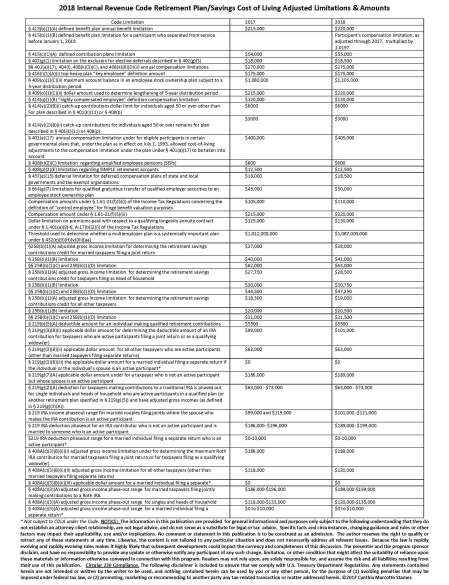
Employers, employee benefit plan sponsors, fiduciaries, administrators and other vendors, participants and beneficiaries and others working with employee benefit plans or compensation contributed to these arrangements should review these new 2018 COLA limitations to assess their potential impact and make appropriate adjustments to avoid compliance challenges or other unfortunate surprises in 2018. If they already have not already done so, reviewing the 2018 Social Security Act COLAs also would be wise. See 2018 Social Security COLAs Set.
About The Author
Recognized by her peers as a Martindale-Hubble “AV-Preeminent” (Top 1%) and “Top Rated Lawyer” with special recognition LexisNexis® Martindale-Hubbell® as “LEGAL LEADER™ Texas Top Rated Lawyer” in Health Care Law and Labor and Employment Law; as among the “Best Lawyers In Dallas” for her work in the fields of “Labor & Employment,” “Tax: Erisa & Employee Benefits,” “Health Care” and “Business and Commercial Law” by D Magazine, Cynthia Marcotte Stamer is a practicing attorney board certified in labor and employment law by the Texas Board of Legal Specialization and management consultant, author, public policy advocate and lecturer widely known for management work, coaching, teachings, and publications.
Ms. Stamer works with businesses and their management, employee benefit plans, governments and other organizations deal with all aspects of human resources and workforce, internal controls and regulatory compliance, change management and other performance and operations management and compliance. Her day-to-day work encompasses both labor and employment issues, as well as independent contractor, outsourcing, employee leasing, management services and other nontraditional service relationships. She supports her clients both on a real-time, “on demand” basis and with longer term basis to deal with all aspects for workforce and human resources management, including, recruitment, hiring, firing, compensation and benefits, promotion, discipline, compliance, trade secret and confidentiality, noncompetition, privacy and data security, safety, daily performance and operations management, emerging crises, strategic planning, process improvement and change management, investigations, defending litigation, audits, investigations or other enforcement challenges, government affairs and public policy.
Well-known for her extensive work with health, insurance, financial services, technology, energy, manufacturing, retail, hospitality, governmental and other highly regulated employers, her nearly 30 years’ of experience encompasses domestic and international businesses of all types and sizes.
A Fellow in the American College of Employee Benefit Counsel, the American Bar Foundation and the Texas Bar Foundation, Ms. Stamer also shares her thought leadership, experience and advocacy on these and other concerns by her service as a management consultant, business coach and consultant and policy strategist as well through her leadership participation in professional and civic organizations such her involvement as the Vice Chair of the North Texas Healthcare Compliance Association; Executive Director of the Coalition on Responsible Health Policy and its PROJECT COPE: Coalition on Patient Empowerment; former Board President of the early childhood development intervention agency, The Richardson Development Center for Children; former Gulf Coast TEGE Council Exempt Organization Coordinator; a founding Board Member and past President of the Alliance for Healthcare Excellence; former board member and Vice President of the Managed Care Association; past Board Member and Board Compliance Committee Chair for the National Kidney Foundation of North Texas; a member and policy adviser to the National Physicians’ Council for Healthcare Policy; current Vice Chair of the ABA Tort & Insurance Practice Section Employee Benefits Committee; current Vice Chair of Policy for the Life Sciences Committee of the ABA International Section; Past Chair of the ABA Health Law Section Managed Care & Insurance Section; ABA Real Property Probate and Trust (RPTE) Section former Employee Benefits Group Chair, immediate past RPTE Representative to ABA Joint Committee on Employee Benefits Council Representative, and Defined Contribution Committee Co-Chair, past Welfare Benefit Committee Chair and current Employee Benefits Group Fiduciary Responsibility Committee Co-Chair, Substantive and Group Committee member, Membership Committee member and RPTE Representative to the ABA Health Law Coordinating Council; past Chair of the Dallas Bar Association Employee Benefits & Executive Compensation Committee; a former member of the Board of Directors, Treasurer, Member and Continuing Education Chair of the Southwest Benefits Association and others.
Ms. Stamer also is a widely published author, highly popular lecturer, and serial symposia chair, who publishes and speaks extensively on human resources, labor and employment, employee benefits, compensation, occupational safety and health, and other leadership, performance, regulatory and operational risk management, public policy and community service concerns for the American Bar Association, ALI-ABA, American Health Lawyers, Society of Human Resources Professionals, the Southwest Benefits Association, the Society of Employee Benefits Administrators, the American Law Institute, Lexis-Nexis, Atlantic Information Services, The Bureau of National Affairs (BNA), InsuranceThoughtLeaders.com, Benefits Magazine, Employee Benefit News, Texas CEO Magazine, HealthLeaders, the HCCA, ISSA, HIMSS, Modern Healthcare, Managed Healthcare, Institute of Internal Auditors, Society of CPAs, Business Insurance, Employee Benefits News, World At Work, Benefits Magazine, the Wall Street Journal, the Dallas Morning News, the Dallas Business Journal, the Houston Business Journal, and many other symposia and publications. She also has served as an Editorial Advisory Board Member for human resources, employee benefit and other management focused publications of BNA, HR.com, Employee Benefit News, InsuranceThoughtLeadership.com and many other prominent publications and speaks and conducts training for a broad range of professional organizations and for clients on the Advisory Boards of InsuranceThoughtLeadership.com, HR.com, Employee Benefit News, and many other publications.
Want to know more? See here for details about the author of this update, attorney Cynthia Marcotte Stamer, e-mail her here or telephone Ms. Stamer at (469) 767-8872.
About Solutions Law Press, Inc.™
Solutions Law Press, Inc.™ provides human resources and employee benefit and other business risk management, legal compliance, management effectiveness and other coaching, tools and other resources, training and education on leadership, governance, human resources, employee benefits, data security and privacy, insurance, health care and other key compliance, risk management, internal controls and operational concerns. If you find this of interest, you also be interested reviewing some of our other Solutions Law Press, Inc.™ resources at SolutionsLawPress.com such as the following:
If you or someone else you know would like to receive future updates about developments on these and other concerns, please provide your current contact information and preferences including your preferred e-mail by creating or updating your profile here.
NOTICE: These statements and materials are for general informational and purposes only. They do not establish an attorney-client relationship, are not legal advice, and do not serve as a substitute for legal advice. Readers are urged to engage competent legal counsel for consultation and representation in light of the specific facts and circumstances presented in their unique circumstance at any particular time. No comment or statement in this publication is to be construed as an admission. The author reserves the right to qualify or retract any of these statements at any time. Likewise, the content is not tailored to any particular situation and does not necessarily address all relevant issues. Because the law is rapidly evolving and rapidly evolving rules makes it highly likely that subsequent developments could impact the currency and completeness of this discussion. The presenter and the program sponsor disclaim, and have no responsibility to provide any update or otherwise notify any participant of any such change, limitation, or other condition that might affect the suitability of reliance upon these materials or information otherwise conveyed in connection with this program. Readers may not rely upon, are solely responsible for, and assume the risk and all liabilities resulting from their use of this publication.
Circular 230 Compliance. The following disclaimer is included to ensure that we comply with U.S. Treasury Department Regulations. Any statements contained herein are not intended or written by the writer to be used, and nothing contained herein can be used by you or any other person, for the purpose of (1) avoiding penalties that may be imposed under federal tax law, or (2) promoting, marketing or recommending to another party any tax-related transaction or matter addressed herein.
©2017 Cynthia Marcotte Stamer. Non-exclusive right to republish granted to Solutions Law Press, Inc.™ For information about republication, please contact the author directly. All other rights reserved
Comments Off on Check How IRS 2018 Retirement & Saving Plan Limits and Amounts Cost Of Living Adjustments Impact Your HR & Retirement Plan Administration & Planning | 401(k), Association Health Plan, Brokers, compensation, compliance, defined benefit plan, Defined Benefit Plans, defined contribution plan, Defined Contribution Plans, Disability, Disability Plans, employee, Employee Benefits, Employer, Employers, Employment, Employment Policies, Employment Tax, ERISA, ESOP, Excise Taxes, Form 5500, Health Plans, HR, Human Resources, Internal Revenue Code, IRC, Labor Management Relations, Management, Pay, pension plan, Reporting & Disclosure, retirement plan, Retirement Plans, Retirements, Salaried, Tax, Uncategorized | Permalink
Posted by Cynthia Marcotte Stamer
December 14, 2017
Employer and other sponsors, fiduciaries, administrators and insurers of the Employee Retirement Income Security Act (ERISA)-covered employee benefit plans making disability-based benefit determinations should confirm that their plan documents, summary plan descriptions, procedures and claims and appeals notices are updated and ready to meet tightened new federal rules on disability-based benefit determinations applicable to all post December 31, 2017 claims under the restated Final Rule on Claims Procedure for Plans Providing Disability Benefits (“Disability Claims Rule”). Given the nature and scope of these new requirements, most covered plans will require specific action be taken before the new rules take effect to update plan documents, summary plan descriptions, notices, contracts, processes and procedures to meet the January 1, 2018 deadline.
The Disability Claims Rule published by the Department of Labor Employee Benefit Security Administration (“EBSA”) on December 19, 2016 generally require all ERISA-covered employee benefit plans making any disability benefit or other determination conditioned upon a finding of disability to comply with the new Disability Claims Rule for any claim received after December 31, 2017.
The new Final Disability Claims Rule will apply to all disability determinations made under any ERISA-covered plan after December 31, 2017, regardless of how the plan characterizes the benefit or whether the plan is a health or other welfare, pension, 401(k) plan or other savings plan.
Significant affirmative action is likely required to prepare covered plans to meet these requirements since most plans historically have not followed the detailed claims and appeals notification, independent and impartial decision-making, rescission, deemed exhaustion, “culturally and linguistically appropriate” and other procedural protections and safeguards based on EBSA’s previously adopted Patient Protection and Affordable Care Act (“ACA”) group health plan claims and appeals rules, which the Disability Claims Rules extend and make applicable to all ERISA-covered plans making benefit determinations based on disability. Covered plans making disability-based benefit or other covered determinations are likely to require updates to plan documents, insurance or administrative services contracts, summary plan descriptions and other plan communications, claims and appeals notices, and other related processes, procedures and documentation to meet these new requirements. Since certain requirements of the Disability Claims Rules like the summary plan description advance disclosure requirements are required to be provided before the claim is received, plans and their sponsors risk being accused of violating these requirements by waiting to update plans, their processes and materials until after claim involving a disability based determination arises.
Ensuring that impacted plans are updated before the January 1, 2018 deadline is important because the Disability Claims Rule, like the group health plan claims and appeals rules upon which it is based, also states that noncompliance with any of its requirements empowers a participant to immediately sue the plan for enforcement if his rights without further complying the the plan’s administrative procedures. Moreover, failing to comply with summary plan disclosure or claims or appeal adverse benefit determination notification requirements also may subject the plan administrator to administrative penalties under ERISA section 514(c). Consequently, employers and other plan sponsors, fiduciaries, administrators and insurers will want to act quickly to ensure that their plans, their summary plan descriptions and other communications, notices, processes, contracts and procedures are updated appropriately before January 1, 2018.
About The Author
Recognized by her peers as a Martindale-Hubble “AV-Preeminent” (Top 1%) and “Top Rated Lawyer” with special recognition LexisNexis® Martindale-Hubbell® as “LEGAL LEADER™ Texas Top Rated Lawyer” in Health Care Law and Labor and Employment Law; as among the “Best Lawyers In Dallas” for her work in the fields of “Labor & Employment,” “Tax: Erisa & Employee Benefits,” “Health Care” and “Business and Commercial Law” by D Magazine, Cynthia Marcotte Stamer is a practicing attorney board certified in labor and employment law by the Texas Board of Legal Specialization and management consultant, author, public policy advocate and lecturer widely known for management work, coaching, teachings, and publications.
Ms. Stamer works with businesses and their management, employee benefit plans, governments and other organizations deal with all aspects of human resources and workforce, internal controls and regulatory compliance, change management and other performance and operations management and compliance. Her day-to-day work encompasses both labor and employment issues, as well as independent contractor, outsourcing, employee leasing, management services and other nontraditional service relationships. She supports her clients both on a real-time, “on demand” basis and with longer term basis to deal with all aspects for workforce and human resources management, including, recruitment, hiring, firing, compensation and benefits, promotion, discipline, compliance, trade secret and confidentiality, noncompetition, privacy and data security, safety, daily performance and operations management, emerging crises, strategic planning, process improvement and change management, investigations, defending litigation, audits, investigations or other enforcement challenges, government affairs and public policy.
Well-known for her extensive work with health, insurance, financial services, technology, energy, manufacturing, retail, hospitality, governmental and other highly regulated employers, her nearly 30 years’ of experience encompasses domestic and international businesses of all types and sizes.
A Fellow in the American College of Employee Benefit Counsel, the American Bar Foundation and the Texas Bar Foundation, Ms. Stamer also shares her thought leadership, experience and advocacy on these and other concerns by her service as a management consultant, business coach and consultant and policy strategist as well through her leadership participation in professional and civic organizations such her involvement as the Vice Chair of the North Texas Healthcare Compliance Association; Executive Director of the Coalition on Responsible Health Policy and its PROJECT COPE: Coalition on Patient Empowerment; former Board President of the early childhood development intervention agency, The Richardson Development Center for Children; former Gulf Coast TEGE Council Exempt Organization Coordinator; a founding Board Member and past President of the Alliance for Healthcare Excellence; former board member and Vice President of the Managed Care Association; past Board Member and Board Compliance Committee Chair for the National Kidney Foundation of North Texas; a member and policy adviser to the National Physicians’ Council for Healthcare Policy; current Vice Chair of the ABA Tort & Insurance Practice Section Employee Benefits Committee; current Vice Chair of Policy for the Life Sciences Committee of the ABA International Section; Past Chair of the ABA Health Law Section Managed Care & Insurance Section; ABA Real Property Probate and Trust (RPTE) Section former Employee Benefits Group Chair, immediatepast RPTE Representative to ABA Joint Committee on Employee Benefits Council Representative, and Defined Contribution Committee Co-Chair, past Welfare Benefit Committee Chair and current Employee Benefits Group Fiduciary Responsibility Committee Co-Chair, Substantive and Group Committee member, Membership Committee member and RPTE Representative to the ABA Health Law Coordinating Council; past Chair of the Dallas Bar Association Employee Benefits & Executive Compensation Committee; a former member of the Board of Directors, Treasurer, Member and Continuing Education Chair of the Southwest Benefits Association and others.
Ms. Stamer also is a widely published author, highly popular lecturer, and serial symposia chair, who publishes and speaks extensively on human resources, labor and employment, employee benefits, compensation, occupational safety and health, and other leadership, performance, regulatory and operational risk management, public policy and community service concerns for the American Bar Association, ALI-ABA, American Health Lawyers, Society of Human Resources Professionals, the Southwest Benefits Association, the Society of Employee Benefits Administrators, the American Law Institute, Lexis-Nexis, Atlantic Information Services, The Bureau of National Affairs (BNA), InsuranceThoughtLeaders.com, Benefits Magazine, Employee Benefit News, Texas CEO Magazine, HealthLeaders, the HCCA, ISSA, HIMSS, Modern Healthcare, Managed Healthcare, Institute of Internal Auditors, Society of CPAs, Business Insurance, Employee Benefits News, World At Work, BenefitsMagazine, the Wall Street Journal, the Dallas Morning News, the Dallas Business Journal, the Houston Business Journal, and many other symposia and publications. She also has served as an Editorial Advisory Board Member for human resources, employee benefit and other management focused publications of BNA, HR.com, Employee Benefit News, InsuranceThoughtLeadership.com and many other prominent publications and speaks and conducts training for a broad range of professional organizations and for clients on the Advisory Boards of InsuranceThoughtLeadership.com, HR.com, Employee Benefit News, and many other publications.
Want to know more? See here for details about the author of this update, attorney Cynthia Marcotte Stamer, e-mail her here or telephone Ms. Stamer at (469) 767-8872.
About Solutions Law Press, Inc.™
Solutions Law Press, Inc.™ provides human resources and employee benefit and other business risk management, legal compliance, management effectiveness and other coaching, tools and other resources, training and education on leadership, governance, human resources, employee benefits, data security and privacy, insurance, health care and other key compliance, risk management, internal controls and operational concerns. If you find this of interest, you also be interested reviewing some of our other Solutions Law Press, Inc.™ resources at SolutionsLawPress.com such as the following:
If you or someone else you know would like to receive future updates about developments on these and other concerns, please provide your current contact information and preferences including your preferred e-mail by creating or updating your profile here.
NOTICE: These statements and materials are for general informational and purposes only. They do not establish an attorney-client relationship, are not legal advice, and do not serve as a substitute for legal advice. Readers are urged to engage competent legal counsel for consultation and representation in light of the specific facts and circumstances presented in their unique circumstance at any particular time. No comment or statement in this publication is to be construed as an admission. The author reserves the right to qualify or retract any of these statements at any time. Likewise, the content is not tailored to any particular situation and does not necessarily address all relevant issues. Because the law is rapidly evolving and rapidly evolving rules makes it highly likely that subsequent developments could impact the currency and completeness of this discussion. The presenter and the program sponsor disclaim, and have no responsibility to provide any update or otherwise notify any participant of any such change, limitation, or other condition that might affect the suitability of reliance upon these materials or information otherwise conveyed in connection with this program. Readers may not rely upon, are solely responsible for, and assume the risk and all liabilities resulting from their use of this publication.
Circular 230 Compliance. The following disclaimer is included to ensure that we comply with U.S. Treasury Department Regulations. Any statements contained herein are not intended or written by the writer to be used, and nothing contained herein can be used by you or any other person, for the purpose of (1) avoiding penalties that may be imposed under federal tax law, or (2) promoting, marketing or recommending to another party any tax-related transaction or matter addressed herein.
©2017 Cynthia Marcotte Stamer. Non-exclusive right to republish granted to Solutions Law Press, Inc.™ For information about republication, please contact the author directly. All other rights reserved.
Comments Off on Confirm Your Benefit Plans Ready For New Disability Determination Rules on 1/1/18 | 401(k), ACA, ADA, Affordable Care Act, Appeals, board of directors, Brokers, Cafeteria Plans, Claims, Claims Administration, compensation, compliance, Construction, Corporate Compliance, defined benefit plan, Defined Benefit Plans, defined contribution plan, Defined Contribution Plans, directors, Disability, Disability, Disability Plans, Drug & Alcohol, EBSA, employee, Employee Benefits, Employee Handbook, Employer, Employers, Employment, Employment Policies, ERISA, Executive Compensation, family leave, Fiduciary Responsibility, health benefit, Health Benefits, health insurance, Leave, Management, medical leave, Mental Health, Mental Health Parity, Obamacare, Patient Protection & Affordable Care Act, Pay, pension plan, Plan Admistrator, Professional Liability, third party administrators, Uncategorized, Union, Worker | Tagged: Appeals, Claims, defined benefit plan, Disability, Disability Insurance, Disability Plan, EBSA, Employee Retirement Income Security act, ERISA, Fiduciary Responsibility, pension plan | Permalink
Posted by Cynthia Marcotte Stamer
December 13, 2017
 Teamwork is a valuable and necessary to organizational performance in most workplaces. However management undermines team performance and effectiveness by giving participation trophies to team members that don’t give their best when working on teams.
Managements goal at all-time should be to maximize the effectiveness of the team by encouraging and require each individual team member to contribute their best on the team.
Overemphasizing team work at the expense of individual performance accountability, however, undermines team performance by disincentivizing optimal performance by every team member. Optimal management and performance rewards ensure that each individual member of the team remains accountable for optimizing his or her individual performance while encouraging effective participation on the team. To maintain individual performance within the team, ensure your expectations and performance measures track not only team performance but also individual performance on the team. Measure and award teamwork by individual members of the team as one of the performance measures rather than making teamwork itself at the expense of the performance goals the basis of the reward.
Check out this coach’s perspective for more food for thought.
About The Author
Recognized by her peers as a Martindale-Hubble “AV-Preeminent” (Top 1%) and “Top Rated Lawyer” with special recognition LexisNexis® Martindale-Hubbell® as “LEGAL LEADER™ Texas Top Rated Lawyer” in Health Care Law and Labor and Employment Law; as among the “Best Lawyers In Dallas” for her work in the fields of “Labor & Employment,” “Tax: Erisa & Employee Benefits,” “Health Care” and “Business and Commercial Law” by D Magazine, Cynthia Marcotte Stamer is a practicing attorney board certified in labor and employment law by the Texas Board of Legal Specialization and management consultant, author, public policy advocate and lecturer widely known for management work, coaching, teachings, and publications.
Ms. Stamer works with businesses and their management, employee benefit plans, governments and other organizations deal with all aspects of human resources and workforce, internal controls and regulatory compliance, change management and other performance and operations management and compliance. Her day-to-day work encompasses both labor and employment issues, as well as independent contractor, outsourcing, employee leasing, management services and other nontraditional service relationships. She supports her clients both on a real-time, “on demand” basis and with longer term basis to deal with all aspects for workforce and human resources management, including, recruitment, hiring, firing, compensation and benefits, promotion, discipline, compliance, trade secret and confidentiality, noncompetition, privacy and data security, safety, daily performance and operations management, emerging crises, strategic planning, process improvement and change management, investigations, defending litigation, audits, investigations or other enforcement challenges, government affairs and public policy.
Well-known for her extensive work with health, insurance, financial services, technology, energy, manufacturing, retail, hospitality, governmental and other highly regulated employers, her nearly 30 years’ of experience encompasses domestic and international businesses of all types and sizes.
A Fellow in the American College of Employee Benefit Counsel, the American Bar Foundation and the Texas Bar Foundation, Ms. Stamer also shares her thought leadership, experience and advocacy on these and other concerns by her service as a management consultant, business coach and consultant and policy strategist as well through her leadership participation in professional and civic organizations such her involvement as the Vice Chair of the North Texas Healthcare Compliance Association; Executive Director of the Coalition on Responsible Health Policy and its PROJECT COPE: Coalition on Patient Empowerment; former Board President of the early childhood development intervention agency, The Richardson Development Center for Children; former Gulf Coast TEGE Council Exempt Organization Coordinator; a founding Board Member and past President of the Alliance for Healthcare Excellence; former board member and Vice President of the Managed Care Association; past Board Member and Board Compliance Committee Chair for the National Kidney Foundation of North Texas; a member and policy adviser to the National Physicians’ Council for Healthcare Policy; current Vice Chair of the ABA Tort & Insurance Practice Section Employee Benefits Committee; current Vice Chair of Policy for the Life Sciences Committee of the ABA International Section; Past Chair of the ABA Health Law Section Managed Care & Insurance Section; ABA Real Property Probate and Trust (RPTE) Section former Employee Benefits Group Chair, immediate past RPTE Representative to ABA Joint Committee on Employee Benefits Council Representative, and Defined Contribution Committee Co-Chair, past Welfare Benefit Committee Chair and current Employee Benefits Group Fiduciary Responsibility Committee Co-Chair, Substantive and Group Committee member, Membership Committee member and RPTE Representative to the ABA Health Law Coordinating Council; past Chair of the Dallas Bar Association Employee Benefits & Executive Compensation Committee; a former member of the Board of Directors, Treasurer, Member and Continuing Education Chair of the Southwest Benefits Association and others.
Ms. Stamer also is a widely published author, highly popular lecturer, and serial symposia chair, who publishes and speaks extensively on human resources, labor and employment, employee benefits, compensation, occupational safety and health, and other leadership, performance, regulatory and operational risk management, public policy and community service concerns for the American Bar Association, ALI-ABA, American Health Lawyers, Society of Human Resources Professionals, the Southwest Benefits Association, the Society of Employee Benefits Administrators, the American Law Institute, Lexis-Nexis, Atlantic Information Services, The Bureau of National Affairs (BNA), InsuranceThoughtLeaders.com, Benefits Magazine, Employee Benefit News, Texas CEO Magazine, HealthLeaders, the HCCA, ISSA, HIMSS, Modern Healthcare, Managed Healthcare, Institute of Internal Auditors, Society of CPAs, Business Insurance, Employee Benefits News, World At Work, Benefits Magazine, the Wall Street Journal, the Dallas Morning News, the Dallas Business Journal, the Houston Business Journal, and many other symposia and publications. She also has served as an Editorial Advisory Board Member for human resources, employee benefit and other management focused publications of BNA, HR.com, Employee Benefit News, InsuranceThoughtLeadership.com and many other prominent publications and speaks and conducts training for a broad range of professional organizations and for clients on the Advisory Boards of InsuranceThoughtLeadership.com, HR.com, Employee Benefit News, and many other publications.
Want to know more? See here for details about the author of this update, attorney Cynthia Marcotte Stamer, e-mail her here or telephone Ms. Stamer at (469) 767-8872.
About Solutions Law Press, Inc.™
Solutions Law Press, Inc.™ provides human resources and employee benefit and other business risk management, legal compliance, management effectiveness and other coaching, tools and other resources, training and education on leadership, governance, human resources, employee benefits, data security and privacy, insurance, health care and other key compliance, risk management, internal controls and operational concerns. If you find this of interest, you also be interested reviewing some of our other Solutions Law Press, Inc.™ resources at SolutionsLawPress.com such as the following:
▪DOL Proposes Changing FLSA Tipped Employee Pay Rules
▪Consider Internal Investigation & Defense Costs When Administering Compliance Programs
▪Recruiting Qualified Workers Biggest Challenge US Manufacturers See In Otherwise Optimistic 3rd Quarter 2017
▪Government Retirees Get New Thrift Plan Distributing Choices
▪Jennifer A. Abruzzo Named NLRB Acting General Counsel
▪Bill Mandating E-Verify, Raising Employer I-9 Penalties Approved By House Judiciary Committee
▪Address Workplace Harassment During October Stop Bullying Month
▪NIOSH Proposed Updated Occupational Safety Chemical Monitoring Rules
▪2018 Social Security COLAs Set
▪IRS Updates Defined Benefit Plan Guidance
▪Read Trump Health Care Executive Order
▪Dealing With HR, Benefits & Other Headaches From Equifax and Other Data Breach
▪Employers Should Manage Potential Unfair Labor Practice Risks From Recording, Acceptable Use, Fighting, Integrity & Other Employment Policies
If you or someone else you know would like to receive future updates about developments on these and other concerns, please provide your current contact information and preferences including your preferred e-mail by creating or updating your profile here.
NOTICE: These statements and materials are for general informational and purposes only. They do not establish an attorney-client relationship, are not legal advice, and do not serve as a substitute for legal advice. Readers are urged to engage competent legal counsel for consultation and representation in light of the specific facts and circumstances presented in their unique circumstance at any particular time. No comment or statement in this publication is to be construed as an admission. The author reserves the right to qualify or retract any of these statements at any time. Likewise, the content is not tailored to any particular situation and does not necessarily address all relevant issues. Because the law is rapidly evolving and rapidly evolving rules makes it highly likely that subsequent developments could impact the currency and completeness of this discussion. The presenter and the program sponsor disclaim, and have no responsibility to provide any update or otherwise notify any participant of any such change, limitation, or other condition that might affect the suitability of reliance upon these materials or information otherwise conveyed in connection with this program. Readers may not rely upon, are solely responsible for, and assume the risk and all liabilities resulting from their use of this publication.
Circular 230 Compliance. The following disclaimer is included to ensure that we comply with U.S. Treasury Department Regulations. Any statements contained herein are not intended or written by the writer to be used, and nothing contained herein can be used by you or any other person, for the purpose of (1) avoiding penalties that may be imposed under federal tax law, or (2) promoting, marketing or recommending to another party any tax-related transaction or matter addressed herein.
©2017 Cynthia Marcotte Stamer. Non-exclusive right to republish granted to Solutions Law Press, Inc.™ For information about republication, please contact the author directly. All other rights reserved
Comments Off on Individual Accountability For Performance Matters | compensation, compliance, Corporate Compliance, corporate governance, employee, Employee Benefits, Employee Handbook, Employer, Employers, Employment, Employment Policies, Executive Compensation, Hiring, HR, Human Resources, Internal Controls, Management, Pay, Uncategorized | Permalink
Posted by Cynthia Marcotte Stamer
December 12, 2017
The Internal Revenue Service (“IRS”) is acting to help Patient Protection and Affordable Care Act (“Obamacare”) health subsidy-eligible individuals living in regions where exchange insurers do not offer bronze (lowest cost) coverage even as it moves ahead to nail employers failing to comply with Obamacare’s employer shared responsibility rules (commonly referred to as the “employer mandate”). The move comes as House and Senate Conferees are preparing to conference to work out differences in the tax bill which could repeal the Obamacare individual mandate penalty for failing to maintain coverage while leaving intact penalties against employers violating the employer mandate by failing to offer affordable minimum essential coverage as well as other Obamacare penalties on plans and their employers.
IRS New Individual Obamacare Relief
Notice 2017-74 will provide that Individuals who are not eligible for coverage under an eligible employer-sponsored plan and who lack access to affordable coverage should not be denied the use of the affordability exemption under § 5000A(e)(1) of the Code and § 1.5000A-3(e) of the Regulations merely because they reside in an area served by a Marketplace that does not offer a bronze-level plan. Consequently, for purposes of the affordability exemption under § 5000A(e)(1) and § 1.5000A-3(e), if an individual resides in a rating area served by a Marketplace that does not offer a bronze plan, the individual generally should use as his or her applicable plan the lowest cost metal-level plan available in the Marketplace serving the rating area in which the individual resides.
Notice 2017-74 will be in IRB 2017-51, dated December 18, 2017.
Employer’s Still Face Obamacare Penalties
While the IRS has issued limited relief for individuals from the ACA’s individual mandate penalties, so far it has remained steadfast in its refusal to grant employers corresponding relief from the ACA employer shared responsibility penalties or other ACA penalties. Instead, IRS officials continue to make clear that the IRS intends to enforce the ACA employer shared responsibility rules against employers with 50 or more full-time employees (including full-time equivalent employees) (“covered employers”).
Under the Obamacare employer mandate rules, covered employers face significant Federal tax penalties for (1) failing to offer minimal essential coverage to substantially all full-time employees and their dependents (the “A Penalty”), or (2) offering coverage that is either “unaffordable” or does not provide “minimum value” (the “B Penalty”) (referred to collectively as the “ACA Penalties”) if a full-time employee enrolls in the Health Insurance Marketplace (the “Exchange”) and receives a Premium Tax Credit.
While many employers assumed President Trump’s January 20, 2017 Executive Order Executive Order Minimizing the Economic Burden of the Patient Protection and Affordable Care Act Pending Repeal would insulate them against enforcement of the employer mandate and other Obamacare penalties, the IRS doesn’t see the Executive Order as barring its enforcement of Obamacare against sponsoring employers or their group health plans. An April 14, 2017 IRS Chief Counsel letter, for instance, the IRS announced it does not interpret its discretionary authority under Obamacare to allow waiver of the employer mandate tax imposed under Internal Revenue Code Section 4980H against covered employers that fail to provide the affordable minimum essential coverage required by the employer mandate. In keeping with this interpretation, the IRS has announced that it will begin enforcement of the employer mandate tax liability for plan years after 2015 against covered employers that failed to meet the employer mandate.
Of course, the employer mandate is not the only Obama care provision that employers and their health plans need to worry about. In addition to the employer mandate, Obamacare imposed a host of patient protection and other federal mandates upon employer-sponsored plans, most of which apply to plans covering two or more employees. In addition to any benefit and other administrative penalties that otherwise arise under the Employee Retirement Income Security Act and/or the Social Security Act for violating these mandates, employers sponsoring plans that violate any of 40 listed mandates imposed by Obamacare or certain other federal laws also become liable under Internal Revenue Code Section 6039D to self-identify, self-assess, report on Form 8928 and pay an excise tax equal to $100 per person per uncorrected violation. The IRS, Department Of Labor and Department Of Health and Human Services have taken the position the January 20 Executive Order also does not bar enforcement of those Obamacare penalties. Accordingly, employers and their group health plans continue to face potentially substantial liability if their group health plan does not comply with Obamacare.
In the face of these exposures, employers and their group health plan administrators, fiduciaries and advisors should carefully review their plans and their administration for compliance before the end of the plan year so as to be able to take appropriate and timely corrective action before penalties attach and while stop loss or other insurance is available to help mitigate the cost of these corrections. Employers preparing for upcoming health plan renewals also should review their group contracts and conduct due diligence to verify their group health plan terms and operations meet the mandates as they initiate new plan years. Employers also generally will want to review their compliance and take action to address any deficiencies against any vendors or advisers who may have culpability in the defective health plan design or administration. Prompt action against vendors who may be culpable for the design or administration defects is necessary to preserve potential claims for contractual, deceptive trade practices or other causes of action that an employer might have under state contract, tort or other law. Employers and health plan fiduciaries should consider engaging experienced legal counsel to conduct this review on behalf of the employer other plan sponsor within the scope of attorney-client privilege so as to assess and address these potential risks on a timely basis and explore options within the scope of privilege. Brokers, advisors, consultants and insurers whose employer clients also may want to assess compliance risks and/or urge their clients to do so to help minimize their exposure to malfeasance or other claims from clients angry about penalties and other unexpected costs of noncompliance.
About The Author
Recognized by her peers as a Martindale-Hubble “AV-Preeminent” (Top 1%) and “Top Rated Lawyer” with special recognition LexisNexis® Martindale-Hubbell® as “LEGAL LEADER™ Texas Top Rated Lawyer” in Health Care Law and Labor and Employment Law; as among the “Best Lawyers In Dallas” for her work in the fields of “Labor & Employment,” “Tax: Erisa & Employee Benefits,” “Health Care” and “Business and Commercial Law” by D Magazine, Cynthia Marcotte Stamer is a practicing attorney board certified in labor and employment law by the Texas Board of Legal Specialization and management consultant, author, public policy advocate and lecturer widely known for management work, coaching, teachings, and publications.
Ms. Stamer works with businesses and their management, employee benefit plans, governments and other organizations deal with all aspects of human resources and workforce, internal controls and regulatory compliance, change management and other performance and operations management and compliance. Her day-to-day work encompasses both labor and employment issues, as well as independent contractor, outsourcing, employee leasing, management services and other nontraditional service relationships. She supports her clients both on a real-time, “on demand” basis and with longer term basis to deal with all aspects for workforce and human resources management, including, recruitment, hiring, firing, compensation and benefits, promotion, discipline, compliance, trade secret and confidentiality, noncompetition, privacy and data security, safety, daily performance and operations management, emerging crises, strategic planning, process improvement and change management, investigations, defending litigation, audits, investigations or other enforcement challenges, government affairs and public policy.
Well-known for her extensive work with health, insurance, financial services, technology, energy, manufacturing, retail, hospitality, governmental and other highly regulated employers, her nearly 30 years’ of experience encompasses domestic and international businesses of all types and sizes.
A Fellow in the American College of Employee Benefit Counsel, the American Bar Foundation and the Texas Bar Foundation, Ms. Stamer also shares her thought leadership, experience and advocacy on these and other concerns by her service as a management consultant, business coach and consultant and policy strategist as well through her leadership participation in professional and civic organizations such her involvement as the Vice Chair of the North Texas Healthcare Compliance Association; Executive Director of the Coalition on Responsible Health Policy and its PROJECT COPE: Coalition on Patient Empowerment; former Board President of the early childhood development intervention agency, The Richardson Development Center for Children; former Gulf Coast TEGE Council Exempt Organization Coordinator; a founding Board Member and past President of the Alliance for Healthcare Excellence; former board member and Vice President of the Managed Care Association; past Board Member and Board Compliance Committee Chair for the National Kidney Foundation of North Texas; a member and policy adviser to the National Physicians’ Council for Healthcare Policy; current Vice Chair of the ABA Tort & Insurance Practice Section Employee Benefits Committee; current Vice Chair of Policy for the Life Sciences Committee of the ABA International Section; Past Chair of the ABA Health Law Section Managed Care & Insurance Section; ABA Real Property Probate and Trust (RPTE) Section former Employee Benefits Group Chair, immediatepast RPTE Representative to ABA Joint Committee on Employee Benefits Council Representative, and Defined Contribution Committee Co-Chair, past Welfare Benefit Committee Chair and current Employee Benefits Group Fiduciary Responsibility Committee Co-Chair, Substantive and Group Committee member, Membership Committee member and RPTE Representative to the ABA Health Law Coordinating Council; past Chair of the Dallas Bar Association Employee Benefits & Executive Compensation Committee; a former member of the Board of Directors, Treasurer, Member and Continuing Education Chair of the Southwest Benefits Association and others.
Ms. Stamer also is a widely published author, highly popular lecturer, and serial symposia chair, who publishes and speaks extensively on human resources, labor and employment, employee benefits, compensation, occupational safety and health, and other leadership, performance, regulatory and operational risk management, public policy and community service concerns for the American Bar Association, ALI-ABA, American Health Lawyers, Society of Human Resources Professionals, the Southwest Benefits Association, the Society of Employee Benefits Administrators, the American Law Institute, Lexis-Nexis, Atlantic Information Services, The Bureau of National Affairs (BNA), InsuranceThoughtLeaders.com, Benefits Magazine, Employee Benefit News, Texas CEO Magazine, HealthLeaders, the HCCA, ISSA, HIMSS, Modern Healthcare, Managed Healthcare, Institute of Internal Auditors, Society of CPAs, Business Insurance, Employee Benefits News, World At Work, BenefitsMagazine, the Wall Street Journal, the Dallas Morning News, the Dallas Business Journal, the Houston Business Journal, and many other symposia and publications. She also has served as an Editorial Advisory Board Member for human resources, employee benefit and other management focused publications of BNA, HR.com, Employee Benefit News, InsuranceThoughtLeadership.com and many other prominent publications and speaks and conducts training for a broad range of professional organizations and for clients on the Advisory Boards of InsuranceThoughtLeadership.com, HR.com, Employee Benefit News, and many other publications.
Want to know more? See here for details about the author of this update, attorney Cynthia Marcotte Stamer, e-mail her here or telephone Ms. Stamer at (469) 767-8872.
About Solutions Law Press, Inc.™
Solutions Law Press, Inc.™ provides human resources and employee benefit and other business risk management, legal compliance, management effectiveness and other coaching, tools and other resources, training and education on leadership, governance, human resources, employee benefits, data security and privacy, insurance, health care and other key compliance, risk management, internal controls and operational concerns. If you find this of interest, you also be interested reviewing some of our other Solutions Law Press, Inc.™ resources at SolutionsLawPress.com such as the following:
If you or someone else you know would like to receive future updates about developments on these and other concerns, please provide your current contact information and preferences including your preferred e-mail by creating or updating your profile here.
NOTICE: These statements and materials are for general informational and purposes only. They do not establish an attorney-client relationship, are not legal advice, and do not serve as a substitute for legal advice. Readers are urged to engage competent legal counsel for consultation and representation in light of the specific facts and circumstances presented in their unique circumstance at any particular time. No comment or statement in this publication is to be construed as an admission. The author reserves the right to qualify or retract any of these statements at any time. Likewise, the content is not tailored to any particular situation and does not necessarily address all relevant issues. Because the law is rapidly evolving and rapidly evolving rules makes it highly likely that subsequent developments could impact the currency and completeness of this discussion. The presenter and the program sponsor disclaim, and have no responsibility to provide any update or otherwise notify any participant of any such change, limitation, or other condition that might affect the suitability of reliance upon these materials or information otherwise conveyed in connection with this program. Readers may not rely upon, are solely responsible for, and assume the risk and all liabilities resulting from their use of this publication.
Circular 230 Compliance. The following disclaimer is included to ensure that we comply with U.S. Treasury Department Regulations. Any statements contained herein are not intended or written by the writer to be used, and nothing contained herein can be used by you or any other person, for the purpose of (1) avoiding penalties that may be imposed under federal tax law, or (2) promoting, marketing or recommending to another party any tax-related transaction or matter addressed herein.
©2017 Cynthia Marcotte Stamer. Non-exclusive right to republish granted to Solutions Law Press, Inc.™ For information about republication, please contact the author directly. All other rights reserved.
Comments Off on IRS Prepares To Nail Employers Under Obamacare Mandate While Giving Some Individual Mandate Relief | 105(h), 5000, ACA, compliance, Employee Benefits, Employer, Employers, Employment, Employment Policies, Employment Tax, ERISA, Excise Taxes, health benefit, Health Benefits, health Care, health insurance, health insurance marketplace, health plan, Health Plans, health reform, Human Resources, Premium Subsidies, Uncategorized | Permalink
Posted by Cynthia Marcotte Stamer
October 14, 2017
Monthly Social Security and Supplemental Security Income (SSI) benefits for more than 66 million Americans will increase 2.0 percent in 2018.
The Social Security Administration announced the 2.0 cost of living adjustment (COLA) Friday announced a 2% increase in benefits for 2018.
The largest COLA increase since 2012 will increase the benefits payable to more than 61 million Social Security beneficiaries in January 2018. Increased payments to more than 8 million SSI beneficiaries will begin on December 29, 2017. The Social Security Administration deducts $1 from benefits for each $3 earned over $45,360 until the month the worker turns age 66.)
There is no limit on earnings for workers who are “full” retirement age or older for the entire year.
The slight increase in benefits also may result in a corresponding decrease in disability benefits under plans that integrate or otherwise offset plan benefits with Social Security.
Information about Medicare COLAs for 2018, when announced, will be available at www.Medicare.gov.
About The Author
Recognized by her peers as a Martindale-Hubble “AV-Preeminent” (Top 1%) and “Top Rated Lawyer” with special recognition LexisNexis® Martindale-Hubbell® as “LEGAL LEADER™ Texas Top Rated Lawyer” in Health Care Law and Labor and Employment Law; as among the “Best Lawyers In Dallas” for her work in the fields of “Labor & Employment,” “Tax: Erisa & Employee Benefits,” “Health Care” and “Business and Commercial Law” by D Magazine, Cynthia Marcotte Stamer is a practicing attorney board certified in labor and employment law by the Texas Board of Legal Specialization and management consultant, author, public policy advocate and lecturer widely known for management work, coaching, teachings, and publications.
Ms. Stamer works with businesses and their management, employee benefit plans, governments and other organizations deal with all aspects of human resources and workforce, internal controls and regulatory compliance, change management and other performance and operations management and compliance. Her day-to-day work encompasses both labor and employment issues, as well as independent contractor, outsourcing, employee leasing, management services and other nontraditional service relationships. She supports her clients both on a real-time, “on demand” basis and with longer term basis to deal with all aspects for workforce and human resources management, including, recruitment, hiring, firing, compensation and benefits, promotion, discipline, compliance, trade secret and confidentiality, noncompetition, privacy and data security, safety, daily performance and operations management, emerging crises, strategic planning, process improvement and change management, investigations, defending litigation, audits, investigations or other enforcement challenges, government affairs and public policy.
Well-known for her extensive work with health, insurance, financial services, technology, energy, manufacturing, retail, hospitality, governmental and other highly regulated employers, her nearly 30 years’ of experience encompasses domestic and international businesses of all types and sizes.
A Fellow in the American College of Employee Benefit Counsel, the American Bar Foundation and the Texas Bar Foundation, Ms. Stamer also shares her thought leadership, experience and advocacy on these and other concerns by her service as a management consultant, business coach and consultant and policy strategist as well through her leadership participation in professional and civic organizations such her involvement as the Vice Chair of the North Texas Healthcare Compliance Association; Executive Director of the Coalition on Responsible Health Policy and its PROJECT COPE: Coalition on Patient Empowerment; former Board President of the early childhood development intervention agency, The Richardson Development Center for Children; former Gulf Coast TEGE Council Exempt Organization Coordinator; a founding Board Member and past President of the Alliance for Healthcare Excellence; former board member and Vice President of the Managed Care Association; past Board Member and Board Compliance Committee Chair for the National Kidney Foundation of North Texas; a member and policy adviser to the National Physicians’ Council for Healthcare Policy; current Vice Chair of the ABA Tort & Insurance Practice Section Employee Benefits Committee; current Vice Chair of Policy for the Life Sciences Committee of the ABA International Section; Past Chair of the ABA Health Law Section Managed Care & Insurance Section; ABA Real Property Probate and Trust (RPTE) Section former Employee Benefits Group Chair, immediate past RPTE Representative to ABA Joint Committee on Employee Benefits Council Representative, and Defined Contribution Committee Co-Chair, past Welfare Benefit Committee Chair and current Employee Benefits Group Fiduciary Responsibility Committee Co-Chair, Substantive and Group Committee member, Membership Committee member and RPTE Representative to the ABA Health Law Coordinating Council; past Chair of the Dallas Bar Association Employee Benefits & Executive Compensation Committee; a former member of the Board of Directors, Treasurer, Member and Continuing Education Chair of the Southwest Benefits Association and others.
Ms. Stamer also is a widely published author, highly popular lecturer, and serial symposia chair, who publishes and speaks extensively on human resources, labor and employment, employee benefits, compensation, occupational safety and health, and other leadership, performance, regulatory and operational risk management, public policy and community service concerns for the American Bar Association, ALI-ABA, American Health Lawyers, Society of Human Resources Professionals, the Southwest Benefits Association, the Society of Employee Benefits Administrators, the American Law Institute, Lexis-Nexis, Atlantic Information Services, The Bureau of National Affairs (BNA), InsuranceThoughtLeaders.com, Benefits Magazine, Employee Benefit News, Texas CEO Magazine, HealthLeaders, the HCCA, ISSA, HIMSS, Modern Healthcare, Managed Healthcare, Institute of Internal Auditors, Society of CPAs, Business Insurance, Employee Benefits News, World At Work, Benefits Magazine, the Wall Street Journal, the Dallas Morning News, the Dallas Business Journal, the Houston Business Journal, and many other symposia and publications. She also has served as an Editorial Advisory Board Member for human resources, employee benefit and other management focused publications of BNA, HR.com, Employee Benefit News, InsuranceThoughtLeadership.com and many other prominent publications and speaks and conducts training for a broad range of professional organizations and for clients on the Advisory Boards of InsuranceThoughtLeadership.com, HR.com, Employee Benefit News, and many other publications.
Want to know more? See here for details about the author of this update, attorney Cynthia Marcotte Stamer, e-mail her here or telephone Ms. Stamer at (469) 767-8872.
About Solutions Law Press, Inc.™
Solutions Law Press, Inc.™ provides human resources and employee benefit and other business risk management, legal compliance, management effectiveness and other coaching, tools and other resources, training and education on leadership, governance, human resources, employee benefits, data security and privacy, insurance, health care and other key compliance, risk management, internal controls and operational concerns. If you find this of interest, you also be interested reviewing some of our other Solutions Law Press, Inc.™ resources at SolutionsLawPress.com such as the following:
▪ RAISE Act Immigration Reforms Touted As “Giving Americans A Raise”
▪ Health Clinic At Houston Convention Center, Other HHS Help For Hurricane Harvey Victims
▪ IRS Updates Amounts Used To Calculate 2017 Obamacare Individual Individual Shares Responsibility Tax Penalties
▪ DB Plan Sponsors Check Out New Bifurcated Distribution Model Amendmentsy
▪ U.S. News Names 2017-2018 “Best” Hospitals; Patient Usefulness Starts With Metholodogy Understanding
▪ Use Lessons Of Past Mistakes or Injustice To Build Better Future
▪ Prepare For Turnover, Other Challenges From Rising Workforce Competition
▪ Employers, Health Plans Should Brace For Tightened Federal Mental Health Coverage Mandate Disclosure And Enforcement
▪ Withholding Calculator Tool Helps Workers Figure Withholding
▪ Better Preparing U.S. Workers To Fill Your Jobs
▪ SCOTUS Ruling Bars Many State Arbitration Agreement Restrictions
▪ $2.4M HIPAA Settlement Message Warns Health Plans & Providers Against Sharing Medical Info With Media, Others
If you or someone else you know would like to receive future updates about developments on these and other concerns, please provide your current contact information and preferences including your preferred e-mail by creating or updating your profile here.
NOTICE: These statements and materials are for general informational and purposes only. They do not establish an attorney-client relationship, are not legal advice, and do not serve as a substitute for legal advice. Readers are urged to engage competent legal counsel for consultation and representation in light of the specific facts and circumstances presented in their unique circumstance at any particular time. No comment or statement in this publication is to be construed as an admission. The author reserves the right to qualify or retract any of these statements at any time. Likewise, the content is not tailored to any particular situation and does not necessarily address all relevant issues. Because the law is rapidly evolving and rapidly evolving rules makes it highly likely that subsequent developments could impact the currency and completeness of this discussion. The presenter and the program sponsor disclaim, and have no responsibility to provide any update or otherwise notify any participant of any such change, limitation, or other condition that might affect the suitability of reliance upon these materials or information otherwise conveyed in connection with this program. Readers may not rely upon, are solely responsible for, and assume the risk and all liabilities resulting from their use of this publication.
Circular 230 Compliance. The following disclaimer is included to ensure that we comply with U.S. Treasury Department Regulations. Any statements contained herein are not intended or written by the writer to be used, and nothing contained herein can be used by you or any other person, for the purpose of (1) avoiding penalties that may be imposed under federal tax law, or (2) promoting, marketing or recommending to another party any tax-related transaction or matter addressed herein.
©2017 Cynthia Marcotte Stamer. Non-exclusive right to republish granted to Solutions Law Press, Inc.™ For information about republication, please contact the author directly. All other rights reserved.
Comments Off on 2018 Social Security COLAs Set | Claims Administration, defined benefit plan, Defined Benefit Plans, Disability, Disability Plans, Employee Benefits, Employer, Employers, Employment, ERISA, HR, Human Resources, pension plan, retirement plan, Retirement Plans, Retirements, Social Security, Uncategorized | Tagged: Social Security, SSI | Permalink
Posted by Cynthia Marcotte Stamer
October 13, 2017
Qualified profit-sharing and pension plan sponsors, fiduciaries, administrators and service providers should check of this recent guidance on various qualified pension and profit sharing plan qualification:
Organizations and service providers involved in defined benefit plans should review their programs and make adjustments as warranted.
About The Author
Recognized by her peers as a Martindale-Hubble “AV-Preeminent” (Top 1%) and “Top Rated Lawyer” with special recognition LexisNexis® Martindale-Hubbell® as “LEGAL LEADER™ Texas Top Rated Lawyer” in Health Care Law and Labor and Employment Law; as among the “Best Lawyers In Dallas” for her work in the fields of “Labor & Employment,” “Tax: Erisa & Employee Benefits,” “Health Care” and “Business and Commercial Law” by D Magazine, Cynthia Marcotte Stamer is a practicing attorney board certified in labor and employment law by the Texas Board of Legal Specialization and management consultant, author, public policy advocate and lecturer widely known for management work, coaching, teachings, and publications.
Ms. Stamer works with businesses and their management, employee benefit plans, governments and other organizations deal with all aspects of human resources and workforce, internal controls and regulatory compliance, change management and other performance and operations management and compliance. Her day-to-day work encompasses both labor and employment issues, as well as independent contractor, outsourcing, employee leasing, management services and other nontraditional service relationships. She supports her clients both on a real-time, “on demand” basis and with longer term basis to deal with all aspects for workforce and human resources management, including, recruitment, hiring, firing, compensation and benefits, promotion, discipline, compliance, trade secret and confidentiality, noncompetition, privacy and data security, safety, daily performance and operations management, emerging crises, strategic planning, process improvement and change management, investigations, defending litigation, audits, investigations or other enforcement challenges, government affairs and public policy.
Well-known for her extensive work with health, insurance, financial services, technology, energy, manufacturing, retail, hospitality, governmental and other highly regulated employers, her nearly 30 years’ of experience encompasses domestic and international businesses of all types and sizes.
A Fellow in the American College of Employee Benefit Counsel, the American Bar Foundation and the Texas Bar Foundation, Ms. Stamer also shares her thought leadership, experience and advocacy on these and other concerns by her service as a management consultant, business coach and consultant and policy strategist as well through her leadership participation in professional and civic organizations such her involvement as the Vice Chair of the North Texas Healthcare Compliance Association; Executive Director of the Coalition on Responsible Health Policy and its PROJECT COPE: Coalition on Patient Empowerment;a member and policy technical adviser to the National Physicians’ Council for Healthcare Policy; current Vice Chair of the ABA Tort & Insurance Practice Section Employee Benefits Committee; current Vice Chair of Policy for the Life Sciences Committee of the ABA International Section; former Board President of the early childhood development intervention agency, The Richardson Development Center for Children; former Gulf Coast TEGE Council Exempt Organization Coordinator; a founding Board Member and past President of the Alliance for Healthcare Excellence; former board member and Vice President of the Managed Care Association; past Board Member and Board Compliance Committee Chair for the National Kidney Foundation of North Texas; Past Chair of the ABA Health Law Section Managed Care & Insurance Section; ABA Real Property Probate and Trust (RPTE) Section former Employee Benefits Group Chair, immediate past RPTE Representative to ABA Joint Committee on Employee Benefits Council Representative, and Defined Contribution Committee Co-Chair, past Welfare Benefit Committee Chair and current Employee Benefits Group Fiduciary Responsibility Committee Co-Chair, Substantive and Group Committee member, Membership Committee member and RPTE Representative to the ABA Health Law Coordinating Council; past Chair of the Dallas Bar Association Employee Benefits & Executive Compensation Committee; a former member of the Board of Directors, Treasurer, Member and Continuing Education Chair of the Southwest Benefits Association and others.
Ms. Stamer also is a widely published author, highly popular lecturer, and serial symposia chair, who publishes and speaks extensively on human resources, labor and employment, employee benefits, compensation, occupational safety and health, and other leadership, performance, regulatory and operational risk management, public policy and community service concerns for the American Bar Association, ALI-ABA, American Health Lawyers, Society of Human Resources Professionals, the Southwest Benefits Association, the Society of Employee Benefits Administrators, the American Law Institute, Lexis-Nexis, Atlantic Information Services, The Bureau of National Affairs (BNA), InsuranceThoughtLeaders.com, Benefits Magazine, Employee Benefit News, Texas CEO Magazine, HealthLeaders, the HCCA, ISSA, HIMSS, Modern Healthcare, Managed Healthcare, Institute of Internal Auditors, Society of CPAs, Business Insurance, Employee Benefits News, World At Work, Benefits Magazine, the Wall Street Journal, the Dallas Morning News, the Dallas Business Journal, the Houston Business Journal, and many other symposia and publications. She also has served as an Editorial Advisory Board Member for human resources, employee benefit and other management focused publications of BNA, HR.com, Employee Benefit News, Insurance Thought Leaders, and many other prominent publications and speaks and conducts training for a broad range of professional organizations and for clients on the Advisory Boards of InsuranceThoughtLeadership.com, HR.com, Employee Benefit News, and many other publications.
Want to know more? See here for details about the author of this update, attorney Cynthia Marcotte Stamer, e-mail her here or telephone Ms. Stamer at (469) 767-8872.
About Solutions Law Press, Inc.™
Solutions Law Press, Inc.™ provides human resources and employee benefit and other business risk management, legal compliance, management effectiveness and other coaching, tools and other resources, training and education on leadership, governance, human resources, employee benefits, data security and privacy, insurance, health care and other key compliance, risk management, internal controls and operational concerns. If you find this of interest, you also be interested reviewing some of our other Solutions Law Press, Inc.™ resources at SolutionsLawPress.com.
If you or someone else you know would like to receive future updates about developments on these and other concerns, please provide your current contact information and preferences including your preferred e-mail by creating or updating your profile here including:
NOTICE: These statements and materials are for general informational and purposes only. They do not establish an attorney-client relationship, are not legal advice, and do not serve as a substitute for legal advice. Readers are urged to engage competent legal counsel for consultation and representation in light of the specific facts and circumstances presented in their unique circumstance at any particular time. No comment or statement in this publication is to be construed as an admission. The author reserves the right to qualify or retract any of these statements at any time. Likewise, the content is not tailored to any particular situation and does not necessarily address all relevant issues. Because the law is rapidly evolving and rapidly evolving rules makes it highly likely that subsequent developments could impact the currency and completeness of this discussion. The presenter and the program sponsor disclaim, and uhave no responsibility to provide any update or otherwise notify any participant of any such change, limitation, or other condition that might affect the suitability of reliance upon these materials or information otherwise conveyed in connection with this program. Readers may not rely upon, are solely responsible for, and assume the risk and all liabilities resulting from their use of this publication.
Circular 230 Compliance. The following disclaimer is included to ensure that we comply with U.S. Treasury Department Regulations. Any statements contained herein are not intended or written by the writer to be used, and nothing contained herein can be used by you or any other person, for the purpose of (1) avoiding penalties that may be imposed under federal tax law, or (2) promoting, marketing or recommending to another party any tax-related transaction or matter addressed herein.
©2017 Cynthia Marcotte Stamer. Non-exclusive right to republish granted to Solutions Law Press, Inc.™ For information about republication, please contact the author directly. All other rights reserved.
Comments Off on IRS Updates Defined Benefit Plan Guidance | Bankruptcy, board of directors, Brokers, Corporate Compliance, corporate governance, defined benefit plan, Defined Benefit Plans, directors, employee, Employee Benefits, Employer, Employers, Employment Policies, Employment Tax, ERISA, Excise Tax, Form 5500, Government Contractors, government plan, HR, Human Resources, Insurance, Internal Revenue Code, IRC, Labor Management Relations, Management, retirement plan, Retirement Plans, Retirements, Tax, Tax Qualification, Uncategorized, Worker Classification | Tagged: defined benefit plan, Retirement Plans, tax qualification | Permalink
Posted by Cynthia Marcotte Stamer
October 12, 2017
President Trump today (October 12, 2017) issued the following that he promised to be the first in a series of executive orders and other administrative actions that his administration will roll out to provide Obamacare relief for consumers, employers and others by promoting healthcare choice and competition given the continued difficulty by the Republican-led Congress to pass legislation repealing or replacing the health care law.
What actually will result remains to be seen. Like the January 20, 2017 Executive Order Minimizing the Economic Burden of the Patient Protection and Affordable Care Act Pending Repeal that President Trump signed as his first executive order, the new Executive Order doesn’t actually change anything; it merely directs the agencies to review and propose for implementation changes to regulations and other guidance allowed by law.
On the heels of his announcement of the Executive Order, President Trump moved forward on his promise to take other action on Obamacare by announcing that the Administration will not continue funding for individual subsidies that currently are continued under an Obama Administration action in the absence of Congressional action funding those subsidies.
Concerned parties should monitor and inform themselves about proposed changes in the Executive Order and other actions as they are proposed and develop, and provide timely comments and other input to help influence the shape and content of any changes proposed or adopted in response to the Executive Order. Solutions Law Press, Inc. will be monitoring developments. Stay tuned for updates.
Language of Executive Order
By the authority vested in me as President by the Constitution and the laws of the United States of America, it is hereby ordered as follows:
Section 1. Policy.
(a) It shall be the policy of the executive branch, to the extent consistent with law, to facilitate the purchase of insurance across State lines and the development and operation of a healthcare system that provides high-quality care at affordable prices for the American people. The Patient Protection and Affordable Care Act (PPACA), however, has severely limited the choice of healthcare options available to many Americans and has produced large premium increases in many State individual markets for health insurance. The average exchange premium in the 39 States that are using http://www.healthcare.gov in 2017 is more than double the average overall individual market premium recorded in 2013. The PPACA has also largely failed to provide meaningful choice or competition between insurers, resulting in one-third of America’s counties having only one insurer offering coverage on their applicable government-run exchange in 2017.
(b) Among the myriad areas where current regulations limit choice and competition, my Administration will prioritize three areas for improvement in the near term: association health plans (AHPs), short-term, limited-duration insurance (STLDI), and health reimbursement arrangements (HRAs).
(i) Large employers often are able to obtain better terms on health insurance for their employees than small employers because of their larger pools of insurable individuals across which they can spread risk and administrative costs. Expanding access to AHPs can help small businesses overcome this competitive disadvantage by allowing them to group together to self-insure or purchase large group health insurance. Expanding access to AHPs will also allow more small businesses to avoid many of the PPACA’s costly requirements. Expanding access to AHPs would provide more affordable health insurance options to many Americans, including hourly wage earners, farmers, and the employees of small businesses and entrepreneurs that fuel economic growth.
(ii) STLDI is exempt from the onerous and expensive insurance mandates and regulations included in title I of the PPACA. This can make it an appealing and affordable alternative to government-run exchanges for many people without coverage available to them through their workplaces. The previous administration took steps to restrict access to this market by reducing the allowable coverage period from less than 12 months to less than 3 months and by preventing any extensions selected by the policyholder beyond 3 months of total coverage.
(iii) HRAs are tax-advantaged, account-based arrangements that employers can establish for employees to give employees more flexibility and choices regarding their healthcare. Expanding the flexibility and use of HRAs would provide many Americans, including employees who work at small businesses, with more options for financing their healthcare.
(c) My Administration will also continue to focus on promoting competition in healthcare markets and limiting excessive consolidation throughout the healthcare system. To the extent consistent with law, government rules and guidelines affecting the United States healthcare system should:
(i) expand the availability of and access to alternatives to expensive, mandate-laden PPACA insurance, including AHPs, STLDI, and HRAs;
(ii) re-inject competition into healthcare markets by lowering barriers to entry, limiting excessive consolidation, and preventing abuses of market power; and
(iii) improve access to and the quality of information that Americans need to make informed healthcare decisions, including data about healthcare prices and outcomes, while minimizing reporting burdens on affected plans, providers, or payers.
Sec. 2. Expanded Access to Association Health Plans.
Within 60 days of the date of this order, the Secretary of Labor shall consider proposing regulations or revising guidance, consistent with law, to expand access to health coverage by allowing more employers to form AHPs. To the extent permitted by law and supported by sound policy, the Secretary should consider expanding the conditions that satisfy the commonality‑of-interest requirements under current Department of Labor advisory opinions interpreting the definition of an “employer” under section 3(5) of the Employee Retirement Income Security Act of 1974. The Secretary of Labor should also consider ways to promote AHP formation on the basis of common geography or industry.
Sec. 3. Expanded Availability of Short-Term, Limited‑Duration Insurance.
Within 60 days of the date of this order, the Secretaries of the Treasury, Labor, and Health and Human Services shall consider proposing regulations or revising guidance, consistent with law, to expand the availability of STLDI. To the extent permitted by law and supported by sound policy, the Secretaries should consider allowing such insurance to cover longer periods and be renewed by the consumer.
Sec. 4. Expanded Availability and Permitted Use of Health Reimbursement Arrangements.
Within 120 days of the date of this order, the Secretaries of the Treasury, Labor, and Health and Human Services shall consider proposing regulations or revising guidance, to the extent permitted by law and supported by sound policy, to increase the usability of HRAs, to expand employers’ ability to offer HRAs to their employees, and to allow HRAs to be used in conjunction with nongroup coverage.
Sec. 5. Public Comment.
The Secretaries shall consider and evaluate public comments on any regulations proposed under sections 2 through 4 of this order.
Within 180 days of the date of this order, and every 2 years thereafter, the Secretary of Health and Human Services, in consultation with the Secretaries of the Treasury and Labor and the Federal Trade Commission, shall provide a report to the President that:
(a) details the extent to which existing State and Federal laws, regulations, guidance, requirements, and policies fail to conform to the policies set forth in section 1 of this order; and
(b) identifies actions that States or the Federal Government could take in furtherance of the policies set forth in section 1 of this order.
Sec. 7. General Provisions.
(a) Nothing in this order shall be construed to impair or otherwise affect:
(i) the authority granted by law to an executive department or agency, or the head thereof; or
(ii) the functions of the Director of the Office of Management and Budget relating to budgetary, administrative, or legislative proposals.
(b) This order shall be implemented consistent with applicable law and subject to the availability of appropriations.
(c) This order is not intended to, and does not, create any right or benefit, substantive or procedural, enforceable at law or in equity by any party against the United States, its departments, agencies, or entities, its officers, employees, or agents, or any other person.
DONALD J. TRUMP
THE WHITE HOUSE,
October 12, 2017
Implications & Actions
The impact of this and other Executive Orders and other Presidential actions depend upon what actions, if any, the agencies determine they are allowed by law to take and how those changes are implemented. Concerned persons and organizations should begin preparing input to the agencies and monitoring and commenting on proposals and other guidance to help shape the outcome.
Solutions Law Press, Inc. is preparing initial analysis of this Executive Order and will be closely monitoring and updating this analysis. Follow up to learn more and stay abreast of new developments.
About The Author
Recognized by her peers as a Martindale-Hubble “AV-Preeminent” (Top 1%) and “Top Rated Lawyer” with special recognition LexisNexis® Martindale-Hubbell® as “LEGAL LEADER™ Texas Top Rated Lawyer” in Health Care Law and Labor and Employment Law; as among the “Best Lawyers In Dallas” for her work in the fields of “Labor & Employment,” “Tax: Erisa & Employee Benefits,” “Health Care” and “Business and Commercial Law” by D Magazine, Cynthia Marcotte Stamer is a practicing attorney board certified in labor and employment law by the Texas Board of Legal Specialization and management consultant, author, public policy advocate and lecturer widely known for management work, coaching, teachings, and publications.
Ms. Stamer works with businesses and their management, employee benefit plans, governments and other organizations deal with all aspects of human resources and workforce, internal controls and regulatory compliance, change management and other performance and operations management and compliance. Her day-to-day work encompasses both labor and employment issues, as well as independent contractor, outsourcing, employee leasing, management services and other nontraditional service relationships. She supports her clients both on a real-time, “on demand” basis and with longer term basis to deal with all aspects for workforce and human resources management, including, recruitment, hiring, firing, compensation and benefits, promotion, discipline, compliance, trade secret and confidentiality, noncompetition, privacy and data security, safety, daily performance and operations management, emerging crises, strategic planning, process improvement and change management, investigations, defending litigation, audits, investigations or other enforcement challenges, government affairs and public policy.
Well-known for her extensive work with health, insurance, financial services, technology, energy, manufacturing, retail, hospitality, governmental and other highly regulated employers, her nearly 30 years’ of experience encompasses domestic and international businesses of all types and sizes. Author of numerous works on privacy and data security, Ms. Stamer‘s experience includes involvement in cyber security and other data privacy and security matters for more than 20 years.
A Fellow in the American College of Employee Benefit Counsel, the American Bar Foundation and the Texas Bar Foundation, Ms. Stamer also shares her thought leadership, experience and advocacy on these and other concerns by her service as a management consultant, business coach and consultant and policy strategist as well through her leadership participation in professional and civic organizations such her involvement as the Vice Chair of the North Texas Healthcare Compliance Association; Executive Director of the Coalition on Responsible Health Policy and its PROJECT COPE: Coalition on Patient Empowerment; former Board President of the early childhood development intervention agency, The Richardson Development Center for Children; former Gulf Coast TEGE Council Exempt Organization Coordinator; a founding Board Member and past President of the Alliance for Healthcare Excellence; former board member and Vice President of the Managed Care Association; past Board Member and Board Compliance Committee Chair for the National Kidney Foundation of North Texas; a member and policy adviser to the National Physicians’ Council for Healthcare Policy; current Vice Chair of the ABA Tort & Insurance Practice Section Employee Benefits Committee; current Vice Chair of Policy for the Life Sciences Committee of the ABA International Section; Past Chair of the ABA Health Law Section Managed Care & Insurance Section; ABA Real Property Probate and Trust (RPTE) Section former Employee Benefits Group Chair, immediate past RPTE Representative to ABA Joint Committee on Employee Benefits Council Representative, and Defined Contribution Committee Co-Chair, past Welfare Benefit Committee Chair and current Employee Benefits Group Fiduciary Responsibility Committee Co-Chair, Substantive and Group Committee member, Membership Committee member and RPTE Representative to the ABA Health Law Coordinating Council; past Chair of the Dallas Bar Association Employee Benefits & Executive Compensation Committee; a former member of the Board of Directors, Treasurer, Member and Continuing Education Chair of the Southwest Benefits Association and others.
Ms. Stamer also is a widely published author, highly popular lecturer, and serial symposia chair, who publishes and speaks extensively on human resources, labor and employment, employee benefits, compensation, occupational safety and health, and other leadership, performance, regulatory and operational risk management, public policy and community service concerns for the American Bar Association, ALI-ABA, American Health Lawyers, Society of Human Resources Professionals, the Southwest Benefits Association, the Society of Employee Benefits Administrators, the American Law Institute, Lexis-Nexis, Atlantic Information Services, The Bureau of National Affairs (BNA), InsuranceThoughtLeaders.com, Benefits Magazine, Employee Benefit News, Texas CEO Magazine, HealthLeaders, the HCCA, ISSA, HIMSS, Modern Healthcare, Managed Healthcare, Institute of Internal Auditors, Society of CPAs, Business Insurance, Employee Benefits News, World At Work, Benefits Magazine, the Wall Street Journal, the Dallas Morning News, the Dallas Business Journal, the Houston Business Journal, and many other symposia and publications. She also has served as an Editorial Advisory Board Member for human resources, employee benefit and other management focused publications of BNA, HR.com, Employee Benefit News, InsuranceThoughtLeadership.com and many other prominent publications and speaks and conducts training for a broad range of professional organizations and for clients on the Advisory Boards of InsuranceThoughtLeadership.com, HR.com, Employee Benefit News, and many other publications.
Want to know more? See here for details about the author of this update, attorney Cynthia Marcotte Stamer, e-mail her here or telephone Ms. Stamer at (469) 767-8872.
About Solutions Law Press, Inc.™
Solutions Law Press, Inc.™ provides human resources and employee benefit and other business risk management, legal compliance, management effectiveness and other coaching, tools and other resources, training and education on leadership, governance, human resources, employee benefits, data security and privacy, insurance, health care and other key compliance, risk management, internal controls and operational concerns. If you find this of interest, you also be interested reviewing some of our other Solutions Law Press, Inc.™ resources at SolutionsLawPress.com such as the following:
If you or someone else you know would like to receive future updates about developments on these and other concerns, please provide your current contact information and preferences including your preferred e-mail by creating or updating your profile here.
NOTICE: These statements and materials are for general informational and purposes only. They do not establish an attorney-client relationship, are not legal advice, and do not serve as a substitute for legal advice. Readers are urged to engage competent legal counsel for consultation and representation in light of the specific facts and circumstances presented in their unique circumstance at any particular time. No comment or statement in this publication is to be construed as an admission. The author reserves the right to qualify or retract any of these statements at any time. Likewise, the content is not tailored to any particular situation and does not necessarily address all relevant issues. Because the law is rapidly evolving and rapidly evolving rules makes it highly likely that subsequent developments could impact the currency and completeness of this discussion. The presenter and the program sponsor disclaim, and have no responsibility to provide any update or otherwise notify any participant of any such change, limitation, or other condition that might affect the suitability of reliance upon these materials or information otherwise conveyed in connection with this program. Readers may not rely upon, are solely responsible for, and assume the risk and all liabilities resulting from their use of this publication.
Circular 230 Compliance. The following disclaimer is included to ensure that we comply with U.S. Treasury Department Regulations. Any statements contained herein are not intended or written by the writer to be used, and nothing contained herein can be used by you or any other person, for the purpose of (1) avoiding penalties that may be imposed under federal tax law, or (2) promoting, marketing or recommending to another party any tax-related transaction or matter addressed herein.
©2017 Cynthia Marcotte Stamer. Non-exclusive right to republish granted to Solutions Law Press, Inc.™ For information about republication, please contact the author directly. All other rights reserved.
Comments Off on Read Trump Health Care Executive Order | 105(h), ACA, Affordable Care Act, Association Health Plan, Brokers, Civil Rights, Claims Administration, Corporate Compliance, EBSA, employee, Employee Benefits, Employer, Employers, ERISA, Excise Tax, Excise Taxes, Fiduciary Responsibility, FLSA, Form 5500, health benefit, Health Benefits, health Care, Health Care Reform, health insurance, health insurance marketplace, health plan, Health Plans, health reform, HR, Human Resources, Insurance, insurers, Internal Controls, Internal Revenue Code, IRC, MEWA, Payroll Tax, Premium Subsidies, Reporting & Disclosure, Tax Credit, Uncategorized, Union, Wellness, Wellness Programs, Worker Classification, Workforce, zane benefits | Tagged: ACA, Affordable Care Act, Corporate Compliance, Employee Benefits, Employer, Employers, Employment, employment law, ERISA, executive, Health Care, Health Care Reform, Health Insurance, Health Plan, Health Plans, Human Resources, Insurance, Labor, Labor Department, Managed Care, Medical Coverage, Overtime, Tax, wage and hour, Worker Classification | Permalink
Posted by Cynthia Marcotte Stamer
October 6, 2017
As businesses continue to struggle to comply with the growing plethora of federal and state laws mandating data security, the identity theft and cyber security epidemic keeps growing.
As human resources and other business leaders work to guard their own data and respond to employee demands for assistance in responding to breaches of their personal financial and other data, this weeks’ announcement that embattled credit monitoring giant Equifax has been awarded the exclusive contract to provide taxpayer identification and fraud prevention services to the Internal Revenue Service has many questioning whether these investments are futile.
The IRS’ announcement comes despite the September 7, 2017 announcement by Equifax of a data breach of its records impacting sensitive personal information of millions of consumers including:
- The names, Social Security numbers, birth dates, addresses and, in some instances, driver’s license numbers of an estimated 143 million U.S. consumers;
- Credit card numbers for approximately 209,000 U.S. consumers,
- Certain dispute documents with personal identifying information for approximately 182,000 U.S. consumers,and
- Personal information for certain U.K. and Canadian consumers.
The huge breach already was creating many headaches for many businesses and their human resources departments before the IRS announced the award of the contract to Equifax. Due to the massive size of the breach, mist companies have been required to respond to concerns of workers impacted directly by the breach as well as requests of employees and identity theft protection companies that the business consider offering cybersecurity protection for employees or customers.
Beyond helping their workforce understand and cope with the news, many businesses and employee benefit plans also face the added headache of needing to investigate and respond to concerns about their own potential responsibilities to provide breach notification or take other actions. This added headache arises due to their or their plans’ use of Equifax or vendors utilizing Equifax to run employee or vendor background checks or carry out internal employee or employee benefit plan, customer or other business activities. These involvements often give rise to duties to conduct investigations and potentially provide notification or other responses to employees, applicants, benefit plan members, contractors or customers whose data may have been impacted under the Fair and Accurate Credit Transactions Act (FACTA), the Health Insurance Portability and Accountability Act (HIPAA), the Employee Retirement Income Security Act (ERISA) Fiduciary Responsibility rules or various other federal and state laws and regulations, vendor contracts or their own data privacy or security policies.
When notification is recommended or required, human resources and other business leaders also have to consider if modifications should be considered to standard protocols recommended to data breach victims. Notification and registration as an identity theft victim with Equifax long has been a standard part of the federal and state government recommended protocol for recommended to consumers impacted by identity theft or other data breaches. See,e.g., IRS Taxpayer Guide To Identity Theft. Although government agencies as of yet have not changed this recommendation to remove Equifax reporting, many consumers and others view reporting to Equifax as akin to the fox watching the hen house. Consequently, employers and other parties helping consumers respond to the breach often receive push back or questions from consumers about the appropriateness and security reporting to Equifax in light of its breach.
Beyond evaluating and handling their own legal responsibilities to investigate and deal with any breach impacting their data, employers and other business leaders also likely are or should consider what claims against Equifax, other vendors and business partners involved with Equifax and their own liability insurers are available and warranted to help cover the costs and potential liabilities for the business arising from the breach and it’s fall out.
As employers and other businesses work through these issues, They should keep in mind that the fallout is likely to continue for years and be further complicated by past and subsequent breaches impacting other governmental and private organizations. Human resources, employee benefits and other businesses and their leaders can expect to experience challenges dealing with fraudulent uses of misappropriated information as well as demands that they tighten up their background check, data security and usage and other practices and documentation to mitigate risks from the compromised data.
Human resources, employee benefits and other business leaders need to secure the assistance of counsel experienced in guiding their organizations through these and other challenges.
About The Author
Recognized by her peers as a Martindale-Hubble “AV-Preeminent” (Top 1%) and “Top Rated Lawyer” with special recognition LexisNexis® Martindale-Hubbell® as “LEGAL LEADER™ Texas Top Rated Lawyer” in Health Care Law and Labor and Employment Law; as among the “Best Lawyers In Dallas” for her work in the fields of “Labor & Employment,” “Tax: Erisa & Employee Benefits,” “Health Care” and “Business and Commercial Law” by D Magazine, Cynthia Marcotte Stamer is a practicing attorney board certified in labor and employment law by the Texas Board of Legal Specialization and management consultant, author, public policy advocate and lecturer widely known for management work, coaching, teachings, and publications.
Ms. Stamer works with businesses and their management, employee benefit plans, governments and other organizations deal with all aspects of human resources and workforce, internal controls and regulatory compliance, change management and other performance and operations management and compliance. Her day-to-day work encompasses both labor and employment issues, as well as independent contractor, outsourcing, employee leasing, management services and other nontraditional service relationships. She supports her clients both on a real-time, “on demand” basis and with longer term basis to deal with all aspects for workforce and human resources management, including, recruitment, hiring, firing, compensation and benefits, promotion, discipline, compliance, trade secret and confidentiality, noncompetition, privacy and data security, safety, daily performance and operations management, emerging crises, strategic planning, process improvement and change management, investigations, defending litigation, audits, investigations or other enforcement challenges, government affairs and public policy.
Well-known for her extensive work with health, insurance, financial services, technology, energy, manufacturing, retail, hospitality, governmental and other highly regulated employers, her nearly 30 years’ of experience encompasses domestic and international businesses of all types and sizes. Author of numerous works on privacy and data security, Ms. Stamer‘s experience includes involvement in cyber security and other data privacy and security matters for more than 20 years.
A Fellow in the American College of Employee Benefit Counsel, the American Bar Foundation and the Texas Bar Foundation, Ms. Stamer also shares her thought leadership, experience and advocacy on these and other concerns by her service as a management consultant, business coach and consultant and policy strategist as well through her leadership participation in professional and civic organizations such her involvement as the Vice Chair of the North Texas Healthcare Compliance Association; Executive Director of the Coalition on Responsible Health Policy and its PROJECT COPE: Coalition on Patient Empowerment; former Board President of the early childhood development intervention agency, The Richardson Development Center for Children; former Gulf Coast TEGE Council Exempt Organization Coordinator; a founding Board Member and past President of the Alliance for Healthcare Excellence; former board member and Vice President of the Managed Care Association; past Board Member and Board Compliance Committee Chair for the National Kidney Foundation of North Texas; a member and policy adviser to the National Physicians’ Council for Healthcare Policy; current Vice Chair of the ABA Tort & Insurance Practice Section Employee Benefits Committee; current Vice Chair of Policy for the Life Sciences Committee of the ABA International Section; Past Chair of the ABA Health Law Section Managed Care & Insurance Section; ABA Real Property Probate and Trust (RPTE) Section former Employee Benefits Group Chair, immediate past RPTE Representative to ABA Joint Committee on Employee Benefits Council Representative, and Defined Contribution Committee Co-Chair, past Welfare Benefit Committee Chair and current Employee Benefits Group Fiduciary Responsibility Committee Co-Chair, Substantive and Group Committee member, Membership Committee member and RPTE Representative to the ABA Health Law Coordinating Council; past Chair of the Dallas Bar Association Employee Benefits & Executive Compensation Committee; a former member of the Board of Directors, Treasurer, Member and Continuing Education Chair of the Southwest Benefits Association and others.
Ms. Stamer also is a widely published author, highly popular lecturer, and serial symposia chair, who publishes and speaks extensively on human resources, labor and employment, employee benefits, compensation, occupational safety and health, and other leadership, performance, regulatory and operational risk management, public policy and community service concerns for the American Bar Association, ALI-ABA, American Health Lawyers, Society of Human Resources Professionals, the Southwest Benefits Association, the Society of Employee Benefits Administrators, the American Law Institute, Lexis-Nexis, Atlantic Information Services, The Bureau of National Affairs (BNA), InsuranceThoughtLeaders.com, Benefits Magazine, Employee Benefit News, Texas CEO Magazine, HealthLeaders, the HCCA, ISSA, HIMSS, Modern Healthcare, Managed Healthcare, Institute of Internal Auditors, Society of CPAs, Business Insurance, Employee Benefits News, World At Work, Benefits Magazine, the Wall Street Journal, the Dallas Morning News, the Dallas Business Journal, the Houston Business Journal, and many other symposia and publications. She also has served as an Editorial Advisory Board Member for human resources, employee benefit and other management focused publications of BNA, HR.com, Employee Benefit News, InsuranceThoughtLeadership.com and many other prominent publications and speaks and conducts training for a broad range of professional organizations and for clients on the Advisory Boards of InsuranceThoughtLeadership.com, HR.com, Employee Benefit News, and many other publications.
Want to know more? See here for details about the author of this update, attorney Cynthia Marcotte Stamer, e-mail her here or telephone Ms. Stamer at (469) 767-8872.
About Solutions Law Press, Inc.™
Solutions Law Press, Inc.™ provides human resources and employee benefit and other business risk management, legal compliance, management effectiveness and other coaching, tools and other resources, training and education on leadership, governance, human resources, employee benefits, data security and privacy, insurance, health care and other key compliance, risk management, internal controls and operational concerns. If you find this of interest, you also be interested reviewing some of our other Solutions Law Press, Inc.™ resources at SolutionsLawPress.com such as the following:
▪RAISE Act Immigration Reforms Touted As “Giving Americans A Raise”
▪Health Clinic At Houston Convention Center, Other HHS Help For Hurricane Harvey Victims
▪IRS Updates Amounts Used To Calculate 2017 Obamacare Individual Individual Shares Responsibility Tax Penalties
▪DB Plan Sponsors Check Out New Bifurcated Distribution Model Amendmentsy
▪U.S. News Names 2017-2018 “Best” Hospitals; Patient Usefulness Starts With Metholodogy Understanding
▪Use Lessons Of Past Mistakes or Injustice To Build Better Future
▪Prepare For Turnover, Other Challenges From Rising Workforce Competition
▪Employers, Health Plans Should Brace For Tightened Federal Mental Health Coverage Mandate Disclosure And Enforcement
▪Withholding Calculator Tool Helps Workers Figure Withholding
▪Better Preparing U.S. Workers To Fill Your Jobs
▪SCOTUS Ruling Bars Many State Arbitration Agreement Restrictions
▪$2.4M HIPAA Settlement Message Warns Health Plans & Providers Against Sharing Medical Info With Media, Others
If you or someone else you know would like to receive future updates about developments on these and other concerns, please provide your current contact information and preferences including your preferred e-mail by creating or updating your profile here.
NOTICE: These statements and materials are for general informational and purposes only. They do not establish an attorney-client relationship, are not legal advice, and do not serve as a substitute for legal advice. Readers are urged to engage competent legal counsel for consultation and representation in light of the specific facts and circumstances presented in their unique circumstance at any particular time. No comment or statement in this publication is to be construed as an admission. The author reserves the right to qualify or retract any of these statements at any time. Likewise, the content is not tailored to any particular situation and does not necessarily address all relevant issues. Because the law is rapidly evolving and rapidly evolving rules makes it highly likely that subsequent developments could impact the currency and completeness of this discussion. The presenter and the program sponsor disclaim, and have no responsibility to provide any update or otherwise notify any participant of any such change, limitation, or other condition that might affect the suitability of reliance upon these materials or information otherwise conveyed in connection with this program. Readers may not rely upon, are solely responsible for, and assume the risk and all liabilities resulting from their use of this publication.
Circular 230 Compliance. The following disclaimer is included to ensure that we comply with U.S. Treasury Department Regulations. Any statements contained herein are not intended or written by the writer to be used, and nothing contained herein can be used by you or any other person, for the purpose of (1) avoiding penalties that may be imposed under federal tax law, or (2) promoting, marketing or recommending to another party any tax-related transaction or matter addressed herein.
©2017 Cynthia Marcotte Stamer. Non-exclusive right to republish granted to Solutions Law Press, Inc.™ For information about republication, please contact the author directly. All other rights reserved.
Comments Off on Dealing With HR, Benefits & Other Headaches From Equifax and Other Data Breach | Banking, board of directors, Brokers, Civil Monetary Penalties, Claims, Claims Administration, compliance, conflict of interest, Consumer Protection, Corporate Compliance, corporate governance, Cybercrime, Data Breach, Data Security, defined benefit plan, Defined Benefit Plans, defined contribution plan, Defined Contribution Plans, directors, E-Verify, EBSA, Educational Privacy, employee, Employee Benefits, Employer, Employers, Employment, Employment Policies, Employment Tax, ERISA, ESOP, Excise Tax, FACTA, Fair Credit Reporting Act, FICA, fiduciary duty, Fiduciary Responsibility, Financial Security, Form 5500, GINA, Government Contractors, health benefit, Health Benefits, health Care, health insurance, health plan, Health Plans, HIPAA, Hiring, HR, Human Resources, I-9, Identity Theft, Income Tax, Insurance, insurers, Internal Controls, Internal Investigations, Internal Revenue Code, Internet, IRC, Labor Management Relations, Leadership, Management, Managment, Patient Empowerment, Payroll Tax, pension plan, Physician, Plan Admistrator, Privacy, Professional Liability, Protected Health Information, Provider, Reporting & Disclosure, retirement plan, Retirement Plans, Retirements, Risk Management, Security, Tax, Tax Credit, Tax Qualification, Technology, third party administrators, visas, Workforce | Tagged: ADA, Corporate Compliance, Data Breach, Employee Benefits, Employer, Employers, employment law, Equifax, ERISA, Health Care, Health Insurance, HIPAA, Human Resources, Insurance, Insurer, Labor Department, Privacy, Retirement Plans, Risk Management, Tax, Technology, wage and hour, Worker Classification | Permalink
Posted by Cynthia Marcotte Stamer
August 21, 2017
Individual Americans that don’t maintain their and their dependents’ enrollment in at least minimum essential coverage in a health program meeting the requirements of the Patient Protection & Affordable Care Act commonly referred to as “Obama Care” still generally should expect to pay individual shared responsibility tax penalties imposed by Obamacare.
Despite campaign promises to quickly repeal or reform Obamacare, the Republican controlled Congress has been unable to pass legislation repealing the individual tax penalty or other Obamacare coverage mandate related rules. Moreover, contrary to the impression widely held by many Americans that President Trump’s January 20 Executive Order protects uncovered individuals from the tax imposed under Internal Revenue Code Section 5001A, the Internal Revenue Service still plans to enforce and collect the tax. See here. Consequently, Internal Revenue Code Section 5001A still generally requires uncovered taxpayers to pay the individual shared responsibility payment.
This means that taxpayers not enrolled in minimum essential coverage or otherwise exempt from the individual responsibility payment need to be prepared to pay the tax.
In anticipation of enforcement of the individual shared responsibility tax, the Internal Revenue Service just set the monthly national average premium for qualified health plans that have a bronze level of coverage offered through Exchanges at $272 per individual and the maximum monthly national average premium for qualified health plans with a bronze level of coverage offered through Exchanges at $1,360 for a shared responsibility family with five or more members. The Internal Revenue Service intends that these amounts will be used to calculate individual shared responsibility tax penalties for 2017. The updated amounts are published in Rev. Proc. 2017-48
In general, the individual responsibility tax equals the lesser of (1) the sum of the monthly penalty amounts, or (2) the sum of the monthly national average bronze plan premiums for the shared responsibility family. See § 1.5000A-4(a). The monthly national average bronze plan premium means, for a month for which a shared responsibility payment is imposed, 1/12 of the annual national average premium for qualified health plans that (1) have a bronze level of coverage, (2) would provide coverage for the taxpayer’s shared responsibility family members, and (3) are offered through Exchanges for plan years beginning in a calendar year with or within which the taxable year ends. §§ 5000A(c)(1)(B) and 1.5000A-4(c). For this purpose, “shared responsibility family” means, for a month in a taxable year, all nonexempt individuals for whom the taxpayer and the taxpayer’s spouse, if the taxpayer is married and files a joint return with the spouse, are liable for the shared responsibility payment under § 5000A for that taxable year. See § 1.5000A-1(d)(17).
Taxpayers who are not enrolled in the necessary health coverage to meet the Obamacare health coverage mandate should evaluate their shared responsibility tax penalty exposure and weigh whether it makes more sense to enroll in qualifying health coverage or prepare to pay the tax.
About The Author
Recognized as “Legal Leader™ Texas Top Rated Lawyer” in both Health Care Law and Labor and Employment Law, a “Texas Top Lawyer,” and an “AV-Preeminent” and “Top Rated Lawyer” by Martindale-Hubble, singled out as among the “Best Lawyers In Dallas” in employee benefits by D Magazine; Cynthia Marcotte Stamer is a practicing attorney and management consultant, author, public policy advocate and lecturer widely recognized for her nearly 30 years’ of work and pragmatic thought leadership, publications and training on health coverage and health care, health plan and employee benefits, workforce and related regulatory and other compliance, performance management, risk management, product and process development, public policy, operations and other concerns.
Throughout her legal and consulting career, Ms. Stamer has drawn recognition for combining extensive knowledge and experience with her talents as an insightful innovator and problem solver when advising, representing and defending employer and other plan sponsors, insurers, fiduciaries, insurers, electronic and other technology, plan administrators and other service providers, governments and others about health coverage, benefit program design, funding, documentation, administration, data security and use, contracting, plan, public and regulatory reforms and enforcement, and other risk management and operations matters as well as for her work and thought leadership on a broad range of other health, employee benefits, human resources and other workforce, insurance, tax, compliance and other matters. Her experience encompasses leading and supporting the development and defense of innovative new programs, practices and solutions; advising and representing clients on routine plan establishment, plan documentation and contract drafting and review, administration, change and other compliance and operations crisis prevention and response, compliance and risk management audits and investigations, enforcement actions and other dealings with the US Congress, Departments of Labor, Treasury, Health & Human Services, Federal Trade Commission, Justice, state legislatures, attorneys general, insurance, labor, worker’s compensation, and other agencies and regulators, She also provides strategic and other supports clients in defending litigation as lead strategy counsel, special counsel and as an expert witness.
A Fellow in the American College of Employee Benefit Counsel, the American Bar Foundation and the Texas Bar Foundation, Ms. Stamer also shares shared her thought leadership, experience and advocacy on these and other concerns by her service in the leadership of a broad range of other professional and civic organization including her involvement as Executive Director of the Coalition on Responsible Health Policy and its PROJECT COPE; Coalition on Patient Empowerment, a founding Board Member and past President of the Alliance for Healthcare Excellence, past Board Member and Board Compliance Committee Chair for the National Kidney Foundation of North Texas; former Board President of the early childhood development intervention agency, The Richardson Development Center for Children; current Vice Chair of the ABA Tort & Insurance Practice Section Employee Benefits Committee, current Vice Chair of Policy for the Life Sciences Committee of the ABA International Section, Past Chair of the ABA Health Law Section Managed Care & Insurance Section, Past Group Chair, current Defined Contribution Plan Committee Co-Chair, former Welfare Committee Chair and Co-Chair of the ABA RPTE Section Employee Benefits Group, immediate past RPTE Representative to ABA Joint Committee on Employee Benefits Council Representative and current RPTE Representative to the ABA Health Law Coordinating Counsel, former Coordinator and a Vice-Chair of the Gulf Coast TEGE Council TE Division, past Chair of the Dallas Bar Association Employee Benefits & Executive Compensation Committee, former member of the Board of Directors of the Southwest Benefits Association and others.
Ms. Stamer also is a highly popular lecturer, symposia chair and author, who publishes and speaks extensively on health and managed care industry, human resources, employment and other privacy, data security and other technology, regulatory and operational risk management for the American Bar Association, ALI-ABA, American Health Lawyers, Society of Human Resources Professionals, the Southwest Benefits Association, the Society of Employee Benefits Administrators, the American Law Institute, Lexis-Nexis, Atlantic Information Services, The Bureau of National Affairs (BNA), InsuranceThoughtLeaders.com, the Society of Professional Benefits Administrators, Benefits Magazine, Employee Benefit News, Texas CEO Magazine, HealthLeaders, the HCCA, ISSA, HIMSS, Modern Healthcare, Managed Healthcare, Institute of Internal Auditors, Society of CPAs, Business Insurance, Employee Benefits News, World At Work, Benefits Magazine, the Wall Street Journal, the Dallas Morning News, the Dallas Business Journal, the Houston Business Journal, and many other symposia and publications. She also has served as an Editorial Advisory Board Member for human resources, employee benefit and other management focused publications of BNA, HR.com, Employee Benefit News, InsuranceThoughtLeadership.com and many other prominent publications and speaks and conducts training for a broad range of professional organizations and for clients, serves on the faculty and planning committee of many workshops, seminars, and symposia, and on the Advisory Boards of InsuranceThoughtLeadership.com, HR.com, Employee Benefit News, and many other publications. For additional information about Ms. Stamer, see CynthiaStamer.com or contact Ms. Stamer via email to here or via telephone to (469) 767-8872.
About Solutions Law Press
Solutions Law Press, Inc.™ provides human resources and employee benefit and other business risk management, legal compliance, management effectiveness and other coaching, tools and other resources, training and education on leadership, governance, human resources, employee benefits, data security and privacy, insurance, health care and other key compliance, risk management, internal controls and operational concerns. If you find this of interest, you also be interested reviewing some of our other Solutions Law Press, Inc.™ resources at www.SolutionsLawPress.com.
If you or someone else you know would like to receive future updates and notices about other upcoming Solutions Law Press™ events, please be sure that we have your current contact information – including your preferred e-mail by creating or updating your profile here. For important information concerning this communication, see here.
NOTICE: Any party accessing or using any content obtained from or through Solutions Law Press, Inc.™ acknowledges and agrees that any and all programs, publications, statements and materials presented or published by Solutions Law Press, Inc.™ and any statements or other contents made or contained therein are for general informational and educational purposes only. They are generic in nature and not tailored or intended to be relied upon by any person, business, entity or other party for purposes for determining the legal, financial or other appropriateness, defensibility, suitability, outcome or consequences of any strategy, action, course of action, or any other facts, circumstances, event or conduct. Users of these resources are responsible at all times for independently evluating the suitability of any content, materials, tools or other materials or information accessed from or through Solutions Law Press, Inc. directly or indirectly.
Solutions Law Press, Inc.™ and its authors and contributors do not represent or warrant in any form or manner, and expressly disclaim and deny the appropriateness of the use or reliance of any person or entity on any content, tools or resources accessed or obtained from or through Solutions Law Press, Inc.™ for any general or particular use or purpose by any party under any circumstances.
Likewise, they do not establish an attorney-client relationship or other fiduciary, contractual or other relationship between Solutions Law Press, Inc. and/or any of its authors or contributors and any other party. They are not, and do not serve as a substitute for legal, accounting, tax or other advice. They don’t create or otherwise give rise to any duty, obligation, responsibility on behalf of Solutions Law Press, Inc™ or any provider or offeree of content, tools or services to any party.
Parties accessing or using any of Solutions Law Press, Inc.™ competent legal counsel for consultation and representation in light of the specific facts and circumstances presented in their unique circumstance at any particular time. No comment or statement in this publication is to be construed as an admission. The author reserves the right to qualify or retract any of these statements at any time. Likewise, the content is not tailored to any particular situation and does not necessarily address all relevant issues. Because the law is rapidly evolving and rapidly evolving rules makes it highly likely that subsequent developments could impact the currency and completeness of this discussion. The publisher and the author expressly disclaim all liability for this content and any responsibility to provide any update or otherwise notify anyone of any such change, limitation, or other condition that might affect the suitability of reliance upon these materials or information otherwise conveyed in connection with this program. Readers may not rely upon, are solely responsible for, and assume the risk and all liabilities resulting from their use of this publication.
©2017 Cynthia Marcotte Stamer. Non-Exclusive License To Republish Granted To Solutions Law Press.
Comments Off on IRS Updates Amounts Used To Calculate 2017 Obamacare Individual Individual Shares Responsibility Tax Penalties | 4980D, 4980H, 6039D, ACA, Affordable Care Act, Employee Benefits, Employer, Employers, Excise Tax, health benefit, Health Benefits, health Care, Health Care Reform, health insurance, health insurance marketplace, health plan, Health Plans, health reform, HR, Human Resources, Insurance, insurers, Internal Revenue Code, IRC, Patient Protection & Affordable Care Act, Premium Subsidies, Tax, Uncategorized | Tagged: ACA, Health Insurance, Health Plans, individual shared responsibility tax, Obamacare | Permalink
Posted by Cynthia Marcotte Stamer
August 8, 2017
U.S. employers recruiting or employing workers with high demand skills or experience in the U.S. labor market should reevaluate existing employee retention and recruiting packages and policies and intellectual property safeguards to deal with the increasingly competitive job market reflected in June, 2017 employment data and trends reflected in U.S. Bureau of Labor Statistics (BLS) data released today (August 8, 2017). Employers relying on workers within these industries should re-evaluate and update as necessary their existing budgeting, hiring, recruitment and retention, trade secret, noncompetition and other policies and practices to proactively position their companies to effectively compete to ensure they retain and recruit the necessary workers to operate effectively.
The BLS statistics offer employers and others key insights into various workforce and employment trend, not the least of which are signs of growing competition among employers for high demand workers arising from the continued growth in job openings reported in the BLS statistics. See, e.g. Table A. Job openings, hires, and total separations by industry, seasonally adjusted and Job Openings and Labor Turnover Technical Note; Table 1. Job openings levels and rates by industry and region, seasonally adjusted; Table 2. Hires levels and rates by industry and region, seasonally adjusted; Table 3. Total separations levels and rates by industry and region, seasonally adjusted.
BLS statistics showing new hires lagging behind the continued growth in job openings signal that employers in impacted industries and regions should prepare to face growing competition for qualified workers.
According to BLS, the U.S. job openings level increased by 461,000 to 6.2 million openings as of the last day of June. Among these 461,000 new openings, the overwhelming majority – 417,000 openings were for private sector positions, with the largest increases occurring in professional and business services (+179,000), health care and social assistance (+125,000) and construction (+62,000) while job openings decreased for other services by 62,000.
Meanwhile, BLS statistics showing that hires and total separations did not keep up with the growth in job openings sends a strong message that employers employing workers from increasingly competitive talent pools should focus as much on their ability to retain existing workers as to recruit new workers to fill new positions or replace workers. Aside from the gap between job openings and hires generally, quit rate statistics reported by BLS merit special consideration. As quits are voluntary separations initiated by the employee, the quit rate can serve as a measure of workers’ willingness or ability to leave an existing position for a new opportunity. BLS statistics showing continued stability in the quit rate and number of quits during June suggests that as of the end of June, reflected that many employed workers in high growth industries had not yet decided to make the leap to a new position. See Table 4. Quits levels and rates by industry and region, seasonally adjusted. Table 10. Quits levels and rates by industry and region, not seasonally adjusted.
Amid growing competition for workers, however, it is foreseeable that employers seeking to fill open positions will turn their attention to employers already employed. Accordingly, in addition to evaluating their ability to recruit qualified workers away from other employers, employers should anticipate and prepare for the likelihood that other employers increasingly will target their workers for recruitment.
Adequate analysis and preparation now could help position their businesses both to retain valuable workers and recruit new or replacement workers to fulfill their staffing leads. Beyond considering the adequacy of current recruitment, compensation, benefits, work rules and culture to compete effectively amid the evolving labor market, business leaders also generally will want to evaluate the adequacy and enforceability of trade secret, noncompetition and solicitation, and other legal and operational controls to protect their organization’s workforce and intellectual property from turnover related threats and dilution both as they relate to new hires and potential departing employees.
About The Author
Recognized by her peers as a Martindale-Hubble “AV-Preeminent” (Top 1%) and “Top Rated Lawyer” with special recognition LexisNexis® Martindale-Hubbell® as “LEGAL LEADER™ Texas Top Rated Lawyer” in Health Care Law and Labor and Employment Law; as among the “Best Lawyers In Dallas” for her work in the fields of “Labor & Employment,” “Tax: Erisa & Employee Benefits,” “Health Care” and “Business and Commercial Law” by D Magazine, Cynthia Marcotte Stamer is a practicing attorney board certified in labor and employment law by the Texas Board of Legal Specialization and management consultant, author, public policy advocate and lecturer widely known for management work, coaching, teachings, and publications.
Ms. Stamer works with businesses and their management, employee benefit plans, governments and other organizations deal with all aspects of human resources and workforce, internal controls and regulatory compliance, change management and other performance and operations management and compliance. Her day-to-day work encompasses both labor and employment issues, as well as independent contractor, outsourcing, employee leasing, management services and other nontraditional service relationships. She supports her clients both on a real-time, “on demand” basis and with longer term basis to deal with all aspects for workforce and human resources management, including, recruitment, hiring, firing, compensation and benefits, promotion, discipline, compliance, trade secret and confidentiality, noncompetition, privacy and data security, safety, daily performance and operations management, emerging crises, strategic planning, process improvement and change management, investigations, defending litigation, audits, investigations or other enforcement challenges, government affairs and public policy.
Well-known for her extensive work with health, insurance, financial services, technology, energy, manufacturing, retail, hospitality, governmental and other highly regulated employers, her nearly 30 years’ of experience encompasses domestic and international businesses of all types and sizes.
A Fellow in the American College of Employee Benefit Counsel, the American Bar Foundation and the Texas Bar Foundation, Ms. Stamer also shares her thought leadership, experience and advocacy on these and other concerns by her service as a management consultant, business coach and consultant and policy strategist as well through her leadership participation in professional and civic organizations such her involvement as the Vice Chair of the North Texas Healthcare Compliance Association; Executive Director of the Coalition on Responsible Health Policy and its PROJECT COPE: Coalition on Patient Empowerment; former Board President of the early childhood development intervention agency, The Richardson Development Center for Children; former Gulf Coast TEGE Council Exempt Organization Coordinator; a founding Board Member and past President of the Alliance for Healthcare Excellence; former board member and Vice President of the Managed Care Association; past Board Member and Board Compliance Committee Chair for the National Kidney Foundation of North Texas; a member and policy adviser to the National Physicians’ Council for Healthcare Policy; current Vice Chair of the ABA Tort & Insurance Practice Section Employee Benefits Committee; current Vice Chair of Policy for the Life Sciences Committee of the ABA International Section; Past Chair of the ABA Health Law Section Managed Care & Insurance Section; ABA Real Property Probate and Trust (RPTE) Section former Employee Benefits Group Chair, immediate past RPTE Representative to ABA Joint Committee on Employee Benefits Council Representative, and Defined Contribution Committee Co-Chair, past Welfare Benefit Committee Chair and current Employee Benefits Group Fiduciary Responsibility Committee Co-Chair, Substantive and Group Committee member, Membership Committee member and RPTE Representative to the ABA Health Law Coordinating Council; past Chair of the Dallas Bar Association Employee Benefits & Executive Compensation Committee; a former member of the Board of Directors, Treasurer, Member and Continuing Education Chair of the Southwest Benefits Association and others.
Ms. Stamer also is a widely published author, highly popular lecturer, and serial symposia chair, who publishes and speaks extensively on human resources, labor and employment, employee benefits, compensation, occupational safety and health, and other leadership, performance, regulatory and operational risk management, public policy and community service concerns for the American Bar Association, ALI-ABA, American Health Lawyers, Society of Human Resources Professionals, the Southwest Benefits Association, the Society of Employee Benefits Administrators, the American Law Institute, Lexis-Nexis, Atlantic Information Services, The Bureau of National Affairs (BNA), InsuranceThoughtLeaders.com, Benefits Magazine, Employee Benefit News, Texas CEO Magazine, HealthLeaders, the HCCA, ISSA, HIMSS, Modern Healthcare, Managed Healthcare, Institute of Internal Auditors, Society of CPAs, Business Insurance, Employee Benefits News, World At Work, Benefits Magazine, the Wall Street Journal, the Dallas Morning News, the Dallas Business Journal, the Houston Business Journal, and many other symposia and publications. She also has served as an Editorial Advisory Board Member for human resources, employee benefit and other management focused publications of BNA, HR.com, Employee Benefit News, InsuranceThoughtLeadership.com and many other prominent publications and speaks and conducts training for a broad range of professional organizations and for clients on the Advisory Boards of InsuranceThoughtLeadership.com, HR.com, Employee Benefit News, and many other publications.
Want to know more? See here for details about the author of this update, attorney Cynthia Marcotte Stamer, e-mail her here or telephone Ms. Stamer at (469) 767-8872.
About Solutions Law Press, Inc.™
Solutions Law Press, Inc.™ provides human resources and employee benefit and other business risk management, legal compliance, management effectiveness and other coaching, tools and other resources, training and education on leadership, governance, human resources, employee benefits, data security and privacy, insurance, health care and other key compliance, risk management, internal controls and operational concerns. If you find this of interest, you also be interested reviewing some of our other Solutions Law Press, Inc.™ resources at SolutionsLawPress.com such as the following:
If you or someone else you know would like to receive future updates about developments on these and other concerns, please provide your current contact information and preferences including your preferred e-mail by creating or updating your profile here.
NOTICE: These statements and materials are for general informational and purposes only. They do not establish an attorney-client relationship, are not legal advice, and do not serve as a substitute for legal advice. Readers are urged to engage competent legal counsel for consultation and representation in light of the specific facts and circumstances presented in their unique circumstance at any particular time. No comment or statement in this publication is to be construed as an admission. The author reserves the right to qualify or retract any of these statements at any time. Likewise, the content is not tailored to any particular situation and does not necessarily address all relevant issues. Because the law is rapidly evolving and rapidly evolving rules makes it highly likely that subsequent developments could impact the currency and completeness of this discussion. The presenter and the program sponsor disclaim, and have no responsibility to provide any update or otherwise notify any participant of any such change, limitation, or other condition that might affect the suitability of reliance upon these materials or information otherwise conveyed in connection with this program. Readers may not rely upon, are solely responsible for, and assume the risk and all liabilities resulting from their use of this publication.
Circular 230 Compliance. The following disclaimer is included to ensure that we comply with U.S. Treasury Department Regulations. Any statements contained herein are not intended or written by the writer to be used, and nothing contained herein can be used by you or any other person, for the purpose of (1) avoiding penalties that may be imposed under federal tax law, or (2) promoting, marketing or recommending to another party any tax-related transaction or matter addressed herein.
©2017 Cynthia Marcotte Stamer. Non-exclusive right to republish granted to Solutions Law Press, Inc.™ For information about republication, please contact the author directly. All other rights reserved.
Comments Off on Prepare For Turnover, Other Challenges From Rising Workforce Competition | 401(k), directors, employee, Employee Benefits, Employer, Employers, Employment, Employment Agreement, ERISA, Executive Compensation, health plan, Management, Managment, Non-Compete, Non-Competition Agreement, Uncategorized | Tagged: Economy, Employer, Hiring, HR, Job Growth, Labor, Labor Management Relations, Labor Pool, Labor Statistics, Management, Recruiting, Workforce | Permalink
Posted by Cynthia Marcotte Stamer
August 2, 2017
Employers operating in the United States (U.S.) should evaluate potential workforce and implications of immigration law reforms proposed in the revised The Reforming American Immigration for a Strong Economy Act (RAISE Act) reintroduced in the Senate by co-sponsors Senators Tom Cotton and David Perdue with the announced backing of President Donald Trump earlier today (August 2, 2017).
Applauding the RAISE ACT as his preferred vehicle for implementing the “merit based” Green Card system he promised would be implemented during his Presidential campaign, President Trump said the RAISE Act reforms will “give Americans a raise” by creating a “skills-based immigration system that seeks to make America more competitive, raise wages for American workers, and create jobs” while also ensuring that “newcomers to our wonderful country will be assimilated, will succeed, and will achieve the American Dream.”
In pursuit of these goals, the RAISE Act would radically restructure U.S. rules to radically change the foreign workers and others eligible to qualify for work or other visas to enter the U.S., the procedures for their selection and other visa rules.
The centerpiece of these reforms are the RAISE Act’s proposal to replace the current permanent employment visa and lottery visa programs used to determine what foreign workers receive Green Cards to work in the U.S. with a “merit based system” under which a newly created “skills-based point system” would determine the workers eligible for selection to receive a work visa to work in the U.S. based upon listed “predictors of immigrant success and economic contribution.” Under the skills-based point system created by the RAISE Act, selection for inclusion in the pool of workers eligible to work in the U.S. would rank foreign workers seeking visas based on a merit-based point system created under the legislation.
Beyond these specific reforms to the worker visa programs, other proposed reforms that tighten the eligibility rules and requirements for granting visas to noncitizen family members of U.S. citizens and foreign workers also can be expected to impact the recruitment and employment of foreign workers. For this reason, employers and workers concerned with the recruitment of foreign labor to work in the United States generally will want to carefully evaluate all of these proposed reforms.
Proposed Direct Reforms To Work Visa Programs
The RAISE Act’s strategy for reforming the worker visa program focuses on the replacement of the current permanent employment visa and lottery programs with a newly created “skills-based points system” for granting work-eligible visas similar to systems used by Canada and Australia. Concurrent with the deployment of the new skills-based point system, the RAISE Act provides for the elimination of the existing diversity visa lottery program, pursuant to which the U.S. currently grants via lottery selection 50,000 visas annually in a lottery to applicants from countries with low rates of immigration to the United States, with no regard to the applicants’ skills.
As proposed under RAISE Act §5, the U.S. would issue up to 140,000 employment-based visas annually to applicants selected by the U.S. Citizenship and Immigration Services twice a year to receive an invitation to file full applications and undergo security vetting from the pool of applicants scoring the highest points the new skills-based points system created under the RAISE Act.
Under the RAISE Act reforms, a new skills-based points system would be used to prioritize applicants for visa eligibility based on the following “predictors of immigrant success and economic contribution:”
- Education,
- English-language ability,
- High-paying job offers,
- Age,
- Record of extraordinary achievement, and
- Entrepreneurial initiative.
The RAISE Act would require that an applicant score at least 30-points to eligible to qualify for inclusion in the pool of applicants eligible to be considered for possible selection to receive an employment-based visa or “Green Card.” Subject to this floor, applicants would be selected for invitation to complete the application process and undergo a security check based on their score relative to other applicants.
Immigrant households arriving through the points system are not eligible for federal means tested benefits for a period of 5 years.
Section 5(e) of the RAISE Act requires an annual statistical report on the skills-based points system while Section 5(f) requires a quadrennial report to Congress recommending updates to the points system with the aim of improving the economy and enhancing working Americans’ wages.
Section 6 conditions naturalization on the sponsors of an immigrant fulfilling their obligation to reimburse the federal government for benefits used by the immigrant, as required under current law.
Proposed Changes To Immigration Preferences for Family Members of U.S. Citizens & Residents
Beyond the direct reforms to the worker visa systems, the RAISE Act’s proposed changes to the preferences for granting visas to family members of U.S. citizens and residents also are likely to impact the recruitment and retention of foreign workers to fill positions in the United States by both narrowing to spouses and children the list of family members eligible to qualify as “family-sponsored immigrants” and tightening the requirements for parents of citizens and residents to qualify for visitors visa.
As proposed, the RAISE Act would keep, but narrow the availability of visas for “family-sponsored immigrants.” RAISE Act §4 would continue to allow preferences for spouses and minor children of U.S. residents but eliminate visa preferences for extended family and grown adult family members of U.S. residents. Along with narrowing the individuals that can qualify for visa preferences as family-sponsored immigrants, the RAISE Act also caps the allowable number of “family-sponsored immigrants” eligible for admission per fiscal year to 88,000 reduced by the number of certain previously admitted family-sponsored immigrants not obtaining alien lawfully admitted to the United States for permanent residence status within a specified period remaining in the United States.
Along with this narrowing of the applicability of preferences for family-sponsored immigrants, the RAISE Act also proposes to create a temporary visa under which elderly parents of U.S. residents could come to the United States for a limited period of time conditional upon the fulfillment by the resident of certain conditions. This newly created nonimmigrant classification for alien parents of adult United States Citizens would be conditional upon the sponsoring nonimmigrant child being at least 21 years old, legally resident in the U.S., responsible for the nonimmigrant parent’s support and for providing satisfactory proof that the sponsoring child maintains health insurance coverage for the parent at no cost to the parent. Furthermore, the parent receiving the visitor’s visa would not be authorized to be employed in the United States or eligible for any Federal, State, or local public benefit.
Proposed Cap on Offers Of Permanent Residency To Refugees
RAISE Act § 3 would caps the number of refugees granted permanent visas to the United States at 50,000 per year, in line with a 13-year average. It also requires the President to report the annual number of refugees admitted to the United States.
President, Sponsors Say Reforms Give U.S. Citizens “A Raise”
Joined by RAISE Act co-sponsors Senator Cotton and Senator Perdue for his Rose Garden announcement of support for enactment of the RAISE Act this morning, President Trump reaffirmed his campaign commitment to create “a merit-based immigration system that protects U.S. workers and taxpayers” that “demonstrates our compassion for struggling American families who deserve an immigration system that puts their needs first and that puts America first” while helping “ensure that newcomers to our wonderful country will be assimilated, will succeed, and will achieve the American Dream.
According to President Trump, “The RAISE Act — R-A-I-S-E — the RAISE Act will reduce poverty, increase wages, and save taxpayers billions and billions of dollars … by changing the way the United States issues Green Cards to nationals from other countries” to protect low skilled U.S. workers from unfair foreign immigrant competition by replacing a “low-skilled system” with a new points-based system for receiving a Green Card “that favors applicants who can speak English, financially support themselves and their families, and demonstrate skills that will contribute to our economy.”
President Trump also touted provisions of the RAISE Act for preventing new migrants and new immigrants from collecting welfare and other benefits upon entry to the country as protecting U.S. taxpayers.
Implications For Employers
The reforms proposed by the RAISE Act, if enacted as proposed are likely to impact U.S. based employers in a multitude of ways including, but not limited to the obvious changes in the selection and availability of foreign workers for employment in the United States.
Obviously, the proposed changes to the processes for selection and qualification of non-citizens will impact both the nature of the workers eligible for employment, and the procedures and timing of their availability. The emphasis on granting visas to higher skilled workers over those with lower skills likely will raise concerns for employers reliant upon lower skilled foreign labor. While the new point system is touted as preferring the recruitment of higher skilled workers, it remains to be seen whether the system actually will meet the workforce needs already expressed by a host of hi-tech and other U.S. businesses concerned about immigration reform. Meanwhile, employers recruiting foreign workers with family members also should anticipate that foreign workers may request or require assistance from their U.S. employer to fulfill newly imposed requirements that the worker provide health care coverage as a condition to his sponsorship of a parental visa or to address new government benefit eligibility exclusions included in the RAISE Act.
Beyond impacting the actual availability of foreign workers and their skill sets, it also is likely that the English-speaking and other preferences incorporated into the skills based point system proposed by the REACH Act also inevitably will necessitate some reconsideration if not actual reform of federal or state laws or regulations concerning nondiscrimination based on national origin, race or other civil rights laws that have been the basis of challenges to English language only workforce or other business rules. It remains to be seen how Congress and the Administration contemplates the new priority system will integrate with the employment and other federal and state laws that commonly are relied upon to protect foreign and English as a Second Language individuals against employment and other discrimination.
About The Author
Recognized by her peers as a Martindale-Hubble “AV-Preeminent” (Top 1%) and “Top Rated Lawyer” with special recognition LexisNexis® Martindale-Hubbell® as “LEGAL LEADER™ Texas Top Rated Lawyer” in Health Care Law and Labor and Employment Law; as among the “Best Lawyers In Dallas” for her work in the fields of “Labor & Employment,” “Tax: Erisa & Employee Benefits,” “Health Care” and “Business and Commercial Law” by D Magazine, Cynthia Marcotte Stamer is a practicing attorney board certified in labor and employment law by the Texas Board of Legal Specialization and management consultant, author, public policy advocate and lecturer widely known for management work, coaching, teachings, and publications.
Ms. Stamer works with businesses and their management, employee benefit plans, governments and other organizations deal with all aspects of human resources and workforce, internal controls and regulatory compliance, change management and other performance and operations management and compliance. Her day-to-day work encompasses both labor and employment issues, as well as independent contractor, outsourcing, employee leasing, management services and other nontraditional service relationships. She supports her clients both on a real-time, “on demand” basis and with longer term basis to deal with all aspects for workforce and human resources management, including, recruitment, hiring, firing, compensation and benefits, promotion, discipline, compliance, trade secret and confidentiality, noncompetition, privacy and data security, safety, daily performance and operations management, emerging crises, strategic planning, process improvement and change management, investigations, defending litigation, audits, investigations or other enforcement challenges, government affairs and public policy.
Well-known for her extensive work with health, insurance, financial services, technology, energy, manufacturing, retail, hospitality, governmental and other highly regulated employers, her nearly 30 years’ of experience encompasses domestic and international businesses of all types and sizes. A former lead consultant to the Government of Bolivia on its Pension Reform project, Vice Chair of Policy of the American Bar Association International Section Life Sciences Committee and an active in a host of migration reform and other cross-border workforce, pandemic and other healthcare, education, ethics, cyber crime policy reforms within and outside the United States throughout her career, Ms. Stamer also has extensive experience working with domestic and foreign businesses on a host of immigration, workforce, compensation, benefits, privacy, and other compliance and management challenges arising in connection with the management and use of ex-pat and other global workforces by U.S. and foreign businesses.
A Fellow in the American College of Employee Benefit Counsel, the American Bar Foundation and the Texas Bar Foundation, Ms. Stamer also shares her thought leadership, experience and advocacy on these and other concerns by her service as a management consultant, business coach and consultant and policy strategist as well through her leadership participation in professional and civic organizations such her involvement as the Vice Chair of the North Texas Healthcare Compliance Association; Executive Director of the Coalition on Responsible Health Policy and its PROJECT COPE: Coalition on Patient Empowerment; former Board President of the early childhood development intervention agency, The Richardson Development Center for Children; former Gulf Coast TEGE Council Exempt Organization Coordinator; a founding Board Member and past President of the Alliance for Healthcare Excellence; former board member and Vice President of the Managed Care Association; past Board Member and Board Compliance Committee Chair for the National Kidney Foundation of North Texas; a member and policy adviser to the National Physicians’ Council for Healthcare Policy; current Vice Chair of the ABA Tort & Insurance Practice Section Employee Benefits Committee; current Vice Chair of Policy for the Life Sciences Committee of the ABA International Section; Past Chair of the ABA Health Law Section Managed Care & Insurance Section; ABA Real Property Probate and Trust (RPTE) Section former Employee Benefits Group Chair, immediate past RPTE Representative to ABA Joint Committee on Employee Benefits Council Representative, and Defined Contribution Committee Co-Chair, past Welfare Benefit Committee Chair and current Employee Benefits Group Fiduciary Responsibility Committee Co-Chair, Substantive and Group Committee member, Membership Committee member and RPTE Representative to the ABA Health Law Coordinating Council; past Chair of the Dallas Bar Association Employee Benefits & Executive Compensation Committee; a former member of the Board of Directors, Treasurer, Member and Continuing Education Chair of the Southwest Benefits Association, the US-Mexico Chamber of Commerce and others.
Ms. Stamer also is a widely published author, highly popular lecturer, and serial symposia chair, who publishes and speaks extensively on human resources, labor and employment, employee benefits, compensation, occupational safety and health, and other leadership, performance, regulatory and operational risk management, public policy and community service concerns for the American Bar Association, ALI-ABA, American Health Lawyers, Society of Human Resources Professionals, the Southwest Benefits Association, the Society of Employee Benefits Administrators, the American Law Institute, Lexis-Nexis, Atlantic Information Services, The Bureau of National Affairs (BNA), InsuranceThoughtLeaders.com, Benefits Magazine, Employee Benefit News, Texas CEO Magazine, HealthLeaders, the HCCA, ISSA, HIMSS, Modern Healthcare, Managed Healthcare, Institute of Internal Auditors, Society of CPAs, Business Insurance, Employee Benefits News, World At Work, Benefits Magazine, the Wall Street Journal, the Dallas Morning News, the Dallas Business Journal, the Houston Business Journal, and many other symposia and publications. She also has served as an Editorial Advisory Board Member for human resources, employee benefit and other management focused publications of BNA, HR.com, Employee Benefit News, InsuranceThoughtLeadership.com and many other prominent publications and speaks and conducts training for a broad range of professional organizations and for clients on the Advisory Boards of InsuranceThoughtLeadership.com, HR.com, Employee Benefit News, and many other publications.
Want to know more? See here for details about the author of this update, attorney Cynthia Marcotte Stamer, e-mail her here or telephone Ms. Stamer at (469) 767-8872.
About Solutions Law Press, Inc.™
Solutions Law Press, Inc.™ provides human resources and employee benefit and other business risk management, legal compliance, management effectiveness and other coaching, tools and other resources, training and education on leadership, governance, human resources, employee benefits, data security and privacy, insurance, health care and other key compliance, risk management, internal controls and operational concerns. If you find this of interest, you also be interested reviewing some of our other Solutions Law Press, Inc.™ resources at SolutionsLawPress.com.
If you or someone else you know would like to receive future updates about developments on these and other concerns, please provide your current contact information and preferences including your preferred e-mail by creating or updating your profile here.
NOTICE: These statements and materials are for general informational and purposes only. They do not establish an attorney-client relationship, are not legal advice, and do not serve as a substitute for legal advice. Readers are urged to engage competent legal counsel for consultation and representation in light of the specific facts and circumstances presented in their unique circumstance at any particular time. No comment or statement in this publication is to be construed as an admission. The author reserves the right to qualify or retract any of these statements at any time. Likewise, the content is not tailored to any particular situation and does not necessarily address all relevant issues. Because the law is rapidly evolving and rapidly evolving rules makes it highly likely that subsequent developments could impact the currency and completeness of this discussion. The presenter and the program sponsor disclaim, and have no responsibility to provide any update or otherwise notify any participant of any such change, limitation, or other condition that might affect the suitability of reliance upon these materials or information otherwise conveyed in connection with this program. Readers may not rely upon, are solely responsible for, and assume the risk and all liabilities resulting from their use of this publication.
Circular 230 Compliance. The following disclaimer is included to ensure that we comply with U.S. Treasury Department Regulations. Any statements contained herein are not intended or written by the writer to be used, and nothing contained herein can be used by you or any other person, for the purpose of (1) avoiding penalties that may be imposed under federal tax law, or (2) promoting, marketing or recommending to another party any tax-related transaction or matter addressed herein.
©2017 Cynthia Marcotte Stamer. Non-exclusive right to republish granted to Solutions Law Press, Inc.™ For information about republication, please contact the author directly. All other rights reserved.
Comments Off on RAISE Act Immigration Reforms Touted As “Giving Americans A Raise” | Discrimination, E-Verify, EEOC, EEOC, employee, Employee Benefits, Employer, Employers, English As A Second Language, h-2A Visa, health benefit, Health Benefits, health Care, health insurance, health plan, Health Plans, Hiring, HR, I-9, Immigration, Internal Controls, RAISE Act, Uncategorized, visas, Worker | Tagged: EEOC, ESL, Immigration, International, Migration, RAISE Act | Permalink
Posted by Cynthia Marcotte Stamer
August 1, 2017
Employers and employee benefit plan fiduciaries and administrators should consider sharing the free IRS Withholding Calculator resource offered in English, Spanish, and ASL formats with workers in annual employee benefit enrollment packages, new hire paperwork, bonus announcement and other wage related materials and other employee communications to help workers better understand and manage the tax and other effects of their annual employee benefit elections on their take-home pay. Including reminders to re-evaluate withholding and if necessary, change their W-4 withholding elections also helps employees and their families ensure that withholding elections that workers complete as part of new hire documentation are updated in response to changing taxable income and other relevant events.
Communicating the availability of these free government-resource tools to workers during the annual employee benefit plan enrollment period, year-end, raise or bonus time or other strategic times throughout the year could help employees better appreciate the tax-preferred benefit offerings provided by the employer as well as provide significant financial education benefits many workers need for little or no employer cost.
While enrollment packages typically tout the potential “tax savings” that employees can enjoy from participating in tax-favored, employer-sponsored health, group term life, qualified pension or profit-sharing, and other tax-preferred employee benefit or fringe benefit programs offered by their employers, few employees truly understand how to determine properly their necessary wage withholding on taxable wages, much less the specific effects of their employee benefit elections on their income or employment tax liability or withholding.
A better understanding of the relative tax benefits and savings of enrollment in tax-preferred benefits offered by an employer and their potential implications on the income tax withholding elected by the workers can benefit both employees and their employer. Aside from illustrating in real, meaningful terms specific to the worker the tax benefits of his election of employer-offered, tax preferred benefits, proper tax withholding helps employees avoid unnecessary over withholding that can reduce employees’ take-home pay as well as helps protect employees from unexpectedly higher year-end tax bills that often surprise workers when an employee sets his withholding too low.
While few employers or plans want to incur the potential financial costs or liability of estimating savings for individual workers, sharing information about free government-provided resources like the IRS calculator or using vendor-provided solutions that incorporate tools in employee enrollment and other communications can help employees appreciate the benefits of tax-preferred employee benefits and make more informed choices about their benefits and their withholding.
Educating employees about the availability of these free resources also is a low-cost way of providing valuable information to workers whether or not the employer or plan has a vendor offered solution that includes the same or similar tool. However, educating workers about the availability of the withholding calculator and other tools can be a particularly attractive option for an employer when the employer doesn’t have a vendor-provided option that includes that information or can only access the tool for added charges.
While many vendors offer similar tools and materials sold to employers and employee benefit plans, employers or benefit plan fiduciaries generally must pay fees, share promotional materials or meet at the requirements to deliver those resources as part of a vendor-supplied package. Utilizing these vendor supplied resources without fulfilling these preconditions could expose the employer or plan to potential copyright, trademark or other contractual or intellectual property claims from the vendor. In contrast, IRS withholding calculator and many other government tools can be used or shared freely without these concerns. Moreover, employers and plans are less likely to face challenges for sharing an unfiltered government resource than a similar tool packaged within a vendor communication package promoting other options.
Of course, regardless of whether these or other tools or information are shared as a free-standing tool or as part of a broader communication package, employers, plans and others sharing these government tools and other similar resources generally will want to ensure that the materials are distributed along with and subject to general tax advice and other disclaimers of reliance as well as statements encouraging users to consult with their own qualified tax or other qualified professionals about the users’ specific circumstance.
About The Author
Recognized by her peers as a Martindale-Hubble “AV-Preeminent” (Top 1%) and “Top Rated Lawyer” with special recognition LexisNexis® Martindale-Hubbell® as “LEGAL LEADER™ Texas Top Rated Lawyer” in Health Care Law and Labor and Employment Law; as among the “Best Lawyers In Dallas” for her work in the fields of “Labor & Employment,” “Tax: Erisa & Employee Benefits,” “Health Care” and “Business and Commercial Law” by D Magazine, Cynthia Marcotte Stamer is a practicing attorney board certified in labor and employment law by the Texas Board of Legal Specialization and management consultant, author, public policy advocate and lecturer widely known for management work, coaching, teachings, and publications.
Ms. Stamer works with businesses and their management, employee benefit plans, governments and other organizations deal with all aspects of human resources and workforce, internal controls and regulatory compliance, change management and other performance and operations management and compliance. Her day-to-day work encompasses both labor and employment issues, as well as independent contractor, outsourcing, employee leasing, management services and other nontraditional service relationships. She supports her clients both on a real-time, “on demand” basis and with longer term basis to deal with all aspects for workforce and human resources management, including, recruitment, hiring, firing, compensation and benefits, promotion, discipline, compliance, trade secret and confidentiality, noncompetition, privacy and data security, safety, daily performance and operations management, emerging crises, strategic planning, process improvement and change management, investigations, defending litigation, audits, investigations or other enforcement challenges, government affairs and public policy.
Well-known for her extensive work with health, insurance, financial services, technology, energy, manufacturing, retail, hospitality, governmental and other highly regulated employers, her nearly 30 years’ of experience encompasses domestic and international businesses of all types and sizes.
A Fellow in the American College of Employee Benefit Counsel, the American Bar Foundation and the Texas Bar Foundation, Ms. Stamer also shares her thought leadership, experience and advocacy on these and other concerns by her service as a management consultant, business coach and consultant and policy strategist as well through her leadership participation in professional and civic organizations such her involvement as the Vice Chair of the North Texas Healthcare Compliance Association; Executive Director of the Coalition on Responsible Health Policy and its PROJECT COPE: Coalition on Patient Empowerment; former Board President of the early childhood development intervention agency, The Richardson Development Center for Children; former Gulf Coast TEGE Council Exempt Organization Coordinator; a founding Board Member and past President of the Alliance for Healthcare Excellence; former board member and Vice President of the Managed Care Association; past Board Member and Board Compliance Committee Chair for the National Kidney Foundation of North Texas; a member and policy adviser to the National Physicians’ Council for Healthcare Policy; current Vice Chair of the ABA Tort & Insurance Practice Section Employee Benefits Committee; current Vice Chair of Policy for the Life Sciences Committee of the ABA International Section; Past Chair of the ABA Health Law Section Managed Care & Insurance Section; ABA Real Property Probate and Trust (RPTE) Section former Employee Benefits Group Chair, immediate past RPTE Representative to ABA Joint Committee on Employee Benefits Council Representative, and Defined Contribution Committee Co-Chair, past Welfare Benefit Committee Chair and current Employee Benefits Group Fiduciary Responsibility Committee Co-Chair, Substantive and Group Committee member, Membership Committee member and RPTE Representative to the ABA Health Law Coordinating Council; past Chair of the Dallas Bar Association Employee Benefits & Executive Compensation Committee; a former member of the Board of Directors, Treasurer, Member and Continuing Education Chair of the Southwest Benefits Association and others.
Ms. Stamer also is a widely published author, highly popular lecturer, and serial symposia chair, who publishes and speaks extensively on human resources, labor and employment, employee benefits, compensation, occupational safety and health, and other leadership, performance, regulatory and operational risk management, public policy and community service concerns for the American Bar Association, ALI-ABA, American Health Lawyers, Society of Human Resources Professionals, the Southwest Benefits Association, the Society of Employee Benefits Administrators, the American Law Institute, Lexis-Nexis, Atlantic Information Services, The Bureau of National Affairs (BNA), InsuranceThoughtLeaders.com, Benefits Magazine, Employee Benefit News, Texas CEO Magazine, HealthLeaders, the HCCA, ISSA, HIMSS, Modern Healthcare, Managed Healthcare, Institute of Internal Auditors, Society of CPAs, Business Insurance, Employee Benefits News, World At Work, Benefits Magazine, the Wall Street Journal, the Dallas Morning News, the Dallas Business Journal, the Houston Business Journal, and many other symposia and publications. She also has served as an Editorial Advisory Board Member for human resources, employee benefit and other management focused publications of BNA, HR.com, Employee Benefit News, InsuranceThoughtLeadership.com and many other prominent publications and speaks and conducts training for a broad range of professional organizations and for clients on the Advisory Boards of InsuranceThoughtLeadership.com, HR.com, Employee Benefit News, and many other publications.
Want to know more? See here for details about the author of this update, attorney Cynthia Marcotte Stamer, e-mail her here or telephone Ms. Stamer at (469) 767-8872.
About Solutions Law Press, Inc.™
Solutions Law Press, Inc.™ provides human resources and employee benefit and other business risk management, legal compliance, management effectiveness and other coaching, tools and other resources, training and education on leadership, governance, human resources, employee benefits, data security and privacy, insurance, health care and other key compliance, risk management, internal controls and operational concerns. If you find this of interest, you also be interested reviewing some of our other Solutions Law Press, Inc.™ resources at SolutionsLawPress.com.
If you or someone else you know would like to receive future updates about developments on these and other concerns, please provide your current contact information and preferences including your preferred e-mail by creating or updating your profile here.
NOTICE: These statements and materials are for general informational and purposes only. They do not establish an attorney-client relationship, are not legal advice, and do not serve as a substitute for legal advice. Readers are urged to engage competent legal counsel for consultation and representation in light of the specific facts and circumstances presented in their unique circumstance at any particular time. No comment or statement in this publication is to be construed as an admission. The author reserves the right to qualify or retract any of these statements at any time. Likewise, the content is not tailored to any particular situation and does not necessarily address all relevant issues. Because the law is rapidly evolving and rapidly evolving rules makes it highly likely that subsequent developments could impact the currency and completeness of this discussion. The presenter and the program sponsor disclaim, and have no responsibility to provide any update or otherwise notify any participant of any such change, limitation, or other condition that might affect the suitability of reliance upon these materials or information otherwise conveyed in connection with this program. Readers may not rely upon, are solely responsible for, and assume the risk and all liabilities resulting from their use of this publication.
Circular 230 Compliance. The following disclaimer is included to ensure that we comply with U.S. Treasury Department Regulations. Any statements contained herein are not intended or written by the writer to be used, and nothing contained herein can be used by you or any other person, for the purpose of (1) avoiding penalties that may be imposed under federal tax law, or (2) promoting, marketing or recommending to another party any tax-related transaction or matter addressed herein.
©2017 Cynthia Marcotte Stamer. Non-exclusive right to republish granted to Solutions Law Press, Inc.™ For information about republication, please contact the author directly. All other rights reserved.
Comments Off on Withholding Calculator Tool Helps Workers Figure Withholding | 105(h), 401(k), Affordable Care Act, Brokers, Cafeteria Plans, compensation, compliance, Corporate Compliance, Default enrollment, defined benefit plan, Defined Benefit Plans, Defined Contribution Plans, Disability, Disability Plans, EBSA, employee, Employee Benefits, Employer, Employers, Employment, Employment Tax, Executive Compensation, FICA, fiduciary duty, Form 5500, HR, Human Resources, Income Tax, Insurance, Managment, Tax, Tax Qualification, Uncategorized, Worker, Workforce | Tagged: Employee Benefits, employee communications, Health Insurance, Human Resources, Income Tax, onboarding, Tax, Withholding, Workforce | Permalink
Posted by Cynthia Marcotte Stamer
June 22, 2017
Register Now To Participate In
“2017 Federal Group Health Plan Mental Health Rules Update”
Solutions Law Press, Inc™ Health Plan Update WebEx Briefing
Tuesday, June 27, 2017
10:30 A.M.-11:30 P.M. Eastern | 11:30 A.M.-12:30 P.M. Central
EXPANDING REGULATORY REQUIREMENTS & ENFORCEMENT SPELL TROUBLE FOR HEALTH PLANS AND THEIR SPONSORING EMPLOYERS.
Solutions Law Press, Inc.™ invites employer and other group health plan sponsors, fiduciaries, insurers, administrative service providers, plan brokers and consultants are invited learn critical information about their expanding risks and responsibilities arising from existing and proposed changes to rules and enforcement of federal group health plan mental health and substance abuse (MH/SUB) coverage and privacy rules under the Mental Health Parity and Addiction Equity Act of 2008 (MHPAEA), as supplemented by the Patient Protection and Affordable Care Act (ACA) and the 21st Century Cures Act (Cures Act) and the Privacy Rules of the Health Insurance Portability & Accountability Act (HIPAA) conducted by attorney Cynthia Marcotte Stamer, a Fellow in the American College of Employee Benefits recognized as among the “Best Lawyers” in employee benefits for her health and other benefit knowledge, experience, policy advocacy and thought leadership. Register here now!
Tightening Health Plan Mental Health & Substance Abuse Rules & Enforcement Make Group Health Plan Compliance Critical
New and proposed guidance jointly published June 16, 2017 by the Departments of Labor (DOL), Health & Human Services (HHS) and Treasury is the latest in a series of regulatory and enforcement developments over the past year alerting group health plans and their employer and other group health plan sponsors, fiduciaries, insurers, administrative services providers, plan brokers and consultants involved in health plan design, funding, or administration to get serious about their group health plans’ compliance with the MHPAEA federal group health plan mental health and substance abuse coverage and benefit requirements, as supplemented by the ACA and the Cures Act without running afoul of the Privacy Rules of HIPAA.
Building upon federal group health plan mental health parity mandates originally implemented under the Mental Health Parity Act, the MHPAEA generally requires that any financial requirements or treatment limitations group health plans impose on mental health and substance use disorder (MH/SUD) benefits not be restrictive than the predominant financial requirements and treatment limitations that apply to substantially all medical and surgical benefits. MHPAEA also imposes several disclosure requirements on group health plans and health insurance issuers. Not satisfied with the MHPAEA coverage and disclosure protections, however, Congress subsequently broadened federal MH/SUD benefit rights under group health plans through the enactment of the ACA and the Cures Act. Congress also has imposed special requirements and protections for mental health treatment records adds additional responsibilities for group health plans and their service providers when dealing with information and records in connection with the administration of MH/SUD benefits.
After a long period of lax oversight and enforcement of these federal group health plan mental health rules, the Departments of Labor (DOL), Health and Human Services (HHS), and the Treasury (collectively, the Departments) since October, 2016 have begun both tightening the rules and acting to increase oversight and enforcement. The Departments have issued a series of joint guidance clarifying and broadening their interpretations of these MH/SUD benefit and disclosure mandates while simultaneously taking steps to increase awareness and enforcement of these rights. As part of these ongoing efforts, Departments’ on June 16, 2017 expanded this guidance with their publication of new Mental Health Parity Implementation FAQs Part 38 discussing their joint interpretation of the broadening effect of the enactment of the ACA and the Cure Act on these plan requirements. Concurrently, the Departments signaled their intention to add additional responsibilities for group health plans and insurers by publishing along with FAQ Part 38 a Draft MHPAEA Disclosure Template and request for comments. This latest guidance package reaffirms that the Departments are continuing efforts to increase oversight of and enforcement of MH/SUD compliance against group health plans, their sponsors, fiduciaries, insurers, and their administrative and other service providers. In the face of these developments and the reported initiation of enforcement actions by the Departments, the group health plans, their employer and other sponsors, fiduciaries, insurers, and their administrative and other service providers should move quickly to understand and update their plans and practices to comply with these recent developments while bracing for the likely need to deal with further expanded disclosure and other additional responsibilities under the MHPAEA jointly proposed by the Departments on June 16, 2017.
Beyond fulfilling these expanding MHPAEA responsibilities, health plan fiduciaries, administrators, insurers and sponsors also must ensure their health plan and its business associates comply with special rules concerning the protection, use and disclosure of mental health treatment records and information that may impact certain mental health treatment and other records received, used, retained or disclosed in the course of administering mental health, substance abuse or other provisions of their group health plans under the HIPAA Privacy Rules. Keeping in mind that HHS audit and enforcement of compliance by health plans and other HIPAA covered entities with HIPAA’s medical privacy and data security rules, health plan sponsors, fiduciaries, insurers and administrative and other service providers also should take the opportunity to verify that their plans and practices comply with special HIPAA rules impacting authorizations and other dealings with certain mental health and substance abuse health information and records and other HIPAA medical privacy and security requirements.
Given these developments, group health plans, their sponsors, fiduciaries, insurers and administrator must take steps to verify and maintain compliance with these federal MH/SUD requirements. Ensuring proper compliance with these federal rules is particularly important to avoid triggering the substantial liability that health plans, their employer and other sponsors, insurers, and administrators can incur if their health plan violates these mandates. Obviously, plans and their sponsors, insurers and fiduciaries can expect to pay additional plan expenses necessary to pay wrongfully denied benefits and other expenditures these plan or its fiduciaries expend to investigate, defend and resolve claims or compliance audits, investigations, litigation or actions brought by the Departments, state insurance regulators with respect to state governments or insurers, or private litigation by participants or beneficiaries. Many employer or other plan sponsors may be unaware that these violations also generally expose employers and other health plan sponsors to liability to self identify, self-report on Internal Revenue Service Form 8928 and self-pay and excise tax of up to $100 per participant per day per uncorrected violation by the due date for filing of their annual corporate tax return.
With oversight and enforcement already rising and the Departments proposing to expand further both disclosure duties and enforcement, group health plans, their employer and other sponsors, insurers, fiduciaries and administrators clearly need to take prompt action to verify their existing health plan provisions and administrative practices are up-to-date and administered to withstand challenge from the Departments, participants, beneficiaries, health care providers and others. Consequently, employer and other group health plan sponsors, fiduciaries, insurers, administrative services providers, plan brokers and consultants involved in health plan design, funding, or administration should act quickly to verify their plan terms and practices are updated to comply with existing rules and share their input in response to the Departments June 16, 2017 requests for comments.
ABOUT CYNTHIA MARCOTTE STAMER
Recognized as “Legal Leader™ Texas Top Rated Lawyer” in both Health Care Law and Labor and Employment Law, a “Texas Top Lawyer,” and an “AV-Preeminent” and “Top Rated Lawyer” by Martindale-Hubble, singled out as among the “Best Lawyers In Dallas” in employee benefits by D Magazine; Cynthia Marcotte Stamer is a practicing attorney and management consultant, author, public policy advocate and lecturer widely recognized for her nearly 30 years’ of work and pragmatic thought leadership, publications and training on health coverage and health care, health plan and employee benefits, workforce and related regulatory and other compliance, performance management, risk management, product and process development, public policy, operations and other concerns.
Throughout her legal and consulting career, Ms. Stamer has drawn recognition for combining extensive knowledge and experience with her talents as an insightful innovator and problem solver when advising, representing and defending employer and other plan sponsors, insurers, fiduciaries, insurers, electronic and other technology, plan administrators and other service providers, governments and others about health coverage, benefit program design, funding, documentation, administration, data security and use, contracting, plan, public and regulatory reforms and enforcement, and other risk management and operations matters as well as for her work and thought leadership on a broad range of other health, employee benefits, human resources and other workforce, insurance, tax, compliance and other matters. Her experience encompasses leading and supporting the development and defense of innovative new programs, practices and solutions; advising and representing clients on routine plan establishment, plan documentation and contract drafting and review, administration, change and other compliance and operations crisis prevention and response, compliance and risk management audits and investigations, enforcement actions and other dealings with the US Congress, Departments of Labor, Treasury, Health & Human Services, Federal Trade Commission, Justice, state legislatures, attorneys general, insurance, labor, worker’s compensation, and other agencies and regulators, She also provides strategic and other supports clients in defending litigation as lead strategy counsel, special counsel and as an expert witness.
A Fellow in the American College of Employee Benefit Counsel, the American Bar Foundation and the Texas Bar Foundation, Ms. Stamer also shares shared her thought leadership, experience and advocacy on these and other concerns by her service in the leadership of a broad range of other professional and civic organization including her involvement as Executive Director of the Coalition on Responsible Health Policy and its PROJECT COPE; Coalition on Patient Empowerment, a founding Board Member and past President of the Alliance for Healthcare Excellence, past Board Member and Board Compliance Committee Chair for the National Kidney Foundation of North Texas; former Board President of the early childhood development intervention agency, The Richardson Development Center for Children; current Vice Chair of the ABA Tort & Insurance Practice Section Employee Benefits Committee, current Vice Chair of Policy for the Life Sciences Committee of the ABA International Section, Past Chair of the ABA Health Law Section Managed Care & Insurance Section, Past Group Chair, current Defined Contribution Plan Committee Co-Chair, former Welfare Committee Chair and Co-Chair of the ABA RPTE Section Employee Benefits Group, immediate past RPTE Representative to ABA Joint Committee on Employee Benefits Council Representative and current RPTE Representative to the ABA Health Law Coordinating Counsel, former Coordinator and a Vice-Chair of the Gulf Coast TEGE Council TE Division, past Chair of the Dallas Bar Association Employee Benefits & Executive Compensation Committee, former member of the Board of Directors of the Southwest Benefits Association and others.
Ms. Stamer also is a highly popular lecturer, symposia chair and author, who publishes and speaks extensively on health and managed care industry, human resources, employment and other privacy, data security and other technology, regulatory and operational risk management for the American Bar Association, ALI-ABA, American Health Lawyers, Society of Human Resources Professionals, the Southwest Benefits Association, the Society of Employee Benefits Administrators, the American Law Institute, Lexis-Nexis, Atlantic Information Services, The Bureau of National Affairs (BNA), InsuranceThoughtLeaders.com, the Society of Professional Benefits Administrators, Benefits Magazine, Employee Benefit News, Texas CEO Magazine, HealthLeaders, the HCCA, ISSA, HIMSS, Modern Healthcare, Managed Healthcare, Institute of Internal Auditors, Society of CPAs, Business Insurance, Employee Benefits News, World At Work, Benefits Magazine, the Wall Street Journal, the Dallas Morning News, the Dallas Business Journal, the Houston Business Journal, and many other symposia and publications. She also has served as an Editorial Advisory Board Member for human resources, employee benefit and other management focused publications of BNA, HR.com, Employee Benefit News, InsuranceThoughtLeadership.com and many other prominent publications and speaks and conducts training for a broad range of professional organizations and for clients, serves on the faculty and planning committee of many workshops, seminars, and symposia, and on the Advisory Boards of InsuranceThoughtLeadership.com, HR.com, Employee Benefit News, and many other publications. For additional information about Ms. Stamer, see CynthiaStamer.com or contact Ms. Stamer via email to here or via telephone to (469) 767-8872.
About Solutions Law Press
Solutions Law Press, Inc.™ provides human resources and employee benefit and other business risk management, legal compliance, management effectiveness and other coaching, tools and other resources, training and education on leadership, governance, human resources, employee benefits, data security and privacy, insurance, health care and other key compliance, risk management, internal controls and operational concerns. If you find this of interest, you also be interested reviewing some of our other Solutions Law Press, Inc.™ resources at www.SolutionsLawPress.com.
If you or someone else you know would like to receive future updates and notices about other upcoming Solutions Law Press™ events, please be sure that we have your current contact information – including your preferred e-mail by creating or updating your profile here. For important information concerning this communication, see here.
NOTICE: Any party accessing or using any content obtained from or through Solutions Law Press, Inc.™ acknowledges and agrees that any and all programs, publications, statements and materials presented or published by Solutions Law Press, Inc.™ and any statements or other contents made or contained therein are for general informational and educational purposes only. They are generic in nature and not tailored or intended to be relied upon by any person, business, entity or other party for purposes for determining the legal, financial or other appropriateness, defensibility, suitability, outcome or consequences of any strategy, action, course of action, or any other facts, circumstances, event or conduct. Users of these resources are responsible at all times for independently evluating the suitability of any content, materials, tools or other materials or information accessed from or through Solutions Law Press, Inc. directly or indirectly.
Solutions Law Press, Inc.™ and its authors and contributors do not represent or warrant in any form or manner, and expressly disclaim and deny the appropriateness of the use or reliance of any person or entity on any content, tools or resources accessed or obtained from or through Solutions Law Press, Inc.™ for any general or particular use or purpose by any party under any circumstances.
Likewise, they do not establish an attorney-client relationship or other fiduciary, contractual or other relationship between Solutions Law Press, Inc. and/or any of its authors or contributors and any other party. They are not, and do not serve as a substitute for legal, accounting, tax or other advice. They don’t create or otherwise give rise to any duty, obligation, responsibility on behalf of Solutions Law Press, Inc™ or any provider or offeree of content, tools or services to any party.
Parties accessing or using any of Solutions Law Press, Inc.™ competent legal counsel for consultation and representation in light of the specific facts and circumstances presented in their unique circumstance at any particular time. No comment or statement in this publication is to be construed as an admission. The author reserves the right to qualify or retract any of these statements at any time. Likewise, the content is not tailored to any particular situation and does not necessarily address all relevant issues. Because the law is rapidly evolving and rapidly evolving rules makes it highly likely that subsequent developments could impact the currency and completeness of this discussion. The publisher and the author expressly disclaim all liability for this content and any responsibility to provide any update or otherwise notify anyone of any such change, limitation, or other condition that might affect the suitability of reliance upon these materials or information otherwise conveyed in connection with this program. Readers may not rely upon, are solely responsible for, and assume the risk and all liabilities resulting from their use of this publication.
©2017 Solutions Law Press. All rights reserved.
Comments Off on Learn About Rising Group Health Plan Mental Health Mandate Risks From 6/27 “2017 Federal Group Health Plan Mental Health Rules Update” | 4980D, 6039D, ACA, Affordable Care Act, Appeals, Attorney-Client Privilege, board of directors, Brokers, Cafeteria Plans, church plan, Civil Monetary Penalties, Civil Rights, Claims, Claims Administration, compensation, compliance, conflict of interest, Corporate Compliance, corporate governance, Data Breach, Data Security, EBSA, employee, Employee Benefits, Employer, Employers, Employment, Employment Tax, ERISA, Excepted Benefits, exchange, Excise Tax, Excise Taxes, Exempt, fiduciary duty, Fiduciary Responsibility, H.R. 4872, health reform, HIPAA, HR, Human Resources, Identity Theft, Income Tax, Insurance, insurers, Internal Revenue Code, IRC, Labor Management Relations, Management, Mental Health, Mental Health Parity, MEWA, Obamacare, Patient Protection & Affordable Care Act, Pay, Physician, Plan Admistrator, preventive care, Privacy, Professional Liability, Protected Health Information, Provider, Risk Management, SBC, Tax Credit, Uncategorized, Union | Tagged: ACA, Brokers, CCIIO, Corporate Compliance, EBSA, Employers, enforcement, Essential health benefits, Fiduciary, Fiduciary Duties, Health Benefits, health coverage, Health Plans, health reform, HHS, Mental Health, Mental Health Parity, mental health records, substance abuse, Third party Administrators | Permalink
Posted by Cynthia Marcotte Stamer
May 12, 2017
Solutions Law Press, Inc. editor and attorney Cynthia Marcotte Stamer will speak and moderate two key panel programs on health care privacy and data security scheduled at the Healthcare Privacy & Security Form hosted on May 19, 2017 by the Information Security Systems Association of Los Angeles County (ISSA-LA) as a component of its 9th Annual ISSA-LA Information Security Summit. The presentations of Ms. Stamer and others at the conference are particularly timely coming on the heels of the May 12 Cyber alerts to U.S. health industry and other businesses about the urgent need to defend against the spread of an epidemic international malware threat targeting U.S. healthcare and other businesses. See Urgent WannaCry Ransomware Cyber Warning Issued; Alert: Guard Health E-Mail, Other IT Against WannaCry Malware Attack.
The Medical Privacy & Security Summit is part of the 9th Annual ISSA-LA Information Security Summit scheduled for May 18-19, 2017 at the Universal City Hilton in Los Angeles. Recognized as a premier information security education and networking event, the Summit is expected to bring together 1000 or more health industry and other IT and InfoSec executives, leaders, analysts, and practitioners to learn from the experts, exchange ideas with their peers, and enjoy conversations with the community.
The Healthcare Privacy & Security Forum offered for the 5th year as a component of the annual Summit on May 19 specifically focuses on leading challenges, issues and opportunities confronted by health industry privacy and security professionals and their organizations. Ms. Stamer has served on the steering committee, moderator and popular faculty member for the 2017 Forum for the 5th consecutive year. During the 2017 Forum, she will moderate and speak on two panels:
- “Finding & Negotiating The Mine Fields: CISO, CIO & Privacy Officer’s Playbook for Promoting Compliance & Security Without Getting Fired,” a luncheon interactive panel discussion with the audience exploring the challenging mission CISOs, CIOs and Privacy Officers face to ensure their healthcare, financial and other critical information, data and systems continue to support the patient care and operating functions of their organizations, while at the same time defending these systems, operations and their sensitive, but mission critical data against malicious or innocent misappropriation, use, access or destruction; and
- The closing panel on “What Initiatives Are on the Horizon in Healthcare, and How Can We Secure Them?”, which will explore likely future emerging privacy and security threats and technologies, regulatory challenges and enforcement, and other trends that Privacy and Security professionals are likely to face and tips and strategies for preparing to leverage these likely new opportunities and manage new challenges.
Register or get the full schedule of programs and other events scheduled at the Healthcare Privacy & Security Forum specifically along with the overall Information Security Summit here.
About Ms. Stamer
Cynthia Marcotte Stamer is a Martindale-Hubble “AV-Preeminent (Top 1%) rated practicing attorney and management consultant, health industry public policy advocate, widely published author and lecturer, recognized for her nearly 30 years’ of work on health industry and other privacy and data security and other health care, health benefit, health policy and regulatory affairs and other health industry legal and operational as a LexisNexis® Martindale-Hubbell® “LEGAL LEADER™ and “Top Rated Lawyer,” in Health Care Law and Labor and Employment Law; a D Magazine “Best Lawyers In Dallas” in the fields of “Health Care,” “Labor & Employment,” “Tax: Erisa & Employee Benefits” and “Business and Commercial Law,” a Fellow in the American Bar Foundation, the Texas Bar Foundation and the American College of Employee Benefit Counsel.
Scribe for ABA JCEB annual agency meeting with OCR for many years, Ms. Stamer is well-known for her extensive work and leadership throughout her career on HIPAA, FACTA, PCI, IRC and other tax, Social Security, GLB, trade secret, physician and other medical confidentiality and privacy, federal and state data security and data breach and other information privacy and data security rules and concerns. Ms. Stamer has worked extensively throughout her career with health care providers, health plans, health care clearinghouses, their business associates, employers and other plan sponsors, banks, insurers and other financial institutions, and others on trade secret confidentiality, privacy, data security and other risk management and compliance including design, establishment, documentation, implementation, audit and enforcement of policies, procedures, systems and safeguards, drafting and negotiation of business associate, chain of custody, confidentiality, and other contracting; risk assessments, audits and other risk prevention and mitigation; investigation, reporting, mitigation and resolution of known or suspected breaches, violations or other incidents; and defending investigations or other actions by plaintiffs, OCR, FTC, state attorneys’ general and other federal or state agencies, other business partners, patients and others; reporting known or suspected violations; commenting or obtaining other clarification of guidance and other regulatory affairs, training and enforcement, and a host of other related concerns.
Her clients include public and private health care providers, health insurers, health plans, employers, payroll, staffing, recruitment, insurance and financial services, health and other technology and other vendors, and others.
Author of a multitude of highly-regarded works and training programs on HIPAA and other data security, privacy and use published by BNA, the ABA and other premier legal industry publishers In addition to representing and advising these organizations, she also speaks extensively and conducts training on health care and other privacy and data security and many other matters Privacy & The Pandemic for the Association of State & Territorial Health Plans, as well as HIPAA, FACTA, PCI, medical confidentiality, insurance confidentiality and other privacy and data security compliance and risk management for Los Angeles County Health Department, ISSA, HIMMS, the ABA, SHRM, schools, medical societies, government and private health care and health plan organizations, their business associates, trade associations and others.
Beyond these involvements, Ms. Stamer also is active in the leadership of a broad range of other professional and civic organizations. Through these and other involvements, she helps develop and build solutions, build consensus, garner funding and other resources, manage compliance and other operations, and take other actions to identify promote tangible improvements in health care and other policy and operational areas.
For additional information about Ms. Stamer, see here or contact Ms. Stamer directly by e-mail here or by telephone at (469) 767-8872. ©2017 Cynthia Marcotte Stamer. Limited, non-exclusive right to republish granted to Solutions Law Press, Inc. All other rights reserved.
Comments Off on Stamer To Moderate, Talk Medical CyberSecurity At 5/19 ISSA-LA IT Security Meedical Privacy Forum | ADA, ARRA, board of directors, Brokers, Child Safety, Civil Monetary Penalties, compliance, Consumer Protection, Corporate Compliance, corporate governance, Cybercrime, Data Breach, Data Security, EBSA, Educational Privacy, Electronic Medical Record, employee, Employee Benefits, Employer, Employers, EMR, ERISA, FACTA, Fair Credit Reporting Act, FICA, fiduciary duty, FINRA, Government Contractors, health benefit, Health Benefits, health Care, health insurance, health insurance marketplace, health plan, Health Plans, HIPAA, HIPAA, HR, Human Resources, Identity Theft, Insurance, insurers, Internal Controls, Internal Investigations, Internet, Management, Mental Health, officers, Physician, Plan Admistrator, Privacy, Professional Liability, Protected Health Information, Provider, Public Policy, Security, Technology, third party administrators, Uncategorized | Tagged: Cyber Security, Cybercrime, Data Security, Information Security, IT, medical data, Medical Privacy, medical security, Protected Health Information, speech | Permalink
Posted by Cynthia Marcotte Stamer
May 10, 2017
Healthcare providers, health plans, healthcare clearinghouses and their business associates (Covered Entities) can’t disclose the name or other protected health care information about a patient in press releases or other announcements without prior authorization from the patient. That’s the clear lesson Covered Entities should learn from the $2.4 million payment to the U.S. Department of Health and Human Services (HHS) that the largest not-for-profit health system in Southeast Texas, Memorial Hermann Health System (MHHS) is paying to settle charges it violated the Health Insurance Portability and Accountability Act (HIPAA) Privacy Rule by issuing a press release with the name and other protected health information (PHI) about a patient without the patient’s prior HIPAA-compliant authorization under a Resolution Agreement and Corrective Action Plan (Resolution Agreement) announced May 10, 2017 by HHS Office of Civil Rights (OCR).
The Resolution Agreement resolves OCR charges the operator of 13 hospitals, eight Cancer Centers, three Heart & Vascular Institutes, and 27 sports medicine and rehabilitation centers violated the Privacy Rule that resulted from an OCR compliance review of MHHS triggered by multiple media reports suggesting that MHHS improperly disclosed the name and other details about a patient arrested and charged with presenting an allegedly fraudulent identification card to office staff at an MHHS’s clinic after MHHS clinic staff alerted law enforcement of suspicions the patient was presenting false identification to the clinic. According to OCR, after law enforcement investigated and arrested the patient, MHHS published a press release concerning the incident in which MHHS senior management approved the impermissible disclosure of the patient’s PHI by adding the patient’s name in the title of the press release without securing prior authorization of the patient.
While OCR concluded the report to law enforcement allowable under the Privacy Rule, OCR found MHHS violated the Privacy Rule by issuing the press release disclosing the patient’s name and other PHI without authorization from the patient and also by failing to timely document the sanctioning of its workforce members for impermissibly disclosing the patient’s information.
To resolve and avoid the potential Civil Monetary Penalties that HIPAA could authorize OCR to impose for the alleged Privacy Rule violation, MHHS agrees in the Resolution Agreement to pay OCR a $2.4 million monetary settlement and implement a corrective action plan that obligates MHHS to update and train its workforce on its policies and procedures on safeguarding PHI from impermissible uses and disclosures including specific instructions and procedures to:
- Address (a) Uses and disclosures for which an authorization is required, including to the media, to public officials, and on the internet; (b) Disclosures for law enforcement purposes; and (c) Uses and disclosures for health oversight activities;
- Identify MHHS personnel or representatives whom workforce members, agents, or business associates may contact in the event of any inquiry or concern regarding compliance with HIPAA in relation to these activities;
- Internal reporting procedures requiring all workforce members to report to the designated person or office at the earliest possible time any potential violations of the Privacy, Security or Breach Notification Rules or of MHHS’ privacy and security policies and procedures and MHHS promptly to investigate and address all received reports in a timely manner; and
- Application and documentation of appropriate sanctions (which may include retraining or other instructive corrective action, depending on the circumstances) against members of MHHS’ workforce, including senior level management, who fail to comply with the Privacy, Security or Breach Notification Rules or MHHS’ privacy and security policies and procedures, including a description of the sanctions; a timeframe in which MHHS will apply and document sanctions for violations of the HIPAA Rules or of MHHS’ privacy, security or breach policies or procedures; the manner in which MHHS will document the sanctions; and where MHHS will store or retain such documentation (e.g., personnel file).
The corrective action plan in the Resolution Agreement also requires all MHHS facilities to attest to their understanding of permissible uses and disclosures of PHI, including disclosures to the media and others.
Covered entities should keep in mind the MHHS Resolution Agreement is the latest in a series of OCR enforcement actions and resolution agreements highlighting the need for Covered Entities to adopt and use appropriate policies and procedures to prevent wrongful disclosures of PHI to the media or public. For instance, in June, 2013, OCR required Shasta Regional Medical Center (SRMC) to pay a $275,000 settlement payment and implement a comprehensive corrective action plan to resolve OCR charges stemming from SRMC’s disclosure of PHI about a patient to members of the media and its workforce in an effort to respond to accusations the patient made that SRMC engaged in fraud and other misconduct. See HIPAA Sanctions Triggered From Covered Entity Statements To Media, Workforce. In contrast, the $2.2 million resolution agreement that OCR required New York Presbyterian Hospital for improperly allowing a film crew to film hospital patients in violation of HIPAA was almost 10 times greater than the SRMC penalty and was accompanied by OCR’s publication OCR of specific additional guidance warning Covered Entities against improper disclosures to the media. See $2 Million+ HIPAA Settlement, FAQ Warn Providers Protect PHI From Media, Other Recording Or Use.
Following on the heels of this previous guidance and prior enforcement actions warning Covered Entities against wrongful disclosure to the media, the MHHS Resolution Agreement sends a strong message to Covered Entities that they should expect little sympathy if their organizations improperly share PHI with the media. OCR’s announcement of the MHHS Resolution Agreement, for instance quotes OCR Director Roger Severino with stating that “Senior management should have known that disclosing a patient’s name on the title of a press release was a clear HIPAA Privacy violation that would induce a swift OCR response.” The announcement goes on to quote Director Severino further as stating, “This case reminds us that organizations can readily cooperate with law enforcement without violating HIPAA, but that they must nevertheless continue to protect patient privacy when making statements to the public and elsewhere.”
Conduct Entity-Wide Risk Assessment & Review & Tighten Media Relations Policies, Processes & Training ASAP
Covered entities should heed the warning by conducting a risk assessment of their organization’s susceptibility to potential improper disclosures to media or others and reviewing and implementing necessary written policies, procedures and training to prevent the improper disclosure of patient PHI to media or others unless the Covered Entity either secures prior HIPAA-compliant authorization from the patient or can prove the disclosure falls squarely under an exception to the Privacy Rule’s prohibition against disclosure of PHI without authorization except as allowed by the Privacy Rule.
Taking these and other needed steps to evaluate, and strengthen and enforce as needed, risk assessments, policies, procedures, and training to prevent wrongful use, access or disclosure of PHI to the media or others is particularly critical in light of the ongoing tightening of expectations, and rising enforcement and sanctions for HIPAA violations since Congress amended HIPAA in 2009. See OCR Audit Program Kickoff Further Heats HIPAA Privacy Risks; HIPAA Heats Up: HITECH Act Changes Take Effect & OCR Begins Posting Names, Other Details Of Unsecured PHI Breach Reports On Website.
Based on experiences reported in the MHHS and other similar resolution agreements, Covered Entities also generally will want to ensure that their policies, procedures and training extend to all potential sources of communications that could involve patient information and make clear that the Privacy Rule restrictions must be followed even if the circumstances involve allegations of misconduct, special performance by healthcare providers or others that it would benefit the organization or certain individuals to have known to the public, or other circumstances likely to be of interest to the media or other parties.
As part of this process, covered entities should ensure they look outside the four corners of their Privacy Policies to ensure that appropriate training and clarification is provided to address media, practice transition, workforce communication and other policies and practices that may be covered by pre-existing or other policies of other departments or operational elements not typically under the direct oversight and management of the Privacy Officer such as media relations. Media relations, physician and patients affairs, outside legal counsel, media relations, marketing and other internal and external departments and consultants dealing with the media, the public or other inquiries or disputes should carefully include and coordinate with the privacy officer both to ensure appropriate policies and procedures are followed and proper documentation created and retained to show authorization, account, or meet other requirements.
In conducting this analysis and risk assessment, it will be important that Covered Entities include, but also look beyond the four corners of their Privacy Policies to ensure that their review and risk assessment identifies and assesses and addresses compliance risks on an entity wide basis. This entity-wide assessment should include both communications and requests for information normally addressed to the Privacy Officer as well as requests and communications that could arise in the course of media or other public relations, practice transition, workforce communication and other operations not typically under the direct oversight and management of the Privacy Officer. For this reason, Covered Entities also generally will not only to adopt and implement specific policies, processes and training in these other departments to prohibit and prevent inappropriate disclosures of PHI in the course of those departments operations. It also may be advisable to pre-established processes for reviewing media or other communications for potential PHI content and require prior review of any proposed public relations and other internal or external communications containing patient PHI or other information by the privacy officer, legal counsel or another suitably qualified party.
Because of the high risk that the preparation or review of media or other public communications reports will involve the use and disclosure of PHI, Covered Entities also generally should verify that all outside media or public relations, legal, or other outside service providers participating in the investigation, response or preparation or review of communications to the media or others both are covered by signed business associate agreements that fulfill the Privacy Rule and other requirements of HIPAA as well as possess detailed knowledge and understanding of the Privacy and Security Rules suitable to participate in and help safeguard the Covered Entity against violations of these and other Privacy Rules. See e.g., Latest HIPAA Resolution Agreement Drives Home Importance Of Maintaining Current, Signed Business Associate Agreements.
About The Author
Recognized by LexisNexis® Martindale-Hubbell® as a “AV-Preeminent” (Top 1%/ the highest) and “Top Rated Lawyer,” with special recognition as “LEGAL LEADER™ Texas Top Rated Lawyer” in Health Care Law and Labor and Employment Law; as among the “Best Lawyers In Dallas” for her work in the fields of “Health Care,” “Labor & Employment,” “Tax: Erisa & Employee Benefits” and “Business and Commercial Law” by D Magazine, the author of this update is widely known for her 29 plus years’ of work in health care, health benefit, health policy and regulatory affairs and other health industry concerns as a practicing attorney and management consultant, thought leader, author, public policy advocate and lecturer.
Throughout her adult life and nearly 30-year legal career, Ms. Stamer’s legal, management and governmental affairs work has focused on helping health industry, health benefit and other organizations and their management use the law, performance and risk management tools and process to manage people, performance, quality, compliance, operations and risk. Highly valued for her rare ability to find pragmatic client-centric solutions by combining her detailed legal and operational knowledge and experience with her talent for creative problem-solving, Ms. Stamer supports these organizations and their leaders on both a real-time, “on demand” basis as well as outsourced operations or special counsel on an interim, special project, or ongoing basis with strategic planning and product and services development and innovation; workforce and operations management, crisis preparedness and response as well as to prevent, stabilize and cleanup legal and operational crises large and small that arise in the course of operations.
As a core component of her work, Ms. Stamer has worked extensively throughout her career with health care providers, health plans and insurers, managed care organizations, health care clearinghouses, their business associates, employers, banks and other financial institutions, management services organizations, professional associations, medical staffs, accreditation agencies, auditors, technology and other vendors and service providers, and others on legal and operational compliance, risk management and compliance, public policies and regulatory affairs, contracting, payer-provider, provider-provider, vendor, patient, governmental and community relations and matters including extensive involvement advising, representing and defending public and private hospitals and health care systems; physicians, physician organizations and medical staffs; specialty clinics and pharmacies; skilled nursing, home health, rehabilitation and other health care providers and facilities; medical staff, accreditation, peer review and quality committees and organizations; billing and management services organizations; consultants; investors; technology, billing and reimbursement and other services and product vendors; products and solutions consultants and developers; investors; managed care organizations, insurers, self-insured health plans and other payers; and other health industry clients to manage and defend compliance, public policy, regulatory, staffing and other operations and risk management concerns. A core focus of this work includes work to establish and administer compliance and risk management policies; comply with requirements, investigate and respond to Board of Medicine, Health, Nursing, Pharmacy, Chiropractic, and other licensing agencies, Department of Aging & Disability, FDA, Drug Enforcement Agency, OCR Privacy and Civil Rights, Department of Labor, IRS, HHS, DOD, FTC, SEC, CDC and other public health, Department of Justice and state attorneys’ general and other federal and state agencies; dealings with JCHO and other accreditation and quality organizations; investigation and defense of private litigation and other federal and state health care industry investigations and enforcement; insurance or other liability management and allocation; process and product development; managed care, physician and other staffing, business associate and other contracting; evaluation, commenting or seeking modification of regulatory guidance, and other regulatory and public policy advocacy; training and discipline; and a host of other related concerns for public and private health care providers, health insurers, health plans, technology and other vendors, employers, and others.
Author of leading works on HIPAA and other privacy and data security works and the scribe leading the American Bar Association Joint Committee on Employee Benefits Annual Agency Meeting with OCR, her experience includes extensive compliance, risk management and data breach and other crisis event investigation, response and remediation under HIPAA and other data security, privacy and breach laws. Heavily involved in health care and health information technology, data and related process and systems development, policy and operations innovation and a Scribe for ABA JCEB annual agency meeting with OCR for many years who has authored numerous highly regarded works and training programs on trade secret, HIPAA and other medical, consumer, insurance, tax, and other privacy and data security, Ms. Stamer also is widely recognized for her extensive work and leadership on leading edge health care and benefit policy and operational issues including meaningful use and EMR, billing and reimbursement, quality measurement and reimbursement, HIPAA, FACTA, PCI, trade secret, physician and other medical confidentiality and privacy, federal and state data security and data breach and other information privacy and data security rules and many other concerns.
In connection with this work, Ms. Stamer has worked extensively with health care providers, health plans, health care clearinghouses, their business associates, employers and other plan sponsors, banks and other financial institutions, and others on risk management and compliance with HIPAA, FACTA, trade secret and other information privacy and data security rules, including the establishment, documentation, implementation, audit and enforcement of policies, procedures, systems and safeguards, investigating and responding to known or suspected breaches, defending investigations or other actions by plaintiffs, OCR and other federal or state agencies, reporting known or suspected violations, business associate and other contracting, commenting or obtaining other clarification of guidance, training and enforcement, and a host of other related concerns. Her clients include public and private health care providers, health insurers, health plans, technology and other vendors, and others.
Her work includes both regulatory and public policy advocacy and thought leadership, as well as advising and representing a broad range of health industry and other clients about policy design, drafting, administration, business associate and other contracting, risk assessments, audits and other risk prevention and mitigation, investigation, reporting, mitigation and resolution of known or suspected violations or other incidents and responding to and defending investigations or other actions by plaintiffs, DOJ, OCR, FTC, state attorneys’ general and other federal or state agencies, other business partners, patients and others.
In addition to representing and advising these organizations, she also has conducted training on Privacy & The Pandemic for the Association of State & Territorial Health Plans, as well as HIPAA, FACTA, PCI, medical confidentiality, insurance confidentiality and other privacy and data security compliance and risk management for Los Angeles County Health Department, MGMA, ISSA, HIMMS, the ABA, SHRM, schools, medical societies, government and private health care and health plan organizations, their business associates, trade associations and others.
A former lead consultant to the Government of Bolivia on its Pension Privatization Project with extensive domestic and international public policy concerns in Pensions, healthcare, workforce, immigration, tax, education and other areas.
The American Bar Association (ABA) International Section Life Sciences Committee Vice Chair, a Scribe for the ABA Joint Committee on Employee Benefits (JCEB) Annual OCR Agency Meeting, former Vice President of the North Texas Health Care Compliance Professionals Association, past Chair of the ABA Health Law Section Managed Care & Insurance Section, past ABA JCEB Council Representative, past Board President of Richardson Development Center (now Warren Center) for Children Early Childhood Intervention Agency, past North Texas United Way Long Range Planning Committee Member, and past Board Member and Compliance Chair of the National Kidney Foundation of North Texas, Ms. Stamer has worked closely with a diverse range of physicians, hospitals and healthcare systems, DME, Pharma, clinics, health care providers, managed care, insurance and other health care payers, quality assurance, credentialing, technical, research, public and private social and community organizations, and other health industry organizations and their management deal with governance; credentialing, patient relations and care; staffing, peer review, human resources and workforce performance management; outsourcing; internal controls and regulatory compliance; billing and reimbursement; physician, employment, vendor, managed care, government and other contracting; business transactions; grants; tax-exemption and not-for-profit; licensure and accreditation; vendor selection and management; privacy and data security; training; risk and change management; regulatory affairs and public policy and other concerns.
Past Chair of the ABA Managed Care & Insurance Interest Group and, a Fellow in the American College of Employee Benefit Counsel, the American Bar Foundation and the Texas Bar Foundation, Ms. Stamer also has extensive health care reimbursement and insurance experience advising and defending health plans, health care providers, payers, and others about Medicare, Medicaid, Medicare and Medicaid Advantage, Tri-Care, self-insured group, association, individual and group and other health benefit programs and coverages including but not limited to advising public and private payers about coverage and program design and documentation, advising and defending providers, payers and systems and billing services entities about systems and process design, audits, and other processes; provider credentialing, and contracting; providers and payer billing, reimbursement, claims audits, denials and appeals, coverage coordination, reporting, direct contracting, False Claims Act, Medicare & Medicaid, ERISA, state Prompt Pay, out-of-network and other “nonpar,” insured, and other health care claims, prepayment, post-payment and other coverage, claims denials, appeals, billing and fraud investigations and actions and other reimbursement and payment related investigation, enforcement, litigation and actions.
A popular lecturer and widely published author on health industry concerns, Ms. Stamer continuously advises health industry clients about compliance and internal controls, workforce and medical staff performance, quality, governance, reimbursement, privacy and data security, and other risk management and operational matters. Ms. Stamer also publishes and speaks extensively on health and managed care industry regulatory, staffing and human resources, compensation and benefits, technology, public policy, reimbursement and other operations and risk management concerns.
A Fellow in the American College of Employee Benefit Counsel, the American Bar Foundation and the Texas Bar Foundation, Ms. Stamer also shares her thought leadership, experience and advocacy on these and other related concerns by her service in the leadership of the Solutions Law Press, Inc. Coalition for Responsible Health Policy, its PROJECT COPE: Coalition on Patient Empowerment, and a broad range of other professional and civic organizations including North Texas Healthcare Compliance Association, a founding Board Member and past President of the Alliance for Healthcare Excellence, past Board Member and Board Compliance Committee Chair for the National Kidney Foundation of North Texas; former Board President of the early childhood development intervention agency, The Richardson Development Center for Children (now Warren Center For Children); current Vice Chair of the ABA Tort & Insurance Practice Section Employee Benefits Committee, current Vice Chair of Policy for the Life Sciences Committee of the ABA International Section, Past Chair of the ABA Health Law Section Managed Care & Insurance Section, a current Defined Contribution Plan Committee Co-Chair, former Group Chair and Co-Chair of the ABA RPTE Section Employee Benefits Group, past Representative and chair of various committees of ABA Joint Committee on Employee Benefits; an ABA Health Law Coordinating Council representative, former Coordinator and a Vice-Chair of the Gulf Coast TEGE Council TE Division, past Chair of the Dallas Bar Association Employee Benefits & Executive Compensation Committee, a former member of the Board of Directors of the Southwest Benefits Association and others.
Ms. Stamer also is a highly popular lecturer, symposium and chair, faculty member and author, who publishes and speaks extensively on health and managed care industry, human resources, employment and other privacy, data security and other technology, regulatory and operational risk management. Examples of her many highly regarded publications on these matters include “Protecting & Using Patient Data In Disease Management: Opportunities, Liabilities And Prescriptions,” “Privacy Invasions of Medical Care-An Emerging Perspective,” “Cybercrime and Identity Theft: Health Information Security: Beyond HIPAA,” as well as thousands of other publications, programs and workshops these and other concerns for the American Bar Association, ALI-ABA, American Health Lawyers, Society of Human Resources Professionals, the Southwest Benefits Association, the Society of Employee Benefits Administrators, the American Law Institute, Lexis-Nexis, Atlantic Information Services, The Bureau of National Affairs (BNA), InsuranceThoughtLeaders.com, Benefits Magazine, Employee Benefit News, Texas CEO Magazine, HealthLeaders, the HCCA, ISSA, HIMSS, Modern Healthcare, Managed Healthcare, Institute of Internal Auditors, Society of CPAs, Business Insurance, Employee Benefits News, World At Work, Benefits Magazine, the Wall Street Journal, the Dallas Morning News, the Dallas Business Journal, the Houston Business Journal, and many other symposia and publications. She also has served as an Editorial Advisory Board Member for human resources, employee benefit and other management focused publications of BNA, HR.com, Employee Benefit News, Insurance Thought Leadership and many other prominent publications and speaks and conducts training for a broad range of professional organizations.
For more information about Ms. Stamer or her health industry and other experience and involvements, see here or contact Ms. Stamer via telephone at (469) 767-8872 or via e-mail here.
About Solutions Law Press, Inc.™
Solutions Law Press, Inc.™ provides human resources and employee benefit and other business risk management, legal compliance, management effectiveness and other coaching, tools and other resources, training and education on leadership, governance, human resources, employee benefits, data security and privacy, insurance, health care and other key compliance, risk management, internal controls and operational concerns. If you find this of interest, you also be interested reviewing some of our other Solutions Law Press, Inc.™ resources here.
If you or someone else you know would like to receive future updates about developments on these and other concerns, please be sure that we have your current contact information including your preferred e-mail by creating your profile here.
©2017 Cynthia Marcotte Stamer. Non-exclusive right to republish granted to Solutions Law Press, Inc.™ All other rights reserved. For information about republication or other use, please contact Ms. Stamer here.
Comments Off on $2.4M HIPAA Settlement Message Warns Health Plans & Providers Against Sharing Medical Info With Media, Others | ADA, board of directors, Brokers, Cafeteria Plans, Civil Monetary Penalties, Civil Rights, compliance, conflict of interest, Corporate Compliance, corporate governance, Cybercrime, Data Breach, Data Security, directors, Disability Discrimination, Electronic Medical Record, employee, Employee Benefits, Employer, Employers, Employment, EMR, ERISA, Fair Credit Reporting Act, fiduciary duty, GINA, HIPAA, HIPAA, Hiring, HR, Human Resources, Identity Theft, Insurance, insurers, Internal Controls, Internal Investigations, Internal Revenue Code, IRC, Leadership, LGBT, Management, Medicare Part D, Mental Health, Mental Health Parity, MEWA, Physician, Prescription Drugs, Privacy, Professional Liability, Protected Health Information, Provider, Risk Management, Technology, third party administrators, Uncategorized | Tagged: Health Care Provider, Health Plans, HIPAA, Medical Privacy, PHI, Privacy | Permalink
Posted by Cynthia Marcotte Stamer
May 10, 2017
While Congress continues to debate the future of the Obamacare health reforms and its exchanges, the Department of Health & Human Services is reminding employers with less than 50 employees that wish to offer group health coverage for their employees to check out their coverage options offered the Small Business Health Options Program (SHOP) Marketplace established as part of the Patient Protection and Affordable Care Act (ACA). Before or when offering health coverage for employees or their dependents, employers and their management should confirm they fully understand and appropriately arrange for fulfillment of all applicable federal, contractual and other requirements to avoid unfortunate and often expensive liabilities.
The SHOP Marketplace is intended to offer an opportunity for for small employers who want to provide health and dental insurance to their employees. Use of the SHOP Marketplace to obtain coverage may be an option for an employer if it is a business or non-profit organization with 50 or fewer full-time equivalent employees (FTEs). An employer that qualifies to get group health coverage through the SHOP doesn’t have to wait for an annual enrollment period; it can start offering SHOP insurance to your employees any time of year by completing the enrollment process by the applicable deadline prior to the first day of the month that the employer wants to start offering coverage through the SHOP.
In addition to the option to buy coverage through the SHOP, employers with 25 or fewer employees also may be eligible to use the Small Employer Health Care Credit created by the ACA to help defray the costs of providing this coverage to their qualifying employees. For instance, Monday, May 15 is the sign up deadline for small employers and nonprofit employees interested in obtaining small group health plan coverage for their employees through the the SHOP Marketplace beginning on June 1. See HealthCare.gov/Small-Business to enroll your small business or non-profit employees or get more details.
While many excellent reasons may exist for a business to offer group health coverage for qualifying employees, all employers regardless of size considering offering group health coverage obtained through the SHOP or other sources should keep in mind that employers that establish and maintain group health coverage, the group health plans they establish and the company or persons with discretionary authority or responsibility for the maintenance, management or administration of these programs or their plans are required to comply with a variety of federal tax, labor and other rules.
Businesses and their owners or management leaders making these decisions should confirm that they fully understand these responsibilities and take appropriate steps to ensure their fulfillment before establishing or maintaining a group health plan to avoid exposing their business, its management or owners or others to unexpected and often substantial liabilities that can result from violation of these requirements. While small employers plans sometimes qualify for some relief from a few of these requirements, depending on their size, the majority of these federal rules apply to most if not all group health plans. Furthermore, businesses sponsoring these programs and their leaders involved in deciding whether and what health coverage to offer for employees and their dependents should not presume that their organization, the resulting plan or its fiduciaries will fulfill these requirements simply by purchasing coverage through the SHOP Marketplace, directly from an insurer, or with the assistance of a broker or consultant. Fulfillment of applicable requirements generally requires that sponsoring employers and individuals within the management responsible for or appointed to oversee the program to take other steps. The scope of responsibility and resulting liability to a sponsoring employer and members of its ownership or management also typically are impacted by the plan design and contracts used to establish and maintain the program, its funding, and various other factors. These factors generally include contractual language in insurance, consulting or brokerage, administrative services and other contracts presented by vendors for use in purchasing and maintaining the program that often shift responsibility for many duties an employer otherwise might assume would be born by the vendor. For these and other reasons, most businesses and their leadership will want to consider arranging for their proposed program and its associated contracts and arrangements to be reviewed by legal counsel experienced in group health plan and associated labor, tax and other laws and arrangements.
About The Author
Recognized by her peers as a Martindale-Hubble “AV-Preeminent” (Top 1%) and “Top Rated Lawyer” with special recognition LexisNexis® Martindale-Hubbell® as “LEGAL LEADER™ Texas Top Rated Lawyer” in Health Care Law and Labor and Employment Law; as among the “Best Lawyers In Dallas” for her work in the fields of “Labor & Employment,” “Tax: Erisa & Employee Benefits,” “Health Care” and “Business and Commercial Law” by D Magazine, Cynthia Marcotte Stamer is a practicing attorney board certified in labor and employment law by the Texas Board of Legal Specialization and management consultant, author, public policy advocate and lecturer widely known for work, teachings and publications.
Ms. Stamer works with businesses and their management, employee benefit plans, governments and other organizations deal with all aspects of human resources and workforce, internal controls and regulatory compliance, change management and other performance and operations management and compliance. Her day-to-day work encompasses both labor and employment issues, as well as independent contractor, outsourcing, employee leasing, management services and other nontraditional service relationships. She supports her clients both on a real-time, “on demand” basis and with longer term basis to deal with all aspects for workforce and human resources management, including, recruitment, hiring, firing, compensation and benefits, promotion, discipline, compliance, trade secret and confidentiality, noncompetition, privacy and data security, safety, daily performance and operations management, emerging crises, strategic planning, process improvement and change management, investigations, defending litigation, audits, investigations or other enforcement challenges, government affairs and public policy.
Well-known for her extensive work with health, insurance, financial services, technology, energy, manufacturing, retail, hospitality and governmental employers, her nearly 30 years’ of experience encompasses domestic and international businesses of all types and sizes.
A Fellow in the American College of Employee Benefit Counsel, the American Bar Foundation and the Texas Bar Foundation, Ms. Stamer also shares her thought leadership, experience and advocacy on these and other concerns by her service in the leadership of a broad range of other professional and civic organization including her involvement as the Vice Chair of the North Texas Healthcare Compliance Association; Executive Director of the Coalition on Responsible Health Policy and its PROJECT COPE: Coalition on Patient Empowerment; former Board President of the early childhood development intervention agency, The Richardson Development Center for Children; former Gulf Coast TEGE Council Exempt Organization Coordinator; a founding Board Member and past President of the Alliance for Healthcare Excellence; former board member and Vice President of the Managed Care Association; past Board Member and Board Compliance Committee Chair for the National Kidney Foundation of North Texas; a member and advisor to the National Physicians’ Council for Healthcare Policy; current Vice Chair of the ABA Tort & Insurance Practice Section Employee Benefits Committee; current Vice Chair of Policy for the Life Sciences Committee of the ABA International Section; Past Chair of the ABA Health Law Section Managed Care & Insurance Section; a current Defined Contribution Plan Committee Co-Chair, former Group Chair and Co-Chair of the ABA RPTE Section Employee Benefits Group; immediate past RPTE Representative to ABA Joint Committee on Employee Benefits Council Representative and current RPTE Representative to the ABA Health Law Coordinating Council; past Chair of the Dallas Bar Association Employee Benefits & Executive Compensation Committee; a former member of the Board of Directors, Treasurer, Member and Continuing Education Chair of the Southwest Benefits Association and others.
Ms. Stamer also is a highly popular lecturer, symposia chair and author, who publishes and speaks extensively on human resources, labor and employment, employee benefits, compensation, occupational safety and health, and other regulatory and operational risk management. Examples of her many highly regarded publications on these matters include the “Texas Payday Law” Chapter of Texas Employment Law, as well as thousands of other publications, programs and workshops these and other concerns for the American Bar Association, ALI-ABA, American Health Lawyers, Society of Human Resources Professionals, the Southwest Benefits Association, the Society of Employee Benefits Administrators, the American Law Institute, Lexis-Nexis, Atlantic Information Services, The Bureau of National Affairs (BNA), InsuranceThoughtLeaders.com, Benefits Magazine, Employee Benefit News, Texas CEO Magazine, HealthLeaders, the HCCA, ISSA, HIMSS, Modern Healthcare, Managed Healthcare, Institute of Internal Auditors, Society of CPAs, Business Insurance, Employee Benefits News, World At Work, Benefits Magazine, the Wall Street Journal, the Dallas Morning News, the Dallas Business Journal, the Houston Business Journal, and many other symposia and publications. She also has served as an Editorial Advisory Board Member for human resources, employee benefit and other management focused publications of BNA, HR.com, Employee Benefit News, InsuranceThoughtLeadership.com and many other prominent publications and speaks and conducts training for a broad range of professional organizations and for clients on the Advisory Boards of InsuranceThoughtLeadership.com, HR.com, Employee Benefit News, and many other publications.
Want to know more? See here for details about the author of this update, attorney Cynthia Marcotte Stamer, e-mail her here or telephone Ms. Stamer at (469) 767-8872.
About Solutions Law Press, Inc.™
Solutions Law Press, Inc.™ provides human resources and employee benefit and other business risk management, legal compliance, management effectiveness and other coaching, tools and other resources, training and education on leadership, governance, human resources, employee benefits, data security and privacy, insurance, health care and other key compliance, risk management, internal controls and operational concerns. If you find this of interest, you also be interested reviewing some of our other Solutions Law Press, Inc.™ resources at SolutionsLawPress.com
If you or someone else you know would like to receive future updates about developments on these and other concerns, please provide your current contact information and preferences including your preferred e-mail by creating or updating your profile here.
NOTICE: These statements and materials are for general informational and purposes only. They do not establish an attorney-client relationship, are not legal advice, and do not serve as a substitute for legal advice. Readers are urged to engage competent legal counsel for consultation and representation in light of the specific facts and circumstances presented in their unique circumstance at any particular time. No comment or statement in this publication is to be construed as an admission. The author reserves the right to qualify or retract any of these statements at any time. Likewise, the content is not tailored to any particular situation and does not necessarily address all relevant issues. Because the law is rapidly evolving and rapidly evolving rules makes it highly likely that subsequent developments could impact the currency and completeness of this discussion. The presenter and the program sponsor disclaim, and have no responsibility to provide any update or otherwise notify any participant of any such change, limitation, or other condition that might affect the suitability of reliance upon these materials or information otherwise conveyed in connection with this program. Readers may not rely upon, are solely responsible for, and assume the risk and all liabilities resulting from their use of this publication.
Circular 230 Compliance. The following disclaimer is included to ensure that we comply with U.S. Treasury Department Regulations. Any statements contained herein are not intended or written by the writer to be used, and nothing contained herein can be used by you or any other person, for the purpose of (1) avoiding penalties that may be imposed under federal tax law, or (2) promoting, marketing or recommending to another party any tax-related transaction or matter addressed herein.
©2017 Cynthia Marcotte Stamer. Non-exclusive right to republish granted to Solutions Law Press, Inc.™ All other rights reserved.
Leave a Comment » | employee, Employer, Employers, Employment, HR, Human Resources, Labor Management Relations, Leadership, Managment, MSHA, NLRA, Uncategorized | Tagged: Labor Law, labor-management relations, NLRA, Trump Administration | Permalink
Posted by Cynthia Marcotte Stamer
April 25, 2017
While Congress and the Trump Administration continue to ponder and debate what if anything to do with the health care reforms of the Patient Protection and Affordable Care Act (ACA), employer and other health plan sponsors, health plan insurers, plan fiduciaries and others responsible for health plan design, administration or funding must take steps to verify their past and continuing compliance with the ACA and other federal mandates while laying the groundwork to respond quickly to any eventual reforms.
Regardless of what, if anything, the existing Congress or the Trump Administration does to repeal or reform the ACA or other federal health plan rules, all health plan sponsors, insurers, fiduciaries and administrators should act to mitigate their substantial and ever-growing health plan exposures by arranging for an independent compliance audit of their health plan terms, materials and operations for potential uncorrected past or current violations of the 40 federal mandates covered by the Form 8928 reporting and associated Internal Revenue Code excise tax liability exposure, as well as other applicable plan liabilities under the Employee Retirement Income Security Act (ERISA), the Social Security Act, the Internal Revenue Code and other federal laws within open statute of limitation periods.
The cost, complexity and riskiness of health plan sponsorship and administration has grown exponentially over the past two decades. Thanks to the ACA and the continuous stream of other federal laws and regulations implemented over the past 20 years, sponsoring employers, as well as their health plans and those responsible as fiduciaries for administering, funding and insuring these programs now face huge costs, responsibilities and liabilities. While the ACA substantially expanded the federal health plan mandates and liabilities, the ACA is not the lone cause and its amendment or repeal alone won’t fully resolve these risks prospectively or retrospectively insulate sponsoring employers, their plans or their fiduciaries and insurers from the liabilities and costs of compliance issues occurring before Congress repeals or amends the ACA.
Of particular note for employer and other sponsors of group health plans are the self-reporting and excise tax self-assessment and payment requirements for employers coupled with the companion responsibilities and liabilities fiduciaries, plan administrators and others face under these federal mandates make it important that employers and others sponsoring group health plans and their management or other leaders overseeing or participating in plan design or vendor selection, plan administration or other plan related activities get advice and help from qualified legal counsel experienced in health plan matters:
- To conduct an independent compliance review and risk assessment of their health plans,
- To recommend and assist in the performance of recommended steps to correct or mitigate risks from any potential past or existing violations or other exposures that have arisen or are likely to arise from existing contractual, plan design or other health plan actions;
- To explore the potential advisability of taking additional steps to prevent or mitigate health plan associated compliance or other risks going forward whether or not health reform happens; and
- To begin preparing to take advantage of any impending health care reforms by evaluating the requirements and procedures that existing plan terms, contracts, vendors and arrangements are likely to require to implement changes necessary to respond to any reforms as quickly and efficiently as possible.
Spring Clean Your Health Plan House
Since any reforms eventually enacted are unlikely to retroactively eliminate liability of employers, their health plans or fiduciaries for violations of federal health plan mandates, health plan terms, or associated contracts occurring before the effective date of reform, employer and other health plan sponsors, fiduciaries, insurers and administrators should begin by identifying, cleaning up any existing, unresolved, and preventing any new health plan compliance problems.
While overall compliance with applicable federal mandates and health terms generally should be the goal, employers or others sponsoring group health plans need to be particularly concerned with their responsibilities and potential liability under the Internal Revenue Code to self-identify, report and pay stiff excise tax penalties of $100 per day per violation of any of 40 federal health plan mandates imposed by the ACA and various other federal laws when the sponsor files its annual tax return.
This employer or other plan sponsor excise tax liability generally arises in addition to the liabilities that plans, their fiduciaries and their insures face for failing to administer and pay benefits under the plans in accordance with the listed 40 federal mandates, whether actually written into or imputed by operation of law into the plan, the costs of which sponsoring employers often will bear responsibility for funding in whole or in part pursuant to their contractual liabilities under the health plan contracts, as plan fiduciaries or both. See, Businesses Must Confirm & Clean Up Health Plan ACA & Other Compliance Following Supreme Court’s King v. Burwell Decision; More Work For Employers, Benefit Plans Following SCOTUS Same-Sex Marriage Ruling; 2016 & 2017 Health Plan Budgets, Workplans Should Anticipate Expected Changes To SBCs.
Sponsors and plan fiduciaries also need to be concerned about other risks beyond sponsoring employers’ excise tax liability exposures for sponsoring a non-compliant group health plan. Among other things, group health plans and their fiduciaries can face audits, litigation and enforcement actions by the Centers for Medicare & Medicaid Services and other health plans for improperly coordinating plan claims with other coverage as well as lawsuits from covered persons, their health care providers or other beneficiaries, the Department of Labor and CMS, or others seeking to enforce rights to benefits, penalties in the case of CMS or the Department of Labor, and attorneys’ fees and other costs of enforcement. Beyond benefit litigation, the employer or representatives of the sponsoring employer, if any, named or acting as fiduciaries, insurer or third-party service providers named or acting as fiduciaries, also could face fiduciary lawsuits seeking damages, equitable relief, and attorneys’ fees and costs of court, for failing to prudently administer the plan in accordance with its terms and the law brought by covered persons or their beneficiaries or the DOL as well as fiduciary breach penalties if the fiduciary breach action is brought by the DOL. If the plan fails to comply with claims and appeals procedures or other ERISA notification requirements, parties named or functioning as the plan administrator for this purpose also could face penalties of up to $125 per violation per day in the case of enforcement actions brought by participants and beneficiaries or $1025 per violation per day in the case of actions brought by the DOL, plus attorneys’ fees and other costs of enforcement. Unless the employer previously took steps to draft its health plan documents and negotiate its vendor contracts to provide otherwise, most vendor provided plans typically assign these liabilities to the sponsoring employer or a member of its management by naming that employer or the management person the “plan administrator” and/or “named fiduciary” responsible for those activities and liabilities, requiring the plan sponsor to indemnify the vendor for costs and liabilities arising from the performance of actions under the plan even when those actions don’t comply with ERISA fiduciary or other legal standards applicable to the performance of those duties under the plan, or both, and other contractual or plan provisions that shift liabilities and costs to the plan sponsor.
To mitigate their exposure to these liabilities and costs, employer or other health plan sponsors should consider arranging for an independent legal compliance and risk assessment of their health plan, its terms, materials and operations to help mitigate the sponsoring employer’s exposure to self-identify, self-report on IRS Form 2848 and pay the $100 per day per violation excise tax liability now generally required under the Internal Revenue Code for any such violation.
Beyond mitigating a plan sponsor’s Form 8928 reporting and associated excise tax exposures, an independent compliance audit also can mitigate other risks and exposures for the sponsoring employer, the plan and its fiduciaries, the cost of which the sponsoring employer often bears financial responsibility for funding pursuant to the contractual indemnification and funding obligations entered into in connection with the establishment and maintenance of the plan, the fiduciary role, if any, of the employer with respect to the plan, or both. Accordingly, a timely and appropriate review is likely to help mitigate other risks and liabilities such as:
- Fiduciary liability that can arising from failing to administer the plan in accordance with these and other federal health plan mandates under ERISA;
- Unanticipated benefit costs and liabilities, which for self-insured plans are likely to be particularly burdensome if compliance issues are not identified and corrected before applicable deadlines to pay and submit claims to the stop-loss or other insurer expire (usually at or shortly after the close of a plan year or if earlier, contract termination);
- Benefit costs and penalties for wrongful coordination of benefits with Medicare, Medicaid, DOD and certain other plans or coverage in violation of Secondary Payer and other mandates; and
- Costs of defending and settling audits, litigation and other government or participant enforcement actions.
Since prompt self-audit and correction can help mitigate all of these liabilities, business leaders of employers sponsoring health plans should act promptly to engage experienced legal counsel experienced with health plan laws and operations to advise the plan sponsor about how to audit their group health plan’s plan documents, materials and operations for compliance with these and other federal health plan rules within the scope of attorney-client privilege while managing tax, financial, benefit and fiduciary liability exposures to deal with potential compliance concerns that the review might discover as well as mitigate risks that could result if the audit is improperly structured or conducted.
Prepare To Respond To Potential Health Reform & Other Health Plan Improvement
Beyond identifying and addressing existing compliance concerns and other risks associated with prior or existing plan design or administration, most employer and other sponsors also will want to review the health plan document and materials and associated insurance, third-party administration and other health plan vendor contracts pursuant to which the health plan is established, maintained and administered to identify requirements and opportunities to respond quickly to make changes when and if health care reform happens as well as for other opportunities to mitigate existing risks and costs.
As most commentators expect some type of regulatory or statutory health plan relief to result from the current health care reform debates in Congress, employer and other health plan sponsors desiring to accelerate their ability to take advantage of any forthcoming relief should familiarize themselves with the procedures required under existing plan terms, contracts and rules to modify their programs in response to these changes. Almost certainly, plan sponsors should anticipate needing to adopt some amendments to plan documents, summary plan descriptions and other materials to take advantage of any legislative or statutory relief. Plan sponsors also need to keep in mind that their vendor contracts with administrators, group, stop-loss or captive insurers, and other vendors likely also will require the plan sponsor to notify and negotiate with its vendors to secure their agreement before adopting these changes to avoid violating those vendor agreements and prudently to arrange for appropriate implementation and administration of the modified plan design and terms. Identification of the contractual and plan requirements and commencement of discussions with the relevant vendors can help expedite the planning and implementation of any desired plan modifications the plan sponsor elects to make in response to any statutory or regulatory reforms.
While preparing for anticipated health care reforms, most plan sponsors also will want to review their plans and vendor contracts for other potential opportunities to mitigate risks or expenses. With respect to existing and future liability mitigation, each plan sponsor generally should carefully assess the allocation of fiduciary responsibility and liability between the sponsoring employer, members of its management or other workforce team, and vendors to identify potential areas where the contract may assign named or other plan administrator or other fiduciary status and liability to the plan sponsor or a member of its workforce for duties outsourced to a vendor. Sponsoring employers or their management may want to initiate negotiations with the vendor to reallocate the fiduciary role and responsibility to the party responsible for performance of the specific duties, enhancement of performance guarantees, indemnifications and insurance coverage for proper performance of the outsourced duties by the vendor in accordance with the plan terms, including any mandates imposed by the ACA and other federal laws in form and operation, and other safeguards or, if the vendor is unwilling to consider these changes, begin searching for a replacement vendor willing to provide better accountability for its actions with respect to the services it is hired to perform.
Except in rare circumstances where the sponsoring employer has carefully contracted to transfer fiduciary liability to its insurer or administrator and otherwise does not exercise or have a fiduciary obligation to exercise discretion or control over these responsibilities, employers sponsoring group health plans that violate federal mandates like the out-of-pocket limit often ultimately bear some or all of these liabilities even if the violation actually was committed by a plan vendor hired to administer the program either because the plan documents name the employer as the “named fiduciary” or “plan administrator” under ERISA, the employer or a member of its management named in the plan generally bears fiduciary responsibility functionally for selection or oversight of the culpable party, the employer signed a contract, resolution or plan document obligating the employer to indemnify the service provider for the liability, or a combination of these reasons.
Since prompt self-audit and correction can help mitigate all of these liabilities as well as help to preserve access to stop-loss or other reinsurance coverage, if any, applicable to help pay for some or all of any additional benefit liabilities resulting from these benefit mandates, business leaders of companies offering group health plan coverage should act quickly to engage experienced legal counsel for their companies for advice about how to audit their group health plan’s compliance with these and other federal health plan rules within the scope of attorney-client privilege while managing tax, financial, benefit and fiduciary liability exposures to deal with potential compliance concerns that the review might discover as well as mitigate risks that could result if the audit is improperly structured or conducted.
While businesses inevitably will need to involve or coordinate with their accounting, broker, and other vendors involved with the plans, businesses generally will want to get legal advice in a manner that preserves their potential to claim attorney-client privilege to protect against discovery in the event of future enforcement or litigation actions sensitive discussions and analysis about compliance audits, plan design choices, and other risk management and liability planning as well as to get help identifying potential plan design, contracting, procedural or other changes that may be needed to fix compliance deficiencies and mitigate other risks, particularly in light of complexity of the exposures and risks.
About The Author
Recognized by LexisNexis® Martindale-Hubbell® as a “AV-Preeminent” (Top 1%/ the highest) and “Top Rated Lawyer,” with special recognition as “LEGAL LEADER™ Texas Top Rated Lawyer” in Health Care Law and Labor and Employment Law; as among the “Best Lawyers In Dallas” for her work in the fields of “Health Care,” “Labor & Employment,” “Tax: Erisa & Employee Benefits” and “Business and Commercial Law” by D Magazine, the author of this update is widely known for her 29 plus years’ of work in health care, health benefit, health policy and regulatory affairs and other health industry concerns as a practicing attorney and management consultant, thought leader, author, public policy advocate and lecturer.
Throughout her adult life and nearly 30-year legal career, Ms. Stamer’s legal, management and governmental affairs work has focused on helping health and othre employee benefit, financial services, health care and other organizations and their management use the law, performance and risk management tools and process to manage people, performance, quality, compliance, operations and risk.
Highly valued for her rare ability to find pragmatic client-centric solutions by combining her detailed legal and operational knowledge and experience with her talent for creative problem-solving, Ms. Stamer supports these organizations and their leaders on both a real-time, “on demand” basis as well as outsourced operations or special counsel on an interim, special project, or ongoing basis with strategic planning and product and services development and innovation; workforce and operations management, crisis preparedness and response as well as to prevent, stabilize and cleanup legal and operational crises large and small that arise in the course of operations.
Throughout her career, she has helped a diverse array of clients manage, administer and defend employee and other workforce, vendors and suppliers, their recruitment, selection, performance management, contracting, investigation, discipline and termination; health and other employee benefits; compensation; safety; governance; compliance and internal controls; strategic planning, process and quality improvement; change management; trade secret and other privacy, data security and data breach;; crisis preparedness and response; internal, government and third-party reporting relations, audits, investigations and enforcement; government affairs and public policy; and other compliance and risk management, government and regulatory affairs and operations concerns.
The American Bar Association (ABA) International Section Life Sciences Committee Vice Chair, a Scribe for the ABA Joint Committee on Employee Benefits (JCEB) Annual OCR Agency Meeting, former Vice President of the North Texas Health Care Compliance Professionals Association, past Chair of the ABA Health Law Section Managed Care & Insurance Section, past ABA JCEB Council Representative, past Board President of Richardson Development Center (now Warren Center) for Children Early Childhood Intervention Agency, past North Texas United Way Long Range Planning Committee Member, and past Board Member and Compliance Chair of the National Kidney Foundation of North Texas, Ms. Stamer has worked extensively throughout her career with employers, health and other employee benefit plans, insurers, managed care organizations, health care clearinghouses, health care providers, their business associates, employers, banks and other financial institutions, management services organizations, professional and trade associations, accreditation agencies, auditors, technology and other vendors and service providers, and others on benefit and insurance program legal and operational compliance, risk management, public policies and regulatory affairs, contracting, payer-provider, provider-provider, vendor, patient, governmental and community relations and matters including extensive involvement advising, representing and defending plan sponsors, fiduciaries, service providers, managed care organizations, insurers, self-insured health plans and other payers. Her experience includes both leading edge work designing and administering programs, as well as defending clients in connection with audits and enforcement actions by OCR Privacy and Civil Rights, Department of Labor, IRS, HHS, DOD, FTC, SEC, CDC, OSHA, Department of Insurance, Department of Justice and state attorneys’ general and other federal and state agencies; accreditation and quality organizations; private litigation and other federal and state health care industry investigation, enforcement including insurance or other liability management and allocation; process and product development, contracting, deployment and defense; evaluation, commenting or seeking modification of regulatory guidance, and other regulatory and public policy advocacy; training and discipline; enforcement, and a host of other related concerns for public and private health care providers, health insurers, health plans, technology and other vendors, employers, and others.and other compliance, public policy, regulatory, staffing, and other operations and risk management concerns.
Past Chair of the ABA Managed Care & Insurance Interest Group and, a Fellow in the American College of Employee Benefit Counsel, the American Bar Foundation and the Texas Bar Foundation, Ms. Stamer also has extensive health care reimbursement and insurance experience advising and defending health care providers, payers, and others about Medicare, Medicaid, Medicare and Medicaid Advantage, Tri-Care, self-insured group, association, individual and group and other health benefit programs and coverages including but not limited to advising public and private payers about coverage and program design and documentation, advising and defending providers, payers and systems and billing services entities about systems and process design, audits, and other processes; provider credentialing, and contracting; providers and payer billing, reimbursement, claims audits, denials and appeals, coverage coordination, reporting, direct contracting, False Claims Act, Medicare & Medicaid, ERISA, state Prompt Pay, out-of-network and other nonpar insured, and other health care claims, prepayment, post-payment and other coverage, claims denials, appeals, billing and fraud investigations and actions and other reimbursement and payment related investigation, enforcement, litigation and actions.
Heavily involved in health care and health information technology, data and related process and systems development, policy and operations innovation and a Scribe for ABA JCEB annual agency meeting with OCR for many years who has authored numerous highly-regarded works and training programs on HIPAA and other data security, privacy and use, Ms. Stamer also is widely recognized for her extensive work and leadership on leading edge health care and benefit policy and operational issues including meaningful use and EMR, billing and reimbursement, quality measurement and reimbursement, HIPAA, FACTA, PCI, trade secret, physician and other medical confidentiality and privacy, federal and state data security and data breach and other information privacy and data security rules and many other concerns. Her work includes both regulatory and public policy advocacy and thought leadership, as well as advising and representing a broad range of health industry and other clients about policy design, drafting, administration, business associate and other contracting, risk assessments, audits and other risk prevention and mitigation, investigation, reporting, mitigation and resolution of known or suspected violations or other incidents and responding to and defending investigations or other actions by plaintiffs, DOJ, OCR, FTC, state attorneys’ general and other federal or state agencies, other business partners, patients and others.
A lead policy advisor to the Government of Bolivia on its pension privitization project and involved in U.S. federal and state as well as cross border workforce, pension, health care, Social Security, immigration, and tax regulatory and statutory reform throughout her adult life, Ms. Stamer also is widely sought out for her thoughtleadership and assistance with domestic and international public policy concerns in Pensions, healthcare, workforce, immigration, tax, education and other areas.
A popular lecturer and widely published author on health industry concerns, Ms. Stamer continuously advises health industry clients about compliance and internal controls, workforce and medical staff performance, quality, governance, reimbursement, privacy and data security, and other risk management and operational matters. Ms. Stamer also publishes and speaks extensively on health and managed care industry regulatory, staffing and human resources, compensation and benefits, technology, public policy, reimbursement and other operations and risk management concerns.
A Fellow in the American College of Employee Benefit Counsel, the American Bar Foundation and the Texas Bar Foundation, Ms. Stamer also shares her thought leadership, experience and advocacy on these and other related concerns by her service in the leadership of the Solutions Law Press, Inc. Coalition for Responsible Health Policy, its PROJECT COPE: Coalition on Patient Empowerment, and a broad range of other professional and civic organizations including North Texas Healthcare Compliance Association, a founding Board Member and past President of the Alliance for Healthcare Excellence, past Board Member and Board Compliance Committee Chair for the National Kidney Foundation of North Texas; former Board President of the early childhood development intervention agency, The Richardson Development Center for Children (now Warren Center For Children); current Vice Chair of the ABA Tort & Insurance Practice Section Employee Benefits Committee, current Vice Chair of Policy for the Life Sciences Committee of the ABA International Section, Past Chair of the ABA Health Law Section Managed Care & Insurance Section, a current Defined Contribution Plan Committee Co-Chair, former Group Chair and Co-Chair of the ABA RPTE Section Employee Benefits Group, past Representative and chair of various committees of ABA Joint Committee on Employee Benefits; a ABA Health Law Coordinating Council representative, former Coordinator and a Vice-Chair of the Gulf Coast TEGE Council TE Division, past Chair of the Dallas Bar Association Employee Benefits & Executive Compensation Committee, a former member of the Board of Directors of the Southwest Benefits Association and others.
Ms. Stamer also is a highly popular lecturer, symposium and chair, faculty member and author, who publishes and speaks extensively on health and managed care industry, human resources, employment and other privacy, data security and other technology, regulatory and operational risk management for the American Bar Association, ALI-ABA, American Health Lawyers, Society of Human Resources Professionals, the Southwest Benefits Association, the Society of Employee Benefits Administrators, the American Law Institute, Lexis-Nexis, Atlantic Information Services, The Bureau of National Affairs (BNA), InsuranceThoughtLeaders.com, Benefits Magazine, Employee Benefit News, Texas CEO Magazine, HealthLeaders, the HCCA, ISSA, HIMSS, Modern Healthcare, Managed Healthcare, Institute of Internal Auditors, Society of CPAs, Business Insurance, Employee Benefits News, World At Work, Benefits Magazine, the Wall Street Journal, the Dallas Morning News, the Dallas Business Journal, the Houston Business Journal, and many other symposia and publications. She also has served as an Editorial Advisory Board Member for human resources, employee benefit and other management focused publications of BNA, HR.com, Employee Benefit News, Insurance Thought Leadership and many other prominent publications and speaks and conducts training for a broad range of professional organizations.
For more information about Ms. Stamer or her experience and involvements, see here or contact Ms. Stamer via telephone at (469) 767-8872 or via e-mail here.
About Solutions Law Press, Inc.™
Solutions Law Press, Inc.™ provides human resources and employee benefit and other business risk management, legal compliance, management effectiveness and other coaching, tools and other resources, training and education on leadership, governance, human resources, employee benefits, data security and privacy, insurance, health care and other key compliance, risk management, internal controls and operational concerns. If you find this of interest, you also be interested reviewing some of our other Solutions Law Press, Inc.™ resources at www.solutionslawpress.com.
If you or someone else you know would like to receive future updates about developments on these and other concerns, please be sure that we have your current contact information including your preferred e-mail by creating your profile here.
©2017 Cynthia Marcotte Stamer. Non-exclusive right to republish granted to Solutions Law Press, Inc.™ All other rights reserved. For information about republication or other use, please contact Ms. Stamer here.
If you or someone else you know would like to receive future updates about developments on these and other concerns, please be sure that we have your current contact information including your preferred e-mail by creating or updating your profile here.
©2017 Cynthia Marcotte Stamer. Non-exclusive right to republish granted to Solutions Law Press, Inc.™. All other rights reserved.
Leave a Comment » | 4980D, 4980H, 6039D, ACA, board of directors, Brokers, Cafeteria Plans, church plan, Civil Monetary Penalties, Civil Rights, Claims Administration, compliance, Corporate Compliance, corporate governance, directors, employee, Employee Benefits, Employer, Employment, ERISA, Fair Labor Standards Act, fiduciary duty, Fiduciary Responsibility, health benefit, Health Benefits, health Care, health insurance, health insurance marketplace, health plan, health reform, HR, Human Resources, Insurance, insurers, Internal Controls, IRC, Management, Mental Health, Mental Health Parity, Obamacare, Patient Empowerment, Patient Protection & Affordable Care Act, Premium Subsidies, preventive care, Reporting & Disclosure, SBC, Uncategorized, Wellness Programs | Tagged: Americas Health Care Act, Employee Benefits, Employer, Health Benefits, Health Care Reform, Health Plans, Obamacare, Trump Care | Permalink
Posted by Cynthia Marcotte Stamer
April 24, 2017
Health plans, their fiduciaries and sponsors, health insurers, health care providers, health care clearinghouses (“covered entities”) and their business associates must get and keep your business associate (BA) agreements (BAAs) in place, up-to-date, and readily available for inspection in accordance with the Health Insurance Portability & Accountability Act (HIPAA) Privacy Rule, 45 C.F.R. Part 160 and Subparts A and E of Part 164 (Privacy Rule). That’s the clear message to covered entities and their business associates in the April 17, 2017 HIPAA Resolution Agreement just announced by the Department of Health & Human Services (HHS) Office of Civil Rights (OCR) with the Center for Children’s Digestive Health (CCDH).
While the Resolution Agreement relates to breaches of the BAA requirements of a small pediatric practice, all health plans, health care providers and other covered entities and business associates should focus on the adequacy of their BAAs and their BAA record keeping. HIPAA compliance surveys reflect deficiencies with the BAA rules are common throughout the industry. These findings and the involvement of BAs in data breaches or other OCR enforcement activities suggest a high probability that many other covered entities and business associates may be sitting ducks for similar sanctions. See e.g., HIPAA Compliance Survey Churns Up Many Business Associate Problems (January 3, 2017). Consequently, all covered entities and business associates generally should treat the CCDH Resolution Agreement as a message to review and correct as necessary their organizations’ compliance and recordkeeping to minimize their exposure to potential sanctions from violations of the HIPAA business associate rules.
The HIPAA Business Associate Agreement Requirements
OCR’s announcement of the CCDH Resolution Agreement is the latest in a growing series of HIPAA enforcement actions showing the growing risk covered entities and their business associates face for failing to take appropriate steps to comply with the BAA and other Privacy Rule requirements of HIPAA.
As compliance audits and surveys of covered entities and business associates suggest a high level of noncompliance with the business associate agreement requirements among covered entities and business associates, While the ever-growing list of Resolution Agreements and Civil Monetary Penalties announced by OCR cover a variety of categories of HIPAA violations, the CCDH Resolution Agreement highlights the importance of covered entities and their business associates ensuring that before the BA creates, accesses, receives, discloses, retains or destroys any PHI for the covered entity, a BAA meeting the Privacy Rule requirements is signed and retained for at least the six-year period the Privacy Rule requires in a manner easily producible when and if OCR or another agency asks for a copy as part of an investigation or other compliance audit. See Privacy Rule §§ 164.502(e), 164.504(e), 164.532(d) and (e).
The Privacy Rule requires that covered entities and business associates enter into a written and signed business associate agreement that contains the elements specified in Privacy Rule § 164.504(e) before the business associate creates, uses, accesses or discloses PHI of the covered entity. Meanwhile, the Privacy Rule recordkeeping requirements require that covered entities and BAs maintain copies of these BAAs for a minimum of six years.
Violations of the Privacy Rule can carry stiff civil or even criminal penalties Pursuant to amendments to HIPAA enacted as part of the HITECH Act, civil penalties typically do not apply to violations punished under the criminal penalty rules of HIPAA set forth in Social Security Act , 42 U.S.C § 1320d-6 (Section 1177).
Under Section 1177, the criminal enforcement provisions of HIPAA authorize the Justice Department to prosecute a person who knowingly in violation of the Privacy Rule (1) uses or causes to be used a unique health identifier; (2) obtains individually identifiable health information relating to an individual; or (3) discloses individually identifiable health information to another person, punishable by the following criminal sanctions and penalties:
- A fine of up to $50,000, imprisoned not more than 1 year, or both;
- If the offense is committed under false pretenses, a fine of up to $100,000, imprisonment of not more than 5 years, or both; and
- If the offense is committed with intent to sell, transfer, or use individually identifiable health information for commercial advantage, personal gain, or malicious harm, a fine of up to $250,000, imprisoned not more than 10 years, or both.
In contrast, as amended by the HITECH Act, the civil enforcement provisions of HIPAA empower OCR to impose Civil Monetary Penalties on both covered entities and BAs for violations of any of the requirements of the Privacy or Security Rules. The penalty ranges for civil violations depends upon the circumstances associated with the violations and are subject to upward adjustment for inflation. As most recently adjusted here effective September 6, 2016, the following currently are the progressively increasing Civil Monetary Penalty tiers:
- A minimum penalty of $100 and a maximum penalty of $50,000 per violation, for violations which the CE or BA “did not know, and by exercising reasonable diligence would not have known” about using “the business care and prudence expected from a person seeking to satisfy a legal requirement under similar circumstances;”
- A minimum penalty of $1,000 and a maximum penalty of $50,000 per violation, for violations for “reasonable cause” which do not rise to the level of “willful neglect” where “reasonable cause” means the “circumstances that would make it unreasonable for the covered entity, despite the exercise of ordinary business care and prudence, to comply with the violated Privacy Rule requirement;”
- A minimum penalty of $10,000 and a maximum penalty of $50,000 per violation, for violations attributed to “willful neglect,” defined as “the conscious, intentional failure or reckless indifference to the obligation to comply” with the requirement or prohibition; and
- A minimum penalty of $50,000 and a maximum penalty of $1.5 million per violation, for violations attributed to “willful neglect” not remedied within 30 days of the date that the covered entity or BA knew or should have known of the violation.
For continuing violations such as failing to implement a required BAA, OCR can treat each day of noncompliance as a separate violation. However, sanctions under each of these tiers generally are subject to a maximum penalty of $1,500,000 for violations of identical requirements or prohibitions during a calendar year. For violations such as the failure to implement and maintain a required BAA where more than one covered entity bears responsibility for the violation, OCR an impose Civil Monetary Penalties against each culpable party. OCR considers a variety of mitigating and aggravating facts and circumstances when arriving at the amount of the penalty within each of these applicable tiers to impose.
While criminal enforcement of HIPAA remains relatively rare, a review of the OCR enforcement record in recent years makes clear that civil enforcement of HIPAA and the sanctions imposed is growing. See e.g., $400K HIPAA Settlement Shows Need To Conduct Timely & Appropriate Risk Assessments; $5.5M Memorial HIPAA Resolution Agreement Shows Need To Audit. For more examples, also see here.
CCDH Sanctions For Violation Of HIPAA Business Associate Agreement Rules
The CCDH Resolution Agreement arises from violations of this requirement that OCR says it discovered as a result of a compliance review conducted in response to an OCR investigation of a CCDH business associate, FileFax, Inc. According to OCR, OCR found from the compliance review of CCDH triggered by OCR’s investigation of FileFax that while CCDH began disclosing PHI to Filefax in 2003 and that Filefax stored records containing protected health information (PHI) for CCDH, neither CCDH nor Filefax could produce a signed Business Associate Agreement (BAA) covering their relationship for any period before October 12, 2015.
Based on the resulting investigation, OCR concluded:
- CCDH failed to obtain a BAA providing written assurances from Filefax that it would appropriately safeguard the PHI in Filefax’s possession or control satisfactory assurances as required by Privacy Rule §164.502(e); and
- Because CCDH failed to secure the required BAA, it violated the Privacy Rule by impermissibly disclosing the PHI of at least 10,728 individuals to Filefax when CCDH transferred the PHI to Filefax without obtaining the requisite BAA from Filefax (Covered Conduct).
In the Resolution Agreement, CCDH agrees to pay HHS $31,000.00 (Resolution Amount) and enter into and comply with a Corrective Action Plan (CAP) in return for OCR’s release of CCDH from liability for “any actions it may have against CCDH under the HIPAA Rules” for the Covered Conduct. The Resolution Agreement only settles the civil monetary penalty and other OCR enforcement liabilities of CCDH with respect to the Covered Conduct. Its provisions expressly state the Resolution Agreement does not affect any exposures of CCDH to CCDH to OCR civil monetary penalties or other enforcement for any HIPAA violations other than the Covered Conduct.
Perhaps even more noteworthy given the HITECH Act’s provisions coordinating the civil and criminal sanctions of HIPAA, while the Resolution Agreement provides no clear indication that the Justice Department might be considering criminally prosecuting CCDH or any other party in relation to the Covered Conduct, the Resolution Agreement also expressly states that its provisions do not affect CCDH’s potential exposure, if any, to criminal prosecution by the Justice Department for a criminal violation of the Privacy Rules under Section 1177 of the Social Security Act.
Implications For Covered Entities & Business Associates
Covered entities and their business associates should heed the CCDH Resolution Agreement as a strong message from OCR to ensure their organizations are complying with HIPAA’s BAA and other requirements. The Resolution Agreement makes clear that the starting point of this compliance effort must be obtaining and maintaining the requisite BAAs for each BA relationship.
To position their organizations to withstand potential investigation by OCR, covered entities and BAs should start by conducting a well-documented audit within the scope of attorney-client privilege both to verify that an appropriate, signed BAA is in place for each BA relationship as well as adequacy of processes for identifying business associate relationships, ensuring that signed BAAs are in effect before BAs access any PHI, and for investigating, reporting and resolving any breaches of the HIPAA Privacy or Security Rules that may arise in the course of operations.
Conducting this audit as soon as possible is particularly important in light of reported findings of widespread compliance concerns. See HIPAA Compliance Survey Churns Up Many Business Associate Problems (January 3, 2017). As the audit process could identify potential violations or other legally sensitive concerns, covered entities and business associates generally will want to arrange for this audit and evaluation to be conducted under the supervision of legal counsel experienced with HIPAA within or pursuant to processes structured with the assistance of legal counsel within the scope of attorney-client privilege.
Beyond confirming all necessary BAAs are in place, covered entities and business associates also generally will want to evaluate the adequacy of BAs’ processes and procedures for maintaining compliance with the Privacy and Security Rules as well as processes and procedures for responding to audits, investigations and complaints, reporting and addressing breaches of electronic and other PHI and other possible compliance concerns under HIPAA and other related laws. In many instances, parties may n wish to revise and strengthen existing BAAs to more specifically define these policies and procedures more specifically as well as indemnification, cyber or other liability coverage requirements and other contractual provisions for allocating potential costs and liabilities arising from breaches, audits, investigations and other expenses associated with the administration of these provisions.
About The Author
Recognized by LexisNexis® Martindale-Hubbell® as a “AV-Preeminent” (Top 1%/ the highest) and “Top Rated Lawyer,” with special recognition as “LEGAL LEADER™ Texas Top Rated Lawyer” in Health Care Law and Labor and Employment Law; as among the “Best Lawyers In Dallas” for her work in the fields of “Health Care,” “Labor & Employment,” “Tax: Erisa & Employee Benefits” and “Business and Commercial Law” by D Magazine, the author of this update is widely known for her 29 plus years’ of work in health care, health benefit, health policy and regulatory affairs and other health industry concerns as a practicing attorney and management consultant, thought leader, author, public policy advocate and lecturer.
Throughout her adult life and nearly 30-year legal career, Ms. Stamer’s legal, management and governmental affairs work has focused on helping health industry, health benefit and other organizations and their management use the law, performance and risk management tools and process to manage people, performance, quality, compliance, operations and risk. Highly valued for her rare ability to find pragmatic client-centric solutions by combining her detailed legal and operational knowledge and experience with her talent for creative problem-solving, Ms. Stamer supports these organizations and their leaders on both a real-time, “on demand” basis as well as outsourced operations or special counsel on an interim, special project, or ongoing basis with strategic planning and product and services development and innovation; workforce and operations management, crisis preparedness and response as well as to prevent, stabilize and cleanup legal and operational crises large and small that arise in the course of operations.
As a core component of her work, Ms. Stamer has worked extensively throughout her career with health care providers, health plans and insurers, managed care organizations, health care clearinghouses, their business associates, employers, banks and other financial institutions, management services organizations, professional associations, medical staffs, accreditation agencies, auditors, technology and other vendors and service providers, and others on legal and operational compliance, risk management and compliance, public policies and regulatory affairs, contracting, payer-provider, provider-provider, vendor, patient, governmental and community relations and matters including extensive involvement advising, representing and defending public and private hospitals and health care systems; physicians, physician organizations and medical staffs; specialty clinics and pharmacies; skilled nursing, home health, rehabilitation and other health care providers and facilities; medical staff, accreditation, peer review and quality committees and organizations; billing and management services organizations; consultants; investors; technology, billing and reimbursement and other services and product vendors; products and solutions consultants and developers; investors; managed care organizations, insurers, self-insured health plans and other payers; and other health industry clients to manage and defend compliance, public policy, regulatory, staffing and other operations and risk management concerns. A core focus of this work includes work to establish and administer compliance and risk management policies; comply with requirements, investigate and respond to Board of Medicine, Health, Nursing, Pharmacy, Chiropractic, and other licensing agencies, Department of Aging & Disability, FDA, Drug Enforcement Agency, OCR Privacy and Civil Rights, Department of Labor, IRS, HHS, DOD, FTC, SEC, CDC and other public health, Department of Justice and state attorneys’ general and other federal and state agencies; dealings with JCHO and other accreditation and quality organizations; investigation and defense of private litigation and other federal and state health care industry investigations and enforcement; insurance or other liability management and allocation; process and product development; managed care, physician and other staffing, business associate and other contracting; evaluation, commenting or seeking modification of regulatory guidance, and other regulatory and public policy advocacy; training and discipline; and a host of other related concerns for public and private health care providers, health insurers, health plans, technology and other vendors, employers, and others.
In the course of this work, Ms. Stamer has accumulated extensive experience helping health industry clients manage workforce, medical staff, vendors and suppliers, medical billing, reimbursement, claims and other provider-payer relations, business partners, and their recruitment, performance, discipline, compliance, safety, compensation, benefits, and training, board, medical staff and other governance; compliance and internal controls; strategic planning, process and quality improvement; change management; assess, deter, investigate and address staffing, quality, compliance and other performance; meaningful use, EMR, HIPAA and other data security and breach and other health IT and data; crisis preparedness and response; internal, government and third-party reporting, audits, investigations and enforcement; government affairs and public policy; and other compliance and risk management, government and regulatory affairs and operations concerns.
Author of leading works on HIPAA and other privacy and data security works and the scribe leading the American Bar Association Joint Committee on Employee Benefits Annual Agency Meeting with OCR, her experience includes extensive compliance, risk management and data breach and other crisis event investigation, response and remediation under HIPAA and other laws.
The American Bar Association (ABA) International Section Life Sciences Committee Vice Chair, a Scribe for the ABA Joint Committee on Employee Benefits (JCEB) Annual OCR Agency Meeting, former Vice President of the North Texas Health Care Compliance Professionals Association, past Chair of the ABA Health Law Section Managed Care & Insurance Section, past ABA JCEB Council Representative, past Board President of Richardson Development Center (now Warren Center) for Children Early Childhood Intervention Agency, past North Texas United Way Long Range Planning Committee Member, and past Board Member and Compliance Chair of the National Kidney Foundation of North Texas, Ms. Stamer has worked closely with a diverse range of physicians, hospitals and healthcare systems, DME, Pharma, clinics, health care providers, managed care, insurance and other health care payers, quality assurance, credentialing, technical, research, public and private social and community organizations, and other health industry organizations and their management deal with governance; credentialing, patient relations and care; staffing, peer review, human resources and workforce performance management; outsourcing; internal controls and regulatory compliance; billing and reimbursement; physician, employment, vendor, managed care, government and other contracting; business transactions; grants; tax-exemption and not-for-profit; licensure and accreditation; vendor selection and management; privacy and data security; training; risk and change management; regulatory affairs and public policy and other concerns.
Past Chair of the ABA Managed Care & Insurance Interest Group and, a Fellow in the American College of Employee Benefit Counsel, the American Bar Foundation and the Texas Bar Foundation, Ms. Stamer also has extensive health care reimbursement and insurance experience advising and defending health care providers, payers, and others about Medicare, Medicaid, Medicare and Medicaid Advantage, Tri-Care, self-insured group, association, individual and group and other health benefit programs and coverages including but not limited to advising public and private payers about coverage and program design and documentation, advising and defending providers, payers and systems and billing services entities about systems and process design, audits, and other processes; provider credentialing, and contracting; providers and payer billing, reimbursement, claims audits, denials and appeals, coverage coordination, reporting, direct contracting, False Claims Act, Medicare & Medicaid, ERISA, state Prompt Pay, out-of-network and other nonpar, insured, and other health care claims, prepayment, post-payment and other coverage, claims denials, appeals, billing and fraud investigations and actions and other reimbursement and payment related investigation, enforcement, litigation and actions.
Heavily involved in health care and health information technology, data and related process and systems development, policy and operations innovation and a Scribe for ABA JCEB annual agency meeting with OCR for many years who has authored numerous highly-regarded works and training programs on HIPAA and other data security, privacy and use, Ms. Stamer also is widely recognized for her extensive work and leadership on leading edge health care and benefit policy and operational issues including meaningful use and EMR, billing and reimbursement, quality measurement and reimbursement, HIPAA, FACTA, PCI, trade secret, physician and other medical confidentiality and privacy, federal and state data security and data breach and other information privacy and data security rules and many other concerns.
In connection with this work, Ms. Stamer has worked extensively with health care providers, health plans, health care clearinghouses, their business associates, employers and other plan sponsors, banks and other financial institutions, and others on risk management and compliance with HIPAA, FACTA, trade secret and other information privacy and data security rules, including the establishment, documentation, implementation, audit and enforcement of policies, procedures, systems and safeguards, investigating and responding to known or suspected breaches, defending investigations or other actions by plaintiffs, OCR and other federal or state agencies, reporting known or suspected violations, business associate and other contracting, commenting or obtaining other clarification of guidance, training and and enforcement, and a host of other related concerns. Her clients include public and private health care providers, health insurers, health plans, technology and other vendors, and others.
Her work includes both regulatory and public policy advocacy and thought leadership, as well as advising and representing a broad range of health industry and other clients about policy design, drafting, administration, business associate and other contracting, risk assessments, audits and other risk prevention and mitigation, investigation, reporting, mitigation and resolution of known or suspected violations or other incidents and responding to and defending investigations or other actions by plaintiffs, DOJ, OCR, FTC, state attorneys’ general and other federal or state agencies, other business partners, patients and others.
In addition to representing and advising these organizations, she also has conducted training on Privacy & The Pandemic for the Association of State & Territorial Health Plans, as well as HIPAA, FACTA, PCI, medical confidentiality, insurance confidentiality and other privacy and data security compliance and risk management for Los Angeles County Health Department, MGMA, ISSA, HIMMS, the ABA, SHRM, schools, medical societies, government and private health care and health plan organizations, their business associates, trade associations and others.
A former lead consultant to the Government of Bolivia on its Pension Privatization Project with extensive domestic and international public policy concerns in Pensions, healthcare, workforce, immigration, tax, education and other areas.
A popular lecturer and widely published author on health industry concerns, Ms. Stamer continuously advises health industry clients about compliance and internal controls, workforce and medical staff performance, quality, governance, reimbursement, privacy and data security, and other risk management and operational matters. Ms. Stamer also publishes and speaks extensively on health and managed care industry regulatory, staffing and human resources, compensation and benefits, technology, public policy, reimbursement and other operations and risk management concerns.
A Fellow in the American College of Employee Benefit Counsel, the American Bar Foundation and the Texas Bar Foundation, Ms. Stamer also shares her thought leadership, experience and advocacy on these and other related concerns by her service in the leadership of the Solutions Law Press, Inc. Coalition for Responsible Health Policy, its PROJECT COPE: Coalition on Patient Empowerment, and a broad range of other professional and civic organizations including North Texas Healthcare Compliance Association, a founding Board Member and past President of the Alliance for Healthcare Excellence, past Board Member and Board Compliance Committee Chair for the National Kidney Foundation of North Texas; former Board President of the early childhood development intervention agency, The Richardson Development Center for Children (now Warren Center For Children); current Vice Chair of the ABA Tort & Insurance Practice Section Employee Benefits Committee, current Vice Chair of Policy for the Life Sciences Committee of the ABA International Section, Past Chair of the ABA Health Law Section Managed Care & Insurance Section, a current Defined Contribution Plan Committee Co-Chair, former Group Chair and Co-Chair of the ABA RPTE Section Employee Benefits Group, past Representative and chair of various committees of ABA Joint Committee on Employee Benefits; a ABA Health Law Coordinating Council representative, former Coordinator and a Vice-Chair of the Gulf Coast TEGE Council TE Division, past Chair of the Dallas Bar Association Employee Benefits & Executive Compensation Committee, a former member of the Board of Directors of the Southwest Benefits Association and others.
Ms. Stamer also is a highly popular lecturer, symposium and chair, faculty member and author, who publishes and speaks extensively on health and managed care industry, human resources, employment and other privacy, data security and other technology, regulatory and operational risk management. Examples of her many highly regarded publications on these matters include “Protecting & Using Patient Data In Disease Management: Opportunities, Liabilities And Prescriptions,” “Privacy Invasions of Medical Care-An Emerging Perspective,” “Cybercrime and Identity Theft: Health Information Security: Beyond HIPAA,” as well as thousands of other publications, programs and workshops these and other concerns for the American Bar Association, ALI-ABA, American Health Lawyers, Society of Human Resources Professionals, the Southwest Benefits Association, the Society of Employee Benefits Administrators, the American Law Institute, Lexis-Nexis, Atlantic Information Services, The Bureau of National Affairs (BNA), InsuranceThoughtLeaders.com, Benefits Magazine, Employee Benefit News, Texas CEO Magazine, HealthLeaders, the HCCA, ISSA, HIMSS, Modern Healthcare, Managed Healthcare, Institute of Internal Auditors, Society of CPAs, Business Insurance, Employee Benefits News, World At Work, Benefits Magazine, the Wall Street Journal, the Dallas Morning News, the Dallas Business Journal, the Houston Business Journal, and many other symposia and publications. She also has served as an Editorial Advisory Board Member for human resources, employee benefit and other management focused publications of BNA, HR.com, Employee Benefit News, Insurance Thought Leadership and many other prominent publications and speaks and conducts training for a broad range of professional organizations.
For more information about Ms. Stamer or her health industry and other experience and involvements, see here or contact Ms. Stamer via telephone at (469) 767-8872 or via e-mail here.
About Solutions Law Press, Inc.™
Solutions Law Press, Inc.™ provides human resources and employee benefit and other business risk management, legal compliance, management effectiveness and other coaching, tools and other resources, training and education on leadership, governance, human resources, employee benefits, data security and privacy, insurance, health care and other key compliance, risk management, internal controls and operational concerns. If you find this of interest, you also be interested reviewing some of our other Solutions Law Press, Inc.™ resources here.
If you or someone else you know would like to receive future updates about developments on these and other concerns, please be sure that we have your current contact information including your preferred e-mail by creating your profile here.
©2017 Cynthia Marcotte Stamer. Non-exclusive right to republish granted to Solutions Law Press, Inc.™ All other rights reserved. For information about republication or other use, please contact Ms. Stamer here.
Leave a Comment » | ARRA, Attorney-Client Privilege, Cafeteria Plans, church plan, Civil Monetary Penalties, Civil Rights, Claims, Consumer Protection, Corporate Compliance, corporate governance, Cybercrime, Data Breach, Data Security, employee, Employee Benefits, Employer, Employers, Employment, HIPAA, HR, Human Resources, Identity Theft, Insurance, insurers, Internal Controls, Internal Investigations, Patient Empowerment, Physician, Plan Admistrator, Privacy, Professional Liability, Protected Health Information, Provider, Risk Management, Uncategorized | Tagged: Business Associate, Health Care, Health Insurer, Health Plans, HIPAA, HIPAA OCR, HIPAA Privacy, HITECH, Insurer, Technology, tpa | Permalink
Posted by Cynthia Marcotte Stamer
April 19, 2017
https://videopress.com/embed/3futNZyv?hd=0&autoPlay=0&permalink=0&loop=0
If you or someone else you know would like to receive future updates about developments on these and other concerns, please be sure that we have your current contact information including your preferred e-mail by creating or updating your profile here.©2017. Cynthia Marcotte Stamer. Non-exclusive right to republish granted to Solutions Law Press, Inc. All other rights reserved.
Leave a Comment » | Uncategorized | Permalink
Posted by Cynthia Marcotte Stamer
April 19, 2017
https://videopress.com/embed/MqUiaSs1?hd=0&autoPlay=0&permalink=0&loop=0
If you or someone else you know would like to receive future updates about developments on these and other concerns, please be sure that we have your current contact information including your preferred e-mail by creating or updating your profile here.
©2017. Cynthia Marcotte Stamer. Non-exclusive right to republish granted to Solutions Law Press, Inc. All other rights reserved.
Leave a Comment » | Uncategorized | Permalink
Posted by Cynthia Marcotte Stamer
Comments Off on SHOP Marketplace Still Health Coverage Option For Small Employers; All Employers Should Confirm Health Plan Compliance | 105(h), 4980D, 4980H, 6039D, ACA, Affordable Care Act, Bankruptcy, board of directors, Brokers, Cafeteria Plans, Claims, Claims Administration, COBRA, compensation, compliance, conflict of interest, Contraception, Corporate Compliance, corporate governance, EBSA, employee, Employee Benefits, Employer, Employers, Employment, Employment Tax, ERISA, Excise Tax, Excise Taxes, Exempt, Fiduciary Responsibility, Form 5500, health benefit, Health Benefits, health Care, health insurance, health insurance marketplace, health plan, Health Plans, health reform, HIPAA, HIPAA, HR, Human Resources, Uncategorized | Tagged: ACA, Employer, Health Benefits, Health Insurance, Health Plan, Obamacare, shop marketplace | Permalink
Posted by Cynthia Marcotte Stamer
May 4, 2017
The US House of Representatives is scheduled to vote again tonight on the revised Majority-leadership lead first step healthcare reform legislation seeking to provide Americans and American business with some initial relief from the soaring premium and health care costs, care access barriers and regulatory and other burdens that have resulted under the ObamaCare law and regulations. Every American should call, e-mail or fax the leaders and their Congressperson as soon as possible today and tell them to pass this legislation and get busy passing the next set of reforms with no further delay, the get and stay II formed and involved until it gets it done starting with the House hearing and vote slated tonight starting at 8:30 Eastern. Get details here.
Health care and its reform is a complex challenge. Americans and American businesses, health payers, and States and their healthcare needs are highly diverse. The ambitious but far from successful Obamacare law shows the dangers of well-meaning but unrealistic To try to fix these challenges with a sweeping, one shot fix.
While passage of this legislative package won’t magically fix these challenges, it will provide quick relief for some of the ObamaCare expense and restrictions and expand the choices that Americans, American business, payers, providers and States while Congress works with American to identify and pursue legislative, regulatory, marketplace and other improvements.
Let’s get things going in the right direction!
Comments Off on Tell Congress Pass AHCA Today | 4980D, 4980H, 6039D, ACA, Affordable Care Act, board of directors, Cafeteria Plans, Claims Administration, Consumer Protection, Contraception, Corporate Compliance, directors, EBSA, employee, Employee Benefits, Employer, Employers, Employment, Employment Tax, ERISA, Excepted Benefits, exchange, Excise Tax, Excise Taxes, Fair Labor Standards Act, fiduciary duty, Fiduciary Responsibility, health benefit, Health Benefits, health Care, health insurance, health insurance marketplace, health plan, Health Plans, health reform, HR, Human Resources, Insurance, insurers, Internal Revenue Code, IRC, King V. Burwell, Leadership, Management, Managment, MEWA, Non-Exempt, Obamacare, Overtime, Patient Empowerment, Patient Protection & Affordable Care Act, Patient Protection and Affordabel Care Act, Patient Protection and Affordable Care Act, Pay, Payroll Tax, Physician, Plan Admistrator, Premium Subsidies, preventive care, Provider, Public Policy, Reporting & Disclosure, SBC, Tax, Wellness, Wellness Programs, Worker Classification, Workforce | Tagged: Affordable Care Act, American Health Care Act, Health Plans, health reform, HSA | Permalink
Posted by Cynthia Marcotte Stamer
April 26, 2017
A new Department of Health and Human Services Office of Civil Rights (OCR) CardioNet Resolution Agreement and Corrective Action Plan (Resolution Agreement) settling OCR charges of violations of the Privacy and Security Rules of the Health Insurance Portability & Accountability Act against remote cardiac monitoring provider CardioNet provides important lessons for all health plans, health insurers, telemedicine and other healthcare providers, healthcare clearinghouses (Covered Entities) and their business associates about steps to take to reduce their risk of getting hit with big OCR penalty like the $2.5 million settlement payment CardioNet must pay under the Resolution Agreement.
OCR announced the first OCR HIPAA settlement involving a wireless health services provider Monday, April 24. Under the Resolution Agreement, CardioNet agrees to pay OCR $2.5 million and to implement a corrective action plan to settle potential OCR charges it violated the HIPAA Privacy and Security Rules based on the impermissible disclosure of unsecured electronic protected health information (ePHI).
CardioNet Charges & Settlement
As has become increasingly common in recent years, the CardioNet settlement arose from concerns initially brought to OCR’s attention in connection with a HIPAA breach notification report. On January 10, 2012, OCR received notification from the provider of remote mobile monitoring of and rapid response to patients at risk for cardiac arrhythmias that a workforce member’s laptop with the ePHI of 1,391 individuals was stolen from a parked vehicle outside of the employee’s home. CardioNet subsequently notified OCR of a second breach of ePHI 2,219 individuals, respectively.
Likewise, the HIPAA breaches uncovered by OCR in the course of investigating these CardioNet breaches occur in the operations of many other covered entities. According to the OCR’s investigation in response to these breach reports revealed a series of continuing compliance concerns, including:
- CardioNet failed to conduct an accurate and thorough risk analysis to assess the potential risks and vulnerabilities to the confidentiality, integrity, and availability of ePHI and failed to plan for and implement security measures sufficient to reduce those risks and vulnerabilities;
- CardioNet’s policies and procedures implementing the standards of the HIPAA Security Rule were in draft form and had not been implemented;
- CardioNet was unable to produce any final policies or procedures regarding the implementation of safeguards for ePHI, including those for mobile devices;
- CardioNet failed to implement policies and procedures that govern the receipt and removal of hardware and electronic media that contain electronic protected health information into and out of its facilities, the encryption of such media, and the movement of these items within its facilities until March 2015; and
- CardioNet failed to safeguard against the impermissible disclosure of protected health information by its employees, thereby permitting access to that information by an unauthorized individual, and failed to take sufficient steps to immediately correct the disclosure.
To resolve these OCR charges, CardioNet agrees in the Resolution Agreement to pay $2.5 million to OCR and implement a corrective action plan. Among other things, the corrective action plan requires CardioNet to complete the following actions to the satisfaction of OCR:
- Prepare a current, comprehensive and thorough Risk Analysis of security risks and vulnerabilities that incorporates its current facility or facilities and the electronic equipment, data systems, and applications controlled, currently administered or owned by CardioNet, that contain, store, transmit, or receive electronic protected health information (“ePHI”) and update that Risk Analysis annually or more frequently, if appropriate in response to environmental or operational changes affecting the security of ePHI.
- Assess whether its existing security measures are sufficient to protect its ePHI and revise its Risk Management Plan, Policies and Procedures, and training materials and implement additional security measures, as needed.
- Develop and implement an organization-wide Risk Management Plan to address and mitigate any security risks and vulnerabilities found in the Risk Analysis as required by the Risk Management Plan.
- Review and, to the extent necessary, revise, its current Security Rule Policies and Procedures (“Policies and Procedures”) based on the findings of the Risk Analysis and the implementation of the Risk Management Plan to comply with the HIPAA Security Rule.
- Provide certification to OCR that all laptops, flashdrives, SD cards, and other portable media devices are encrypted, together with a description of the encryption methods used (“Certification”).
- Review, revise its HIPAA Security training to include a focus on security, encryption, and handling of mobile devices and out-of-office transmissions and other policies and practices require to address the issues identified in the Risk Assessment and otherwise comply with the Risk Management Plan and HIPAA train its workforce on these policies and practices.
- Investigate all potential violations of its HIPAA policies and procedures and notify OCR in writing within 30 days of any violation.
- Submit annual reports to OCR, which must be signed by an owner or officer of CardioNet attesting that he or she has reviewed the annual report, has made a reasonable inquiry regarding its content and believes that, upon such inquiry, the information is accurate and truthful.
- Maintain for inspection and copying, and provide to OCR, upon request, all documents and records relating to compliance with the corrective action plan for six years.
Implications For Covered Entities & Business Associates
The latest in a rapidly-growing list of high dollar HIPAA enforcement actions by OCR, the CardioNet Resolution Agreement contains numerous lessons for other Covered entities and their business associates about the importance of appropriate HIPAA privacy and security compliance, including but not limited to the following:
- Like many previous resolution agreements announced by OCR, the Resolution Agreement reiterates the responsibility of covered entities and business associates to properly secure their ePHI and that as part of this process, OCR expects all laptop computers and other mobile devices containing or with access to ePHI be properly encrypted and secured.
- It also reminds covered entities and their business associates to be prepared for, and expect an audit from OCR when OCR receives a report that their organization experienced a large breach of unsecured ePHI.
- The Resolution Agreement’s highlighting of the draft status of CardioNet’s privacy and security policies also reflects OCR expects covered entities to actually final policies, procedures and training in place for maintaining compliance with HIPAA.
- The discussion and requirements in the Corrective Action Plan relating to requirements to conduct comprehensive risk assessments at least annually and in response to other events, and to update policies and procedures in response to findings of these risk assessments also drives home the importance of conducting timely, documented risk analyses of the security of their ePHI, taking prompt action to address known risks and periodically updating the risk assessment and the associated privacy and security policies and procedures in response to the findings of the risk assessment and other changing events.
- The requirement in the Resolution Agreement of leadership attestation and certification on the required annual report reflects OCR’s expectation that leadership within covered entities and business associates will make HIPAA compliance a priority and will take appropriate action to oversee compliance.
- Finally, the $2.5 million settlement payment required by the Resolution Agreement and its implementation against CardioNet makes clear that OCR remains serious about HIPAA enforcement.
Clearly, covered entities, business associates and their management should take steps to promptly review the adequacy of their organizations’ HIPAA compliance policies, practices and documentation in light of the deficiencies listed in the CardioNet and other HIPAA OCR settlements and civil monetary penalty assessments. See e.g., Latest HIPAA Resolution Agreement Drives Home Importance Of Maintaining Current, Signed Business Associate Agreements; $400K HIPAA Penalty Teaches Risk Assessment Importance; $3.2 Children’s HIPAA CMP Teaches Key Lessons.
Of course, covered entities and business associates need to keep in mind that acts, omissions and events that create HIPAA liability risks also carry many other potential legal and business risks. For instance, since PHI records and data involved in such breaches usually incorporates Social Security Numbers, credit card or other debt or payment records or other personal consumer information, and other legally sensitive data, covered entities and business associates generally also may face investigation, notification and other responsibilities and liabilities under confidentiality, privacy or data security rules of the Fair and Accurate Credit Transaction Act (FACTA), the Internal Revenue Code, the Social Security Act, state identity theft, data security, medical confidentiality, privacy and ethics, insurance, consumer privacy, common law or other state privacy claims and a host of other federal or state laws. Depending on the nature of the covered entity or its business associates, the breach or other privacy event also may trigger fiduciary liability exposures for health plan fiduciaries in the case of a health plan, professional ethics or licensing investigations or actions against health care providers, insurance companies, administrative service providers or brokers, shareholder or other investor actions, employment or vendor termination or disputes and a host of other indirect legal consequences.
Beyond, and regardless of if, a covered entity or business ultimately succeeds in defending its actions against a charge of violating any of these or other standards, however, covered entities, business associates and their leaders should keep in mind that the most material and often most intractable consequences of a HIPAA or other data or other privacy breach report or public accusation, investigation, admission also typically are the most inevitable:
- The intangible, but critical loss of trust and reputation covered entities and business associates inevitably incur among their patients, participants, business partners, investors and the community; and
- The substantial financial expenses and administrative and operational disruptions of investigating, defending the actions of the organization and implementation of post-event corrective actions following a data or other privacy breach, audit, investigation, or charge.
In light of these risks, covered entities business associates and their management should use the experiences of CardioNet and other covered entities or business associates caught violating HIPAA or other privacy and security standards to reduce their HIPAA and other privacy and data security exposures. Management of covered entities and their business associates should take steps to ensure that their organizations policies, practices and procedures currently are up-to-date, appropriately administered and monitored, and properly documented. Management should ensure that their organizations carefully evaluate and strengthen as necessary their current HIPAA risk assessments, policies, practices, record keeping and retention and training in light of these and other reports as they are announced in a well-documented manner. The focus of these activities should be both to maintain compliance and position their organizations efficiently and effectively to respond to and defend their actions against a data breach, investigation, audit or accusation of a HIPAA or other privacy or security rule violation with a minimum of liability, cost and reputational and operational damages.
As the conduct of these activities generally will involve the collection and analysis of legally sensitive matters, most covered entities and business associates will want to involve legal counsel experienced with these matters and utilize appropriate procedures to be able to use and assert attorney-client privilege and other evidentiary privileges to mitigate risks associated with these processes. To help plan for and mitigate foreseeable expenses of investigating, responding to or mitigating a known, suspected or asserted breech or other privacy event, most covered entities and business associates also will want to consider the advisability of tightening privacy and data security standards, notification, cooperation and indemnification protections in contracts between covered entities and business associates, acquiring or expanding data breach or other liability coverage, or other options for mitigating the financial costs of responding to a breach notification, investigation or enforcement action.
About The Author
Recognized by LexisNexis® Martindale-Hubbell® as a “AV-Preeminent” (Top 1%/ the highest) and “Top Rated Lawyer,” with special recognition as “LEGAL LEADER™ Texas Top Rated Lawyer” in Health Care Law and Labor and Employment Law; as among the “Best Lawyers In Dallas” for her work in the fields of “Health Care,” “Labor & Employment,” “Tax: Erisa & Employee Benefits” and “Business and Commercial Law” by D Magazine, the author of this update is widely known for her 29 plus years’ of work in health care, health benefit, health policy and regulatory affairs and other health industry concerns as a practicing attorney and management consultant, thought leader, author, public policy advocate and lecturer.
Throughout her adult life and nearly 30-year legal career, Ms. Stamer’s legal, management and governmental affairs work has focused on helping health industry, health benefit and other organizations and their management use the law, performance and risk management tools and process to manage people, performance, quality, compliance, operations and risk. Highly valued for her rare ability to find pragmatic client-centric solutions by combining her detailed legal and operational knowledge and experience with her talent for creative problem-solving, Ms. Stamer supports these organizations and their leaders on both a real-time, “on demand” basis as well as outsourced operations or special counsel on an interim, special project, or ongoing basis with strategic planning and product and services development and innovation; workforce and operations management, crisis preparedness and response as well as to prevent, stabilize and cleanup legal and operational crises large and small that arise in the course of operations.
As a core component of her work, Ms. Stamer has worked extensively throughout her career with health care providers, health plans and insurers, managed care organizations, health care clearinghouses, their business associates, employers, banks and other financial institutions, management services organizations, professional associations, medical staffs, accreditation agencies, auditors, technology and other vendors and service providers, and others on legal and operational compliance, risk management and compliance, public policies and regulatory affairs, contracting, payer-provider, provider-provider, vendor, patient, governmental and community relations and matters including extensive involvement advising, representing and defending public and private hospitals and health care systems; physicians, physician organizations and medical staffs; specialty clinics and pharmacies; skilled nursing, home health, rehabilitation and other health care providers and facilities; medical staff, accreditation, peer review and quality committees and organizations; billing and management services organizations; consultants; investors; technology, billing and reimbursement and other services and product vendors; products and solutions consultants and developers; investors; managed care organizations, insurers, self-insured health plans and other payers; and other health industry clients to manage and defend compliance, public policy, regulatory, staffing and other operations and risk management concerns. A core focus of this work includes work to establish and administer compliance and risk management policies; comply with requirements, investigate and respond to Board of Medicine, Health, Nursing, Pharmacy, Chiropractic, and other licensing agencies, Department of Aging & Disability, FDA, Drug Enforcement Agency, OCR Privacy and Civil Rights, Department of Labor, IRS, HHS, DOD, FTC, SEC, CDC and other public health, Department of Justice and state attorneys’ general and other federal and state agencies; dealings with JCHO and other accreditation and quality organizations; investigation and defense of private litigation and other federal and state health care industry investigations and enforcement; insurance or other liability management and allocation; process and product development; managed care, physician and other staffing, business associate and other contracting; evaluation, commenting or seeking modification of regulatory guidance, and other regulatory and public policy advocacy; training and discipline; and a host of other related concerns for public and private health care providers, health insurers, health plans, technology and other vendors, employers, and others.
In the course of this work, Ms. Stamer has accumulated extensive experience helping health industry clients manage workforce, medical staff, vendors and suppliers, medical billing, reimbursement, claims and other provider-payer relations, business partners, and their recruitment, performance, discipline, compliance, safety, compensation, benefits, and training, board, medical staff and other governance; compliance and internal controls; strategic planning, process and quality improvement; change management; assess, deter, investigate and address staffing, quality, compliance and other performance; meaningful use, EMR, HIPAA and other data security and breach and other health IT and data; crisis preparedness and response; internal, government and third-party reporting, audits, investigations and enforcement; government affairs and public policy; and other compliance and risk management, government and regulatory affairs and operations concerns.
Author of leading works on HIPAA and other privacy and data security works and the scribe leading the American Bar Association Joint Committee on Employee Benefits Annual Agency Meeting with OCR, her experience includes extensive compliance, risk management and data breach and other crisis event investigation, response and remediation under HIPAA and other data security, privacy and breach laws. Heavily involved in health care and health information technology, data and related process and systems development, policy and operations innovation and a Scribe for ABA JCEB annual agency meeting with OCR for many years who has authored numerous highly regarded works and training programs on HIPAA and other data security, privacy and use, Ms. Stamer also is widely recognized for her extensive work and leadership on leading edge health care and benefit policy and operational issues including meaningful use and EMR, billing and reimbursement, quality measurement and reimbursement, HIPAA, FACTA, PCI, trade secret, physician and other medical confidentiality and privacy, federal and state data security and data breach and other information privacy and data security rules and many other concerns.
In connection with this work, Ms. Stamer has worked extensively with health care providers, health plans, health care clearinghouses, their business associates, employers and other plan sponsors, banks and other financial institutions, and others on risk management and compliance with HIPAA, FACTA, trade secret and other information privacy and data security rules, including the establishment, documentation, implementation, audit and enforcement of policies, procedures, systems and safeguards, investigating and responding to known or suspected breaches, defending investigations or other actions by plaintiffs, OCR and other federal or state agencies, reporting known or suspected violations, business associate and other contracting, commenting or obtaining other clarification of guidance, training and enforcement, and a host of other related concerns. Her clients include public and private health care providers, health insurers, health plans, technology and other vendors, and others.
Her work includes both regulatory and public policy advocacy and thought leadership, as well as advising and representing a broad range of health industry and other clients about policy design, drafting, administration, business associate and other contracting, risk assessments, audits and other risk prevention and mitigation, investigation, reporting, mitigation and resolution of known or suspected violations or other incidents and responding to and defending investigations or other actions by plaintiffs, DOJ, OCR, FTC, state attorneys’ general and other federal or state agencies, other business partners, patients and others.
In addition to representing and advising these organizations, she also has conducted training on Privacy & The Pandemic for the Association of State & Territorial Health Plans, as well as HIPAA, FACTA, PCI, medical confidentiality, insurance confidentiality and other privacy and data security compliance and risk management for Los Angeles County Health Department, MGMA, ISSA, HIMMS, the ABA, SHRM, schools, medical societies, government and private health care and health plan organizations, their business associates, trade associations and others.
A former lead consultant to the Government of Bolivia on its Pension Privatization Project with extensive domestic and international public policy concerns in Pensions, healthcare, workforce, immigration, tax, education and other areas.
The American Bar Association (ABA) International Section Life Sciences Committee Vice Chair, a Scribe for the ABA Joint Committee on Employee Benefits (JCEB) Annual OCR Agency Meeting, former Vice President of the North Texas Health Care Compliance Professionals Association, past Chair of the ABA Health Law Section Managed Care & Insurance Section, past ABA JCEB Council Representative, past Board President of Richardson Development Center (now Warren Center) for Children Early Childhood Intervention Agency, past North Texas United Way Long Range Planning Committee Member, and past Board Member and Compliance Chair of the National Kidney Foundation of North Texas, Ms. Stamer has worked closely with a diverse range of physicians, hospitals and healthcare systems, DME, Pharma, clinics, health care providers, managed care, insurance and other health care payers, quality assurance, credentialing, technical, research, public and private social and community organizations, and other health industry organizations and their management deal with governance; credentialing, patient relations and care; staffing, peer review, human resources and workforce performance management; outsourcing; internal controls and regulatory compliance; billing and reimbursement; physician, employment, vendor, managed care, government and other contracting; business transactions; grants; tax-exemption and not-for-profit; licensure and accreditation; vendor selection and management; privacy and data security; training; risk and change management; regulatory affairs and public policy and other concerns.
Past Chair of the ABA Managed Care & Insurance Interest Group and, a Fellow in the American College of Employee Benefit Counsel, the American Bar Foundation and the Texas Bar Foundation, Ms. Stamer also has extensive health care reimbursement and insurance experience advising and defending health care providers, payers, and others about Medicare, Medicaid, Medicare and Medicaid Advantage, Tri-Care, self-insured group, association, individual and group and other health benefit programs and coverages including but not limited to advising public and private payers about coverage and program design and documentation, advising and defending providers, payers and systems and billing services entities about systems and process design, audits, and other processes; provider credentialing, and contracting; providers and payer billing, reimbursement, claims audits, denials and appeals, coverage coordination, reporting, direct contracting, False Claims Act, Medicare & Medicaid, ERISA, state Prompt Pay, out-of-network and other “nonpar,” insured, and other health care claims, prepayment, post-payment and other coverage, claims denials, appeals, billing and fraud investigations and actions and other reimbursement and payment related investigation, enforcement, litigation and actions.
A popular lecturer and widely published author on health industry concerns, Ms. Stamer continuously advises health industry clients about compliance and internal controls, workforce and medical staff performance, quality, governance, reimbursement, privacy and data security, and other risk management and operational matters. Ms. Stamer also publishes and speaks extensively on health and managed care industry regulatory, staffing and human resources, compensation and benefits, technology, public policy, reimbursement and other operations and risk management concerns.
A Fellow in the American College of Employee Benefit Counsel, the American Bar Foundation and the Texas Bar Foundation, Ms. Stamer also shares her thought leadership, experience and advocacy on these and other related concerns by her service in the leadership of the Solutions Law Press, Inc. Coalition for Responsible Health Policy, its PROJECT COPE: Coalition on Patient Empowerment, and a broad range of other professional and civic organizations including North Texas Healthcare Compliance Association, a founding Board Member and past President of the Alliance for Healthcare Excellence, past Board Member and Board Compliance Committee Chair for the National Kidney Foundation of North Texas; former Board President of the early childhood development intervention agency, The Richardson Development Center for Children (now Warren Center For Children); current Vice Chair of the ABA Tort & Insurance Practice Section Employee Benefits Committee, current Vice Chair of Policy for the Life Sciences Committee of the ABA International Section, Past Chair of the ABA Health Law Section Managed Care & Insurance Section, a current Defined Contribution Plan Committee Co-Chair, former Group Chair and Co-Chair of the ABA RPTE Section Employee Benefits Group, past Representative and chair of various committees of ABA Joint Committee on Employee Benefits; an ABA Health Law Coordinating Council representative, former Coordinator and a Vice-Chair of the Gulf Coast TEGE Council TE Division, past Chair of the Dallas Bar Association Employee Benefits & Executive Compensation Committee, a former member of the Board of Directors of the Southwest Benefits Association and others.
Ms. Stamer also is a highly popular lecturer, symposium and chair, faculty member and author, who publishes and speaks extensively on health and managed care industry, human resources, employment and other privacy, data security and other technology, regulatory and operational risk management. Examples of her many highly regarded publications on these matters include “Protecting & Using Patient Data In Disease Management: Opportunities, Liabilities And Prescriptions,” “Privacy Invasions of Medical Care-An Emerging Perspective,” “Cybercrime and Identity Theft: Health Information Security: Beyond HIPAA,” as well as thousands of other publications, programs and workshops these and other concerns for the American Bar Association, ALI-ABA, American Health Lawyers, Society of Human Resources Professionals, the Southwest Benefits Association, the Society of Employee Benefits Administrators, the American Law Institute, Lexis-Nexis, Atlantic Information Services, The Bureau of National Affairs (BNA), InsuranceThoughtLeaders.com, Benefits Magazine, Employee Benefit News, Texas CEO Magazine, HealthLeaders, the HCCA, ISSA, HIMSS, Modern Healthcare, Managed Healthcare, Institute of Internal Auditors, Society of CPAs, Business Insurance, Employee Benefits News, World At Work, Benefits Magazine, the Wall Street Journal, the Dallas Morning News, the Dallas Business Journal, the Houston Business Journal, and many other symposia and publications. She also has served as an Editorial Advisory Board Member for human resources, employee benefit and other management focused publications of BNA, HR.com, Employee Benefit News, Insurance Thought Leadership and many other prominent publications and speaks and conducts training for a broad range of professional organizations.
For more information about Ms. Stamer or her health industry and other experience and involvements, see here or contact Ms. Stamer via telephone at (469) 767-8872 or via e-mail here.
About Solutions Law Press, Inc.™
Solutions Law Press, Inc.™ provides human resources and employee benefit and other business risk management, legal compliance, management effectiveness and other coaching, tools and other resources, training and education on leadership, governance, human resources, employee benefits, data security and privacy, insurance, health care and other key compliance, risk management, internal controls and operational concerns. If you find this of interest, you also be interested reviewing some of our other Solutions Law Press, Inc.™ resources here.
If you or someone else you know would like to receive future updates about developments on these and other concerns, please be sure that we have your current contact information including your preferred e-mail by creating your profile here.
©2017 Cynthia Marcotte Stamer. Non-exclusive right to republish granted to Solutions Law Press, Inc.™ All other rights reserved. For information about republication or other use, please contact Ms. Stamer here.
Comments Off on Latest $2.5M HIPAA Settlement Warning To Health Plans, Providers: Get HIPAA Compliant | ARRA, Attorney-Client Privilege, board of directors, Brokers, Civil Monetary Penalties, Civil Rights, compliance, Consumer Protection, Corporate Compliance, corporate governance, Cybercrime, Data Breach, Data Security, directors, Electronic Medical Record, Employee Benefits, Employer, fiduciary duty, Fiduciary Responsibility, FINRA, GINA, health benefit, Health Benefits, health Care, health insurance, health insurance marketplace, health plan, Health Plans, HIPAA, HR, Human Resources, Identity Theft, Insurance, insurers, Internal Controls, Internal Investigations, Physician, Plan Admistrator, Privacy, Professional Liability, Protected Health Information, Provider, Risk Management, Technology, Telecommuting, Uncategorized | Tagged: Breach, Breach Notification, Business Associate, Covered Entity, Health Insurance, Health Plan, HIPAA, HIPAA Privacy, HIPAA Security, Medical Privacy, OCR, Office of Civil Rights, REmote Care, Technology, Telemedicine | Permalink
Posted by Cynthia Marcotte Stamer
April 25, 2017
While Congress and the Trump Administration continue to ponder and debate what if anything to do with the health care reforms of the Patient Protection and Affordable Care Act (ACA), employer and other health plan sponsors, health plan insurers, plan fiduciaries and others responsible for health plan design, administration or funding must take steps to verify their past and continuing compliance with the ACA and other federal mandates while laying the groundwork to respond quickly to any eventual reforms.
Regardless of what, if anything, the existing Congress or the Trump Administration does to repeal or reform the ACA or other federal health plan rules, all health plan sponsors, insurers, fiduciaries and administrators should act to mitigate their substantial and ever-growing health plan exposures by arranging for an independent compliance audit of their health plan terms, materials and operations for potential uncorrected past or current violations of the 40 federal mandates covered by the Form 8928 reporting and associated Internal Revenue Code excise tax liability exposure, as well as other applicable plan liabilities under the Employee Retirement Income Security Act (ERISA), the Social Security Act, the Internal Revenue Code and other federal laws within open statute of limitation periods.
The cost, complexity and riskiness of health plan sponsorship and administration has grown exponentially over the past two decades. Thanks to the ACA and the continuous stream of other federal laws and regulations implemented over the past 20 years, sponsoring employers, as well as their health plans and those responsible as fiduciaries for administering, funding and insuring these programs now face huge costs, responsibilities and liabilities. While the ACA substantially expanded the federal health plan mandates and liabilities, the ACA is not the lone cause and its amendment or repeal alone won’t fully resolve these risks prospectively or retrospectively insulate sponsoring employers, their plans or their fiduciaries and insurers from the liabilities and costs of compliance issues occurring before Congress repeals or amends the ACA.
Of particular note for employer and other sponsors of group health plans are the self-reporting and excise tax self-assessment and payment requirements for employers coupled with the companion responsibilities and liabilities fiduciaries, plan administrators and others face under these federal mandates make it important that employers and others sponsoring group health plans and their management or other leaders overseeing or participating in plan design or vendor selection, plan administration or other plan related activities get advice and help from qualified legal counsel experienced in health plan matters:
- To conduct an independent compliance review and risk assessment of their health plans,
- To recommend and assist in the performance of recommended steps to correct or mitigate risks from any potential past or existing violations or other exposures that have arisen or are likely to arise from existing contractual, plan design or other health plan actions;
- To explore the potential advisability of taking additional steps to prevent or mitigate health plan associated compliance or other risks going forward whether or not health reform happens; and
- To begin preparing to take advantage of any impending health care reforms by evaluating the requirements and procedures that existing plan terms, contracts, vendors and arrangements are likely to require to implement changes necessary to respond to any reforms as quickly and efficiently as possible.
Spring Clean Your Health Plan House
Since any reforms eventually enacted are unlikely to retroactively eliminate liability of employers, their health plans or fiduciaries for violations of federal health plan mandates, health plan terms, or associated contracts occurring before the effective date of reform, employer and other health plan sponsors, fiduciaries, insurers and administrators should begin by identifying, cleaning up any existing, unresolved, and preventing any new health plan compliance problems.
While overall compliance with applicable federal mandates and health terms generally should be the goal, employers or others sponsoring group health plans need to be particularly concerned with their responsibilities and potential liability under the Internal Revenue Code to self-identify, report and pay stiff excise tax penalties of $100 per day per violation of any of 40 federal health plan mandates imposed by the ACA and various other federal laws when the sponsor files its annual tax return.
This employer or other plan sponsor excise tax liability generally arises in addition to the liabilities that plans, their fiduciaries and their insures face for failing to administer and pay benefits under the plans in accordance with the listed 40 federal mandates, whether actually written into or imputed by operation of law into the plan, the costs of which sponsoring employers often will bear responsibility for funding in whole or in part pursuant to their contractual liabilities under the health plan contracts, as plan fiduciaries or both. See, Businesses Must Confirm & Clean Up Health Plan ACA & Other Compliance Following Supreme Court’s King v. Burwell Decision; More Work For Employers, Benefit Plans Following SCOTUS Same-Sex Marriage Ruling; 2016 & 2017 Health Plan Budgets, Workplans Should Anticipate Expected Changes To SBCs.
Sponsors and plan fiduciaries also need to be concerned about other risks beyond sponsoring employers’ excise tax liability exposures for sponsoring a non-compliant group health plan. Among other things, group health plans and their fiduciaries can face audits, litigation and enforcement actions by the Centers for Medicare & Medicaid Services and other health plans for improperly coordinating plan claims with other coverage as well as lawsuits from covered persons, their health care providers or other beneficiaries, the Department of Labor and CMS, or others seeking to enforce rights to benefits, penalties in the case of CMS or the Department of Labor, and attorneys’ fees and other costs of enforcement. Beyond benefit litigation, the employer or representatives of the sponsoring employer, if any, named or acting as fiduciaries, insurer or third-party service providers named or acting as fiduciaries, also could face fiduciary lawsuits seeking damages, equitable relief, and attorneys’ fees and costs of court, for failing to prudently administer the plan in accordance with its terms and the law brought by covered persons or their beneficiaries or the DOL as well as fiduciary breach penalties if the fiduciary breach action is brought by the DOL. If the plan fails to comply with claims and appeals procedures or other ERISA notification requirements, parties named or functioning as the plan administrator for this purpose also could face penalties of up to $125 per violation per day in the case of enforcement actions brought by participants and beneficiaries or $1025 per violation per day in the case of actions brought by the DOL, plus attorneys’ fees and other costs of enforcement. Unless the employer previously took steps to draft its health plan documents and negotiate its vendor contracts to provide otherwise, most vendor provided plans typically assign these liabilities to the sponsoring employer or a member of its management by naming that employer or the management person the “plan administrator” and/or “named fiduciary” responsible for those activities and liabilities, requiring the plan sponsor to indemnify the vendor for costs and liabilities arising from the performance of actions under the plan even when those actions don’t comply with ERISA fiduciary or other legal standards applicable to the performance of those duties under the plan, or both, and other contractual or plan provisions that shift liabilities and costs to the plan sponsor.
To mitigate their exposure to these liabilities and costs, employer or other health plan sponsors should consider arranging for an independent legal compliance and risk assessment of their health plan, its terms, materials and operations to help mitigate the sponsoring employer’s exposure to self-identify, self-report on IRS Form 2848 and pay the $100 per day per violation excise tax liability now generally required under the Internal Revenue Code for any such violation.
Beyond mitigating a plan sponsor’s Form 8928 reporting and associated excise tax exposures, an independent compliance audit also can mitigate other risks and exposures for the sponsoring employer, the plan and its fiduciaries, the cost of which the sponsoring employer often bears financial responsibility for funding pursuant to the contractual indemnification and funding obligations entered into in connection with the establishment and maintenance of the plan, the fiduciary role, if any, of the employer with respect to the plan, or both. Accordingly, a timely and appropriate review is likely to help mitigate other risks and liabilities such as:
- Fiduciary liability that can arising from failing to administer the plan in accordance with these and other federal health plan mandates under ERISA;
- Unanticipated benefit costs and liabilities, which for self-insured plans are likely to be particularly burdensome if compliance issues are not identified and corrected before applicable deadlines to pay and submit claims to the stop-loss or other insurer expire (usually at or shortly after the close of a plan year or if earlier, contract termination);
- Benefit costs and penalties for wrongful coordination of benefits with Medicare, Medicaid, DOD and certain other plans or coverage in violation of Secondary Payer and other mandates; and
- Costs of defending and settling audits, litigation and other government or participant enforcement actions.
Since prompt self-audit and correction can help mitigate all of these liabilities, business leaders of employers sponsoring health plans should act promptly to engage experienced legal counsel experienced with health plan laws and operations to advise the plan sponsor about how to audit their group health plan’s plan documents, materials and operations for compliance with these and other federal health plan rules within the scope of attorney-client privilege while managing tax, financial, benefit and fiduciary liability exposures to deal with potential compliance concerns that the review might discover as well as mitigate risks that could result if the audit is improperly structured or conducted.
Prepare To Respond To Potential Health Reform & Other Health Plan Improvement
Beyond identifying and addressing existing compliance concerns and other risks associated with prior or existing plan design or administration, most employer and other sponsors also will want to review the health plan document and materials and associated insurance, third-party administration and other health plan vendor contracts pursuant to which the health plan is established, maintained and administered to identify requirements and opportunities to respond quickly to make changes when and if health care reform happens as well as for other opportunities to mitigate existing risks and costs.
As most commentators expect some type of regulatory or statutory health plan relief to result from the current health care reform debates in Congress, employer and other health plan sponsors desiring to accelerate their ability to take advantage of any forthcoming relief should familiarize themselves with the procedures required under existing plan terms, contracts and rules to modify their programs in response to these changes. Almost certainly, plan sponsors should anticipate needing to adopt some amendments to plan documents, summary plan descriptions and other materials to take advantage of any legislative or statutory relief. Plan sponsors also need to keep in mind that their vendor contracts with administrators, group, stop-loss or captive insurers, and other vendors likely also will require the plan sponsor to notify and negotiate with its vendors to secure their agreement before adopting these changes to avoid violating those vendor agreements and prudently to arrange for appropriate implementation and administration of the modified plan design and terms. Identification of the contractual and plan requirements and commencement of discussions with the relevant vendors can help expedite the planning and implementation of any desired plan modifications the plan sponsor elects to make in response to any statutory or regulatory reforms.
While preparing for anticipated health care reforms, most plan sponsors also will want to review their plans and vendor contracts for other potential opportunities to mitigate risks or expenses. With respect to existing and future liability mitigation, each plan sponsor generally should carefully assess the allocation of fiduciary responsibility and liability between the sponsoring employer, members of its management or other workforce team, and vendors to identify potential areas where the contract may assign named or other plan administrator or other fiduciary status and liability to the plan sponsor or a member of its workforce for duties outsourced to a vendor. Sponsoring employers or their management may want to initiate negotiations with the vendor to reallocate the fiduciary role and responsibility to the party responsible for performance of the specific duties, enhancement of performance guarantees, indemnifications and insurance coverage for proper performance of the outsourced duties by the vendor in accordance with the plan terms, including any mandates imposed by the ACA and other federal laws in form and operation, and other safeguards or, if the vendor is unwilling to consider these changes, begin searching for a replacement vendor willing to provide better accountability for its actions with respect to the services it is hired to perform.
Except in rare circumstances where the sponsoring employer has carefully contracted to transfer fiduciary liability to its insurer or administrator and otherwise does not exercise or have a fiduciary obligation to exercise discretion or control over these responsibilities, employers sponsoring group health plans that violate federal mandates like the out-of-pocket limit often ultimately bear some or all of these liabilities even if the violation actually was committed by a plan vendor hired to administer the program either because the plan documents name the employer as the “named fiduciary” or “plan administrator” under ERISA, the employer or a member of its management named in the plan generally bears fiduciary responsibility functionally for selection or oversight of the culpable party, the employer signed a contract, resolution or plan document obligating the employer to indemnify the service provider for the liability, or a combination of these reasons.
Since prompt self-audit and correction can help mitigate all of these liabilities as well as help to preserve access to stop-loss or other reinsurance coverage, if any, applicable to help pay for some or all of any additional benefit liabilities resulting from these benefit mandates, business leaders of companies offering group health plan coverage should act quickly to engage experienced legal counsel for their companies for advice about how to audit their group health plan’s compliance with these and other federal health plan rules within the scope of attorney-client privilege while managing tax, financial, benefit and fiduciary liability exposures to deal with potential compliance concerns that the review might discover as well as mitigate risks that could result if the audit is improperly structured or conducted.
While businesses inevitably will need to involve or coordinate with their accounting, broker, and other vendors involved with the plans, businesses generally will want to get legal advice in a manner that preserves their potential to claim attorney-client privilege to protect against discovery in the event of future enforcement or litigation actions sensitive discussions and analysis about compliance audits, plan design choices, and other risk management and liability planning as well as to get help identifying potential plan design, contracting, procedural or other changes that may be needed to fix compliance deficiencies and mitigate other risks, particularly in light of complexity of the exposures and risks.
About The Author
Recognized by LexisNexis® Martindale-Hubbell® as a “AV-Preeminent” (Top 1%/ the highest) and “Top Rated Lawyer,” with special recognition as “LEGAL LEADER™ Texas Top Rated Lawyer” in Health Care Law and Labor and Employment Law; as among the “Best Lawyers In Dallas” for her work in the fields of “Health Care,” “Labor & Employment,” “Tax: Erisa & Employee Benefits” and “Business and Commercial Law” by D Magazine, the author of this update is widely known for her 29 plus years’ of work in health care, health benefit, health policy and regulatory affairs and other health industry concerns as a practicing attorney and management consultant, thought leader, author, public policy advocate and lecturer.
Throughout her adult life and nearly 30-year legal career, Ms. Stamer’s legal, management and governmental affairs work has focused on helping health and othre employee benefit, financial services, health care and other organizations and their management use the law, performance and risk management tools and process to manage people, performance, quality, compliance, operations and risk.
Highly valued for her rare ability to find pragmatic client-centric solutions by combining her detailed legal and operational knowledge and experience with her talent for creative problem-solving, Ms. Stamer supports these organizations and their leaders on both a real-time, “on demand” basis as well as outsourced operations or special counsel on an interim, special project, or ongoing basis with strategic planning and product and services development and innovation; workforce and operations management, crisis preparedness and response as well as to prevent, stabilize and cleanup legal and operational crises large and small that arise in the course of operations.
Throughout her career, she has helped a diverse array of clients manage, administer and defend employee and other workforce, vendors and suppliers, their recruitment, selection, performance management, contracting, investigation, discipline and termination; health and other employee benefits; compensation; safety; governance; compliance and internal controls; strategic planning, process and quality improvement; change management; trade secret and other privacy, data security and data breach;; crisis preparedness and response; internal, government and third-party reporting relations, audits, investigations and enforcement; government affairs and public policy; and other compliance and risk management, government and regulatory affairs and operations concerns.
The American Bar Association (ABA) International Section Life Sciences Committee Vice Chair, a Scribe for the ABA Joint Committee on Employee Benefits (JCEB) Annual OCR Agency Meeting, former Vice President of the North Texas Health Care Compliance Professionals Association, past Chair of the ABA Health Law Section Managed Care & Insurance Section, past ABA JCEB Council Representative, past Board President of Richardson Development Center (now Warren Center) for Children Early Childhood Intervention Agency, past North Texas United Way Long Range Planning Committee Member, and past Board Member and Compliance Chair of the National Kidney Foundation of North Texas, Ms. Stamer has worked extensively throughout her career with employers, health and other employee benefit plans, insurers, managed care organizations, health care clearinghouses, health care providers, their business associates, employers, banks and other financial institutions, management services organizations, professional and trade associations, accreditation agencies, auditors, technology and other vendors and service providers, and others on benefit and insurance program legal and operational compliance, risk management, public policies and regulatory affairs, contracting, payer-provider, provider-provider, vendor, patient, governmental and community relations and matters including extensive involvement advising, representing and defending plan sponsors, fiduciaries, service providers, managed care organizations, insurers, self-insured health plans and other payers. Her experience includes both leading edge work designing and administering programs, as well as defending clients in connection with audits and enforcement actions by OCR Privacy and Civil Rights, Department of Labor, IRS, HHS, DOD, FTC, SEC, CDC, OSHA, Department of Insurance, Department of Justice and state attorneys’ general and other federal and state agencies; accreditation and quality organizations; private litigation and other federal and state health care industry investigation, enforcement including insurance or other liability management and allocation; process and product development, contracting, deployment and defense; evaluation, commenting or seeking modification of regulatory guidance, and other regulatory and public policy advocacy; training and discipline; enforcement, and a host of other related concerns for public and private health care providers, health insurers, health plans, technology and other vendors, employers, and others.and other compliance, public policy, regulatory, staffing, and other operations and risk management concerns.
Past Chair of the ABA Managed Care & Insurance Interest Group and, a Fellow in the American College of Employee Benefit Counsel, the American Bar Foundation and the Texas Bar Foundation, Ms. Stamer also has extensive health care reimbursement and insurance experience advising and defending health care providers, payers, and others about Medicare, Medicaid, Medicare and Medicaid Advantage, Tri-Care, self-insured group, association, individual and group and other health benefit programs and coverages including but not limited to advising public and private payers about coverage and program design and documentation, advising and defending providers, payers and systems and billing services entities about systems and process design, audits, and other processes; provider credentialing, and contracting; providers and payer billing, reimbursement, claims audits, denials and appeals, coverage coordination, reporting, direct contracting, False Claims Act, Medicare & Medicaid, ERISA, state Prompt Pay, out-of-network and other nonpar insured, and other health care claims, prepayment, post-payment and other coverage, claims denials, appeals, billing and fraud investigations and actions and other reimbursement and payment related investigation, enforcement, litigation and actions.
Heavily involved in health care and health information technology, data and related process and systems development, policy and operations innovation and a Scribe for ABA JCEB annual agency meeting with OCR for many years who has authored numerous highly-regarded works and training programs on HIPAA and other data security, privacy and use, Ms. Stamer also is widely recognized for her extensive work and leadership on leading edge health care and benefit policy and operational issues including meaningful use and EMR, billing and reimbursement, quality measurement and reimbursement, HIPAA, FACTA, PCI, trade secret, physician and other medical confidentiality and privacy, federal and state data security and data breach and other information privacy and data security rules and many other concerns. Her work includes both regulatory and public policy advocacy and thought leadership, as well as advising and representing a broad range of health industry and other clients about policy design, drafting, administration, business associate and other contracting, risk assessments, audits and other risk prevention and mitigation, investigation, reporting, mitigation and resolution of known or suspected violations or other incidents and responding to and defending investigations or other actions by plaintiffs, DOJ, OCR, FTC, state attorneys’ general and other federal or state agencies, other business partners, patients and others.
A lead policy advisor to the Government of Bolivia on its pension privitization project and involved in U.S. federal and state as well as cross border workforce, pension, health care, Social Security, immigration, and tax regulatory and statutory reform throughout her adult life, Ms. Stamer also is widely sought out for her thoughtleadership and assistance with domestic and international public policy concerns in Pensions, healthcare, workforce, immigration, tax, education and other areas.
A popular lecturer and widely published author on health industry concerns, Ms. Stamer continuously advises health industry clients about compliance and internal controls, workforce and medical staff performance, quality, governance, reimbursement, privacy and data security, and other risk management and operational matters. Ms. Stamer also publishes and speaks extensively on health and managed care industry regulatory, staffing and human resources, compensation and benefits, technology, public policy, reimbursement and other operations and risk management concerns.
A Fellow in the American College of Employee Benefit Counsel, the American Bar Foundation and the Texas Bar Foundation, Ms. Stamer also shares her thought leadership, experience and advocacy on these and other related concerns by her service in the leadership of the Solutions Law Press, Inc. Coalition for Responsible Health Policy, its PROJECT COPE: Coalition on Patient Empowerment, and a broad range of other professional and civic organizations including North Texas Healthcare Compliance Association, a founding Board Member and past President of the Alliance for Healthcare Excellence, past Board Member and Board Compliance Committee Chair for the National Kidney Foundation of North Texas; former Board President of the early childhood development intervention agency, The Richardson Development Center for Children (now Warren Center For Children); current Vice Chair of the ABA Tort & Insurance Practice Section Employee Benefits Committee, current Vice Chair of Policy for the Life Sciences Committee of the ABA International Section, Past Chair of the ABA Health Law Section Managed Care & Insurance Section, a current Defined Contribution Plan Committee Co-Chair, former Group Chair and Co-Chair of the ABA RPTE Section Employee Benefits Group, past Representative and chair of various committees of ABA Joint Committee on Employee Benefits; a ABA Health Law Coordinating Council representative, former Coordinator and a Vice-Chair of the Gulf Coast TEGE Council TE Division, past Chair of the Dallas Bar Association Employee Benefits & Executive Compensation Committee, a former member of the Board of Directors of the Southwest Benefits Association and others.
Ms. Stamer also is a highly popular lecturer, symposium and chair, faculty member and author, who publishes and speaks extensively on health and managed care industry, human resources, employment and other privacy, data security and other technology, regulatory and operational risk management for the American Bar Association, ALI-ABA, American Health Lawyers, Society of Human Resources Professionals, the Southwest Benefits Association, the Society of Employee Benefits Administrators, the American Law Institute, Lexis-Nexis, Atlantic Information Services, The Bureau of National Affairs (BNA), InsuranceThoughtLeaders.com, Benefits Magazine, Employee Benefit News, Texas CEO Magazine, HealthLeaders, the HCCA, ISSA, HIMSS, Modern Healthcare, Managed Healthcare, Institute of Internal Auditors, Society of CPAs, Business Insurance, Employee Benefits News, World At Work, Benefits Magazine, the Wall Street Journal, the Dallas Morning News, the Dallas Business Journal, the Houston Business Journal, and many other symposia and publications. She also has served as an Editorial Advisory Board Member for human resources, employee benefit and other management focused publications of BNA, HR.com, Employee Benefit News, Insurance Thought Leadership and many other prominent publications and speaks and conducts training for a broad range of professional organizations.
For more information about Ms. Stamer or her experience and involvements, see here or contact Ms. Stamer via telephone at (469) 767-8872 or via e-mail here.
About Solutions Law Press, Inc.™
Solutions Law Press, Inc.™ provides human resources and employee benefit and other business risk management, legal compliance, management effectiveness and other coaching, tools and other resources, training and education on leadership, governance, human resources, employee benefits, data security and privacy, insurance, health care and other key compliance, risk management, internal controls and operational concerns. If you find this of interest, you also be interested reviewing some of our other Solutions Law Press, Inc.™ resources at www.solutionslawpress.com.
If you or someone else you know would like to receive future updates about developments on these and other concerns, please be sure that we have your current contact information including your preferred e-mail by creating your profile here.
©2017 Cynthia Marcotte Stamer. Non-exclusive right to republish granted to Solutions Law Press, Inc.™ All other rights reserved. For information about republication or other use, please contact Ms. Stamer here.
If you or someone else you know would like to receive future updates about developments on these and other concerns, please be sure that we have your current contact information including your preferred e-mail by creating or updating your profile here.
©2017 Cynthia Marcotte Stamer. Non-exclusive right to republish granted to Solutions Law Press, Inc.™. All other rights reserved.
Comments Off on Employers Review Health Plans Now To Avoid Excise Taxes & Other Current Law Plan Risks & Ready For Health Reform | 4980D, 4980H, 6039D, ACA, board of directors, Brokers, Cafeteria Plans, church plan, Civil Monetary Penalties, Civil Rights, Claims Administration, compliance, Corporate Compliance, corporate governance, directors, employee, Employee Benefits, Employer, Employment, ERISA, Fair Labor Standards Act, fiduciary duty, Fiduciary Responsibility, health benefit, Health Benefits, health Care, health insurance, health insurance marketplace, health plan, health reform, HR, Human Resources, Insurance, insurers, Internal Controls, IRC, Management, Mental Health, Mental Health Parity, Obamacare, Patient Empowerment, Patient Protection & Affordable Care Act, Premium Subsidies, preventive care, Reporting & Disclosure, SBC, Uncategorized, Wellness Programs | Tagged: Americas Health Care Act, Employee Benefits, Employer, Health Benefits, Health Care Reform, Health Plans, Obamacare, Trump Care | Permalink
Posted by Cynthia Marcotte Stamer
April 24, 2017
Health plans, their fiduciaries and sponsors, health insurers, health care providers, health care clearinghouses (“covered entities”) and their business associates must get and keep your business associate (BA) agreements (BAAs) in place, up-to-date, and readily available for inspection in accordance with the Health Insurance Portability & Accountability Act (HIPAA) Privacy Rule, 45 C.F.R. Part 160 and Subparts A and E of Part 164 (Privacy Rule). That’s the clear message to covered entities and their business associates in the April 17, 2017 HIPAA Resolution Agreement just announced by the Department of Health & Human Services (HHS) Office of Civil Rights (OCR) with the Center for Children’s Digestive Health (CCDH).
While the Resolution Agreement relates to breaches of the BAA requirements of a small pediatric practice, all health plans, health care providers and other covered entities and business associates should focus on the adequacy of their BAAs and their BAA record keeping. HIPAA compliance surveys reflect deficiencies with the BAA rules are common throughout the industry. These findings and the involvement of BAs in data breaches or other OCR enforcement activities suggest a high probability that many other covered entities and business associates may be sitting ducks for similar sanctions. See e.g., HIPAA Compliance Survey Churns Up Many Business Associate Problems (January 3, 2017). Consequently, all covered entities and business associates generally should treat the CCDH Resolution Agreement as a message to review and correct as necessary their organizations’ compliance and recordkeeping to minimize their exposure to potential sanctions from violations of the HIPAA business associate rules.
The HIPAA Business Associate Agreement Requirements
OCR’s announcement of the CCDH Resolution Agreement is the latest in a growing series of HIPAA enforcement actions showing the growing risk covered entities and their business associates face for failing to take appropriate steps to comply with the BAA and other Privacy Rule requirements of HIPAA.
As compliance audits and surveys of covered entities and business associates suggest a high level of noncompliance with the business associate agreement requirements among covered entities and business associates, While the ever-growing list of Resolution Agreements and Civil Monetary Penalties announced by OCR cover a variety of categories of HIPAA violations, the CCDH Resolution Agreement highlights the importance of covered entities and their business associates ensuring that before the BA creates, accesses, receives, discloses, retains or destroys any PHI for the covered entity, a BAA meeting the Privacy Rule requirements is signed and retained for at least the six-year period the Privacy Rule requires in a manner easily producible when and if OCR or another agency asks for a copy as part of an investigation or other compliance audit. See Privacy Rule §§ 164.502(e), 164.504(e), 164.532(d) and (e).
The Privacy Rule requires that covered entities and business associates enter into a written and signed business associate agreement that contains the elements specified in Privacy Rule § 164.504(e) before the business associate creates, uses, accesses or discloses PHI of the covered entity. Meanwhile, the Privacy Rule recordkeeping requirements require that covered entities and BAs maintain copies of these BAAs for a minimum of six years.
Violations of the Privacy Rule can carry stiff civil or even criminal penalties Pursuant to amendments to HIPAA enacted as part of the HITECH Act, civil penalties typically do not apply to violations punished under the criminal penalty rules of HIPAA set forth in Social Security Act , 42 U.S.C § 1320d-6 (Section 1177).
Under Section 1177, the criminal enforcement provisions of HIPAA authorize the Justice Department to prosecute a person who knowingly in violation of the Privacy Rule (1) uses or causes to be used a unique health identifier; (2) obtains individually identifiable health information relating to an individual; or (3) discloses individually identifiable health information to another person, punishable by the following criminal sanctions and penalties:
- A fine of up to $50,000, imprisoned not more than 1 year, or both;
- If the offense is committed under false pretenses, a fine of up to $100,000, imprisonment of not more than 5 years, or both; and
- If the offense is committed with intent to sell, transfer, or use individually identifiable health information for commercial advantage, personal gain, or malicious harm, a fine of up to $250,000, imprisoned not more than 10 years, or both.
In contrast, as amended by the HITECH Act, the civil enforcement provisions of HIPAA empower OCR to impose Civil Monetary Penalties on both covered entities and BAs for violations of any of the requirements of the Privacy or Security Rules. The penalty ranges for civil violations depends upon the circumstances associated with the violations and are subject to upward adjustment for inflation. As most recently adjusted here effective September 6, 2016, the following currently are the progressively increasing Civil Monetary Penalty tiers:
- A minimum penalty of $100 and a maximum penalty of $50,000 per violation, for violations which the CE or BA “did not know, and by exercising reasonable diligence would not have known” about using “the business care and prudence expected from a person seeking to satisfy a legal requirement under similar circumstances;”
- A minimum penalty of $1,000 and a maximum penalty of $50,000 per violation, for violations for “reasonable cause” which do not rise to the level of “willful neglect” where “reasonable cause” means the “circumstances that would make it unreasonable for the covered entity, despite the exercise of ordinary business care and prudence, to comply with the violated Privacy Rule requirement;”
- A minimum penalty of $10,000 and a maximum penalty of $50,000 per violation, for violations attributed to “willful neglect,” defined as “the conscious, intentional failure or reckless indifference to the obligation to comply” with the requirement or prohibition; and
- A minimum penalty of $50,000 and a maximum penalty of $1.5 million per violation, for violations attributed to “willful neglect” not remedied within 30 days of the date that the covered entity or BA knew or should have known of the violation.
For continuing violations such as failing to implement a required BAA, OCR can treat each day of noncompliance as a separate violation. However, sanctions under each of these tiers generally are subject to a maximum penalty of $1,500,000 for violations of identical requirements or prohibitions during a calendar year. For violations such as the failure to implement and maintain a required BAA where more than one covered entity bears responsibility for the violation, OCR an impose Civil Monetary Penalties against each culpable party. OCR considers a variety of mitigating and aggravating facts and circumstances when arriving at the amount of the penalty within each of these applicable tiers to impose.
While criminal enforcement of HIPAA remains relatively rare, a review of the OCR enforcement record in recent years makes clear that civil enforcement of HIPAA and the sanctions imposed is growing. See e.g., $400K HIPAA Settlement Shows Need To Conduct Timely & Appropriate Risk Assessments; $5.5M Memorial HIPAA Resolution Agreement Shows Need To Audit. For more examples, also see here.
CCDH Sanctions For Violation Of HIPAA Business Associate Agreement Rules
The CCDH Resolution Agreement arises from violations of this requirement that OCR says it discovered as a result of a compliance review conducted in response to an OCR investigation of a CCDH business associate, FileFax, Inc. According to OCR, OCR found from the compliance review of CCDH triggered by OCR’s investigation of FileFax that while CCDH began disclosing PHI to Filefax in 2003 and that Filefax stored records containing protected health information (PHI) for CCDH, neither CCDH nor Filefax could produce a signed Business Associate Agreement (BAA) covering their relationship for any period before October 12, 2015.
Based on the resulting investigation, OCR concluded:
- CCDH failed to obtain a BAA providing written assurances from Filefax that it would appropriately safeguard the PHI in Filefax’s possession or control satisfactory assurances as required by Privacy Rule §164.502(e); and
- Because CCDH failed to secure the required BAA, it violated the Privacy Rule by impermissibly disclosing the PHI of at least 10,728 individuals to Filefax when CCDH transferred the PHI to Filefax without obtaining the requisite BAA from Filefax (Covered Conduct).
In the Resolution Agreement, CCDH agrees to pay HHS $31,000.00 (Resolution Amount) and enter into and comply with a Corrective Action Plan (CAP) in return for OCR’s release of CCDH from liability for “any actions it may have against CCDH under the HIPAA Rules” for the Covered Conduct. The Resolution Agreement only settles the civil monetary penalty and other OCR enforcement liabilities of CCDH with respect to the Covered Conduct. Its provisions expressly state the Resolution Agreement does not affect any exposures of CCDH to CCDH to OCR civil monetary penalties or other enforcement for any HIPAA violations other than the Covered Conduct.
Perhaps even more noteworthy given the HITECH Act’s provisions coordinating the civil and criminal sanctions of HIPAA, while the Resolution Agreement provides no clear indication that the Justice Department might be considering criminally prosecuting CCDH or any other party in relation to the Covered Conduct, the Resolution Agreement also expressly states that its provisions do not affect CCDH’s potential exposure, if any, to criminal prosecution by the Justice Department for a criminal violation of the Privacy Rules under Section 1177 of the Social Security Act.
Implications For Covered Entities & Business Associates
Covered entities and their business associates should heed the CCDH Resolution Agreement as a strong message from OCR to ensure their organizations are complying with HIPAA’s BAA and other requirements. The Resolution Agreement makes clear that the starting point of this compliance effort must be obtaining and maintaining the requisite BAAs for each BA relationship.
To position their organizations to withstand potential investigation by OCR, covered entities and BAs should start by conducting a well-documented audit within the scope of attorney-client privilege both to verify that an appropriate, signed BAA is in place for each BA relationship as well as adequacy of processes for identifying business associate relationships, ensuring that signed BAAs are in effect before BAs access any PHI, and for investigating, reporting and resolving any breaches of the HIPAA Privacy or Security Rules that may arise in the course of operations.
Conducting this audit as soon as possible is particularly important in light of reported findings of widespread compliance concerns. See HIPAA Compliance Survey Churns Up Many Business Associate Problems (January 3, 2017). As the audit process could identify potential violations or other legally sensitive concerns, covered entities and business associates generally will want to arrange for this audit and evaluation to be conducted under the supervision of legal counsel experienced with HIPAA within or pursuant to processes structured with the assistance of legal counsel within the scope of attorney-client privilege.
Beyond confirming all necessary BAAs are in place, covered entities and business associates also generally will want to evaluate the adequacy of BAs’ processes and procedures for maintaining compliance with the Privacy and Security Rules as well as processes and procedures for responding to audits, investigations and complaints, reporting and addressing breaches of electronic and other PHI and other possible compliance concerns under HIPAA and other related laws. In many instances, parties may n wish to revise and strengthen existing BAAs to more specifically define these policies and procedures more specifically as well as indemnification, cyber or other liability coverage requirements and other contractual provisions for allocating potential costs and liabilities arising from breaches, audits, investigations and other expenses associated with the administration of these provisions.
About The Author
Recognized by LexisNexis® Martindale-Hubbell® as a “AV-Preeminent” (Top 1%/ the highest) and “Top Rated Lawyer,” with special recognition as “LEGAL LEADER™ Texas Top Rated Lawyer” in Health Care Law and Labor and Employment Law; as among the “Best Lawyers In Dallas” for her work in the fields of “Health Care,” “Labor & Employment,” “Tax: Erisa & Employee Benefits” and “Business and Commercial Law” by D Magazine, the author of this update is widely known for her 29 plus years’ of work in health care, health benefit, health policy and regulatory affairs and other health industry concerns as a practicing attorney and management consultant, thought leader, author, public policy advocate and lecturer.
Throughout her adult life and nearly 30-year legal career, Ms. Stamer’s legal, management and governmental affairs work has focused on helping health industry, health benefit and other organizations and their management use the law, performance and risk management tools and process to manage people, performance, quality, compliance, operations and risk. Highly valued for her rare ability to find pragmatic client-centric solutions by combining her detailed legal and operational knowledge and experience with her talent for creative problem-solving, Ms. Stamer supports these organizations and their leaders on both a real-time, “on demand” basis as well as outsourced operations or special counsel on an interim, special project, or ongoing basis with strategic planning and product and services development and innovation; workforce and operations management, crisis preparedness and response as well as to prevent, stabilize and cleanup legal and operational crises large and small that arise in the course of operations.
As a core component of her work, Ms. Stamer has worked extensively throughout her career with health care providers, health plans and insurers, managed care organizations, health care clearinghouses, their business associates, employers, banks and other financial institutions, management services organizations, professional associations, medical staffs, accreditation agencies, auditors, technology and other vendors and service providers, and others on legal and operational compliance, risk management and compliance, public policies and regulatory affairs, contracting, payer-provider, provider-provider, vendor, patient, governmental and community relations and matters including extensive involvement advising, representing and defending public and private hospitals and health care systems; physicians, physician organizations and medical staffs; specialty clinics and pharmacies; skilled nursing, home health, rehabilitation and other health care providers and facilities; medical staff, accreditation, peer review and quality committees and organizations; billing and management services organizations; consultants; investors; technology, billing and reimbursement and other services and product vendors; products and solutions consultants and developers; investors; managed care organizations, insurers, self-insured health plans and other payers; and other health industry clients to manage and defend compliance, public policy, regulatory, staffing and other operations and risk management concerns. A core focus of this work includes work to establish and administer compliance and risk management policies; comply with requirements, investigate and respond to Board of Medicine, Health, Nursing, Pharmacy, Chiropractic, and other licensing agencies, Department of Aging & Disability, FDA, Drug Enforcement Agency, OCR Privacy and Civil Rights, Department of Labor, IRS, HHS, DOD, FTC, SEC, CDC and other public health, Department of Justice and state attorneys’ general and other federal and state agencies; dealings with JCHO and other accreditation and quality organizations; investigation and defense of private litigation and other federal and state health care industry investigations and enforcement; insurance or other liability management and allocation; process and product development; managed care, physician and other staffing, business associate and other contracting; evaluation, commenting or seeking modification of regulatory guidance, and other regulatory and public policy advocacy; training and discipline; and a host of other related concerns for public and private health care providers, health insurers, health plans, technology and other vendors, employers, and others.
In the course of this work, Ms. Stamer has accumulated extensive experience helping health industry clients manage workforce, medical staff, vendors and suppliers, medical billing, reimbursement, claims and other provider-payer relations, business partners, and their recruitment, performance, discipline, compliance, safety, compensation, benefits, and training, board, medical staff and other governance; compliance and internal controls; strategic planning, process and quality improvement; change management; assess, deter, investigate and address staffing, quality, compliance and other performance; meaningful use, EMR, HIPAA and other data security and breach and other health IT and data; crisis preparedness and response; internal, government and third-party reporting, audits, investigations and enforcement; government affairs and public policy; and other compliance and risk management, government and regulatory affairs and operations concerns.
Author of leading works on HIPAA and other privacy and data security works and the scribe leading the American Bar Association Joint Committee on Employee Benefits Annual Agency Meeting with OCR, her experience includes extensive compliance, risk management and data breach and other crisis event investigation, response and remediation under HIPAA and other laws.
The American Bar Association (ABA) International Section Life Sciences Committee Vice Chair, a Scribe for the ABA Joint Committee on Employee Benefits (JCEB) Annual OCR Agency Meeting, former Vice President of the North Texas Health Care Compliance Professionals Association, past Chair of the ABA Health Law Section Managed Care & Insurance Section, past ABA JCEB Council Representative, past Board President of Richardson Development Center (now Warren Center) for Children Early Childhood Intervention Agency, past North Texas United Way Long Range Planning Committee Member, and past Board Member and Compliance Chair of the National Kidney Foundation of North Texas, Ms. Stamer has worked closely with a diverse range of physicians, hospitals and healthcare systems, DME, Pharma, clinics, health care providers, managed care, insurance and other health care payers, quality assurance, credentialing, technical, research, public and private social and community organizations, and other health industry organizations and their management deal with governance; credentialing, patient relations and care; staffing, peer review, human resources and workforce performance management; outsourcing; internal controls and regulatory compliance; billing and reimbursement; physician, employment, vendor, managed care, government and other contracting; business transactions; grants; tax-exemption and not-for-profit; licensure and accreditation; vendor selection and management; privacy and data security; training; risk and change management; regulatory affairs and public policy and other concerns.
Past Chair of the ABA Managed Care & Insurance Interest Group and, a Fellow in the American College of Employee Benefit Counsel, the American Bar Foundation and the Texas Bar Foundation, Ms. Stamer also has extensive health care reimbursement and insurance experience advising and defending health care providers, payers, and others about Medicare, Medicaid, Medicare and Medicaid Advantage, Tri-Care, self-insured group, association, individual and group and other health benefit programs and coverages including but not limited to advising public and private payers about coverage and program design and documentation, advising and defending providers, payers and systems and billing services entities about systems and process design, audits, and other processes; provider credentialing, and contracting; providers and payer billing, reimbursement, claims audits, denials and appeals, coverage coordination, reporting, direct contracting, False Claims Act, Medicare & Medicaid, ERISA, state Prompt Pay, out-of-network and other nonpar, insured, and other health care claims, prepayment, post-payment and other coverage, claims denials, appeals, billing and fraud investigations and actions and other reimbursement and payment related investigation, enforcement, litigation and actions.
Heavily involved in health care and health information technology, data and related process and systems development, policy and operations innovation and a Scribe for ABA JCEB annual agency meeting with OCR for many years who has authored numerous highly-regarded works and training programs on HIPAA and other data security, privacy and use, Ms. Stamer also is widely recognized for her extensive work and leadership on leading edge health care and benefit policy and operational issues including meaningful use and EMR, billing and reimbursement, quality measurement and reimbursement, HIPAA, FACTA, PCI, trade secret, physician and other medical confidentiality and privacy, federal and state data security and data breach and other information privacy and data security rules and many other concerns.
In connection with this work, Ms. Stamer has worked extensively with health care providers, health plans, health care clearinghouses, their business associates, employers and other plan sponsors, banks and other financial institutions, and others on risk management and compliance with HIPAA, FACTA, trade secret and other information privacy and data security rules, including the establishment, documentation, implementation, audit and enforcement of policies, procedures, systems and safeguards, investigating and responding to known or suspected breaches, defending investigations or other actions by plaintiffs, OCR and other federal or state agencies, reporting known or suspected violations, business associate and other contracting, commenting or obtaining other clarification of guidance, training and and enforcement, and a host of other related concerns. Her clients include public and private health care providers, health insurers, health plans, technology and other vendors, and others.
Her work includes both regulatory and public policy advocacy and thought leadership, as well as advising and representing a broad range of health industry and other clients about policy design, drafting, administration, business associate and other contracting, risk assessments, audits and other risk prevention and mitigation, investigation, reporting, mitigation and resolution of known or suspected violations or other incidents and responding to and defending investigations or other actions by plaintiffs, DOJ, OCR, FTC, state attorneys’ general and other federal or state agencies, other business partners, patients and others.
In addition to representing and advising these organizations, she also has conducted training on Privacy & The Pandemic for the Association of State & Territorial Health Plans, as well as HIPAA, FACTA, PCI, medical confidentiality, insurance confidentiality and other privacy and data security compliance and risk management for Los Angeles County Health Department, MGMA, ISSA, HIMMS, the ABA, SHRM, schools, medical societies, government and private health care and health plan organizations, their business associates, trade associations and others.
A former lead consultant to the Government of Bolivia on its Pension Privatization Project with extensive domestic and international public policy concerns in Pensions, healthcare, workforce, immigration, tax, education and other areas.
A popular lecturer and widely published author on health industry concerns, Ms. Stamer continuously advises health industry clients about compliance and internal controls, workforce and medical staff performance, quality, governance, reimbursement, privacy and data security, and other risk management and operational matters. Ms. Stamer also publishes and speaks extensively on health and managed care industry regulatory, staffing and human resources, compensation and benefits, technology, public policy, reimbursement and other operations and risk management concerns.
A Fellow in the American College of Employee Benefit Counsel, the American Bar Foundation and the Texas Bar Foundation, Ms. Stamer also shares her thought leadership, experience and advocacy on these and other related concerns by her service in the leadership of the Solutions Law Press, Inc. Coalition for Responsible Health Policy, its PROJECT COPE: Coalition on Patient Empowerment, and a broad range of other professional and civic organizations including North Texas Healthcare Compliance Association, a founding Board Member and past President of the Alliance for Healthcare Excellence, past Board Member and Board Compliance Committee Chair for the National Kidney Foundation of North Texas; former Board President of the early childhood development intervention agency, The Richardson Development Center for Children (now Warren Center For Children); current Vice Chair of the ABA Tort & Insurance Practice Section Employee Benefits Committee, current Vice Chair of Policy for the Life Sciences Committee of the ABA International Section, Past Chair of the ABA Health Law Section Managed Care & Insurance Section, a current Defined Contribution Plan Committee Co-Chair, former Group Chair and Co-Chair of the ABA RPTE Section Employee Benefits Group, past Representative and chair of various committees of ABA Joint Committee on Employee Benefits; a ABA Health Law Coordinating Council representative, former Coordinator and a Vice-Chair of the Gulf Coast TEGE Council TE Division, past Chair of the Dallas Bar Association Employee Benefits & Executive Compensation Committee, a former member of the Board of Directors of the Southwest Benefits Association and others.
Ms. Stamer also is a highly popular lecturer, symposium and chair, faculty member and author, who publishes and speaks extensively on health and managed care industry, human resources, employment and other privacy, data security and other technology, regulatory and operational risk management. Examples of her many highly regarded publications on these matters include “Protecting & Using Patient Data In Disease Management: Opportunities, Liabilities And Prescriptions,” “Privacy Invasions of Medical Care-An Emerging Perspective,” “Cybercrime and Identity Theft: Health Information Security: Beyond HIPAA,” as well as thousands of other publications, programs and workshops these and other concerns for the American Bar Association, ALI-ABA, American Health Lawyers, Society of Human Resources Professionals, the Southwest Benefits Association, the Society of Employee Benefits Administrators, the American Law Institute, Lexis-Nexis, Atlantic Information Services, The Bureau of National Affairs (BNA), InsuranceThoughtLeaders.com, Benefits Magazine, Employee Benefit News, Texas CEO Magazine, HealthLeaders, the HCCA, ISSA, HIMSS, Modern Healthcare, Managed Healthcare, Institute of Internal Auditors, Society of CPAs, Business Insurance, Employee Benefits News, World At Work, Benefits Magazine, the Wall Street Journal, the Dallas Morning News, the Dallas Business Journal, the Houston Business Journal, and many other symposia and publications. She also has served as an Editorial Advisory Board Member for human resources, employee benefit and other management focused publications of BNA, HR.com, Employee Benefit News, Insurance Thought Leadership and many other prominent publications and speaks and conducts training for a broad range of professional organizations.
For more information about Ms. Stamer or her health industry and other experience and involvements, see here or contact Ms. Stamer via telephone at (469) 767-8872 or via e-mail here.
About Solutions Law Press, Inc.™
Solutions Law Press, Inc.™ provides human resources and employee benefit and other business risk management, legal compliance, management effectiveness and other coaching, tools and other resources, training and education on leadership, governance, human resources, employee benefits, data security and privacy, insurance, health care and other key compliance, risk management, internal controls and operational concerns. If you find this of interest, you also be interested reviewing some of our other Solutions Law Press, Inc.™ resources here.
If you or someone else you know would like to receive future updates about developments on these and other concerns, please be sure that we have your current contact information including your preferred e-mail by creating your profile here.
©2017 Cynthia Marcotte Stamer. Non-exclusive right to republish granted to Solutions Law Press, Inc.™ All other rights reserved. For information about republication or other use, please contact Ms. Stamer here.
Comments Off on Latest HIPAA Resolution Agreement Drives Home Importance Of Maintaining Current, Signed Business Associate Agreements | ARRA, Attorney-Client Privilege, Cafeteria Plans, church plan, Civil Monetary Penalties, Civil Rights, Claims, Consumer Protection, Corporate Compliance, corporate governance, Cybercrime, Data Breach, Data Security, employee, Employee Benefits, Employer, Employers, Employment, HIPAA, HR, Human Resources, Identity Theft, Insurance, insurers, Internal Controls, Internal Investigations, Patient Empowerment, Physician, Plan Admistrator, Privacy, Professional Liability, Protected Health Information, Provider, Risk Management, Uncategorized | Tagged: Business Associate, Health Care, Health Insurer, Health Plans, HIPAA, HIPAA OCR, HIPAA Privacy, HITECH, Insurer, Technology, tpa | Permalink
Posted by Cynthia Marcotte Stamer
April 12, 2017
Metro Community Provider Network (MCPN), a federally-qualified health center (FQHC), must pay $400,000 and implement a corrective action plan to resolve U.S. Department of Health and Human Services, Office for Civil Rights (OCR) charges it violated the Health Insurance Portability and Accountability Act of 1996 (HIPAA) Security Rule by failing to implement a security management process to safeguard electronic protected health information (ePHI). The latest in a growing series of high-dollar HIPAA settlements and penalty assessments, it reminds health plans and other HIPAA-covered entities of the importance of conducting risk assessments and other actions to prevent and prepare to respond to hacking and other data breach and security events.
The Resolution Agreement and Corrective Action Plan, like most others before it, resulted from an investigation opened in response to a breach report. On January 27, 2012, MCPN filed a breach report with OCR indicating that a hacker accessed employees’ email accounts and obtained 3,200 individuals’ ePHI through a phishing incident. OCR’s investigation revealed that MCPN took necessary corrective action related to the phishing incident. However, the investigation also revealed that MCPN failed to conduct a risk analysis until mid-February 2012 – well after the hacking incident reported in the breach report.Prior to the breach incident, MCPN had not conducted a risk analysis to assess the risks and vulnerabilities in its ePHI environment, and, consequently, had not implemented any corresponding risk management plans to address the risks and vulnerabilities identified in a risk analysis.
When MCPN finally conducted a risk analysis, OCR found that risk analysis, as well as all subsequent risk analyses, were insufficient to meet the requirements of the Security Rule.
OCR made a point in announcing the Resolution Agreement of noting it considered MCPN’s status as a FQHC when balancing the significance of the violation with MCPN’s ability to maintain sufficient financial standing to ensure the provision of ongoing patient care. MCPN provides primary medical care, dental care, pharmacies, social work, and behavioral health care services throughout the greater Denver, Colorado metropolitan area to approximately 43,000 patients per year, a large majority of whom have incomes at or below the poverty level. It is likely that OCR would have imposed a much greater settlement amount had the covered entity not been a FQHC serving the poor.
About The Author
Recognized by LexisNexis® Martindale-Hubbell® as a “AV-Preeminent” (Top 1%/ the highest) and “Top Rated Lawyer,” with special recognition as “LEGAL LEADER™ Texas Top Rated Lawyer” in Health Care Law and Labor and Employment Law; as among the “Best Lawyers In Dallas” for her work in the fields of “Health Care,” “Labor & Employment,” “Tax: Erisa & Employee Benefits” and “Business and Commercial Law” by D Magazine, the author of this update is widely known for her 29 plus years’ of work in health care, health benefit, health policy and regulatory affairs and other health industry concerns as a practicing attorney and management consultant, thought leader, author, public policy advocate and lecturer.
Throughout her adult life and nearly 30-year legal career, Ms. Stamer’s legal, management and governmental affairs work has focused on helping health industry, health benefit and other organizations and their management use the law, performance and risk management tools and process to manage people, performance, quality, compliance, operations and risk. Highly valued for her rare ability to find pragmatic client-centric solutions by combining her detailed legal and operational knowledge and experience with her talent for creative problem-solving, Ms. Stamer supports these organizations and their leaders on both a real-time, “on demand” basis as well as outsourced operations or special counsel on an interim, special project, or ongoing basis with strategic planning and product and services development and innovation; workforce and operations management, crisis preparedness and response as well as to prevent, stabilize and cleanup legal and operational crises large and small that arise in the course of operations.
Throughout her career, she has helped health industry clients manage workforce, medical staff, vendors and suppliers, medical billing, reimbursement, claims and other provider-payer relations, business partners, and their recruitment, performance, discipline, compliance, safety, compensation, benefits, and training ;board, medical staff and other governance; compliance and internal controls; strategic planning, process and quality improvement; change management; assess, deter, investigate and address staffing, quality, compliance and other performance; meaningful use, EMR, HIPAA and other data security and breach and other health IT and data; crisis preparedness and response; internal, government and third-party reporting, audits, investigations and enforcement; government affairs and public policy; and other compliance and risk management, government and regulatory affairs and operations concerns.
Author of leading works on HIPAA and other privacy and data security works and the scribe leading the American Bar Association Joint Committee on Employee Benefits Annual Agency Meeting with OCR, her experience includes extensive compliance, risk management and data breach and other crisis event investigation, response and remediation under HIPAA and other laws.
The American Bar Association (ABA) International Section Life Sciences Committee Vice Chair, a Scribe for the ABA Joint Committee on Employee Benefits (JCEB) Annual OCR Agency Meeting, former Vice President of the North Texas Health Care Compliance Professionals Association, past Chair of the ABA Health Law Section Managed Care & Insurance Section, past ABA JCEB Council Representative, past Board President of Richardson Development Center (now Warren Center) for Children Early Childhood Intervention Agency, past North Texas United Way Long Range Planning Committee Member, and past Board Member and Compliance Chair of the National Kidney Foundation of North Texas, Ms. Stamer has worked closely with a diverse range of physicians, hospitals and healthcare systems, DME, Pharma, clinics, health care providers, managed care, insurance and other health care payers, quality assurance, credentialing, technical, research, public and private social and community organizations, and other health industry organizations and their management deal with governance; credentialing, patient relations and care; staffing, peer review, human resources and workforce performance management; outsourcing; internal controls and regulatory compliance; billing and reimbursement; physician, employment, vendor, managed care, government and other contracting; business transactions; grants; tax-exemption and not-for-profit; licensure and accreditation; vendor selection and management; privacy and data security; training; risk and change management; regulatory affairs and public policy and other concerns.
As a core component of her work, Ms. Stamer has worked extensively throughout her career with health care providers, health plans and insurers, managed care organizations, health care clearinghouses, their business associates, employers, banks and other financial institutions, management services organizations, professional associations, medical staffs, accreditation agencies, auditors, technology and other vendors and service providers, and others on legal and operational compliance, risk management and compliance, public policies and regulatory affairs, contracting, payer-provider, provider-provider, vendor, patient, governmental and community relations and matters including extensive involvement advising, representing and defending public and private hospitals and health care systems; physicians, physician organizations and medical staffs; specialty clinics and pharmacies; skilled nursing, home health, rehabilitation and other health care providers and facilities; medical staff, accreditation, peer review and quality committees and organizations; billing and management services organizations; consultants; investors; technology, billing and reimbursement and other services and product vendors; products and solutions consultants and developers; investors; managed care organizations, insurers, self-insured health plans and other payers; and other health industry clients to establish and administer compliance and risk management policies; comply with requirements, investigate and respond to Board of Medicine, Health, Nursing, Pharmacy, Chiropractic, and other licensing agencies, Department of Aging & Disability, FDA, Drug Enforcement Agency, OCR Privacy and Civil Rights, Department of Labor, IRS, HHS, DOD, FTC, SEC, CDC and other public health, Department of Justice and state attorneys’ general and other federal and state agencies; JCHO and other accreditation and quality organizations; private litigation and other federal and state health care industry investigation, enforcement including insurance or other liability management and allocation; process and product development, contracting, deployment and defense; evaluation, commenting or seeking modification of regulatory guidance, and other regulatory and public policy advocacy; training and discipline; enforcement, and a host of other related concerns for public and private health care providers, health insurers, health plans, technology and other vendors, employers, and others.and other compliance, public policy, regulatory, staffing, and other operations and risk management concerns.
Past Chair of the ABA Managed Care & Insurance Interest Group and, a Fellow in the American College of Employee Benefit Counsel, the American Bar Foundation and the Texas Bar Foundation, Ms. Stamer also has extensive health care reimbursement and insurance experience advising and defending health care providers, payers, and others about Medicare, Medicaid, Medicare and Medicaid Advantage, Tri-Care, self-insured group, association, individual and group and other health benefit programs and coverages including but not limited to advising public and private payers about coverage and program design and documentation, advising and defending providers, payers and systems and billing services entities about systems and process design, audits, and other processes; provider credentialing, and contracting; providers and payer billing, reimbursement, claims audits, denials and appeals, coverage coordination, reporting, direct contracting, False Claims Act, Medicare & Medicaid, ERISA, state Prompt Pay, out-of-network and other nonpar insured, and other health care claims, prepayment, post-payment and other coverage, claims denials, appeals, billing and fraud investigations and actions and other reimbursement and payment related investigation, enforcement, litigation and actions.
Heavily involved in health care and health information technology, data and related process and systems development, policy and operations innovation and a Scribe for ABA JCEB annual agency meeting with OCR for many years who has authored numerous highly-regarded works and training programs on HIPAA and other data security, privacy and use, Ms. Stamer also is widely recognized for her extensive work and leadership on leading edge health care and benefit policy and operational issues including meaningful use and EMR, billing and reimbursement, quality measurement and reimbursement, HIPAA, FACTA, PCI, trade secret, physician and other medical confidentiality and privacy, federal and state data security and data breach and other information privacy and data security rules and many other concerns. Her work includes both regulatory and public policy advocacy and thought leadership, as well as advising and representing a broad range of health industry and other clients about policy design, drafting, administration, business associate and other contracting, risk assessments, audits and other risk prevention and mitigation, investigation, reporting, mitigation and resolution of known or suspected violations or other incidents and responding to and defending investigations or other actions by plaintiffs, DOJ, OCR, FTC, state attorneys’ general and other federal or state agencies, other business partners, patients and others.
Ms. Stamer has worked extensively with health care providers, health plans, health care clearinghouses, their business associates, employers and other plan sponsors, banks and other financial institutions, and others on risk management and compliance with HIPAA, FACTA, trade secret and other information privacy and data security rules, including the establishment, documentation, implementation, audit and enforcement of policies, procedures, systems and safeguards, investigating and responding to known or suspected breaches, defending investigations or other actions by plaintiffs, OCR and other federal or state agencies, reporting known or suspected violations, business associate and other contracting, commenting or obtaining other clarification of guidance, training and and enforcement, and a host of other related concerns. Her clients include public and private health care providers, health insurers, health plans, technology and other vendors, and others. In addition to representing and advising these organizations, she also has conducted training on Privacy & The Pandemic for the Association of State & Territorial Health Plans, as well as HIPAA, FACTA, PCI, medical confidentiality, insurance confidentiality and other privacy and data security compliance and risk management for Los Angeles County Health Department, MGMA, ISSA, HIMMS, the ABA, SHRM, schools, medical societies, government and private health care and health plan organizations, their business associates, trade associations and others.
A former lead consultant to the Government of Bolivia on its Pension Privatization Project with extensive domestic and international public policy concerns in Pensions, healthcare, workforce, immigration, tax, education and other areas.
A popular lecturer and widely published author on health industry concerns, Ms. Stamer continuously advises health industry clients about compliance and internal controls, workforce and medical staff performance, quality, governance, reimbursement, privacy and data security, and other risk management and operational matters. Ms. Stamer also publishes and speaks extensively on health and managed care industry regulatory, staffing and human resources, compensation and benefits, technology, public policy, reimbursement and other operations and risk management concerns.
A Fellow in the American College of Employee Benefit Counsel, the American Bar Foundation and the Texas Bar Foundation, Ms. Stamer also shares her thought leadership, experience and advocacy on these and other related concerns by her service in the leadership of the Solutions Law Press, Inc. Coalition for Responsible Health Policy, its PROJECT COPE: Coalition on Patient Empowerment, and a broad range of other professional and civic organizations including North Texas Healthcare Compliance Association, a founding Board Member and past President of the Alliance for Healthcare Excellence, past Board Member and Board Compliance Committee Chair for the National Kidney Foundation of North Texas; former Board President of the early childhood development intervention agency, The Richardson Development Center for Children (now Warren Center For Children); current Vice Chair of the ABA Tort & Insurance Practice Section Employee Benefits Committee, current Vice Chair of Policy for the Life Sciences Committee of the ABA International Section, Past Chair of the ABA Health Law Section Managed Care & Insurance Section, a current Defined Contribution Plan Committee Co-Chair, former Group Chair and Co-Chair of the ABA RPTE Section Employee Benefits Group, past Representative and chair of various committees of ABA Joint Committee on Employee Benefits; a ABA Health Law Coordinating Council representative, former Coordinator and a Vice-Chair of the Gulf Coast TEGE Council TE Division, past Chair of the Dallas Bar Association Employee Benefits & Executive Compensation Committee, a former member of the Board of Directors of the Southwest Benefits Association and others.
Ms. Stamer also is a highly popular lecturer, symposium and chair, faculty member and author, who publishes and speaks extensively on health and managed care industry, human resources, employment and other privacy, data security and other technology, regulatory and operational risk management. Examples of her many highly regarded publications on these matters include “Protecting & Using Patient Data In Disease Management: Opportunities, Liabilities And Prescriptions,” “Privacy Invasions of Medical Care-An Emerging Perspective,” “Cybercrime and Identity Theft: Health Information Security: Beyond HIPAA,” as well as thousands of other publications, programs and workshops these and other concerns for the American Bar Association, ALI-ABA, American Health Lawyers, Society of Human Resources Professionals, the Southwest Benefits Association, the Society of Employee Benefits Administrators, the American Law Institute, Lexis-Nexis, Atlantic Information Services, The Bureau of National Affairs (BNA), InsuranceThoughtLeaders.com, Benefits Magazine, Employee Benefit News, Texas CEO Magazine, HealthLeaders, the HCCA, ISSA, HIMSS, Modern Healthcare, Managed Healthcare, Institute of Internal Auditors, Society of CPAs, Business Insurance, Employee Benefits News, World At Work, Benefits Magazine, the Wall Street Journal, the Dallas Morning News, the Dallas Business Journal, the Houston Business Journal, and many other symposia and publications. She also has served as an Editorial Advisory Board Member for human resources, employee benefit and other management focused publications of BNA, HR.com, Employee Benefit News, Insurance Thought Leadership and many other prominent publications and speaks and conducts training for a broad range of professional organizations.
For more information about Ms. Stamer or her health industry and other experience and involvements, see here or contact Ms. Stamer via telephone at (469) 767-8872 or via e-mail here.
About Solutions Law Press, Inc.™
Solutions Law Press, Inc.™ provides human resources and employee benefit and other business risk management, legal compliance, management effectiveness and other coaching, tools and other resources, training and education on leadership, governance, human resources, employee benefits, data security and privacy, insurance, health care and other key compliance, risk management, internal controls and operational concerns. If you find this of interest, you also be interested reviewing some of our other Solutions Law Press, Inc.™ resources at www.solutionslawpress.com.
If you or someone else you know would like to receive future updates about developments on these and other concerns, please be sure that we have your current contact information including your preferred e-mail by creating your profile here.
©2017 Cynthia Marcotte Stamer. Non-exclusive right to republish granted to Solutions Law Press, Inc.™ All other rights reserved. For information about republication or other use, please contact Ms. Stamer here.
Comments Off on $400K HIPAA Penalty Teaches Risk Assessment Importance | board of directors, Civil Monetary Penalties, compliance, Corporate Compliance, corporate governance, Cybercrime, Data Breach, Data Security, Employee Benefits, Employer, Employers, health benefit, Health Benefits, health Care, health insurance, health plan, Health Plans, HIPAA, HIPAA, HR, Human Resources, Identity Theft, Uncategorized | Tagged: Data Security, HIPAA, Privacy | Permalink
Posted by Cynthia Marcotte Stamer
April 5, 2017
Employers looking for cost-effective opportunities to sweeten the perceived value their compensation and fringe benefit packages periodically should re-examine their policies for reimbursement of employees for ordinary and necessary business expenses an employee incurs in connection with the performance of his duties, such as:
- Required work clothes or uniforms not appropriate for everyday use.
- Supplies and tools for use on the job.
- Business use of a car.
- Business meals and entertainment.
- Business travel away from home.
- Business use of a home.
- Work-related education.
Businesses generally consider a wide range of factors when deciding what expenses to reimburse to employees. In arriving at these decisions, however, many businesses overlook the opportunity to stretch the overall compensation dollars by reimbursing employees for business expenses in lieu of paying cash compensation to the employee but requiring the employee to use after tax dollars to pay business expenses not reimbursed by the employer.
While many employers believe “cash is king” when paying employees, paying employees more cash in lieu of reimbursing employees for business often increases the employment tax liability of the employer while also unwittingly diminishing the value of the cash compensation paid to the employee because of federal tax rules governing individual deductions a business expenses.
While the Internal Revenue Code and associated Internal Revenue Service regulations impose special rules for certain categories of employment, federal tax law generally allows businesses both:
- To deduct from the gross income of the business for purposes of determining its adjusted gross income those amounts the business pays as wages as well as amounts paid to reimburse an employee for ordinary and necessary business expenses expended by the employee in the performance of his duties and to exclude such amounts for calculating the employment tax liabilities of both the employer and the employee; and
- In many, but not all instances, to exclude all or some of the reimbursement amount from the taxable wages of the employee for income tax and/or employment tax purposes.
The income and employment tax treatment of business expenses paid by an employee generally is much less favorable when an employee seeks to deduct or exclude xpenditures made for ordinary and necessary business expenses from taxable income.
While federal income tax rules generally allow businesses to deduct ordinary and business expenses directly from gross income to arrive at their taxable adjusted gross income, federal tax rules are more restrictive concerning the deduction of business expenses by employees for income tax purposes and provides no easy mechanism to claim credit for such amounts for employment tax purposes.
In general, the Internal Revenue Code generally only allows employees who otherwise have sufficient deductible expenses to itemize deductions to claim any business expenses as a deduction when calculating their federal income taxes. Depending on the income of the workforce and particularly in the case of lower income workers, the itemization requirement effectively bars a large percentage of employees from any possibility of deducting business expenses incurred in the performance of their work.
Beyond the requirement to itemize, the Internal Revenue Code also imposes a second hurdle that further restricts the deductibility of business expenses when claimed by an employee versus a business. Specifically, the Internal Revenue Code generally only allows an employee to deduct business expenses paid by the employee to the extent those expenses exceed 2% of the employee’ adjusted gross income. This means that even those employees who qualify to file itemize deductions cannot deduct the initial 2% of the ordinary and necessary business expenses the employee pays and connection of the performance of his job even though the Internal Revenue Code would allow the employer to deduct the full amount of amounts paid to reimburse the employee for those same expenses.
Since most employees understand that the purchasing power of any cash compensation they receive from the employer is reduced by the amount of any expenses that they pay but are not reimbursed for, considering reimbursing employees for expenses in lieu of paying the employee cash, then requiring the employee to pay those expenses out of taxable income.
Of course, when considering whether to pay or reimburse employee expenses, employers also should evaluate and verify that their planned treatment of an expenditure and its reimbursement otherwise complies with any union or other contracts, as well as any applicable federal and state occupational safety, wage and hour and other laws.
Regardless of whether the employer or the employee plans to claim a business expense for tax purposes, an employer should encourage its employees to keep, and if reimbursing the employee, submit good records for proof of income and expenses. Employers reimbursing business expenses may wish to educate employees about both the tax and financial value of these reimbursement benefits as a part of the overall compensation package provided to employees. Even where an employer does not reimburse its employees all or part of an otherwise deductible business expense, however, it also may want to share Internal Revenue Service resources like “IRS Publication 529, Miscellaneous Deductions,” and “Publication 463, Travel, Entertainment, Gift and Car Expenses” with employees to help educate employees about these tax rules and their opportunities and responsibilities.
About The Author
Recognized by her peers as a Martindale-Hubble “AV-Preeminent” (Top 1%) and “Top Rated Lawyer” with special recognition LexisNexis® Martindale-Hubbell® as “LEGAL LEADER™ Texas Top Rated Lawyer” in Health Care Law and Labor and Employment Law; as among the “Best Lawyers In Dallas” for her work in the fields of “Labor & Employment,” “Tax: Erisa & Employee Benefits,” “Health Care” and “Business and Commercial Law” by D Magazine, Cynthia Marcotte Stamer is a practicing attorney and management consultant, author, public policy advocate and lecturer widely known for work, teachings and publications.
Ms. Stamer works with businesses and their management, employee benefit plans, governments and other organizations deal with all aspects of human resources and workforce, internal controls and regulatory compliance, change management and other performance and operations management and compliance. She supports her clients both on a real-time, “on demand” basis and with longer term basis to deal with daily performance management and operations, emerging crises, strategic planning, process improvement and change management, investigations, defending litigation, audits, investigations or other enforcement challenges, government affairs and public policy.
A Fellow in the American College of Employee Benefit Counsel, the American Bar Foundation and the Texas Bar Foundation, Ms. Stamer also shares her thought leadership, experience and advocacy on these and other concerns by her service in the leadership of a broad range of other professional and civic organization including her involvement as the Vice Chair of the North Texas Healthcare Compliance Association; Executive Director of the Coalition on Responsible Health Policy and its PROJECT COPE: Coalition on Patient Empowerment; former Board President of the early childhood development intervention agency, The Richardson Development Center for Children; former Gulf Coast TEGE Council Exempt Organization Coordinator; a founding Board Member and past President of the Alliance for Healthcare Excellence; former board member and Vice President of the Managed Care Association; past Board Member and Board Compliance Committee Chair for the National Kidney Foundation of North Texas; a member and advisor to the National Physicians’ Council for Healthcare Policy; current Vice Chair of the ABA Tort & Insurance Practice Section Employee Benefits Committee; current Vice Chair of Policy for the Life Sciences Committee of the ABA International Section; Past Chair of the ABA Health Law Section Managed Care & Insurance Section; a current Defined Contribution Plan Committee Co-Chair, former Group Chair and Co-Chair of the ABA RPTE Section Employee Benefits Group; immediate past RPTE Representative to ABA Joint Committee on Employee Benefits Council Representative and current RPTE Representative to the ABA Health Law Coordinating Council; past Chair of the Dallas Bar Association Employee Benefits & Executive Compensation Committee; a former member of the Board of Directors, Treasurer, Member and Continuing Education Chair of the Southwest Benefits Association and others.
Ms. Stamer also is a highly popular lecturer, symposia chair and author, who publishes and speaks extensively on health and managed care industry, human resources, employment, employee benefits, compensation, and other regulatory and operational risk management. Examples of her many highly regarded publications on these matters include the “Texas Payday Law” Chapter of Texas Employment Law, as well as thousands of other publications, programs and workshops these and other concerns for the American Bar Association, ALI-ABA, American Health Lawyers, Society of Human Resources Professionals, the Southwest Benefits Association, the Society of Employee Benefits Administrators, the American Law Institute, Lexis-Nexis, Atlantic Information Services, The Bureau of National Affairs (BNA), InsuranceThoughtLeaders.com, Benefits Magazine, Employee Benefit News, Texas CEO Magazine, HealthLeaders, the HCCA, ISSA, HIMSS, Modern Healthcare, Managed Healthcare, Institute of Internal Auditors, Society of CPAs, Business Insurance, Employee Benefits News, World At Work, Benefits Magazine, the Wall Street Journal, the Dallas Morning News, the Dallas Business Journal, the Houston Business Journal, and many other symposia and publications. She also has served as an Editorial Advisory Board Member for human resources, employee benefit and other management focused publications of BNA, HR.com, Employee Benefit News, InsuranceThoughtLeadership.com and many other prominent publications and speaks and conducts training for a broad range of professional organizations and for clients on the Advisory Boards of InsuranceThoughtLeadership.com, HR.com, Employee Benefit News, and many other publications. For additional information about Ms. Stamer, see CynthiaStamer.com or contact Ms. Stamer via email here or via telephone to (469) 767-8872.
About Solutions Law Press, Inc.™
Solutions Law Press, Inc.™ provides human resources and employee benefit and other business risk management, legal compliance, management effectiveness and other coaching, tools and other resources, training and education on leadership, governance, human resources, employee benefits, data security and privacy, insurance, health care and other key compliance, risk management, internal controls and operational concerns. If you find this of interest, you also be interested reviewing some of our other Solutions Law Press, Inc.™ resources at SolutionsLawPress.com
If you or someone else you know would like to receive future updates about developments on these and other concerns, please provide your current contact information and preferences including your preferred e-mail by creating or updating your profile here.
NOTICE: These statements and materials are for general informational and purposes only. They do not establish an attorney-client relationship, are not legal advice, and do not serve as a substitute for legal advice. Readers are urged to engage competent legal counsel for consultation and representation in light of the specific facts and circumstances presented in their unique circumstance at any particular time. No comment or statement in this publication is to be construed as an admission. The author reserves the right to qualify or retract any of these statements at any time. Likewise, the content is not tailored to any particular situation and does not necessarily address all relevant issues. Because the law is rapidly evolving and rapidly evolving rules makes it highly likely that subsequent developments could impact the currency and completeness of this discussion. The presenter and the program sponsor disclaim, and have no responsibility to provide any update or otherwise notify any participant of any such change, limitation, or other condition that might affect the suitability of reliance upon these materials or information otherwise conveyed in connection with this program. Readers may not rely upon, are solely responsible for, and assume the risk and all liabilities resulting from their use of this publication.
Circular 230 Compliance. The following disclaimer is included to ensure that we comply with U.S. Treasury Department Regulations. Any statements contained herein are not intended or written by the writer to be used, and nothing contained herein can be used by you or any other person, for the purpose of (1) avoiding penalties that may be imposed under federal tax law, or (2) promoting, marketing or recommending to another party any tax-related transaction or matter addressed herein.
©2017 Cynthia Marcotte Stamer. Non-exclusive right to republish granted to Solutions Law Press, Inc.™ All other rights reserved.
Comments Off on Periodically Reevaluate Employee Business Expense Reimbursement Practices | employee, Employee Benefits, Employment, Employment Discrimination, Employment Tax, HR, Human Resources, Income Tax, IRC, Tax, Unemployment Benefits, Unemployment Insurance | Tagged: benefits, Compensation, Employee, Employer, Employment Tax, expense reimbursement, Fringe Benefits, Income Tax | Permalink
Posted by Cynthia Marcotte Stamer
March 1, 2017
Heads up tax-exempt and governmental entities, employer and other qualified employee benefit plan sponsor, fiduciaries, administrators, and recordkeepers and their management, accountants, attorneys, and other service providers and advisors. Changes to the procedures that Internal Revenue Service (IRS) Tax Exempt and Government Entities TE/GE examiners use to make and enforce Information Document Request (IDR) in connection with an audit or other examination make it more important than ever that taxpayers use special care to collect, organize and maintain all of the data and documentation that examiners are likely to request in IDR and take other steps to prepare in advance to respond to an IDR.
New procedures announced in the February 27, 2017 Memorandum For All TE/GE Examiners On New Process For All Information Document Requests and scheduled to take effect April 1 seek to expedite the examination process and reduce backlogs. To accomplish this, the new procedures impose specific, tightened timelines for responding to IDRs and IRS follow and enforcement of data and document productions demanded by an IDR. As part of these changes, the new procedures shorten the time that the examiners will issue early subpoena warnings and subpoenas to compel taxpayers to produce requested data.
Taxpayers unable to respond in a timely fashion risk of both triggering these perilous enforcement procedures and an enhanced risk that IRS examiners will view the delay as an indication that the taxpayer may not be using the internal controls and processes expected by the IRS rules. Accordingly, taxpayers should seek advise from experienced legal counsel about the policies, practices, data and information they might be expected to need to respond to a IDR or other government investigation, recommendations for conducting their operations to promote their ability to efficiently assemble and produce the necessary data, records and other information to respond to a IDR or other investigation, audit or enforcement action, and other appropriate steps to position their organizations timely to recognize and produce the often substantial data generally demanded by an IRD and minimize risks of liability likely to arise from an IRS examination or other governmental or private investigation or action.
About The Author
Recognized by LexisNexis® Martindale-Hubbell® as a “AV-Preeminent” (Top 1%/ the highest) and “Top Rated Lawyer,” with special recognition as “LEGAL LEADER™ Texas Top Rated Lawyer” in Health Care Law and Labor and Employment Law; as among the “Best Lawyers In Dallas” for her work in the fields of “Labor & Employment,” “Tax: Erisa & Employee Benefits,” “Health Care” and “Business and Commercial Law” by D Magazine, the author of this update is widely known for her 28 plus years’ of work in health care, health benefit, health policy and regulatory affairs and other health industry concerns as a practicing attorney and management consultant, thought leader, author, public policy advocate and lecturer.
Throughout her adult life and nearly 30-year legal career, Ms. Stamer’s legal, management and governmental affairs work has focused on helping health industry, health benefit and other employee benefit, insurance, technology and other highly regulated organizations and their management use the law, performance and risk management tools and process to manage people, performance, quality, compliance, operations and risk. Highly valued for her rare ability to find pragmatic client-centric solutions by combining her detailed legal and operational knowledge and experience with her talent for creative problem-solving, Ms. Stamer helps these and other organizations and their leaders manage their employees, vendors and suppliers, and other workforce members, customers and other’ performance, compliance, compensation and benefits, operations, risks and liabilities, as well as to prevent, stabilize and cleanup legal and operational crises large and small that arise in the course of operations.
A Fellow in the American College of Employee Benefit Counsel, the American Bar Foundation and the Texas Bar Foundation, current American Bar Association (ABA) International Section Life Sciences Committee Vice Chair, Scribe for the ABA Joint Committee on Employee Benefits (JCEB) Annual OCR Agency Meeting, former Vice President of the North Texas Health Care Compliance Professionals Association, past Chair of the ABA Health Law Section Managed Care & Insurance Section, past ABA JCEB Council Representative, past Board President of Richardson Development Center (now Warren Center) for Children Early Childhood Intervention Agency, past North Texas United Way Long Range Planning Committee Member, and past Board Compliance Chair of the National Kidney Foundation of North Texas, and Board Certified in Labor & Employment Law by the Texas Board of Legal Specialization, Ms. Stamer’s includes nearly 30 years’ of work with a diverse range of health industry clients on an extensive range of matters.
Ms. Stamer has worked closely with health industry, managed care and insurance, employee benefit, financial services, technology, restructuring, retail, hospitality, manufacturing, consulting, sales, energy, import-export, staffing and other businesses and their management, employee benefit plans, governments and other organizations deal with all aspects of staffing, human resources and workforce performance management, internal controls and regulatory compliance, change management and other performance and operations management and compliance. She supports her clients both on a real-time, “on demand” basis and with longer term basis to deal with daily performance management and operations, emerging crises, strategic planning, process improvement and change management, investigations, defending litigation, audits, investigations or other enforcement challenges, government affairs and public policy.
As a core component of her work, Ms. Stamer has worked extensively throughout her career with health care providers, health plans and insurers, managed care organizations, health care clearinghouses, their business associates, employers, banks and other financial institutions, management services organizations, professional associations, medical staffs, accreditation agencies, auditors, technology and other vendors and service providers, and others on legal and operational compliance, risk management and compliance, public policies and regulatory affairs, contracting, payer-provider, provider-provider, vendor, patient, governmental and community relations and matters including extensive involvement advising, representing and defending public and private hospitals and health care systems; physicians, physician organizations and medical staffs; specialty clinics and pharmacies; skilled nursing, home health, rehabilitation and other health care providers and facilities; medical staff, accreditation, peer review and quality committees and organizations; billing and management services organizations; consultants; investors; technology, billing and reimbursement and other services and product vendors; products and solutions consultants and developers; investors; managed care organizations, insurers, self-insured health plans and other payers; and other health industry clients to establish and administer compliance and risk management policies; comply with requirements, investigate and respond to Board of Medicine, Health, Nursing, Pharmacy, Chiropractic, and other licensing agencies, Department of Aging & Disability, FDA, Drug Enforcement Agency, OCR Privacy and Civil Rights, Department of Labor, IRS, HHS, DOD, FTC, SEC, CDC and other public health, Department of Justice and state attorneys’ general and other federal and state agencies; JCHO and other accreditation and quality organizations; private litigation and other federal and state health care industry investigation, enforcement including insurance or other liability management and allocation; process and product development, contracting, deployment and defense; evaluation, commenting or seeking modification of regulatory guidance, and other regulatory and public policy advocacy; training and discipline; enforcement, and a host of other related concerns for public and private health care providers, health insurers, health plans, technology and other vendors, employers, and others, and other compliance, public policy, regulatory, staffing, and other operations and risk management concerns.
Best known for her thoughleadership and experience on health benefit and other health and insurance industy matters, Ms. Stamer has worked throughout her career health care, health benefit and insurance and health information technology, data and related process and systems development, policy and operations design, management, product development, innovation, administration, public policy, regulatory compliance, enforcement, contracting, privacy and data security and related matter. Ms. Stamer continuously advises health and insurance industry clients about licensing, regulatory compliance and internal controls, workforce, agent and broker and medical staff performance, claims and reimbursement, quality, governance, reimbursement, privacy and data security, and other risk management and operational matters. Scribe for ABA JCEB annual agency meeting with OCR for many years, Ms. Stamer also is widely recognized for her extensive work and leadership on HIPAA, FACTA, PCI, IRC and other tax, Social Security, GLB, rade secret, physician and other medical confidentiality and privacy, federal and state data security and data breach and other information privacy and data security rules and concerns including policy design, drafting, administration and training; business associate and other contracting; risk assessments, audits and other risk prevention and mitigation; investigation, reporting, mitigation and resolution of known or suspected breaches, violations or other incidents; and defending investigations or other actions by plaintiffs, OCR, FTC, state attorneys’ general and other federal or state agencies, other business partners, patients and others. Ms. Stamer has worked extensively with health care providers, health plans, health care clearinghouses, their business associates, employers and other plan sponsors, banks, insurers and other financial institutions, and others on trade secret confidentiality, privacy, data security and other risk management and compliance including the design, establishment, documentation, implementation, audit and enforcement of policies, procedures, systems and safeguards, investigating and responding to known or suspected breaches, defending investigations or other actions by plaintiffs, OCR, FTC and other federal or state agencies, reporting known or suspected violations, business associate and other contracting, commenting or obtaining other clarification of guidance, training and enforcement, and a host of other related concerns.
Her clients include public and private health care providers, health insurers, health plans, employers, payroll, staffing, recruitment, insurance and financial services, technology and other vendors, and others. In addition to representing and advising these organizations, she also has conducted training on Privacy & The Pandemic for the Association of State & Territorial Health Plans, as well as HIPAA, FACTA, PCI, medical confidentiality, insurance confidentiality and other privacy and data security compliance and risk management for Los Angeles County Health Department, ISSA, HIMMS, the ABA, SHRM, schools, medical societies, government and private health care and health plan organizations, their business associates, trade associations and others. Ms. Stamer also has authored numerous highly-regarded works and training programs on HIPAA and other data security, privacy and use published by BNA, the ABA and other premier legal industy publishers.
Ms. Stamer also has extensive experience with a diverse array of other human resources and other staffing, services, outsourcing and other workforce, qualified and nonqualified employee benefit, compensation, and related matters, their design, documentation, administration, modification, enforcement and defense and other related operational, compliance and risk management. Her experience includes advising andassisting employer and other plan sponsors, fiduciaries, administrators, vendors and others with and program design, documentation and ongoing administration administration for compliance and defensibility under IRS and other federal and state tax, OFCCP, CAS, SCA, Davis Bacon, SEC and other corporate, ERISA and other federal and state labor and employment, SEC and other corporate, Department of Insurance and other laws and regulations; advising and assisting buyers, sellers, investors, debtors, creditors, trustees, plan fiduciaries and service providers and others in relation to business transactions, restructurings, bankruptcies and other substantial corporate and business events and transactions including significant work involving amendment, termination, windup and restructuring of employee benefit plans and workforce concerns in highly publicized fiduciary, securities or other misconduct investigation and enforcement, bankruptcy, restructuring or other distress situations.
A former lead consultant to the Government of Bolivia on its Pension Privatization Project with extensive domestic and international public policy and governmental and regulatory affairs experience, Ms. Stamer also is widely recognized for regulatory and policy work, advocacy and outreach on healthcare, education, aging, disability, savings and retirement, workforce, ethics, and other policies. Throughout her adult life and career, Ms. Stamer has provided thought leadership; policy and program design, statutory and regulatory development design and analysis; drafted legislation, proposed regulations and other guidance, position statements and briefs, comments and other critical policy documents; advised, assisted and represented health care providers, health plans and insurers, employers, professional. and trade associations, community and government leaders and others on health care, health, pension and retirement, workers’ compensation, Social Security and other benefit, insurance and financial services, tax, workforce, aging and disability, immigration, privacy and data security and a host of other international and domestic federal, state and local public policy and regulatory reforms through her involvement and participation in numerous client engagements, founder and Executive Director of the Coalition for Responsible Health Policy and its PROJECT COPE: the Coalition on Patient Empowerment, adviser to the National Physicians Congress for Healthcare Policy, leadership involvement with the US-Mexico Chamber of Commerce, the Texas Association of Business, the ABA JCEB, Health Law, RPTE, Tax, Labor, TIPS, International Life Sciences, and other Sections and Committees, SHRM Governmental Affairs Committee and a host of other involvements and activities.
A Fellow in the American College of Employee Benefit Counsel, the American Bar Foundation and the Texas Bar Foundation, Ms. Stamer also publishes and speaks extensively on health and managed care industry regulatory, staffing and human resources, compensation and benefits, technology, public policy, reimbursement and other operations and risk management concerns. Her insights on these and other related matters appear in the Health Care Compliance Association, Atlantic Information Service, Bureau of National Affairs, The Wall Street Journal, Business Insurance, the Dallas Morning News, Modern Health Care, Managed Healthcare, Health Leaders, and a many other national and local publications. In addition to her many years of service as a scrivener for the ABA JCEB’s meeting with OCR, for instance, she also serves as Chair the Southern California ISSA Health Care Privacy & Security Summit, and an editorial advisory board member, author, program chair or steering committee member, and faculties for a multitude of other programs and publications regarding privacy, data security, technology and other compliance, risk management and operational concerns in the health care, health and other insurance, employee benefits and human resources, retail, financial services and other arenas.Ms. Stamer also shares her thought leadership, experience and advocacy on HIPAA and other concerns by her service in the leadership of a broad range of other professional and civic organization including her involvement as the Vice Chair of the North Texas Healthcare Compliance Association, Executive Director of the Coalition on Responsible Health Policy and its PROJECT COPE: Coalition on Patient Empowerment, a founding Board Member and past President of the Alliance for Healthcare Excellence, past Board Member and Board Compliance Committee Chair for the National Kidney Foundation of North Texas; former Board President of the early childhood development intervention agency, The Richardson Development Center for Children; former Board Compliance Chair and Board member of the National Kidney Foundation of North Texas, current Vice Chair of the ABA Tort & Insurance Practice Section Employee Benefits Committee, current Vice Chair of Policy for the Life Sciences Committee of the ABA International Section, Past Chair of the ABA Health Law Section Managed Care & Insurance Section, a current Defined Contribution Plan Committee Co-Chair, former Group Chair and Co-Chair of the ABA RPTE Section Employee Benefits Group, immediate past RPTE Representative to ABA Joint Committee on Employee Benefits Council Representative and current RPTE Representative to the ABA Health Law Coordinating Council, former Coordinator and a Vice-Chair of the Gulf Coast TEGE Council TE Division, past Chair of the Dallas Bar Association Employee Benefits & Executive Compensation Committee, a former member of the Board of Directors of the Southwest Benefits Association and others.
Ms. Stamer also is a highly popular lecturer, symposium and chair, faculty member and author, who publishes and speaks extensively on health and managed care industry, human resources, employment and other privacy, data security and other technology, regulatory and operational risk management. Examples of her many highly regarded publications on these matters include “Protecting & Using Patient Data In Disease Management: Opportunities, Liabilities And Prescriptions,” “Privacy Invasions of Medical Care-An Emerging Perspective,” “Cybercrime and Identity Theft: Health Information Security: Beyond HIPAA,” as well as thousands of other publications, programs and workshops these and other concerns for the American Bar Association, ALI-ABA, American Health Lawyers, Society of Human Resources Professionals, the Southwest Benefits Association, the Society of Employee Benefits Administrators, the American Law Institute, Lexis-Nexis, Atlantic Information Services, The Bureau of National Affairs (BNA), InsuranceThoughtLeaders.com, Benefits Magazine, Employee Benefit News, Texas CEO Magazine, HealthLeaders, the HCCA, ISSA, HIMSS, Modern Healthcare, Managed Healthcare, Institute of Internal Auditors, Society of CPAs, Business Insurance, Employee Benefits News, World At Work, Benefits Magazine, the Wall Street Journal, the Dallas Morning News, the Dallas Business Journal, the Houston Business Journal, and many other symposia and publications. She also has served as an Editorial Advisory Board Member for human resources, employee benefit and other management focused publications of BNA, HR.com, Employee Benefit News, Insurance Thought Leadership and many other prominent publications and speaks and conducts training for a broad range of professional organizations.
For more information about Ms. Stamer or her health industry and other experience and involvements, see here or contact Ms. Stamer via telephone at (469) 767-8872 or via e-mail here.
About Solutions Law Press, Inc.™
Solutions Law Press, Inc.™ provides human resources and employee benefit and other business risk management, legal compliance, management effectiveness and other coaching, tools and other resources, training and education on leadership, governance, human resources, employee benefits, data security and privacy, insurance, health care and other key compliance, risk management, internal controls and operational concerns. If you find this of interest, you also be interested reviewing some of our other Solutions Law Press, Inc.™ resources here such as:
If you or someone else you know would like to receive future updates about developments on these and other concerns, please be sure that we have your current contact information including your preferred e-mail by creating or your profile here.
©2017 Cynthia Marcotte Stamer. Non-exclusive right to republish granted to Solutions Law Press, Inc.™ All other rights reserved.
Comments Off on Employers, Benefit Plans & Exempt Org: Prepare For Shortened Deadlines & Other Changes To IRS Employee Plan & Exempt Organization Exam Documentation Request Procedures | 401(k), Attorney-Client Privilege, board of directors, church plan, compensation, compliance, Corporate Compliance, corporate governance, Defined Benefit Plans, defined contribution plan, Defined Contribution Plans, directors, Discrimination, Employee Benefits, Employer, Employers, Employment Tax, ERISA, Executive Compensation, Fiduciary Responsibility, Form 5500, HR, Human Resources, Internal Revenue Code, IRC, Pay, pension plan, Plan Admistrator, Retirements, Tax, Tax Qualification, third party administrators, Workforce | Tagged: 401(k), 457 plan, Employee Benefits, Exempt Organizations, IRS, retirement plan, tax exempt, tax qualification, TEGE | Permalink
Posted by Cynthia Marcotte Stamer
January 23, 2017
Employer and other health plan sponsors, fiduciaries and insurers generally should be prepared to prove that they are maintaining and administering their health plans to comply with many Patient Protection and Affordable Care Act (ACA) mandates pending Congressional repeal or reform of the ACA, despite President Trump’s January 20, 2017 Executive Order on “Minimizing the Economic Burden of the Patient Protection and Affordable Care Act Pending Repeal” (Executive Order) because the Federal agencies responsible for the implementation and interpretation of the ACA generally don’t have authority to bar health plan participants and beneficiaries from bringing benefit denial or breach of fiduciary duty lawsuits against health plans or fiduciaries for violating ACA mandates incorporated into the Employee Retirement Income Security Act (ERISA).
In addition to affirming President Trump’s commitment to seek the prompt repeal of the ACA, the Executive Order seeks to mitigate the burden of the ACA pending Congressional repeal by ordering the Departments Health and Human Services (HHS), Labor (DOL), Treasury (Treasury) and other agencies with ACA authority (Agencies) to exercise all available authority and discretion to the “maximum extent permitted by law:”
- To waive, defer, grant exemptions from, or delay the implementation of any provision or requirement of the ACA that would impose a “cost, fee, tax, penalty, or regulatory burden on individuals, families, healthcare providers, health insurers, patients, recipients of healthcare services, purchasers of health insurance, or makers of medical devices, products, or medications.”
- To provide greater flexibility to States and cooperate with them in implementing healthcare programs and to waive, defer, grant exemptions from, or delay the implementation of any provision or requirement of the Act that would impose a fiscal burden on any State;
- For departments and agencies with responsibilities relating to healthcare or health insurance to encourage the development of a free and open market in interstate commerce for the offering of healthcare services and health insurance, with the goal of achieving and preserving maximum options for patients and consumers.
While applicable Agencies are expected to act as quickly as possible to comply with President Trump’s orders, various statutory and procedural requirements almost certainly will limit both the relief granted and the speed with which the Agencies can grant the relief. One obvious place where statutory limitations on Agencies authority almost certainly will impact the availability of relief arises from the ACA’s incorporation of many of its patient protection act group mandates into ERISA. While the Agencies may possess the authority to lessen the burden of compliance with the regulatory mandates of the ACA by revising regulations, issuing enforcement relief or other certain other actions, these powers do not extend to blocking the authority of participants and beneficiaries to bring suit to enforce the provision of the ACA that the ACA added to ERISA through private benefit denial or breach of fiduciary duty lawsuits brought under ERISA.
In the case of insured health plans, sponsors, insurers and administrators also will need to consider whether their ability to take advantage of the federal relieve available is blocked or restricted by state insurance statutes, regulations or other administrative requirements. The likelihood of state statutory or regulatory restrictions on insured arrangements is particularly likely because of the heavy regulation of these products by states including the widespread incorporation of ACA mandates into state insurance laws and regulations in response to the Market Reform provisions of the ACA.
Even if these federal requirements are met to qualify for, adopt and implement any federally issued regulatory relief, employer and other plan sponsors, insurers, fiduciaries and administrators also should plan for and be prepared to run the necessary traps to properly amend their plan document, summary plan description and other plan notifications, administrative services agreements, stop loss or other insurance contracts and other vendor agreements to implement their desired changes. Beyond knowing what has to be done to adopt and communicate the desired changes, employer and other sponsors and fiduciaries, their consultants, brokers and advisors need to consider the requirements and consequences that the planned changes might have under applicable plan documents and vendor agreements to avoid unanticipated costs or liabilities as well as what actions are needed to ensure that ERISA’s prudence and other fiduciary requirements are met.
Until these and other required actions are completed by the Agencies and the applicable plan sponsors, fiduciaries and other parties, employers and other plan sponsors, their management, their health plans, health plan fiduciaries, administrators and insurers remain legally obligated to continue to comply with the ACA as presently implemented under the existing regulations and judicial and administrative rulings.
Responsible parties should begin preparing to take advantage of the anticipated legislative and regulatory relief both by both carefully monitoring statutory and regulatory health plan developments and positioning themselves to act quickly when relief comes by evaluating their existing heath plan documents, contracts, communications and systems to verify existing compliance and determine requirements for implementing any planned changes, opening up discussion vendors about these possibilities and taking other steps to position themselves to act knowledgeably and efficiently to take advantage of new opportunities if and when they emerge and are warranted.
About The Author
Recognized by her peers as a Martindale-Hubble “AV-Preeminent” (Top 1%) and “Top Rated Lawyer” with special recognition LexisNexis® Martindale-Hubbell® as “LEGAL LEADER™ Texas Top Rated Lawyer” in Health Care Law and Labor and Employment Law; as among the “Best Lawyers In Dallas” for her work in the fields of “Labor & Employment,” “Tax: Erisa & Employee Benefits,” “Health Care” and “Business and Commercial Law” by D Magazine, Cynthia Marcotte Stamer is a practicing attorney and management consultant, author, public policy advocate and lecturer widely known for work, teachings and publications.
Ms. Stamer works with health industry and other businesses and their management, employee benefit plans, governments and other organizations deal with all aspects of human resources and workforce, internal controls and regulatory compliance, change management and other performance and operations management and compliance. She supports her clients both on a real-time, “on demand” basis and with longer term basis to deal with daily performance management and operations, emerging crises, strategic planning, process improvement and change management, investigations, defending litigation, audits, investigations or other enforcement challenges, government affairs and public policy.
A Fellow in the American College of Employee Benefit Counsel, the American Bar Foundation and the Texas Bar Foundation, Ms. Stamer also shares her thought leadership, experience and advocacy on these and other concerns by her service in the leadership of a broad range of other professional and civic organization including her involvement as the Vice Chair of the North Texas Healthcare Compliance Association; Executive Director of the Coalition on Responsible Health Policy and its PROJECT COPE: Coalition on Patient Empowerment; former Board President of the early childhood development intervention agency, The Richardson Development Center for Children; former Gulf Coast TEGE Council Exempt Organization Coordinator; a founding Board Member and past President of the Alliance for Healthcare Excellence; former board member and Vice President of the Managed Care Association; past Board Member and Board Compliance Committee Chair for the National Kidney Foundation of North Texas; a member and advisor to the National Physicians’ Council for Healthcare Policy; current Vice Chair of the ABA Tort & Insurance Practice Section Employee Benefits Committee; current Vice Chair of Policy for the Life Sciences Committee of the ABA International Section; Past Chair of the ABA Health Law Section Managed Care & Insurance Section; a current Defined Contribution Plan Committee Co-Chair, former Group Chair and Co-Chair of the ABA RPTE Section Employee Benefits Group; immediate past RPTE Representative to ABA Joint Committee on Employee Benefits Council Representative and current RPTE Representative to the ABA Health Law Coordinating Council; past Chair of the Dallas Bar Association Employee Benefits & Executive Compensation Committee; a former member of the Board of Directors, Treasurer, Member and Continuing Education Chair of the Southwest Benefits Association and others.
Ms. Stamer also is a highly popular lecturer, symposia chair and author, who publishes and speaks extensively on health and managed care industry, human resources, employment, employee benefits, compensation, and other regulatory and operational risk management. Examples of her many highly regarded publications on these matters include the “Texas Payday Law” Chapter of Texas Employment Law, as well as thousands of other publications, programs and workshops these and other concerns for the American Bar Association, ALI-ABA, American Health Lawyers, Society of Human Resources Professionals, the Southwest Benefits Association, the Society of Employee Benefits Administrators, the American Law Institute, Lexis-Nexis, Atlantic Information Services, The Bureau of National Affairs (BNA), InsuranceThoughtLeaders.com, Benefits Magazine, Employee Benefit News, Texas CEO Magazine, HealthLeaders, the HCCA, ISSA, HIMSS, Modern Healthcare, Managed Healthcare, Institute of Internal Auditors, Society of CPAs, Business Insurance, Employee Benefits News, World At Work, Benefits Magazine, the Wall Street Journal, the Dallas Morning News, the Dallas Business Journal, the Houston Business Journal, and many other symposia and publications. She also has served as an Editorial Advisory Board Member for human resources, employee benefit and other management focused publications of BNA, HR.com, Employee Benefit News, InsuranceThoughtLeadership.com and many other prominent publications and speaks and conducts training for a broad range of professional organizations and for clients on the Advisory Boards of InsuranceThoughtLeadership.com, HR.com, Employee Benefit News, and many other publications. For additional information about Ms. Stamer, see CynthiaStamer.com or contact Ms. Stamer via email here or via telephone to (469) 767-8872.
About Solutions Law Press, Inc.™
Solutions Law Press, Inc.™ provides human resources and employee benefit and other business risk management, legal compliance, management effectiveness and other coaching, tools and other resources, training and education on leadership, governance, human resources, employee benefits, data security and privacy, insurance, health care and other key compliance, risk management, internal controls and operational concerns. If you find this of interest, you also be interested reviewing some of our other Solutions Law Press, Inc.™ resources at SolutionsLawPress.com such as:
If you or someone else you know would like to receive future updates about developments on these and other concerns, please provide your current contact information and preferences including your preferred e-mail by creating or updating your profile here.
NOTICE: These statements and materials are for general informational and purposes only. They do not establish an attorney-client relationship, are not legal advice, and do not serve as a substitute for legal advice. Readers are urged to engage competent legal counsel for consultation and representation in light of the specific facts and circumstances presented in their unique circumstance at any particular time. No comment or statement in this publication is to be construed as an admission. The author reserves the right to qualify or retract any of these statements at any time. Likewise, the content is not tailored to any particular situation and does not necessarily address all relevant issues. Because the law is rapidly evolving and rapidly evolving rules makes it highly likely that subsequent developments could impact the currency and completeness of this discussion. The presenter and the program sponsor disclaim, and have no responsibility to provide any update or otherwise notify any participant of any such change, limitation, or other condition that might affect the suitability of reliance upon these materials or information otherwise conveyed in connection with this program. Readers may not rely upon, are solely responsible for, and assume the risk and all liabilities resulting from their use of this publication.
Circular 230 Compliance. The following disclaimer is included to ensure that we comply with U.S. Treasury Department Regulations. Any statements contained herein are not intended or written by the writer to be used, and nothing contained herein can be used by you or any other person, for the purpose of (1) avoiding penalties that may be imposed under federal tax law, or (2) promoting, marketing or recommending to another party any tax-related transaction or matter addressed herein
©2017 Cynthia Marcotte Stamer. Non-exclusive right to republish granted to Solutions Law Press, Inc.™ All other rights reserved.
Comments Off on ACA-ERISA Lawsuit Risks Likely To Continue Until Congress Acts Despite Trump Executive Order For Agencies To Issue Relief | 105(h), 4980D, 4980H, 6039D, ACA, Affordable Care Act, Appeals, board of directors, Brokers, Cafeteria Plans, Claims, Claims Administration, COBRA, COBRA Subsidy, compliance, Consumer Protection, Contraception, Corporate Compliance, corporate governance, directors, EBSA, employee, Employee Benefits, Employer, ERISA, Excepted Benefits, exchange, Excise Tax, Excise Taxes, fiduciary duty, Fiduciary Responsibility, FLSA, FMLA, Health Care Reform, health reform, Human Resources, Insurance, insurers, Internal Controls, Internal Revenue Code, IRC, King V. Burwell, Management, Mental Health, Mental Health Parity, MEWA, Obamacare, Patient Empowerment, Patient Protection & Affordable Care Act, Physician, Plan Admistrator, Prescription Drugs, preventive care, Provider, SBC, Uncategorized | Tagged: ACA, Executive Order, Health Care, Health Care Reform, Health Care Reimbursement, Health Insurance, Health Plans, health policy, Minimizing the Economic Burden of the Patient Protection and Affordable Act Act Pending Repeal, Obamacare, Patient Protection and Affordable Care Act | Permalink
Posted by Cynthia Marcotte Stamer
January 23, 2017
Trump Executive Order Promises But Gives No ACA Health Plan Relief Until Agencies Act
Employer and other health plan sponsors, insurers, plan members and their family, health care providers and others struggling to cope with the costs and burdens of complying with the Patient Protection and Affordable Care Act (ACA) health care reforms are celebrating the promise of impending relief from ACA mandates held out by newly inagurated President Donald Trump January 20, 2017 Executive Order on “Minimizing the Economic Burden of the Patient Protection and Affordable Care Act Pending Repeal” (Executive Order).
In addition to affirming President Trump’s commitment to seek the prompt repeal of the ACA, the Executive Order seeks to mitigate the burden of the ACA pending Congressional repeal by ordering the Departments Health and Human Services (HHS), Labor (DOL), Treasury (Treasury) and other agencies with ACA authority (Agencies) to exercise all available authority and discretion to the “maximum extent permitted by law”:
- To waive, defer, grant exemptions from, or delay the implementation of any provision or requirement of the ACA that would impose a “cost, fee, tax, penalty, or regulatory burden on individuals, families, healthcare providers, health insurers, patients, recipients of healthcare services, purchasers of health insurance, or makers of medical devices, products, or medications.”
- To provide greater flexibility to States and cooperate with them in implementing healthcare programs and to waive, defer, grant exemptions from, or delay the implementation of any provision or requirement of the Act that would impose a fiscal burden on any State;
- For departments and agencies with responsibilities relating to healthcare or health insurance to encourage the development of a free and open market in interstate commerce for the offering of healthcare services and health insurance, with the goal of achieving and preserving maximum options for patients and consumers.
While employer and other health plan sponsors and others struggling to cope with the costs and mandates of ACA unquestionably welcome the promise of relief offered by the Executive Order, it is critical that those looking forward to enjoying this promised relief not jump the gun or overestimate the scope of the relief. Because the Executive Order is not self-executing, the Executive Order provides no legally enforceable relief from applicable ACA compliance obligations unless and until the applicable Agency or Congress adopts that relief consistent with law. While applicable Agencies are expected to act as quickly as possible to comply with President Trump’s orders, various statutory and procedural requirements almost certainly will limit both the relief granted and the speed with which the Agencies can grant the relief.
First, because the Executive Order is not self-executing, it doesn’t actually provide any relief for anyone; rather it just creates the expectation that the Agencies will grant some relief in the future. Those anticipating relief should expect that even regulatory relief will take time since the Agencies by law as well as the terms of the Executive Order will be required to comply with the often time consuming and cumbersome requirements of the Administrative Procedure Act and other applicable statutes in considering and issuing regulatory revisions and relief, including any applicable requirements for submission and approval by the Office of Management and Budget. The often added need for interagency collaboration and negotiation created by the ACA’s grant of multijurisdictional authority over many of its provisions historically has made negotiating these requirements more complicated and time consuming.
Second, relief will not be available for certain exposures because statutory limits on the jurisdiction and authority of the Agencies under the ACA will limit the scope of the relief that an Agency can grant. The Agencies generally do not have the authority to waive certain provisions of the ACA which are not within the discretion of the Agencies, such as the right of participants and beneficiaries in employer or union-sponsored health plan to sue to enforce ACA health plan mandates through a benefits or breach of fiduciary action brought under the Employee Retirement Income Security Act. Likewise, Agencies also will be restricted in their ability to waive penalties or requirements where the statutory mandate is drafted in a manner that denies the Agency discretionary authority to offer that relief.
Third, health plans, their sponsors, insurers, fiduciaries and administrators should anticipate that they may need to take certain action in response to any issued relief before they can take advantage of the relief allowed such as adopting health plan amendments, issuing notices to participants or beneficiaries, making elections or a combination of these actions.
In the case of insured health plans, sponsors, insurers and administrators also will need to consider whether their ability to take advantage of the federal relieve available is blocked or restricted by state insurance statutes, regulations or other administrative requirements. The likelihood of state statutory or regulatory restrictions on insured arrangements is particularly likely because of the heavy regulation of these products by states including the widespread incorporation of ACA mandates into state insurance laws and regulations in response to the Market Reform provisions of the ACA.
Even if these federal requirements are met to qualify for, adopt and implement any federally issued regulatory relief, employer and other plan sponsors, insurers, fiduciaries and administrators also should plan for and be prepared to run the necessary traps to properly amend their plan document, summary plan description and other plan notifications, administrative services agreements, stop loss or other insurance contracts and other vendor agreements to implement their desired changes. Beyond knowing what has to be done to adopt and communicate the desired changes, employer and other sponsors and fiduciaries, their consultants, brokers and advisors need to consider the requirements and consequences that the planned changes might have under applicable plan documents and vendor agreements to avoid unanticipated costs or liabilities as well as what actions are needed to ensure that ERISA’s prudence and other fiduciary requirements are met.
Until these and other required actions are completed by the Agencies and the applicable plan sponsors, fiduciaries and other parties, employers and other plan sponsors, their management, their health plans, health plan fiduciaries, administrators and insurers remain legally obligated to continue to comply with the ACA as presently implemented under the existing regulations and judicial and administrative rulings. While preparing for future changes, health plans, their sponsors, fiduciaries, administrators and insurers also should act to manage their prior and existing liabilities arising out of acts or omissions occurring before Congress or the regulators revise and ease the rules.
While health plans, their sponsors, fiduciaries, administrators and insurers remain legally responsible to comply with existing rules until changed by the regulators or Congress, they still have much to do to get ready for the changes that are coming while acting to manage their health plan costs and liabilities in the meantime. Whether or not the Trump Administration in the future provides relief from Form 8928 self-reporting and excise tax self- assessment penalties for violation of 40 federal group health plans, group health plans and their fiduciaries almost certainly will remain exposed to ERISA lawsuits for violation of ACA or other federal group health plan mandates. In addition, until revoked or revised, employers and health plans remain subject to and risk liability for failing to provide ACA-required tax forms, notices, benefits, coverage, rights or other compliance.
Responsible parties should begin preparing to take advantage of the anticipated legislative and regulatory relief both by both carefully monitoring statutory and regulatory health plan developments and positioning themselves to act quickly when relief comes by evaluating their existing heath plan documents, contracts, communications and systems to verify existing compliance and determine requirements for implementing any planned changes, opening up discussion vendors about these possibilities and taking other steps to position themselves to act knowledgeably and efficiently to take advantage of new opportunities if and when they emerge and are warranted.
About The Author
Recognized by her peers as a Martindale-Hubble “AV-Preeminent” (Top 1%) and “Top Rated Lawyer” with special recognition LexisNexis® Martindale-Hubbell® as “LEGAL LEADER™ Texas Top Rated Lawyer” in Health Care Law and Labor and Employment Law; as among the “Best Lawyers In Dallas” for her work in the fields of “Labor & Employment,” “Tax: Erisa & Employee Benefits,” “Health Care” and “Business and Commercial Law” by D Magazine, Cynthia Marcotte Stamer is a practicing attorney and management consultant, author, public policy advocate and lecturer widely known for work, teachings and publications.
Ms. Stamer works with health industry and other businesses and their management, employee benefit plans, governments and other organizations deal with all aspects of human resources and workforce, internal controls and regulatory compliance, change management and other performance and operations management and compliance. She supports her clients both on a real-time, “on demand” basis and with longer term basis to deal with daily performance management and operations, emerging crises, strategic planning, process improvement and change management, investigations, defending litigation, audits, investigations or other enforcement challenges, government affairs and public policy.
A Fellow in the American College of Employee Benefit Counsel, the American Bar Foundation and the Texas Bar Foundation, Ms. Stamer also shares her thought leadership, experience and advocacy on these and other concerns by her service in the leadership of a broad range of other professional and civic organization including her involvement as the Vice Chair of the North Texas Healthcare Compliance Association; Executive Director of the Coalition on Responsible Health Policy and its PROJECT COPE: Coalition on Patient Empowerment; former Board President of the early childhood development intervention agency, The Richardson Development Center for Children; former Gulf Coast TEGE Council Exempt Organization Coordinator; a founding Board Member and past President of the Alliance for Healthcare Excellence; former board member and Vice President of the Managed Care Association; past Board Member and Board Compliance Committee Chair for the National Kidney Foundation of North Texas; a member and advisor to the National Physicians’ Council for Healthcare Policy; current Vice Chair of the ABA Tort & Insurance Practice Section Employee Benefits Committee; current Vice Chair of Policy for the Life Sciences Committee of the ABA International Section; Past Chair of the ABA Health Law Section Managed Care & Insurance Section; a current Defined Contribution Plan Committee Co-Chair, former Group Chair and Co-Chair of the ABA RPTE Section Employee Benefits Group; immediate past RPTE Representative to ABA Joint Committee on Employee Benefits Council Representative and current RPTE Representative to the ABA Health Law Coordinating Council; past Chair of the Dallas Bar Association Employee Benefits & Executive Compensation Committee; a former member of the Board of Directors, Treasurer, Member and Continuing Education Chair of the Southwest Benefits Association and others.
Ms. Stamer also is a highly popular lecturer, symposia chair and author, who publishes and speaks extensively on health and managed care industry, human resources, employment, employee benefits, compensation, and other regulatory and operational risk management. Examples of her many highly regarded publications on these matters include the “Texas Payday Law” Chapter of Texas Employment Law, as well as thousands of other publications, programs and workshops these and other concerns for the American Bar Association, ALI-ABA, American Health Lawyers, Society of Human Resources Professionals, the Southwest Benefits Association, the Society of Employee Benefits Administrators, the American Law Institute, Lexis-Nexis, Atlantic Information Services, The Bureau of National Affairs (BNA), InsuranceThoughtLeaders.com, Benefits Magazine, Employee Benefit News, Texas CEO Magazine, HealthLeaders, the HCCA, ISSA, HIMSS, Modern Healthcare, Managed Healthcare, Institute of Internal Auditors, Society of CPAs, Business Insurance, Employee Benefits News, World At Work, Benefits Magazine, the Wall Street Journal, the Dallas Morning News, the Dallas Business Journal, the Houston Business Journal, and many other symposia and publications. She also has served as an Editorial Advisory Board Member for human resources, employee benefit and other management focused publications of BNA, HR.com, Employee Benefit News, InsuranceThoughtLeadership.com and many other prominent publications and speaks and conducts training for a broad range of professional organizations and for clients on the Advisory Boards of InsuranceThoughtLeadership.com, HR.com, Employee Benefit News, and many other publications. For additional information about Ms. Stamer, see CynthiaStamer.com or contact Ms. Stamer via email here or via telephone to (469) 767-8872.
About Solutions Law Press, Inc.™
Solutions Law Press, Inc.™ provides human resources and employee benefit and other business risk management, legal compliance, management effectiveness and other coaching, tools and other resources, training and education on leadership, governance, human resources, employee benefits, data security and privacy, insurance, health care and other key compliance, risk management, internal controls and operational concerns. If you find this of interest, you also be interested reviewing some of our other Solutions Law Press, Inc.™ resources at SolutionsLawPress.com such as:
If you or someone else you know would like to receive future updates about developments on these and other concerns, please provide your current contact information and preferences including your preferred e-mail by creating or updating your profile here.
NOTICE: These statements and materials are for general informational and purposes only. They do not establish an attorney-client relationship, are not legal advice, and do not serve as a substitute for legal advice. Readers are urged to engage competent legal counsel for consultation and representation in light of the specific facts and circumstances presented in their unique circumstance at any particular time. No comment or statement in this publication is to be construed as an admission. The author reserves the right to qualify or retract any of these statements at any time. Likewise, the content is not tailored to any particular situation and does not necessarily address all relevant issues. Because the law is rapidly evolving and rapidly evolving rules makes it highly likely that subsequent developments could impact the currency and completeness of this discussion. The presenter and the program sponsor disclaim, and have no responsibility to provide any update or otherwise notify any participant of any such change, limitation, or other condition that might affect the suitability of reliance upon these materials or information otherwise conveyed in connection with this program. Readers may not rely upon, are solely responsible for, and assume the risk and all liabilities resulting from their use of this publication.
Circular 230 Compliance. The following disclaimer is included to ensure that we comply with U.S. Treasury Department Regulations. Any statements contained herein are not intended or written by the writer to be used, and nothing contained herein can be used by you or any other person, for the purpose of (1) avoiding penalties that may be imposed under federal tax law, or (2) promoting, marketing or recommending to another party any tax-related transaction or matter addressed herein
©2017 Cynthia Marcotte Stamer. Non-exclusive right to republish granted to Solutions Law Press, Inc.™ All other rights reserved.
Comments Off on Employers, Plans, Don’t Jump The Gun On ACA Relief | 105(h), 4980D, 4980H, 6039D, ACA, Affordable Care Act, Appeals, board of directors, Brokers, Cafeteria Plans, Claims Administration, compensation, compliance, Consumer Protection, Contraception, Corporate Compliance, corporate governance, defined contribution plan, Discrimination, Drug & Alcohol, EBSA, Employee Benefits, Employer, Employment, ERISA, Excepted Benefits, exchange, Excise Tax, Excise Taxes, fiduciary duty, FLSA, FMLA, health reform, HR, Human Resources, Insurance, insurers, Internal Controls, Internal Revenue Code, IRC, Mental Health, Mental Health Parity, MEWA, Obamacare, Patient Empowerment, Patient Protection & Affordable Care Act, Prescription Drugs, SBC, Uncategorized | Tagged: ACA, Health Care Reform, Health Insurance, Health Plans, Insurance, Insurer, Obama Care, Patient Protection and Affordable Care Act, Plan Sponsors, Trump | Permalink
Posted by Cynthia Marcotte Stamer
November 21, 2016
Employee benefit plans and tax-exempt organizations facing Internal Revenue Service (IRS) audits or investigations after April, 2016, their leaders and advisors should prepare for some changes in the practices IRS agents will use to issue and enforce document requests (IDRs) after March 31.
The IRS Tax Exempt and Government Entities Division (TEGE) just issued updated internal guidance (Guidance) governing the procedures its agents will use to gather information for employee benefit plan and exempt organization examinations including information requests made in connection with:
- Employee Benefit Form 5500 Examination Procedures
- Exempt Organizations Pre-Audit Procedures
- On-Site Examinations
- Tax Exempt Bonds Examinations
- Indian Tribal Government Examinations and
- Federal, State and Local Governments (FSLG) Examinations
The new Guidance follows other recent announcements of changes of IRS employee plan or exempt organization procedures such as recently announced changes in IRS employee plan correction procedures. See, e.g., IRS Qualified Plan Correction Procedures Changing 1/1/17.
The new procedures defined in the Guidance apply more broadly and take effect April 1, 2017. The Guidance also requires that TEGE update the following IRMs to specifically reflect the new procedures within the next two years:
- IRM 4.71.1, Overview of Form 5500 Examination Procedures;
- IRM 4.75.10, Exempt Organizations Pre-Audit Procedures;
- IRM 4.75.11, On-Site Examination Guidelines;
- IRM 4.81.5, Tax Exempt Bonds Examination Program Procedures – Conducting the Examination;
- IRM 4.86.5, Conducting Indian Tribal Government Examinations; and
- IRM 4.90.9, Federal, State and Local Governments (FSLG) – Procedures, Workpapers and Report Writing.
Among other things, the new Guidance will require “active involvement” by managers of IRS examiners’ early in the process. The Guidance also calls for:
- Taxpayers to be involved in the IDR process.
- Examiners to discuss the issue being examined and the information needed with the taxpayer prior to issuing an IDR.
- Examiners to ensure that the IDR clearly states the issue and the relevant information they are requesting.
- If the taxpayer does not timely provide the information requested in the IDR by the agreed upon date, including extensions, examiners to issue a delinquency notice.
- If the taxpayer fails to respond to the delinquency notice or provides an incomplete response, for the examiner to issue a pre-summons notice to advise the taxpayer that the IRS will issue a summons unless the missing items are fully provided.
- For a summons to be issued if the taxpayer fails to provide a complete response to the pre-summons letter by its response due date.
According to TEGE the new procedures set forth in the Guidance are designed to “ensure” that IRS Counsel is prepared to enforce IDRs through the issuance of a summons when necessary while also reinforcing the IRS’ commitment to the respect of taxpayer rights under the Taxpayer Bill of Rights. TEGE says the updated procedures established in the Guidance will promote these goals by:
- Providing for open and meaningful communication between the IRS and taxpayers;
- Reducing taxpayer burdens
- Providing for consistent treatment of taxpayers;
- Allowing the IRS to secure more complete and timely responses to IDRs;
- Providing consistent timelines for IRS agents to review IDR responses; and
- Promoting timely issue resolution.
While it remains to be seen exactly how well the new procedures will promote these goals in operation, leaders, sponsors, administrators and tax advisors to employee benefit plans and exempt organizations tagged for audits after the Guidelines take effect will want to ensure that they review and fully understand the new procedures as soon as possible after receiving notice of the audit.
A clear understanding of the procedures can help the entities and their representatives to take advantage of all available options for mitigating exposures and liability from the audit as well as to avoid unfortunate missteps that could result in forfeiture of otherwise available tax-related rights and options or otherwise increase the tax and other associated risks and liabilities of the entities or others associated with them arising from the audit.
Along with responding to these tax-related risks, leaders and advisors of employee benefit plan and exempt organizations also need to keep in mind the often substantial non-tax related risks that may arise concurrently or evolve from a TEGE or other tax-related audit or investigation. The often substantial tax and non-tax exposures typically makes it desirable if not necessary to involve experienced legal counsel in the process as soon as possible.
To help respond to the audit and manage its tax and non-tax related risks and, leaders responsible for these entities generally not only will want to seek legal advice within the scope of attorney-client privilege from legal counsel immediately after receiving an IDR or other notice of an audit or investigation, as well as consider periodically consulting experienced legal counsel for assistance in conducting pre-audit assessment of compliance and other compliance and risk management planning.
Early involvement of legal counsel generally is necessary both to understand and manage both the tax and non-tax exposures associated with the audit, as well as to preserve and utilize the potential benefits of attorney-client privilege and other evidentiary privileges that could help to mitigate both the tax and non-tax related risks. While federal tax rules afford some evidentiary privileges to certain accounting professionals when providing tax representation or advice, the protective scope of such privileges generally are more limited than attorney-client privilege and work product evidentiary privileges and typically do not apply to non-tax matters. As a result, most entities and their leaders will want to consider involvement of legal counsel to maximize privilege protections and non-tax related exposures even if the parties plan for a qualified tax professional or other consultant to play a significant role in assisting them to prepare for and respond to the audit.
About The Author
Recognized by her peers as a Martindale-Hubble “AV-Preeminent” (Top 1%) and “Top Rated Lawyer” with special recognition LexisNexis® Martindale-Hubbell® as “LEGAL LEADER™ Texas Top Rated Lawyer” in Health Care Law and Labor and Employment Law; as among the “Best Lawyers In Dallas” for her work in the fields of “Labor & Employment,” “Tax: Erisa & Employee Benefits,” “Health Care” and “Business and Commercial Law” by D Magazine, Cynthia Marcotte Stamer is a practicing attorney and management consultant, author, public policy advocate and lecturer widely known for work, teachings and publications.
Ms. Stamer works with health industry and other businesses and their management, employee benefit plans, governments and other organizations deal with all aspects of human resources and workforce, internal controls and regulatory compliance, change management and other performance and operations management and compliance. She supports her clients both on a real-time, “on demand” basis and with longer term basis to deal with daily performance management and operations, emerging crises, strategic planning, process improvement and change management, investigations, defending litigation, audits, investigations or other enforcement challenges, government affairs and public policy.
A Fellow in the American College of Employee Benefit Counsel, the American Bar Foundation and the Texas Bar Foundation, Ms. Stamer also shares her thought leadership, experience and advocacy on these and other concerns by her service in the leadership of a broad range of other professional and civic organization including her involvement as the Vice Chair of the North Texas Healthcare Compliance Association; Executive Director of the Coalition on Responsible Health Policy and its PROJECT COPE: Coalition on Patient Empowerment; former Board President of the early childhood development intervention agency, The Richardson Development Center for Children; former Gulf Coast TEGE Council Exempt Organization Coordinator; a founding Board Member and past President of the Alliance for Healthcare Excellence; former board member and Vice President of the Managed Care Association; past Board Member and Board Compliance Committee Chair for the National Kidney Foundation of North Texas; a member and advisor to the National Physicians’ Council for Healthcare Policy; current Vice Chair of the ABA Tort & Insurance Practice Section Employee Benefits Committee; current Vice Chair of Policy for the Life Sciences Committee of the ABA International Section; Past Chair of the ABA Health Law Section Managed Care & Insurance Section; a current Defined Contribution Plan Committee Co-Chair, former Group Chair and Co-Chair of the ABA RPTE Section Employee Benefits Group; immediate past RPTE Representative to ABA Joint Committee on Employee Benefits Council Representative and current RPTE Representative to the ABA Health Law Coordinating Council; past Chair of the Dallas Bar Association Employee Benefits & Executive Compensation Committee; a former member of the Board of Directors, Treasurer, Member and Continuing Education Chair of the Southwest Benefits Association and others.
Ms. Stamer also is a highly popular lecturer, symposia chair and author, who publishes and speaks extensively on health and managed care industry, human resources, employment, employee benefits, compensation, and other regulatory and operational risk management. Examples of her many highly regarded publications on these matters include the “Texas Payday Law” Chapter of Texas Employment Law, as well as thousands of other publications, programs and workshops these and other concerns for the American Bar Association, ALI-ABA, American Health Lawyers, Society of Human Resources Professionals, the Southwest Benefits Association, the Society of Employee Benefits Administrators, the American Law Institute, Lexis-Nexis, Atlantic Information Services, The Bureau of National Affairs (BNA), InsuranceThoughtLeaders.com, Benefits Magazine, Employee Benefit News, Texas CEO Magazine, HealthLeaders, the HCCA, ISSA, HIMSS, Modern Healthcare, Managed Healthcare, Institute of Internal Auditors, Society of CPAs, Business Insurance, Employee Benefits News, World At Work, Benefits Magazine, the Wall Street Journal, the Dallas Morning News, the Dallas Business Journal, the Houston Business Journal, and many other symposia and publications. She also has served as an Editorial Advisory Board Member for human resources, employee benefit and other management focused publications of BNA, HR.com, Employee Benefit News, InsuranceThoughtLeadership.com and many other prominent publications and speaks and conducts training for a broad range of professional organizations and for clients on the Advisory Boards of InsuranceThoughtLeadership.com, HR.com, Employee Benefit News, and many other publications. For additional information about Ms. Stamer, see CynthiaStamer.com or contact Ms. Stamer via email here or via telephone to (469) 767-8872.
About Solutions Law Press, Inc.™
Solutions Law Press, Inc.™ provides human resources and employee benefit and other business risk management, legal compliance, management effectiveness and other coaching, tools and other resources, training and education on leadership, governance, human resources, employee benefits, data security and privacy, insurance, health care and other key compliance, risk management, internal controls and operational concerns. If you find this of interest, you also be interested reviewing some of our other Solutions Law Press, Inc.™ resources at SolutionsLawPress.com such as:
If you or someone else you know would like to receive future updates about developments on these and other concerns, please provide your current contact information and preferences including your preferred e-mail by creating or updating your profile here.
NOTICE: These statements and materials are for general informational and purposes only. They do not establish an attorney-client relationship, are not legal advice, and do not serve as a substitute for legal advice. Readers are urged to engage competent legal counsel for consultation and representation in light of the specific facts and circumstances presented in their unique circumstance at any particular time. No comment or statement in this publication is to be construed as an admission. The author reserves the right to qualify or retract any of these statements at any time. Likewise, the content is not tailored to any particular situation and does not necessarily address all relevant issues. Because the law is rapidly evolving and rapidly evolving rules makes it highly likely that subsequent developments could impact the currency and completeness of this discussion. The presenter and the program sponsor disclaim, and have no responsibility to provide any update or otherwise notify any participant of any such change, limitation, or other condition that might affect the suitability of reliance upon these materials or information otherwise conveyed in connection with this program. Readers may not rely upon, are solely responsible for, and assume the risk and all liabilities resulting from their use of this publication.
Circular 230 Compliance. The following disclaimer is included to ensure that we comply with U.S. Treasury Department Regulations. Any statements contained herein are not intended or written by the writer to be used, and nothing contained herein can be used by you or any other person, for the purpose of (1) avoiding penalties that may be imposed under federal tax law, or (2) promoting, marketing or recommending to another party any tax-related transaction or matter addressed herein
©2016 Cynthia Marcotte Stamer. Non-exclusive right to republish granted to Solutions Law Press, Inc.™ All other rights reserved.
Comments Off on IRS Changing Employee Plans & Exempt Organization Audit Procedures | 105(h), 401(k), 4980D, 4980H, 6039D, ACA, Affordable Care Act, Attorney-Client Privilege, board of directors, Brokers, Cafeteria Plans, church plan, COBRA, compensation, compliance, Corporate Compliance, corporate governance, defined benefit plan, Defined Benefit Plans, defined contribution plan, Defined Contribution Plans, directors, Discrimination, EBSA, employee, Employee Benefits, Employer, Employers, Employment, Employment Tax, ERISA, ESOP, Excise Tax, Excise Taxes, Executive Compensation, Exempt, Form 5500, health reform, HR, Human Resources, Identity Theft, Income Tax, Internal Controls, Internal Investigations, Internal Revenue Code, IRC, Pay, Payroll Tax, pension plan, Plan Admistrator, Tax, Tax Credit, Tax Qualification, Uncategorized | Permalink
Posted by Cynthia Marcotte Stamer
October 27, 2016
Compliance with the Privacy and Security Rules of the Health Insurance Portability & Accountability Act (HIPAA) is a living process that requires employer and other health plans, health insurers, health care providers and healthcare clearinghouses to recurrently reevaluate their HIPAA enterprise risk and timely act to mitigate security threats to electronic (ePHI) and other protected health information and other HIPAA compliance concerns on an ongoing basis. That’s the clear take away applicable to all HIPAA-Covered Entities and business associates from the St. Joseph Health Resolution Agreement and Corrective Action Plan (SJH Settlement) and the Oregon Health & Science University Resolution Agreement and Corrective Action Plan (OHSU Settlement) announced by the Department of Health & Human Services Office of Civil Rights (OCR) in the past 30 days. Health plans, their sponsors, fiduciaries and vendors, health care providers and health care clearinghouses should carefully heed this message and in response take documented steps to ensure
- Their existing policies, practices and procedures properly are updated in response to changing guidance and events;
- They in place the current, comprehensive enterprise risk assessment along with a mitigation plan documenting actions taken to address these risks;
- Ensure that the organization has and is administering appropriate, documented processes and procedures to ensure that the organization reassesses its enterprise risk assessment and compliance on a timely basis as warranted by changes or other events that could impact ePHI, regulatory developments or other events that might impact its compliance; and
- Have an appropriate, documented process for oversight by C-level management.
OHSU Charges & Settlement
The OHSU Settlement Agreement announced by OCR on September 23, 2016 requires OHSU to pay a $2.7 million settlement payment and adopt and implement a comprehensive three-year corrective action plan to address “widespread and diverse” HIPAA compliance problems OCR reports uncovering while investigating multiple HIPAA breach reports the large public academic health center and research university centered in Portland, Oregon.
OCR began investigating OHSU after the large public academic health center and research university centered in Portland, Oregon, submitted three HIPAA breach reports affecting thousands of individuals, including two reports involving unencrypted laptops and another large breach involving a stolen unencrypted thumb drive:
- On March 23, 2013, HHS received notification from OHSU regarding a breach of its unsecured electronic protected health information (“ePHI”) resulting from a stolen laptop computer;
- On July 28, 2013, HHS received notification from OHSU regarding a breach of its ePHI resulting from storing ePHI at an internet-based service provider without a business associate agreement; and.
These incidents each garnered significant local and national press coverage. OCR’s investigation uncovered evidence of widespread vulnerabilities within OHSU’s HIPAA compliance program, including the storage of the ePHI of more than 3,000 individuals on a cloud-based server without a business associate agreement. OCR found significant risk of harm to 1,361 of these individuals due to the sensitive nature of their diagnoses.
OCR’s investigation showed the reported breaches resulted from widespread, long-term, systematic and unresolved HIPAA violations by OHSU that OCR attributed to an inadequate commitment to and oversight of HIPAA compliance by OHSU C-level management which resulted in the failure by OHSU to appropriately monitor the adequacy of its ongoing compliance and to assess and address changes in its enterprise-wide risk and compliance obligations on an ongoing basis. OHSU performed risk analyses in 2003, 2005, 2006, 2008, 2010, and 2013, but OCR’s investigation found that these analyses did not cover all ePHI in OHSU’s enterprise, as required by the Security Rule. While the analyses identified vulnerabilities and risks to ePHI located in many areas of the organization, OHSU did not act in a timely manner to implement measures to address these documented risks and vulnerabilities to a reasonable and appropriate level. OHSU also lacked policies and procedures to prevent, detect, contain, and correct security violations and failed to implement a mechanism to encrypt and decrypt ePHI or an equivalent alternative measure for ePHI maintained on its workstations, despite having identified this lack of encryption as a risk.
OCR concluded that the reported breaches were the result of long-standing, systematic deficiences in OHSU’s processes and procedures for HIPAA compliance, including the following:
- While OHSU reportedly performed risk analyses in 2003, 2005, 2006, 2008, 2010, and 2013, OCR says its investigation found that these analyses did not cover all ePHI in OHSU’s enterprise, as required by the Security Rule;
- While the analyses identified vulnerabilities and risks to ePHI located in many areas of the organization, OHSU did not act in a timely manner to implement measures to address these documented risks and vulnerabilities to a reasonable and appropriate level;
- OHSU also lacked policies and procedures to prevent, detect, contain, and correct security violations and failed to implement a mechanism to encrypt and decrypt ePHI or an equivalent alternative measure for ePHI maintained on its workstations, despite having identified this lack of encryption as a risk;
- OHSU failed to comply with its duty under HIPAA to enter into a business associate agreement with a vendor before allowing a vendor business associate to store ePHI; and
- The absence of meaningful C-suite leadership oversight and commitment to HIPAA compliance.
Based on these investigations, OCR concluded that while OHSU initially adopted HIPAA Policies, the reported breaches were the result of a series of widespread and ongoing breaches of HIPAA resulted including the following:
- From January 5, 2011, until July 3, 2013, OHSU disclosed the ePHI of 3,044 individuals in violation of Privacy Rules §§160.103 and 164.502(a) when workforce members disclosed the ePHI to a third party internet-based service provider without obtaining a business associate agreement or other satisfactory assurance that the internet-based service provider would safeguard the ePHI;
- From January 5, 2011 until July 3, 2013 OHSU failed to obtain a business associate agreement from an internet-based service provider that was storing ePHI on its behalf as a business associate as required by 45 C.F.R. § 164.308(b);
- From January 5, 2011 until July 3, 2013 OHSU failed to implement policies and procedures to prevent, detect, contain, and correct security violations as required under Privacy Rule § 164.308(a)(1)(i);
- From July 12, 2010 to present, OHSU failed to implement a mechanism to encrypt and decrypt ePHI or an equivalent alternative measure for all ePHI maintained in OHSU’s enterprise as required by Privacy Rules §§ 164.312(a)(2)(iv) and 164.306(d)(3)); and
- From May 29, 2013 until July 3, 2013, OHSU failed to implement policies and procedures to address security incidents in violation of Privacy Rule § 164.308(a)(6)(i).
According to statements made by OCR Director Jocelyn Samuels in OCR’s announcement of the OHSU Settlement, the breaches should not have happened. “From well-publicized large scale breaches and findings in their own risk analyses, OHSU had every opportunity to address security management processes that were insufficient,” said OCR Director Jocelyn Samuels. OCR’s announcement also signals that OCR views inadequate commitment and oversight by OHSU’s senior management to have played a key role in the creation and perpetuation of the OHSU violations. It quotes OCR Director Jocelyn Samuels as stating, “This settlement underscores the importance of leadership engagement and why it is so critical for the C-suite to take HIPAA compliance seriously.”
OCR’s announcement of the OHSU Settlement emphasizes its determination that a lack of commitment and oversight by C-level management resulted in the failure by OHSU to periodically perform a comprehensive enterprise risk analysis and to reevaluate and update that analysis and its policies, practices, procedures and training as warranted by changing events and guidance.
To resolve the HIPAA charges, the OHSU Settlement requires OHSU to pay OCR $2,700,000 as well as take a long series of corrective actions detailed in the Corrective Action Plan incorporated into the Settlement Agreement. The requirements of the Corrective Action Plan both seek to address the specific weaknesses that lead to the breaches of unsecured ePHI reported by OHSU in its breach notifications as well as the broader deficiencies in OHSU’s overall HIPAA compliance practice by requiring among other things that OHSU:
- Conduct an accurate and thorough assessment of the potential risks and vulnerabilities to the confidentiality, integrity, and availability of ePHI at all OHSU facilities and on all systems, networks, and devices that create, receive, maintain, or transmit ePHI;.
- Develop and present to OCR for approval a comprehensive written risk management plan that explains OHSU’s strategy for implementing security measures sufficient to reduce the risks and vulnerabilities identified in the risk analysis to a reasonable and appropriate level based on OHSU’s circumstances as well as a comprehensive, enterprise-wide plan to implement effective oversight of OHSU workforce members to ensure their adherence to HIPAA Rules and OHSU’s internal privacy and security policies and procedures with specific timelines for their expected completion and compensating controls identified in the interim to safeguard OHSU’s ePHI;
- Implement and administer the written risk management plan and other safeguards as approved by OCR;
- Provide updates to OCR about OHSU’s implementation of required encryption including a Mobile Device Management (MDM) solution that ensures all OHSU- owned and personally-owned mobile devices (tablets, smart phones, and other mobile devices) that access ePHI on OHSU’s secure network are encrypted other than mobile devices for which OHSU has granted exceptions based on documented evidence of the implementation of alternative reasonable compensating controls to protect the ePHI on such devices;
- Report to OCR on OHSU’s efforts to a solution to enforce encryption of ePHI on OHSU-owned and personally- owned devices (laptops, desktops, and medical equipment) connecting to OHSU’s secure wired and wireless networks except for any devices for which OHSU has granted exceptions to the encryption requirement;
- Report to OCR about its implementation of policies that prohibit the transfer of data containing ePHI from OHSU-owned and personally-owned devices to unencrypted removable storage devices (USB drives and portable hard drives) and implementation of a technical solution that enforces the policies prohibiting transfers of this type when attached to the OHSU secure network, except for any removable storage devices for which OHSU has granted exceptions based on documented evidence of reasonable compensating controls that have been implemented to protect the ePHI on such devices;
- Send a communication to all members of the OHSU community describing its commitment to enterprise encryption;
- Prepare to the satisfaction of OCR security awareness training materials needed to implement its security management processing including specific privacy and security awareness related to a) use of internet-based information storage services; b) disclosures to third party entities that require a business associate agreement or other reasonable assurance in place to ensure that the business associate will safeguard the protected health information (PHI) and/or ePHI; c) regarding managers, effective oversight of workforce members’ uses and disclosures of PHI, including ePHI, to ensure the workforce members’ compliance with the Privacy and Security Rules and OHSU’s internal policies and procedures; d) security incident reporting; and e) password management;
- Initially train all workforce members with access to PHI and/or ePHI with 120 days of OCR’s approval of the training and thereafter ensure that new workforce members are trained with 15 days of hire and that all workforce members subsequently continue to receive training on an on-going basis;
- Review the security awareness training materials annually, and, where appropriate, update the training to reflect changes in Federal law or HHS guidance, any issues discovered during audits or reviews, and any other relevant developments;
- Management oversight and supervision of the implementation and administration of the corrective actions required by the Corrective Action Plan and HIPAA compliance; and
- Management reporting to OCR on its actions and compliance with the Corrective Action Plan.
SJH Settlement
Similarly, the SJH Settlement OCR announced on October 18, 2016 with St. Joseph Health (SJH) requires SJH to pay a $2.4 million plus settlement payment, conduct an enterprise-wide risk analysis and implement and administer a comprehensive correction plan to settle OCR charges that SJH violated HIPAA by allowing files containing ePHI of 31,800 individuals that SJH created for its participation in the Medicare meaningful use program to be publicly accessible on the internet from February 1, 2011, until February 13, 2012.
A nonprofit integrated Catholic health care delivery system sponsored by the St. Joseph Health Ministry, who through its 24,000 employees and 6,000 physicians provides a range of health care services to more than 137,000 inpatients and 3.6 million outpatients each year at SHS’ 4 acute care hospitals, home health agencies, hospice care, outpatient services, skilled nursing facilities, community clinics and physician organizations located throughout California and in parts of Texas and New Mexico.
OCR’s charges against SJH arose out of OCR’s investigation into a 2012 breach notification report SJS filed with OCR. On February 14, 2012, SJH reported to OCR that files containing electronic protected health information (ePHI) of 31,800 individuals from five of the SJH hospitals-St. Jude Medical Center, Mission Hospital, Queen of the Valley Medical Center, Santa Rosa Memorial Hospital, and Petaluma Valley Hospital that SJH created for its participation in the meaningful use program were publicly accessible on the internet from February 1, 2011, until February 13, 2012, via Google and possibly other internet search engines.
SJH’s report to OCR indicated that this public access resulted from a configuration within its network server in which PDF files containing following patient information were uploaded: patient names; BMI; blood pressure; lab results; smoking status; diagnoses lists; medication allergies; advance directive status and demographic information (language, ethnicity, race, sex, and birth date). The server SJH purchased to store the files included a file sharing application whose default settings allowed anyone with an internet connection to access them. Upon implementation of this server and the file sharing application, SJH did not examine or modify it. As a result, the public had unrestricted access to PDF files containing the ePHI of 31,800 individuals, including patient names, health statuses, diagnoses, and demographic information from February 14, 2012 until SJH blocked external access to the ePHI when it shut down the application February 13, 2012.
OCR’s investigation indicated the following potential violations of the HIPAA Rules:
- From February 1, 2011 to February 13, 2012, SJH potentially disclosed the PHI of 31,800 individuals;
- Evidence indicated that SJH failed to conduct an evaluation in response to the environmental and operational changes presented by implementation of a new server for its meaningful use project, thereby compromising the security of ePHI;
- Although SJH hired a number of contractors to assess the risks and vulnerabilities to the confidentiality, integrity and availability of ePHI held by SJH, evidence indicated that this was conducted in a patchwork fashion and did not result in an enterprise-wide risk analysis, as required by the HIPAA Security Rule.
To resolve charges resulting from these findings, the SJH Resolution Agreement requires SJH to pay OCR a $2,140,500 settlement payment and adopt a comprehensive corrective action plan which among other things, requires SJH to conduct an enterprise-wide risk analysis, develop and implement a risk management plan, revise its policies and procedures, and train its staff on these policies and procedures. SJH’s Chief Executive Officer, Annette M. Walker, is named in the Corrective Action Plan as the SJH authorized representative and contact person responsible for overseeing the CAP implementation.
Among other things, the Corrective Action Plan specifically requires that SJH:
- Within 240 days, conduct an enterprise-wide analysis and provide a report to OCR which includes a complete inventory of all electronic equipment, data systems, and applications that contain or store ePHI, and prepare and deliver to OCR for review an enterprise-wide risk analysis that identifies all security risks and vulnerabilities that incorporates all electronic equipment, data systems, and applications controlled, administered, or owned by SJH, its workforce members, and affiliated staff that contains, stores, transmits, or receives electronic protected health information (ePHJ);
- Revise this risk analysis plan as directed by OCR based on its review of the presented risk analysis;
- Develop and implement to the satisfaction of OCR an organization-wide risk management plan to address and mitigate any security risks and vulnerabilities identified in the risk analysis;
- Distribute the risk management plan as finally approved by OCR to to workforce members involved with implementation of the plan within 30 days of OCR approval;
- Revise to OCR’s satisfaction, adopt and implement within 30 days of OCR’s approval compliant HIPAA policies and procedures;
- Prepare for review of OCR training materials and once approved by OCR, provide initial training to required workforce members, and obtain certification of completion of that training from each required workforce member within 60 days of OCR’s approval of the training and thereafter at least annually as long as the Corrective Action Plan remains in force;
- Promptly conduct a documented investigation of any information indicating a potential workforce member violation of the new HIPAA policies in the manner required by OCR and if the investigation confirms a violation (Reportable Event), notify OCR of the relevant facts, findings, corrective actions and sanctions imposed against the violating workforce member in the manner required by the Corrective Action Plan;
- Submit annual report to OCR signed and attested to by an SJH officer, which contains the information and attestations of compliance with the requirements of the Corrective Action Plan in accordance with the Corrective Action Plan;
- Retain for inspection and copying and provide to OCR upon request all documents and records relating to compliance with this Corrective Action Plan for six (6) years from the Effective Date of the SJH Settlement Agreement.
Take Away For Other Covered Entities & Business Associates
The OHSU and SJH Settlement Agreements send a clear message to all Covered Entities and business associates that they must be prepared to demonstrate not only that their initial adoption and implementation of required HIPAA Privacy and Security policies and safeguards, but also that their organization’s leadership needs to be prepared to demonstrate their commitment to HIPAA compliance by making adequate provision for HIPAA compliance, and appropriately monitoring developments that could impact the adequacy of their existing measures and timely update their systems and security, policies, procedures, training and other relevant safeguards.
The Settlements make clear that Covered Entities and their business associates should ensure that their organization possesses a well-documented current enterprise-wide risk assessment, as well as has in place and is administering as necessary to maintain the currency and adequacy of its risk assessment strong practices for conducting documented evaluations of their own HIPAA security, policies, practices, audits and investigations and other procedures necessary to comply with HIPAA, taking into account recent OCR guidance, its initiation of its Phase II audit program, the insights offered by OCR’s ever growing list of enforcement actions and compliance tools, as well as changes in systems, documentation, software, equipment or other occurrences within the operations of the Covered Entity or business associate’s operations that could impact the currency and adequacy of its risk assessment or otherwise raise compliance risks.
In this respect, Covered Entities and business associates are encouraged to take special note of the advisability of specifically reviewing and updating their HIPAA policies, practices, business associate agreements, training, oversight and documentation to in response to the guidance and insight that OCR provides, including:
- A series of recent OCR Resolution Agreements emphasizing the need for Covered Entities and their Business Associates to verify that have in place, and review and update as necessary business associate agreements e.g. HIPAA Settlement Illustrates The Importance Of Reviewing And Updating, As Necessary, Business Associate Agreements (September 23, 2016); Business Associate’s Failure to Safeguard Nursing Home Residents’ PHI Leads to $650,000 HIPAA Settlement (June 29, 2016);
- Clarification of Permissible Fees for HIPAA Right of Access – Flat Rate Option Up to $6.50 is Not a Cap on All Fees for Copies of PHI (May 23, 2016)
- Guidance On HIPAA & Cloud Computing released October 6, 2016, which provides guidance for Covered Entities and business associates about contracting and other procedures that HIPAA-regulated Covered Entities and their business associates should implement when contracting for and using Cloud Computing Services;
- Joint Guidance published October 21, 2016 by the Federal Trade Commission and OCR reminding Covered Entities and their business associates of the need to ensure that in addition to fulfilling the technical content requirements of HIPAA, their HIPAA authorizations, privacy practices notices and other HIPAA notices and communications are written and presented in plan language, include required specific terms and descriptions and in a manner that does not mislead individuals about their rights or about what is happening with their PHI. Furthermore, where Covered Entities and their business associates contemplate that businesses associates may request that individuals sign HIPAA authorizations, Covered Entities and their business associates should the Covered Entity and business associate have in place a current, signed HIPAA-compliant business associate agreement that that expressly authorizes the business associate to request the HIPAA authorization in light of statements in the Joint Guidance indicating that OCR views the Privacy Rules as prohibiting a business associate from asking a consumer to sign a HIPAA authorization unless its business associate contract expressly permits the business associate to do so; and
- Other OCR enforcement actions, tools and guidance. See, e.g. All Covered Entities Should Learn Lessons From Mississippi Medical Center’s $2.75 Million HIPAA Resolution Agreement; Providers, Health Plans Should Confirm Copy Charges Comply With New OCR HIPAA Guidance; $2 Million+ HIPAA Settlement, FAQ Warn Providers Protect PHI From Media, Other Recording Or Use; Addressing Gaps in Cybersecurity: OCR Releases Crosswalk Between HIPAA Security Rule and NIST Cybersecurity Framework; HIPAA Security Rule Crosswalk to NIST Cybersecurity Framework.
Employer and other health plan sponsors, health plan fiduciaries and business associates, and their service providers also generally will want to consider their responsibilities to provide and enforce employer certifications, as well as the fiduciary obligations health plan fiduciaries under the fiduciary responsibility rules of the Employee Retirement Income Security Act (ERISA). Among other things, wrongful disclosure of PHI to a sponsoring employer or others could violate HIPAA or other plan terms. Furthermore, Department of Labor officials have indicated stated that a fiduciary’s general fiduciary responsibilities can apply to the protection and administration of PHI and other health plan information as well as create a duty by a responsible fiduciary to prudently investigate and take steps to address breaches or other potential concerns that place PHI at risk. See, HIPAA Settlement Warns Health Plans, Sponsoring Employers & Business Associates To Manage HIPAA Risks.
Furthermore, as breaches of PHI and other violations of HIPAA also frequently give rise to responsibilities or risks under a broad range of other federal and state laws medical and financial privacy and data security, Medicare and other terms of federal program participation, medical credentialing, licensure and ethics, insurance and Employee Retirement Income Security Act fiduciary responsibilities in the case of health plans, contractual, tort and other exposures, Covered Entities and their business associates also generally are best served to take into account these other responsibilities and exposures in conjunction with the design and administration of their HIPAA compliance and risk management policies and practices.
Covered Entities and their business associates also should seek advice from legal counsel regarding the adequacy of their compliance, investigatory, training, management oversight, training, reporting, documentation, document retention and other processes and procedures that could reduce risks of HIPAA violations and position the organization to effectively and more efficiently respond to a potential breach, audit, investigation or enforcement action and mitigate the costs and potential liability exposures that increasingly attends these events. In addition, given the typically high financial, operational and legal costs typically incurred to conduct investigations, report and redress breaches, and respond to OCR audits or investigations, much less make any payments and implement any corrective actions required to settle OCR changes, most Covered Entities and their business associations will want to consider the advisability and adequacy of insurance and other sources of funding or indemnification for the often substantial costs that often attend a HIPAA breach, audit or enforcement event. Since HIPAA violations under certain circumstances also can give rise to felony criminal liability, boards of directors and other leaders of Covered Entities and business associates also will want to ensure that their HIPAA compliance policies and practices also are incorporated and monitored by management as part of their organization’s overall Federal Sentencing Guideline Compliance programs and practices.
About The Author
Recognized by her peers as a Martindale-Hubble “AV-Preeminent” (Top 1%) and “Top Rated Lawyer” with special recognition LexisNexis® Martindale-Hubbell® as “LEGAL LEADER™ Texas Top Rated Lawyer” in Health Care Law and Labor and Employment Law; as among the “Best Lawyers In Dallas” for her work in the fields of “Labor & Employment,”“Tax: Erisa & Employee Benefits,” “Health Care” and “Business and Commercial Law” by D Magazine, Cynthia Marcotte Stamer is a practicing attorney and management consultant, author, public policy advocate and lecturer widely known for work, teachings and publications on HIPAA and other privacy and data security concerns earned in connection with her more than 28 years’ of involvement advising and representing business and government clients domestically and internationally about workforce and human resources, employee benefits; health care; insurance and financial; privacy and data security and other performance management, regulatory, internal controls and other compliance, risk management, public policy and operational other key concerns.
Board Certified in Labor & Employment Law by the Texas Board of Legal Specialization, a Fellow in the American College of Employee Benefit Counsel, past Group Chair and current Defined Contribution Plans Committee Co-Chair, Groups and Substantive Committee and Membership Committee Members, past Welfare Plans Committee Chair and Co-Chair, and former Fiduciary Responsibility Vice Chair of the American Bar Association (ABA) RPTE Section Employee Benefits Group, Vice Chair of the ABA Tort & Insurance Practice Section Employee Benefits Committee, current ABA International Section Life Sciences Committee Vice Chair, past Chair of the ABA Health Law Section Managed Care & Insurance Interest Group, former ABA Joint Committee on Employee Benefits Council Representative and Marketing Committee Chair and a prolific author and highly popular speaker and consultant, Ms. Stamer helps management manage.
Ms. Stamer’s legal and management consulting work throughout her nearly 30-year career has focused on helping organizations and their management use the law and process to manage people, process, compliance, operations and risk. Highly valued for her rare ability to find pragmatic client-centric solutions by combining her detailed legal and operational knowledge and experience with her talent for creative problem-solving, Ms. Stamer helps public and private, domestic and international businesses, governments, and other organizations and their leaders manage their employees, vendors and suppliers, and other workforce members, customers and other’ performance, compliance, compensation and benefits, operations, risks and liabilities, as well as to prevent, stabilize and cleanup workforce and other legal and operational crises large and small that arise in the course of operations.
Ms. Stamer works with businesses and their management, employee benefit plans, governments and other organizations deal with all aspects of human resources and workforce, internal controls and regulatory compliance, change management and other performance and operations management and compliance. She supports her clients both on a real time, “on demand” basis and with longer term basis to deal with daily performance management and operations, emerging crises, strategic planning, process improvement and change management, investigations, defending litigation, audits, investigations or other enforcement challenges, government affairs and public policy.
As a core component of her work, Ms. Stamer has worked extensively throughout her career with health care providers, health plans, health care clearinghouses, their business associates, employers, banks and other financial institutions, their technology and other vendors and service providers, and others on legal and operational risk management and compliance with HIPAA, FACTA, PCI, trade secret, physician and other medical confidentiality and privacy, federal and state data security and data breach and other information privacy and data security rules and concerns; prevention, investigation, response, mitigation and resolution of known or suspected data or privacy breaches or other incidents; defending investigations or other actions by plaintiffs, OCR, FTC, state attorneys’ general and other federal or state agencies; reporting and redressing known or suspected breaches or other violations; business associate and other contracting; insurance or other liability management and allocation; process and product development, contracting, deployment and defense; evaluation, commenting or seeking modification of regulatory guidance, and other regulatory and public policy advocacy; training and discipline; enforcement, and a host of other related concerns for public and private health care providers, health insurers, health plans, technology and other vendors, employers, and others.
Beyond her extensive involvement advising and representing clients on privacy and data security concerns and other health industry matters, Ms. Stamer also has served for several years as a scrivener for the ABA JCEB’s meeting with OCR, the Chair of the Southern California ISSA Health Care Privacy & Security Summit, and an editorial advisory board member, author, program chair or steering committee member, and faculties for a multitude of other programs and publications regarding privacy, data security, technology and other compliance, risk management and operational concerns in the health care, health and other insurance, employee benefits and human resources, retail, financial services and other arenas.
A Fellow in the American College of Employee Benefit Counsel, the American Bar Foundation and the Texas Bar Foundation, Ms. Stamer also shares shared her thought leadership, experience and advocacy on HIPAA and other concerns by her service in the leadership of a broad range of other professional and civic organization including her involvement as the Vice Chair of the North Texas Healthcare Compliance Association, Executive Director of the Coalition on Responsible Health Policy and its PROJECT COPE: Coalition on Patient Empowerment, a founding Board Member and past President of the Alliance for Healthcare Excellence, past Board Member and Board Compliance Committee Chair for the National Kidney Foundation of North Texas; former Board President of the early childhood development intervention agency, The Richardson Development Center for Children; former Board Compliance Chair and Board member of the National Kidney Foundation of North Texas, current Vice Chair of the ABA Tort & Insurance Practice Section Employee Benefits Committee, current Vice Chair of Policy for the Life Sciences Committee of the ABA International Section, Past Chair of the ABA Health Law Section Managed Care & Insurance Section, a current Defined Contribution Plan Committee Co-Chair, former Group Chair and Co-Chair of the ABA RPTE Section Employee Benefits Group, immediate past RPTE Representative to ABA Joint Committee on Employee Benefits Council Representative and current RPTE Representative to the ABA Health Law Coordinating Council, former Coordinator and a Vice-Chair of the Gulf Coast TEGE Council TE Division, past Chair of the Dallas Bar Association Employee Benefits & Executive Compensation Committee, a former member of the Board of Directors of the Southwest Benefits Association and others.
Ms. Stamer also is a highly popular lecturer, symposia chair and author, who publishes and speaks extensively on health and managed care industry, human resources, employment and other privacy, data security and other technology, regulatory and operational risk management. Examples of her many highly regarded publications on these matters include “Protecting & Using Patient Data In Disease Management: Opportunities, Liabilities And Prescriptions,” “Privacy Invasions of Medical Care-An Emerging Perspective,” “Cybercrime and Identity Theft: Health Information Security: Beyond HIPAA,” as well as thousands of other publications, programs and workshops these and other concerns for the American Bar Association, ALI-ABA, American Health Lawyers, Society of Human Resources Professionals, the Southwest Benefits Association, the Society of Employee Benefits Administrators, the American Law Institute, Lexis-Nexis, Atlantic Information Services, The Bureau of National Affairs (BNA), InsuranceThoughtLeaders.com, Benefits Magazine, Employee Benefit News, Texas CEO Magazine, HealthLeaders, the HCCA, ISSA, HIMSS, Modern Healthcare, Managed Healthcare, Institute of Internal Auditors, Society of CPAs, Business Insurance, Employee Benefits News, World At Work, Benefits Magazine, the Wall Street Journal, the Dallas Morning News, the Dallas Business Journal, the Houston Business Journal, and many other symposia and publications. She also has served as an Editorial Advisory Board Member for human resources, employee benefit and other management focused publications of BNA, HR.com, Employee Benefit News, InsuranceThoughtLeadership.com and many other prominent publications and speaks and conducts training for a broad range of professional organizations and for clientson the Advisory Boards of InsuranceThoughtLeadership.com, HR.com, Employee Benefit News, and many other publications. For additional information about Ms. Stamer, see CynthiaStamer.com or contact Ms. Stamer via email here or via telephone to (469) 767-8872.
About Solutions Law Press, Inc.™
Solutions Law Press, Inc.™ provides human resources and employee benefit and other business risk management, legal compliance, management effectiveness and other coaching, tools and other resources, training and education on leadership, governance, human resources, employee benefits, data security and privacy, insurance, health care and other key compliance, risk management, internal controls and operational concerns. If you find this of interest, you also be interested reviewing some of our other Solutions Law Press, Inc.™ resources at http://www.solutionslawpress.com such as:
If you or someone else you know would like to receive future updates about developments on these and other concerns, please be sure that we have your current contact information including your preferred e-mail by creating or updating your profile here.
©2016 Cynthia Marcotte Stamer. Non-exclusive right to republish granted to Solutions Law Press, Inc.™ All other rights reserved.
Comments Off on Health Plans, Other Covered Entities Have Continuing Duty To Reevaluate HIPAA Enterprise Risk To PHI & Address Security Risks & Other Compliance Concern On Ongoing Basis | ARRA, board of directors, Brokers, Cafeteria Plans, CHIP, Civil Monetary Penalties, Civil Rights, Claims, compliance, Consumer Protection, Corporate Compliance, corporate governance, Cybercrime, Data Breach, Data Security, directors, EBSA, Electronic Medical Record, employee, Employee Benefits, Employer, Employers, Employment, EMR, fiduciary duty, Fiduciary Responsibility, GINA, HIPAA, HR, Human Resources, Identity Theft, Insurance, insurers, Internal Controls, Internal Investigations, Technology, third party administrators, Uncategorized, Union, Workforce | Tagged: Breach Notification, broker, Covered Entity, Data Breach, Data Security, EPHI, ERISA, health care providers, Health Plans, HIPAA, Medical Privach, Medical Privacy, Personal Health Information, Privacy, Technology | Permalink
Posted by Cynthia Marcotte Stamer
October 21, 2016
Colleges and other institutions of higher education within the meaning of the Higher Education Act of 1965 (schools) may continue until further notice to pay or subsidize student health insurance coverage premiums for students performing work-study or other services for the school as part of their financial aid package without fear of prosecution for violation of the group market reform requirements of the Patient Protection & Affordable Care Act (ACA), according to ACA guidance jointly published by the Departments of Labor (DOL), Health and Human Services (HHS), and the Treasury (collectively, the Tri-Agencies) today.
Many schools have arrangements in place with insurers under which students can purchase individual policies providing health insurance coverage (“student health insurance coverage”), which are individual policies required to comply with the individual market reforms of the ACA other than as provided in the student health insurance guidance issued by HHS. See 45 CFR 147.145.
Of course, the agreement between the college and the student health insurance coverage issuer makes the coverage available for purchase by most if not all students attending the school by paying the specified premium. In some cases, however, the school might include in a student’s financial aid package a reduction to the cost of coverage of the otherwise applicable premium for student health insurance through a credit, offset, reimbursement, stipend, or similar arrangement (a premium reduction arrangement). If the student also performs services under a workstudy or other relationship, however, Tri-Agency guidance interpreting the Group Market Reforms could present a problem unless qualifies for an exemption from the Tri-Agencies’ interpretation of the Group Market Reforms as prohibited employers from paying or reimbursing individual health insurance policy premiums of employees..
The Tri-Agencies’ first announced their interpretation of the Group Market Reforms as prohibiting employer reimbursement of individual health insurance premiums in 2013. Technical Release 2013-03 announced that employers sponsoring arrangements under which the employer directly pays or reimburses premiums for employees’ individual health insurance coverage directly, or through a cafeteria plan pre-tax premium program, health flexible spending account arrangement (health FSA), health reimbursement arrangement (HRA), or other employer arrangement would incur excise taxes liability under section 4980D of the Internal Revenue Code and other penalties and liabilities for violating the ACA Group Market Reform rules. This Tri-Agency Guidance states that because by their very definition, these arrangements promise to reimburse or pay medical expenses on the employee’s behalf only up to a certain dollar amount each year, employer-sponsored arrangements that pay or reimburse employees for individual health insurance premiums generally violate the prohibition on annual dollar limits under Public Health Services (PHS) Act section 2711 and the requirement to provide certain preventive services without cost sharing under PHS Act section 2713 unless properly integrated with a group health plan that otherwise complies with ACA requirements. Furthermore, because the Tri-Agencies also construe the ACA market reforms as preventing the integration of EPPs and individual health insurance coverage, the Tri-Agencies’ guidance also states that an arrangement through which an employer reimburses or directly pays the premium for individual coverage violates the ACA market reform rules. Accordingly, unless otherwise exempted from coverage, this Tri-Agency guidance would prohibit schools from reimbursing students providing services to the school for student health insurance premiums.
Under Tri-Agency guidance published in February, 2016, the Tri-Agencies previously announced they would not that a premium reduction arrangement provided by a school to a student fails to satisfy PHS Act section 2711 or 2713 if the arrangement is offered in connection with other student health coverage (insured or self-insured) for a plan year or policy year beginning before January 1, 2017, but until October 21, 2016, did not address the post-2016 treatment of these arrangements . See Technical Release 2016-01; Notice 2016-17, Insurance Standards Bulletin, Application of the Market Reforms and Other Provisions of the Affordable Care Act to Student Health Coverage.
Under guidance jointly published October 21, 2016, however, the Tri-Agencies extended their policy of non-enforcement with respect to school student health insurance premium reimbursement arrangements beyond its previously announced December 31, 2016 expiration date. FAQs About Affordable Care Act Implementation Part 33 (“FAQ 33”) jointly published by the Tri-Agencies states that “pending further guidance, the Tri-Agencies consider it appropriate to further extend the enforcement relief provided in the February 5, 2016 guidance and will not assert that a premium reduction arrangement offered by an institution of higher education fails to satisfy PHS Act section 2711 or 2713 if the arrangement is offered in connection with student health coverage (insured or self-insured).
About The Author
Cynthia Marcotte Stamer is a noted Texas-based management lawyer and consultant, author, lecture and policy advocate, recognized for her nearly 30-years of cutting edge management work as among the “Top Rated Labor & Employment Lawyers in Texas” by LexisNexis® Martindale-Hubbell® and as among the “Best Lawyers In Dallas” for her work in the field of “Labor & Employment,”“Tax: Erisa & Employee Benefits,” “Health Care” and “Business and Commercial Law” by D Magazine.
Board Certified in Labor & Employment Law by the Texas Board of Legal Specialization, a Fellow in the American College of Employee Benefit Counsel, past Group Chair and current Defined Contribution Plans Committee Co-Chair, Groups and Substantive Committee and Membership Committee Members, past Welfare Plans Committee Chair and Co-Chair, and former Fiduciary Responsibility Vice Chair of the American Bar Association (ABA) RPTE Section Employee Benefits Group, Vice Chair of the ABA Tort & Insurance Practice Section Employee Benefits Committee, current ABA International Section Life Sciences Committee Vice Chair, past Chair of the ABA Health Law Section Managed Care & Insurance Interest Group, former ABA Joint Committee on Employee Benefits Council Representative and Marketing Committee Chair and a prolific author and highly popular speaker and consultant, Ms. Stamer helps management manage.
Ms. Stamer’s legal and management consulting work throughout her nearly 30-year career has focused on helping organizations and their management use the law and process to manage people, process, compliance, operations and risk. Highly valued for her rare ability to find pragmatic client-centric solutions by combining her detailed legal and operational knowledge and experience with her talent for creative problem-solving, Ms. Stamer helps public and private, domestic and international businesses, governments, and other organizations and their leaders manage their employees, vendors and suppliers, and other workforce members, customers and other’ performance, compliance, compensation and benefits, operations, risks and liabilities, as well as to prevent, stabilize and cleanup workforce and other legal and operational crises large and small that arise in the course of operations.
Ms. Stamer works with businesses and their management, employee benefit plans, governments and other organizations deal with all aspects of human resources and workforce, internal controls and regulatory compliance, change management and other performance and operations management and compliance. She supports her clients both on a real time, “on demand” basis and with longer term basis to deal with daily performance management and operations, emerging crises, strategic planning, process improvement and change management, investigations, defending litigation, audits, investigations or other enforcement challenges, government affairs and public policy.
For additional information about this topic or Ms. Stamer, see CynthiaStamer.com or contact Ms. Stamer via email here or via telephone to (469) 767-8872.
About Solutions Law Press, Inc.™
Solutions Law Press, Inc.™ provides human resources and employee benefit and other business risk management, legal compliance, management effectiveness and other coaching, tools and other resources, training and education on leadership, governance, human resources, employee benefits, data security and privacy, insurance, health care and other key compliance, risk management, internal control and operational concerns. If you find this of interest, you also be interested reviewing some of our other Solutions Law Press, Inc.™ resources at http://www.Solutionslawpress.com.
If you or someone else you know would like to receive future updates about developments on these and other concerns, please be sure that we have your current contact information including your preferred e-mail by creating or updating your profile here. ©2016 Cynthia Marcotte Stamer. Non-exclusive right to republish granted to Solutions Law Press, Inc.™. All other rights reserved.
IMPORTANT NOTICES
These statements and materials are for general informational and purposes only. They do not establish an attorney-client relationship, are not legal advice, and do not serve as a substitute for legal advice. Readers are urged to engage competent legal counsel for consultation and representation in light of the specific facts and circumstances presented in their unique circumstance at any particular time. No comment or statement in this publication is to be construed as an admission. The author reserves the right to qualify or retract any of these statements at any time. Likewise, the content is not tailored to any particular situation and does not necessarily address all relevant issues. Because the law is rapidly evolving and rapidly evolving rules makes it highly likely that subsequent developments could impact the currency and completeness of this discussion. The presenter and the program sponsor disclaim, and have no responsibility to provide any update or otherwise notify any participant of any such change, limitation, or other condition that might affect the suitability of reliance upon these materials or information otherwise conveyed in connection with this program. Readers may not rely upon, are solely responsible for, and assume the risk and all liabilities resulting from their use of this publication.
Circular 230 Compliance. The following disclaimer is included to ensure that we comply with U.S. Treasury Department Regulations. Any statements contained herein are not intended or written by the writer to be used, and nothing contained herein can be used by you or any other person, for the purpose of (1) avoiding penalties that may be imposed under federal tax law, or (2) promoting, marketing or recommending to another party any tax-related transaction or matter addressed herein
Comments Off on New ACA Student Health Insurance Guidance Allows College Payment Of Working Students’ Student Health Insurance Premiums Post 2016 | 105(h), 4980D, 6039D, ACA, Affordable Care Act, Cafeteria Plans, compliance, Employee Benefits, Employer, Employers, Employment, ERISA, health benefit, health insurance, Health Plans, health reform, HR, Human Resources, Insurance, insurers, Internal Controls, Patient Protection and Affordabel Care Act, Uncategorized | Tagged: ACA, College, employer payment plan, Financial Aid, higher education, HRA, HSA, premium reimbursement, Schools | Permalink
Posted by Cynthia Marcotte Stamer
October 13, 2016
Employers and other plan sponsors of tax-qualified 401(k) and other defined contribution or defined benefit plans (retirement plans) and others working to avoid plan disqualification by correcting plan documentation, administration or other problems that otherwise could disqualify their program for tax qualified treatment under the Internal Revenue Code (Code) under the Internal Revenue Service (IRS) Employee Plans Compliance Resolution System (EPCRS) or the Audit Closing Agreement Program (Audit CAP) modified rules beginning January 1, 2017, under changes announced by the IRS in Revenue Procedure 2016-51 on September 29, 2016.
The EPCRS and Audit CAP programs are two IRS correction programs commonly used to preserve the tax qualified status of a retirement plan affected by plan documentation, administration or other deficiencies that otherwise would result in the plan ceasing to qualify as a tax retirement plan under the Code. The EPCRS program generally is available to correct and resolve certain qualification concerns not eligible for self-correction that retirement plan sponsors or plans self-identify and disclose to the IRS in accordance with the EPCRS correction procedures, In contrast, the Audit CAP program provides an avenue that may provide a pathway for a plan sponsor of a retirement plan with significant problems in its compliance with the Code’s qualification requirements that are discovered by the IRS on audit or during the determination letter application process to preserve the tax benefits associated with maintaining a retirement plan in compliance with the Code’s tax qualification requirements by entering into a Closing Agreement pursuant to which the problems are corrected and paying a reasonable sanction to the IRS based directly on the amount of tax benefits preserved and the nature, extent and severity of the failure, taking into account the extent to which correction occurred before audit.
Key changes to the EPCRS correction procedures scheduled to take effect on January 1, 2017 under Revenue Procedure 2016-51 include the following:
- The IRS no longer will permit determination letter applications when applying the correction programs under EPCRS;
- The requirement for a plan sponsor to submit a determination letter application to the IRS when correcting qualification failures that include a plan amendment no longer will apply; and
- Fees associated with the Voluntary Correction Program (VCP) after December 31, 2017 will be user fees and no longer set forth in the EPCRS revenue procedure. For VCP submissions made in 2016, refer to Proc. 2016-8 and Rev. Proc. 2013-12 to determine the applicable user fee and after 2016, refer to the annual Employee Plans user fees revenue procedure to determine VCP user fees for that year. Availability of Self-Correction Program (SCP) for significant failures has been modified to provide that, for qualified individually designed plans, a determination letter need not be current to satisfy the Favorable Letter requirement
In addition to its announcements of changes to the EPCRS correction program Revenue Procedures 2016-51 also announces various modifications to the Audit CAP program, including:
- A revised approach to determining Audit CAP sanctions under which
- Sanctions, generally, will not be less than the fees associated with voluntary compliance under the EPCRS program;
- The required reasonable sanction will no longer be a negotiated percentage of the maximum payment amount (MPA). Instead, auditors will review facts and circumstances and the MPA amount is simply one factor to consider. In addition, there are revised, additional factors that IRS considers;
- New factors used in determining sanctions for late amender failures will apply;
- For late amender failures discovered by the IRS, while reviewing a determination letter application, a new approach to determining the applicable sanction will apply;
- The IRS will not provide partial refunds for certain Anonymous Submissions
Beyond specific modifications to the EPCRS and Audit CAP procedures, Revenue Procedures 2016-51 also:
- Updates citations and cross-references for several items previously contained in Rev. Proc. 2013-12; and
- Invites public comments on recovery of overpayments and on expanding EPCRS correction rules to provide additional guidance on the recovery or recoupment of overpayments.
Revenue Procedures 2016-51 is effective January 1, 2017. Plan sponsors may not elect to apply provisions before January 1, 2017. Rev. Proc. 2013-12, as modified by Rev. Proc. 2015-27 and Rev. Proc. 2015-28, are in effect for 2016. When Revenue Procedure 2016-51 takes effect on January 1, 2017:
- Proc. 2013-12 no longer applies as of January 1, 2017; and
- Provisions of Rev. Proc. 2015-27 and Rev. Proc. 2015-28 concerning EPCRS and other older revenue procedures will no longer apply.
About The Author
Cynthia Marcotte Stamer is a noted Texas-based management lawyer and consultant, author, lecture and policy advocate, recognized for her nearly 30-years of cutting edge management work as among the “Top Rated Labor & Employment Lawyers in Texas” by LexisNexis® Martindale-Hubbell® and as among the “Best Lawyers In Dallas” for her work in the field of “Labor & Employment,”“Tax: Erisa & Employee Benefits,” “Health Care” and “Business and Commercial Law” by D Magazine.
Board Certified in Labor & Employment Law by the Texas Board of Legal Specialization, a Fellow in the American College of Employee Benefit Counsel, past Group Chair and current Defined Contribution Plans Committee Co-Chair, Groups and Substantive Committee and Membership Committee Members, past Welfare Plans Committee Chair and Co-Chair, and former Fiduciary Responsibility Vice Chair of the American Bar Association (ABA) RPTE Section Employee Benefits Group, Vice Chair of the ABA Tort & Insurance Practice Section Employee Benefits Committee, current ABA International Section Life Sciences Committee Vice Chair, past Chair of the ABA Health Law Section Managed Care & Insurance Interest Group, former ABA Joint Committee on Employee Benefits Council Representative and Marketing Committee Chair and a prolific author and highly popular speaker and consultant, Ms. Stamer helps management manage.
Ms. Stamer’s legal and management consulting work throughout her nearly 30-year career has focused on helping organizations and their management use the law and process to manage people, process, compliance, operations and risk. Highly valued for her rare ability to find pragmatic client-centric solutions by combining her detailed legal and operational knowledge and experience with her talent for creative problem-solving, Ms. Stamer helps public and private, domestic and international businesses, governments, and other organizations and their leaders manage their employees, vendors and suppliers, and other workforce members, customers and other’ performance, compliance, compensation and benefits, operations, risks and liabilities, as well as to prevent, stabilize and cleanup workforce and other legal and operational crises large and small that arise in the course of operations.
Ms. Stamer works with businesses and their management, employee benefit plans, governments and other organizations deal with all aspects of human resources and workforce, internal controls and regulatory compliance, change management and other performance and operations management and compliance. She supports her clients both on a real time, “on demand” basis and with longer term basis to deal with daily performance management and operations, emerging crises, strategic planning, process improvement and change management, investigations, defending litigation, audits, investigations or other enforcement challenges, government affairs and public policy.
For additional information about this topic or Ms. Stamer, see CynthiaStamer.com or contact Ms. Stamer via email here or via telephone to (469) 767-8872.
About Solutions Law Press, Inc.™
Solutions Law Press, Inc.™ provides human resources and employee benefit and other business risk management, legal compliance, management effectiveness and other coaching, tools and other resources, training and education on leadership, governance, human resources, employee benefits, data security and privacy, insurance, health care and other key compliance, risk management, internal control and operational concerns. If you find this of interest, you also be interested reviewing some of our other Solutions Law Press, Inc.™ resources at http://www.Solutionslawpress.com.
If you or someone else you know would like to receive future updates about developments on these and other concerns, please be sure that we have your current contact information including your preferred e-mail by creating or updating your profile here. ©2016 Cynthia Marcotte Stamer. Non-exclusive right to republish granted to Solutions Law Press, Inc.™. All other rights reserved.
Comments Off on IRS Qualified Plan Correction Procedures Changing 1/1/17 | 401(k), compensation, compliance, defined benefit plan, Defined Benefit Plans, defined contribution plan, Defined Contribution Plans, Employee Benefits, Employer, Employers, Employment, ERISA, IRC, Retirement Plans, Uncategorized | Tagged: 401(k), Audits, Compensation, defined benefit plan, defined contribution plan, employee benefit plan, Employee Benefits, E{CRS, Plan Audits, plan qualification, Qualified Plan, Tax | Permalink
Posted by Cynthia Marcotte Stamer
August 31, 2016
U.S. employers, employment agencies, unions, their benefit plans and fiduciaries, and their management and service providers should move quickly to review and strengthen their employment and other practices to guard against a foreseeable surge in employee retaliation claims and judgements likely to follow the August 30, 2016 issuance by the Equal Employment Opportunity Commission (EEOC) of its new final EEOC Enforcement Guidance on Retaliation and Related Issues and concurrently published Question and Answer Guidance(Guidance).
Updating and superceding 2008 guidance previously set forth in the Retaliation Chapter of the EEOC Enforcement Manual, the Guidance details the EEOC’s current policy for investigating and enforcing the retaliation prohibitions under each of the equal employment opportunity (EEO) laws enforced by EEOC, including Title VII of the Civil Rights Act of 1964, the Age Discrimination in Employment Act (ADEA), Title V of the Americans with Disabilities Act (ADA), Section 501 of the Rehabilitation Act, the Equal Pay Act (EPA) and Title II of the Genetic Information Nondiscrimination Act (GINA) as well as the ADA’s separate “interference” prohibitions, which prohibit coercion, threats, or other acts that interfere with the exercise of ADA rights. Among other things, the Guidance discusses :
- What “retaliation means” and the scope of employee activity protected by the prohibitions against retaliation included in all laws enforced by the EEOC as well as the interference prohibitions of the ADA;
- Legal analysis the EEOC will use to determine if evidence supports a claim of retaliation against an employer or other party;
- Detailed examples of employer actions that the EEOC says may constitute prohibited retaliation; and
Remedies available for retaliation.
Understanding and properly responding to the Guidance is critically important for employers and other subject to the EEO laws because in light of the substantial and growing liability exposures retaliation claims present and the likely that the issuance of the Guidance will further fuel these risks.
Even before the EEOC published the Guidance, retaliation and interference exposures were a substantial source of concern for most employers. Employers, employment agencies and unions caught engaging in prohibited retaliation or intimidation in violation of EEO laws can incur compensatory and (except for governmental employers) punitive damage awards, back pay, front pay, reinstatement into a job or other equitable remedies, injunctive or administrative orders requiring changes in employer policies and procedures, managerial training, reporting to the EEOC and other corrective measures, as well as substantial investigation and defense costs.
These substantial liability exposures have become particularly concerning as retaliation and interference claims also have become increasingly common over the past decade. According to the EEOC, for example, EEO law retaliation charges have remained the most frequently alleged basis of charges filed with the EEOC since 2009 and in Fiscal Year 2015 accounted for 44.5 percent of all employment discrimination charges received by EEOC.
Since the EEOC’s issuance of the Retaliation Regs are likely to encourage additional retaliation or interference claims, employers, employment agencies, unions and their management, service providers and agents should quickly to evaluate the updated guidance provided in the Retaliation Reg and act to mitigate their exposure to retaliation retaliation and interference claims under these EEO laws.
Retaliation Risks Under EEO Laws
Federal EEO laws generally prohibit employers, employment agencies, or unions from punishing or taking other adverse actions against job applicants or employees for “asserting their rights” (often referred to as “protected activity”) to be free from harassment or other prohibited employment discrimination as well as certain other conduct. Such claims generally are referred to as “retaliation claims.”
Prohibited retaliation in violation of EEO laws occurs when an employer, employment agency or union takes a materially adverse action because an applicant or employee asserts rights or engages in certain other activities protected by the EEO laws.
To prevail in a retaliation claim, an applicant, employee or other individual generally must show that:
- The individual engaged in prior protected activity;
- The employer, employment agency or union took a materially adverse action; and
- More likely than not, retaliation caused the adverse action by the employer, employment agency or union.
Persons Protected By EEO Retaliation Rules
EEO retaliation prohibitions protect both applicants and current and former employees (full-time, part-time, probationary, seasonal, and temporary) against retaliation under the EEO laws. The retaliation prohibitions bar an employer from refusing to hire or otherwise taking adverse action against any current or former applicant or employee because of his EEO complaint or other protected activity under applicable EEO laws. The EEOC interprets the retaliation rules as prohibiting an employer from giving a false negative job reference to punish a former employee for making an EEO complaint or engaging in other protected activity as well as as prohibiting an employer from refusing to hire or otherwise retaliating or discriminating against an applicant or employee based on a complaint made or other protected activity engaged against any a prior employer. The Guidance also makes clear that the retaliation prohibitions apply regardless of an applicant or employee’s citizenship or work authorization status.
Protected Activity
“Protected activity” generally means either participating in an EEO process or reasonably opposing conduct made unlawful by an EEO law.
The prohibition against an employer retaliating against an individual for “participating” in an EEO process means that an employer cannot punish an applicant or employee for filing an EEO complaint, serving as a witness, or participating in any other way in an EEO matter, even if the underlying discrimination allegation is unsuccessful or untimely. As a part of these prohibitions, the EEOC says that an employer, employment agency or union is not allowed to do anything in response to EEO activity that would discourage someone from resisting or complaining about future discrimination. For example, depending on the facts of the particular case, it could be retaliation because of the employee’s EEO activity for an employer to:
- Reprimand an employee or give a performance evaluation that is lower than it should be;
- Transfer the employee to a less desirable position;
- Engage in verbal or physical abuse;
- Threaten to make, or actually make reports to authorities (such as reporting immigration status or contacting the police);
- Increase scrutiny;
- Spread false rumors, treat a family member negatively (for example, cancel a contract with the person’s spouse); or
-
Take action that makes the person’s work more difficult (for example, punishing an employee for an EEO complaint by purposefully changing his work schedule to conflict with family responsibilities).
The Guidance clearly states that the EEOC views participating in any capacity in a complaint process or other protected equal employment opportunity as protected activity which is protected from retaliation under all circumstances. The EEOC views other acts to oppose discrimination also as protected as long as the employee was acting on a reasonable belief that something in the workplace may violate EEO laws, even if he or she did not use legal terminology to describe the issue. EEOC’s view is that protections against retaliation extend to participation in an employer’s internal EEO complaint process, even if a charge of discrimination has not yet been filed with the EEOC. The EEOC also takes the position that participation in the EEO process is protected whether or not the EEO allegation is based on a reasonable, good faith belief that a violation occurred. While an employer is free to bring these to light in the EEO matter where it may rightly affect the outcome, the Retaliation Regs state it is unlawful retaliation for an employer to take matters into its own hands and impose consequences for participating in an EEO matter.
In addition to prohibition for participation in protected activities, EEO law also prohibits retaliation against an individual for “opposing” a perceived unlawful EEO practice. The EEOC construes prohibition against retaliation for opposition as prohibiting an employer or other covered entity from punishing an applicant or employee for communicating or taking other action in opposition of a perceived EEO violation if the individual acted reasonably and based on a reasonable good faith belief that the conduct opposed is or could become unlawful if repeated.
According to the EEOC, opposition also can be protected even if it is informal or does not include the words “harassment,” “discrimination,” or other legal terminology. A communication or act may be protected opposition as long as the circumstances show that the individual is conveying resistance to a perceived potential EEO violation such as, for example:
- Complaining or threatening to complain about alleged discrimination against oneself or others;
- Taking part in an internal or external investigation of employment discrimination, including harassment;
- Filing or being a witness in a charge, complaint, or lawsuit alleging discrimination;
- Communicating with a supervisor or manager about employment discrimination, including harassment;
- Answering questions during an employer investigation of alleged harassment;
- Refusing to follow orders that would result in discrimination;
- Resisting sexual advances, or intervening to protect others;
- Reporting an instance of harassment to a supervisor;
- Requesting accommodation of a disability or for a religious practice;
- Asking managers or co-workers about salary information to uncover potentially discriminatory wages;
- Providing information in an employer’s internal investigation of an EEO matter;
- Refusing to obey an order reasonably believed to be discriminatory;
- Advising an employer on EEO compliance;
- Resisting sexual advances or intervening to protect others;
- Passive resistance (allowing others to express opposition);
- Requesting reasonable accommodation for disability or religion;
- Complaining to management about EEO-related compensation disparities;
- Talking to coworkers to gather information or evidence in support of a potential EEO claim; or
- Other acts of opposition.
In order for the protection against opposition to apply, however, the individual must act with a reasonable good faith belief that the conduct opposed is unlawful or could become unlawful if repeated. Opposition not based on such a good faith belief is not protected. Employers should note that the EEOC takes the position that opposition by an employee could qualify as reasonable opposition protected against retaliation when an employee or applicant complains about behavior that is not yet legally harassment (i.e., even if the mistreatment has not yet become severe or pervasive) or to complain about conduct the employee believes violates the EEO laws if the EEOC has adopted that interpretation, even if some courts disagree with the EEOC on the issue.
Furthermore, an individual opposing a perceived violation of an EEO law is disqualified for protection against retaliation for his opposition unless the individual behaves in a reasonable manner when expressing his opposition. For example, threats of violence, or badgering a subordinate employee to give a witness statement, are not protected opposition.
Subject to these conditions, however, the Guidance states that retaliation for opposing perceived unlawful EEOC practices need not be applied directly to the employee to qualify for protection. If an employer, employment agency or union takes an action against someone else, such as a family member or close friend, in order to retaliate against an employee, the EEOC says both individuals would have a legal claim against the employer.
Moreover, according to the EEOC, the prohibitions against retaliation for participation and opposition apply regardless of whether the person is suffers the retaliation for acting as a witness or otherwise participating in the investigation of a prohibited practice regarding an EEO complaint brought by others, or for complaining of conduct that directly affects himself.
Materially Adverse Action
To fall within EEO law prohibitions against retaliation, the retaliatory actions must be “materially adverse,” which the Guidance defines to include any action that under the facts and circumstances might deter a reasonable person from engaging in protected activity. This definition of “materially adverse” sweeps broadly to include more than employment actions such as denial of promotion, non-hire, denial of job benefits, demotion, suspension, discharge, or other actions that can be challenged directly as employment discrimination. It also encompasses within the scope of retaliation employer action that is work-related, as well as other actions with no tangible effect on employment, or even an action that takes place exclusively outside of work, as long as it may well dissuade a reasonable person from engaging in protected activity.
Whether an action is materially adverse depends on the facts and circumstances of the particular case. The U.S. Supreme Court has held that transferring a worker to a harder, dirtier job within the same pay grade, and suspending her without pay for more than a month (even though the pay was later reimbursed) were both “materially adverse actions” that could be challenged as retaliation. The Supreme Court has also said that actionable retaliation includes: the FBI’s refusing to investigate death threats against an agent; the filing of false criminal charges against a former employee; changing the work schedule of a parent who has caretaking responsibilities for school-age children; and excluding an employee from a weekly training lunch that contributes to professional advancement.
In contrast, a petty slight, minor annoyance, trivial punishment, or any other action that is not likely to dissuade an employee from engaging in protected activity in the circumstances is not “materially adverse.” For example, courts have concluded on the facts of given cases that temporarily transferring an employee from an office to a cubicle was not a materially adverse action and that occasional brief delays by an employer in issuing refund checks to an employee that involved small amounts of money were not materially adverse.
The facts and circumstances of each case determine whether a particular action is retaliatory in that context. For this reason, the same action may be retaliatory in one case but not in another. Depending on the facts, other examples of “materially adverse” actions may include:
- Work-related threats, warnings, or reprimands;
- Negative or lowered evaluations;
- Transfers to less prestigious or desirable work or work locations;
- Making false reports to government authorities or in the media;
- Filing a civil action;
- Threatening reassignment;
- Scrutinizing work or attendance more closely than that of other employees, without justification;
- Removing supervisory responsibilities;
- Engaging in abusive verbal or physical behavior that is reasonably likely to deter protected activity, even if it is not yet “severe or pervasive” as required for a hostile work environment;
- Requiring re-verification of work status, making threats of deportation, or initiating other action with immigration authorities because of protected activity;
- Terminating a union grievance process or other action to block access to otherwise available remedial mechanisms; or
- Taking (or threatening to take) a materially adverse action against a close family member (who would then also have a retaliation claim, even if not an employee).
ADA Interference Claims
In addition to the need to manage potential exposures for prohibited retaliation, employers, employment agencies and unions also should be careful to manage their exposure to potential liability arising from claims for wrongful interference and individual’s exercise of the disability rights or protections granted under the ADA.
The ADA generally prohibits disability discrimination, limits an employer’s ability to ask for medical information, requires confidentiality of medical information, and gives employees who have disabilities the right to reasonable accommodations at work absent undue hardship and like other EEO laws, prohibits retaliation. In addition to its prohibitions against retaliation, however, the ADA also more broadly prohibits “interference” with statutory rights under the ADA.
Interference is broader than retaliation. The ADA’s interference provision makes it unlawful to coerce, intimidate, threaten, or otherwise interfere with an individual’s exercise of ADA rights, or with an individual who is assisting another to exercise ADA rights.
In addition, the ADA also prohibits employers from interfering with ADA rights by doing anything that makes it more difficult for an applicant or employee to assert any of these rights such as using threats or other actions to discourage someone from asking for, or keeping, a reasonable accommodation; intimidating an applicant or employee into undergoing an unlawful medical examination; or pressuring an applicant or employee not to file a disability discrimination complaint.
Prohibited interference may be actionable under the ADA even if ineffective and even if the person subjected to intimidation goes on to exercise his ADA rights.
- While acknowledging that some employer actions may be both retaliation and interference, or may overlap with unlawful denial of accommodation, the Guidance identifies the following actions as examples of interference prohibited under the ADA:
- Coercing an individual to relinquish or forgo an accommodation to which he or she is otherwise entitled;
- Intimidating an applicant from requesting accommodation for the application process by indicating that such a request will result in the applicant not being hired;
- Threatening an employee with loss of employment or other adverse treatment if he does not “voluntarily” submit to a medical examination or inquiry that is otherwise prohibited under the statute;
- Issuing a policy or requirement that purports to limit an employee’s rights to invoke ADA protections (e.g., a fixed leave policy that states “no exceptions will be made for any reason”);
- Interfering with a former employee’s right to file an ADA lawsuit against the former employer by stating that a negative job reference will be given to prospective employers if the suit is filed; and
- Subjecting an employee to unwarranted discipline, demotion, or other adverse treatment because he assisted a coworker in requesting reasonable accommodation.
According to the EEOC, a threat does not have to be carried out in order to violate the interference provision, and an individual does not actually have to be deterred from exercising or enjoying ADA rights in order for the interference to be actionable.
Strategies To Help Deter Or Rebut Retaliation Charges
Even though individuals claiming retaliation technically bear the burden of proving more likely than not that he suffered an adverse employment action more probably than not as a result of retaliation, an employer, employment agency or union charged with illegal retaliation frequently need to rebut or undermine a claimant’s evidence of retaliation by having and introducing admissible evidence that it a non-retaliatory reason for taking the challenged action such as evidence that:
- The employer was not, in fact, aware of the protected activity;
- There was a legitimate non-retaliatory motive for the challenged action, that the employer can demonstrate, such as poor performance; inadequate qualifications for position sought; qualifications, application, or interview performance inferior to the selectee; negative job references (provided they set forth legitimate reasons for not hiring or promoting an individual); misconduct (e.g., threats, insubordination, unexcused absences, employee dishonesty, abusive or threatening conduct, or theft); or reduction in force or other downsizing;
- Similarly-situated applicants or employees who did not engage in protected activity were similarly treated;
- Where the “but-for” causation standard applies, there is evidence that the challenged adverse action would have occurred anyway, despite the existence of a retaliatory motive; or
- Other credible evidence showing a legitimate, non-discriminatory and non-retalitory motive behind the action.
It is important that employer other other potential defendants in retaliation actions recognize and take appropriate steps to create and retain evidence documenting these or other legitimate business reasons justifying the action prior to taking adverse action. Many employer or other defendants charged with discrimination or retaliation discover too late that a rule of evidence commonly referred to as the “After Acquired Evidence Doctrine” often prevents an employer or other defendant from using documentation or other evidence of motive created after the adverse action occurs. Consequently, employer and other potential targets of retaliation claims before taking the adverse action would be wise to carefully collect, document and retain the evidence and analysis showing their adverse action was taken for a legitimate, nonretalitory, nondiscriminatory reason rather than for any retaliatory purpose.
Other Defensive Actions & Strategies
Beyond taking care to document and retain evidence of its legitimate motivations for taking an adverse employment action, employers, employment agencies and unions interested in avoiding or enhancing their defenses against retaliation or interference claims also may find it helpful to:
- Maintain a written, plain-language anti-retaliation and anti-interference policy that provides practical guidance on the employer’s expectations with user-friendly examples of what to do and not to do;
- Send a message from top management that retaliation and interference are prohibited and will not be tolerated;
- Ensure that top management understands and complies with policies against prohibited discrimination, retaliation and interference;
- Consistently and fairly administer all equal employment opportunity and other policies and procedures in accordance with applicable laws in a documented, defensible manner;
- Post and provide all required posters or other equal employment opportunity notices;
- Timely and accurately complete and file all required EEO reports;
- Clearly communicate orally and in writing the policy against prohibited retaliation and interference, as well as procedures for reporting, investigating and addressing concerns about potential violations of these policies in corporate policies as well as to employees complaining or participating in investigations or other protected activities;
- Conduct documented training for all managers, supervisors and other employees and agents of the employer about policies against prohibited discrimination, retaliation, and interference including, as necessary, specific education about specific behaviors or situations that could raise retaliation or interference concerns, when and how to report or respond to such concerns and other actions to take to prevent or stop potential retaliation and interference;
- Establish and administer clear policies and procedures for reporting and investigating claims or other indicators of potential prohibited employment discrimination, retaliation, interference including appropriate procedures for monitoring and protecting applicants and workers who have made claims of discrimination or have a record of involvement in activities that might qualify for corrective action;
- Review performance, compensation and other criteria for potential evidence of overt or hidden bias or other evidence of potential prohibited retaliation or interference and take documented corrective action as needed to prevent improper bias from adversely corrupting decision-making process;
- Conduct timely, well-documented investigations of all reports or other evidence of suspected discrimination, retaliation, and interference including any disciplinary, remedial or corrective action taken or foregone and the justification underlying these actions;
- Obtain and enforce contractual reassurances from recruiting, staffing and other contractors to adhere to, and cooperate with the employer in its investigation and redress of the nondiscrimination, data collection and reporting, anti-retaliation and anti-interference requirements of equal employment opportunity and other laws;
- Incorporate appropriate inquiries and other procedures for documented evaluating and monitoring that hiring, staffing, performance review, promotion, demotion, discipline, termination and other employment decisions and actions for evidence or other indicators of potential prohibited discrimination, retaliation, interference or other prohibited conduct and take corrective action as necessary based on the evidence developed; and
- Designate appropriately empowered and trained members of the management of the employer to receive and investigate complaints and other potential concerns;
Arrange for an unbiased third party review of the adverse action or the performance or other decision criteria, processes and analysis that the employer or other defendant contemplates relying on to decide and implement employment decisions for indicators of potential discriminatory, retaliatory or other illegal or undesirable biasand take corrective action as needed to address those concerns before undertaking employment actions;
- Evaluate and allocate appropriate funds within the employer’s budget to support the employer’s compliance efforts as well as to provide for the availability of sufficient funds to investigate and defend potential charges or public or private charges of illegal discrimination, retaliation or interference through the purchase of employment practices liablity or other insurance coverages or otherwise;
- If a manager or other party recommends an adverse action in the wake of an employee’s filing of an EEOC charge or participation in other protected activity, conducting or arranging for an another party to ndependently evaluate whether the adverse action is appropriate;
- Proactively seek assistance from qualified legal counsel with the design and review of policies, practices and operations, investigation and analysis of internal or external complaints or other concerns about potential prohibited discrimination, retaliation or interference, review and execution of termination, discipline or other workforce events to mitigate discrimination, retaliation or interference risks as well as the defense of EEOC or private enforcement actions; and
- Be ever diligent in your efforts to prevent, detect and redress actions or situations that could be a basis for retaliation or interference claims.
About The Author
Cynthia Marcotte Stamer is a noted Texas-based management lawyer and consultant, author, lecture and policy advocate, recognized for her nearly 30-years of cutting edge management work as among the “Top Rated Labor & Employment Lawyers in Texas” by LexisNexis® Martindale-Hubbell® and as among the “Best Lawyers In Dallas” for her work in the field of “Labor & Employment,”“Tax: Erisa & Employee Benefits” “Health Care” and “Business and Commercial Law” by D Magazine.
Board Certified in Labor & Employment Law by the Texas Board of Legal Specialization, a Fellow in the American College of Employee Benefit Counsel, past Chair and current committee Co-Chair of the American Bar Association (ABA) RPTE Section Employee Benefits Group, Vice Chair of the ABA Tort & Insurance Practice Section Employee Benefits Committee, former Chair of the ABA Health Law Section Managed Care & Insurance Interest Group, a former ABA Joint Committee on Employee Benefits Council Representative and , Ms. Stamer helps management manage.
Ms. Stamer’s legal and management consulting work throughout her nearly 30-year career has focused on helping organizations and their management use the law and process to manage people, process, compliance, operations and risk. Highly valued for her rare ability to find pragmatic client-centric solutions by combining her detailed legal and operational knowledge and experience with her talent for creative problem-solving, Ms. Stamer helps public and private, domestic and international businesses, governments, and other organizations and their leaders manage their employees, vendors and suppliers, and other workforce members, customers and other’ performance, compliance, compensation and benefits, operations, risks and liabilities, as well as to prevent, stabilize and cleanup workforce and other legal and operational crises large and small that arise in the course of operations.
Ms. Stamer works with businesses and their management, employee benefit plans, governments and other organizations deal with all aspects of human resources and workforce, internal controls and regulatory compliance, change management and other performance and operations management and compliance. She supports her clients both on a real time, “on demand” basis and with longer term basis to deal with daily performance management and operations, emerging crises, strategic planning, process improvement and change management, investigations, defending litigation, audits, investigations or other enforcement challenges, government affairs and public policy.
For additional information about Ms. Stamer, see CynthiaStamer.com or contact Ms. Stamer via email here or via telephone to (469) 767-8872.
About Solutions Law Press, Inc.™
Solutions Law Press, Inc.™ provides human resources and employee benefit and other business risk management, legal compliance, management effectiveness and other coaching, tools and other resources, training and education on leadership, governance, human resources, employee benefits, data security and privacy, insurance, health care and other key compliance, risk management, internal control and operational concerns. If you find this of interest, you also be interested reviewing some of our other Solutions Law Press, Inc.™ resources at www.Solutionslawpress.com.
If you or someone else you know would like to receive future updates about developments on these and other concerns, please be sure that we have your current contact information including your preferred e-mail by creating or updating your profile here. ©2016 Cynthia Marcotte Stamer. Non-exclusive right to republish granted to Solutions Law Press, Inc.™. All other rights reserved.
Comments Off on Manage Retaliation Risks In Response To Updated EEOC Enforcement Guidance, Rising Retaliation Claims | Accommodation, ADA, Affirmative Action, Civil Rights, compensation, Corporate Compliance, corporate governance, Disability, Disability, Disability Discrimination, Disability Plans, Discrimination, E-Verify, EEOC, employee, Employee Benefits, Employer, Employers, Employment, Employment Discrimination, Government Contractors, Hiring, HR, Human Resources, Internal Controls, Internal Investigations, Leave, LEP, LGBT, Management, Managment, Risk Management, Sexual Harassment, Uncategorized, Workforce | Tagged: Civl Rights, Discrimination, EEOC, Employee, Employer, Employment Agency, employment discrimination, Equal Employment Opportunity, Interference, Retaliation, Union | Permalink
Posted by Cynthia Marcotte Stamer
August 1, 2016
The U.S. Department of Labor’s just announced successful whistleblower prosecution in Perez v. Scott Brain, et al of an employee benefit plan trustee, and an individual lawyer and her law firm that served as the employee benefit plan’s outside legal counsel of violating the fiduciary responsibility and whistleblower rules of the Employee Retirement Income Security Act of 1974 (ERISA) illustrates why employee benefit plan sponsors, trustees or other fiduciaries, their management, legal counsel, auditors and other service providers must both prudently investigate whistleblower allegations or other evidence of potential wrongdoing involving their employee benefit plans and resist the temptation to retaliate against employees or others for reporting or cooperating in the investigation of alleged improprieties involving an employee benefit plan.
The Brain decision highlights the care that employee benefit plan sponsors, fiduciaries, advisors and service providers and their management must use when responding to allegations or other evidence of wrongdoing relating to an employee benefit plan or its administration, investigating and addressing alleged misconduct or other performance or disciplinary concerns involving parties whose report or involvement in investigations of ERISA or other misconduct could form the basis of a potential ERISA 510 or other retaliation complaint.
The decision also makes clear that outside legal counsel advising an employee benefit plan or its fiduciaries in relation to the investigation or response to charges of ERISA misconduct involving an employee benefit plan must use care to avoid actions that could render them liable for participation in acts of illegal retaliation, violating their duty of loyalty to the plan by allowing themselves to become involved in a conflict of interest when investigating or defending potential wrongdoing involving an employee benefit plan, or engaging in other discretionary actions that could constitute a breach of fiduciary duty in violation of ERISA.
In Perez v. Scott Brain, et al., the U.S. District Court for the Central District of California ruled that Cement Masons Southern California Trust Fund’s trustee and Cement Masons Local 600 business manager, Scott Brain (Brain) and outside trust fund legal counsel, Melissa Cook, violated sections 510 and 404 of ERISA by causing the firing a trust fund employee Cheryle Robbins (Robbins) and an employee of the plan’s third party administrator, Cory Rice (Rice), in retaliation for their involvement in filing an internal complaint about and cooperating with the Labor Department’s Employee Benefit Security Administration’s federal criminal investigation of reports of Brain’s wrongful interference as a trustee with collections and contributions from unionized employers.
In 2011, Robbins, director of the trust funds’ audit and collections department, responded to a federal criminal investigation into Brain’s activities with contractors. The same year, she and Rice, who worked for the third-party administrator to the trust fund, American Benefit Plan Administrators, now, Zenith American Solutions (Zenith), participated in an effort to complain about Brain’s interference with efforts to collect delinquent contributions from contractors. Within weeks of this conduct, Robbins was suspended from her employment with the trust fund. Less than six months later, both Robbins and Rice were fired.
The court’s 71-page decision chronicles the coordinated retaliatory campaign orchestrated by Brain and Cook that led to Robbins’ suspension and firing by the employee benefit plan as well as the termination of Cook by his employer, Zenith..
With respect to Robbins’ suspension, the court found that the evidence showed Brain and Cook “were very upset with Robbins due to her contact with the [Department of Labor],” and that Brain and Cook “used their positions and influence to cause the other trustees to vote in favor of” suspending Robbins. To do so, the court explained, Brain and Cook “took the lead at the . . . [b]oard meeting with respect to the discussion of Robbins’ contact with the [Department of Labor]” and “created an environment that was hostile to her,” which “caused the trustees to vote to place her on leave.” The court noted that the two “‘set in motion’ the decision by the Joint Board to put Robbins on leave [.]”
As for Rice’s firing, the court explained how Brain and Cook retaliated against Rice by pressuring his employer, Zenith, into firing Rice and manipulating the Zenith relationship to deter Zenith from rehiring Rice in retaliation for his involvement in efforts to make an internal complaint about Brain.
Based upon evidence introduced during a five-day trial, the District Court ruled that Brain, Cook and Cook’s law firm violated ERISA section 510 by suspending and then discharging Robbins, and causing Zenith to refuse to hire Robbins and to discharge Rice in retaliation for their participation in reporting Brian’s misconduct to the General President of the Operative Plasterers’ and Cement Masons’ International Association and because Robbins participated in a federal criminal investigation of Brain. Specifically, the District Court ruled:
- Brain, Cook and Cook’s law firm wrongfully retaliated against Robbins in violation of ERISA 510 for her communications with the DOL by placing her on administrative leave; causing the work performed by the department that Robbins previously managed to be outsourced to Zenith and by causing Zenith not to hire Robbins to participate in its work;
- Brain, Cook and Cook’s law firm wrongfully retaliated against Rice in violation of ERISA 510 by causing Zenith to terminate Cook;
- Brain breached his fiduciary duty under ERISA 404 by retaliating against Robbins and causing her to be placed on administrative leave and that Cook knowingly participated in that breach.
The court held that Brain and Cook’s retaliatory conduct violated section 510 of ERISA, which prohibits retaliation against whistleblowers for complaining of ERISA violations or cooperating with a governmental investigation of such violations. The court also held that the couple’s retaliation against Robbins breached Brain’s fiduciary duties under ERISA section 404 to the trust funds and that Cook participated knowingly in that breach.
In reaching its decision, the court rejected attorney Cook’s argument that she was somehow immunized from her unlawful conduct because she was an attorney to the trust funds. Among other things, the court noted the “apparent conflict of interest” Cook had in representing the trust funds while being in an undisclosed “romantic relationship” with Brain, which existed as defendants carried out their retaliatory scheme. Reminding lawyers of their ethical duties in California, the court cited California Rule of Professional Conduct 3-310(B), which the court explained “requires that an attorney disclose to a client any personal relationship or interest that he or she knows, or with the exercise of reasonable diligence should know, could substantially affect her his or her professional judgment in advising the client.”
As punishing for these criminal violations of ERISA, the District Court ordered the permanent removal of Brain as a trustee. It also ordered the permanent barring of Brain, Cook and her law firm from serving the Cement Masons Southern California Trust Funds. In addition, the court ordered Cook and her law firm to repay all attorneys’ fees she billed the trust funds for the actions she took in retaliating against whistleblowers Robbins and Rice. These criminal sanctions were in addition to the $630,000 civil damage award that the Labor Department previously secured in lost wages and damages for Robbins, Rice and another worker victimized by Brain and Cook in August 2015.
In addition to its successful prosecution of Brain, Cook and Cook’s law firm on these charges, the DOL also had sought, but failed to convince the District Court based on the evidence presented at trial to find Brain, Cook, Cook’s law firm and Brain’s fellow trust fund trustee Local 600 business agent and Joint Board of Trustees member Jaime Briceno guilty of wrongful retaliation against another alleged whistleblower or Briceno of breaching his fiduciary duties under ERISA by failing to prudently investigate Robbins’ allegations against Brain; or by voting to use assets of the Trust Funds to pay the cost of the settlement of the civil action brought by Robbins. The District Court also refused to consider a newly raised charge that Brain breached his fiduciary duty by failing to collect all monies owed to the Trust Funds on the grounds that the Labor Department had failed to timely raise the charge. While the court refused to convict Briceno, Brain, Cook or Cook’s law firm on the additional charges, the Labor Department’s prosecution of these claims illustrates that along with abstaining from retaliating against ERISA whistleblowers, employee benefit plan fiduciaries also should position themselves to defend against potential breach of fiduciary duty claims based on alleged inadequacies in their investigation or response to reports or other evidence of misconduct involving the plan by prudently investigating and acting to redress allegations or other evidence of potential wrongdoing in the administration of employee benefit plans or their assets.
About The Author
A Fellow in the American College of Employee Benefit Counsel, the American Bar Foundation and the Texas Bar Foundation, Board Certified in Labor & Employment Law by the Texas Board of Legal Specialization, the author of this update, attorney Cynthia Marcotte Stamer, is AV-Preeminent (the highest) rated attorney repeatedly recognized as a Martindale-Hubble as a “LEGAL LEADER™” and “Texas Top Rated Lawyer” in Health Care Law, Labor and Employment Law, and Business & Commercial Law and among the “Best Lawyers In Dallas” in ERISA, Labor and Employment and Healthcare Law by D Magazine for her nearly 30 years of experience and knowledge representing and advising employers, employee benefit plans, their sponsors, fiduciaries, service providers and vendors and others on these and other planning, business transaction and contracting, administration, compliance, risk management, audits, investigations, government and private litigation and other enforcement and other related matters.
past Chair and current committee Co-Chair of the American Bar Association (ABA) RPTE Section Employee Benefits Group, Vice Chair of the ABA Tort & Insurance Practice Section Employee Benefits Committee, former Chair of the ABA Health Law Section Managed Care & Insurance Interest Group, a former ABA Joint Committee on Employee Benefits Council Representative ,
Ms. Stamer’s legal and management consulting work throughout her nearly 30-year career has focused on helping management manage. Highly valued for her rare ability to find pragmatic client-centric solutions by combining her detailed legal and operational knowledge and experience with her talent for creative problem-solving, she de[;pus jer her extensive legal and operational knowledge and experience to help organizations and their management use the law and process to manage people, process, compliance, operations and risk.
As a key part of this work, Ms. Stamer helps public and private, domestic and international businesses, governments, and other organizations and their leaders manage their employees, vendors and suppliers, and other workforce members, customers and other’ performance, compliance, compensation and benefits, operations, risks and liabilities, as well as to prevent, stabilize and cleanup workforce and other legal and operational crises large and small that arise in the course of operations.
Ms. Stamer works with businesses and their management, employee benefit plans, governments and other organizations deal with all aspects of human resources and workforce, internal controls and regulatory compliance, change management and other performance and operations management and compliance. She supports her clients both on a real time, “on demand” basis and with longer term basis to deal with daily performance management and operations, emerging crises, strategic planning, process improvement and change management, investigations, defending litigation, audits, investigations or other enforcement challenges, government affairs and public policy.
Well known for her extensive work with health care, insurance and other highly regulated entities on corporate compliance, internal controls and risk management, her clients range from highly regulated entities like employers, contractors and their employee benefit plans, their sponsors, management, administrators, insurers, fiduciaries and advisors, technology and data service providers, health care, managed care and insurance, financial services, government contractors and government entities, as well as retail, manufacturing, construction, consulting and a host of other domestic and international businesses of all types and sizes. Common engagements include internal and external workforce hiring, management, training, performance management, compliance and administration, discipline and termination, and other aspects of workforce management including employment and outsourced services contracting and enforcement, sentencing guidelines and other compliance plan, policy and program development, administration, and defense, performance management, wage and hour and other compensation and benefits, reengineering and other change management, internal controls, compliance and risk management, communications and training, worker classification, tax and payroll, investigations, crisis preparedness and response, government relations, safety, government contracting and audits, litigation and other enforcement, and other concerns.
Ms. Stamer uses her deep and highly specialized health, insurance, labor and employment and other knowledge and experience to help employers and other employee benefit plan sponsors; health, pension and other employee benefit plans, their fiduciaries, administrators and service providers, insurers, and others design legally compliant, effective compensation, health and other welfare benefit and insurance, severance, pension and deferred compensation, private exchanges, cafeteria plan and other employee benefit, fringe benefit, salary and hourly compensation, bonus and other incentive compensation and related programs, products and arrangements. She is particularly recognized for her leading edge work, thought leadership and knowledgeable advice and representation on the design, documentation, administration, regulation and defense of a diverse range of self-insured and insured health and welfare benefit plans including private exchange and other health benefit choices, health care reimbursement and other “defined contribution” limited benefit, 24-hour and other occupational and non-occupational injury and accident, expat and medical tourism, onsite medical, wellness and other medical plans and insurance benefit programs as well as a diverse range of other qualified and nonqualified retirement and deferred compensation, severance and other employee benefits and compensation, insurance and savings plans, programs, products, services and activities. As a key element of this work, Ms. Stamer works closely with employer and other plan sponsors, insurance and financial services companies, plan fiduciaries, administrators, and vendors and others to design, administer and defend effective legally defensible employee benefits and compensation practices, programs, products and technology. She also continuously helps employers, insurers, administrative and other service providers, their officers, directors and others to manage fiduciary and other risks of sponsorship or involvement with these and other benefit and compensation arrangements and to defend and mitigate liability and other risks from benefit and liability claims including fiduciary, benefit and other claims, audits, and litigation brought by the Labor Department, IRS, HHS, participants and beneficiaries, service providers, and others. She also assists debtors, creditors, bankruptcy trustees and others assess, manage and resolve labor and employment, employee benefits and insurance, payroll and other compensation related concerns arising from reductions in force or other terminations, mergers, acquisitions, bankruptcies and other business transactions including extensive experience with multiple, high-profile large scale bankruptcies resulting in ERISA, tax, corporate and securities and other litigation or enforcement actions.
A former lead consultant to the Government of Bolivia on its Social Security reform law Ms. Stamer also is well-known for her leadership on U.S. health and pension, wage and hour, tax, workforce, tax, education, insurance and other policies critical to the workforce, benefits, and compensation practices and other key aspects of a broad range of businesses and their operations. She both helps her clients respond to and resolve emerging regulations and laws, government investigations and enforcement actions and helps them shape the rules through dealings with Congress and other legislatures, regulators and government officials domestically and internationally. Ms. Stamer works with U.S. and foreign businesses, governments, trade associations, and others on workforce, social security and severance, health care, immigration, privacy and data security, tax, ethics and other laws and regulations. Founder and Executive Director of the Coalition for Responsible Healthcare Policy and its PROJECT COPE: the Coalition on Patient Empowerment and a Fellow in the American Bar Foundation and State Bar of Texas, Ms. Stamer for many years acted as the scribe responsible for leading the Joint Committee on Employee Benefits (JCEB) HHS Office of Civil Rights annual agency meeting and regularly participates in the OCR and other JCEB annual agency meetings, and participates in the development and submission of comments and other input to the agencies on regulatory, enforcement and other concerns. She also works as a policy advisor and advocate to many business, professional and civic organizations.
Author of the thousands of publications and workshops these and other employment, employee benefits, health care, insurance, workforce and other management matters, Ms. Stamer also is a highly sought out speaker and industry thought leader known for empowering audiences and readers. Ms. Stamer’s insights on employee benefits, insurance, health care and workforce matters in Atlantic Information Services, The Bureau of National Affairs (BNA), InsuranceThoughtLeaders.com, Benefits Magazine, Employee Benefit News, Texas CEO Magazine, HealthLeaders, Modern Healthcare, Business Insurance, Employee Benefits News, World At Work, Benefits Magazine, the Wall Street Journal, the Dallas Morning News, the Dallas Business Journal, the Houston Business Journal, and many other publications. She also has served as an Editorial Advisory Board Member for human resources, employee benefit and other management focused publications of BNA, HR.com, Employee Benefit News, InsuranceThoughtLeadership.com and many other prominent publications. Ms. Stamer also regularly serves on the faculty and planning committees for symposia of LexisNexis, the American Bar Association, ALIABA, the Society of Employee Benefits Administrators, the American Law Institute, ISSA, HIMMs, and many other prominent educational and training organizations and conducts training and speaks on these and other management, compliance and public policy concerns.
Ms. Stamer also is active in the leadership of a broad range of other professional and civic organizations. For instance, Ms. Stamer serves on the Advisory Boards of InsuranceThoughtLeadership.com, HR.com, Employee Benefit News, and as an editorial advisor and contributing author of many other publications. Her leadership involvements with the American Bar Association (ABA) include year’s serving many years as a Joint Committee on Employee Benefits Council representative; ABA RPTE Section current Practice Management Vice Chair and Substantive Groups & Committees Committee Member, RPTE Employee Benefits & Other Compensation Committee Past Group Chair and Diversity Award Recipient, current Defined Contribution Plans Committee Co-Chair, and past Welfare Benefit Plans Committee Chair Co-Chair; Past Chair of the ABA Health Law Section Managed Care & Insurance Interest Group and a current member of its Healthcare Coordinating Council; current Vice Chair of the ABA TIPS Employee Benefit Committee; International Section Life Sciences Committee Policy Vice Chair; and a speaker, contributing author, comment chair and contributor to numerous Labor, Tax, RPTE, Health Law, TIPS, International and other Section publications, programs and task forces. Other selected service involvements of note include Vice President of the North Texas Healthcare Compliance Professionals Association; past EO Coordinator and a Vice-Chair of the Gulf Coast TEGE Council TE Division; founding Board Member and President of the Alliance for Healthcare Excellence, as a Board Member and Board Compliance Committee Chair for the National Kidney Foundation of North Texas; the Board President of the early childhood development intervention agency, The Richardson Development Center for Children; Chair of the Dallas Bar Association Employee Benefits & Executive Compensation Committee; a former Southwest Benefits Association Board of Directors member, Continuing Education Chair and Treasurer; former Texas Association of Business BACPAC Committee Member, Executive Committee member, Regional Chair and Dallas Chapter Chair; former Society of Human Resources Region 4 Chair and Consultants Forum Board Member and Dallas HR Public Policy Committee Chair; former National Board Member and Dallas Chapter President of Web Network of Benefit Professionals; former Dallas Business League President and others. For additional information about Ms. Stamer, see CynthiaStamer.com or contact Ms. Stamer via email here or via telephone to (469) 767-8872.
About Solutions Law Press, Inc.™
If you found these updates of interest, you may be interested in other recent Solutions Law Press, Inc. updates like the following:
Go here to register to receive other Solutions Law Press, Inc. updates and announcements about other upcoming briefings, training or other programs, products, services, and activities or to learn more about Solutions Law Press, Inc., its publications, programs and training, PROJECT COPE: Coalition on Patient Empowerment community service and education projects, event management and other resources and services.
For important information concerning this communication see here. THE FOLLOWING DISCLAIMER IS INCLUDED TO COMPLY WITH AND IN RESPONSE TO U.S. TREASURY DEPARTMENT CIRCULAR 230 REGULATIONS. ANY STATEMENTS CONTAINED HEREIN ARE NOT INTENDED OR WRITTEN BY THE WRITER TO BE USED, AND NOTHING CONTAINED HEREIN CAN BE USED BY YOU OR ANY OTHER PERSON, FOR THE PURPOSE OF (1) AVOIDING PENALTIES THAT MAY BE IMPOSED UNDER FEDERAL TAX LAW, OR (2) PROMOTING, MARKETING OR RECOMMENDING TO ANOTHER PARTY ANY TAX-RELATED TRANSACTION OR MATTER ADDRESSED HEREIN.
©2016 Cynthia Marcotte Stamer, P.C. Non-exclusive license to republish granted to Solutions Law Press, Inc. All other rights reserved.
Comments Off on Criminal Conviction Of Plan Trustee, Outside Legal Counsel Shows Risks of Retaliating Against Whistleblowers For Reporting ERISA Violations | 401(k), Appeals, Attorney-Client Privilege, Banking, Bankruptcy, board of directors, Brokers, Claims Administration, compensation, compliance, Corporate Compliance, corporate governance, Cybercrime, defined benefit plan, defined contribution plan, Disability Plans, EBSA, employee, Employee Benefits, Employer, Employers, ERISA, fiduciary duty, Fiduciary Responsibility, health benefit, Health Benefits, health insurance, health plan, Health Plans, HR, Human Resources, Insurance, insurers, Internal Controls, Internal Investigations, Labor Management Relations, Malpractice, Reporting & Disclosure, Uncategorized | Tagged: defined contribution plan, EBSA, employee benefit plans, Employer, ERISA, ERISA 404, ERISA 510, Fiduciary responsiility, Health Plan, Health Plans, Multiemployer collectively bargained employee benefit plans, Retailiation, Retirement Plans, Union, Whistleblower | Permalink
Posted by Cynthia Marcotte Stamer
July 28, 2016
Employers, insurers and other health plan sponsors or issuers (health plans), health care providers, healthcare clearinghouses (covered entities) and their business associates should reevaluate the adequacy of their practices and procedures for the protection of electronic protected health information (ePHI) on or accessible through laptops or other mobile devices in light of the $2.75 million penalty and other schooling the Department of Health and Human Services Office for Civil Rights (OCR) just gave the University of Mississippi (UM) Medical Center (UMMC) documented in a July 7, 2016 Resolution Agreement and Corrective Action Plan (Resolution Agreement) resolving OCR charges of multiple violations of the privacy, security and breach notification requirements of the Health Insurance Portability and Accountability Act (HIPAA) OCR says it uncovered while investigating UMMC’s breach notification report to OCR of the loss a laptop containing 328 files containing the ePHI of an estimated 10,000 patients.
UMMC Report of Missing Laptop Leads To Multiple Charges & Resolution Agreement
Mississippi’s sole public academic health science center, UMMC provides patient care in four specialized hospitals on the Jackson campus and at clinics throughout Jackson and the State as well as conducts medical education and research functions. Its designated health care component, UMMC, includes University Hospital, the site of the breach in this case, located on the main UMMC campus in Jackson.
The settlement agreed to by UMMC stems from charges resulting from an OCR investigation of UMMC triggered by a breach of unsecured electronic protected health information (“ePHI”) affecting approximately 10,000 individuals.
Like many prior resolution agreements previously announced by OCR, UMMC’s HIPAA woes came to light after a laptop went missing. OCR learned of the breach and opened its investigation in response to a March 21, 2013 notification UMMC filed with OCR. UMMC made the breach notification to comply with HIPAA’s Breach Notification Rule requirement that health care providers, health plans and healthcare clearinghouses (Covered Entities) timely notify affected individuals, OCR and others of breaches of unsecured ePHI.
UMMC’s breach notification disclosed that UMMC’s privacy officer had discovered a password-protected laptop containing ePHI of thousands of UMMC patients missing from UMMC’s Medical Intensive Care Unit (MICU). UMMC additionally reported that based on its investigation, UMMC believed that the missing laptop likely was stolen by a visitor to the MICU who had inquired about borrowing one of the laptops.
After discovering the loss, UMMC disclosed the breach to local media and on its website and notified OCR of the breach but apparently did not individually notify the subjects of the missing ePHI.
In keeping with its announced policy of investigating all breach reports impacting 500 or more individuals, OCR opened an investigation into UMMC’s breach report. Based on this investigation, OCR concluded that while the laptop apparently was password protected, UMMC had breached the Security Rules because ePHI stored on a UMMC network drive was vulnerable to unauthorized access via UMMC’s wireless network because users could use a generic username and password to access an active directory containing 67,000 files including 328 files containing the ePHI of an estimated 10,000 patients.
While OCR’s investigation confirmed that UMMC had implemented policies and procedures pursuant to the HIPAA Rules, OCR’s additionally found that the theft of the laptop that prompted UMMC’s breach report resulted from broad deficiencies in UMMC’s implementation and administration of these policies and its practices.
Based on these findings, OCR charged UMMC with the following HIPAA violations:
- From the compliance date of the Security Rule, April 20, 2005, through the settlement date, UMMC violated 45 C.F.R. §164.308(a)(1)(i) by failing to implement policies and procedures to prevent, detect, contain, and correct security violations, including conducting an accurate and thorough assessment of the potential risks and vulnerabilities to the confidentiality, integrity, and availability of all of the ePHI it holds, and implementing security measures sufficient to reduce risks and vulnerabilities to a reasonable and appropriate level;
- From January 19, 2013, until March 1, 2014, UMMC violated 45 C.F.R. §164.310(c) by failing to implement physical safeguards for all workstations that access ePHI to restrict access to authorized users;
- From the compliance date of the Security Rule, April 20, 2005, to March 14, 2013, UM violated 45 C.F.R. § 164.312 (a)(2)(i) by failing to assign a unique user name and/or number for identifying and tracking user identity in information systems containing ePHI including, for example, allowing workforce members to access ePHI on a shared department network drive through a generic account, preventing UMMC from tracking which specific users were accessing ePHI; and
- While UMMC provided notification on UMMC’s website and in local media outlets following the discovery of the reported breach of unsecured ePHI,, UMMC violated the Breach Notification Rule by failing to notify each individual whose unsecured ePHI was reasonably believed to have been accessed, acquired, used, or disclosed as a result of the breach.
Finally, OCR determined that UMMC was aware of risks and vulnerabilities to its systems as far back as April 2005, yet took no significant risk management activity until after the breach, due largely to organizational deficiencies and insufficient institutional oversight.
To resolve these charges, UMMC agrees in the Resolution Agreement to pay OCR $2.75 million and implement a comprehensive compliance plan which among other things, requires UMMC to conduct a sweeping review and correct its HIPAA privacy, security and breach notification policies and their implementation and administration to comply with HIPAA as well as implement and administer detailed management and OCR oversight and reporting processes over the implementation and administration of these procedures.
Lessons For Other Covered Entities From UMMC Resolution Agreement
The UMMC charges and Resolution Agreement contains several key lessons for other covered entities and their business associates, which OCR’s July 21, 2016 announcement warns other covered entities and business associates to heed..
Certainly, the $2.75 million settlement amount reaffirms that covered entities and their business associates risk substantial liability for failing to properly assess and protect the security of ePHI in accordance with HIPAA’s Privacy and Security Rule.
Furthermore, the charges and Resolution Agreement also adds a new twist to OCR’s now well established to stiffly sanction covered entities and their business associates that fail appropriately assess and address risks to the security of their ePHI on or accessible from laptops or other mobile devices. Through previous resolution agreements and guidance, OCR has made clear that it interprets the HIPAA Security Rule as generally requiring that covered entities and business associates encrypt all laptops or other mobile devices containing ePHI. The UMMC charges and Resolution Agreement makes clear that the responsibility to protect ePHI on or accessible through laptops or other mobile devices does not end with encryption. Rather, the Resolution Agreement makes clear that covered entities and their business associates also must take appropriate, well-documented steps to monitor, assess, identify, and timely and effectively address other potential risks to the security of the ePHI.
The Resolution Agreement makes clear that these additional responsibilities include, but are not necessarily limited to ensuring that proper safeguards are implemented and enforced to secure access not only to the ePHI contained on the laptop as well as other data bases and systems containing ePHI accessible through the laptop. In this respect, the Resolution Agreement particularly highlights the need for covered entities and their business associates to assess risks and take appropriate steps:
- To safeguard the physical security of laptops and other mobile devices;
- To prevent the use of generic or other unsecure passwords to access ePHI on or accessible through the laptop or other mobile device;
- To establish and administer appropriate, well-documented processes for assessing and addressing the adequacy of safeguards for and potential threats to the security of ePHI both initially and on an ongoing basis in a manner that meaningfully assesses the actual risks and effectiveness of safeguards against these risks, including those resulting from nonadherence to required safeguards and practices such as the sharing of passwords, changing systems or circumstances, and other developments that potentially threaten the adequacy of ePHI security.
Furthermore, OCR’s July 21, 2016 press release concerning the Resolution Agreement also sends a clear message to all covered entities and business associates that OCR views HIPAA as requiring organizations not only to adopt written policies and procedures that comply on paper or in theory with HIPAA, but also to take steps to monitor and maintain the effectiveness of their safeguard by continuously assessing and monitoring their HIPAA risks and acting as necessary to ensure that required safeguards of protected health information and ePHI and other HIPAA requirements are effectively implemented and administered in operation as well as form.
In OCR’s Press Release announcing the Resolution Agreement, OCR Director Jocelyn Samuels. Stated, “We at OCR remain particularly concerned with unaddressed risks that may lead to impermissible access to ePHI.” She also warned “In addition to identifying risks and vulnerabilities to their ePHI, entities must also implement reasonable and appropriate safeguards to address them within an appropriate time frame.”
Additionally, the Resolution Agreement also illustrates need for covered entities and business associates to timely provide all individual and other notifications and otherwise fully comply with all requirements of the Breach Notification Rules.
Since the risk of a breach is ever-present even for Covered Entities and business associates exercising the highest degree of care to safeguard PHI and maintain compliance with HIPAA, Covered Entities and business associates are wise to take steps to position themselves to be able to demonstrate the adequacy of both their written policies and procedures and the effectiveness of their implementation and enforcement including ongoing documented practices for assessing, monitoring and addressing security risks and other compliance concerns as well as prepare to comply with the breach notification requirements in the event they experience their own breach of unsecured ePHI.
About The Author
A Fellow in the American College of Employee Benefit Counsel, the American Bar Foundation and the Texas Bar Foundation, current American Bar Association (ABA) International Section Life Sciences Committee Vice Chair, former scribe for the ABA Joint Committee on Employee Benefits (JCEB) Annual OCR Agency Meeting and JCEB Council Representative, former Vice President of the North Texas Health Care Compliance Professionals Association, Past Chair of the ABA Health Law Section Managed Care & Insurance Section, the former Board President and Treasurer of the Richardson Development Center for Children Early Childhood Intervention Agency, and past Board Compliance Chair of the National Kidney Foundation of North Texas, and Board Certified in Labor & Employment Law by the Texas Board of Legal Specialization, the author of this update, attorney Cynthia Marcotte Stamer, is AV-Preeminent (the highest) rated attorney repeatedly recognized for her nearly 30 years of experience and knowledge representing and advising healthcare, health plan and other health industry and others on these and other regulatory, workforce, risk management, technology, public policy and operations matters as a Martindale-Hubble as a “LEGAL LEADER™” and “Texas Top Rated Lawyer” in Health Care Law, Labor and Employment Law, and Business & Commercial Law and among the “Best Lawyers In Dallas” by D Magazine.
Ms. Stamer’s health industry experience includes advising hospitals, nursing home, home health, rehabilitation and other health care providers and health industry clients to establish and administer compliance and risk management policies; prevent, conduct and investigate, and respond to peer review and other quality concerns; and to respond to Board of Medicine, Department of Aging & Disability, Drug Enforcement Agency, OCR Privacy and Civil Rights, Department of Labor, IRS, HHS, DOD and other health care industry investigation, enforcement and other compliance, public policy, regulatory, staffing, and other operations and risk management concerns.
Ms. Stamer also is known for her experience in HIPAA and other privacy and data security and breach concerns. The scribe for ABA JCEB annual agency meeting with OCR for many years, Ms. Stamer has worked extensively with health care providers, health plans, health care clearinghouses, their business associates, employers and other plan sponsors, banks and other financial institutions, and others on risk management and compliance with HIPAA, FACTA, trade secret and other information privacy and data security rules, including the establishment, documentation, implementation, audit and enforcement of policies, procedures, systems and safeguards, investigating and responding to known or suspected breaches, defending investigations or other actions by plaintiffs, OCR and other federal or state agencies, reporting known or suspected violations, business associate and other contracting, commenting or obtaining other clarification of guidance, training and enforcement, and a host of other related concerns. Her clients include public and private health care providers, health insurers, health plans, technology and other vendors, and others. In addition to representing and advising these organizations, she also has conducted training on Privacy & The Pandemic for the Association of State & Territorial Health Plans, as well as HIPAA, FACTA, PCI, medical confidentiality, insurance confidentiality and other privacy and data security compliance and risk management for Los Angeles County Health Department, ISSA, HIMMS, the ABA, SHRM, schools, medical societies, government and private health care and health plan organizations, their business associates, trade associations and others.
A popular lecturer and widely published author on health industry concerns, Ms. Stamer continuously advises health industry clients about compliance and internal controls, workforce and medical staff performance, quality, governance, reimbursement, and other risk management and operational matters. Ms. Stamer also publishes and speaks extensively on health and managed care industry regulatory, staffing and human resources, compensation and benefits, technology, public policy, reimbursement and other operations and risk management concerns. Her insights on these and other related matters appear in the Health Care Compliance Association, Atlantic Information Service, Bureau of National Affairs, The Wall Street Journal, Business Insurance, the Dallas Morning News, Modern Health Care, Managed Healthcare, Health Leaders, and a many other national and local publications.
You can get more information about her health industry experience here or contact Ms. Stamer via telephone at (469) 767-8872 or via e-mail here.
About Solutions Law Press Inc.™
Solutions Law Press, Inc.™ provides business risk management, legal compliance, management effectiveness and other resources, training and education on human resources, employee benefits, compensation, data security and privacy, health care, insurance, and other key compliance, risk management, internal controls and other key operational concerns.
If you found these updates of interest, you may be interested in other recent Solutions Law Press, Inc. updates like the following:
Go here to register to receive other Solutions Law Press, Inc. updates and announcements about other upcoming briefings, training or other programs, products, services, and activities or to learn more about Solutions Law Press, Inc., its publications, programs and training, PROJECT COPE: Coalition on Patient Empowerment community service and education projects, event management and other resources and services.
For important information concerning this communication see here. THE FOLLOWING DISCLAIMER IS INCLUDED TO COMPLY WITH AND IN RESPONSE TO U.S. TREASURY DEPARTMENT CIRCULAR 230 REGULATIONS. ANY STATEMENTS CONTAINED HEREIN ARE NOT INTENDED OR WRITTEN BY THE WRITER TO BE USED, AND NOTHING CONTAINED HEREIN CAN BE USED BY YOU OR ANY OTHER PERSON, FOR THE PURPOSE OF (1) AVOIDING PENALTIES THAT MAY BE IMPOSED UNDER FEDERAL TAX LAW, OR (2) PROMOTING, MARKETING OR RECOMMENDING TO ANOTHER PARTY ANY TAX-RELATED TRANSACTION OR MATTER ADDRESSED HEREIN.
©2016 Cynthia Marcotte Stamer, P.C. Non-exclusive license to republish granted to Solutions Law Press, Inc. All other rights reserved.
Comments Off on Health Plans & Other HIPAA Entities Should Learn From $2.75M UMMC HIPAA Settlement | Civil Rights, Claims Administration, Consumer Protection, Corporate Compliance, corporate governance, Cybercrime, Data Breach, Data Security, employee, Employee Benefits, Employer, Employers, Employment, Employment Discrimination, ERISA, FACTA, GINA, health benefit, Health Benefits, health Care, health insurance, health insurance marketplace, health plan, Health Plans, HIPAA, HR, Human Resources, Identity Theft, Insurance, insurers, Internal Controls, Mental Health Parity, Uncategorized | Tagged: Business Associate, Corporate Compliance, Data Breach, employee benefitsd, Employer, Health Insurance, Health Insurer, HIPAA, Insurance, Medical Privacy, OCR, Office of Civil Rights, Privacy, Protected Health Information | Permalink
Posted by Cynthia Marcotte Stamer
May 31, 2016
Self-insured employer or union sponsored health plans (Plans), their fiduciaries, third party administrative or other service providers, and sponsors should consult legal counsel for advice about whether their Plans might violate the Privacy Rule of the Health Insurance Portability & Accountability Act (HIPAA) by disclosing individually identifiable claims or other Plan records or data to a state “all payer” claims or other data base in response to a state law or regulation mandating those disclosures in light of the Supreme Court’s recent ruling in Gobeille v. Liberty Mutual, 136 S. Ct. 936 (2016).
Gobeille involved a challenge to a Vermont “all payer” law similar to laws enacted by at least 20 other states, that requires health plan payers, their administrators or both to disclose individually identifiable health claims and other claims data about Plan members to a state created all payer data base. The Vermont law challenged in Gobeille required health insurers and other payers to disclose treatment information about Plan members as well as other certain health care claim payment and other data to an all payer claims database, which under the law is made “available as a resource for insurers, employers, providers, purchasers of health care, and State agencies to continuously review health care utilization, expenditures, and performance in Vermont. See Gobeille at 941. Vermont’s law requires third party administrators of self-insured Plans and other payers to disclose the information regardless of whether the member resides or received the treatment in Vermont.
In Gobeille, the Supreme Court ruled that the preemption provisions of Section 514 of the Employee Retirement Income Security Act (ERISA) bar Vermont from requiring self-insured ERISA Plans
In addition to excusing self-insured Plans from the trouble and expense of complying with Vermont’s disclosure law, the Supreme Court’s ruling in Gobeille that Vermont cannot enforce the law against self-insured ERISA Plans raises a concern that the Privacy Rules of HIPAA may prohibit Plans from disclosing certain individually identifiable claims information. The HIPAA compliance concern arises because the claims information and other data that the Vermont and most other similar laws require Plans and other payers to disclose generally is or include information that qualifies as “protected health information” within the meaning of the HIPAA Privacy Rule. These laws generally are structured either to directly require self-insured Plans to disclose the claims data directly, indirectly compel the disclosure by requiring third party administrators of such Plans to disclose the claims information for Plans they administer, or both.
Under the HIPAA Privacy Rule, Plans and other HIPAA-covered entities and service providers acting as business associates of the Plans are prohibited from using or disclosing individually identifiable protected health information unless the use or disclosure is expressly authorized by the Privacy Rule. Since violations of the Privacy Rule trigger substantial civil or even criminal penalties under HIPAA, Plans, their fiduciaries, service providers acting as business associates and other members of their workforce need to verify that the disclosure meets all of the requirements to fall within an exception to the Privacy Rule’s prohibition against disclosure before allowing such a disclosure
Before Gobeille, many self-insured Plans and their administrators treated the disclosures of individually identifiable claims data of the Plans as permitted as a disclosure “required by law” Privacy § 164.512(a), which provides in relevant part:
- a) Standard: Uses and disclosures required by law.
(1) A covered entity may use or disclose protected health information to the extent that such use or disclosure is required by law and the use or disclosure complies with and is limited to the relevant requirements of such law.
(2) A covered entity must meet the requirements described in paragraph (c), (e), or (f) of this section for uses or disclosures required by law.
The Gobeille ruling that that the Vermont law is unenforceable against self-insured Plans appears to eliminate the availability of this exception as a basis for allowing disclosures in response to the Vermont law as well as calls into question the ability of Plans to rely upon the “required by law” exception to the Privacy Rule to justify disclosures of protected health information to state all payer data bases in response to similar requirements enacted in the other 20 states that have enacted similar mandates. Plans that previously disclose or intend in the future to disclose protected health information to a state all payer data base in Vermont or another state generally will want to carefully document their justification, if any for making that disclosure under the Privacy Rule.
Unless the disclosure otherwise falls within another exception to the HIPAA Privacy Rule against disclosures without authorization, Plans, their sponsors, fiduciaries, third party administrators and other service providers and other members of the Plan workforce at minimum should be concerned that the HIPAA risks of disclosing protected health information in response to these state mandates after Gobeille. Plans that decide not to disclose information otherwise required by such state law requirements in light of the Gobeille ruling or HIPAA concerns may want to consult with qualified legal counsel about the steps, if any, that the Plan might want to take to document its ERISA preemption or other justifications for not providing the otherwise required disclosures.
Beyond evaluating the advisability of future disclosures in response to the Vermont or another similar all payer statute, Plans whose data previously was disclosed by the Plan or its administrator to an all payer data base under the belief that the disclosure was required by law also may want to seek the advice of qualified legal counsel about whether these prior disclosures triggered breach notification responsibilities under the Breach Notification rules of HIPAA with respect to any disclosures previously made. When electronic protected health information is used or disclosed in violation of HIPAA, the Breach Notification Rules of HIPAA generally require Plans and their business associates timely notify impacted individuals and the Department of Health & Human Services Office of Civil Rights (OCR) in accordance with the detailed requirements set forth in OCR’s implementing regulations. Furthermore, where a breach involves 500 or more individuals, the timetable for providing notification to OCR is accelerated and the Plan also is required to provide notification to the media and others.
About The Author
Cynthia Marcotte Stamer is a noted Texas-based management lawyer and consultant, author, lecturer and policy advocate, recognized for her nearly 30-years of cutting edge management work as among the “Top Rated Labor & Employment Lawyers in Texas” by LexisNexis® Martindale-Hubbell® and as among the “Best Lawyers In Dallas” for her work in the field of “Tax: Erisa & Employee Benefits” and “Health Care” by D Magazine.
Board Certified in Labor & Employment Law by the Texas Board of Legal Specialization, a Fellow in the American College of Employee Benefit Counsel, past Chair and current committee Co-Chair of the American Bar Association (ABA) RPTE Section Employee Benefits Group, Vice Chair of the ABA Tort & Insurance Practice Section Employee Benefits Committee, former Chair of the ABA Health Law Section Managed Care & Insurance Interest Group, a former ABA Joint Committee on Employee Benefits Council Representative and , Ms. Stamer helps management manage.
Ms. Stamer’s legal and management consulting work throughout her nearly 30-year career has focused on helping organizations and their management use the law and process to manage people, process, compliance, operations and risk. Highly valued for her rare ability to find pragmatic client-centric solutions by combining her detailed legal and operational knowledge and experience with her talent for creative problem-solving, Ms. Stamer helps public and private, domestic and international businesses, governments, and other organizations and their leaders manage their employees, vendors and suppliers, and other workforce members, customers and other’ performance, compliance, compensation and benefits, operations, risks and liabilities, as well as to prevent, stabilize and cleanup workforce and other legal and operational crises large and small that arise in the course of operations.
Ms. Stamer works with businesses and their management, employee benefit plans, governments and other organizations deal with all aspects of human resources and workforce, internal controls and regulatory compliance, change management and other performance and operations management and compliance. She supports her clients both on a real time, “on demand” basis and with longer term basis to deal with daily performance management and operations, emerging crises, strategic planning, process improvement and change management, investigations, defending litigation, audits, investigations or other enforcement challenges, government affairs and public policy.
Well known for her extensive work with health care, insurance and other highly regulated entities on corporate compliance, internal controls and risk management, her clients range from highly regulated entities like employers, contractors and their employee benefit plans, their sponsors, management, administrators, insurers, fiduciaries and advisors, technology and data service providers, health care, managed care and insurance, financial services, government contractors and government entities, as well as retail, manufacturing, construction, consulting and a host of other domestic and international businesses of all types and sizes. Common engagements include internal and external workforce hiring, management, training, performance management, compliance and administration, discipline and termination, and other aspects of workforce management including employment and outsourced services contracting and enforcement, sentencing guidelines and other compliance plan, policy and program development, administration, and defense, performance management, wage and hour and other compensation and benefits, reengineering and other change management, internal controls, compliance and risk management, communications and training, worker classification, tax and payroll, investigations, crisis preparedness and response, government relations, safety, government contracting and audits, litigation and other enforcement, and other concerns.
Ms. Stamer uses her deep and highly specialized health, insurance, labor and employment and other knowledge and experience to help employers and other employee benefit plan sponsors; health, pension and other employee benefit plans, their fiduciaries, administrators and service providers, insurers, and others design legally compliant, effective compensation, health and other welfare benefit and insurance, severance, pension and deferred compensation, private exchanges, cafeteria plan and other employee benefit, fringe benefit, salary and hourly compensation, bonus and other incentive compensation and related programs, products and arrangements. She is particularly recognized for her leading edge work, thought leadership and knowledgeable advice and representation on the design, documentation, administration, regulation and defense of a diverse range of self-insured and insured health and welfare benefit plans including private exchange and other health benefit choices, health care reimbursement and other “defined contribution” limited benefit, 24-hour and other occupational and non-occupational injury and accident, expat and medical tourism, onsite medical, wellness and other medical plans and insurance benefit programs as well as a diverse range of other qualified and nonqualified retirement and deferred compensation, severance and other employee benefits and compensation, insurance and savings plans, programs, products, services and activities. As a key element of this work, Ms. Stamer works closely with employer and other plan sponsors, insurance and financial services companies, plan fiduciaries, administrators, and vendors and others to design, administer and defend effective legally defensible employee benefits and compensation practices, programs, products and technology. She also continuously helps employers, insurers, administrative and other service providers, their officers, directors and others to manage fiduciary and other risks of sponsorship or involvement with these and other benefit and compensation arrangements and to defend and mitigate liability and other risks from benefit and liability claims including fiduciary, benefit and other claims, audits, and litigation brought by the Labor Department, IRS, HHS, participants and beneficiaries, service providers, and others. She also assists debtors, creditors, bankruptcy trustees and others assess, manage and resolve labor and employment, employee benefits and insurance, payroll and other compensation related concerns arising from reductions in force or other terminations, mergers, acquisitions, bankruptcies and other business transactions including extensive experience with multiple, high-profile large scale bankruptcies resulting in ERISA, tax, corporate and securities and other litigation or enforcement actions.
Ms. Stamer also is deeply involved in helping to influence the Affordable Care Act and other health care, pension, social security, workforce, insurance and other policies critical to the workforce, benefits, and compensation practices and other key aspects of a broad range of businesses and their operations. She both helps her clients respond to and resolve emerging regulations and laws, government investigations and enforcement actions and helps them shape the rules through dealings with Congress and other legislatures, regulators and government officials domestically and internationally. A former lead consultant to the Government of Bolivia on its Social Security reform law and most recognized for her leadership on U.S. health and pension, wage and hour, tax, education and immigration policy reform, Ms. Stamer works with U.S. and foreign businesses, governments, trade associations, and others on workforce, social security and severance, health care, immigration, privacy and data security, tax, ethics and other laws and regulations. Founder and Executive Director of the Coalition for Responsible Healthcare Policy and its PROJECT COPE: the Coalition on Patient Empowerment and a Fellow in the American Bar Foundation and State Bar of Texas, Ms. Stamer annually leads the Joint Committee on Employee Benefits (JCEB) HHS Office of Civil Rights agency meeting and other JCEB agency meetings. She also works as a policy advisor and advocate to many business, professional and civic organizations.
Author of the thousands of publications and workshops these and other employment, employee benefits, health care, insurance, workforce and other management matters, Ms. Stamer also is a highly sought out speaker and industry thought leader known for empowering audiences and readers. Ms. Stamer’s insights on employee benefits, insurance, health care and workforce matters in Atlantic Information Services, The Bureau of National Affairs (BNA), InsuranceThoughtLeaders.com, Benefits Magazine, Employee Benefit News, Texas CEO Magazine, HealthLeaders, Modern Healthcare, Business Insurance, Employee Benefits News, World At Work, Benefits Magazine, the Wall Street Journal, the Dallas Morning News, the Dallas Business Journal, the Houston Business Journal, and many other publications. She also has served as an Editorial Advisory Board Member for human resources, employee benefit and other management focused publications of BNA, HR.com, Employee Benefit News, InsuranceThoughtLeadership.com and many other prominent publications. Ms. Stamer also regularly serves on the faculty and planning committees for symposia of LexisNexis, the American Bar Association, ALIABA, the Society of Employee Benefits Administrators, the American Law Institute, ISSA, HIMMs, and many other prominent educational and training organizations and conducts training and speaks on these and other management, compliance and public policy concerns.
Ms. Stamer also is active in the leadership of a broad range of other professional and civic organizations. For instance, Ms. Stamer serves on the Advisory Boards of InsuranceThoughtLeadership.com, HR.com, Employee Benefit News, and as an editorial advisor and contributing author of many other publications. Her leadership involvements with the American Bar Association (ABA) include year’s serving many years as a Joint Committee on Employee Benefits Council representative; ABA RPTE Section current Practice Management Vice Chair and Substantive Groups & Committees Committee Member, RPTE Employee Benefits & Other Compensation Committee Past Group Chair and Diversity Award Recipient, current Defined Contribution Plans Committee Co-Chair, and past Welfare Benefit Plans Committee Chair Co-Chair; Past Chair of the ABA Health Law Section Managed Care & Insurance Interest Group and a current member of its Healthcare Coordinating Council; current Vice Chair of the ABA TIPS Employee Benefit Committee; International Section Life Sciences Committee Policy Vice Chair; and a speaker, contributing author, comment chair and contributor to numerous Labor, Tax, RPTE, Health Law, TIPS, International and other Section publications, programs and task forces. Other selected service involvements of note include Vice President of the North Texas Healthcare Compliance Professionals Association; past EO Coordinator and a Vice-Chair of the Gulf Coast TEGE Council TE Division; founding Board Member and President of the Alliance for Healthcare Excellence, as a Board Member and Board Compliance Committee Chair for the National Kidney Foundation of North Texas; the Board President of the early childhood development intervention agency, The Richardson Development Center for Children; Chair of the Dallas Bar Association Employee Benefits & Executive Compensation Committee; a former Southwest Benefits Association Board of Directors member, Continuing Education Chair and Treasurer; former Texas Association of Business BACPAC Committee Member, Executive Committee member, Regional Chair and Dallas Chapter Chair; former Society of Human Resources Region 4 Chair and Consultants Forum Board Member and Dallas HR Public Policy Committee Chair; former National Board Member and Dallas Chapter President of Web Network of Benefit Professionals; former Dallas Business League President and others. For additional information about Ms. Stamer, see CynthiaStamer.com or contact Ms. Stamer via email here or via telephone to (469) 767-8872.
About Solutions Law Press, Inc.™
Solutions Law Press, Inc.™ provides human resources and employee benefit and other business risk management, legal compliance, management effectiveness and other coaching, tools and other resources, training and education on leadership, governance, human resources, employee benefits, data security and privacy, insurance, health care and other key compliance, risk management, internal control and operational concerns. If you find this of interest, you also be interested reviewing some of our other Solutions Law Press, Inc.™ resources at Solutionslawpress.com such as:
If you or someone else you know would like to receive future updates about developments on these and other concerns, please be sure that we have your current contact information including your preferred e-mail by creating or updating your profile here. ©2016 Cynthia Marcotte Stamer. Non-exclusive right to republish granted to Solutions Law Press, Inc. ™. All other rights reserved.
Comments Off on Health Plans Disclosing Data To State All Payer Data Banks Face HIPAA Risks | Brokers, Civil Rights, Claims, Claims Administration, Corporate Compliance, Cybercrime, Data Breach, Data Security, EBSA, employee, Employee Benefits, Employer, Employers, Employment, ERISA, fiduciary duty, Fiduciary Responsibility, health benefit, Health Benefits, health Care, health insurance, health plan, Health Plans, health reform, HIPAA, HIPAA, HR, Human Resources, insurers, Internal Controls, Internal Investigations, Patient Empowerment, Preemption, Privacy, Reporting & Disclosure, Uncategorized | Permalink
Posted by Cynthia Marcotte Stamer
April 27, 2016
Employer and other group health plan sponsors, fiduciaries and administrators and individual and group health insurers should confirm their plan documents and practices comply with new additional guidance on when the Patient Protection and Affordable Care Act (ACA) preventive care mandates set forth in Public Health Services (PHS) Act section 2713, the Employee Retirement Income Security Act (ERISA) and the Internal Revenue Code (the Code) require non-grandfathered group health plans to cover colonoscopies and Food and Drug Administration (FDA)-approved contraceptives as preventive services without co-pays or deductibles in light of yet more guidance on the preventive care rule jointly published April 20, 2016 by the Departments of Labor (DOL), Health and Human Services (HHS), and the Treasury (collectively, the “Agencies”) in FAQs about Affordable Care Act Implementation (Part 31) (FAQ 31).
Employer and other plan sponsors, group health plan fiduciaries and insurers alike should make compliance with the ACA preventive care mandates a priority because violations of the preventive coverage rule not only exposes group health plans and insurers to potential liability for wrongful denial of benefits, breach of fiduciary duty for ERISA covered arrangements and other similar insurance claims for insurers under state law, noncompliance with these mandates generally triggers liability for an employer to self-assess, self-report on Internal Revenue Service Form 8928 an excise penalty of $100 per participant per day for each day of uncorrected violation. With most employers sponsoring plans facing a deadline to file Form 8928’s for any uncorrected disclosures soon, now is the time to review and correct any violations of the preventive care guidelines over the past year and preventing future deadlines.
ACA Preventive Care Mandate Overview
The preventive care mandates of ACA generally require that health insurance or plan coverage offered in the individual or group market cover the following items or services without imposing any cost-sharing requirements:
- Evidence-based items or services that have in effect a rating of “A” or “B” in the current recommendations of the United States Preventive Services Task Force (USPSTF) with respect to the individual involved, except for the recommendations of the USPSTF regarding breast cancer screening, mammography, and prevention issued in or around November 2009, which are not considered in effect for this purpose;
- Immunizations for routine use in children, adolescents, and adults that have in effect a recommendation from the Advisory Committee on Immunization Practices (ACIP) of the Centers for Disease Control and Prevention (CDC) with respect to the individual involved;
- With respect to infants, children, and adolescents, evidence-informed preventive care and screenings provided for in comprehensive guidelines supported by the Health Resources and Services Administration (HRSA); and
- For women, evidence-informed preventive care and screening provided for in comprehensive guidelines supported by HRSA, to the extent not included in certain recommendations of the USPSTF subject to special rules with respect to coverage of contraceptive services for group health plans and group health insurance coverage provided in connection with group health plans established or maintained by religious employers.
See 1.26 CFR 54.9815-2713, 29 CFR 2590.715-2713, 45 CFR 147.130.
If a recommendation or guideline does not specify the frequency, method, treatment, or setting for the provision of a recommended preventive service, then the plan or issuer may use reasonable medical management techniques to determine any such coverage limitations. See 26 CFR 54.9815-2713(a)(4), 29 CFR 2590.715-2713(a)(4), 45 CFR 147.130(a)(4).
FAQ 31 On Coverage of Colonoscopies Pursuant to USPSTF Recommendations
Concerning colonoscopies, FAQ 31 states that because the Agencies view preparation for a preventive screening colonoscopy an integral part of the procedure, bowel preparation medications, when medically appropriate and prescribed by a health care provider, are an integral part of the preventive screening colonoscopy that group health plans and health insurers must cover without cost sharing, subject to reasonable medical management).
Coverage of Food and Drug Administration (FDA)-approved Contraceptives
FAQ 31 also supplements an already extensive list of Agency guidance concerning when group health plans and health insurers must cover contraceptives as preventive care without cost sharing under ACA stemming from the HRSA Guidelines’ inclusion of a recommendation of all FDA-approved contraceptive methods, sterilization procedures, and patient education and counseling for all women with reproductive capacity, as prescribed by a health care provider.
FAQs about Affordable Care Act Implementation (Part XII), Q14 (FAQ 12) previously released in 2013 states the HRSA Guidelines ensure women’s access to the full range of FDA-approved contraceptive methods including, but not limited to, barrier methods, hormonal methods, and implanted devices, as well as patient education and counseling, as prescribed by a health care provider. FAQ 12 also states group health plans and insurers may use reasonable medical management techniques to control costs and promote efficient delivery of care, such as covering a generic drug without cost sharing and imposing cost sharing for equivalent branded drugs provided that the plan or insurer accommodates any individual for whom a particular drug (generic or brand name) would be medically inappropriate, as determined by the individual’s health care provider, by having a mechanism for waiving the otherwise applicable cost sharing for the brand or non-preferred brand version.
In FAQs about Affordable Care Act Implementation (Part XXVI), Q2 and Q3 (FAQ26) subsequently published on May 15, 2016, the Agencies clarified that group health plans and health insurers:
- Must cover without cost sharing at least one form of contraception in each of the methods (currently 18) identified for women by the FDA;
- To the extent plans and issuers use reasonable medical management techniques within a specified method of contraception, must have an easily accessible, transparent, and sufficiently expedient exceptions process that provides for making a determination on the claim according to a timeframe and in a manner that takes into account the nature of the claim (e.g., pre-service or post-service) and ensures the medical exigencies involved for a claim involving urgent care is not unduly burdensome on the individual or provider (or other individual acting as a patient’s authorized representative, including a provider) to ensure coverage without cost sharing of any service or FDA-approved item within the specified method of contraception;
- Must defer to the determination of the attending provider and cover a service or item without cost sharing a particular service or FDA-approved item that the individual’s attending provider recommends based on a determination of medical necessity with respect to that individual, where medical necessity could include considerations such as severity of side effects, differences in permanence and reversibility of contraceptives, and ability to adhere to the appropriate use of the item or service, as determined by the attending provider; and
- In the case of health insurers required to provide essential health benefits (EHB) under the ACA, must have an exceptions process that meets the standards in 45 CFR 156.122(c).
FAQ 31 supplements this previous Agency guidance by confirming that group health plans and health insurers may develop a standard exception form with instructions that an attending provider may use to prescribe a particular service or FDA-approved item based on a determination of medical necessity with respect to the individual involved and suggests the Medicare Part D Coverage Determination Request Form as an appropriate model for the development of such forms.
Act To Verify Compliance, Leverage Opportunities
FAQ 31 and the other guidance presents a two-edged sword for health insurers and group health plans and their sponsors. On one hand, failing to design and administer their health benefit programs to comply with these and other rules and interpretations about the preventive care and other federal health plan mandates imposed by the ACA or other laws can trigger significant liability for insurers as well as group health plans and theirsponsoring employers. On the other hand, group health plans and insurers that carefully design and administer their arrangements to comply with the guidance also can take advantage of opportunities to manage utilization and costs using the narrow windows of opportunity offered within the guidance.
In either case, careful, well-documented efforts to verify compliance in response to the evolving guidance is important to prevent unanticipated violations and position group health plans, their sponsoring employers and fiduciaries and insurers to mitigate potential exposures in the event of a violation of existing or subsequently published guidance.
About The Author
A practicing attorney and Managing Shareholder of Cynthia Marcotte Stamer, P.C., Ms. Stamer’s more than 28 years’ of leading edge work as an practicing attorney, author, lecturer and industry and policy thought leader have resulted in her recognition as a “Top” attorney in employee benefits, labor and employment and health care law.
A Fellow in the American College of Employee Benefit Counsel, the American Bar Foundation and the Texas Bar Foundation, Cynthia Marcotte Stamer is a noted Texas-based management lawyer and consultant, author, lecturer and policy advocate, recognized as among the “Top Rated Labor & Employment Lawyers in Texas” by LexisNexis® Martindale-Hubbell® and as among the “Best Lawyers In Dallas” for her work in the field of “Tax: Erisa & Employee Benefits” and “Health Care” by D Magazine.
Ms. Stamer’s legal and management consulting work throughout her career has focused on helping organizations and their management use the law and process to manage people, process, compliance, operations and risk. Highly valued for her rare ability to find pragmatic client-centric solutions by combining her detailed legal and operational knowledge and experience with her talent for creative problem-solving, Ms. Stamer helps public and private, domestic and international businesses, governments, and other organizations and their leaders manage their employees, vendors and suppliers, and other workforce members, customers and other’ performance, compliance, compensation and benefits, operations, risks and liabilities, as well as to prevent, stabilize and cleanup workforce and other legal and operational crises large and small that arise in the course of operations.
Board Certified in Labor & Employment Law by the Texas Board of Legal Specialization, Ms. Stamer helps management manage. Ms. Stamer works with businesses and their management, employee benefit plans, governments and other organizations deal with all aspects of human resources and workforce management operations and compliance. She supports her clients both on a real time, “on demand” basis and with longer term basis to deal with daily performance management and operations, emerging crises, strategic planning, process improvement and change management, investigations, defending litigation, audits, investigations or other enforcement challenges, government affairs and public policy. Well-known for her extensive work with health care, insurance and other highly regulated entities on corporate compliance, internal controls and risk management, her clients range from highly regulated entities like employers, contractors and their employee benefit plans, their sponsors, management, administrators, insurers, fiduciaries and advisors, technology and data service providers, health care, managed care and insurance, financial services, government contractors and government entities, as well as retail, manufacturing, construction, consulting and a host of other domestic and international businesses of all types and sizes. Common engagements include internal and external workforce hiring, management, training, performance management, compliance and administration, discipline and termination, and other aspects of workforce management including employment and outsourced services contracting and enforcement, sentencing guidelines and other compliance plan, policy and program development, administration, and defense, performance management, wage and hour and other compensation and benefits, reengineering and other change management, internal controls, compliance and risk management, communications and training, worker classification, tax and payroll, investigations, crisis preparedness and response, government relations, safety, government contracting and audits, litigation and other enforcement, and other concerns.
A Fellow in the American College of Employee Benefit Counsel, Ms. Stamer uses her deep and highly specialized knowledge and experience to help employers and other employee benefit plan sponsors; health, pension and other employee benefit plans, their fiduciaries, administrators and service providers, insurers, and others design legally compliant, effective compensation, health and other welfare benefit and insurance, severance, pension and deferred compensation, private exchanges, cafeteria plan and other employee benefit, fringe benefit, salary and hourly compensation, bonus and other incentive compensation and related programs, products and arrangements. She is particularly recognized for her leading edge work, thought leadership and knowledgeable advice and representation on the design, documentation, administration, regulation and defense of a diverse range of self-insured and insured health and welfare benefit plans including private exchange and other health benefit choices, health care reimbursement and other “defined contribution” limited benefit, 24-hour and other occupational and non-occupational injury and accident, ex-patriate and medical tourism, onsite medical, wellness and other medical plans and insurance benefit programs as well as a diverse range of other qualified and nonqualified retirement and deferred compensation, severance and other employee benefits and compensation, insurance and savings plans, programs, products, services and activities. As a key element of this work, Ms. Stamer works closely with employer and other plan sponsors, insurance and financial services companies, plan fiduciaries, administrators, and vendors and others to design, administer and defend effective legally defensible employee benefits and compensation practices, programs, products and technology. She also continuously helps employers, insurers, administrative and other service providers, their officers, directors and others to manage fiduciary and other risks of sponsorship or involvement with these and other benefit and compensation arrangements and to defend and mitigate liability and other risks from benefit and liability claims including fiduciary, benefit and other claims, audits, and litigation brought by the Labor Department, IRS, HHS, participants and beneficiaries, service providers, and others. She also assists debtors, creditors, bankruptcy trustees and others assess, manage and resolve labor and employment, employee benefits and insurance, payroll and other compensation related concerns arising from reductions in force or other terminations, mergers, acquisitions, bankruptcies and other business transactions including extensive experience with multiple, high-profile large scale bankruptcies resulting in ERISA, tax, corporate and securities and other litigation or enforcement actions. In the course of this work, Ms. Stamer has accumulated an impressive resume of experience advising and representing clients on HIPAA and other privacy and data security concerns. The scribe for the American Bar Association (ABA) Joint Committee on Employee Benefits annual agency meeting with the Department of Health & Human Services Office of Civil Rights for several years, Ms. Stamer has worked extensively with health plans, health care providers, health care clearinghouses, their business associates, employer and other sponsors, banks and other financial institutions, and others on risk management and compliance with HIPAA and other information privacy and data security rules, investigating and responding to known or suspected breaches, defending investigations or other actions by plaintiffs, OCR and other federal or state agencies, reporting known or suspected violations, business associate and other contracting, commenting or obtaining other clarification of guidance, training and enforcement, and a host of other related concerns. Her clients include public and private health plans, health insurers, health care providers, banking, technology and other vendors, and others. Beyond advising these and other clients on privacy and data security compliance, risk management, investigations and data breach response and remediation, Ms. Stamer also advises and represents clients on OCR and other HHS, Department of Labor, IRS, FTC, DOD and other health care industry investigation, enforcement and other compliance, public policy, regulatory, staffing, and other operations and risk management concerns. She also is the author of numerous highly acclaimed publications, workshops and tools for HIPAA or other compliance including training programs on Privacy & The Pandemic for the Association of State & Territorial Health Plans, as well as HIPAA, FACTA, PCI, medical confidentiality, insurance confidentiality and other privacy and data security compliance and risk management for Los Angeles County Health Department, ISSA, HIMMS, the ABA, SHRM, schools, medical societies, government and private health care and health plan organizations, their business associates, trade associations and others.
Ms. Stamer also is deeply involved in helping to influence the Affordable Care Act and other health care, pension, social security, workforce, insurance and other policies critical to the workforce, benefits, and compensation practices and other key aspects of a broad range of businesses and their operations. She both helps her clients respond to and resolve emerging regulations and laws, government investigations and enforcement actions and helps them shape the rules through dealings with Congress and other legislatures, regulators and government officials domestically and internationally. A former lead consultant to the Government of Bolivia on its Social Security reform law and most recognized for her leadership on U.S. health and pension, wage and hour, tax, education and immigration policy reform, Ms. Stamer works with U.S. and foreign businesses, governments, trade associations, and others on workforce, social security and severance, health care, immigration, privacy and data security, tax, ethics and other laws and regulations. Founder and Executive Director of the Coalition for Responsible Healthcare Policy and its PROJECT COPE: the Coalition on Patient Empowerment and a Fellow in the American Bar Foundation and State Bar of Texas, Ms. Stamer annually leads the Joint Committee on Employee Benefits (JCEB) HHS Office of Civil Rights agency meeting and other JCEB agency meetings. She also works as a policy advisor and advocate to many business, professional and civic organizations.
Author of the thousands of publications and workshops these and other employment, employee benefits, health care, insurance, workforce and other management matters, Ms. Stamer also is a highly sought out speaker and industry thought leader known for empowering audiences and readers. Ms. Stamer’s insights on employee benefits, insurance, health care and workforce matters in Atlantic Information Services, The Bureau of National Affairs (BNA), InsuranceThoughtLeaders.com, Benefits Magazine, Employee Benefit News, Texas CEO Magazine, HealthLeaders, Modern Healthcare, Business Insurance, Employee Benefits News, World At Work, Benefits Magazine, the Wall Street Journal, the Dallas Morning News, the Dallas Business Journal, the Houston Business Journal, and many other publications. She also has served as an Editorial Advisory Board Member for human resources, employee benefit and other management focused publications of BNA, HR.com, Employee Benefit News, InsuranceThoughtLeadership.com and many other prominent publications. Ms. Stamer also regularly serves on the faculty and planning committees for symposia of LexisNexis, the American Bar Association, ALIABA, the Society of Employee Benefits Administrators, the American Law Institute, ISSA, HIMMs, and many other prominent educational and training organizations and conducts training and speaks on these and other management, compliance and public policy concerns.
Beyond these involvements, Ms. Stamer also is active in the leadership of a broad range of other professional and civic organizations. For instance, Ms. Stamer presently serves on an American Bar Association (ABA) Joint Committee on Employee Benefits Council representative; Vice President of the North Texas Healthcare Compliance Professionals Association; Immediate Past Chair of the ABA RPTE Employee Benefits & Other Compensation Committee, its current Welfare Benefit Plans Committee Co-Chair, on its Substantive Groups & Committee and its incoming Defined Contribution Plan Committee Chair and Practice Management Vice Chair; Past Chair of the ABA Health Law Section Managed Care & Insurance Interest Group and a current member of its Healthcare Coordinating Council; current Vice Chair of the ABA TIPS Employee Benefit Committee; the former Coordinator and a Vice-Chair of the Gulf Coast TEGE Council TE Division; on the Advisory Boards of InsuranceThoughtLeadership.com, HR.com, Employee Benefit News, and many other publications. She also previously served as a founding Board Member and President of the Alliance for Healthcare Excellence, as a Board Member and Board Compliance Committee Chair for the National Kidney Foundation of North Texas; the Board President of the early childhood development intervention agency, The Richardson Development Center for Children; Chair of the Dallas Bar Association Employee Benefits & Executive Compensation Committee; a member of the Board of Directors of the Southwest Benefits Association. For additional information about Ms. Stamer, see here or contact Ms. Stamer directly by email here or by telephone at (469) 767-8872.
About Solutions Law Press, Inc.™
Solutions Law Press, Inc.™ provides human resources and employee benefit and other business risk management, legal compliance, management effectiveness and other coaching, tools and other resources, training and education on leadership, governance, human resources, employee benefits, data security and privacy, insurance, health care and other key compliance, risk management, internal controls and operational concerns. If you find this of interest, you also may be interested reviewing other Solutions Law Press, Inc.™ resources at www.solutionslawpress.com such as:
If you or someone else you know would like to receive future updates about developments on these and other concerns, please be sure that we have your current contact information including your preferred e-mail by creating or updating your profile at here.
©2016 Cynthia Marcotte Stamer. Non-exclusive right to republish granted to Solutions Law Press. All other rights reserved.
Comments Off on Confirm Health Plan Contraceptive & Colonoscopy Coverage Meets Latest FAQ ACA Preventive Care Guidance | 4980D, 6039D, ACA, board of directors, Claims Administration, compensation, compensation transparency, compliance, Contraception, EBSA, employee, Employee Benefits, Employer, Employers, Employment, ERISA, Excise Taxes, fiduciary duty, Fiduciary Responsibility, health benefit, Health Benefits, health Care, health insurance, health insurance marketplace, health plan, Health Plans, health reform, HR, Human Resources, Insurance, Internal Controls, Internal Revenue Code, IRC, Medicare Part D, Obamacare, Patient Protection & Affordable Care Act, preventive care, Uncategorized, Wellness Programs | Tagged: ACA, Contraceptive Coverage, Employer, Form 8928, group health plan, health coverage, Health Plan, Health Plans, Patient Proection and Affordable Care Act, preventive care | Permalink
Posted by Cynthia Marcotte Stamer
April 21, 2016
Health Plans, Sponsors & Business Associates Should Verify Plan’s HIPAA Compliance
Employers and other health plan sponsors and the health plan fiduciaries and business associates providing services involving dealings on behalf of the plan with protected health information just received another reminder to confirm and be prepared to prove all required business associate agreements are in place and that the health plans otherwise properly are administering all policies, practices, safeguards and procedures for handling, using and disclosing electronic and other protected health information from the April 20, 2016 Department of Health & Human Services Office of Civil Rights (OCR) announcement of its latest resolution agreement settling Health Insurance Portability and Accountability Act (HIPAA) Privacy and Security Rule charges OCR made against a HIPAA-covered entity for violating HIPAA’s business associate agreement rules.
OCR Charges Brought For Business Associate Agreement Violations
HIPAA’s Privacy Rules generally apply to “covered entities,” which under HIPAA are health plans and insurers, health care providers, health care clearinghouses (Covered Entities) and “business associates,” which are individuals or entities that perform services that aid the Covered Entity to perform its duties as a Covered Entity.
The Resolution Agreement and Corrective Action Plan (Resolution Agreement) with Raleigh Orthopaedic Clinic, P.A. of North Carolina (Raleigh Orthopaedic) announced by OCR on April 20th requires Raleigh Orthopaedic to pay $750,000 to settle charges OCR it violated the Privacy Rule by handing over protected health information of approximately 17,300 patients to a potential business partner without first executing a business associate agreement.
Raleigh Orthopaedic is a provider group practice that operates clinics and a surgery center in the Raleigh, North Carolina area. OCR initiated its investigation of Raleigh Orthopaedic after receiving a breach report on April 30, 2013. OCR’s investigation indicated that Raleigh Orthopaedic violated the Privacy Rules by releasing the x-ray films and related protected health information of 17,300 patients to an entity that promised to transfer the images to electronic media in exchange for harvesting the silver from the x-ray films. Raleigh Orthopaedic failed to execute a business associate agreement with this entity before turning over the x-rays and PHI.
OCR says this sharing of the x-ray files and other protected health information by Raleigh Orthopaedic violated the Privacy Rules.
Specifically, the Privacy Rules prohibit Covered Entities and their business associates from using, accessing and disclosing protected health information except as specifically permitted in the Privacy Rules. As part of these rules, the “Business Associate” requirements of the Privacy Rule prohibit Covered Entities from disclosing or allowing business associates to use, and business associates from receiving or using protected health information unless the parties first enter into a written business associate agreement that complies with the requirements of the Privacy Rules.
The Resolution Agreement settles OCR charges that Raleigh Orthopaedic violated this Business Associate Agreement requirement by sharing the x-rays and other protected health information with the service provider without first entering a business associate agreement. Under the Settlement Agreement, Raleigh Orthopaedic must pay a $750,000 payment, as well as revise its policies and procedures to: establish a process for assessing whether entities are business associates; designate a responsible individual to ensure business associate agreements are in place prior to disclosing PHI to a business associate; create a standard template business associate agreement; establish a standard process for maintaining documentation of a business associate agreements for at least six (6) years beyond the date of termination of a business associate relationship; and limit disclosures of PHI to any business associate to the minimum necessary to accomplish the purpose for which the Covered Entity hires the business associate.
Although the Resolution Agreement only addresses charges OCR brought against the Covered Entity, Raleigh Orthopaedic, business associates need to keep in mind that both Covered Entities and business associates now are responsible for ensuring compliance with the business associate agreement requirements of the Privacy Rules since the Stimulus Bill amended HIPAA to make most provisions of the Privacy Rule directly applicable to business associates as well as Covered Entities.
Take Aways For Covered Entities & Their Business Associates
OCR’s announcement of the Resolution Agreement includes a strong message for other Covered Entities and business associates of the importance of taking seriously their responsibility under the Privacy Rule to ensure that the business associate agreement requirements of the Privacy Rule are met before business associates are allowed to receive, access or use protected health information. The announcement quotes Jocelyn Samuels, Director of the U.S. Department of Health and Human Services (HHS) Office for Civil Rights (OCR) as stating. “It is critical for entities to know to whom they are handing PHI and to obtain assurances that the information will be protected.” and “HIPAA’s obligation on covered entities to obtain business associate agreements is more than a mere check-the-box paperwork exercise.”
In light of the Business Associate Rule and Director Samuels’ comments, Covered Entities and business associates alike should review the adequacy of their documentation, policies and practices regarding dealings with service providers who are or could collect, receive or use electronic or other protected health information to propose or perform services in the capacity as a business associate. Certainly both Covered Entities and business associates to ensure that they possess and are able to produce if needed signed business associate agreements for each current business associate agreement as well as that appropriate policies, practices and procedures are in place to ensure that all required business associate agreements are implemented before any disclosure or use of protected health information to the business associate in the future. As part of these activities, both Covered Entities and business associates also should ensure their policies and practices appropriately provide for the retention of signed copies of all business associate agreements and other records, and the implementation of all other processes and procedures required to position the entity to be able to demonstrate it not only had policies requiring compliance, but appropriately implemented and administered those policies in accordance with the Privacy Rule.
When conducting this review, Covered Entities and business associates also generally should consider the advisability of also reviewing their business associate agreements and the adequacy of these arrangements in light of any other contractual confidentiality and or contractual rights and commitments, regulatory requirements and other operational and risk management concerns that impact or interrelate with the relationship between the business associate and the Covered Entity. It is important to ensure that appropriate steps are taken to evaluate and properly integrate the confidentiality and other commitments that the Privacy Rules mandate a business associate agreement include with audit, performance assessment, and other data access or disclosure, trade secrets, confidentiality, performance standards and guarantees, indemnity and other contractual obligations of other agreements that could impact or be impacted by the business associate agreements. Steps also should be taken to incorporate appropriate processes and procedures for ensuring that the Covered Entity and members of its workforce understand and consistently administer and document their use of appropriate processes to ensure that the business associate agreement and other requirements of the Privacy Rules are fulfilled. In the case of employer sponsored plans subject to the Employee Retirement Income Security Act of 1974, for instance, the selection and proper oversight of business associates and the management of plan data both are subject to the fiduciary responsibility rules of ERISA. Meanwhile, insurers, business associates and other plan vendors also generally should anticipate that beyond HIPAA, they also may be subject to data security, privacy and other mandates and exposures under state HIPAA-like rules for protected health information, as well as other obligations under insurance, data security, identity theft, breach, privacy and other state laws.
The process of evaluating the adequacy of current arrangement and considering the advisability of changes to tighten existing practices in many cases will result in the discovery and discussion of potentially sensitive information about the adequacy of current or past compliance with the Privacy Rules or other matters. For example, it is possible that in the course of review, parties may be unable to locate a signed business associate agreement governing a relationship that the Privacy Rules require be subject to a business associate agreement or in the course of review, information indicating breaches of protected health information or other Privacy Rule violations may have occurred. For this reason, most Covered Entities and their business associates will want to consider arranging for this review and analysis to be conducted within the scope of attorney-client privilege by or under the direction of qualified legal counsel with HIPAA experience that has entered into a business associate agreement with the Covered Entity or business associate.
About The Author
A Fellow in the American College of Employee Benefit Counsel, the American Bar Foundation and the Texas Bar Foundation, Cynthia Marcotte Stamer is a noted Texas-based management lawyer and consultant, author, lecturer and policy advocate, recognized as among the “Top Rated Labor & Employment Lawyers in Texas” by LexisNexis® Martindale-Hubbell® and as among the “Best Lawyers In Dallas” for her work in the field of “Tax: Erisa & Employee Benefits” and “Health Care” by D Magazine who works, writes and speaks extensively about HIPAA and other data privacy and security concerns.
Ms. Stamer’s legal and management consulting work throughout her career has focused on helping organizations and their management use the law and process to manage people, process, compliance, operations and risk. Highly valued for her rare ability to find pragmatic client-centric solutions by combining her detailed legal and operational knowledge and experience with her talent for creative problem-solving, Ms. Stamer helps public and private, domestic and international businesses, governments, and other organizations and their leaders manage their employees, vendors and suppliers, and other workforce members, customers and other’ performance, compliance, compensation and benefits, operations, risks and liabilities, as well as to prevent, stabilize and cleanup workforce and other legal and operational crises large and small that arise in the course of operations.
Board Certified in Labor & Employment Law by the Texas Board of Legal Specialization, Ms. Stamer helps management manage. Ms. Stamer works with businesses and their management, employee benefit plans, governments and other organizations deal with all aspects of human resources and workforce management operations and compliance. She supports her clients both on a real time, “on demand” basis and with longer term basis to deal with daily performance management and operations, emerging crises, strategic planning, process improvement and change management, investigations, defending litigation, audits, investigations or other enforcement challenges, government affairs and public policy. Well-known for her extensive work with health care, insurance and other highly regulated entities on corporate compliance, internal controls and risk management, her clients range from highly regulated entities like employers, contractors and their employee benefit plans, their sponsors, management, administrators, insurers, fiduciaries and advisors, technology and data service providers, health care, managed care and insurance, financial services, government contractors and government entities, as well as retail, manufacturing, construction, consulting and a host of other domestic and international businesses of all types and sizes. Common engagements include internal and external workforce hiring, management, training, performance management, compliance and administration, discipline and termination, and other aspects of workforce management including employment and outsourced services contracting and enforcement, sentencing guidelines and other compliance plan, policy and program development, administration, and defense, performance management, wage and hour and other compensation and benefits, reengineering and other change management, internal controls, compliance and risk management, communications and training, worker classification, tax and payroll, investigations, crisis preparedness and response, government relations, safety, government contracting and audits, litigation and other enforcement, and other concerns.
A Fellow in the American College of Employee Benefit Counsel, Ms. Stamer uses her deep and highly specialized knowledge and experience to help employers and other employee benefit plan sponsors; health, pension and other employee benefit plans, their fiduciaries, administrators and service providers, insurers, and others design legally compliant, effective compensation, health and other welfare benefit and insurance, severance, pension and deferred compensation, private exchanges, cafeteria plan and other employee benefit, fringe benefit, salary and hourly compensation, bonus and other incentive compensation and related programs, products and arrangements. She is particularly recognized for her leading edge work, thought leadership and knowledgeable advice and representation on the design, documentation, administration, regulation and defense of a diverse range of self-insured and insured health and welfare benefit plans including private exchange and other health benefit choices, health care reimbursement and other “defined contribution” limited benefit, 24-hour and other occupational and non-occupational injury and accident, ex-patriate and medical tourism, onsite medical, wellness and other medical plans and insurance benefit programs as well as a diverse range of other qualified and nonqualified retirement and deferred compensation, severance and other employee benefits and compensation, insurance and savings plans, programs, products, services and activities. As a key element of this work, Ms. Stamer works closely with employer and other plan sponsors, insurance and financial services companies, plan fiduciaries, administrators, and vendors and others to design, administer and defend effective legally defensible employee benefits and compensation practices, programs, products and technology. She also continuously helps employers, insurers, administrative and other service providers, their officers, directors and others to manage fiduciary and other risks of sponsorship or involvement with these and other benefit and compensation arrangements and to defend and mitigate liability and other risks from benefit and liability claims including fiduciary, benefit and other claims, audits, and litigation brought by the Labor Department, IRS, HHS, participants and beneficiaries, service providers, and others. She also assists debtors, creditors, bankruptcy trustees and others assess, manage and resolve labor and employment, employee benefits and insurance, payroll and other compensation related concerns arising from reductions in force or other terminations, mergers, acquisitions, bankruptcies and other business transactions including extensive experience with multiple, high-profile large scale bankruptcies resulting in ERISA, tax, corporate and securities and other litigation or enforcement actions.
Throughout her career, Ms. Stamer has advised these and other clients about health care, health plan, financial information, trade secret, privacy and other related compliance, data breach response and remediation and related compliance, risk management and related concerns. In the course of this work, Ms. Stamer has accumulated an impressive resume of experience advising and representing clients on HIPAA and other privacy and data security concerns. The scribe for the American Bar Association (ABA) Joint Committee on Employee Benefits annual agency meeting with the Department of Health & Human Services Office of Civil Rights for several years, Ms. Stamer has worked extensively with health plans, health care providers, health care clearinghouses, their business associates, employer and other sponsors, banks and other financial institutions, and others on risk management and compliance with HIPAA and other information privacy and data security rules, investigating and responding to known or suspected breaches, defending investigations or other actions by plaintiffs, OCR and other federal or state agencies, reporting known or suspected violations, business associate and other contracting, commenting or obtaining other clarification of guidance, training and enforcement, and a host of other related concerns. Her clients include public and private health plans, health insurers, health care providers, banking, technology and other vendors, and others.
Beyond advising these and other clients on privacy and data security compliance, risk management, investigations and data breach response and remediation and other health care industry investigation, enforcement and other compliance, public policy, regulatory, staffing, and other operations and risk management concerns. She also is the author of numerous highly acclaimed publications, workshops and tools for HIPAA or other compliance including training programs on Privacy & The Pandemic for the Association of State & Territorial Health Plans, as well as HIPAA, FACTA, PCI, medical confidentiality, insurance confidentiality and other privacy and data security compliance and risk management for Los Angeles County Health Department, ISSA, HIMMS, the ABA, SHRM, schools, medical societies, government and private health care and health plan organizations, their business associates, trade associations and others.
Ms. Stamer also is deeply involved in helping to influence the Affordable Care Act and other health care, pension, social security, workforce, insurance and other policies critical to the workforce, benefits, and compensation practices and other key aspects of a broad range of businesses and their operations. She both helps her clients respond to and resolve emerging regulations and laws, government investigations and enforcement actions and helps them shape the rules through dealings with Congress and other legislatures, regulators and government officials domestically and internationally. A former lead consultant to the Government of Bolivia on its Social Security reform law and most recognized for her leadership on U.S. health and pension, wage and hour, tax, education and immigration policy reform, Ms. Stamer works with U.S. and foreign businesses, governments, trade associations, and others on workforce, social security and severance, health care, immigration, privacy and data security, tax, ethics and other laws and regulations. Founder and Executive Director of the Coalition for Responsible Healthcare Policy and its PROJECT COPE: the Coalition on Patient Empowerment and a Fellow in the American Bar Foundation and State Bar of Texas, Ms. Stamer annually leads the Joint Committee on Employee Benefits (JCEB) HHS Office of Civil Rights agency meeting and other JCEB agency meetings. She also works as a policy advisor and advocate to many business, professional and civic organizations.
Author of the thousands of publications and workshops these and other employment, employee benefits, health care, insurance, workforce and other management matters, Ms. Stamer also is a highly sought out speaker and industry thought leader known for empowering audiences and readers. Ms. Stamer’s insights on employee benefits, insurance, health care and workforce matters in Atlantic Information Services, The Bureau of National Affairs (BNA), InsuranceThoughtLeaders.com, Benefits Magazine, Employee Benefit News, Texas CEO Magazine, HealthLeaders, Modern Healthcare, Business Insurance, Employee Benefits News, World At Work, Benefits Magazine, the Wall Street Journal, the Dallas Morning News, the Dallas Business Journal, the Houston Business Journal, and many other publications. She also has served as an Editorial Advisory Board Member for human resources, employee benefit and other management focused publications of BNA, HR.com, Employee Benefit News, InsuranceThoughtLeadership.com and many other prominent publications. Ms. Stamer also regularly serves on the faculty and planning committees for symposia of LexisNexis, the American Bar Association, ALIABA, the Society of Employee Benefits Administrators, the American Law Institute, ISSA, HIMMs, and many other prominent educational and training organizations and conducts training and speaks on these and other management, compliance and public policy concerns. She will share updates on HIPAA and other health care and data security concerns when returns to speak and chair at the 4th Annual Healthcare Privacy and Security Forum scheduled on May 20, 2016 in Los Angeles.
Beyond these involvements, Ms. Stamer also is active in the leadership of a broad range of other professional and civic organizations. For instance, Ms. Stamer presently serves on an American Bar Association (ABA) Joint Committee on Employee Benefits Council representative; Vice President of the North Texas Healthcare Compliance Professionals Association; Immediate Past Chair of the ABA RPTE Employee Benefits & Other Compensation Committee, its current Welfare Benefit Plans Committee Co-Chair, on its Substantive Groups & Committee and its incoming Defined Contribution Plan Committee Chair and Practice Management Vice Chair; Past Chair of the ABA Health Law Section Managed Care & Insurance Interest Group and a current member of its Healthcare Coordinating Council; current Vice Chair of the ABA TIPS Employee Benefit Committee; the former Coordinator and a Vice-Chair of the Gulf Coast TEGE Council TE Division; on the Advisory Boards of InsuranceThoughtLeadership.com, HR.com, Employee Benefit News, and many other publications. She also previously served as a founding Board Member and President of the Alliance for Healthcare Excellence, as a Board Member and Board Compliance Committee Chair for the National Kidney Foundation of North Texas; the Board President of the early childhood development intervention agency, The Richardson Development Center for Children; Chair of the Dallas Bar Association Employee Benefits & Executive Compensation Committee; a member of the Board of Directors of the Southwest Benefits Association. For additional information about Ms. Stamer, see here or contact Ms. Stamer directly by email here or by telephone at (469) 767-8872.
About Solutions Law Press, Inc.™
Solutions Law Press, Inc.™ provides human resources and employee benefit and other business risk management, legal compliance, management effectiveness and other coaching, tools and other resources, training and education on leadership, governance, human resources, employee benefits, data security and privacy, insurance, health care and other key compliance, risk management, internal controls and operational concerns. If you find this of interest, you also may be interested reviewing other Solutions Law Press, Inc.™ resources at www.solutionslawpress.com such as:
If you or someone else you know would like to receive future updates about developments on these and other concerns, please be sure that we have your current contact information including your preferred e-mail by creating or updating your profile at here.
©2016 Cynthia Marcotte Stamer. Non-exclusive right to republish granted to Solutions Law Press. All other rights reserved.
Comments Off on Business Associate Rule Violations Behind $750K HIPAA Settlement | Attorney-Client Privilege, board of directors, Corporate Compliance, Cybercrime, Data Breach, Data Security, Employee Benefits, Employer, Employers, Employment, ERISA, FACTA, fiduciary duty, Fiduciary Responsibility, health benefit, Health Benefits, health Care, health insurance, health insurance marketplace, health plan, Health Plans, HIPAA, HIPAA, HR, Human Resources, Insurance, insurers, Internal Controls, Uncategorized | Tagged: Business Associate, Corporate Compliance, Employee Benefits, Employer, ERISA, Health Insurance, Health Plans, HIPAA, Human Resources, Insurance, Privacy | Permalink
Posted by Cynthia Marcotte Stamer
April 12, 2016
Employer and other employee benefit plan sponsors, benefit plan committees and fiduciaries, and the broker-dealers, financial advisors, insurance agents and other plan service providers that provide investment-related platforms, advice, recommendations or other services for employee benefit plans need to reevaluate the fiduciary status of their service providers and begin restructuring as necessary their associated relationships, service provider commission or other compensation, service agreements and arrangements or other services in response to a new Regulatory Guidance Package (Rule) that explicitly classifies parties providing “covered investment advice” as fiduciaries subject to the conflict of interest and other fiduciary responsibility rules of the Employee Retirement Income Security Act (ERISA).
Supplementing existing precedent and EBSA’s already existing broad, functional definition of “fiduciary,” the Rule clarifies when individuals and entities that provide “covered investment advice” to plans, plan sponsors, fiduciaries, plan participants, beneficiaries and Individual Retirement Accounts (IRAs) and IRA owners are:
- Fiduciaries of the Plan or IRA for purposes of Title I of ERISA;
- Required to acknowledge their status and the status of their individual advisers as “fiduciaries” of the plan for purposes of ERISA;
- Accountable as fiduciaries for making prudent investment recommendations without regard to their own interests, or the interests of those other than the plan or plan participant or beneficiary that is the customer;
- Restricted to charging only “reasonable compensation” for their advice or service;
- Prohibited from making misrepresentations to their customers regarding recommended investments; and
- Prohibited from providing advice or making payments that involve any conflicts of interest prohibited by ERISA unless the arrangements fully complies with a prohibited transaction exemption issued by EBSA under ERISA Section 408 that otherwise complies with ERISA Section 404.
Concurrent with its adoption of final regulations implementing these new rules concerning investment advisors and their fiduciary responsibilities, the Rule also adopts certain new Prohibited Transaction Exemptions that define requirements that providers of covered investment advice and the plan fiduciaries that engage them generally will be required after April 7, 2017 to ensure are met for investment advisors to receive commission-based compensation for their services, to sell or purchase certain recommended debt securities and other investments out of their own inventories to or from plans and IRAs, or to receive compensation for recommending fixed rate annuity contracts to plans and IRAs.
Investment Advice Covered By The Rule
The final rule applies to “covered investment advice.” For purposes of the rule, “covered investment advice” generally includes:
- A recommendation to a plan, plan fiduciary, plan participant and beneficiary and IRA owner for a fee or other compensation, direct or indirect, as to the advisability of buying, holding, selling or exchanging securities or other investment property, including recommendations as to the investment of securities or other property after the securities or other property are rolled over or distributed from a plan or IRA;
- A recommendation as to the management of securities or other investment property, including, among other things, recommendations on investment policies or strategies, portfolio composition, selection of other persons to provide investment advice or investment management services, selection of investment account arrangements (e.g., brokerage versus advisory); or recommendations with respect to rollovers, transfers, or distributions from a plan or IRA, including whether, in what amount, in what form, and to what destination such a rollover, transfer, or distribution should be made.
Under the Rule, the fundamental threshold element in establishing the existence of fiduciary investment advice is whether a “recommendation” occurred. The Department has taken an approach to defining “recommendation” that is consistent with and based upon the approach taken by the Financial Industry Regulatory Authority (FINRA), the independent regulatory authority of the broker-dealer industry, subject to the oversight of the Securities and Exchange Commission (SEC).
The Rule specifies that a “recommendation” is a communication that, based on its content, context, and presentation, would reasonably be viewed as a suggestion that the advice recipient engage in or refrain from taking a particular course of action. Under the Rule, the more individually tailored the communication is to a specific advice recipient or recipients, the more likely the communication will be viewed as a recommendation.
The types of relationships that must exist for such recommendations to give rise to fiduciary investment advice responsibilities include recommendations made either directly or indirectly (e.g. through or together with any affiliate) by a person who:
- Represents or acknowledges that they are acting as a fiduciary within the meaning of ERISA or the Internal Revenue Code (Code);
- Renders advice pursuant to a written or verbal agreement, arrangement or understanding that the advice is based on the particular investment needs of the advice recipient; or
- Directs the advice to a specific recipient or recipients regarding the advisability of a particular investment or management decision with respect to securities or other investment property of the plan or IRA.
Also, the Rule only applies where a recommendation is provided directly or indirectly in exchange for a “fee or other compensation.” “Fee or other compensation, direct or indirect” means any explicit fee or compensation for the advice received by the person (or by an affiliate) from any source, and any other fee or compensation received from any source in connection with or as a result of the recommended purchase or sale of a security or the provision of investment advice services including, though not limited to, such things as commissions, loads, finder’s fees, and revenue sharing payments. A fee or compensation is paid “in connection with or as a result of” such transaction or service if the fee or compensation would not have been paid but for the transaction or service or if eligibility for or the amount of the fee or compensation is based in whole or in part on the transaction or service.
Investment Advice Not Covered By Rule
While the Rule reaches broadly, not all communications with financial advisers are covered fiduciary investment advice under the Rule. As a threshold issue, if the communications do not meet the definition of “recommendations” as described above, the communications will be considered non-fiduciary. In response to requests from commenters, and for clarification, the final rule includes some specific examples of communications that would not rise to the level of a recommendation and therefore would not constitute a fiduciary investment advice communication under the Rule.
When evaluating the applicability and effect of these exemptions, however, it is important to keep in mind that by adding the new Rule, EBSA seeks to make clear that individuals or organizations that engage in activities described in the Rule as covered investment advice are fiduciaries subject to these requirements. Since the Rule does not revoke existing EBSA fiduciary guidance or judicial precedent, service providers and other parties with discretionary authority or responsibility over employee benefit plans not covered by the Rule still could qualify as fiduciaries if their authority, responsibility or actions functionally causes them to fall within the definition of a fiduciary under these other pre-existing definitions of fiduciary status. Subject to this cautionary proviso, the following are some of the activities that the Rule identifies as activities that might fall outside the Rule’s covered investment activities in the manner required by the Rule:
- “Education” as defined and provided in accordance with the Rule;
- “General communications that a reasonable person would not view as an investment recommendation;”
- Simply making available a platform of investment alternatives without regard to the individualized needs of the plan, its participants, or beneficiaries if a plan fiduciary independent of the platform service provider actually decides what investment options are offered and the platform service provider also represents in writing to the plan fiduciary that they are not undertaking to provide impartial investment advice or to give advice in a fiduciary capacity; and
- Transactions with independent plan fiduciaries where the adviser knows or reasonably believes that the independent fiduciary is a licensed and regulated provider of financial services (banks, insurance companies, registered investment advisers, broker-dealers) or those that have responsibility for the management of $50 million in assets, and other conditions set forth in the Rule are met;
- Communications and activities made by advisers to ERISA-covered employee benefit plans in swap or security-based swap transactions when the swap transaction meets certain conditions set forth in the Rule, which EBSA designed in coordination with the Securities and Exchange Commission (SEC) and the Commodity Futures Trading Commission (CFTC) to avoid conflicts between the Rule and the swap and security-based swap rules promulgated by those agencies under the Dodd–Frank Wall Street Reform and Consumer Protection Act; and
- Activities and communications of employees working in the payroll, accounting, human resources, and financial departments of the plan sponsor or its affiliated business who routinely develop reports and recommendations for the company and other named fiduciaries of the sponsors’ plans if the employees receive no fee or other compensation in connection with any such recommendations beyond their normal compensation for work performed for their employer.
New Prohibited Transaction Exemptions Published With Rule
Concurrent with its publication of the Rule, EBSA also is adopting the following new “Prohibited Transaction Exemptions to the otherwise applicable statutory list of prohibited conflict of interest transactions in ERISA Section 406 and the companion rules of the Internal Revenue Code (Code) applicable to qualified retirement plans.
Noncompliance with the Rule, including where necessary to avoid violating ERISA Section 406’s prohibited transaction prohibitions, by parties providing covered investment advice or the engagement or retention of such a service provider by an employer or other party exercising or with responsibility or authority to make that engagement carriers big legal risk. Advisers and financial institutions that don’t meet the BICE standards and other requirements of the Rule expose themselves to liability from breach of fiduciary duty claims under ERISA brought by ERISA plans, participants, and beneficiaries or in the case of IRAs or other non-ERISA plans, state law breach of contract or other state law claims brought by IRAs and other non-ERISA plans or accountholders. Likewise an employer, member of its management or other party responsible for or having authority to choose the service provider risks breaching its own fiduciary duties under ERISA by engaging a party that renders covered investment advice without complying with the Rule. In addition, to the extent that the engagement or activities of the service provider involves commission compensation payments, swaps or other activities that would constitute a prohibited conflict of interest under ERISA Section 406 not structured and conducted with an applicable prohibited transaction exemption, both the service provider and the fiduciary could bear personal liability for involving the plan or its assets in a prohibited transaction in violation of ERISA Section 406. For this reason, to help positions themselves to mitigate or defend against liability for such potential claims, advisors generally should take steps to ensure that the advisor can prove the advisor acted in their clients’ best interest by documenting their use of a reasonable process and adherence to professional standards in deciding to make the recommendation and determining it was in the customer’s best interest, and by documenting their compliance with the financial institution’s policies and procedures required by the Best Interest Contract Exemption.
“Best Interest Contract Exemption” (BICE)
ERISA and the Internal Revenue Code rules for qualified retirement plans generally prohibit individuals or entities providing fiduciary investment advice to plan sponsors, plan participants, and IRA owners to receive payments creating any of the listed statutory conflicts of interest listed in ERISA or the Code without a prohibited transaction exemption (PTE), employee benefit plan sponsors, benefit plan committees and other fiduciaries, and the broker-dealers, financial advisors, insurance agents and other plan service providers providing covered investment services to employee benefit plans also need to ensure that their compensation is structured to ensure that the compensation and other arrangements do not violate these prohibited transaction and conflict of interest prohibitions of the Code and ERISA, ERISA’s reasonable compensation rules, or the other requirements of ERISA.
Concerning ERISA Section 406’s party-in-interest and other conflict of interest requirements, EBSA issued in conjunction with its publication of the Rule a new “Best Interest Contract Exemption” (BICE), which provides a prohibited transaction exception that permits the payment of commission-based compensation to fiduciary investment advisors as long as the conditions specified in the BICE are met. Among other things, the BICE requires as a condition of the applicability of this exception that:
- The financial institution to acknowledge in writing fiduciary status for itself and its advisers;
- The financial institution and advisers to adhere to ERISA’s basic standards of impartial conduct, including giving prudent advice that is in the customer’s best interest, avoiding making misleading statements, and receiving no more than reasonable compensation;
- The financial institution to have policies and procedures designed to mitigate harmful impacts of conflicts of interest; and
- The financial institution to disclose specified information about their conflicts of interest and the cost of their advice.
The specified disclosures required to meet the conditions of the BICE include:
- Descriptions of material conflicts of interest;
- Descriptions of fees or charges paid by the retirement investor
- A statement of the types of compensation the firm expects to receive from third parties in connection with recommended investments;
- Notification that investors have the right to obtain specific disclosure of costs, fees, and other compensation upon request; and
- A requirement that a website must be maintained and updated regularly that includes information about the financial institution’s business model and associated material conflicts of interest, a written description of the financial institution’s policies and procedures that mitigate conflicts of interest, and disclosure of compensation and incentive arrangements with advisers, among other information. However, the BICE currently does not require that the website include individualized information about a particular adviser’s compensation.
Noncompliance with the Rule by parties providing covered investment advice or the engagement or retention of such a service provider by an employer or other party exercising or with responsibility or authority to make that engagement carriers big legal risk. Advisers and financial institutions that don’t meet the BICE standards and other requirements of the Rule expose themselves to liability from breach of fiduciary duty claims under ERISA brought by ERISA plans, participants, and beneficiaries or in the case of IRAs or other non-ERISA plans, state law breach of contract or other state law claims brought by IRAs and other non-ERISA plans or accountholders. Likewise an employer, member of its management or other party responsible for or having authority to choose the service provider risks breaching its own fiduciary duties under ERISA by engaging a party that renders covered investment advice without complying with the Rule. In addition, to the extent that the engagement or activities of the service provider involves commission compensation payments, swaps or other activities that would constitute a prohibited conflict of interest under ERISA Section 406 not structured and conducted with an applicable prohibited transaction exemption, both the service provider and the fiduciary could bear personal liability for involving the plan or its assets in a prohibited transaction in violation of ERISA Section 406. For this reason, to help positions themselves to mitigate or defend against liability for such potential claims, advisors generally should take steps to ensure that the advisor can prove the advisor acted in their clients’ best interest by documenting their use of a reasonable process and adherence to professional standards in deciding to make the recommendation and determining it was in the customer’s best interest, and by documenting their compliance with the financial institution’s policies and procedures required by the Best Interest Contract Exemption.
Principle Transactions Exemption
The “Principal Transactions Exemption” published in connection with the Rule provides an exemption from the prohibitions of ERISA Section 406 to allow investment advice fiduciaries to sell or purchase certain recommended debt securities and other investments out of their own inventories to or from plans and IRAs where the requirements of the Exemption are met. As with the Best Interest Contract Exemption, the Principle Transaction Exemption requires, among other things, that investment advice fiduciaries adhere to certain impartial conduct standards, including obligations to act in the customer’s best interest, avoid misleading statements, and seek to obtain the best execution reasonably available under the circumstances for the transaction.
Existing PTE For Fixed Rate Annuity Contracts
In connection with its adoption of the Rule, EBSA also is amending existing exemption, PTE 84-24, which provides relief for insurance agents and brokers, and insurance companies, to receive compensation for recommending fixed rate annuity contracts to plans and IRAs. As amended in connection with the Rule, the requirements of PTE 84-24 are modified to provide increased safeguards for retirement investors while still providing “more streamlined conditions” than those required to meet the Best Interest Contract Exemption. Consistent with its enthusiasm for encouraging the offering and adoption of life time income products to retirees over the past several years, EBSA says these more streamlined conditions of PTE 84-24 are appropriate to “facilitate access by plans and IRAs to these relatively simple lifetime income products.” More complex products, such as variable annuities and indexed annuities, will be able to be recommended by advisers and financial institutions under the terms of the Best Interest Contract Exemption.
Other PTE Exemptions Modified To Raise Requirements
The Department is amending other existing exemptions, as well, to ensure that plan and IRA investors receiving investment advice are consistently protected by impartial conduct standards, regardless of the particular exemption upon which the adviser and the fiduciary engaging that advisor intend to rely upon to avoid violating of ERISA 406.
While the compliance deadline for the new Rule is not until April 8, 2017, the relief from ERISA Section 406 offered by the new Exemptions announced in connection with the Rule’s publication generally became available when EBSA published them in connection with the Rule on April 8, 2016. As this relief could provide helpful protection against fiduciary challenges or exposures that some service providers might already face under already existing fiduciary precedent or guidance, many service providers involved in dealings with plan or IRA investments may wish to take steps to position themselves to claim protection under one of these new PTE Exemptions even before the Rule takes effect. When evaluating this option, some service providers should be aware of the availability of transitional relief that may make it easier for some service providers to claim relief under the new BICE or Principal Transactions Exemption between April 8, 2017 and January 1, 2018 (Transition Period). In addition, parties that contemplate wishing to take advantage of the relief offered by the new BICE or Principal Transactions Exemption may benefit from taking advantage of reduced requirements for meeting these conditions during the phase in Transition Period. During this Transition Period, EBSA still will require firms and advisers to adhere to the Exemptions’ impartial conduct standards, provide a notice to retirement investors that, among other things, acknowledges their fiduciary status and describes their material conflicts of interest, and to designate a person responsible for addressing material conflicts of interest and monitoring advisers’ adherence to the impartial conduct standards; however compliance with certain other requirements is waived until January 1, 2018. Of course, full compliance with all requirements of the applicable Exemptions will be required as of January 1, 2018.
Rule Requires Action By Plan Sponsors, Fiduciaries & Service Providers
The new Rule creates lots of new work both for advisors and other service providers in, as well as plan sponsors, plan administrative committees or other fiduciaries responsible for selection, retention and oversight of those providing these services. All such parties have much to do to fulfill their ERISA responsibilities by the April 8, 2017 deadline for compliance with the new Rule and to deal with other likely fallout from the new Rule.
Fallout for Covered Investment Advisors & Other Service Providers
Clearly, advisors, financial institutions and other service providers providing covered investment advice and others with involvement with investments or investment platforms have much work to do to prepare for the new rule. However, compliance with the Rule is not merely a service provider problem. Employer or other plan sponsors, plan fiduciaries or other responsible for the credentialing, selection, retention, and oversight of service providers dealing with investments also need to ensure that the party or parties responsible for these vendor dealings fulfills its own fiduciary responsibilities in dealing with vendors and service providers that may be impacted by these requirements.
Advisers and financial institutions that don’t meet the requirements of the new Rule expose themselves to liability from breach of fiduciary duty claims under ERISA brought by ERISA plans, participants, and beneficiaries or in the case of IRAs or other non-ERISA plans, state law breach of contract or other state law claims brought by IRAs and other non-ERISA plans or accountholders. Obviously, advisors, financial institutions and other service providers providing advice or having dealings or involvement with IRA or employee benefit plan investments, their selection or administration will want to review and update their relationships and their associated compensation, contracts, disclosures and other arrangements and processes in light of the new Rule. Clearly, those that could be considered to offer or provide covered investment advice need to start revising contracts, compensation, policies, practices and other arrangements in anticipation of the Rule. At the same time, the Rule also is likely to create work for certain service providers with involvement or dealings with investments that the service provider considers to fall outside of the Rule:
- To respond to changes in client requests for proposals, contracts or other due diligence in response to the Rule;
- To respond to changes in response to the Rule by covered investment advisors to reconfigure services, relationships and contracts in response to the Rule;
- To clarify and institutionalize and document communications by the uncovered service provider to clients and others of limits on the service provider’s services and capacity that are necessary or helpful to avoid or limit exposure of the service provider to coverage by or claims of liability arising out of the Rule; and/or
- Otherwise.
Fallout For Plan Sponsors & Plan Fiduciaries Selecting & Overseeing Service Providers
Employer or other plan sponsors, plan fiduciaries or other responsible for the credentialing, selection, retention, and oversight of service providers dealing with investments also need to anticipate and be prepared to deal the effects of adoption of the Rule on their responsibilities and risks as they relate to the selection, retention, contracting, compensation and other dealings with service providers impacted by the Rule.
The Rule’s explicit designation as fiduciaries of certain service providers that previously may have been characterized as providing services as non-fiduciaries, much less its tightening of requirements for the investment advisors that are covered fiduciaries, creates a host of new responsibilities and considerations for employers sponsoring plans and its members of management that select, retain, contract with and oversee these service providers.
Under ERISA, parties designated in writing or function exercising discretionary authority or responsibility for the selection, retention, compensation and oversight of fiduciary or other service providers generally are considered fiduciaries for purposes of carrying out these responsibilities and bear personal liability for prudently selecting, retaining and monitoring the service provider in accordance with ERISA.
To fulfill this fiduciary obligation, those involved in selecting and retaining investment advisors covered by the rules should expect to bear responsibility for ensuring that the covered investment advisor is engaged in compliance with the Rule and the otherwise applicable requirements of ERISA, including that the engagement and compensation of the selected investment advisor will not involve the plan or its assets in a prohibited conflict of interest listed in ERISA Section 406. Furthermore, failing to ensure that the engagement of an investment advisor does not violate these conflict of interest rules also exposes a sponsoring employer of a qualified plan to excise tax liability under the Code’s companion party-in-interest rules applicable to such plans.
Accordingly, whether the employer itself retains and directly exercises the discretionary authority to select and retain a service provider or appoints a committee or member of its staff to perform these responsibilities as a designated fiduciary, an accurate understanding of which service providers, taking into account the rule, now will be considered fiduciaries and the requirements of the Rule flowing from this status is essential to understand and make appropriate provisions to ensure that proper steps are taken to ensure that the Rule and ERISA’s other requirements for prudent credentialing, bonding, contracting, compensation, and other dealings with the service provider and to budget for the proper conduct of the activities needed to fulfill these obligations.
In light of these and other exposures and obligations, employer and other plan sponsors, plan fiduciaries and plan service providers alike all should start preparing to respond to the new Rule.
To help positions themselves to mitigate or defend against liability for such potential claims, each party generally will want to take prudent and well-documented steps to evaluate the fiduciary status of each applicable service provider, as well as its own fiduciary status, capacity, responsibility and other exposures in light of the new Rule. Since ERISA fiduciary status attaches functionally based on the functional facts and circumstances, sponsoring employers, as well as service providers generally will want to consider taking appropriate steps to document this analysis and other compliance and risk management efforts to avoid violations of the Rule, as well as to position themselves to defend against other claims and liabilities.
In all cases, each impacted party should make an effort to apply and retain evidence documenting its efforts including, in the case of all service providers, whether or not covered investment advisors under the Rule, their efforts to act in their clients’ best interest by documenting their use of a reasonable process and adherence to professional standards in deciding to make the recommendation and determining it was in the customer’s best interest, and by documenting their compliance with the financial institution’s policies and procedures and applicable requirements of the law.
About The Author
Board Certified in Labor and Employment Law by the Texas Board of Legal Specialization, a Fellow in the American College of Employee Benefit Counsel, past Group Chair, past Welfare Benefit Committee Chair, and Current Defined Contribution Plan Co-Chair of the American Bar Association (ABA) RPTE Section Employee Benefits Group, Vice Chair of the ABA Tort & Insurance Practice Section Employee Benefits Committee, former Chair of the ABA Health Law Section Managed Care & Insurance Interest Group, a past ABA Joint Committee on Employee Benefits Council Representative Cynthia Marcotte Stamer is a practicing attorney, regulatory and public policy advocate, author, lecturer and industry and public policy thought leader recognized as a “Top” attorney in employee benefits, labor and employment and health care law for her more than 28 years’ of leading edge experience nationally and internationally providing practical and effective advice and representation to management.
Ms. Stamer’s legal and management consulting work throughout her career has focused on helping organizations and their management understand and use the law and process to manage people, performance, compliance, operations and risk. Highly valued for her rare ability to find pragmatic client-centric solutions by combining her detailed legal and operational knowledge and experience with her talent for creative and pragmatic problem-solving, Ms. Stamer helps public and private, domestic and international businesses, governments, and other organizations and their leaders manage their employees, vendors and suppliers, and other workforce members, customers and other’ performance, compliance, compensation and benefits, operations, risks and liabilities, as well as to prevent, stabilize and cleanup workforce and other legal and operational crises large and small that arise in the course of operations.
Ms. Stamer works with businesses and their management, employee benefit plans, governments and other organizations deal with all aspects of human resources and workforce management operations and compliance. She supports her clients both on a real time, “on demand” basis and with longer term basis to deal with daily performance management and operations, emerging crises, strategic planning, process improvement and change management, investigations, defending litigation, audits, investigations or other enforcement challenges, government affairs and public policy.
Well known for her extensive work with health care, insurance and other highly regulated entities on corporate compliance, internal controls and risk management, her clients range from highly regulated entities like employers, contractors and their employee benefit plans, their sponsors, management, administrators, insurers, fiduciaries and advisors, technology and data service providers, health care, managed care and insurance, financial services, government contractors and government entities, as well as retail, manufacturing, construction, consulting and a host of other domestic and international businesses of all types and sizes.
As a key part of this work, Ms. Stamer uses her deep and highly specialized health, insurance, labor and employment and other knowledge and experience to help employers and other employee benefit plan sponsors; health, pension and other employee benefit plans, their fiduciaries, administrators and service providers, insurers, and others design legally compliant, effective compensation, health and other welfare benefit and insurance, severance, pension and deferred compensation, private exchanges, cafeteria plan and other employee benefit, fringe benefit, salary and hourly compensation, bonus and other incentive compensation and related programs, products and arrangements.
She is particularly recognized for her leading edge work, thought leadership and knowledgeable advice and representation on the design, documentation, administration, regulation and defense of a diverse range of self-insured and insured health and welfare benefit plans including private exchange and other health benefit choices, health care reimbursement and other “defined contribution” limited benefit, 24-hour and other occupational and non-occupational injury and accident, ex-patriate and medical tourism, onsite medical, wellness and other medical plans and insurance benefit programs as well as a diverse range of other qualified and nonqualified retirement and deferred compensation, severance and other employee benefits and compensation, insurance and savings plans, programs, products, services and activities. In these and other engagements, Ms. Stamer works closely with employer and other plan sponsors, insurance and financial services companies, plan fiduciaries, administrators, and vendors and others to design, administer and defend effective legally defensible employee benefits and compensation practices, programs, products and technology. She also continuously helps employers, insurers, administrative and other service providers, their officers, directors and others to manage fiduciary and other risks of sponsorship or involvement with these and other benefit and compensation arrangements and to defend and mitigate liability and other risks from benefit and liability claims including fiduciary, benefit and other claims, audits, and litigation brought by the Labor Department, IRS, HHS, participants and beneficiaries, service providers, and others. She also assists debtors, creditors, bankruptcy trustees and others assess, manage and resolve labor and employment, employee benefits and insurance, payroll and other compensation related concerns arising from reductions in force or other terminations, mergers, acquisitions, bankruptcies and other business transactions including extensive experience with multiple, high-profile large scale bankruptcies resulting in ERISA, tax, corporate and securities and other litigation or enforcement actions.
Ms. Stamer also advises and represents clients on OCR and other HHS, Department of Labor, IRS, FTC, DOD and other health care industry investigation, enforcement and other compliance, public policy, regulatory, staffing, and other operations and risk management concerns. In the course of this work, Ms. Stamer has accumulated an impressive resume of more than 28 years’ of experience advising and representing clients on Title I and other ERISA fiduciary responsibility concerns including assisting and advising plan sponsors, plan fiduciary and plan service providers to design and administer fiduciary and other compliance and risk management policies and practices, conducting investigations of potential fiduciary or other breaches, and serving as special counsel, advising and representing these and other clients in connection with EBSA, IRS, SEC and other governmental audits, investigations and enforcement actions; in private disputes and litigation regarding plan investments or other fiduciary concerns between plan participant and beneficiaries, plans, plan fiduciaries, plan sponsors and plan service providers; or both.
Ms. Stamer also is deeply involved in helping to influence health care, pension, social security, workforce, insurance and other policies critical to the workforce, benefits, and compensation practices and other key aspects of a broad range of businesses and their operations. Deeply involved in both U.S. statutory and regulatory pension and health care reform throughout her career, Ms. Stamer both helps her clients respond to and resolve emerging regulations and laws, government investigations and enforcement actions and helps them shape the rules through dealings with Congress and other legislatures, regulators and government officials domestically and internationally. A former lead consultant to the Government of Bolivia on its Social Security reform law and most recognized for her leadership on U.S. health and pension, wage and hour, tax, education and immigration policy reform, Ms. Stamer works with U.S. and foreign businesses, governments, trade associations, and others on workforce, social security and severance, health care, immigration, privacy and data security, tax, ethics and other laws and regulations. Founder and Executive Director of the Coalition for Responsible Healthcare Policy and its PROJECT COPE: the Coalition on Patient Empowerment and a Fellow in the American Bar Foundation and State Bar of Texas. She also works as a policy advisor and advocate to health plans, their sponsors, administrators, insurers and many other business, professional and civic organizations.
Author of the thousands of publications and workshops these and other employment, employee benefits, health care, insurance, workforce and other management matters, Ms. Stamer also is a highly sought out speaker and industry thought leader known for empowering audiences and readers. Ms. Stamer’s insights on employee benefits, insurance, health care and workforce matters in Atlantic Information Services, The Bureau of National Affairs (BNA), InsuranceThoughtLeaders.com, Benefits Magazine, Employee Benefit News, Texas CEO Magazine, HealthLeaders, Modern Healthcare, Business Insurance, Employee Benefits News, World At Work, Benefits Magazine, the Wall Street Journal, the Dallas Morning News, the Dallas Business Journal, the Houston Business Journal, and many other publications. She also has served as an Editorial Advisory Board Member for human resources, employee benefit and other management focused publications of BNA, HR.com, Employee Benefit News, InsuranceThoughtLeadership.com and many other prominent publications. Ms. Stamer also regularly serves on the faculty and planning committees for symposia of LexisNexis, the American Bar Association, ALIABA, the Society of Employee Benefits Administrators, the American Law Institute, ISSA, HIMMs, and many other prominent educational and training organizations and conducts training and speaks on these and other management, compliance and public policy concerns.
Ms. Stamer also is active in the leadership of a broad range of other professional and civic organizations. For instance, Ms. Stamer presently serves on an American Bar Association (ABA) Joint Committee on Employee Benefits Council representative; Vice President of the North Texas Healthcare Compliance Professionals Association; Immediate Past Chair of the ABA RPTE Employee Benefits & Other Compensation Committee, its current Welfare Benefit Plans Committee Co-Chair, on its Substantive Groups & Committee and its incoming Defined Contribution Plan Committee Chair and Practice Management Vice Chair; Past Chair of the ABA Health Law Section Managed Care & Insurance Interest Group and a current member of its Healthcare Coordinating Council; current Vice Chair of the ABA TIPS Employee Benefit Committee; the former Coordinator and a Vice-Chair of the Gulf Coast TEGE Council TE Division; on the Advisory Boards of InsuranceThoughtLeadership.com, HR.com, Employee Benefit News, and many other publications. She also previously served as a founding Board Member and President of the Alliance for Healthcare Excellence, as a Board Member and Board Compliance Committee Chair for the National Kidney Foundation of North Texas; the Board President of the early childhood development intervention agency, The Richardson Development Center for Children; Chair of the Dallas Bar Association Employee Benefits & Executive Compensation Committee; a member of the Board of Directors of the Southwest Benefits Association. For additional information about Ms. Stamer, see www.cynthiastamer.com, or http://www.stamerchadwicksoefje.com the member of contact Ms. Stamer via email here or via telephone to (469) 767-8872.
About Solutions Law Press, Inc.™
Solutions Law Press, Inc.™ provides human resources and employee benefit and other business risk management, legal compliance, management effectiveness and other coaching, tools and other resources, training and education on leadership, governance, human resources, employee benefits, data security and privacy, insurance, health care and other key compliance, risk management, internal controls and operational concerns. If you find this of interest, you also may be interested reviewing other Solutions Law Press, Inc. ™ resources at www.solutionslawpress.com such as:
If you or someone else you know would like to receive future updates about developments on these and other concerns, please be sure that we have your current contact information including your preferred e-mail by creating or updating your profile here. ©2016 Cynthia Marcotte Stamer. Non-exclusive right to republish granted to Solutions Law Press. All other rights reserved.
Comments Off on Final Investment Advice Fiduciary Rules Mean Work For Employers, Fiduciaries & Advisors | 401(k), Banking, board of directors, Brokers, compensation, compliance, Consumer Protection, Corporate Compliance, corporate governance, defined benefit plan, defined contribution plan, directors, EBSA, Employee Benefits, Employer, Employers, Employment, ERISA, Excise Tax, Excise Taxes, fiduciary duty, Fiduciary Responsibility, HR, Human Resources, insurers, Internal Controls, Internal Investigations, Internal Revenue Code, IRC, Tax, Tax Qualification, Uncategorized | Tagged: benefit plan, conflict of interest, conflict of interest rule, employee benefit plan, Employee Benefits, Employer, ERISA, Fiduciary, Fiduciary Responsibility, investment advice, investment advisor, plan, prohibited transaction | Permalink
Posted by Cynthia Marcotte Stamer
April 11, 2016
Group health plans and group and individual health insurers (Health Plans) must add updating their 2017 Summary of Benefits and Coverage (SBC) forms to their 2017 to do list in response to the publication by the Departments of Health and Human Services (HHS), Labor (DOL) and Treasury (collectively “Agencies) of enhanced content requirements for the 2017 Summary of Benefits and Coverage (SBC) template and Uniform Glossary that the Patient Protection & Affordable Care Act (ACA) requires Health Plans to provide to Health Plan members. Health Plans must begin using SBCs updated to comply with the 2017 SBC template released by the Agencies on April 6, 2016 beginning on the first day of the first open enrollment period that begins on or after April 1, 2017.
The ACA requires Health Plans to provide covered persons a brief (4 page) summary of what the plan covers and the plan’s cost sharing along with a comprehensive uniform glossary of commonly used health coverage and medical terms with the detailed content and format dictated by the Agencies SBC regulations. Intended to help covered persons understand and compare coverage options by providing standardized information in a standardized format about each plan, the SBC and Glossary must include all required content in the type and format dictated by the SBC regulations. In addition to ensuring that their SBC and Glossary meet these requirements, Health Plans also may need to prepare and offer translations of the SBC and Glossary to comply with the ACA’s “culturally and linguistically appropriate” requirements.
The current and 2017 SBC Template along with instructions for its preparation and completion, model translation documents for certain forms, and other information about the SBC requirements are available here.
Currently, the dictated SBC format includes coverage examples that demonstrate the cost sharing amounts an individual might be responsible for in three common medical situations. In addition to the current coverage examples that address diabetes care and childbirth, the updated template for 2017 also will require a new coverage example that addresses coverage for a foot fracture so that a consumer understands what a plan covers in an emergency scenario.
Beyond dictating the emergency example, the 2017 templates also expand the information about cost sharing that SBCs much contain to include enhanced language to explain deductibles and a requirement that plans address individual and overall out-of-pocket limits in the SBC.
While the Agencies regulations dictate the required content, health insurers and employers or others serving as health plan administrators or sponsors need to use care to ensure that SBCs are prepared appropriately and provided when and how required. Failure to timely deliver the SBC not only can trigger penalties under ERISA against the plan administrator and/or against the insurer under the ACA market reform rules, noncompliance with the SBC requirements also is among the listed ACA compliance defects that can expose the sponsoring employer to excise tax penalties under the Internal Revenue Code.
In order to fulfill this and other important ACA and other federal health plan notice and reporting mandates, employer and other plan sponsors, administrators and fiduciaries generally must finalize their health plan design well in advance of the date the new health plan design is intended to take effect. The Agencies SBC regulations generally require that the SBC be provided before the first day of the enrollment period and that updated SBCs be provided whenever any material change in benefits or coverage is enacted after the delivery of the original SPB. The requirement to prepare and deliver the SBC is in addition to the current federal mandate that plan administrators provide written notice of material changes to a health plan at least 60 days before the effective date of the material change and a host of other health plan notice requirements imposed by federal law. Employers, insurers, third party administrators and health plan fiduciaries need to understand and make appropriate arrangements to ensure that these SBC and other notice and reporting requirements are timely and appropriately completed.
About The Author
A practicing attorney and Managing Shareholder of Cynthia Marcotte Stamer, P.C., Ms. Stamer’s more than 28 years’ of leading edge work as an practicing attorney, author, lecturer and industry and policy thought leader have resulted in her recognition as a “Top” attorney in employee benefits, labor and employment and health care law.
A Fellow in the American College of Employee Benefit Counsel, the American Bar Foundation and the Texas Bar Foundation, Cynthia Marcotte Stamer is a noted Texas-based management lawyer and consultant, author, lecturer and policy advocate, recognized as among the “Top Rated Labor & Employment Lawyers in Texas” by LexisNexis® Martindale-Hubbell® and as among the “Best Lawyers In Dallas” for her work in the field of “Tax: Erisa & Employee Benefits” and “Health Care” by D Magazine.
Ms. Stamer’s legal and management consulting work throughout her career has focused on helping organizations and their management use the law and process to manage people, process, compliance, operations and risk. Highly valued for her rare ability to find pragmatic client-centric solutions by combining her detailed legal and operational knowledge and experience with her talent for creative problem-solving, Ms. Stamer helps public and private, domestic and international businesses, governments, and other organizations and their leaders manage their employees, vendors and suppliers, and other workforce members, customers and other’ performance, compliance, compensation and benefits, operations, risks and liabilities, as well as to prevent, stabilize and cleanup workforce and other legal and operational crises large and small that arise in the course of operations.
Board Certified in Labor & Employment Law by the Texas Board of Legal Specialization, Ms. Stamer helps management manage. Ms. Stamer works with businesses and their management, employee benefit plans, governments and other organizations deal with all aspects of human resources and workforce management operations and compliance. She supports her clients both on a real time, “on demand” basis and with longer term basis to deal with daily performance management and operations, emerging crises, strategic planning, process improvement and change management, investigations, defending litigation, audits, investigations or other enforcement challenges, government affairs and public policy. Well-known for her extensive work with health care, insurance and other highly regulated entities on corporate compliance, internal controls and risk management, her clients range from highly regulated entities like employers, contractors and their employee benefit plans, their sponsors, management, administrators, insurers, fiduciaries and advisors, technology and data service providers, health care, managed care and insurance, financial services, government contractors and government entities, as well as retail, manufacturing, construction, consulting and a host of other domestic and international businesses of all types and sizes. Common engagements include internal and external workforce hiring, management, training, performance management, compliance and administration, discipline and termination, and other aspects of workforce management including employment and outsourced services contracting and enforcement, sentencing guidelines and other compliance plan, policy and program development, administration, and defense, performance management, wage and hour and other compensation and benefits, reengineering and other change management, internal controls, compliance and risk management, communications and training, worker classification, tax and payroll, investigations, crisis preparedness and response, government relations, safety, government contracting and audits, litigation and other enforcement, and other concerns.
A Fellow in the American College of Employee Benefit Counsel, Ms. Stamer uses her deep and highly specialized knowledge and experience to help employers and other employee benefit plan sponsors; health, pension and other employee benefit plans, their fiduciaries, administrators and service providers, insurers, and others design legally compliant, effective compensation, health and other welfare benefit and insurance, severance, pension and deferred compensation, private exchanges, cafeteria plan and other employee benefit, fringe benefit, salary and hourly compensation, bonus and other incentive compensation and related programs, products and arrangements. She is particularly recognized for her leading edge work, thought leadership and knowledgeable advice and representation on the design, documentation, administration, regulation and defense of a diverse range of self-insured and insured health and welfare benefit plans including private exchange and other health benefit choices, health care reimbursement and other “defined contribution” limited benefit, 24-hour and other occupational and non-occupational injury and accident, ex-patriate and medical tourism, onsite medical, wellness and other medical plans and insurance benefit programs as well as a diverse range of other qualified and nonqualified retirement and deferred compensation, severance and other employee benefits and compensation, insurance and savings plans, programs, products, services and activities. As a key element of this work, Ms. Stamer works closely with employer and other plan sponsors, insurance and financial services companies, plan fiduciaries, administrators, and vendors and others to design, administer and defend effective legally defensible employee benefits and compensation practices, programs, products and technology. She also continuously helps employers, insurers, administrative and other service providers, their officers, directors and others to manage fiduciary and other risks of sponsorship or involvement with these and other benefit and compensation arrangements and to defend and mitigate liability and other risks from benefit and liability claims including fiduciary, benefit and other claims, audits, and litigation brought by the Labor Department, IRS, HHS, participants and beneficiaries, service providers, and others. She also assists debtors, creditors, bankruptcy trustees and others assess, manage and resolve labor and employment, employee benefits and insurance, payroll and other compensation related concerns arising from reductions in force or other terminations, mergers, acquisitions, bankruptcies and other business transactions including extensive experience with multiple, high-profile large scale bankruptcies resulting in ERISA, tax, corporate and securities and other litigation or enforcement actions. In the course of this work, Ms. Stamer has accumulated an impressive resume of experience advising and representing clients on HIPAA and other privacy and data security concerns. The scribe for the American Bar Association (ABA) Joint Committee on Employee Benefits annual agency meeting with the Department of Health & Human Services Office of Civil Rights for several years, Ms. Stamer has worked extensively with health plans, health care providers, health care clearinghouses, their business associates, employer and other sponsors, banks and other financial institutions, and others on risk management and compliance with HIPAA and other information privacy and data security rules, investigating and responding to known or suspected breaches, defending investigations or other actions by plaintiffs, OCR and other federal or state agencies, reporting known or suspected violations, business associate and other contracting, commenting or obtaining other clarification of guidance, training and enforcement, and a host of other related concerns. Her clients include public and private health plans, health insurers, health care providers, banking, technology and other vendors, and others. Beyond advising these and other clients on privacy and data security compliance, risk management, investigations and data breach response and remediation, Ms. Stamer also advises and represents clients on OCR and other HHS, Department of Labor, IRS, FTC, DOD and other health care industry investigation, enforcement and other compliance, public policy, regulatory, staffing, and other operations and risk management concerns. She also is the author of numerous highly acclaimed publications, workshops and tools for HIPAA or other compliance including training programs on Privacy & The Pandemic for the Association of State & Territorial Health Plans, as well as HIPAA, FACTA, PCI, medical confidentiality, insurance confidentiality and other privacy and data security compliance and risk management for Los Angeles County Health Department, ISSA, HIMMS, the ABA, SHRM, schools, medical societies, government and private health care and health plan organizations, their business associates, trade associations and others.
Ms. Stamer also is deeply involved in helping to influence the Affordable Care Act and other health care, pension, social security, workforce, insurance and other policies critical to the workforce, benefits, and compensation practices and other key aspects of a broad range of businesses and their operations. She both helps her clients respond to and resolve emerging regulations and laws, government investigations and enforcement actions and helps them shape the rules through dealings with Congress and other legislatures, regulators and government officials domestically and internationally. A former lead consultant to the Government of Bolivia on its Social Security reform law and most recognized for her leadership on U.S. health and pension, wage and hour, tax, education and immigration policy reform, Ms. Stamer works with U.S. and foreign businesses, governments, trade associations, and others on workforce, social security and severance, health care, immigration, privacy and data security, tax, ethics and other laws and regulations. Founder and Executive Director of the Coalition for Responsible Healthcare Policy and its PROJECT COPE: the Coalition on Patient Empowerment and a Fellow in the American Bar Foundation and State Bar of Texas, Ms. Stamer annually leads the Joint Committee on Employee Benefits (JCEB) HHS Office of Civil Rights agency meeting and other JCEB agency meetings. She also works as a policy advisor and advocate to many business, professional and civic organizations.
Author of the thousands of publications and workshops these and other employment, employee benefits, health care, insurance, workforce and other management matters, Ms. Stamer also is a highly sought out speaker and industry thought leader known for empowering audiences and readers. Ms. Stamer’s insights on employee benefits, insurance, health care and workforce matters in Atlantic Information Services, The Bureau of National Affairs (BNA), InsuranceThoughtLeaders.com, Benefits Magazine, Employee Benefit News, Texas CEO Magazine, HealthLeaders, Modern Healthcare, Business Insurance, Employee Benefits News, World At Work, Benefits Magazine, the Wall Street Journal, the Dallas Morning News, the Dallas Business Journal, the Houston Business Journal, and many other publications. She also has served as an Editorial Advisory Board Member for human resources, employee benefit and other management focused publications of BNA, HR.com, Employee Benefit News, InsuranceThoughtLeadership.com and many other prominent publications. Ms. Stamer also regularly serves on the faculty and planning committees for symposia of LexisNexis, the American Bar Association, ALIABA, the Society of Employee Benefits Administrators, the American Law Institute, ISSA, HIMMs, and many other prominent educational and training organizations and conducts training and speaks on these and other management, compliance and public policy concerns.
Beyond these involvements, Ms. Stamer also is active in the leadership of a broad range of other professional and civic organizations. For instance, Ms. Stamer presently serves on an American Bar Association (ABA) Joint Committee on Employee Benefits Council representative; Vice President of the North Texas Healthcare Compliance Professionals Association; Immediate Past Chair of the ABA RPTE Employee Benefits & Other Compensation Committee, its current Welfare Benefit Plans Committee Co-Chair, on its Substantive Groups & Committee and its incoming Defined Contribution Plan Committee Chair and Practice Management Vice Chair; Past Chair of the ABA Health Law Section Managed Care & Insurance Interest Group and a current member of its Healthcare Coordinating Council; current Vice Chair of the ABA TIPS Employee Benefit Committee; the former Coordinator and a Vice-Chair of the Gulf Coast TEGE Council TE Division; on the Advisory Boards of InsuranceThoughtLeadership.com, HR.com, Employee Benefit News, and many other publications. She also previously served as a founding Board Member and President of the Alliance for Healthcare Excellence, as a Board Member and Board Compliance Committee Chair for the National Kidney Foundation of North Texas; the Board President of the early childhood development intervention agency, The Richardson Development Center for Children; Chair of the Dallas Bar Association Employee Benefits & Executive Compensation Committee; a member of the Board of Directors of the Southwest Benefits Association. For additional information about Ms. Stamer, see here or contact Ms. Stamer directly by email here or by telephone at (469) 767-8872.
About Solutions Law Press, Inc.™
Solutions Law Press, Inc.™ provides human resources and employee benefit and other business risk management, legal compliance, management effectiveness and other coaching, tools and other resources, training and education on leadership, governance, human resources, employee benefits, data security and privacy, insurance, health care and other key compliance, risk management, internal controls and operational concerns. If you find this of interest, you also may be interested reviewing other Solutions Law Press, Inc.™ resources at www.solutionslawpress.com such as:
If you or someone else you know would like to receive future updates about developments on these and other concerns, please be sure that we have your current contact information including your preferred e-mail by creating or updating your profile at here.
©2016 Cynthia Marcotte Stamer. Non-exclusive right to republish granted to Solutions Law Press. All other rights reserved.
Comments Off on Employers, Insurers & TPAS: Budget Time, $ For 2017 Summary of Benefits and Coverage Updates | ACA, Affordable Care Act, Employee Benefits, Employer, Employers, Employment, ERISA, Excise Taxes, Fiduciary Responsibility, health benefit, Health Benefits, Health Care Reform, health insurance, health insurance marketplace, health plan, Health Plans, health reform, HR, Human Resources, Insurance, insurers, Internal Controls, Internal Revenue Code, IRC, Patient Empowerment, Patient Protection & Affordable Care Act, Patient Protection and Affordable Care Act, Public Policy, Reporting & Disclosure, SBC, Uncategorized | Tagged: Affordable Care Act, disclosure, Employee Benefits, Employer, Employment, ERISA, Health Insurance, Health Insurer, Health Plans, Patient Protection & Affordable Care Act, SBC, Summary of Benefts and Coverage, tpa | Permalink
Posted by Cynthia Marcotte Stamer
March 22, 2016

Employer and union sponsored health plans, their sponsors, fiduciaries, and business associates should brace for audits and enforcement of the Privacy, Security, and Breach Notification rules by the Department of Health & Human Service Office of Civil Rights (OCR) follow OCR’s 2016 audit program on the heels of its announcement last week of two large HIPAA settlements last week.
OCR confirmed today it is sending emails notifying health plans, healthcare providers, healthcare clearing houses (Covered Entities) and their business associates identified as part of the kickoff of its next phase of audits of Covered Entities. In light of the HIPAA verification rules and the notorious spread of opportunistic identity theft and other fraud by opportunistic Cybercriminals following these types of announcements, Covered Entities and business associates should carefully verify the requests validity and manage the response to avoid violating HIPAA in responding and position for defensibility against potential penalties.
Even if health plans or other Covered Entities reviewed their practices in the last 12-months, most will want to update this review in response to new OCR guidance and enforcement actions, including new guidance on obligations to provide plan members or other subjects of protected health information with access to or copies of their records and other guidance, as well as the ever-expanding list of enforcement actions by OCR.
To catch up on this latest guidance, Solutions Law Press, Inc. ™ invites you to register to participate in a special WebEx briefing on “HIPAA Update: The Latest On Security, Patient Access & Other HIPAA Developments” on Wednesday, March 30, 2016 beginning at Noon Central Time on Wednesday, March 30, 2016.
2016 Audit Program
In its 2016 Phase 2 HIPAA Audit Program, OCR will review the policies and procedures adopted and employed by Covered Entities and their business associates to meet selected standards and implementation specifications of the Privacy, Security, and Breach Notification Rules. OCR says it will primarily conduct these audits as desk audits, although some on-site audits will be conducted.
According to today’s announcement, the 2016 audit process begins with verification of an entity’s address and contact information. OCR is sending emails to Covered Entities and business associates requesting that contact information be provided to OCR on time. OCR will then send a pre-audit questionnaire to gather data about the size, type, and operations of potential audit targets. OCR says this data will be used with other information to create potential audit subject pools. Recipients should contact qualified legal counsel immediately for advice and assistance about proper procedures to verify the email is in fact from OCR and for assistance in responding.
If an entity does not respond to OCR’s request to verify its contact information or pre-audit questionnaire, OCR will use publicly available information about the entity to create its audit subject pool. Therefore an entity that does not respond to OCR may still be selected for an audit or subject to a compliance review. Communications from OCR will be sent via email and may be incorrectly classified as spam. If your entity’s spam filtering and virus protection are automatically enabled, OCR expects entities to check their junk or spam email folder for emails from OCR.
The announcement also reflects that OCR is still developing other aspects of the audit program. OCR will post updated audit protocols on its website closer to conducting the 2016 audits. The audit protocol will be updated to reflect the HIPAA Omnibus Rulemaking and can be used as a tool by organizations to conduct their own internal self-audits as part of their HIPAA compliance activities.
OCR says its audits will enhance industry awareness of compliance obligations and enable OCR to better target technical assistance regarding problems identified through the audits. Through the information gleaned from the audits, OCR will develop tools and guidance to aid the industry in compliance self-evaluation and in preventing breaches. OCR plans to use results and procedures used in the phase 2 audits to develop its permanent HIPAA audit program.
OCR Settlements Show Enforcement Risk
The audit program announcement comes less than a week after OCR announced millions of dollars of new penalties under settlements with two Covered Entities:
- A $1,555,000 settlement with North Memorial Health Care of Minnesota;
- A $3.9 million settlement with Feinstein Institute for Medical Research.
The two settlements drive home again the substantial liability that health care providers, health plans, health care clearinghouses and their business associates risk for violating HIPAA.
Feinstein Settlement
Feinstein is a biomedical research institute organized as a New York not-for-profit corporation sponsored by Northwell Health, Inc., formerly known as North Shore Long Island Jewish Health System, a large health system headquartered in Manhasset, New York comprised of 21 hospitals and over 450 patient facilities and physician practices.
OCR’s investigation began after Feinstein filed a breach report indicating that on September 2, 2012, a laptop computer containing the electronic protected health information (ePHI) of approximately 13,000 patients and research participants was stolen from an employee’s car. The ePHI stored in the laptop included the names of research participants, dates of birth, addresses, social security numbers, diagnoses, laboratory results, medications, and medical information about potential participation in a research study.
OCR’s investigation discovered that Feinstein’s security management process was limited in scope, incomplete, and insufficient to address potential risks and vulnerabilities to the confidentiality, integrity, and availability of ePHI held by the entity. Further, Feinstein lacked policies and procedures for authorizing access to ePHI by its workforce members, failed to implement safeguards to restrict access to unauthorized users, and lacked policies and procedures to govern the receipt and removal of laptops that contained ePHI into and out of its facilities. For electronic equipment procured outside of Feinstein’s standard acquisition process, Feinstein failed to implement proper mechanisms for safeguarding ePHI as required by the Security Rule.
“Research institutions subject to HIPAA must be held to the same compliance standards as all other HIPAA-covered entities,” said OCR Director Jocelyn Samuels. “For individuals to trust in the research process and for patients to trust in those institutions, they must have some assurance that their information is kept private and secure.”
The resolution agreement and corrective action plan may be found on the OCR website at http://www.hhs.gov/hipaa/for-professionals/compliance-enforcement/agreements/Feinstein/index.html.
North Memorial
The Feinstein settlement announcement follows yesterday’s announcement of a $1.5 million plus settlement with North Memorial to resolve HIPAA charges that it failed to implement a business associate agreement with a major contractor and failed to institute an organization-wide risk analysis to address the risks and vulnerabilities to its patient information. North Memorial is a comprehensive, not-for-profit health care system in Minnesota that serves the Twin Cities and surrounding communities.
The settlement highlights the importance for healthcare providers, health plans, healthcare clearinghouses and their business associates to comply with HIPAA’s business associate agreement and other HIPAA organizational, risk assessment, privacy and security, and other requirements.
OCR’s announcement emphasizes the importance of meeting these requirements. “Two major cornerstones of the HIPAA Rules were overlooked by this entity,” said Director Samuels. “Organizations must have in place compliant business associate agreements as well as an accurate and thorough risk analysis that addresses their enterprise-wide IT infrastructure.”
The settlement comes from charges filed after OCR initiated its investigation of North Memorial following receipt of a breach report on September 27, 2011, which indicated that an unencrypted, password-protected laptop was stolen from a business associate’s workforce member’s locked vehicle, impacting the ePHI of 9,497 individuals.
OCR’s investigation indicated that North Memorial failed to have in place a business associate agreement, as required under the HIPAA Privacy and Security Rules, so that its business associate could perform certain payment and health care operations activities on its behalf. North Memorial gave its business associate, Accretive, access to North Memorial’s hospital database, which stored the ePHI of 289,904 patients. Accretive also received access to non-electronic protected health information as it performed services on-site at North Memorial.
The investigation further determined that North Memorial failed to complete a risk analysis to address all of the potential risks and vulnerabilities to the ePHI that it maintained, accessed, or transmitted across its entire IT infrastructure — including but not limited to all applications, software, databases, servers, workstations, mobile devices and electronic media, network administration and security devices, and associated business processes.
In addition to the $1,550,000 payment, North Memorial is required to develop an organization-wide risk analysis and risk management plan, as required under the Security Rule. North Memorial will also train appropriate workforce members on all policies and procedures newly developed or revised pursuant to this corrective action plan.
The Resolution Agreement and Corrective Action Plan can be found on the HHS website at: http://www.hhs.gov/hipaa/for-professionals/compliance-enforcement/agreements/north-memorial-health-care/index.html.
Settlement Latest Reminder To Manage HIPAA Risks.
Following up on OCR’s imposition of its second-ever HIPAA Civil Monetary Penalty (CMP) and the latest in an ever-growing list of settlements by Covered Entities under HIPAA, these latest settlements illustrate the substantial liability that Covered Entities face for violating HIPAA. To avoid these liabilities, Covered Entities must constantly be diligent to comply with the latest guidance of OCR about their obligations under HIPAA.
As OCR continues to issue additional guidance as well as supplement this guidance through information shared in settlement agreements like the North Memorial settlement, even if Covered Entities reviewed their practices in the last 12-months, most will want to update this review in response to new OCR guidance and enforcement actions, including new guidance on obligations to provide plan members or other subjects of protected health information with access to or copies of their records and other guidance, as well as the ever-expanding list of enforcement actions by OCR.
Since the Health Information Technology for Economic and Clinical Health Act of 2009 (HITECH) amended HIPAA, Covered Entities face growing responsibilities and liability for maintaining the security of ePHI.
In response to HITECH, OCR continues to use a carrot and stick approach to encouraging and enforcing compliance. As demonstrated by OCR’s imposition of the second-ever HIPAA Civil Monetary Penalty (CMP) of $239,000 against Lincare and the ever-growing list of Resolution Agreements OCR announces with other Covered Entities, OCR continues to step up enforcement against Covered Entities that breach the Privacy and Security Rules. See OCR’s 2nd-Ever HIPAA CMP Nails Lincare For $239,000.
On the other hand, OCR also continues to encourage voluntary compliance by Covered Entities by sharing guidance and tools to aid Covered Entities to understand fulfill their HIPAA responsibilities such as the HIPAA Security Rule Crosswalk to NIST Cybersecurity Framework (Crosswalk) unveiled by OCR on February 24, 2016.The crosswalk that maps the HIPAA Security Rule to the standards of the National Institute of Standards and Technology (NIST) Framework for Improving Critical Infrastructure Cybersecurity (the Cybersecurity Framework) as well as mappings to certain other commonly used security frameworks.
While stating that the HIPAA Security Rule does not require use of the NIST Cybersecurity Framework, OCR says it hopes the Crosswalk will provide “a helpful roadmap” for HIPAA Covered Entities and their business associates to understand the overlap between the NIST Cybersecurity Framework, the HIPAA Security Rule, and other security frameworks that can help Covered Entities safeguard health data in a time of increasing risks and help them to identify potential gaps in their programs.
At the same time, OCR’s announcement of its release of the Crosswalk also cautions users that “use of the Framework does not guarantee HIPAA compliance.” Rather, OCR says “the crosswalk provides an informative tool for entities to use to help them more comprehensively manage security risks in their environments.
With a USA Today report attributing more than 40 percent of data breaches to the healthcare industry over the last three years 91 percent of all health organizations having reporting breaches over the last two years, OCR has made clear that it intends to zealously investigate and enforce the Security Rules against Covered Entities that violate the Security Rules against Covered Entities that fail to take suitable steps to safeguard the security of PHI as required by the HIPAA Security Rule.
To meet these requirements, the HIPAA Security Rule requires that Covered Entities conduct and be prepared to product documentation of their audit and other efforts to comply with the Security Rule Most Covered Entities will want to consider including an assessment of the adequacy of their existing practices under the Crosswalk and other requirements disclosed by OCR in these assessments to help position the Covered Entity to defend or mitigate HIPAA CMP and other liabilities in the event of a HIPAA breech or audit.
Changing Rules Complicate Compliance
In addition to maintaining adequate security, HIPAA also requires Covered Entities to provide individuals with the right to access and receive a copy of their health information from their providers, hospitals, and health insurance plans in accordance with the HIPAA Privacy Rule. In response to recurrent difficulties experienced by individuals in exercising these rights, OCR recently published supplemental guidance to clarify and promote better understanding and compliance with these rules by Covered Entities. OCR started this process in January, 2015 by releasing a comprehensive fact sheet (Access fact sheet) and the first in a series of topical frequently asked questions (FAQs) addressing patients’ right to access their medical records, which set forth requirements providers must follow in sharing medical records with patients, including that they must do so in a timely manner and in a format that works for the patient.
Earlier this month, OCR followed up by publishing on March 1, 2016 a second set of FAQs addresses additional issues, including the fees individuals may be charged for copies of their health information and the right of individuals to have their health information sent directly to a third party if they so choose.
Covered entities and their business associates should expect OCR to ask about use of these tools in audits and investigations. Accordingly, they should move quickly to review and update their business associate agreements and other practices to comply with this new guidance as well as watch for further guidance and enforcement about these practices from OCR.
Other Key HIPAA Regulatory & Enforcement Changes Raise Responsibilities & Risks
OCR’s new guidance on access to PHI follows a host of other regulatory and enforcement activities. While the particulars of each of these new actions and guidance vary, all send a very clear message: OCR expects Covered Entities and their business associates to comply with HIPAA and is offering tools and other guidance to aid them in that process. In the event of a breach or audit, Covered Entities and their business associates need to be prepared to demonstrate their efforts to comply.
Those that cannot show adequate compliance efforts should be prepared for potentially substantial CMP or Resolution Agreement payments and other sanctions.
Register For 3/30 Webex Briefing
Solutions Law Press, Inc.™ invites to catch up on the latest guidance on the Covered Entities’ responsibility under HIPAA to provide access to patients to PHI by registering here to participate in the “HIPAA Update: The Latest On Security, Patient Access & Other HIPAA Developments” Webex briefing by attorney Cynthia Marcotte Stamer that Solutions Law Press, Inc.™ will host beginning at Noon Central Time on Wednesday, March 30, 2016.
About The Author
Cynthia Marcotte Stamer is a practicing attorney and management consultant, author, public policy advocate and lecturer widely recognized for her extensive work and pragmatic thought leadership, experience, publications and training on HIPAA and other privacy, medical records and data and other health care and health plan concerns.
Recognized as “LEGAL LEADER™ Texas Top Rated Lawyer” in both Health Care Law and Labor and Employment Law, a “Texas Top Lawyer,” an “AV-Preeminent” and “Top Rated Lawyer” by Martindale-Hubble and as among the “Best Lawyers In Dallas” in employee benefits 2015 by D Magazine; Ms. Stamer has more than 28 years of extensive proven, pragmatic knowledge and experience representing and advising health industry clients and others on operational, regulatory and other compliance, risk management, product and process development, public policy and other key concerns.
As a core component of her work as the Managing Shareholder of Cynthia Marcotte Stamer, PC, the Co-Managing Member of Stamer Chadwick Soefje PLLC, Ms. Stamer has worked extensively throughout her nearly 30 year career with health care providers, health plans, health care clearinghouses, their business associates, employers, banks and other financial institutions, their technology and other vendors and service providers, and others on legal and operational risk management and compliance with HIPAA, FACTA, PCI, trade secret, physician and other medical confidentiality and privacy, federal and state data security and data breach and other information privacy and data security rules and concerns; prevention, investigation, response, mitigation and resolution of known or suspected data or privacy breaches or other incidents; defending investigations or other actions by plaintiffs, OCR, FTC, state attorneys’ general and other federal or state agencies; reporting and redressing known or suspected breaches or other violations; business associate and other contracting; insurance or other liability management and allocation; process and product development, contracting, deployment and defense; evaluation, commenting or seeking modification of regulatory guidance, and other regulatory and public policy advocacy; training and discipline; enforcement, and a host of other related concerns for public and private health care providers, health insurers, health plans, technology and other vendors, employers, and others.
Beyond her extensive involvement advising and defending clients on these matters, Ms. Stamer also has served for several years as the scrivener for the ABA JCEB’s meeting with OCR for many years. She returns as Chair of the Southern California ISSA Health Care Privacy & Security Summit for the third year in 2016, as well as speaks and serves on the steering committee of a multitude of other programs.
A Fellow in the American College of Employee Benefit Counsel, the American Bar Foundation and the Texas Bar Foundation, Ms. Stamer also shares shared her thought leadership, experience and advocacy on HIPAA and other concerns by her service in the leadership of a broad range of other professional and civic organization including her involvement as the Vice Chair of the North Texas Healthcare Compliance Association, Executive Director of the Coalition on Responsible Health Policy and its PROJECT COPE; Coalition on Patient Empowerment, a founding Board Member and past President of the Alliance for Healthcare Excellence, past Board Member and Board Compliance Committee Chair for the National Kidney Foundation of North Texas; former Board President of the early childhood development intervention agency, The Richardson Development Center for Children; former Board Compliance Chair and Board member of the National Kidney Foundation of North Texas, current Vice Chair of the ABA Tort & Insurance Practice Section Employee Benefits Committee, current Vice Chair of Policy for the Life Sciences Committee of the ABA International Section, Past Chair of the ABA Health Law Section Managed Care & Insurance Section, a current Defined Contribution Plan Committee Co-Chair, former Group Chair and Co-Chair of the ABA RPTE Section Employee Benefits Group, immediate past RPTE Representative to ABA Joint Committee on Employee Benefits Council Representative and current RPTE Representative to the ABA Health Law Coordinating Counsel, former Coordinator and a Vice-Chair of the Gulf Coast TEGE Council TE Division, past Chair of the Dallas Bar Association Employee Benefits & Executive Compensation Committee, a former member of the Board of Directors of the Southwest Benefits Association and others.
Ms. Stamer also is a highly popular lecturer, symposia chair and author, who publishes and speaks extensively on health and managed care industry, human resources, employment and other privacy, data security and other technology, regulatory and operational risk management. Examples of her many highly regarded publications on these matters include “Protecting & Using Patient Data In Disease Management: Opportunities, Liabilities And Prescriptions,” “Privacy Invasions of Medical Care-An Emerging Perspective,” “Cybercrime and Identity Theft: Health Information Security: Beyond HIPAA,” as well as thousands of other publications, programs and workshops these and other concerns for the American Bar Association, ALI-ABA, American Health Lawyers, Society of Human Resources Professionals, the Southwest Benefits Association, the Society of Employee Benefits Administrators, the American Law Institute, Lexis-Nexis, Atlantic Information Services, The Bureau of National Affairs (BNA), InsuranceThoughtLeaders.com, Benefits Magazine, Employee Benefit News, Texas CEO Magazine, HealthLeaders, the HCCA, ISSA, HIMSS, Modern Healthcare, Managed Healthcare, Institute of Internal Auditors, Society of CPAs, Business Insurance, Employee Benefits News, World At Work, Benefits Magazine, the Wall Street Journal, the Dallas Morning News, the Dallas Business Journal, the Houston Business Journal, and many other symposia and publications. She also has served as an Editorial Advisory Board Member for human resources, employee benefit and other management focused publications of BNA, HR.com, Employee Benefit News, InsuranceThoughtLeadership.com and many other prominent publications and speaks and conducts training for a broad range of professional organizations and for clientson the Advisory Boards of InsuranceThoughtLeadership.com, HR.com, Employee Benefit News, and many other publications. For additional information about Ms. Stamer, see CynthiaStamer.com or the Stamer│Chadwick │Soefje PLLC or contact Ms. Stamer via email here or via telephone to (469) 767-8872.
About Solutions Law Press, Inc.™
Solutions Law Press, Inc.™ provides human resources and employee benefit and other business risk management, legal compliance, management effectiveness and other coaching, tools and other resources, training and education on leadership, governance, human resources, employee benefits, data security and privacy, insurance, health care and other key compliance, risk management, internal controls and operational concerns. If you find this of interest, you also be interested reviewing some of our other Solutions Law Press, Inc.™ resources at www.solutionslawpress.com such as:
If you or someone else you know would like to receive future updates about developments on these and other concerns, please be sure that we have your current contact information including your preferred e-mail by creating or updating your profile here. ©2016 Cynthia Marcotte Stamer. Non-exclusive right to republish granted to Solutions Law Press, Inc.™ All other rights reserved.
Comments Off on Brace For Health Plan OCR HIPAA Audits | Brokers, Civil Rights, compensation, compliance, Corporate Compliance, Cybercrime, Data Breach, Data Security, employee, Employee Benefits, FACTA, fiduciary duty, Fiduciary Responsibility, Financial Security, GINA, health benefit, Health Benefits, health Care, health insurance, health insurance marketplace, health plan, Health Plans, HIPAA, HIPAA, Hospitality, HR, Human Resources, Identity Theft, Insurance, insurers, Internal Controls, Management, Medicare Part D, Mental Health, Mental Health Parity, MEWA, Obamacare, Patient Empowerment, Prescription Drugs, Privacy, Professional Liability, Risk Management, third party administrators, Uncategorized, Wellness, Wellness Programs, Workforce | Tagged: Data Breach, Data Security, Employee Benefits, ERISA, Fiduciary Liability, financial privacy, Health Insurance, Health Plan, Health Plans, HIPAA, Medical Privacy, OCR, Office of Civil Rights, Privacy | Permalink
Posted by Cynthia Marcotte Stamer
March 9, 2016
Solutions Law Press, Inc. ™ Invites You To A Special WebEx Briefing
HIPAA Update: The Latest On Security, Patient Access & Other HIPAA Developments
Wednesday, March 30, 2016
1:00 P.M.-2:00 P.M. Eastern | 12:00 P.M.-1:00 P.M. Central 11:00 A.M-12:00 P.M. Mountain | 10:00 A.M-11:00 A.M. Pacific
Health care providers, health plans, health care clearinghouses and their business associates (Covered Entities) face new imperatives to review and tighten their practices to ensure their practices comply with recently released guidance from the U.S. Department of Health & Human Services Office of Civil Rights (OCR)) emphasizing and clarifying the responsibilities of health care providers, health plans and the healthcare clearinghouses under the Health Insurance Portability & Accountability Act of 1996 (HIPAA) to provide access to individuals that are the subject of protected health information or “PHI” to access or copies of their PHI in accordance with HIPAA’s rules and other recent HIPAA guidance and enforcement. With OCR’s recent release of added guidance and OCR enforcement statistics continuing to show HIPAA access rule violations among the most common HIPAA violations and OCR stepping up HIPAA enforcement, health care providers, health plans, healthcare clearinghouses can expect heightened scrutiny and enforcement of these requirements. Additionally, Covered Entities also should evaluate the adequacy of their other practices in light of other recent OCR guidance and enforcement actions.
Solutions Law Press, Inc.™ invites to catch up on the latest guidance on HIPAA’s requirements to provide access to patients to PHI by registering here to participate in the Solutions Law Press, Inc.™ “HIPAA Update: The Latest On Security, Patient Access & Other HIPAA Developments” WebEx briefing from Cynthia Marcotte Stamer on Friday, March 18, 2016. During the Briefing, Ms. Stamer will provide participants with:
√ An update on OCR enforcement actiions and guidance over past 12 months
√ A detailed discussion of OCR’s new guidance about when Covered Entities must provide PHI access or copies to patients
√ Discuss rules and best practices for verifying the identity and credentials of an individual requesting PHI as a patient or personal representative of a patient
√ Share tips for contracting and dealing with business associates to facilitate administration of patient PHI access and security compliance activities
√ Share other practical considerations & best practices for compliance and risk management
√ Respond to participant questions on a time permitting basis
√ More
ABOUT THE SPEAKER
Recognized as “Legal Leader™ Texas Top Rated Lawyer” in both Health Care Law and Labor and Employment Law, a “Texas Top Lawyer,” and an “AV-Preeminent” and “Top Rated Lawyer” by Martindale-Hubble, singled out as among the “Best Lawyers In Dallas” in employee benefits 2015 by D Magazine;, Cynthia Marcotte Stamer is a practicing attorney and management consultant, author, public policy advocate and lecturer widely recognized for her more than 28 years extensive work and pragmatic thought leadership, experience, publications and training on HIPAA and other privacy, medical records and data and other health care, health plan and employee benefits, workforce and related regulatory and other compliance, performance management, risk management, product and process development, public policy and other key operational concerns.
As a core component of her work as the Managing Shareholder of Cynthia Marcotte Stamer, PC, the Co-Managing Member of Stamer Chadwick Soefje PLLC, Ms. Stamer has worked extensively throughout her nearly 30 year career with health care providers, health plans, health care clearinghouses, their business associates, employers, banks and other financial institutions, their technology and other vendors and service providers, and others on legal and operational risk management and compliance including extensive involvement with HIPAA, FACTA, PCI, trade secret, physician and other medical confidentiality and privacy, federal and state data security and data breach and other information privacy and data security rules and concerns; prevention, investigation, response, mitigation and resolution of known or suspected data or privacy breaches or other incidents; defending investigations or other actions by plaintiffs, OCR, FTC, state attorneys’ general and other federal or state agencies; reporting and redressing known or suspected breaches or other violations; business associate and other contracting; insurance or other liability management and allocation; process and product development, contracting, deployment and defense; evaluation, commenting or seeking modification of regulatory guidance, and other regulatory and public policy advocacy; training and discipline; enforcement, and a host of other related concerns for public and private health care providers, health insurers, health plans, technology and other vendors, employers, and others. Ms. Stamer also has worked extensively domestically and internationally on public policy and regulatory advocacy on HIPAA and other privacy and data security risks and requirements as well as a broad range of other health, employee benefits, human resources, insurance, tax, compliance and other matters and representing clients in dealings with the US Congress, Departments of Labor, Treasury, Health & Human Services, Federal Trade Commission, HUD and Justice, as well as a state legislatures attorneys general, insurance, labor, worker’s compensation, and other agencies and regulators as well supports clients in defending litigation as lead strategy counsel, special counsel and as an expert witness.
Beyond her extensive involvement advising and defending clients on these matters, Ms. Stamer also has served as the scrivener for the ABA JCEB’s meeting with OCR on HIPAA for many years. She returns as Chair of the Southern California ISSA Health Care Privacy & Security Summit for the third year in 2016, as well as speaks and serves on the steering committee of a multitude of other programs.
A Fellow in the American College of Employee Benefit Counsel, the American Bar Foundation and the Texas Bar Foundation, Ms. Stamer also shares shared her thought leadership, experience and advocacy on HIPAA and other concerns by her service in the leadership of a broad range of other professional and civic organization including her involvement as the Vice Chair of the North Texas Healthcare Compliance Association, Executive Director of the Coalition on Responsible Health Policy and its PROJECT COPE; Coalition on Patient Empowerment, a founding Board Member and past President of the Alliance for Healthcare Excellence, past Board Member and Board Compliance Committee Chair for the National Kidney Foundation of North Texas; former Board President of the early childhood development intervention agency, The Richardson Development Center for Children; former Board Compliance Chair and Board member of the National Kidney Foundation of North Texas, current Vice Chair of the ABA Tort & Insurance Practice Section Employee Benefits Committee, current Vice Chair of Policy for the Life Sciences Committee of the ABA International Section, Past Chair of the ABA Health Law Section Managed Care & Insurance Section, a current Defined Contribution Plan Committee Co-Chair, former Group Chair and Co-Chair of the ABA RPTE Section Employee Benefits Group, immediate past RPTE Representative to ABA Joint Committee on Employee Benefits Council Representative and current RPTE Representative to the ABA Health Law Coordinating Counsel, former Coordinator and a Vice-Chair of the Gulf Coast TEGE Council TE Division, past Chair of the Dallas Bar Association Employee Benefits & Executive Compensation Committee, a former member of the Board of Directors of the Southwest Benefits Association and others.
Ms. Stamer also is a highly popular lecturer, symposia chair and author, who publishes and speaks extensively on health and managed care industry, human resources, employment and other privacy, data security and other technology, regulatory and operational risk management. Examples of her many highly regarded publications on these matters include “Protecting & Using Patient Data In Disease Management: Opportunities, Liabilities And Prescriptions,” “Privacy Invasions of Medical Care-An Emerging Perspective,” “Cybercrime and Identity Theft: Health Information Security: Beyond HIPAA,” as well as thousands of other publications, programs and workshops these and other concerns for the American Bar Association, ALI-ABA, American Health Lawyers, Society of Human Resources Professionals, the Southwest Benefits Association, the Society of Employee Benefits Administrators, the American Law Institute, Lexis-Nexis, Atlantic Information Services, The Bureau of National Affairs (BNA), InsuranceThoughtLeaders.com, Benefits Magazine, Employee Benefit News, Texas CEO Magazine, HealthLeaders, the HCCA, ISSA, HIMSS, Modern Healthcare, Managed Healthcare, Institute of Internal Auditors, Society of CPAs, Business Insurance, Employee Benefits News, World At Work, Benefits Magazine, the Wall Street Journal, the Dallas Morning News, the Dallas Business Journal, the Houston Business Journal, and many other symposia and publications. She also has served as an Editorial Advisory Board Member for human resources, employee benefit and other management focused publications of BNA, HR.com, Employee Benefit News, InsuranceThoughtLeadership.com and many other prominent publications and speaks and conducts training for a broad range of professional organizations and for clients, serves on the faculty and planning committee of many workshops, seminars, and symposia, and on the Advisory Boards of InsuranceThoughtLeadership.com, HR.com, Employee Benefit News, and many other publications. For additional information about Ms. Stamer, see CynthiaStamer.com or the Stamer│Chadwick │Soefje PLLC or contact Ms. Stamer via email to here or via telephone to (469) 767-8872.
REGISTRATION & PROGRAM DETAILS
Registration Fee per course is $75.00 per person. Registration Fee Discounts available for groups of three or more participants from the same organization. Limited opportunities for participation. Registration accommodated on a first come basis. Completed registration and payment required via website registration 48 hours in advance of the program. No checks or cash accepted. Persons not registered with completed payment at least 48 hours in advance will only participate subject to availability and completed registration and payment. Payment only accepted via website PayPal. Register Here!
The Webex will be conducted over the internet. Participants will receive access code and instructions for sign on to participate in the Webex and/or dial in to participate in the program via telephone after processing of completed registration. Participants must have access to a computer with internet access and to telephone access to dial in via telephone to participate in the program. Solutions Law Press, Inc. is not responsible for any interruption or interference in participation resulting from limitations in the internet connectivity, computer, telephone or other equipment used by the participant to access and participate in the program.
ABOUT SOLUTIONS LAW PRESS, INC.™
Solutions Law Press, Inc.™ provides business and management information, tools and solutions, training and education, services and support to help organizations and their leaders better anticipate legal and operational issues impacting their organization’s performance, regulatory compliance and risk management, data and information protection and risk management and other key management objectives. Solutions Law Press, Inc.™ also conducts and assist businesses and associations to design, present and conduct customized programs and training targeted to their specific audiences and needs. For additional information about upcoming programs, to inquire about becoming a presenting sponsor for an upcoming event, e-mail your request to info@Solutionslawpress.com. These programs, publications and other resources are provided only for general informational and educational purposes, the applicability of which to any particular circumstances may be impacted by legal changes, the specific facts and circumstances or other factors. Consequently, neither the distribution or presentation of these programs and materials to any party nor any statement or information provided in or in connection with this communication, the program or associated materials are not intended to or shall not be construed as establishing an attorney-client relationship, to constitute legal advice or a substitute for legal advice, or otherwise provide any assurance or expectation from Solutions Law Press, Inc., the presenter or any related parties that any participant or any other party can rely upon the information or any statements presented herein. If you or someone else you know would like to receive future Alerts or other information about developments, publications or programs or other updates, send your request to info@solutionslawpress.com. If you would prefer not to receive communications from Solutions Law Press, Inc. send an e-mail with “Solutions Law Press Unsubscribe” in the Subject to support@solutionslawyer.net. CIRCULAR 230 NOTICE: The following disclaimer is included to comply with and in response to U.S. Treasury Department Circular 230 Regulations. ANY STATEMENTS CONTAINED HEREIN ARE NOT INTENDED OR WRITTEN BY THE WRITER TO BE USED, AND NOTHING CONTAINED HEREIN CAN BE USED BY YOU OR ANY OTHER PERSON, FOR THE PURPOSE OF (1) AVOIDING PENALTIES THAT MAY BE IMPOSED UNDER FEDERAL TAX LAW, OR (2) PROMOTING, MARKETING OR RECOMMENDING TO ANOTHER PARTY ANY TAX-RELATED TRANSACTION OR MATTER ADDRESSED HEREIN. If you are an individual with a disability who requires accommodation to participate, please let us know at the time of your registration so that we may consider your request. ©2016 Solutions Law Press, Inc.
Comments Off on Learn Latest HIPAA Health Plan Rules In 3/30 SLP Webex | Employee Benefits, Employer, Employers, health benefit, Health Benefits, health Care, Health Care Reform, health insurance, health insurance marketplace, health plan, Health Plans, HIPAA, HIPAA, Privacy, Protected Health Information, Uncategorized | Tagged: Business Associate, Health Insurance, Health Plan, HIPAA, Medical Privacy, PHI, Protected Health Information, third party administrator, tpa | Permalink
Posted by Cynthia Marcotte Stamer
March 9, 2016
By: Cynthia Marcotte Stamer
Employers, health plans and individual taxpayers should be concerned about reports of deficiencies in the eligibility and enrollment tracking procedures of some health insurance exchanges or “marketplaces” created under the Patient Protection and Affordable Care Act (ACA) that are likely to identify individuals enrolling in health insurance coverage offered through the Healthcare.gov and certain state health insurance exchanges or “marketplaces” as eligible for subsidies who in fact are ineligible for subsidies.
As the Internal Revenue Service (IRS) and Department of Health & Human Services (HHS) rely upon Marketplaces’ eligibility and enrollment records to enroll Americans in health insurance coverage through the ACA created marketplaces, to help determine in individual Americans and employers are complying with the ACA shared responsibility rules, and to determine which individuals enrolling in coverage through marketplaces qualify for ACA subsidies, deficiencies in these practices and resulting errors in eligibility and enrollment records are likely to mean headaches for employer, health plans and individual Americans.
Marketplace Eligibility & Enrollment Data Critical To Administer ACA Reforms
Accurate eligibility and enrollment determination by marketplaces is critical to the administration of the ACA’s complicated web of reforms, including the determination the determination of whether the employee of a large employer who enrolls in coverage qualifies for a subsidy so as to trigger an obligation for the employer to pay an employer shared responsibility payment under IRC Section 4980H if the employee is not enrolled in group health coverage offered by the employer meeting ACA’s requirements.
As part of ACA’s massive restructuring of the health care payment system enacted by President Obama and the then Democrat-led Congress, most Americans now must pay an “individual shared responsibility payment” unless enrolled in “minimum essential coverage” one of the ACA-approved health coverage options. Along with this individual mandate, the ACA:
- Dictates that all group and individual health insurance policies other than a narrow list of “excluded” plans include the rich and generally expensive package of ACA-mandated “essential health benefits,” pay a host of ACA-imposed taxes and assessments, and comply with a host of tight ACA market reforms;
- Penalizes employers with 50 or more full-time employees (large employers) that fail to offer all full-time employees group health coverage for the employee and each of his dependent children (hereafter “dependent coverage”) through an employer-sponsored arrangement that provides minimum essential benefits at a cost not greater than 9.5 percent of the federal poverty level by providing that any large employer with at least 1 employee enrolled in subsidized health coverage offered through an ACA-established health insurance marketplace, to pay a monthly “employer shared responsibility payment” under Internal Revenue Code Section 4980H of:
- For any large employer not offering any group health plan employee and dependent coverage providing minimum essential coverage to each full-time employee, $150 per full-time employee per month; or
- For any other large employer, $250 per month for each full-time employee earning less than 400 percent of the federal poverty level enrolled in subsidized health insurance coverage through an ACA-established health insurance marketplace unless the employer shows the employer offered the employee the opportunity to enroll in employee and dependent coverage under a group health plan that provided the ACA-required minimum essential coverage at a cost not exceeding 9.5 percent of the employee’s adjusted gross income; and
- Seeks to incentivize small employers (generally with fewer than 25 full-time and full-time equivalent employees) tax credits for offering minimum essential coverage under an employer-sponsored plan that meets the ACA requirements; and
- Created a system of one federal and various state health care exchanges or “marketplaces” through which individual Americans and small employers can purchase an expensive package of “essential health benefits” from private health insurers offering “qualified health plans” (QHPs) through the their state “marketplace,” if any, or for Americans living in a state with that elected not to establish a state marketplace, the federal Healthcare.gov marketplace;
- Uses federal tax dollars to subsidize a portion of the premiums paid by certain Americans earning less than 400% of the federal poverty level that enroll in coverage under a QHP through the marketplace applicable in their states unless the individual had the option to enroll in an employer-sponsored group health plan meeting the ACA’s “minimum essential coverage,” “minimum value” and “affordability” standards; and
- Requires all employers, health plans and insurers and each Marketplace accurately and reliably to collect, maintain and report certain key data needed to coordinate and administer ACA’s individual coverage mandates, employer mandates and subsidy rules.
For proper administration and coordination with other plans and employers and the administration by the Internal Revenue Service of ACA tax subsidies payable to qualifying individuals obtaining coverage in a QHP through an exchange, HHS regulations require each marketplace to implement and administer reliably an application and enrollment process for enrollment in QHPs through the exchange.
To enroll in a QHP, an applicant must complete an application and meet eligibility requirements defined by the ACA. An applicant can enroll in a QHP through the Federal or a State marketplace, depending on the applicant’s State of residence. Applicants can enroll through a Web site, by phone, by mail, in person, or directly with a broker or an agent of a health insurance company. For online and phone applications, the marketplace verifies the applicant’s identity through an identity-proofing process. For paper applications, the marketplace requires the applicant’s signature before the marketplace processes the application. When completing any type of application, the applicant attests that answers to all questions are true and that the applicant is subject to the penalty of perjury.
After reviewing the applicant’s information, HHS expects the marketplace to determine whether the applicant is eligible for a QHP and, when applicable, eligible for insurance affordability programs. To verify the information submitted by the applicant, the marketplace is expected to use multiple electronic data sources, including those available through the Federal Data Services Hub (Data Hub). Data sources available through the Data Hub are the U.S. Department of Health and Human Services, Social Security Administration (SSA), U.S. Department of Homeland Security, and Internal Revenue Service, among others. The marketplace can verify an applicant’s eligibility for ESI through Federal employment by obtaining information from the U.S. Office of Personnel Management through the Data Hub.
Generally, when a marketplace cannot verify information that the applicant submitted or the information is inconsistent with information available through the Data Hub or other sources, HHS regulations require the marketplace to attempt to resolve the inconsistency in accordance with HHS regulations before treating the individual as ineligible. Because of the presumption of eligibility built into the system, individual’s who care not verified as ineligible are treated as eligible. As a result, inadequate verification practices by marketplaces are likely to result in the inappropriate characterization of individuals as eligible for enrollment with subsidies.
Audits Show Marketplace Eligibility & Enrollment Practices Deficient
Unfortunately, recent OIG reports raising concerns about the adequacy of the eligibility and enrollment verification procedures of various marketplaces are raising concerns about the reliability and adequacy of the eligibility and enrollment verification procedures and resulting data of various marketplaces. For instance, in its recently released report, Not All of the District of Columbia Marketplace’s Internal Controls Were Effective in Ensuring That Individuals Were Enrolled in Qualified Health Plans According to Federal Requirements, HHS OIG Report A-03-14-03301 (the ”D.C. Report”), OIG reports that OIG’s audit of 45 sample applicants from the enrollment period for insurance coverage in the District of Colombia’s exchange for calendar year 2014 revealed that District of Colombia’s health insurance marketplace had ineffective internal processes and controls for:
- Verifying an applicant’s eligibility for minimum essential coverage (both employer-sponsored insurance and non-employer-sponsored insurance;
- Maintaining application and eligibility verification data;
- Maintain identity-proofing documentation for applicants who apply for QHPs;
- Verifying annual household income in accordance with Federal requirements;
- Maintaining documentation demonstrating that it verified whether an applicant was eligible for minimum essential coverage under an employment based health plan; and
- Ensuring that its enrollment system maintains application, eligibility, and documentation, including all electronic eligibility verifications from the Data Hub.
Deficiencies Create Likely Headaches For Employers, Plans & Individual Taxpayers
Given the importance of accurate subsidy eligibility and other marketplace enrollment information, marketplace audit results recently reported by the OIG finding certain federal and state health insurance marketplaces are not using effective internal controls to verify and administer eligibility and enrollment processes raises concerns not only concerns for taxpayers generally, but also could signal added headaches for employers and health plans.
Large employers and individual Americans receiving subsidies are likely to experience the greatest impact because of the reliance upon the IRS on marketplace data to determine employer and individual shared responsibility payment liability. However, all employers and health plans also could experience some fallout.
Large employers should be prepared to receive and defend against IRS assertions that the employer is liable for paying employer shared responsibility payment under IRC Section 4980H when an employee of the employer is one of those individuals that a marketplace improperly classifies as eligible to receive subsidies because of deficient marketplace eligibility or enrollment data collection and verification practices. In addition, all employers should be prepared to receive and respond to inquiries from marketplaces, the IRS or HHS seeking to investigate, verify and reconcile data relevant to the administration of the ACA market, subsidy, shared responsibility and other reforms of the ACA.
Meanwhile, employers, health plans and individual Americans alike should brace to receive inquiries from the IRS, HHS, marketplaces, health plans and others seeking to verify and reconcile marketplace data with data reported by health plans, employers and individual Americans. While timely and appropriate response to legitimate requests from the IRS, HHS, a marketplace or other appropriate party is important, all parties should be careful to verify the legitimacy of the request and the identity and credentials of the party making the request in light of the IRS and other agencies’ reports of the identity theft and other scams by opportunist criminals using the pretext of acting for the IRS or other legitimate purposes illegally to trick businesses or individuals into sharing sensitive tax, financial or other information. While all parties need to use care in responding to these requests, employers, health plans and their service providers also need to ensure that these procedures are appropriately conducted and documented to minimize their exposure to liability for violations of the confidentiality, privacy or data security requirements that may apply to the employer, health plan or other party under the IRC, the Health Insurance Portability & Accountability Act (HIPAA) or various other federal or state laws.
To help prepare for these potential inquiries, employers, health plans and other parties should ensure that their recordkeeping, enrollment and reporting practices under ACA are clean and ready to respond to these and other government or employee inquiries.
Employers and others concerned about the impact of these deficiencies on the liabilities of large employers, taxpayers or both may wish express concern to their elected representatives in Congress.
About The Author
Recognized as a “Top” attorney in employee benefits, labor and employment and health care law extensively involved in health and other employee benefit and human resources policy and program design and administration representation and advocacy throughout her career, Cynthia Marcotte Stamer is a practicing attorney and Managing Shareholder of Cynthia Marcotte Stamer, P.C., a member of Stamer│Chadwick│Soefje PLLC, author, pubic speaker, management policy advocate and industry thought leader with more than 28 years’ experience practicing at the forefront of employee benefits and human resources law.
A Fellow in the American College of Employee Benefit Counsel, past Chair and current Welfare Benefit Committee Co-Chair of the American Bar Association (ABA) RPTE Section Employee Benefits Group, Vice Chair of the ABA Tort & Insurance Practice Section Employee Benefits Committee, former Chair of the ABA Health Law Section Managed Care & Insurance Interest Group, an ABA Joint Committee on Employee Benefits Council Representative and Board Certified in Labor & Employment Law by the Texas Board of Legal Specialization, Ms. Stamer is recognized nationally and internationally for her practical and creative insights and leadership on health and other employee benefit, human resources and insurance matters and policy.
Ms. Stamer helps management manage. Ms. Stamer’s legal and management consulting work throughout her career has focused on helping organizations and their management use the law and process to manage people, process, compliance, operations and risk. Highly valued for her rare ability to find pragmatic client-centric solutions by combining her detailed legal and operational knowledge and experience with her talent for creative problem-solving, Ms. Stamer helps public and private, domestic and international businesses, governments, and other organizations and their leaders manage their employees, vendors and suppliers, and other workforce members, customers and other’ performance, compliance, compensation and benefits, operations, risks and liabilities, as well as to prevent, stabilize and cleanup workforce and other legal and operational crises large and small that arise in the course of operations.
Ms. Stamer works with businesses and their management, employee benefit plans, governments and other organizations deal with all aspects of human resources and workforce management operations and compliance. She supports her clients both on a real time, “on demand” basis and with longer term basis to deal with daily performance management and operations, emerging crises, strategic planning, process improvement and change management, investigations, defending litigation, audits, investigations or other enforcement challenges, government affairs and public policy. Well known for her extensive work with health care, insurance and other highly regulated entities on corporate compliance, internal controls and risk management, her clients range from highly regulated entities like employers, contractors and their employee benefit plans, their sponsors, management, administrators, insurers, fiduciaries and advisors, technology and data service providers, health care, managed care and insurance, financial services, government contractors and government entities, as well as retail, manufacturing, construction, consulting and a host of other domestic and international businesses of all types and sizes. Common engagements include internal and external workforce hiring, management, training, performance management, compliance and administration, discipline and termination, and other aspects of workforce management including employment and outsourced services contracting and enforcement, sentencing guidelines and other compliance plan, policy and program development, administration, and defense, performance management, wage and hour and other compensation and benefits, reengineering and other change management, internal controls, compliance and risk management, communications and training, worker classification, tax and payroll, investigations, crisis preparedness and response, government relations, safety, government contracting and audits, litigation and other enforcement, and other concerns.
Ms. Stamer uses her deep and highly specialized health, insurance, labor and employment and other knowledge and experience to help employers and other employee benefit plan sponsors; health, pension and other employee benefit plans, their fiduciaries, administrators and service providers, insurers, and others design legally compliant, effective compensation, health and other welfare benefit and insurance, severance, pension and deferred compensation, private exchanges, cafeteria plan and other employee benefit, fringe benefit, salary and hourly compensation, bonus and other incentive compensation and related programs, products and arrangements. She is particularly recognized for her leading edge work, thought leadership and knowledgeable advice and representation on the design, documentation, administration, regulation and defense of a diverse range of self-insured and insured health and welfare benefit plans including private exchange and other health benefit choices, health care reimbursement and other “defined contribution” limited benefit, 24-hour and other occupational and non-occupational injury and accident, ex-patriate and medical tourism, onsite medical, wellness and other medical plans and insurance benefit programs as well as a diverse range of other qualified and nonqualified retirement and deferred compensation, severance and other employee benefits and compensation, insurance and savings plans, programs, products, services and activities. As a key element of this work, Ms. Stamer works closely with employer and other plan sponsors, insurance and financial services companies, plan fiduciaries, administrators, and vendors and others to design, administer and defend effective legally defensible employee benefits and compensation practices, programs, products and technology. She also continuously helps employers, insurers, administrative and other service providers, their officers, directors and others to manage fiduciary and other risks of sponsorship or involvement with these and other benefit and compensation arrangements and to defend and mitigate liability and other risks from benefit and liability claims including fiduciary, benefit and other claims, audits, and litigation brought by the Labor Department, IRS, HHS, participants and beneficiaries, service providers, and others. She also assists debtors, creditors, bankruptcy trustees and others assess, manage and resolve labor and employment, employee benefits and insurance, payroll and other compensation related concerns arising from reductions in force or other terminations, mergers, acquisitions, bankruptcies and other business transactions including extensive experience with multiple, high-profile large scale bankruptcies resulting in ERISA, tax, corporate and securities and other litigation or enforcement actions.
Ms. Stamer also is deeply involved in helping to influence the Affordable Care Act and other health care, pension, social security, workforce, insurance and other policies critical to the workforce, benefits, and compensation practices and other key aspects of a broad range of businesses and their operations. She both helps her clients respond to and resolve emerging regulations and laws, government investigations and enforcement actions and helps them shape the rules through dealings with Congress and other legislatures, regulators and government officials domestically and internationally. A former lead consultant to the Government of Bolivia on its Social Security reform law and most recognized for her leadership on U.S. health and pension, wage and hour, tax, education and immigration policy reform, Ms. Stamer works with U.S. and foreign businesses, governments, trade associations, and others on workforce, social security and severance, health care, immigration, privacy and data security, tax, ethics and other laws and regulations. Founder and Executive Director of the Coalition for Responsible Healthcare Policy and its PROJECT COPE: the Coalition on Patient Empowerment and a Fellow in the American Bar Foundation and State Bar of Texas, Ms. Stamer annually leads the Joint Committee on Employee Benefits (JCEB) HHS Office of Civil Rights agency meeting and other JCEB agency meetings. She also works as a policy advisor and advocate to many business, professional and civic organizations.
Author of the thousands of publications and workshops these and other employment, employee benefits, health care, insurance, workforce and other management matters, Ms. Stamer also is a highly sought out speaker and industry thought leader known for empowering audiences and readers. Ms. Stamer’s insights on employee benefits, insurance, health care and workforce matters in Atlantic Information Services, The Bureau of National Affairs (BNA), InsuranceThoughtLeaders.com, Benefits Magazine, Employee Benefit News, Texas CEO Magazine, HealthLeaders, Modern Healthcare, Business Insurance, Employee Benefits News, World At Work, Benefits Magazine, the Wall Street Journal, the Dallas Morning News, the Dallas Business Journal, the Houston Business Journal, and many other publications. She also has served as an Editorial Advisory Board Member for human resources, employee benefit and other management focused publications of BNA, HR.com, Employee Benefit News, InsuranceThoughtLeadership.com and many other prominent publications. Ms. Stamer also regularly serves on the faculty and planning committees for symposia of LexisNexis, the American Bar Association, ALIABA, the Society of Employee Benefits Administrators, the American Law Institute, ISSA, HIMMs, and many other prominent educational and training organizations and conducts training and speaks on these and other management, compliance and public policy concerns.
Ms. Stamer also is active in the leadership of a broad range of other professional and civic organizations. For instance, Ms. Stamer presently serves on an American Bar Association (ABA) Joint Committee on Employee Benefits Council representative; Vice President of the North Texas Healthcare Compliance Professionals Association; Immediate Past Chair of the ABA RPTE Employee Benefits & Other Compensation Committee, its current Welfare Benefit Plans Committee Co-Chair, on its Substantive Groups & Committee and its incoming Defined Contribution Plan Committee Chair and Practice Management Vice Chair; Past Chair of the ABA Health Law Section Managed Care & Insurance Interest Group and a current member of its Healthcare Coordinating Council; current Vice Chair of the ABA TIPS Employee Benefit Committee; the former Coordinator and a Vice-Chair of the Gulf Coast TEGE Council TE Division; on the Advisory Boards of InsuranceThoughtLeadership.com, HR.com, Employee Benefit News, and many other publications. She also previously served as a founding Board Member and President of the Alliance for Healthcare Excellence, as a Board Member and Board Compliance Committee Chair for the National Kidney Foundation of North Texas; the Board President of the early childhood development intervention agency, The Richardson Development Center for Children; Chair of the Dallas Bar Association Employee Benefits & Executive Compensation Committee; a member of the Board of Directors of the Southwest Benefits Association. For additional information about Ms. Stamer, see CynthiaStamer.com or the Stamer│Chadwick │Soefje PLLC or contact Ms. Stamer via email here or via telephone to (469) 767-8872.
About Solutions Law Press, Inc.™
Solutions Law Press, Inc.™ provides human resources and employee benefit and other business risk management, legal compliance, management effectiveness and other coaching, tools and other resources, training and education on leadership, governance, human resources, employee benefits, data security and privacy, insurance, health care and other key compliance, risk management, internal controls and operational concerns. If you find this of interest, you also be interested reviewing some of our other Solutions Law Press, Inc.™ resources at http://www.solutionslawpress.com such as:
If you or someone else you know would like to receive future updates about developments on these and other concerns, please be sure that we have your current contact information including your preferred e-mail by creating or updating your profile here.
©2016 Cynthia Marcotte Stamer. Non-exclusive right to republish granted to Solutions Law Press, Inc.™ All other rights reserved.
Comments Off on Marketplace Data Deficiencies Signal Employer ACA Headaches | 105(h), 4980D, 4980H, 6039D, ACA, Corporate Compliance, corporate governance, Cybercrime, Data Breach, Data Security, EBSA, employee, Employee Benefits, Employer, Employers, Employment, Employment Tax, ERISA, exchange, Excise Tax, Excise Taxes, fiduciary duty, health benefit, Health Benefits, health Care, Health Care Reform, health insurance, health insurance marketplace, health plan, Health Plans, health reform, HIPAA, HIPAA, Hiring, HR, Identity Theft, Income Tax, Insurance, insurers, Internal Controls, Internal Revenue Code, IRC, Obamacare, Patient Protection & Affordable Care Act, Patient Protection and Affordable Care Act, Pay, Premium Subsidies, Privacy, Protected Health Information, Reporting & Disclosure, Risk Management, third party administrators, Worker Classification, Workforce | Tagged: 4980H, ACA, group health plan, Health Care Reform, health insurance marketplace, Health Plans, Insurer, marketplace, Obama Care, shared responsibility payment | Permalink
Posted by Cynthia Marcotte Stamer
March 2, 2016
Employer and union sponsored group health plans covered by the Employee Retirement Income Security Act of 1974 (ERISA) and their insurers are not required to comply with a Vermont state law that requires health insurers and certain other parties to report payments relating to health care claims and other information relating to health care services to a state agency for compilation in an all-inclusive health care database, according to the United States Supreme Court’s March 1, 2016 ruling in Gobeille v. Liberty Mutual Insurance Company.
In a 6-2 opinion authored by Justice Kennedy, the Supreme Court held in Gobeille that ERISA Section 514 preempts Vermont’s requirement that health insurers and other health benefit payers report health care claims and other information relating to health care services to a state agency for inclusion in an all-inclusive health care data base.
The lawsuit stemmed from a lawsuit challenging Vermont’s attempt to enforce the law against Liberty Mutual Insurance Company’s self-insured health plan (Plan). Liberty Mutual provides benefits under the Plan to its thousands of employees which are located in all 50 States of which only approximately 140 of which are located in Vermont. When Vermont sought to require the Plan’s third-party administrator, Blue Cross Blue Shield of Massachusetts, Inc. (Blue Cross) to transmit its files on the Plan’s eligibility, medical claims, and pharmacy claims for the Plan’s Vermont members to the state data base, Liberty Mutual was concerned that the disclosure of such confidential information might violate its fiduciary duties, It instructed Blue Cross not to comply and sued seeking a declaratory judgement that ERISA pre-empts application of Vermont’s statute and regulation to the Plan and an injunction prohibiting Vermont from trying to acquire data about the Plan or its members. After the District Court granted summary judgment to Vermont, the Second Circuit reversed, concluding that Vermont’s reporting scheme is pre-empted by ERISA as applied to the Plan.
When Vermont appealed the Second Circuit’s decision to the Supreme Court, the Supreme Court sided with Liberty Mutual. It upheld the Second Circuit’s ruling, holding that the preemption provisions of ERISA bar Vermont from enforcing the reporting requirement against ERISA-covered health plans or their administrators.
Righting for the Supreme Court Majority, Justice Kennedy explained that ERISA expressly pre-empts “any and all State laws insofar as they may now or hereafter relate to any employee benefit plan.” 29 U.S.C §1144(a). Commenting that this preemption reaches to any state law that has an impermissible “connection with” ERISA plans, Justice Kennedy took judicial notice that ERISA seeks to make the benefits promised by an employer more secure by mandating certain uniform reporting and other oversight systems and other standard procedures, Justice Kennedy said ERISA’s extensive reporting, disclosure, and recordkeeping requirements are central to, and an essential part of, this uniform plan administration system. He also wrote that ERISA’s uniform rule design also makes clear that it is the Secretary of Labor, not the separate States, that is authorized to decide whether to exempt plans from ERISA reporting requirements or to require ERISA plans to report data such as that sought by Vermont. Because Vermont’s law and regulation also govern plan reporting, disclosure, and recordkeeping, Justice Kennedy explained that pre-emption is necessary in order to prevent multiple jurisdictions from imposing differing or even parallel, regulations, creating wasteful administrative costs and threatening to subject plans to wide-ranging liability.
Justice Kennedy also found unpersuasive Vermont’s counterargument that respondent has not shown that the State scheme has caused it to suffer economic costs, stating that Liberty Mutual need not wait to bring its pre-emption claim until confronted with numerous inconsistent obligations and encumbered with any ensuing costs. In addition, Justice Kennedy wrote that the fact that ERISA and the state reporting scheme have different objectives does not transform Vermont’s direct regulation of a fundamental ERISA function into an innocuous and peripheral set of additional rules and that Vermont’s regime also cannot be saved by invoking the State’s traditional power to regulate in the area of public health. Furthermore, Justice Kennedy added that ERISA’s pre-existing reporting, disclosure, and recordkeeping provisions maintain their pre-emptive force regardless of whether the new Patient Protection and Affordable Care Act’s reporting obligations also pre-empt state law.
About The Author
Recognized as a “Top” attorney in employee benefits, labor and employment and health care law extensively involved in health and other employee benefit and human resources policy and program design and administration representation and advocacy throughout her career, Cynthia Marcotte Stamer is a practicing attorney and Managing Shareholder of Cynthia Marcotte Stamer, P.C., a member of Stamer│Chadwick│Soefje PLLC, author, pubic speaker, management policy advocate and industry thought leader with more than 27 years’ experience practicing at the forefront of employee benefits and human resources law.
A Fellow in the American College of Employee Benefit Counsel, past Chair and current Welfare Benefit Committee Co-Chair of the American Bar Association (ABA) RPTE Section Employee Benefits Group, Vice Chair of the ABA Tort & Insurance Practice Section Employee Benefits Committee, former Chair of the ABA Health Law Section Managed Care & Insurance Interest Group, an ABA Joint Committee on Employee Benefits Council Representative and Board Certified in Labor & Employment Law by the Texas Board of Legal Specialization, Ms. Stamer is recognized nationally and internationally for her practical and creative insights and leadership on health and other employee benefit, human resources and insurance matters and policy.
Ms. Stamer helps management manage. Ms. Stamer’s legal and management consulting work throughout her 27 plus year career has focused on helping organizations and their management use the law and process to manage people, process, compliance, operations and risk. Highly valued for her rare ability to find pragmatic client-centric solutions by combining her detailed legal and operational knowledge and experience with her talent for creative problem-solving, Ms. Stamer helps public and private, domestic and international businesses, governments, and other organizations and their leaders manage their employees, vendors and suppliers, and other workforce members, customers and other’ performance, compliance, compensation and benefits, operations, risks and liabilities, as well as to prevent, stabilize and cleanup workforce and other legal and operational crises large and small that arise in the course of operations.
Ms. Stamer works with businesses and their management, employee benefit plans, governments and other organizations deal with all aspects of human resources and workforce management operations and compliance. She supports her clients both on a real time, “on demand” basis and with longer term basis to deal with daily performance management and operations, emerging crises, strategic planning, process improvement and change management, investigations, defending litigation, audits, investigations or other enforcement challenges, government affairs and public policy. Well known for her extensive work with health care, insurance and other highly regulated entities on corporate compliance, internal controls and risk management, her clients range from highly regulated entities like employers, contractors and their employee benefit plans, their sponsors, management, administrators, insurers, fiduciaries and advisors, technology and data service providers, health care, managed care and insurance, financial services, government contractors and government entities, as well as retail, manufacturing, construction, consulting and a host of other domestic and international businesses of all types and sizes. Common engagements include internal and external workforce hiring, management, training, performance management, compliance and administration, discipline and termination, and other aspects of workforce management including employment and outsourced services contracting and enforcement, sentencing guidelines and other compliance plan, policy and program development, administration, and defense, performance management, wage and hour and other compensation and benefits, reengineering and other change management, internal controls, compliance and risk management, communications and training, worker classification, tax and payroll, investigations, crisis preparedness and response, government relations, safety, government contracting and audits, litigation and other enforcement, and other concerns.
Ms. Stamer uses her deep and highly specialized health, insurance, labor and employment and other knowledge and experience to help employers and other employee benefit plan sponsors; health, pension and other employee benefit plans, their fiduciaries, administrators and service providers, insurers, and others design legally compliant, effective compensation, health and other welfare benefit and insurance, severance, pension and deferred compensation, private exchanges, cafeteria plan and other employee benefit, fringe benefit, salary and hourly compensation, bonus and other incentive compensation and related programs, products and arrangements. She is particularly recognized for her leading edge work, thought leadership and knowledgeable advice and representation on the design, documentation, administration, regulation and defense of a diverse range of self-insured and insured health and welfare benefit plans including private exchange and other health benefit choices, health care reimbursement and other “defined contribution” limited benefit, 24-hour and other occupational and non-occupational injury and accident, ex-patriate and medical tourism, onsite medical, wellness and other medical plans and insurance benefit programs as well as a diverse range of other qualified and nonqualified retirement and deferred compensation, severance and other employee benefits and compensation, insurance and savings plans, programs, products, services and activities. As a key element of this work, Ms. Stamer works closely with employer and other plan sponsors, insurance and financial services companies, plan fiduciaries, administrators, and vendors and others to design, administer and defend effective legally defensible employee benefits and compensation practices, programs, products and technology. She also continuously helps employers, insurers, administrative and other service providers, their officers, directors and others to manage fiduciary and other risks of sponsorship or involvement with these and other benefit and compensation arrangements and to defend and mitigate liability and other risks from benefit and liability claims including fiduciary, benefit and other claims, audits, and litigation brought by the Labor Department, IRS, HHS, participants and beneficiaries, service providers, and others. She also assists debtors, creditors, bankruptcy trustees and others assess, manage and resolve labor and employment, employee benefits and insurance, payroll and other compensation related concerns arising from reductions in force or other terminations, mergers, acquisitions, bankruptcies and other business transactions including extensive experience with multiple, high-profile large scale bankruptcies resulting in ERISA, tax, corporate and securities and other litigation or enforcement actions.
Ms. Stamer also is deeply involved in helping to influence the Affordable Care Act and other health care, pension, social security, workforce, insurance and other policies critical to the workforce, benefits, and compensation practices and other key aspects of a broad range of businesses and their operations. She both helps her clients respond to and resolve emerging regulations and laws, government investigations and enforcement actions and helps them shape the rules through dealings with Congress and other legislatures, regulators and government officials domestically and internationally. A former lead consultant to the Government of Bolivia on its Social Security reform law and most recognized for her leadership on U.S. health and pension, wage and hour, tax, education and immigration policy reform, Ms. Stamer works with U.S. and foreign businesses, governments, trade associations, and others on workforce, social security and severance, health care, immigration, privacy and data security, tax, ethics and other laws and regulations. Founder and Executive Director of the Coalition for Responsible Healthcare Policy and its PROJECT COPE: the Coalition on Patient Empowerment and a Fellow in the American Bar Foundation and State Bar of Texas, Ms. Stamer annually leads the Joint Committee on Employee Benefits (JCEB) HHS Office of Civil Rights agency meeting and other JCEB agency meetings. She also works as a policy advisor and advocate to many business, professional and civic organizations.
Author of the thousands of publications and workshops these and other employment, employee benefits, health care, insurance, workforce and other management matters, Ms. Stamer also is a highly sought out speaker and industry thought leader known for empowering audiences and readers. Ms. Stamer’s insights on employee benefits, insurance, health care and workforce matters in Atlantic Information Services, The Bureau of National Affairs (BNA), InsuranceThoughtLeaders.com, Benefits Magazine, Employee Benefit News, Texas CEO Magazine, HealthLeaders, Modern Healthcare, Business Insurance, Employee Benefits News, World At Work, Benefits Magazine, the Wall Street Journal, the Dallas Morning News, the Dallas Business Journal, the Houston Business Journal, and many other publications. She also has served as an Editorial Advisory Board Member for human resources, employee benefit and other management focused publications of BNA, HR.com, Employee Benefit News, InsuranceThoughtLeadership.com and many other prominent publications. Ms. Stamer also regularly serves on the faculty and planning committees for symposia of LexisNexis, the American Bar Association, ALIABA, the Society of Employee Benefits Administrators, the American Law Institute, ISSA, HIMMs, and many other prominent educational and training organizations and conducts training and speaks on these and other management, compliance and public policy concerns.
Ms. Stamer also is active in the leadership of a broad range of other professional and civic organizations. For instance, Ms. Stamer presently serves on an American Bar Association (ABA) Joint Committee on Employee Benefits Council representative; Vice President of the North Texas Healthcare Compliance Professionals Association; Immediate Past Chair of the ABA RPTE Employee Benefits & Other Compensation Committee, its current Welfare Benefit Plans Committee Co-Chair, on its Substantive Groups & Committee and its incoming Defined Contribution Plan Committee Chair and Practice Management Vice Chair; Past Chair of the ABA Health Law Section Managed Care & Insurance Interest Group and a current member of its Healthcare Coordinating Council; current Vice Chair of the ABA TIPS Employee Benefit Committee; the former Coordinator and a Vice-Chair of the Gulf Coast TEGE Council TE Division; on the Advisory Boards of InsuranceThoughtLeadership.com, HR.com, Employee Benefit News, and many other publications. She also previously served as a founding Board Member and President of the Alliance for Healthcare Excellence, as a Board Member and Board Compliance Committee Chair for the National Kidney Foundation of North Texas; the Board President of the early childhood development intervention agency, The Richardson Development Center for Children; Chair of the Dallas Bar Association Employee Benefits & Executive Compensation Committee; a member of the Board of Directors of the Southwest Benefits Association. For additional information about Ms. Stamer, see CynthiaStamer.com or the Stamer│Chadwick │Soefje PLLC or contact Ms. Stamer via email to here or via telephone to (469) 767-8872.
About Solutions Law Press, Inc.™
Solutions Law Press, Inc.™ provides human resources and employee benefit and other business risk management, legal compliance, management effectiveness and other coaching, tools and other resources, training and education on leadership, governance, human resources, employee benefits, data security and privacy, insurance, health care and other key compliance, risk management, internal controls and operational concerns. If you find this of interest, you also be interested reviewing some of our other Solutions Law Press, Inc.™ resources at http://www.solutionslawpress.com such as:
If you or someone else you know would like to receive future updates about developments on these and other concerns, please be sure that we have your current contact information including your preferred e-mail by creating or updating your profile here.
©2016 Cynthia Marcotte Stamer. Non-exclusive right to republish granted to Solutions Law Press, Inc.™ All other rights reserved.
Comments Off on SCOTUS: States Can’t Require Reporting of ERISA Health Plan Data | ACA, Claims Administration, employee, Employee Benefits, Employer, Employers, ERISA, fiduciary duty, Fiduciary Responsibility, Form 5500, health benefit, Health Benefits, health Care, health insurance, health insurance marketplace, health plan, Health Plans, health reform, HIPAA, HIPAA, Preemption, Uncategorized | Tagged: 10th Amendment, eligibility, Employee Benefits, Employee Retirement Income Security act, enrollment, ERISA, Health Data, Health Data Privacy, Health Data Reporting, Health Insurance, Health Plan, HIPAA, Plan Administration, Privacy, reporting, Supreme Court, third party administrator, Vermont | Permalink
Posted by Cynthia Marcotte Stamer
February 29, 2016
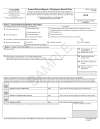
The Internal Revenue Service (IRS) has announced that it will not require plan administrators to answer certain new questions added to the Form 5500/5500-SF and Schedules H, I and R for the 2015 plan year. The questions on the 2015 Form 5500 that the IRS says plan administrators can skip answering are:
- The Preparer Information on the bottom of page 1 of the Form 5500
- Lines 4o-p, 6a-d on the Schedule H
- Lines 4o-p, 6a-d on the Schedule I
- New Part VII (Lines 20a-c, 21a-b, 22a-d, and 23) on Schedule R
- Preparer Information (page 1 bottom), Lines 10j, 14a-d, and New Part IX
(Lines 15a-c, 16a-b, 17a-d, 18, 19, and 20) on Form 5500-SF
See IRS Compliance Questions on the 2015 Form 5500-Series Returns (February 25, 2016).
About the Author
Recognized as a “Top” attorney in employee benefits, labor and employment and health care law extensively involved in health and other employee benefit and human resources policy and program design and administration representation and advocacy throughout her career, Cynthia Marcotte Stamer is a practicing attorney and Managing Shareholder of Cynthia Marcotte Stamer P.C,, a member of Stamer│Chadwick│Soefje PLLC author, pubic speaker, management policy advocate and industry thought leader with more than 27 years’ experience practicing at the forefront of employee benefits and human resources law.
A Fellow in the American College of Employee Benefit Counsel, past Chair and current Welfare Benefit Committee Co-Chair of the American Bar Association (ABA) RPTE Section Employee Benefits Group, Vice Chair of the ABA Tort & Insurance Practice Section Employee Benefits Committee, former Chair of the ABA Health Law Section Managed Care & Insurance Interest Group, an ABA Joint Committee on Employee Benefits Council Representative and Board Certified in Labor & Employment Law by the Texas Board of Legal Specialization, Ms. Stamer is recognized nationally and internationally for her practical and creative insights and leadership on health and other employee benefit, human resources and insurance matters and policy.
Ms. Stamer helps management manage. Ms. Stamer’s legal and management consulting work throughout her nearly 30- year career has focused on helping organizations and their management use the law and process to manage people, process, compliance, operations and risk. Highly valued for her rare ability to find pragmatic client-centric solutions by combining her detailed legal and operational knowledge and experience with her talent for creative problem-solving, Ms. Stamer helps public and private, domestic and international businesses, governments, and other organizations and their leaders manage their employees, vendors and suppliers, and other workforce members, customers and other’ performance, compliance, compensation and benefits, operations, risks and liabilities, as well as to prevent, stabilize and cleanup workforce and other legal and operational crises large and small that arise in the course of operations.
Ms. Stamer works with businesses and their management, employee benefit plans, governments and other organizations deal with all aspects of human resources and workforce management operations and compliance. She supports her clients both on a real time, “on demand” basis and with longer term basis to deal with daily performance management and operations, emerging crises, strategic planning, process improvement and change management, investigations, defending litigation, audits, investigations or other enforcement challenges, government affairs and public policy. Well known for her extensive work with health care, insurance and other highly regulated entities on corporate compliance, internal controls and risk management, her clients range from highly regulated entities like employers, contractors and their employee benefit plans, their sponsors, management, administrators, insurers, fiduciaries and advisors, technology and data service providers, health care, managed care and insurance, financial services, government contractors and government entities, as well as retail, manufacturing, construction, consulting and a host of other domestic and international businesses of all types and sizes. Common engagements include internal and external workforce hiring, management, training, performance management, compliance and administration, discipline and termination, and other aspects of workforce management including employment and outsourced services contracting and enforcement, sentencing guidelines and other compliance plan, policy and program development, administration, and defense, performance management, wage and hour and other compensation and benefits, reengineering and other change management, internal controls, compliance and risk management, communications and training, worker classification, tax and payroll, investigations, crisis preparedness and response, government relations, safety, government contracting and audits, litigation and other enforcement, and other concerns.
Ms. Stamer uses her deep and highly specialized health, insurance, labor and employment and other knowledge and experience to help employers and other employee benefit plan sponsors; health, pension and other employee benefit plans, their fiduciaries, administrators and service providers, insurers, and others design legally compliant, effective compensation, health and other welfare benefit and insurance, severance, pension and deferred compensation, private exchanges, cafeteria plan and other employee benefit, fringe benefit, salary and hourly compensation, bonus and other incentive compensation and related programs, products and arrangements. She is particularly recognized for her leading edge work, thought leadership and knowledgeable advice and representation on the design, documentation, administration, regulation and defense of a diverse range of self-insured and insured health and welfare benefit plans including private exchange and other health benefit choices, health care reimbursement and other “defined contribution” limited benefit, 24-hour and other occupational and non-occupational injury and accident, expat and medical tourism, onsite medical, wellness and other medical plans and insurance benefit programs as well as a diverse range of other qualified and nonqualified retirement and deferred compensation, severance and other employee benefits and compensation, insurance and savings plans, programs, products, services and activities. As a key element of this work, Ms. Stamer works closely with employer and other plan sponsors, insurance and financial services companies, plan fiduciaries, administrators, and vendors and others to design, administer and defend effective legally defensible employee benefits and compensation practices, programs, products and technology. She also continuously helps employers, insurers, administrative and other service providers, their officers, directors and others to manage fiduciary and other risks of sponsorship or involvement with these and other benefit and compensation arrangements and to defend and mitigate liability and other risks from benefit and liability claims including fiduciary, benefit and other claims, audits, and litigation brought by the Labor Department, IRS, HHS, participants and beneficiaries, service providers, and others. She also assists debtors, creditors, bankruptcy trustees and others assess, manage and resolve labor and employment, employee benefits and insurance, payroll and other compensation related concerns arising from reductions in force or other terminations, mergers, acquisitions, bankruptcies and other business transactions including extensive experience with multiple, high-profile large scale bankruptcies resulting in ERISA, tax, corporate and securities and other litigation or enforcement actions.
Ms. Stamer also is deeply involved in helping to influence the Affordable Care Act and other health care, pension, social security, workforce, insurance and other policies critical to the workforce, benefits, and compensation practices and other key aspects of a broad range of businesses and their operations. She both helps her clients respond to and resolve emerging regulations and laws, government investigations and enforcement actions and helps them shape the rules through dealings with Congress and other legislatures, regulators and government officials domestically and internationally. A former lead consultant to the Government of Bolivia on its Social Security reform law and most recognized for her leadership on U.S. health and pension, wage and hour, tax, education and immigration policy reform, Ms. Stamer works with U.S. and foreign businesses, governments, trade associations, and others on workforce, social security and severance, health care, immigration, privacy and data security, tax, ethics and other laws and regulations. Founder and Executive Director of the Coalition for Responsible Healthcare Policy and its PROJECT COPE: the Coalition on Patient Empowerment and a Fellow in the American Bar Foundation and State Bar of Texas, Ms. Stamer annually leads the Joint Committee on Employee Benefits (JCEB) HHS Office of Civil Rights agency meeting and other JCEB agency meetings. She also works as a policy advisor and advocate to many business, professional and civic organizations.
Author of the thousands of publications and workshops these and other employment, employee benefits, health care, insurance, workforce and other management matters, Ms. Stamer also is a highly sought out speaker and industry thought leader known for empowering audiences and readers. Ms. Stamer’s insights on employee benefits, insurance, health care and workforce matters in Atlantic Information Services, The Bureau of National Affairs (BNA), InsuranceThoughtLeaders.com, Benefits Magazine, Employee Benefit News, Texas CEO Magazine, HealthLeaders, Modern Healthcare, Business Insurance, Employee Benefits News, World At Work, Benefits Magazine, the Wall Street Journal, the Dallas Morning News, the Dallas Business Journal, the Houston Business Journal, and many other publications. She also has served as an Editorial Advisory Board Member for human resources, employee benefit and other management focused publications of BNA, HR.com, Employee Benefit News, InsuranceThoughtLeadership.com and many other prominent publications. Ms. Stamer also regularly serves on the faculty and planning committees for symposia of LexisNexis, the American Bar Association, ALIABA, the Society of Employee Benefits Administrators, the American Law Institute, ISSA, HIMMs, and many other prominent educational and training organizations and conducts training and speaks on these and other management, compliance and public policy concerns.
Ms. Stamer also is active in the leadership of a broad range of other professional and civic organizations. For instance, Ms. Stamer presently serves on an American Bar Association (ABA) Joint Committee on Employee Benefits Council representative; Vice President of the North Texas Healthcare Compliance Professionals Association; Immediate Past Chair of the ABA RPTE Employee Benefits & Other Compensation Committee, its current Welfare Benefit Plans Committee Co-Chair, on its Substantive Groups & Committee and its incoming Defined Contribution Plan Committee Chair and Practice Management Vice Chair; Past Chair of the ABA Health Law Section Managed Care & Insurance Interest Group and a current member of its Healthcare Coordinating Council; current Vice Chair of the ABA TIPS Employee Benefit Committee; the former Coordinator and a Vice-Chair of the Gulf Coast TEGE Council TE Division; on the Advisory Boards of InsuranceThoughtLeadership.com, HR.com, Employee Benefit News, and many other publications. She also previously served as a founding Board Member and President of the Alliance for Healthcare Excellence, as a Board Member and Board Compliance Committee Chair for the National Kidney Foundation of North Texas; the Board President of the early childhood development intervention agency, The Richardson Development Center for Children; Chair of the Dallas Bar Association Employee Benefits & Executive Compensation Committee; a member of the Board of Directors of the Southwest Benefits Association. For additional information about Ms. Stamer, see CynthiaStamer.com or StamerChadwickSoefje.com or contact Ms. Stamer via email here or via telephone to (469) 767-8872.
About Solutions Law Press, Inc.™
Solutions Law Press, Inc.™ provides human resources and employee benefit and other business risk management, legal compliance, management effectiveness and other coaching, tools and other resources, training and education on leadership, governance, human resources, employee benefits, data security and privacy, insurance, health care and other key compliance, risk management, internal controls and operational concerns. If you find this of interest, you also be interested reviewing some of our other Solutions Law Press, Inc. ™ resources at SolutionsLawPress.com such as:
If you or someone else you know would like to receive future updates about developments on these and other concerns, please be sure that we have your current contact information including your preferred e-mail by creating or updating your profile here.
©2016 Cynthia Marcotte Stamer. Non-exclusive right to republish granted to Solutions Law Press, Inc. ™. All other rights reserved.
Comments Off on IRS OK’s Skipping Certain 2015 Form 5500 Questions | 401(k), EBSA, Employee Benefits, Employers, ERISA, Health Benefits, health Care, health insurance, health plan, Health Plans, Reporting & Disclosure, Uncategorized | Tagged: Employee Benefits, Employer, Form 5500, Form 5500 ERISA Employee Benefits, Health Plans | Permalink
Posted by Cynthia Marcotte Stamer
July 11, 2015
Health plans, insurers and other health plan industry service providers widespread use and reliance on internet applications to access and share protected health information when performing online enrollment, claims administration and payment, reporting, member and provider communications and a host of other key health plan functions makes it particularly important for health plans, their employer or other sponsors, fiduciaries, insurers and other vendors and their management to respond quickly to a warning from Department of Health & Human Services (HHS) Office of Civil Rights (OCR) warning to ensure applications and systems properly safeguard protected health information (PHI) as required by the Health Insurance Portability & Accountability (HIPAA) Privacy, Security & Breach Notification Rules (HIPAA Rules) and other laws made in its July 10, 2015 announcement of its latest HIPAA settlement.
The new Resolution Agreement with the Massachusetts based hospital system, St. Elizabeth’s Medical Center (SEMC) settles charges OCR made that SEMC reached HIPAA by failing to protect the security of PHI when using internet applications to access and share PHI. The Resolution Agreement also shows how complaints filed with OCR by workforce members can create additional compliance headaches for Covered Entities or their business associates while the “robust corrective action plan” imposed under the Resolution Agreement shares examples of ladder reporting and management oversight and documentation Covered Entities and business associates can expect to need to prove their organizations maintains the “culture of compliance” with HIPAA OCR expects in the event of an OCR audit or investigation.
With recent reports on massive health plan HIPAA and other data breaches fueling widespread participant and regulatory concern over identity theft and other data security, Covered Entities and their business associates should prepare to defend the adequacy of their own HIPAA and other data security practices in the event of an OCR breach investigation or audit. Accordingly, health plans and their employer or other sponsors, health plan fiduciaries, health plan vendors acting as business associates and others dealing with health plans and their management should contact legal counsel experienced in these matters for advice within the scope of attorney-client privilege about how to respond to the OCR warning and other developments to manage their HIPAA and other privacy and data security legal and operational risks and liabilities.
SEMC Resolution Agreement Overview
The SEMC Resolution Agreement settles OCR charges that SEMC violated HIPAA stemming from an OCR investigation of a November 16, 2012 complaint by SEMC workforce members and a separate data breach report SEMC separately made to OCR of a breach of unsecured electronic PHI (ePHI) stored on a former SEMC workforce member’s personal laptop and USB flash drive affecting 595 individuals. In their complaint, SEMC workers complained SEMC violated HIPAA by allowing workforce members to use an internet-based document sharing application to share and store documents containing electronic protected health information (ePHI) of at least 498 individuals without adequately analyzing the risks. OCR says its investigation of the complaint and breach report revealed among other things that:
- SEMC improperly disclosed the PHI of at least 1,093 individuals;
- SEMC failed to implement sufficient security measures regarding the transmission of and storage of ePHI to reduce risks and vulnerabilities to a reasonable and appropriate level; and
- SEMC failed to timely identify and respond to a known security incident, mitigate the harmful effects of the security incident, and document the security incident and its outcome.
To resolve OCR’s charges, SMCS agreed to pay $218,400 to OCR and implement a “robust corrective action plan” to correct these alleged HIPAA violations. While the required settlement payment is relatively small, the Resolution Agreement’s focus security requirements for internet application and data use and sharing activities engaged in by virtually every Covered Entity and business associate make the Resolution Agreement merit the immediate attention of all Covered Entities, their business associates and their management.
SEMC HIPAA Specific Compliance Lessons For Health Plans & Business Associates
In announcing the Resolution Agreement, OCR Director Jocelyn Samuels sent a clear warning to all Covered Entities and their business associates “to pay particular attention to HIPAA’s requirements when using internet-based document sharing applications,” stating “In order to reduce potential risks and vulnerabilities, all workforce members must follow all policies and procedures, and entities must ensure that incidents are reported and mitigated in a timely manner.”
The Resolution Agreement makes clear that OCR expects health plans and other Covered Entities and their business associates to be able to show both their timely investigation of reported or suspected HIPAA susceptibilities or violations as well as to self-audit and spot test HIPAA compliance in their operations. The SEMC corrective action plan also indicates Covered Entities and business associates must be able to produce documentation and other evidence needed to show the top to bottom dedication to HIPAA compliance necessary to prove a “culture of compliance” with HIPAA permeates their organizations.
In light of OCR’s warning and expectations, Covered Entities and business associates should start by considering the advisability for their own organization to take one or more of the steps outlined in the “robust corrective action plan” included in the Resolution Agreement, starting with the specific steps the corrective action plan requires SEMC to address its internet application security concerns such as:
- Conducting self-audits and spot checks of workforce members’ familiarity and compliance with HIPAA policies and procedures on transmitting ePHI using unauthorized networks; storing ePHI on unauthorized information systems, including unsecured networks and devices; removal of ePHI from SEMC; prohibition on sharing accounts and passwords for ePHI access or storage; encryption of portable devices that access or store ePHI; security incident reporting related to ePHI; and
- Inspecting laptops, smartphones, storage media and other portable devices, workstations and other devices containing ePHI and other data devices and systems and their use; and
- Conducting other tests and audits of security and compliance with policies, processes and procedures; and
- Documenting results, findings, and corrective actions including appropriate up the ladder reporting and management oversight of these and other HIPAA compliance expectations, training and other efforts.
Broader HIPAA Compliance & Risk Management Lessons
Beyond the specific internet applications and other security of ePHI lessons in the Resolution Agreement, Covered Entities and their business associates also should be mindful of other more subtle, but equally important broader HIPAA compliance and risk management lessons provided in the Resolution Agreement and other recent OCR guidance about their overall HIPAA compliance responsibilities.
One of the most significant of these lessons is the need for proper workforce training, oversight and management. The Resolution Agreement sends an undeniable message that OCR expects Covered Entities, business associates and their leaders to be able to show their effective oversight and management of the operational compliance of their systems and members of their workforce with HIPAA policies. The SEMC corrective action plan should prompt Covered Entities and business associates to weigh the adequacy of their existing workforce training, reporting, investigation and other management processes and documentation. Meanwhile, OCR’s report that an OCR complaint made by SEMC insiders to OCR prompted its investigation also should sensitize Covered Entities and their business associates of the need to ensure that their workforce training and management processes are appropriate to position their organization both to show their processes encourage proper internal reporting and investigation of compliance concerns, as well as manage the inevitable HIPAA and other human resources retaliation and whistleblower exposures that can arise out of such reports.
The Resolution Agreement also provides insights to the internal corporate processes and documentation of compliance efforts that Covered Entities and business associates may need to show their organization has the required “culture of compliance” needed to mitigate consequences of breaches or other compliance glitches. Particularly notable are Resolution Agreement’s terms on the documentation and up the ladder reporting to management and OCR of SEMC’s self-audit and self-correction activities and management oversight and management of these activities. Like tips shared by HHS in the recently released Practical Guidance for Health Care Governing Boards on Compliance Oversight, these details in the Resolution Agreement provide invaluable tips to Boards and other leaders of Covered Entities and business associates about steps they can take to promote their ability to demonstrate their organizations have the necessary culture of HIPAA compliance OCR expects.
Health Plan HIPAA Compliance Risks & Responsibilities of Employers & Their Leaders
While HIPAA places the primary duty for complying with HIPAA on Covered Entities and business associates, health plan sponsors and their management still need to make HIPAA compliance a priority for many practical and legal reasons.
As employers forced to cope with the deluge of fears and questions of employees and other health plan members impacted by recent massive PHI breach reports shared by Blue Cross association health insurance plan giants, Anthem and Premera can attest, HIPAA data breach or other compliance reports often trigger significant financial, administrative, workforce satisfaction and other operational costs employer health plan sponsors. Inevitable employee concern about health plan data breaches undermines employee value and satisfaction of the health benefit plan as an employee benefit. These concerns also usually require employers to expend significant management and financial resources to respond to these concerns and address other employer fallout from the breach.
The costs of investigation and redress of a known or suspected HIPAA data or other breach typically far exceed the actual damages to participants resulting from the breach. While HIPAA technically does not make sponsoring employers directly responsible for these duties or the costs of their performance, as a practical matter sponsoring employers typically can expect to pay costs and other expenses that its health plan incurs to investigate and redress a HIPAA breach. For one thing, except in the all too rare circumstances where employers as plan sponsors have specifically negotiated more favorable indemnification and liability provisions in their vendor contracts, employer and other health plan sponsors usually agree in their health plan vendor contracts to pay the expenses and to indemnify health plan insurers, third party administrators, and other vendors for costs and liabilities arising from HIPAA breaches or other events arising in the course of the administration of the health plan. Since employers typically are obligated to pay health plan costs in excess of participant contributions, employers also typically would be required to provide the funding their health plan needs to cover these costs even in the absence of such indemnification agreements.
Sponsoring employers and their management also should be aware the employer’s exception from direct liability for HIPAA Rule compliance does not fully insulate the employer or its management from legal risks in the event of a health plan data breach or other HIPAA violation.
While HIPAA generally limits direct responsibility for compliance with the HIPAA Rules to a health plan or other Covered Entity and their business associates, HIPAA hybrid entity and other organizational rules and criminal provisions of HIPAA, as well as various other federal laws arguably could create liability risks for the employer. See, e.g., Cyber Liability, Healthcare: Healthcare Breaches: How to Respond; Restated HIPAA Regulations Require Health Plans to Tighten Privacy Policies and Practices; Cybercrime and Identity Theft: Health Information Security Beyond. For example, hybrid entity and other organizational provisions in the HIPAA Rules generally require employers and their health plan to ensure that health plan operations are appropriately distinguished from other employer operations in order for otherwise non-covered human resources, accounting or other employer activities to avoid subjecting their otherwise non-covered employer operations and data to HIPAA Rules. To achieve this required designation and separation, the HIPAA rules typically also require that the health plan include specific HIPAA language and the employer and health plan take appropriate steps to designate and separate health plan records and data, workforces, and operations from the non-covered business operations and records of the sponsoring employer. Failure to fulfill these requirements could result in the unintended spread of HIPAA restrictions and liabilities to other aspects of the employer’s human resources or other operations. Sponsoring employers will want to confirm that health plan and other operations and workforces are properly designated, distinguished and separated to reduce this risk.
When putting these designations and separations in place, employers also generally will want to make arrangements to ensure that their health plan includes the necessary terms and the employer implements the policies necessary for the employer to provide the certifications to the health plan that HIPAA will require that the health plan receive before HIPAA will allow health plan PHI to disclosed to the employer or its representative for the limited underwriting and other specified plan administration purposes permitted by the HIPAA Rules.
Once these arrangements are in place, employers and their management also generally will want to take steps to minimize the risk that their organization or a member of the employer’s workforce honors these arrangements and does not improperly access or use health plan PHI, systems in violation of these conditions or other HIPAA Rules. This or other wrongful use or access of health plan PHI or systems could violate criminal provisions of HIPAA or other federal laws making it a crime for any person – including the employer or a member of its workforce – from wrongfully accessing health plan PHI, electronic records or systems. Since health plan PHI records also typically include personal tax, social security information that the Internal Revenue Code, the Social Security Act and other federal laws generally would require the employer to keep confidential and to protect against improper use, employers and their management also generally should be concern about potential exposures for their organization that could result from improper use or access of this information in violation of these other federal laws. Since HIPAA and some of these other laws under certain conditions make it a felony crime to violate these rules, employer and their management generally will want to treat compliance with these federal rules as critical elements of the employer’s Federal Sentencing Guideline and other compliance programs.
Beyond the already discussed concerns, employers or members of their management also may have an incentive to promote health plan compliance with HIPAA or other health plan privacy or data security requirements to many the exposure of the employer or management or other staff to statutory, regulatory, contractual or ethical liabilities arising under ERISA, Internal Revenue Code, the Fair & Accurate Credit Transaction Act (FACTA), trade secret, insurance, disability, identity theft, cybersecurity or other federal or state laws.
For instance, health plan sponsors and management involved in health plan decisions, administration or oversight could face personal fiduciary liability risks under ERISA for failing to act prudently to ensure that the health plan compliance with HIPAA and other federal privacy and data security requirements.. ERISA’s broad functional fiduciary definition encompasses both persons and entities appointed as “named” fiduciaries and others who functionally exercise discretion or control over a plan or its administration. Consequently, the sponsoring employer and certain members of its human resources or other executive management team who functionally possess or exercise responsibility or authority over the administration of the employer’s health plan or its data or other assets, the selection or oversight of plan fiduciaries, vendors, or other workforce members its administration, or other key health plan operations risk ERISA fiduciary liability for their own failures to act prudently in carrying out HIPAA compliance or other responsibilities or to take action when they know or should know that another fiduciary is or has breached these duties. This fiduciary status and risk can occur even if the entity or individual does not is not named a named fiduciary, expressly disclaims fiduciary responsibility or does not realize it bears fiduciary status or responsibility. Since fiduciaries generally bear personal liability for their own breaches of fiduciary duty as well as potential co-fiduciary liability for fiduciary breaches committed by others that they knew or prudently should have known, most employers and members of their management will make HIPAA health plan compliance a priority to avoid or minimize these potential ERISA fiduciary exposures.
Furthermore, most employers and their management also will appreciate the desirability of taking reasonable steps to manage potential exposures that the employer or members of its management could face if their health plan or the employer violates the anti-retaliation rules of HIPAA or other laws through the adoption and administration of appropriate human resources, internal investigation and reporting, risk management policies and practices. See Employee & Other Whistleblower Complaints Common Source of HIPAA Privacy & Other Complaints.
Act To Manage HIPAA & Other Related Risks
OCR’s release of the Resolution Agreement on the heels of widespread publicity about massive health plan and other data breaches at Blue Cross health care giants, Anthem and Premera and other U.S. businesses and the potential legal and financial exposures that a HIPAA data breach or other violation could create, health plans and their sponsors, insurers, business associates, and leaders should appreciate the advisability of acting promptly to ensure that their health plans and business associates are taking appropriate steps to comply with the HIPAA Rules and manage other associated risks and liabilities. At minimum, health plans and their business associates should move quickly to conduct a documented assessment of the adequacy of their health plan internet applications and other HIPAA compliance in in light of the Resolution Agreement and other developments. Given the scope and diversity of the legal responsibilities, risks and exposures associated with this analysis, most health plan sponsors, fiduciaries, business associates and their management also will want to consider taking other steps to mitigate various other legal and operational risks that lax protection or use of health plan PHI or systems could create for their health plan, its sponsors, fiduciaries, business associates and their management. Health plan fiduciaries, sponsors and business associates and their leaders also generally will want to explore options to use indemnification agreements, liability insurance or other risk management tools as a stop gap against the costs of investigation or defense of a HIPAA security or other data breach.
For Legal or Consulting Advice, Legal Representation, Training Or More Information
If you need help responding to these new or other workforce, benefits and compensation, performance and risk management, compliance, enforcement or management concerns, help updating or defending your workforce or employee benefit policies or practices, or other related assistance, the author of this update, attorney Cynthia Marcotte Stamer may be able to help.
A practicing attorney and Managing Shareholder of Cynthia Marcotte Stamer, P.C., a member of Stamer│Chadwick │Soefje PLLC, Ms. Stamer’s more than 27 years’ of leading edge work as an practicing attorney, author, lecturer and industry and policy thought leader have resulted in her recognition as a “Top” attorney in employee benefits, labor and employment and health care law.
Board certified in labor and employment law by the Texas Board of Legal Specialization, a Fellow in the American College of Employee Benefit Counsel, past Chair and current Welfare Benefit Committee Co-Chair of the American Bar Association (ABA) RPTE Section Employee Benefits Group, Vice Chair of the ABA Tort & Insurance Practice Section Employee Benefits Committee, former Chair of the ABA Health Law Section Managed Care & Insurance Interest Group, an ABA Joint Committee on Employee Benefits Council Representative and Board Certified in Labor & Employment Law by the Texas Board of Legal Specialization, Ms. Stamer is recognized nationally and internationally for her practical and creative insights and leadership on HIPAA and other health and other employee benefit, human resources, and related insurance, health care, privacy and data security and tax matters and policy.
Ms. Stamer’s legal and management consulting work throughout her 27 plus year career has focused on helping organizations and their management use the law and process to manage people, process, compliance, operations and risk. Highly valued for her rare ability to find pragmatic client-centric solutions by combining her detailed legal and operational knowledge and experience with her talent for creative problem-solving, Ms. Stamer helps public and private, domestic and international businesses, governments, and other organizations and their leaders manage their employees, vendors and suppliers, and other workforce members, customers and other’ performance, compliance, compensation and benefits, operations, risks and liabilities, as well as to prevent, stabilize and cleanup workforce and other legal and operational crises large and small that arise in the course of operations.
Ms. Stamer works with businesses and their management, employee benefit plans, governments and other organizations deal with all aspects of human resources and workforce management operations and compliance. She supports her clients both on a real time, “on demand” basis and with longer term basis to deal with daily performance management and operations, emerging crises, strategic planning, process improvement and change management, investigations, defending litigation, audits, investigations or other enforcement challenges, government affairs and public policy.
Well known for her extensive work with health care, insurance and other highly regulated entities on corporate compliance, internal controls and risk management, her clients range from highly regulated entities like employers, contractors and their employee benefit plans, their sponsors, management, administrators, insurers, fiduciaries and advisors, technology and data service providers, health care, managed care and insurance, financial services, government contractors and government entities, as well as retail, manufacturing, construction, consulting and a host of other domestic and international businesses of all types and sizes.
As a key part of this work, Ms. Stamer uses her deep and highly specialized health, insurance, labor and employment and other knowledge and experience to help employers and other employee benefit plan sponsors; health, pension and other employee benefit plans, their fiduciaries, administrators and service providers, insurers, and others design legally compliant, effective compensation, health and other welfare benefit and insurance, severance, pension and deferred compensation, private exchanges, cafeteria plan and other employee benefit, fringe benefit, salary and hourly compensation, bonus and other incentive compensation and related programs, products and arrangements.
She is particularly recognized for her leading edge work, thought leadership and knowledgeable advice and representation on the design, documentation, administration, regulation and defense of a diverse range of self-insured and insured health and welfare benefit plans including private exchange and other health benefit choices, health care reimbursement and other “defined contribution” limited benefit, 24-hour and other occupational and non-occupational injury and accident, ex-patriate and medical tourism, onsite medical, wellness and other medical plans and insurance benefit programs as well as a diverse range of other qualified and nonqualified retirement and deferred compensation, severance and other employee benefits and compensation, insurance and savings plans, programs, products, services and activities. In these and other engagements, Ms. Stamer works closely with employer and other plan sponsors, insurance and financial services companies, plan fiduciaries, administrators, and vendors and others to design, administer and defend effective legally defensible employee benefits and compensation practices, programs, products and technology. She also continuously helps employers, insurers, administrative and other service providers, their officers, directors and others to manage fiduciary and other risks of sponsorship or involvement with these and other benefit and compensation arrangements and to defend and mitigate liability and other risks from benefit and liability claims including fiduciary, benefit and other claims, audits, and litigation brought by the Labor Department, IRS, HHS, participants and beneficiaries, service providers, and others. She also assists debtors, creditors, bankruptcy trustees and others assess, manage and resolve labor and employment, employee benefits and insurance, payroll and other compensation related concerns arising from reductions in force or other terminations, mergers, acquisitions, bankruptcies and other business transactions including extensive experience with multiple, high-profile large scale bankruptcies resulting in ERISA, tax, corporate and securities and other litigation or enforcement actions.
In the course of this work, Ms. Stamer has accumulated an impressive resume of experience advising and representing clients on HIPAA and other privacy and data security concerns. The scribe for the American Bar Association (ABA) Joint Committee on Employee Benefits annual agency meeting with the Department of Health & Human Services Office of Civil Rights for several years, Ms. Stamer has worked extensively with health plans, health care providers, health care clearinghouses, their business associates, employer and other sponsors, banks and other financial institutions, and others on risk management and compliance with HIPAA and other information privacy and data security rules, investigating and responding to known or suspected breaches, defending investigations or other actions by plaintiffs, OCR and other federal or state agencies, reporting known or suspected violations, business associate and other contracting, commenting or obtaining other clarification of guidance, training and enforcement, and a host of other related concerns. Her clients include public and private health plans, health insurers, health care providers, banking, technology and other vendors, and others. Beyond advising these and other clients on privacy and data security compliance, risk management, investigations and data breach response and remediation, Ms. Stamer also advises and represents clients on OCR and other HHS, Department of Labor, IRS, FTC, DOD and other health care industry investigation, enforcement and other compliance, public policy, regulatory, staffing, and other operations and risk management concerns. She also is the author of numerous highly acclaimed publications, workshops and tools for HIPAA or other compliance including training programs on Privacy & The Pandemic for the Association of State & Territorial Health Plans, as well as HIPAA, FACTA, PCI, medical confidentiality, insurance confidentiality and other privacy and data security compliance and risk management for Los Angeles County Health Department, ISSA, HIMMS, the ABA, SHRM, schools, medical societies, government and private health care and health plan organizations, their business associates, trade associations and others.
Ms. Stamer also is deeply involved in helping to influence the Affordable Care Act and other health care, pension, social security, workforce, insurance and other policies critical to the workforce, benefits, and compensation practices and other key aspects of a broad range of businesses and their operations. She both helps her clients respond to and resolve emerging regulations and laws, government investigations and enforcement actions and helps them shape the rules through dealings with Congress and other legislatures, regulators and government officials domestically and internationally. A former lead consultant to the Government of Bolivia on its Social Security reform law and most recognized for her leadership on U.S. health and pension, wage and hour, tax, education and immigration policy reform, Ms. Stamer works with U.S. and foreign businesses, governments, trade associations, and others on workforce, social security and severance, health care, immigration, privacy and data security, tax, ethics and other laws and regulations. Founder and Executive Director of the Coalition for Responsible Healthcare Policy and its PROJECT COPE: the Coalition on Patient Empowerment and a Fellow in the American Bar Foundation and State Bar of Texas. She also works as a policy advisor and advocate to health plans, their sponsors, administrators, insurers and many other business, professional and civic organizations.
Author of the thousands of publications and workshops these and other employment, employee benefits, health care, insurance, workforce and other management matters, Ms. Stamer also is a highly sought out speaker and industry thought leader known for empowering audiences and readers. Ms. Stamer’s insights on employee benefits, insurance, health care and workforce matters in Atlantic Information Services, The Bureau of National Affairs (BNA), InsuranceThoughtLeaders.com, Benefits Magazine, Employee Benefit News, Texas CEO Magazine, HealthLeaders, Modern Healthcare, Business Insurance, Employee Benefits News, World At Work, Benefits Magazine, the Wall Street Journal, the Dallas Morning News, the Dallas Business Journal, the Houston Business Journal, and many other publications. She also has served as an Editorial Advisory Board Member for human resources, employee benefit and other management focused publications of BNA, HR.com, Employee Benefit News, InsuranceThoughtLeadership.com and many other prominent publications. Ms. Stamer also regularly serves on the faculty and planning committees for symposia of LexisNexis, the American Bar Association, ALIABA, the Society of Employee Benefits Administrators, the American Law Institute, ISSA, HIMMs, and many other prominent educational and training organizations and conducts training and speaks on these and other management, compliance and public policy concerns.
Ms. Stamer also is active in the leadership of a broad range of other professional and civic organizations. For instance, Ms. Stamer presently serves on an American Bar Association (ABA) Joint Committee on Employee Benefits Council representative; Vice President of the North Texas Healthcare Compliance Professionals Association; Immediate Past Chair of the ABA RPTE Employee Benefits & Other Compensation Committee, its current Welfare Benefit Plans Committee Co-Chair, on its Substantive Groups & Committee and its incoming Defined Contribution Plan Committee Chair and Practice Management Vice Chair; Past Chair of the ABA Health Law Section Managed Care & Insurance Interest Group and a current member of its Healthcare Coordinating Council; current Vice Chair of the ABA TIPS Employee Benefit Committee; the former Coordinator and a Vice-Chair of the Gulf Coast TEGE Council TE Division; on the Advisory Boards of InsuranceThoughtLeadership.com, HR.com, Employee Benefit News, and many other publications. She also previously served as a founding Board Member and President of the Alliance for Healthcare Excellence, as a Board Member and Board Compliance Committee Chair for the National Kidney Foundation of North Texas; the Board President of the early childhood development intervention agency, The Richardson Development Center for Children; Chair of the Dallas Bar Association Employee Benefits & Executive Compensation Committee; a member of the Board of Directors of the Southwest Benefits Association. For additional information about Ms. Stamer, see www.cynthiastamer.com, or http://www.stamerchadwicksoefje.com the member of contact Ms. Stamer via email here or via telephone to (469) 767-8872.
About Solutions Law Press, Inc.™
Solutions Law Press, Inc.™ provides human resources and employee benefit and other business risk management, legal compliance, management effectiveness and other coaching, tools and other resources, training and education on leadership, governance, human resources, employee benefits, data security and privacy, insurance, health care and other key compliance, risk management, internal controls and operational concerns. If you find this of interest, you also may be interested reviewing other Solutions Law Press, Inc.™ resources at www.solutionslawpress.com such as:
If you or someone else you know would like to receive future updates about developments on these and other concerns, please be sure that we have your current contact information including your preferred e-mail by creating or updating your profile at here.
©2015 Cynthia Marcotte Stamer. Non-exclusive right to republish granted to Solutions Law Press. All other rights reserved.
Comments Off on HIPAA Settlement Warns Health Plans, Sponsoring Employers & Business Associates To Manage HIPAA Risks | 105(h), ADA, ARRA, Cafeteria Plans, Civil Rights, Claims Administration, Corporate Compliance, Defined Contribution Plans, Employee Benefits, Employers, ERISA, Fiduciary Responsibility, GINA, Government Contractors, Health Plans, HIPAA, Human Resources, Mental Health, MEWA, Retaliation, Risk Management | Tagged: Breach Notification, Data Breach, Employer, ERISA, Federal Sentencing Guidelines, Fiduciary Duties, Health Plans, HIPAA, Privacy, Risk Managemnet | Permalink
Posted by Cynthia Marcotte Stamer
June 30, 2015
With the Obama Administration construing the United States Supreme Court’s King v. Burwell decision as a green light for its full implementation and enforcement of the Patient Protection & Affordable Care Act (ACA), U.S. businesses should brace for both increases in health benefit costs and liabilities over the next year as well as take prompt action to identify and mitigate potential excise tax and other exposures from any unaddressed compliance deficiencies in their 2014 or 2015 health plans as soon as possible and no later than the due date for filing their 2014 business tax return.
As health benefit costs continue their upward trend, many businesses and their leaders plan to look for new options to manage costs and liabilities following the King decision. In most cases, businesses assume they can delay these actions until the beginning of their upcoming health plan year, not realizing their company’s potential liability exposures from existing and past defects. Businesses and their leaders who have held off updating their health plan compliance and expect to delay completion of these activities until the beginning of their upcoming health plan year are likely to be in for a rude awakening, however, particularly since a much underappreciated Sarbanes-Oxley style provision of the Internal Revenue Code will require employer or other group health plan sponsors to self-report, self-assess and pay stiff excise tax penalties when filing their company’s 2014 business tax return unless their group health plan complied with a long list of ACA and other federal health plan rules in 2014.
Employer Health Benefit & Other Compensation Up, Costs Exposures Projected To Continue To Rise
While many businesses delayed making tough choices about their health plan design and compliance over the past several years in hopes of some judicial or Congressional relief from the mandates and costs of ACA, businesses generally have continued to struggle with ever-rising compensation and benefit costs, with health benefit costs the biggest challenge. Recent U.S. Bureau of Labor Statistics (BLS) data confirms what business leaders already know. Compensation and benefit costs rose over the past year, with health benefit costs remaining a big factor in these increased costs. According to BLS, employer compensation costs rose slightly and health benefit costs remained the largest individual benefit cost for employers during the 12-month period ending March 31, 2015, according to the U.S. Bureau of Labor Statistics (BLS). See BLS Employment Cost Index News Release (April 30, 2015).
The BLS Employer Costs For Employee Compensation Report, March 2015 released June 10, 2015 Report) shows private employers spent an average of $31.65 per hour worked for compensation in March 2015 with health benefits accounting averaging 7.7 percent of this average employer total compensation cost per employee. This compares to BLS showing that in March 2014, In March 2014, total employer compensation costs for private industry workers averaged $29.99 per hour worked, with wages and salaries averaging $20.96 per hour (69.9 percent) and benefits averaging $9.03 per hour (30.1 percent). See BLS Employer Costs For Employee Compensation, March 2014 (June 12, 2014)(2014 Report).
BLS data on health benefit and other compensation and benefit costs and trends provides many interesting insights for business as well as government leaders and the role health benefit cost increases play in these increased expenditures. For instance, BLS statistics show for private employers on average during the 12-month period ending March 31, 2015:
- Compensation costs for private industry workers increased 2.8 percent over the year, higher than the March 2014 increase of 1.7 percent;
- Wages and salaries increased 2.8 percent, also higher than the March 2014 increase of 1.7 percent;
- Benefits costs rose 2.6 percent, which was higher than March 2014, when the increase was 1.8 percent; and
- Health benefits on average increased 2.5 percent over during the 12-month period that ended on March 31, 2015, rising from the March 2014 increase in compensation costs of 1.8 percent.
Businesses Must Prepare For Impending ACA Enforcement While Dealing With Upsurge In Health Benefit Costs
While the continued rise in the average hourly cost of health benefits for employers is significant in its own right, the reported health benefit cost and employer health cost data in the Report does not include additional reporting and other compliance and risk management costs, which in light of the explosion in employer group health plan mandates since the passage of the Patient Protection and Affordable Care Act (ACA). Research indicates that the employer plan design changes slowed the upward trend in employer health benefit expenditures that otherwise would have occurred in 2015. This upward trend is projected to continue if not accelerate in 2016, however.
The 2015 Report shows these upward increases in employer costs for health benefits and other compensation continued in the first quarter of 2015. Concerning health benefits, for instance, the 2015 Report shows health benefit costs paid by employers averaged $2.43 per hour worked (7.7 percent of total compensation)in private industry in March 2015, compared to the average health benefit costs BLS reported. In comparison, the 2014 Report indicated in March, 2014, the average cost for health insurance benefits in private industry was $2.36 per hour worked in March 2014 (7.9 percent of total compensation).
Overall health benefit costs and associated compliance expenses of employers that elect to continue to offer health benefits for employees are projected to rise throughout 2015 and 2016 as ACA driven mandates and market changes drive up employer’s direct health benefit costs. See, e.g. Employers’ Health Costs Projected to Rise 6.5% for 2016.
The trend data and judicial and political developments indicate that business leaders can look for these trends not only to continue, but accelerate. With an impending responsibility to self-report violations of ACA and various of federal health plan mandates imminent, business leaders should brace to deal with any deficiencies in compliance in their 2014 and 2015 health plans much sooner than they might have expected following the Supreme Court’s King v. Burwell decision last week. President Obama made clear last week he views the King ruling as giving the Internal Revenue Service, Department of Labor and Department of Health & Human Services the all clear for full implementation and enforcement of ACA and other federal health plan rules. While these overall enforcement exposures will play out over the next several years, many employers are poised to experience the first bite of these new enforcement exposures over the next few months, when the Internal Revenue Code will require that employers that offered health coverage for employees in 2014 self-assess, report and pay stiff new excise tax penalties of $100 per day per violation when filing their 2014 tax return unless their program complied with all of a long list of ACA or other federal law mandates in addition to otherwise applicable exposures under the Employee Retirement Income Security Act (ERISA) and other laws. See, Businesses Must Confirm & Clean Up Health Plan ACA & Other Compliance Following Supreme Court’s King v. Burwell Decision. Since prompt self-audit and correction can help mitigate these liabilities, business leaders should act quickly to engage experienced legal counsel for their companies for help in evaluating, within the scope of attorney client privilege, the adequacy of their 2014 and 2015 health plan compliance, options for addressing potential exposures from any compliance deficiencies, and for advice and assistance to decide whether to offer health benefits going forward and if so, aid in designing and implementing their future health benefit program to enhance its defensibility. While businesses inevitably will need to involve or coordinate with their accounting, broker, and other vendors involved with the plans, businesses generally will want to get legal advice in a manner that preserves their potential to claim attorney-client privilege to protect against discovery in the event of future enforcement or litigation actions sensitive discussions and analysis about compliance audits, plan design choices, and other risk management and liability planning as well as to get help evaluating potential future plan design changes or proposed solutions to known or suspected liability exposures, particularly in light of complexity of the exposures and risks.
For Legal or Consulting Advice, Legal Representation, Training Or More Information
If you need help responding to these new or other workforce, benefits and compensation, performance and risk management, compliance, enforcement or management concerns, help updating or defending your workforce or employee benefit policies or practices, or other related assistance, the author of this update, attorney Cynthia Marcotte Stamer may be able to help.
Recognized as a “Top” attorney in employee benefits, labor and employment and health care law extensively involved in health and other employee benefit and human resources policy and program design and administration representation and advocacy throughout her career, Cynthia Marcotte Stamer is a practicing attorney and Managing Shareholder of Cynthia Marcotte Stamer, P.C., a member of Stamer│Chadwick │Soefje PLLC, author, pubic speaker, management policy advocate and industry thought leader with more than 27 years’ experience practicing at the forefront of employee benefits and human resources law.
A Fellow in the American College of Employee Benefit Counsel, past Chair and current Welfare Benefit Committee Co-Chair of the American Bar Association (ABA) RPTE Section Employee Benefits Group, Vice Chair of the ABA Tort & Insurance Practice Section Employee Benefits Committee, former Chair of the ABA Health Law Section Managed Care & Insurance Interest Group, an ABA Joint Committee on Employee Benefits Council Representative and Board Certified in Labor & Employment Law by the Texas Board of Legal Specialization, Ms.Stamer is recognized nationally and internationally for her practical and creative insights and leadership on health and other employee benefit, human resources and insurance matters and policy.
Ms. Stamer helps management manage. Ms. Stamer’s legal and management consulting work throughout her 27 plus year career has focused on helping organizations and their management use the law and process to manage people, process, compliance, operations and risk. Highly valued for her rare ability to find pragmatic client-centric solutions by combining her detailed legal and operational knowledge and experience with her talent for creative problem-solving, Ms. Stamer helps public and private, domestic and international businesses, governments, and other organizations and their leaders manage their employees, vendors and suppliers, and other workforce members, customers and other’ performance, compliance, compensation and benefits, operations, risks and liabilities, as well as to prevent, stabilize and cleanup workforce and other legal and operational crises large and small that arise in the course of operations.
Ms. Stamer works with businesses and their management, employee benefit plans, governments and other organizations deal with all aspects of human resources and workforce management operations and compliance. She supports her clients both on a real time, “on demand” basis and with longer term basis to deal with daily performance management and operations, emerging crises, strategic planning, process improvement and change management, investigations, defending litigation, audits, investigations or other enforcement challenges, government affairs and public policy. Well known for her extensive work with health care, insurance and other highly regulated entities on corporate compliance, internal controls and risk management, her clients range from highly regulated entities like employers, contractors and their employee benefit plans, their sponsors, management, administrators, insurers, fiduciaries and advisors, technology and data service providers, health care, managed care and insurance, financial services, government contractors and government entities, as well as retail, manufacturing, construction, consulting and a host of other domestic and international businesses of all types and sizes. Common engagements include internal and external workforce hiring, management, training, performance management, compliance and administration, discipline and termination, and other aspects of workforce management including employment and outsourced services contracting and enforcement, sentencing guidelines and other compliance plan, policy and program development, administration, and defense, performance management, wage and hour and other compensation and benefits, reengineering and other change management, internal controls, compliance and risk management, communications and training, worker classification, tax and payroll, investigations, crisis preparedness and response, government relations, safety, government contracting and audits, litigation and other enforcement, and other concerns.
Ms. Stamer uses her deep and highly specialized health, insurance, labor and employment and other knowledge and experience to help employers and other employee benefit plan sponsors; health, pension and other employee benefit plans, their fiduciaries, administrators and service providers, insurers, and others design legally compliant, effective compensation, health and other welfare benefit and insurance, severance, pension and deferred compensation, private exchanges, cafeteria plan and other employee benefit, fringe benefit, salary and hourly compensation, bonus and other incentive compensation and related programs, products and arrangements. She is particularly recognized for her leading edge work, thought leadership and knowledgeable advice and representation on the design, documentation, administration, regulation and defense of a diverse range of self-insured and insured health and welfare benefit plans including private exchange and other health benefit choices, health care reimbursement and other “defined contribution” limited benefit, 24-hour and other occupational and non-occupational injury and accident, ex-patriate and medical tourism, onsite medical, wellness and other medical plans and insurance benefit programs as well as a diverse range of other qualified and nonqualified retirement and deferred compensation, severance and other employee benefits and compensation, insurance and savings plans, programs, products, services and activities. As a key element of this work, Ms. Stamer works closely with employer and other plan sponsors, insurance and financial services companies, plan fiduciaries, administrators, and vendors and others to design, administer and defend effective legally defensible employee benefits and compensation practices, programs, products and technology. She also continuously helps employers, insurers, administrative and other service providers, their officers, directors and others to manage fiduciary and other risks of sponsorship or involvement with these and other benefit and compensation arrangements and to defend and mitigate liability and other risks from benefit and liability claims including fiduciary, benefit and other claims, audits, and litigation brought by the Labor Department, IRS, HHS, participants and beneficiaries, service providers, and others. She also assists debtors, creditors, bankruptcy trustees and others assess, manage and resolve labor and employment, employee benefits and insurance, payroll and other compensation related concerns arising from reductions in force or other terminations, mergers, acquisitions, bankruptcies and other business transactions including extensive experience with multiple, high-profile large scale bankruptcies resulting in ERISA, tax, corporate and securities and other litigation or enforcement actions.
Ms. Stamer also is deeply involved in helping to influence the Affordable Care Act and other health care, pension, social security, workforce, insurance and other policies critical to the workforce, benefits, and compensation practices and other key aspects of a broad range of businesses and their operations. She both helps her clients respond to and resolve emerging regulations and laws, government investigations and enforcement actions and helps them shape the rules through dealings with Congress and other legislatures, regulators and government officials domestically and internationally. A former lead consultant to the Government of Bolivia on its Social Security reform law and most recognized for her leadership on U.S. health and pension, wage and hour, tax, education and immigration policy reform, Ms. Stamer works with U.S. and foreign businesses, governments, trade associations, and others on workforce, social security and severance, health care, immigration, privacy and data security, tax, ethics and other laws and regulations. Founder and Executive Director of the Coalition for Responsible Healthcare Policy and its PROJECT COPE: the Coalition on Patient Empowerment and a Fellow in the American Bar Foundation and State Bar of Texas, Ms. Stamer annually leads the Joint Committee on Employee Benefits (JCEB) HHS Office of Civil Rights agency meeting and other JCEB agency meetings. She also works as a policy advisor and advocate to many business, professional and civic organizations.
Author of the thousands of publications and workshops these and other employment, employee benefits, health care, insurance, workforce and other management matters, Ms. Stamer also is a highly sought out speaker and industry thought leader known for empowering audiences and readers. Ms. Stamer’s insights on employee benefits, insurance, health care and workforce matters in Atlantic Information Services, The Bureau of National Affairs (BNA), InsuranceThoughtLeaders.com, Benefits Magazine, Employee Benefit News, Texas CEO Magazine, HealthLeaders, Modern Healthcare, Business Insurance, Employee Benefits News, World At Work, Benefits Magazine, the Wall Street Journal, the Dallas Morning News, the Dallas Business Journal, the Houston Business Journal, and many other publications. She also has served as an Editorial Advisory Board Member for human resources, employee benefit and other management focused publications of BNA, HR.com, Employee Benefit News, InsuranceThoughtLeadership.com and many other prominent publications. Ms. Stamer also regularly serves on the faculty and planning committees for symposia of LexisNexis, the American Bar Association, ALIABA, the Society of Employee Benefits Administrators, the American Law Institute, ISSA, HIMMs, and many other prominent educational and training organizations and conducts training and speaks on these and other management, compliance and public policy concerns.
Ms. Stamer also is active in the leadership of a broad range of other professional and civic organizations. For instance, Ms. Stamer presently serves on an American Bar Association (ABA) Joint Committee on Employee Benefits Council representative; Vice President of the North Texas Healthcare Compliance Professionals Association; Immediate Past Chair of the ABA RPTE Employee Benefits & Other Compensation Committee, its current Welfare Benefit Plans Committee Co-Chair, on its Substantive Groups & Committee and its incoming Defined Contribution Plan Committee Chair and Practice Management Vice Chair; Past Chair of the ABA Health Law Section Managed Care & Insurance Interest Group and a current member of its Healthcare Coordinating Council; current Vice Chair of the ABA TIPS Employee Benefit Committee; the former Coordinator and a Vice-Chair of the Gulf Coast TEGE Council TE Division; on the Advisory Boards of InsuranceThoughtLeadership.com, HR.com, Employee Benefit News, and many other publications. She also previously served as a founding Board Member and President of the Alliance for Healthcare Excellence, as a Board Member and Board Compliance Committee Chair for the National Kidney Foundation of North Texas; the Board President of the early childhood development intervention agency, The Richardson Development Center for Children; Chair of the Dallas Bar Association Employee Benefits & Executive Compensation Committee; a member of the Board of Directors of the Southwest Benefits Association. For additional information about Ms. Stamer, see www.cynthiastamer.com, or www.stamerchadwicksoefje.com the member of contact Ms. Stamer via email here or via telephone to (469) 767-8872.
About Solutions Law Press, Inc.™
Solutions Law Press, Inc.™ provides human resources and employee benefit and other business risk management, legal compliance, management effectiveness and other coaching, tools and other resources, training and education on leadership, governance, human resources, employee benefits, data security and privacy, insurance, health care and other key compliance, risk management, internal controls and operational concerns. If you find this of interest, you also be interested reviewing some of our other Solutions Law Press, Inc.™ resources at www.solutionslawpress.com including:
If you or someone else you know would like to receive future updates about developments on these and other concerns, please be sure that we have your current contact information including your preferred e-mail by creating or updating your profile at here.
©2015 Cynthia Marcotte Stamer. Non-exclusive right to republish granted to Solutions Law Press. All other rights reserved.
1 Comment | 105(h), ACA, board of directors, compensation, compliance, corporate governance, directors, Employee Benefits, Excise Tax, Health Care Reform, health insurance, Health Plans, insurers, Internal Controls, Internal Revenue Code, officers, Tax, third party administrators | Tagged: ACA, business, compensaton, compliance, corporate budgets, corporate liability, Employee Benefits, Employer, ERISA, Group Health plans, Health Insurance, Health Plans, Insurance, king, King v. Burwell, Management, Obamacare, officers and directors, Patient Protection & Affordable Care Act, Risk Management | Permalink
Posted by Cynthia Marcotte Stamer
June 25, 2015
With the Supreme Court’s much anticipated June 25, 2015 King v. Burwell decision dashing the hope that the Supreme Court would provide relief for businesses and their group health plans from the Patient Protection and Affordable Care Act (ACA) mandates by striking down ACA, U.S. businesses that offered health coverage in 2014 and those continuing to sponsor health coverage currently swiftly to act to review and verify the adequacy of their 2014 and current group health plan’s compliance with ACA and other federal group health plan mandates as well as begin their finalizing their group health plan design decisions for the upcoming year.
King Decision Nixes Hope For Meaningful Judicial Relief For Businesses, Plans For Existing ACA Violations
Prompt action to assess and verify compliance is particularly critical in light of much overlooked the “Sox For Health Plans” style rules of Internal Revenue Code (Code) Section 6039D, which generally require group health plans that violated various federal group health plan mandates to self-identify and self-report these violations, as well as self-assess and pay the excise taxes of up to $100 per day per violation triggered by uncorrected violations. While applicable prior to 2014 for uncorrected violations of a relatively short list of pre-ACA federal group health mandates, ACA broadened the applicability of Code Section 6039D to include ACA’s group health plan mandates beginning in 2014. see SOX FOR HEALTH PLANS? IRS Excise Tax Requirements For Failing to Report Plan Violations Who Must File the IRS Form 8928, Requirement for Self-Reporting? This means that in addition to any other liability that the company, its group health plan and its fiduciaries might bear for violating these rules under the Employee Retirement Income Security Act, the Code, the Social Security Act or otherwise, the sponsoring business also will incur liability for the Code Section 6039D excise tax for uncorrected violations, as well as late or non-filing penalties and interest that can result from late or non-filing.
Many employers have significant exposure to these Code Section 6039D excise tax liabilities since many plan sponsors or their vendors have delayed reviewing or updating their group health plans for compliance with some or all of ACA’s mandates. In many cases, businesses delayed in hopes that the Supreme Court would strike down the law, Congress would amend or repeal it, or both. In other cases, limited or continuing changes to the regulatory guidance about some of ACA’s mandates prompted businesses to hold off investing in compliance to minimize compliance costs. Regardless of the past reasons for such delays, however, businesses sponsoring group health plans after 2013 need to recognize and act to address their uncorrected post-2013 ACA violations exposures.
While many businesses as well as individual Americans have held off taking long overdue steps to comply with ACA’s mandates pending the Supreme Court’s King v. Burwell decision, the three agencies charged with enforcement of its provision – the IRS, Department of Labor and Department of Health and Human Service has been gearing up to enforce those provisions of ACA already in effect and to finalize implementation of others in the expectation of today’s ruling in favor of the Obama Administration. As a practical matter, businesses sponsoring group health plans and other ACA opponents need to recognize that the Supreme Court’s King decision realistically gives these agencies the go ahead to move forward with these plans for aggressive implementation and enforcement.
While technically only addressing a challenge to the Obama Administration’s interpretation of the individual tax credit (“Individual Subsidy”) ACA created under Code Section 36B, the Supreme Court’s decision realistically eliminates any realistic hope for that the Supreme Court will provide businesses or their group health plans with any meaningful past or current ACA violations by striking down the law itself. Of all of the currently pending challenges to ACA working their way to through the courts, the King case presented the best chance of a Supreme Court ruling that would wholesale invalidate ACA’s insurance reforms, if not the law itself, because of the importance of the Individual Subsidy to the intended workings of those reforms. By upholding the Obama Administration’s interpretation of Code Section 36B as allowing otherwise qualifying individuals living in states without a state run ACA health insurance exchange to claim the Individual Subsidy for buying health care coverage through the federal Healthcare.gov health insurance exchange, the Supreme Court effectively killed the best possibility that the Supreme Court would invalidate the insurance reforms or ACA itself. While various challenges to the law or certain of the Obama Administration’s interpretations of its provisions, none of these existing challenges present any significant possibility that the Supreme Court will strike down ACA.
While the Republicans in Congress have promised to take Congressional action to repeal or reform ACA since retaking control of the Senate in last Fall’s elections, meaningful legislative reform also looks unlikely. Its narrow majority in the Senate means that Republicans alone do not have sufficient votes to override President Obama’s promised veto of these efforts. Consequently, prospects for meaningful legislative relief or repeal of ACA’s mandates remain extremely dim even with Republicans holding the majority in both the House and Senate.
Deadline To Self-Report, Pay Excise Tax Penalties For 2014 Health Plan Violations Rapidly Approaching
In light of these developments, businesses must prepare both to meet their current and future ACA and other federal health plan compliance obligations and defend potential deficiencies in their previous compliance over the past several years. The importance of these actions take on particular urgency given the impending deadlines under the largely overlooked “Sox for Health Plans” rules of Code Section 6039D for businesses that sponsored group health plans after 2013.
Under Code Section 6039D, businesses sponsoring group health plans in 2014 must self-assess the adequacy of their group health plan’s compliance with a long list of ACA and other federal mandates in 2014 and to the extent that there exist uncorrected violations, to self-report these violations and self-assess on IRS Form 8928 and pay the required excise tax penalty of $100 for each day in the noncompliance period with respect to each individual to whom such failure relates. For ACA violations, the reporting and payment deadline generally is the original due date for the business’ tax return. Absent further regulatory or legislative relief, businesses providing group health plan coverage in 2014 or thereafter also should expect to face similar obligations and exposures. As a result, businesses that sponsored group health plans in 2014 or thereafter should take affirmative steps to act quickly to verify the adequacy of their group health plan’s compliance with all ACA and other group health plan mandates covered by the Code Section 6039D reporting requirements. Prompt action to identify and sel-correct covered violations may mitigate the penalties a company faces under Code Section 6039D as well as other potential liabilities associated with those violations under the Employee Retirement Income Security Act (ERISA), the Social Security Act, or other federal laws. On the other hand, failing to act promptly to identify and deal with these requirements and the potential reporting and excise tax penalty self-assessment and payment requirements imposed by Code Section 6039D can significantly increase the liability the business faces for these violations substantially both by triggering additional interest and late payment and filing penalties, as well as forfeiting the potential opportunities that Code Section 6039D otherwise might offer to qualify to reduce or avoid penalties through good faith efforts to comply or self-correct.
While current guidance allows businesses the opportunity to extend the deadline for filing of their Form 8928, the payment deadline for the excise taxes cannot be extended. Code Section 6039D provides opportunities for businesses to reduce their excise tax exposure by self-correction or showing good faith efforts to comply with the ACA and other group health plan mandates covered by Code Section 6039D. Businesses need to recognize, however, that delay in identification and correction of any compliance concerns less likely to qualify for this relief. Accordingly prompt action to audit compliance and address any compliance concerns is advisable to mitigate these risks as well as other exposures.
Other Enforcement & Liability Risks
Beyond the impending Form 8928 excise tax responsibilities, employer and other health plan sponsors, fiduciaries, insurers and administrators also need to update their health plan compliance and risk management in anticipation of other challenges. Many health plan sponsors, fiduciaries, administrators, insurers and other vendors and advisors have allowed ongoing challenges and debates about ACA in the Courts, Congress and the media to lull them into delaying investing the money and other resources required to review and update of their programs for compliance with ACA and a host of other federal rules and court decisions impacting their programs and its associated risks. With their impending Form 8928 disclosures providing invaluable admissions of potential exposures and the Obama Administration and plaintiff’s bar likely to take King as a green light to enforce ACA and other group health plan mandates, plan sponsors, fiduciaries, insurers and administrators can expect greater scrutiny and challenges of their health plan design and administration by private plaintiffs, the Department of Labor, Department of Health & Human Services, IRS, and in the case of insured arrangements, state insurance regulators. Officers, directors and management leaders of employer or other sponsors of plans facing expenses from delayed or flawed compliance efforts, as well as their health plan insurers, administrative service providers, brokers, consultants, stop los insurers, auditors and other vendors and advisors also should brace for demands and other painful pushback from employers or health plan fiduciaries looking to shift liability to advisors or vendors for costs and damages resulting from claims or other enforcement liabilities resulting from delayed enforcement in alleged reliance upon the advisor or vendor. Strategic actions taken now could help mitigate potential exposures and other fallout of these and other health plan compliance delays.
Liabilities Make Advisable Engaging Legal Counsel For Privilege & Other Risk Management Assistance.
Businesses preparing to conduct audits also are urged to consider seeking the advice from qualified legal counsel experienced in these and other group health plan matters before initiating their audit as well as regarding the evaluation of any concerns that might be uncovered. While businesses inevitably will need to involve or coordinate with their accounting, broker, and other vendors involved with the plans, businesses generally will want to preserve the ability to claim attorney-client privilege to protect all or parts of their audit investigation and analysis and certain other matters against discovery as well as assistance with proper evaluation of options in light of findings and assistance from counsel to document the investigation and carefully craft any corrective actions for defensibility.
For Legal or Consulting Advice, Legal Representation, Training Or More Information
If you need help responding to these new or other workforce, benefits and compensation, performance and risk management, compliance, enforcement or management concerns, help updating or defending your workforce or employee benefit policies or practices, or other related assistance, the author of this update, attorney Cynthia Marcotte Stamer may be able to help.
Recognized as a “Top” attorney in employee benefits, labor and employment and health care law extensively involved in health and other employee benefit and human resources policy and program design and administration representation and advocacy throughout her career, Cynthia Marcotte Stamer is a practicing attorney and Managing Shareholder of Cynthia Marcotte Stamer, P.C., a member of Stamer│Chadwick │Soefje PLLC, author, pubic speaker, management policy advocate and industry thought leader with more than 27 years’ experience practicing at the forefront of employee benefits and human resources law.
A Fellow in the American College of Employee Benefit Counsel and Board Certified in Labor & Employment Law by the Texas Board of Legal Specialization, Ms.Stamer is recognized nationally and internationally for her practical and creative insights and leadership on health and other employee benefit, human resources and insurance matters and policy. Ms. Stamer uses her deep and highly specialized knowledge and experience to help employers and other employee benefit plan sponsors; health, pension and other employee benefit plans, their fiduciaries, administrators and service providers, insurers, and others design legally compliant, effective compensation, health and other welfare benefit and insurance, severance, pension and deferred compensation, private exchanges, cafeteria plan and other employee benefit, fringe benefit, salary and hourly compensation, bonus and other incentive compensation and related programs, products and arrangements. She is particularly recognized for her leading edge work, thought leadership and knowledgeable advice and representation on the design, documentation, administration, regulation and defense of a diverse range of self-insured and insured health and welfare benefit plans including private exchange and other health benefit choices, health care reimbursement and other “defined contribution” limited benefit, 24-hour and other occupational and non-occupational injury and accident, ex-patriate and medical tourism, onsite medical, wellness and other medical plans and insurance benefit programs as well as a diverse range of other qualified and nonqualified retirement and deferred compensation, severance and other employee benefits and compensation, insurance and savings plans, programs, products, services and activities. As a key element of this work, Ms. Stamer works closely with employer and other plan sponsors, insurance and financial services companies, plan fiduciaries, administrators, and vendors and others to design, administer and defend effective legally defensible employee benefits and compensation practices, programs, products and technology. She also continuously helps employers, insurers, administrative and other service providers, their officers, directors and others to manage fiduciary and other risks of sponsorship or involvement with these and other benefit and compensation arrangements and to defend and mitigate liability and other risks from benefit and liability claims including fiduciary, benefit and other claims, audits, and litigation brought by the Labor Department, IRS, HHS, participants and beneficiaries, service providers, and others. She also assists debtors, creditors, bankruptcy trustees and others assess, manage and resolve labor and employment, employee benefits and insurance, payroll and other compensation related concerns arising from reductions in force or other terminations, mergers, acquisitions, bankruptcies and other business transactions including extensive experience with multiple, high-profile large scale bankruptcies resulting in ERISA, tax, corporate and securities and other litigation or enforcement actions.
Ms. Stamer also is deeply involved in helping to influence the Affordable Care Act and other health care, pension, social security, workforce, insurance and other policies critical to the workforce, benefits, and compensation practices and other key aspects of a broad range of businesses and their operations. She both helps her clients respond to and resolve emerging regulations and laws, government investigations and enforcement actions and helps them shape the rules through dealings with Congress and other legislatures, regulators and government officials domestically and internationally. A former lead consultant to the Government of Bolivia on its Social Security reform law and most recognized for her leadership on U.S. health and pension, wage and hour, tax, education and immigration policy reform, Ms. Stamer works with U.S. and foreign businesses, governments, trade associations, and others on workforce, social security and severance, health care, immigration, privacy and data security, tax, ethics and other laws and regulations. Founder and Executive Director of the Coalition for Responsible Healthcare Policy and its PROJECT COPE: the Coalition on Patient Empowerment and a Fellow in the American Bar Foundation and State Bar of Texas, Ms. Stamer annually leads the Joint Committee on Employee Benefits (JCEB) HHS Office of Civil Rights agency meeting and other JCEB agency meetings. She also works as a policy advisor and advocate to many business, professional and civic organizations.
Ms. Stamer helps management manage.Ms. Stamer’s legal and management consulting work throughout her 27 plus year career has focused on helping organizations and their management use the law and process to manage people, process, compliance, operations and risk. Highly valued for her rare ability to find pragmatic client-centric solutions by combining her detailed legal and operational knowledge and experience with her talent for creative problem-solving, Ms. Stamer helps public and private, domestic and international businesses, governments, and other organizations and their leaders manage their employees, vendors and suppliers, and other workforce members, customers and other’ performance, compliance, compensation and benefits, operations, risks and liabilities, as well as to prevent, stabilize and cleanup workforce and other legal and operational crises large and small that arise in the course of operations.
Ms. Stamer works with businesses and their management, employee benefit plans, governments and other organizations deal with all aspects of human resources and workforce management operations and compliance. She supports her clients both on a real time, “on demand” basis and with longer term basis to deal with daily performance management and operations, emerging crises, strategic planning, process improvement and change management, investigations, defending litigation, audits, investigations or other enforcement challenges, government affairs and public policy. Well known for her extensive work with health care, insurance and other highly regulated entities on corporate compliance, internal controls and risk management, her clients range from highly regulated entities like employers, contractors and their employee benefit plans, their sponsors, management, administrators, insurers, fiduciaries and advisors, technology and data service providers, health care, managed care and insurance, financial services, government contractors and government entities, as well as retail, manufacturing, construction, consulting and a host of other domestic and international businesses of all types and sizes. Common engagements include internal and external workforce hiring, management, training, performance management, compliance and administration, discipline and termination, and other aspects of workforce management including employment and outsourced services contracting and enforcement, sentencing guidelines and other compliance plan, policy and program development, administration, and defense, performance management, wage and hour and other compensation and benefits, reengineering and other change management, internal controls, compliance and risk management, communications and training, worker classification, tax and payroll, investigations, crisis preparedness and response, government relations, safety, government contracting and audits, litigation and other enforcement, and other concerns.
Author of the thousands of publications and workshops these and other employment, employee benefits, health care, insurance, workforce and other management matters, Ms. Stamer also is a highly sought out speaker and industry thought leader known for empowering audiences and readers. Ms. Stamer’s insights on employee benefits, insurance, health care and workforce matters in Atlantic Information Services, The Bureau of National Affairs (BNA), InsuranceThoughtLeaders.com, Benefits Magazine, Employee Benefit News, Texas CEO Magazine, HealthLeaders, Modern Healthcare, Business Insurance, Employee Benefits News, World At Work, Benefits Magazine, the Wall Street Journal, the Dallas Morning News, the Dallas Business Journal, the Houston Business Journal, and many other publications. She also has served as an Editorial Advisory Board Member for human resources, employee benefit and other management focused publications of BNA, HR.com, Employee Benefit News, InsuranceThoughtLeadership.com and many other prominent publications. Ms. Stamer also regularly serves on the faculty and planning committees for symposia of LexisNexis, the American Bar Association, ALIABA, the Society of Employee Benefits Administrators, the American Law Institute, ISSA, HIMMs, and many other prominent educational and training organizations and conducts training and speaks on these and other management, compliance and public policy concerns.
Ms. Stamer also is active in the leadership of a broad range of other professional and civic organizations. For instance, Ms. Stamer presently serves on an American Bar Association (ABA) Joint Committee on Employee Benefits Council representative; Vice President of the North Texas Healthcare Compliance Professionals Association; Immediate Past Chair of the ABA RPTE Employee Benefits & Other Compensation Committee, its current Welfare Benefit Plans Committee Co-Chair, on its Substantive Groups & Committee and its incoming Defined Contribution Plan Committee Chair and Practice Management Vice Chair; Past Chair of the ABA Health Law Section Managed Care & Insurance Interest Group and a current member of its Healthcare Coordinating Council; current Vice Chair of the ABA TIPS Employee Benefit Committee; the former Coordinator and a Vice-Chair of the Gulf Coast TEGE Council TE Division; on the Advisory Boards of InsuranceThoughtLeadership.com, HR.com, Employee Benefit News, and many other publications. She also previously served as a founding Board Member and President of the Alliance for Healthcare Excellence, as a Board Member and Board Compliance Committee Chair for the National Kidney Foundation of North Texas; the Board President of the early childhood development intervention agency, The Richardson Development Center for Children; Chair of the Dallas Bar Association Employee Benefits & Executive Compensation Committee; a member of the Board of Directors of the Southwest Benefits Association. For additional information about Ms. Stamer, see www.cynthiastamer.com or contact Ms. Stamer via email here or via telephone to (469) 767-8872.
About Solutions Law Press, Inc.™
Solutions Law Press, Inc.™ provides human resources and employee benefit and other business risk management, legal compliance, management effectiveness and other coaching, tools and other resources, training and education on leadership, governance, human resources, employee benefits, data security and privacy, insurance, health care and other key compliance, risk management, internal controls and operational concerns. If you find this of interest, you also be interested reviewing some of our other Solutions Law Press, Inc.™ resources at www.solutionslawpress.com.
If you or someone else you know would like to receive future updates about developments on these and other concerns, please be sure that we have your current contact information including your preferred e-mail by creating or updating your profile at here.
©2015 Cynthia Marcotte Stamer. Non-exclusive right to republish granted to Solutions Law Press. All other rights reserved.
Comments Off on Businesses Must Confirm & Clean Up Health Plan ACA & Other Compliance Following Supreme Court’s King v. Burwell Decision | Affordable Care Act, Brokers, Employee Benefits, Employer, ERISA, Fiduciary Responsibility, Health Care Reform, Health Plans, Insurance, King V. Burwell, Patient Protection and Affordable Care Act, Supreme Court | Tagged: ACA, Affordable Care Act, King v. Burwell, subsidies | Permalink
Posted by Cynthia Marcotte Stamer
May 6, 2015
Monday, May 11, 2015 is the deadline to submit comments about proposed regulations which would address the conditions under which a State or local retirement system that covers employees of a public charter school will qualify as a “government plan” under Internal Revenue Code (Code) Section 414(d). The Department of Treasury and Internal Revenue invited the comments on its proposed regulation in Notice 2015-7. Interested organizations concerned about the treatment of such arrangements should review the proposed regulations and comment as soon as possible and by May 11.
For Advice, Representation, Training & Other Resources
If you need help responding to these new or other workforce, benefits and compensation, performance and risk management, compliance, enforcement or management concerns, help updating or defending your workforce or employee benefit policies or practices, or other related assistance, the author of this update, attorney Cynthia Marcotte Stamer may be able to help.
Recognized as a “Top” attorney in employee benefits, labor and employment and health care law, Ms. Stamer is a practicing attorney Board Certified in Labor & Employment Law by the Texas Board of Legal Specialization, author, pubic speaker,management policy advocate and thought leader with more than 25 years’ experience advising government contractors and other employers, their management, benefit plans and plan fiduciaries, vendors and service providers and others about OFCCP, EEOC, and other employment discrimination, government contracting compliance, and other workforce and operational performance, compliance, risk management, compensation, and benefits matters. As a part of this involvement, Ms. Stamer throughout her career specifically has advised and represented a broad range of employers across the U.S., their employee benefit plans and plan fiduciaries, insurers, health care providers and others about the implications of DOMA and other rules relating to rights and expectations of LBGT community members and others in federally protected classes under Federal and state employment, tax, discrimination, employee benefits, health care and other laws.
In addition to her extensive client work Ms. Stamer also is a widely published author, management policy advocate and thought leader, and management policy advocate on these and other workforce and related matters who shares her experience and leadership in a wide range of contexts. A current or former author and advisory board member of HR.com, Insurance Thought Leadership, SHRM, BNA and several other the prominent publications, Past Chair of the ABA RPTE Employee Benefit & Other Compensation Arrangements Group, Co-Chair and Past Chair of the ABA RPTE Welfare Plan Committee, Vice Chair of the ABA TIPS Employee Benefit Plans Committee, Vice President of the North Texas Health Care Compliance Professionals Association, Past Chair of the ABA Health Law Section Managed Care & Insurance Section, former President of the Richardson Development Center Board of Directors, and the former Board Compliance Chair of the National Kidney Foundation of North Texas, An American College of Employee Benefit Counsel, American Bar Association (ABA) and State Bar of Texas Fellow, Martindale Hubble Premier AV Rated (the highest), Ms. Stamer publishes and speaks extensively on these and other staffing and human resources, compensation and benefits, technology, health care, privacy, public policy, and other operations and risk management concerns. Her publications and insights appear in the ABA and other professional publications, HR.com, SHRM, Insurance Thought Leadership, Health Care Compliance Association, Atlantic Information Service, Bureau of National Affairs, World At Work, The Wall Street Journal, Business Insurance, the Dallas Morning News, Modern Health Care, Managed Healthcare, Health Leaders, and a many other national and local publications.
You can review other recent human resources, employee benefits and internal controls publications and resources and additional information about the employment, employee benefits and other experience of the Cynthia Marcotte Stamer, PC here. If you or someone else you know would like to receive future updates about developments on these and other concerns, please be sure that we have your current contact information – including your preferred e-mail – by creating or updating your profile www.cynthiastamer.com or by registering to participate in the distribution of these and other updates on our HR & Employee Benefits Update here including:
About Solutions Law Press
Solutions Law Press, Inc. provides business risk management, legal compliance, management effectiveness and other resources, training and education on human resources, employee benefits, data security and privacy, insurance, health care and other key compliance, risk management, internal controls and operational concerns. If you find this of interest, you also be interested reviewing some of our other Solutions Law Press resources at www.solutionslawpress.com.
If you or someone else you know would like to receive future updates about developments on these and other concerns, please be sure that we have your current contact information – including your preferred e-mail – by creating or updating your profile at here or e-mailing this information here.
©2015 Cynthia Marcotte Stamer. Non-exclusive right to republish granted to Solutions Law Press. All other rights reserved.
Comments Off on 5/11 Deadline To Comment On Proposed Rule On Charter School Plan As Government Plan | church plan, Employee Benefits, government plan, health plan, retirement plan, Tax | Tagged: defined benefit plan, defined contributon plan, DOL, employee benefit, employee benefit plan, government plan, IRS, plan qualification, retirement plan | Permalink
Posted by Cynthia Marcotte Stamer
February 26, 2015
The Internal Revenue Service (IRS) is revising the application procedures for pre-approved 403(b) opinions and advisory letters. Revenue Procedure 2015-22 modifies Revenue Procedure 2013-22, 2013-18 I.R.B. 985, as modified by Revenue Procedure 2014-28, 2014-16 I.R.B. 944, and Revenue Procedure 2015-8, 2015-1 I.R.B. 235 to:
Update the addresses to which applications for opinion and advisory letters for § 403(b) pre-approved plans should be submitted; and
To insert a user fee that was omitted from Rev. Proc. 2015-8. Revenue Procedure 2015-22 will be officially published in Internal Revenue Bulletin 2015-11 dated March 16, 2015.
For Advice, Training & Other Resources
If you need assistance with plan design or qualification, monitoring and responding to these and other regulatory policy, enforcement, litigation or other developments, or to review or respond to these or other workforce, benefits and compensation, performance and risk management, compliance, enforcement or management concerns, the author of this update, attorney Cynthia Marcotte Stamer may be able to help.
Board Certified in Labor & Employment Law, Past Chair of the ABA RPTE Employee Benefit & Other Compensation Arrangements Group, Co-Chair and Past Chair of the ABA RPTE Welfare Plan Committee, Vice Chair of the ABA TIPS Employee Benefit Plans Committee, an ABA Joint Committee On Employee Benefits Council representative, Past Chair of the ABA Health Law Section Managed Care & Insurance Section, a Fellow in the American College of Employee Benefit Counsel, ABA, and State Bar of Texas, Ms. Stamer has more than 25 years’ experience advising health plan and employee benefit, insurance, financial services, employer and health industry clients about these and other matters. Ms. Stamer has extensive experience advising and assisting health plans and insurers about ACA, and a wide range of other plan design, administration, data security and privacy and other compliance risk management policies. Ms. Stamer also regularly represents clients and works with Congress and state legislatures, EBSA, IRS, EEOC, OCR and other HHS agencies, state insurance and other regulators, and others. She also publishes and speaks extensively on health and other employee benefit plan and insurance, staffing and human resources, compensation and benefits, technology, public policy, privacy, regulatory and public policy and other operations and risk management concerns. Her publications and insights appear in the Health Care Compliance Association, Atlantic Information Service, Bureau of National Affairs, World At Work, The Wall Street Journal, Business Insurance, the Dallas Morning News, Modern Health Care, Managed Healthcare, Health Leaders, and a many other national and local publications.
You can review other recent human resources, employee benefits and internal controls publications and resources and additional information about the employment, employee benefits and other experience of the Cynthia Marcotte Stamer, PC here. If you or someone else you know would like to receive future updates about developments on these and other concerns, please be sure that we have your current contact information – including your preferred e-mail – by creating or updating your profile www.cynthiastamer.com or by registering to participate in the distribution of these and other updates on our HR & Employee Benefits Update distributions here including:
If you or someone else you know would like to receive future updates about developments on these and other concerns, please be sure that we have your current contact information including your preferred e-mail by creating or updating your profile here. For important information about this communication click here.
NOTE: This article is provided for educational purposes. It is does not establish any attorney-client relationship nor provide or serve as a substitute for legal advice to any individual or organization. Readers must engage properly qualified legal counsel to secure legal advice about the rules discussed in light of specific circumstances.
The following disclaimer is included to ensure that we comply with U.S. Treasury Department Regulations. The Regulations now require that either we (1) include the following disclaimer in most written Federal tax correspondence or (2) undertake significant due diligence that we have not performed (but can perform on request).
ANY STATEMENTS CONTAINED HEREIN ARE NOT INTENDED OR WRITTEN BY THE WRITER TO BE USED, AND NOTHING CONTAINED HEREIN CAN BE USED BY YOU OR ANY OTHER PERSON, FOR THE PURPOSE OF (1) AVOIDING PENALTIES THAT MAY BE IMPOSED UNDER FEDERAL TAX LAW, or (2) PROMOTING, MARKETING OR RECOMMENDING TO ANOTHER PARTY ANY TAX-RELATED TRANSACTION OR MATTER ADDRESSED HEREIN.
©2014 Cynthia Marcotte Stamer. Limited, non-exclusive right to republished granted to Solutions Law Press, Inc. All other rights reserved.
Comments Off on IRS Updates Procedures For 403(b) Opinions & Approvals | Employee Benefits, Employers, ERISA, Form 5500, Health Plans, Human Resources, Insurance, MEWA, Reporting & Disclosure, Uncategorized | Tagged: 125 Plan, Annual Return, cafeteria plan, Data Breach, Dependent Care Assistance Plan, Disability Plan, EBSA, employee benefit plan, FLexible Spending Account Plan, Form 5500, Group Legal Services Plan, Group Term Life, Health FSA, Health Plan, Health Plans, information return, IRS, M-1, PBGC, penalties, pension plan, plan administrator, retirement plan | Permalink
Posted by Cynthia Marcotte Stamer
January 28, 2015
The EEOC has declared war on many employer sponsored wellness programs. The Senate Health, Education, Labor, and Pensions Committee will hold a hearing about how to improve employer wellness programs on Thursday, January 29. Employers and others should urge the Committee and other Congressional leaders to overrule the EEOC’s attacks on wellness programs as illegal disability discrimination under the Americans with Disabilities Act.
1 Comment | ADA, Affordable Care Act, Disability, Discrimination, EEOC, EEOC, Employee Benefits, Employers, ERISA, GINA, Health Care Reform, Health Plans, Human Resources, Insurance, Internal Controls, MEWA, Patient Empowerment, Patient Protection and Affordable Care Act, Privacy, Rehabilitation Act, Wellness, Wellness Programs | Permalink
Posted by Cynthia Marcotte Stamer
January 7, 2015
Cynthia Marcotte Stamer is recognized among the “Top Rated” Labor & Employment Lawyers in Texas in the 2014 LexisNexis® Martindale-Hubbell® list of Top Rated Lawyers. An AV® Preeminent™ (the highest Peer Review Rating available) rated lawyer, Ms. Stamer earned the “Top Rated” Distinction based on confidential Martindale-Hubbell Peer Review Ratings opinions about her skills and experience submitted by other AV® Preeminent™ lawyers and members with professional knowledge of her work.
A noted Texas-based management lawyer and consultant, author, lecturer and policy advocate, Ms. Stamer is nationally and internationally known for her innovative leadership and work helping businesses, governments, and communities manage workforce and other performance and other labor and employment, employee benefits and workforce related representations.
Board Certified in Labor & Employment Law by the Texas Board of Legal Specialization, and a Fellow in the American Bar Association, Texas Bar Association, and the American College of Employee Benefit Counsel, Ms. Stamer’s legal and management consulting work focuses on helping employers, insurers, employee benefit plans and their administrators, fiduciaries and advisors, community leaders and governments manage people, process and risk. Throughout her more than 25 year career, Ms. Stamer has helped management deal with all aspects of human resources and workforce management, including employment and outsourcing contracting and performance management, reengineering and other change management, internal controls, compliance and risk management, compensation and employee benefits, communications, worker classification, tax, government relations, enforcement and litigation defense, and other related matters. Drawing upon her extensive knowledge base of knowledge and wealth of practical skills, Ms. Stamer helps businesses and their leaders manage their employees and other workers and service providers, their performance, compliance, compensation, benefits, risks and liabilities, as well as to prevent, stabilize and cleanup workforce and operations crises large and small that arise in the course of operations.
In addition to her more traditional legal, internal controls and other management consulting work, Ms. Stamer also extensively works with a broad range of business and government clients on health care, pension, social security, workforce, insurance and many other related policy matters critical to their business success and liability management. She both only helps her clients anticipate, monitor and cope with emerging laws, regulations and enforcement and respond to and resolve government investigations and enforcement actions, she also helps them shape the rules through dealings with Congress and other legislatures, regulators and government officials domestically and internationally. A former lead consultant to the Government of Bolivia on its Social Security reform law and most recognized for her leadership on U.S. health and pension, wage and hour, tax, education and immigration policy reform, Ms. Stamer works with U.S. and foreign businesses, governments, trade associations, and others on workforce, social security and severance, health care, immigration, privacy and data security, tax, ethics and other laws and regulations. Founder and Executive Director of the Coalition for Responsible Healthcare Policy and its PROJECT COPE: the Coalition on Patient Empowerment and a Fellow in the American College of Employee Benefit Counsel, the American Bar Association (ABA) and the State Bar of Texas, Ms. Stamer annually leads the Joint Committee on Employee Benefits (JCEB) HHS Office of Civil Rights agency meeting. She also works as a policy advisor and advocate to many business, professional and civic organizations.
Author of the thousands of publications and workshops these and other employment, employee benefits, health care, insurance, workforce and other management matters, Ms. Stamer’s insights on employee benefits, insurance, health care and workforce matters in Atlantic Information Services, The Bureau of National Affairs (BNA), InsuranceThoughtLeaders, Employee Benefit News, Texas CEO Magazine, HealthLeaders, Modern Healthcare, Business Insurance, Employee Benefits News, World At Work, Benefits Magazine, the Wall Street Journal, the Dallas Morning News, the Dallas Business Journal, the Houston Business Journal, and many other publications. She also has served as an Editorial Advisory Board Member for human resources, employee benefit and other management focused publications of BNA,HR.com, Employee Benefit News, InsuranceThoughtLeadership.com and many other prominent publications. She also regularly serves on the faculty and planning committees for symposia of LexisNexis, the American Bar Association, the Society of Employee Benefits Administrators, the American Law Institute, ISSA, HIMMs, and many other prominent educational and training organizations and conducts training and speaks on these and other management, compliance and public policy concerns.
Beyond these involvements, Ms. Stamer also is active in the leadership of a broad range of other professional and civic organizations. For instance, Ms. Stamer presently serves as Vice President of the North Texas Healthcare Compliance Professionals Association; Immediate Past Chair of the American Bar Association RPTE Employee Benefits & Other Compensation Committee and its current Welfare Benefit Plans Committee Co-Chair, on its Substantive Groups & Committee and its representative to the ABA Joint Committee on Employee Benefits; Past Chair of the ABA Health Law Section Managed Care & Insurance Interest Group and a current member of its Healthcare Coordinating Council; current Vice Chair of the ABA TIPS Employee Benefit Committee; the former Coordinator and a Vice-Chair of the Gulf Coast TEGE Council TE Division and as a faculty member, editorial advisory board member, speaker and author for numerous human resources, employee benefits, insurance, technology and data security and other professional associations, programs, and publications. She previously served as a founding Board Member and President of the Alliance for Healthcare Excellence, as a Board Member and Board Compliance Committee Chair for the National Kidney Foundation of North Texas; the Board President of the early retirement intervention agency, The Richardson Development Center for Children; Chair of the Dallas Bar Association Employee Benefits & Executive Compensation Committee; a member of the Board of Directors of the Southwest Benefits Association.
You can review other recent human resources, employee benefits and internal controls publications and resources and additional information about the employment, employee benefits and other experience of the Cynthia Marcotte Stamer, PC here.
©2015 Cynthia Marcotte Stamer. Limited, non-exclusive right to republished granted to Solutions Law Press, Inc. All other rights reserved.
2 Comments | Employee Benefits, Employers, ERISA, Form 5500, Health Plans, Human Resources, Insurance, MEWA, Reporting & Disclosure, Uncategorized | Tagged: defined benefit, IRC 412, Pension, Pension Funding, Qualified Plans, Retirement Plans, Tax | Permalink
Posted by Cynthia Marcotte Stamer
January 6, 2015
The Internal Revenue Service (IRS) today (January 6, 2015) published guidance on when a change in a single-employer defined benefit plan’s funding method due to a change in the plan’s enrolled actuary will qualify for automatic approval. For additional details, see Announcement 2015-03, which is scheduled for official publication in Internal Revenue Bulletin 2015-3 on January 20, 2015.
For Advice, Training & Other Resources
If you need assistance resolving past Form 5500 or other filing exposures, or monitoring and responding to these and other regulatory policy, enforcement, litigation or other developments, or to review or respond to these or other workforce, benefits and compensation, performance and risk management, compliance, enforcement or management concerns, the author of this update, attorney Cynthia Marcotte Stamer may be able to help.
Board Certified in Labor & Employment Law, Past Chair of the ABA RPTE Employee Benefit & Other Compensation Arrangements Group, Co-Chair and Past Chair of the ABA RPTE Welfare Plan Committee, Vice Chair of the ABA TIPS Employee Benefit Plans Committee, an ABA Joint Committee On Employee Benefits Council representative, Past Chair of the ABA Health Law Section Managed Care & Insurance Section, a Fellow in the American College of Employee Benefit Counsel, ABA, and State Bar of Texas, Ms. Stamer has more than 25 years’ experience advising health plan and employee benefit, insurance, financial services, employer and health industry clients about these and other matters. Ms. Stamer has extensive experience advising and assisting health plans and insurers about ACA, and a wide range of other plan design, administration, data security and privacy and other compliance risk management policies. Ms. Stamer also regularly represents clients and works with Congress and state legislatures, EBSA, IRS, EEOC, OCR and other HHS agencies, state insurance and other regulators, and others. She also publishes and speaks extensively on health and other employee benefit plan and insurance, staffing and human resources, compensation and benefits, technology, public policy, privacy, regulatory and public policy and other operations and risk management concerns. Her publications and insights appear in the Health Care Compliance Association, Atlantic Information Service, Bureau of National Affairs, World At Work, The Wall Street Journal, Business Insurance, the Dallas Morning News, Modern Health Care, Managed Healthcare, Health Leaders, and a many other national and local publications.
You can review other recent human resources, employee benefits and internal controls publications and resources and additional information about the employment, employee benefits and other experience of the Cynthia Marcotte Stamer, PC here. If you or someone else you know would like to receive future updates about developments on these and other concerns, please be sure that we have your current contact information – including your preferred e-mail – by creating or updating your profile www.cynthiastamer.com or by registering to participate in the distribution of these and other updates on our HR & Employee Benefits Update distributions here including:
If you or someone else you know would like to receive future updates about developments on these and other concerns, please be sure that we have your current contact information including your preferred e-mail by creating or updating your profile here. For important information about this communication click here.
NOTE: This article is provided for educational purposes. It is does not establish any attorney-client relationship nor provide or serve as a substitute for legal advice to any individual or organization. Readers must engage properly qualified legal counsel to secure legal advice about the rules discussed in light of specific circumstances.
The following disclaimer is included to ensure that we comply with U.S. Treasury Department Regulations. The Regulations now require that either we (1) include the following disclaimer in most written Federal tax correspondence or (2) undertake significant due diligence that we have not performed (but can perform on request).
ANY STATEMENTS CONTAINED HEREIN ARE NOT INTENDED OR WRITTEN BY THE WRITER TO BE USED, AND NOTHING CONTAINED HEREIN CAN BE USED BY YOU OR ANY OTHER PERSON, FOR THE PURPOSE OF (1) AVOIDING PENALTIES THAT MAY BE IMPOSED UNDER FEDERAL TAX LAW, or (2) PROMOTING, MARKETING OR RECOMMENDING TO ANOTHER PARTY ANY TAX-RELATED TRANSACTION OR MATTER ADDRESSED HEREIN.
©2014 Cynthia Marcotte Stamer. Limited, non-exclusive right to republished granted to Solutions Law Press, Inc. All other rights reserved.
Comments Off on IRS Gives Guidance On When Defined Benefit Funding Method Changes Due Actuary Change Automatically Approved | Employee Benefits, Employers, ERISA, Form 5500, Health Plans, Human Resources, Insurance, MEWA, Reporting & Disclosure, Uncategorized | Tagged: defined benefit, IRC 412, Pension, Pension Funding, Qualified Plans, Retirement Plans, Tax | Permalink
Posted by Cynthia Marcotte Stamer
January 5, 2015
Findings of a just-released Kaiser Family Foundation study, At Least Half of New Medicare Advantage Enrollees Had Switched from Traditional Medicare During 2006-11, disputes the popular misperception that Baby Boomers’ overwhelmingly choice of private plans accounts for the steady rise in Medicare Advantage enrollment. Instead, Study reports that seniors switching from traditional Medicare account for the majority of new enrollees in Medicare Advantage each year.
According to the study published January 5, 2015 in the journal Health Affairs, fewer than one-quarter of people newly-eligible for Medicare enrolled in Medicare Advantage from the outset, and these newly-Medicare eligible comprised less than half of all new Medicare Advantage enrollees each year between 2006 and 2011. However the study also reports that the share of seniors who switch between traditional Medicare and Medicare Advantage is relatively small, reinforcing the notion that most Medicare beneficiaries make a coverage choice and stick with it.
Other findings reported in the study include:
- The share of people newly eligible for Medicare that elected Medicare Advantage plan coverage instead of traditional Medicare at initial enrollment rose slightly from 15 percent in 2006 to 22 percent in 2011;
- In each year between 2006 and 2011, the majority of new Medicare Advantage enrollees were people who had switched from traditional Medicare; seniors in their first few years on Medicare (in their late sixties) switched from traditional Medicare to Medicare Advantage at higher than average rates;
- In each year between 2006 and 2011, fewer than 5 percent of traditional Medicare beneficiaries switched to Medicare Advantage, and a similar percentage of Medicare Advantage enrollees switched to traditional Medicare, suggesting that initial coverage decisions made by Medicare beneficiaries have long-lasting effects;
- People dually eligible for Medicare and Medicaid (“dual eligibles”) and Medicare beneficiaries under age 65 and disabled disenrolled from Medicare Advantage at higher than average rates.
Understanding Medicare Advantage enrollment preferences and trends is of growing importance to Congress as well as private insurers and plan sponsors as the Obama Administration – long hostile to Medicare Advantage plans – is expected to continue to try to curb the growth of Medicare Advantage enrollment, cut Medicare Advantage expenditures and tighten regulations and enforcement against these private sector alternatives to traditional Medicare implemented as part of Republican-lead health care reforms during the Bush Administration.
For Advice, Training & Other Resources
If you need assistance resolving past Form 5500 or other filing exposures, or monitoring and responding to these and other regulatory policy, enforcement, litigation or other developments, or to review or respond to these or other workforce, benefits and compensation, performance and risk management, compliance, enforcement or management concerns, the author of this update, attorney Cynthia Marcotte Stamer may be able to help.
Board Certified in Labor & Employment Law, Past Chair of the ABA RPTE Employee Benefit & Other Compensation Arrangements Group, Co-Chair and Past Chair of the ABA RPTE Welfare Plan Committee, Vice Chair of the ABA TIPS Employee Benefit Plans Committee, an ABA Joint Committee On Employee Benefits Council representative, Past Chair of the ABA Health Law Section Managed Care & Insurance Section, a Fellow in the American College of Employee Benefit Counsel, ABA, and State Bar of Texas, Ms. Stamer has more than 25 years’ experience advising health plan and employee benefit, insurance, financial services, employer and health industry clients about these and other matters. Ms. Stamer has extensive experience advising and assisting health plans and insurers about ACA, and a wide range of other plan design, administration, data security and privacy and other compliance risk management policies. Ms. Stamer also regularly represents clients and works with Congress and state legislatures, EBSA, IRS, EEOC, OCR and other HHS agencies, state insurance and other regulators, and others. She also publishes and speaks extensively on health and other employee benefit plan and insurance, staffing and human resources, compensation and benefits, technology, public policy, privacy, regulatory and public policy and other operations and risk management concerns. Her publications and insights appear in the Health Care Compliance Association, Atlantic Information Service, Bureau of National Affairs, World At Work, The Wall Street Journal, Business Insurance, the Dallas Morning News, Modern Health Care, Managed Healthcare, Health Leaders, and a many other national and local publications.
You can review other recent human resources, employee benefits and internal controls publications and resources and additional information about the employment, employee benefits and other experience of the Cynthia Marcotte Stamer, PC here. If you or someone else you know would like to receive future updates about developments on these and other concerns, please be sure that we have your current contact information – including your preferred e-mail – by creating or updating your profile www.cynthiastamer.com or by registering to participate in the distribution of these and other updates on our HR & Employee Benefits Update distributions here including:
If you or someone else you know would like to receive future updates about developments on these and other concerns, please be sure that we have your current contact information including your preferred e-mail by creating or updating your profile here. For important information about this communication click here.
NOTE: This article is provided for educational purposes. It is does not establish any attorney-client relationship nor provide or serve as a substitute for legal advice to any individual or organization. Readers must engage properly qualified legal counsel to secure legal advice about the rules discussed in light of specific circumstances.
The following disclaimer is included to ensure that we comply with U.S. Treasury Department Regulations. The Regulations now require that either we (1) include the following disclaimer in most written Federal tax correspondence or (2) undertake significant due diligence that we have not performed (but can perform on request).
ANY STATEMENTS CONTAINED HEREIN ARE NOT INTENDED OR WRITTEN BY THE WRITER TO BE USED, AND NOTHING CONTAINED HEREIN CAN BE USED BY YOU OR ANY OTHER PERSON, FOR THE PURPOSE OF (1) AVOIDING PENALTIES THAT MAY BE IMPOSED UNDER FEDERAL TAX LAW, or (2) PROMOTING, MARKETING OR RECOMMENDING TO ANOTHER PARTY ANY TAX-RELATED TRANSACTION OR MATTER ADDRESSED HEREIN.
©2014 Cynthia Marcotte Stamer. Limited, non-exclusive right to republished granted to Solutions Law Press, Inc. All other rights reserved.
Comments Off on Newly-Medicare Eligible Not Driving Medicare Advantage Enrollment Increases | Employee Benefits, Employers, ERISA, Form 5500, Health Plans, Human Resources, Insurance, MEWA, Reporting & Disclosure, Uncategorized | Tagged: 125 Plan, Annual Return, cafeteria plan, Data Breach, Dependent Care Assistance Plan, Disability Plan, EBSA, employee benefit plan, FLexible Spending Account Plan, Form 5500, Group Legal Services Plan, Group Term Life, Health FSA, Health Plan, Health Plans, information return, IRS, M-1, PBGC, penalties, pension plan, plan administrator, retirement plan | Permalink
Posted by Cynthia Marcotte Stamer
December 16, 2014
Employers and other sponsors, plan administrators, third party administrators, and other service providers of employee benefit plans will want to check out the relevant advance informational copies of the 2014 Form 5500 and 5500-SF and final copy of the 2014 Form M-1 annual returns released by the U.S. Departments of Employee Benefits Security Administration, the Internal Revenue Service, and the Pension Benefit Guaranty Corporation December 15, 2015.
Subject to certain exceptions, federal law generally requires that the plan administrator of a pension as well as health and welfare benefit plan electronically file the appropriate annual return/report about the employee benefit plan’s financial conditions, investments and operations along with any required attachments satisfy annual reporting requirements under Title I and Title IV of the Employee Benefit Security Act (ERISA) and under the Internal Revenue Code (Code). Late or non-filing a required Form 5500 can be an expensive mistake. ERISA subjects the plan administrator of an employee benefit plan that fails to file required Form 5500s on time to penalties of up to $1,100 per day. Meanwhile, violations of the Code’s Form 5500 requirements by late filing or non-filing of a Form 5500 also carries its own penalties. In addition to DOL penalties, the IRS may impose a penalty of:
- $1 for each participant for whom the plan fails to file a Form 8955-SSA statement for each day the failure continues, up to $5,000 for any plan year
- $1 for each day for not filing a notification of change of status, up to $1,000
- $1,000 for each failure to file an actuarial report by the required deadline and
- $25 each day the Form 5500-series return is not filed, up to a maximum of $15,000.Copies of the current Form 5500 Forms and associated schedules are available here.
- A quick review of the advance copies of the 2014 Form 5500s that plan administrators will be required to file for 2014 plan years reveals various changes compared to the 2013 Form 5500s. “The Changes to Note” discussion in the Instructions to the 2014 instructions to the Forms highlights these changes, which include:
- In light of these penalties, plan administrators need to ensure that all required Form 5500s and other annual returns are appropriately completed and filed on a timely basis. To the extent that any previously required Form 5500s were not filed or were filed late, the plan administrator also will want to correct this deficiency promptly using the Voluntary Compliance Resolution Programs currently offered by the Internal Revenue Service and Department of Labor. See Labor Department Delinquent Filer Voluntary Compliance Program; IRS Notice 2014-35.
- The MEWA Form M-1 compliance information that was filed as an attachment for 2013 now appears as three new questions on the Form 5500.
- The Form 5500 and Form 5500-SF instructions for “Signature and Date” have been updated to caution filers to check the Filing Status. If the filing status is “Processing Stopped” or “Unprocessable,” the submission may not have had a valid electronic signature, and depending on the error, may be considered not to have been filed.
- Filers are now required to provide the total number of active participants at the beginning of the plan year and at the end of the plan year on both forms.
- Form 5500-SF filers now must provide the number of participants that terminated employment during the plan year with accrued benefits that were not fully vested.
- Multiple-Employer Plan Information. In accordance with the Cooperative and Small Employer Charity Pension Flexibility Act, the Form 5500 and Form 5500-SF now require multiple-employer pension plans and multiple-employer welfare plans to include an attachment that generally identifies each participating employer, and includes a good faith estimate of each employer’s percentage of the total contributions during the year.
- The instructions for line 1c(13) have been enhanced to set out what is an investment company registered under the Investment Company Act of 1940.
- New Line 4f requires plans in critical status to indicate the plan year in which a plan is projected to emerge from critical status or, if the rehabilitation plan is based on forestalling possible insolvency, the plan year in which insolvency is expected.
- Schedule SB, line 3 has been modified so that the funding target is reported separately for each type of participant (active, retired, or terminated vested). Schedule SB, Line 11b has been split into two parts: the calculation based on the prior year’s effective interest rate, and the calculation based on the prior year’s actual return. Modifications to Form 5500 and Form 5500-SF, and their schedules and instructions for plan year 2014 are described under “Changes to Note” in the 2014 instructions. Examples of these changes include:
- DOL Form M-1 Compliance Information. The MEWA Form M-1 compliance information that was filed as an attachment for 2013 now appears as three new questions on the Form 5500.
- Signature and Date. The Form 5500 and Form 5500-SF instructions for “Signature and Date” have been updated to caution filers to check the Filing Status. If the filing status is “Processing Stopped” or “Unprocessable,” the submission may not have had a valid electronic signature, and depending on the error, may be considered not to have been filed.
- Active Participant Information. Filers are now required to provide the total number of active participants at the beginning of the plan year and at the end of the plan year on both forms.
- Terminated Participant Vesting Information. Form 5500-SF filers now must provide the number of participants that terminated employment during the plan year with accrued benefits that were not fully vested.
- Multiple-Employer Plan Information. In accordance with the Cooperative and Small Employer Charity Pension Flexibility Act, the Form 5500 and Form 5500-SF now require multiple-employer pension plans and multiple-employer welfare plans to include an attachment that generally identifies each participating employer, and includes a good faith estimate of each employer’s percentage of the total contributions during the year.
- Schedule H. The instructions for line 1c(13) have been enhanced to set out what is an investment company registered under the Investment Company Act of 1940.
- Schedule MB. New Line 4f requires plans in critical status to indicate the plan year in which a plan is projected to emerge from critical status or, if the rehabilitation plan is based on forestalling possible insolvency, the plan year in which insolvency is expected.
- In Schedule SB, line 3 has been modified so that the funding target is reported separately for each type of participant (active, retired, or terminated vested); line 11b has been split into two parts: the calculation based on the prior year’s effective interest rate, and the calculation based on the prior year’s actual return; line 15 instructions have been expanded to address situations in which the AFTAP was not certified for the plan year; and line 27 and related instructions have been modified to reflect funding changes under the CSEC Act for defined benefit pension plans impacted by the act.
- Line 15 instructions have been expanded to address situations in which the AFTAP was not certified for the plan year. Line 27 and related instructions have been modified to reflect funding changes under the CSEC Act for defined benefit pension plans impacted by the act.
The Form 5500 annual filing requirements are only one of a growing series of informational returns and reports that employee benefit plan sponsors or administrators are likely to be required to file concerning their employee benefit plans annually or in response to other specified events depending on the nature of the plan and the circumstances. In the case of health plans, for instance, the health care reforms of the Patient Protection & Affordable Care Act have resulted in a proliferation of new reporting requirements. Underfunding, plan termination or a series of other events also can trigger special reporting requirements for defined benefit pension plans. Other special rules also may apply for profit-sharing defined contribution pension plans, as well as other types of employee benefit plans. As proper understanding and timely fulfillment of these requirements is key to avoiding potentially significant liabilities, plan administrators, plan fiduciaries, employers or other plan sponsors and their service providers should consult with qualified experienced legal counsel to confirm they understand these requirements, conduct documented due diligence to confirm timely fulfillment of past filing requirements, take prompt action to correct any past deficiencies, and plan ahead and prepare for the upcoming 2014 filing deadlines by scheduling preparations and arranging to collect the necessary data to timely meet these deadlines now.
For Advice, Training & Other Resources
If you need assistance resolving past Form 5500 or other filing exposures, or monitoring and responding to these and other regulatory policy, enforcement, litigation or other developments, or to review or respond to these or other workforce, benefits and compensation, performance and risk management, compliance, enforcement or management concerns, the author of this update, attorney Cynthia Marcotte Stamer may be able to help.
Board Certified in Labor & Employment Law, Past Chair of the ABA RPTE Employee Benefit & Other Compensation Arrangements Group, Co-Chair and Past Chair of the ABA RPTE Welfare Plan Committee, Vice Chair of the ABA TIPS Employee Benefit Plans Committee, an ABA Joint Committee On Employee Benefits Council representative, Past Chair of the ABA Health Law Section Managed Care & Insurance Section, a Fellow in the American College of Employee Benefit Counsel, ABA, and State Bar of Texas, Ms. Stamer has more than 25 years’ experience advising health plan and employee benefit, insurance, financial services, employer and health industry clients about these and other matters. Ms. Stamer has extensive experience advising and assisting health plans and insurers about ACA, and a wide range of other plan design, administration, data security and privacy and other compliance risk management policies. Ms. Stamer also regularly represents clients and works with Congress and state legislatures, EBSA, IRS, EEOC, OCR and other HHS agencies, state insurance and other regulators, and others. She also publishes and speaks extensively on health and other employee benefit plan and insurance, staffing and human resources, compensation and benefits, technology, public policy, privacy, regulatory and public policy and other operations and risk management concerns. Her publications and insights appear in the Health Care Compliance Association, Atlantic Information Service, Bureau of National Affairs, World At Work, The Wall Street Journal, Business Insurance, the Dallas Morning News, Modern Health Care, Managed Healthcare, Health Leaders, and a many other national and local publications.
You can review other recent human resources, employee benefits and internal controls publications and resources and additional information about the employment, employee benefits and other experience of the Cynthia Marcotte Stamer, PC here. If you or someone else you know would like to receive future updates about developments on these and other concerns, please be sure that we have your current contact information – including your preferred e-mail – by creating or updating your profile www.cynthiastamer.com or by registering to participate in the distribution of these and other updates on our HR & Employee Benefits Update distributions here including:
If you or someone else you know would like to receive future updates about developments on these and other concerns, please be sure that we have your current contact information including your preferred e-mail by creating or updating your profile here. For important information about this communication click here.
NOTE: This article is provided for educational purposes. It is does not establish any attorney-client relationship nor provide or serve as a substitute for legal advice to any individual or organization. Readers must engage properly qualified legal counsel to secure legal advice about the rules discussed in light of specific circumstances.
The following disclaimer is included to ensure that we comply with U.S. Treasury Department Regulations. The Regulations now require that either we (1) include the following disclaimer in most written Federal tax correspondence or (2) undertake significant due diligence that we have not performed (but can perform on request).
ANY STATEMENTS CONTAINED HEREIN ARE NOT INTENDED OR WRITTEN BY THE WRITER TO BE USED, AND NOTHING CONTAINED HEREIN CAN BE USED BY YOU OR ANY OTHER PERSON, FOR THE PURPOSE OF (1) AVOIDING PENALTIES THAT MAY BE IMPOSED UNDER FEDERAL TAX LAW, or (2) PROMOTING, MARKETING OR RECOMMENDING TO ANOTHER PARTY ANY TAX-RELATED TRANSACTION OR MATTER ADDRESSED HEREIN.
©2014 Cynthia Marcotte Stamer. Limited, non-exclusive right to republished granted to Solutions Law Press, Inc. All other rights reserved.
Comments Off on Advance Copies Of 2014 Form 5500s Reminder To Avoid Penalties By Confirming Compliance | Employee Benefits, Employers, ERISA, Form 5500, Health Plans, Human Resources, Insurance, MEWA, Reporting & Disclosure, Uncategorized | Tagged: 125 Plan, Annual Return, cafeteria plan, Data Breach, Dependent Care Assistance Plan, Disability Plan, EBSA, employee benefit plan, FLexible Spending Account Plan, Form 5500, Group Legal Services Plan, Group Term Life, Health FSA, Health Plan, Health Plans, information return, IRS, M-1, PBGC, penalties, pension plan, plan administrator, retirement plan | Permalink
Posted by Cynthia Marcotte Stamer
December 11, 2014
Health plans, health care providers ealth care clearinghouses (covered entities) and their business associates need to watch for and protect protected health information (PHI) against security exposures from unpatched or unsupported software and other weaknesses in their data security protections as part of their compliance obligations under the Security Rules of the Health Insurance Portability & Accountability Act (HIPAA).
The need to monitor and address data security threats associated with unpatched or unsupported software is demonstrated by the December 9, 2014 announcement by the U.S. Department of Health & Human Services (HHS) Office of Civil Rights (OCR) that Anchorage Community Mental Health Services (ACMHS) will pay $150,000 and adopt a corrective action plan to correct deficiencies in its HIPAA compliance program resulting from unpatched and unsupported software.
OCR opened an investigation against the five-facility, nonprofit provider of behavioral health care services to children, adults, and families in Anchorage, Alaska after receiving notification from ACMHS of a breach of unsecured electronic protected health information (ePHI) affecting 2,743 individuals due to malware compromising the security of its information technology resources.
According to the OCR announcement of the ACMHS Resolution Agreement with OCR, OCR’s investigation revealed that ACMHS had adopted sample Security Rule policies and procedures in 2005, but failed to follow these procedures. Moreover, OCR found that the reported security incident directly resulted of ACMHS failing to identify and address basic risks, such as not regularly updating their IT resources with available patches and running outdated, unsupported software.
“Successful HIPAA compliance requires a common sense approach to assessing and addressing the risks to ePHI on a regular basis,” said OCR Director Jocelyn Samuels. “This includes reviewing systems for unpatched vulnerabilities and unsupported software that can leave patient information susceptible to malware and other risks.”
In an effort to promote awareness of the need to assess and monitor the security of ePHI by covered entities and business associates, OCR continues to encourage covered entities and business associates to conduct regular documented evaluations of the adequacy of their ePHI safeguards and systems. To aid in this process, OCR and the Office of the National Coordinator for Health Information Technology have created a Security Rule Risk Assessment Tool available here to assist organizations that handle PHI in conducting a regular review of the administrative, physical and technical safeguards they have in place to protect the security of the information. Since OCR points to the Tool as a resource, covered entities and business associates should anticipate that their failure to identify and address any deficiencies in the areas identified by the tools as a potentially serious compliance issue. As a result, covered entities and business associates likely will want to take steps to ensure that their records include documented review of the adequacy of the security safeguards identified in the Tool. At the same time, covered entities and their business associates should not assume that the Tool adequately covers all potential HIPAA Security Rule exposures. OCR has made clear in this and other Resolution Agreements that HIPAA’s Security Rule requires ongoing monitoring and assessment of the adequacy of security in response to changes in software or system, emerging threats and other developments.
For Advice, Training & Other Resources
If you need assistance monitoring these and other regulatory policy, enforcement, litigation or other developments, or to review or respond to these or other workforce, benefits and compensation, performance and risk management, compliance, enforcement or management concerns, the author of this update, attorney Cynthia Marcotte Stamer may be able to help.
Board Certified in Labor & Employment Law, Past Chair of the ABA RPTE Employee Benefit & Other Compensation Arrangements Group, Co-Chair and Past Chair of the ABA RPTE Welfare Plan Committee, Vice Chair of the ABA TIPS Employee Benefit Plans Committee, an ABA Joint Committee On Employee Benefits Council representative, Past Chair of the ABA Health Law Section Managed Care & Insurance Section, a Fellow in the American College of Employee Benefit Counsel, ABA, and State Bar of Texas, Ms. Stamer has more than 25 years’ experience advising health plan and employee benefit, insurance, financial services, employer and health industry clients about these and other matters. Ms. Stamer has extensive experience advising and assisting health plans and insurers about ACA, and a wide range of other plan design, administration, data security and privacy and other compliance risk management policies. Ms. Stamer also regularly represents clients and works with Congress and state legislatures, EBSA, IRS, EEOC, OCR and other HHS agencies, state insurance and other regulators, and others. She also publishes and speaks extensively on health and other employee benefit plan and insurance, staffing and human resources, compensation and benefits, technology, public policy, privacy, regulatory and public policy and other operations and risk management concerns. Her publications and insights appear in the Health Care Compliance Association, Atlantic Information Service, Bureau of National Affairs, World At Work, The Wall Street Journal, Business Insurance, the Dallas Morning News, Modern Health Care, Managed Healthcare, Health Leaders, and a many other national and local publications.
You can review other recent human resources, employee benefits and internal controls publications and resources and additional information about the employment, employee benefits and other experience of the Cynthia Marcotte Stamer, PC here. If you or someone else you know would like to receive future updates about developments on these and other concerns, please be sure that we have your current contact information – including your preferred e-mail – by creating or updating your profile www.cynthiastamer.com or by registering to participate in the distribution of these and other updates on our HR & Employee Benefits Update distributions here including:
If you or someone else you know would like to receive future updates about developments on these and other concerns, please be sure that we have your current contact information including your preferred e-mail by creating or updating your profile here. For important information about this communication click here.
NOTE: This article is provided for educational purposes. It is does not establish any attorney-client relationship nor provide or serve as a substitute for legal advice to any individual or organization. Readers must engage properly qualified legal counsel to secure legal advice about the rules discussed in light of specific circumstances.
The following disclaimer is included to ensure that we comply with U.S. Treasury Department Regulations. The Regulations now require that either we (1) include the following disclaimer in most written Federal tax correspondence or (2) undertake significant due diligence that we have not performed (but can perform on request).
ANY STATEMENTS CONTAINED HEREIN ARE NOT INTENDED OR WRITTEN BY THE WRITER TO BE USED, AND NOTHING CONTAINED HEREIN CAN BE USED BY YOU OR ANY OTHER PERSON, FOR THE PURPOSE OF (1) AVOIDING PENALTIES THAT MAY BE IMPOSED UNDER FEDERAL TAX LAW, or (2) PROMOTING, MARKETING OR RECOMMENDING TO ANOTHER PARTY ANY TAX-RELATED TRANSACTION OR MATTER ADDRESSED HEREIN.
©2014 Cynthia Marcotte Stamer. Limited, non-exclusive right to republished granted to Solutions Law Press, Inc. All other rights reserved.
Comments Off on Out-Of-Date, Unpatched Software Triggers HIPAA Security Sanction | Employee Benefits, Employers, ERISA, Health Plans, Human Resources, Insurance, MEWA, Reporting & Disclosure, Uncategorized | Tagged: Data Breach, Health Plans, HIPAA, Mileage, OCR employer, Privacy | Permalink
Posted by Cynthia Marcotte Stamer
December 10, 2014
Employers should review and update mileage reimbursement policies and rates in light of the 2015 standard mileage rates that the Internal Revenue Service (IRS) just announced will apply for federal tax deduction purposes in 2015.
Employers should review and update mileage reimbursement policies and rates in light of the 2015 standard mileage rates that the Internal Revenue Service (IRS) just announced will apply for federal tax deduction purposes in 2015. Meanwhile, employees and other individuals also will want to review these updated rates for purposes of estimating their expected mileage-related income and deductions for 2015.
Notice 2014-79 scheduled for official publication in Internal Revenue Bulletin 2014-53 on December 29, 2014 sets the optional standard mileage rates for substantiating the amount of deductible expenses for using an automobile for business, moving, medical, or charitable purposes. For 2015, the standard mileage rates are 57.5 cents for business use of an automobile, 14 cents for use of an automobile as a charitable contribution, and 23 cents for use of an automobile as a medical or moving expense. s
Notice 2014-79 also provides the amount a taxpayer must use in calculating reductions to basis for depreciation taken under the business standard mileage rate and the maximum standard automobile cost that a taxpayer may use in computing the allowance under a fixed and variable rate plan.
When projecting expected income or deductions based on the 2015 number, individuals planning to claim deductions for mileage and employers responsible for reporting income on taxable mileage reimbursements to employees and other service providers should keep in mind that the standard deductible mileage rates for medical travel mileage differ from those for other business purposes. The rules for using the optional standard mileage rates to calculate the amount of a deductible business, moving, medical, or charitable expense are in Rev. Proc. 2010-51.
For Advice, Training & Other Resources
If you need assistance monitoring these and other regulatory policy, enforcement, litigation or other developments, or to review or respond to these or other workforce, benefits and compensation, performance and risk management, compliance, enforcement or management concerns, the author of this update, attorney Cynthia Marcotte Stamer may be able to help.
Board Certified in Labor & Employment Law, Past Chair of the ABA RPTE Employee Benefit & Other Compensation Arrangements Group, Co-Chair and Past Chair of the ABA RPTE Welfare Plan Committee, Vice Chair of the ABA TIPS Employee Benefit Plans Committee, an ABA Joint Committee On Employee Benefits Council representative, Past Chair of the ABA Health Law Section Managed Care & Insurance Section, a Fellow in the American College of Employee Benefit Counsel, ABA, and State Bar of Texas, Ms. Stamer has more than 25 years’ experience advising health plan and employee benefit, insurance, financial services, employer and health industry clients about these and other matters. Ms. Stamer has extensive experience advising and assisting health plans and insurers about ACA, and a wide range of other plan design, administration, data security and privacy and other compliance risk management policies. Ms. Stamer also regularly represents clients and works with Congress and state legislatures, EBSA, IRS, EEOC, OCR and other HHS agencies, state insurance and other regulators, and others. She also publishes and speaks extensively on health and other employee benefit plan and insurance, staffing and human resources, compensation and benefits, technology, public policy, privacy, regulatory and public policy and other operations and risk management concerns. Her publications and insights appear in the Health Care Compliance Association, Atlantic Information Service, Bureau of National Affairs, World At Work, The Wall Street Journal, Business Insurance, the Dallas Morning News, Modern Health Care, Managed Healthcare, Health Leaders, and a many other national and local publications.
You can review other recent human resources, employee benefits and internal controls publications and resources and additional information about the employment, employee benefits and other experience of the Cynthia Marcotte Stamer, PC here. If you or someone else you know would like to receive future updates about developments on these and other concerns, please be sure that we have your current contact information – including your preferred e-mail – by creating or updating your profile www.cynthiastamer.com or by registering to participate in the distribution of these and other updates on our HR & Employee Benefits Update distributions here including:
If you or someone else you know would like to receive future updates about developments on these and other concerns, please be sure that we have your current contact information including your preferred e-mail by creating or updating your profile here. For important information about this communication click here.
NOTE: This article is provided for educational purposes. It is does not establish any attorney-client relationship nor provide or serve as a substitute for legal advice to any individual or organization. Readers must engage properly qualified legal counsel to secure legal advice about the rules discussed in light of specific circumstances.
The following disclaimer is included to ensure that we comply with U.S. Treasury Department Regulations. The Regulations now require that either we (1) include the following disclaimer in most written Federal tax correspondence or (2) undertake significant due diligence that we have not performed (but can perform on request).
ANY STATEMENTS CONTAINED HEREIN ARE NOT INTENDED OR WRITTEN BY THE WRITER TO BE USED, AND NOTHING CONTAINED HEREIN CAN BE USED BY YOU OR ANY OTHER PERSON, FOR THE PURPOSE OF (1) AVOIDING PENALTIES THAT MAY BE IMPOSED UNDER FEDERAL TAX LAW, or (2) PROMOTING, MARKETING OR RECOMMENDING TO ANOTHER PARTY ANY TAX-RELATED TRANSACTION OR MATTER ADDRESSED HEREIN.
©2014 Cynthia Marcotte Stamer. Limited, non-exclusive right to republished granted to Solutions Law Press, Inc. All other rights reserved.
Comments Off on 2015 Tax Standard Mileage Rates Announced | Employee Benefits, Employers, ERISA, Health Plans, Human Resources, Insurance, MEWA, Reporting & Disclosure, Uncategorized | Tagged: Employer, Health Plans, Mileage | Permalink
Posted by Cynthia Marcotte Stamer
December 3, 2014
Friday, December 5, 2014 is the last day for health insurers and certain self-insured group health plans that are “contributing entities” to submit their required 2014 enrollment counts for the transitional reinsurance program contributions under 45 CFR 153.405(b).
Section 1341 of the Patient Protection & Affordable Care Act (ACA) established the transitional reinsurance program to help stabilize premiums in the individual market by partially offsetting issuers’ risk associated with high-cost enrollees.
The transitional reinsurance program will collect contributions from health insurance issuers and certain self-insured group health plans offering major medical coverage for the 2014, 2015 and 2016 benefit years. Under Final Rules published March 5, 2014, the insurer pays the fee for insured plans but where a group health plan is self-insured, the plan itself pays the fee.
In preparation for the collection of the transition reinsurance program fees, the Department of Health & Human Services (HHS) required that contributing entities, or third party administrators or administrative services-only contractors on their behalf, to complete the reinsurance contributions submission process through the Pay.gov website starting October 24, 2014. Subsequently, HHS extended the 2014 data submission deadline to submit the 2014 enrollment counts for transitional reinsurance program contributions but to date has not modified the deadline for making the required transition reinsurance program fees.
The reinsurance fee equals the yearly rate times the number of plan participants. The yearly rate is $63 for 2014, $44 for 2015, and to be announced for 2016.
Final Rules published March 5, 2014 provide that self-insured plans that are self-administered plans are exempt from the fees in 2015 and 2016. Since the guidance about these determinations is impacted by the allocation of fiduciary responsibilities under the plan and its associated vendor contracts, plan sponsors need to verify both whether their existing obligations qualifies as exempt and that any planned changes in their vendor contracts and other associated allocation of duties for its administration will not impact this determination. Employers and others sponsoring self-insured plans should consult with qualified counsel about whether they fall into this exception under the applicable rules, as well as to confirm that their program meets these and other applicable requirements.
Self-insured group health plan sponsors, fiduciaries and administrators should confirm with qualified legal counsel whether their program is a contributing entity required covered by the program and if so, both include the expected cost of the required payments in their budgets and obtain written confirmation from their third party administrator that the data reporting is completed and all other required steps to calculate, pay required contributions and fulfill reporting and other requirements of the program are completed for their records.
For Advice, Training & Other Resources
If you need assistance monitoring these and other regulatory policy, enforcement, litigation or other developments, or to review or respond to these or other workforce, benefits and compensation, performance and risk management, compliance, enforcement or management concerns, the author of this update, attorney Cynthia Marcotte Stamer may be able to help.
Board Certified in Labor & Employment Law, Past Chair of the ABA RPTE Employee Benefit & Other Compensation Arrangements Group, Co-Chair and Past Chair of the ABA RPTE Welfare Plan Committee, Vice Chair of the ABA TIPS Employee Benefit Plans Committee, an ABA Joint Committee On Employee Benefits Council representative, Past Chair of the ABA Health Law Section Managed Care & Insurance Section, a Fellow in the American College of Employee Benefit Counsel, ABA, and State Bar of Texas, Ms. Stamer has more than 25 years’ experience advising health plan and employee benefit, insurance, financial services, employer and health industry clients about these and other matters. Ms. Stamer has extensive experience advising and assisting health plans and insurers about ACA, and a wide range of other plan design, administration, data security and privacy and other compliance risk management policies. Ms. Stamer also regularly represents clients and works with Congress and state legislatures, EBSA, IRS, EEOC, OCR and other HHS agencies, state insurance and other regulators, and others. She also publishes and speaks extensively on health and other employee benefit plan and insurance, staffing and human resources, compensation and benefits, technology, public policy, privacy, regulatory and public policy and other operations and risk management concerns. Her publications and insights appear in the Health Care Compliance Association, Atlantic Information Service, Bureau of National Affairs, World At Work, The Wall Street Journal, Business Insurance, the Dallas Morning News, Modern Health Care, Managed Healthcare, Health Leaders, and a many other national and local publications.
You can review other recent human resources, employee benefits and internal controls publications and resources and additional information about the employment, employee benefits and other experience of the Cynthia Marcotte Stamer, PC here. If you or someone else you know would like to receive future updates about developments on these and other concerns, please be sure that we have your current contact information – including your preferred e-mail – by creating or updating your profile www.cynthiastamer.com or by registering to participate in the distribution of these and other updates on our HR & Employee Benefits Update distributions here including:
If you or someone else you know would like to receive future updates about developments on these and other concerns, please be sure that we have your current contact information including your preferred e-mail by creating or updating your profile here. For important information about this communication click here.
NOTE: This article is provided for educational purposes. It is does not establish any attorney-client relationship nor provide or serve as a substitute for legal advice to any individual or organization. Readers must engage properly qualified legal counsel to secure legal advice about the rules discussed in light of specific circumstances.
The following disclaimer is included to ensure that we comply with U.S. Treasury Department Regulations. The Regulations now require that either we (1) include the following disclaimer in most written Federal tax correspondence or (2) undertake significant due diligence that we have not performed (but can perform on request).
ANY STATEMENTS CONTAINED HEREIN ARE NOT INTENDED OR WRITTEN BY THE WRITER TO BE USED, AND NOTHING CONTAINED HEREIN CAN BE USED BY YOU OR ANY OTHER PERSON, FOR THE PURPOSE OF (1) AVOIDING PENALTIES THAT MAY BE IMPOSED UNDER FEDERAL TAX LAW, or (2) PROMOTING, MARKETING OR RECOMMENDING TO ANOTHER PARTY ANY TAX-RELATED TRANSACTION OR MATTER ADDRESSED HEREIN.
©2014 Cynthia Marcotte Stamer. Limited, non-exclusive right to republished granted to Solutions Law Press, Inc. All other rights reserved.
Comments Off on 12/5 Deadline For Insurers, Certain Self-Insured Health Plans To Submit 2014 Transitional Reinsurance Program Contribution Data | Employee Benefits, Employers, ERISA, Health Plans, Human Resources, Insurance, MEWA, Reporting & Disclosure, Uncategorized | Tagged: 105(h), ACA, Affordable Care Act, Code Section 4980H, Health Care Reform, Health Plans, Insurer, issuer, Patient Protection and Affordable Care Act, Pay or Play, Reinsurance Fee, Risk ADjustment, Skinny Plans, tpa | Permalink
Posted by Cynthia Marcotte Stamer
December 3, 2014
Employee benefit plan sponsors, administrators, fiduciaries and the banks, insurers and other service providers involved in the investment or management of plan assets that currently rely upon existing Employee Benefit Security Administration (EBSA) limited scope audit regulations to avoid the expense and other burdens of conducting full scale audits of certain employee benefit plan assets held by banks, insurers and certain other regulated entities should watch for EBSA proposals to repeal or tighten these regulations in response to recommendations in a new report published by the U.S. Department of Labor Office of Inspector General (OIG) . If adopted by the EBSA, plans sponsors, administrators and fiduciaries could expect to incur significant increases in the annual audit expenses of their employee benefit plans, banks, insurers and other organizations currently covered by the small scope audit exception could expect greater scrutiny and expenses when dealing with employee benefit plan accounts, and all of these parties could expect greater fiduciary risk and other compliance obligations.
Repealing or tightening the EBSA limited scope audit regulations and finalizing proposed conflict of interest rules are two key recommendations that OIG urges EBSA to adopt to strengthen its ability to fulfill its mission to protect the security of retirement, health, and other private‐sector employer‐sponsored benefit plans for America’s workers, retirees, and their families in the Top Management Challenges Facing the Department of Labor report (Report) just released by the OIG.
While ERISA generally requires plan asset audits on most employee benefit plan assets, the small scope audit rule of the Employee Retirement Income Security Act (ERISA) currently authorizes so‐called “limited scope audits” for plan assets held in certain banks, insurance companies and certain other qualifying entities under the presumption that these organizations and their actions with respect to the assets are being audited by other entities for other purposes. As a result, the independent public accountants that conduct their audits express “no opinion” on the financial statements of the assets they hold on behalf of plans.
According to the OIG Report, this small scope audit rule inappropriately challenges EBSA’s oversight efforts by allowing as much as $3.3 billion in pension assets held in otherwise regulated entities, such as banks to “escape audit scrutiny.” The Report states, “These limited scope audits weaken assurances to stakeholders and may put retirement plan assets at risk because they provide little or no confirmation regarding the existence or value of plan assets.
In addition to attacking the small scope audit rule, OIG also urges EBSA to finalize its long awaited rules defining prohibited conflicts of interest for parties and individuals providing investment advice to employee benefit plans that EBSA has been working on since 2010. The so‐called “conflict of interest ‐‐ fiduciary investment advice rule” would broaden the definition of investment advice fiduciary for ERISA plans and individual retirement accounts to try to reduce the opportunities for financial conflicts of interest to compromise the impartiality of investment advice in the retirement savings marketplace.
Accordingly, the OIG Report concludes that EBSA should “concentrate on issuing final regulations on the so‐called “conflict of interest rule” and continue its work to obtain legislative changes repealing the limited‐scope audit exemption. In the interim, EBSA should continue to expand upon its existing authority to clarify and strengthen limited scope audit regulations and evaluate the ERISA Council’s recommendations on the issue.”
The OIG recommendations in the Report are likely to refuel pressure on EBSA to finalize the fiduciary investment advice rule and tighten or eliminate the small scope audit rule. Since either or both of these actions would likely increase the expense and other responsibilities and risks associated with the investment and maintenance of employee benefit plan assets, plan sponsors, fiduciaries, administrators, banks, insurers, investment advisors and others involved in the investment or administration of employee benefit plans and their assets should both carefully monitor the response of the EBSA to the OIG recommendations and react promptly to provide feedback to help shape any changes to manage these costs and expenses.
About Author Cynthia Marcotte Stamer
If you need help evaluating or monitoring the implications of these developments or reviewing or updating your health benefit program for compliance or with any other employment, employee benefit, compensation or internal controls matter, please contact the author of this article, attorney Cynthia Marcotte Stamer.
A Fellow in the American College of Employee Benefits Council, immediate past-Chair and current Welfare Benefit Committee Co-Chair of the American Bar Association (ABA) RPPT Employee Benefits & Other Compensation Arrangements, an ABA Joint Committee on Employee Benefits Council Representative, the ABA TIPS Employee Benefit Plan Committee Vice Chair, former ABA Health Law Section Managed Care & Insurance Interest Group Chair, past Southwest Benefits Association Board Member, Employee Benefit News Editorial Advisory Board Member, and a widely published speaker and author, Ms. Stamer has more than 24 years experience advising businesses, plans, fiduciaries, insurers. plan administrators and other services providers, and governments on health care, retirement, employment, insurance, and tax program design, administration, defense and policy. Nationally and internationally known for her creative and highly pragmatic knowledge and work on health benefit and insurance programs, Ms. Stamer’s experience includes extensive involvement in advising and representing these and other clients on ACA and other health care legislation, regulation, enforcement and administration.
Widely published on health benefit and other related matters, Ms. Stamer’s insights and articles have been published by the HealthLeaders, Modern Health Care, Managed Care Executive, the Bureau of National Affairs, Aspen Publishers, Business Insurance, Employee Benefit News, the Wall Street Journal, the American Bar Association, Aspen Publishers, World At Work, Spencer Publications, SHRM, the International Foundation, Solutions Law Press and many others.
For additional information about Ms. Stamer and her experience, see www.CynthiaStamer.com.
For Added Information and Other Resources
If you found this update of interest, you also may be interested in reviewing some of the other updates and publications authored by Ms. Stamer available including:
- Private Exchanges: Employer Health Program Panacea or Problem? Consider Carefully!
- Tell Senate To Pass Fix To ACA’s Full-Time Employee Definition
- HHS Delays Deadline To Submit ACA Reinsurance Program Enrollment Counts To 12/5
- Check Out Updated Kaiser Calculator For 2015 Zip Code-Specific Premium and Tax Credit Estimates for Health Marketplace Coverage Coverage
- Ebola Scare & New OCR Privacy Guidance Reminder To Prepare For Pandemic & Other Emergencies
- Stamer Kicks Off Dallas HR 2015 Monthly Lunch Series With 2015 Federal Legislative, Regulatory & Enforcement Update
- New DOL, IRS & HHS FAQ Confirms Employers Can’t Pay, Use HRAs to Reimburse Employees For Individual Policy Premiums
- Review Health Plans With Reference-Based Reimbursement Designs Under New Agency FAQ Guidance
- IRS Raises Health FSA Contribution Limit For 2015
- IRS Guidance Raises Concerns For Many Employers Offering “Skinny” & Other Limited Coverage Health Plans
- Supreme Court Delays Deciding Availabilities of ACA Subsidies For Coverage Purchased On Federal Exchange
- HHS Delays Enforcement Of HIPAA HPID Requirements
- Plan’s Purchase of Company Stock Triggers $6.48 Million Judgment Against ESOP Sponsor, Shareholder, Board Members & Trustees
- Government Contractors Get More Time To Comment On Burdens Of OFCCP Proposed Compensation Transparency Disclosure Regs
- IRS Announces Employee Plan Cost-Of-Living Adjustments
- Encourage Workers To Review Withholding As Part Of Annual Enrollment
- OFCCP FAQs On Veteran Hiring & Telework Rules
- New EEOC Lawsuit Challenges Orion Energy Systems Employee Benefit Program Under ADA
- Shell Oil/Motiva Enterprises $4.5M FLSA Overtime Backpay Settlement Reminder To Pay Workers Properly
- OFCCP Proposes Compensation Transparency Mandates For Government Contractors
- Labor Department Adds State Unemployment Insurance To War Against Worker Misclassification
- EBSA Invites Input By November 19 On Need for More Regulation Of Investment Windows
- House Hearings Consider Authorizing House Lawsuit Challenging Constitutionality of Obama’s Health Care Reform Actions
- Review & Update HR & Benefit Practices For DOL Proposed Change In FMLA Regs, Other Rules Treating Some Same-Sex Couples As Spouses
- Employee & Other Whistleblower Complaints Common Source of HIPAA Privacy & Other Complaints
- Consider Fiduciary & Other Risk Management When Planning For ACA Transitional Reinsurance Costs, Other Plan Design Changes
- HHS Claims Average $69/Month Cost for Subsidized Coverage Shows ACA Success Challenged
- HIPAA Compliance & Breach Data Shares Helpful Lessons For Health Plans, Providers and Business Associates
- Review & Update Health Plan Notices, Language & Process For New Guidance On COBRA, Other Key Health Plan Rules
- EEOC Suit Against Pipe Fitting Business Shows Disability Discrimination Risks For Employers Hiring Vets With PTSD
- Businesses Face Rising Disability Discrimination Enforcement Risks
- EEOC Finalizes Updates To Disability Regulations In Response to ADA Amendments Act: Employers Should Manage Risks
- NLRB Settlement Shows Care Necessary When Employers Use Social Networking & Other Policies Restricting Employee Communications
- Wage & Hour Law Settlements Highlight Rising Wage & Hour Risks of U.S. Employers
- OCR Requires Rhode Island DHS To Provide Translation, Other Services For Limited English, Other Language Impaired Accommodations
For Help Or More Information
If you need assistance in auditing or assessing, updating or defending your organization’s compliance, risk manage or other internal controls practices or actions, please contact the author of this update, attorney Cynthia Marcotte Stamer here or at (469)767-8872.
Board Certified in Labor & Employment Law by the Texas Board of Legal Specialization, management attorney and consultant Ms. Stamer is nationally and internationally recognized for more than 24 years of work helping employers and other management; employee benefit plans and their sponsors, administrators, fiduciaries; employee leasing, recruiting, staffing and other professional employment organizations; and others design, administer and defend innovative workforce, compensation, employee benefit and management policies and practices. Her experience includes extensive work helping employers implement, audit, manage and defend union-management relations, wage and hour, discrimination and other labor and employment laws, privacy and data security, internal investigation and discipline and other workforce and internal controls policies, procedures and actions. The Chair of the American Bar Association (ABA) RPTE Employee Benefits & Other Compensation Committee, a Council Representative on the ABA Joint Committee on Employee Benefits, Government Affairs Committee Legislative Chair for the Dallas Human Resources Management Association, and past Chair of the ABA Health Law Section Managed Care & Insurance Interest Group, Ms. Stamer works, publishes and speaks extensively on management, re-engineering, investigations, human resources and workforce, employee benefits, compensation, internal controls and risk management, federal sentencing guideline and other enforcement resolution actions, and related matters. She also is recognized for her publications, industry leadership, workshops and presentations on these and other human resources concerns and regularly speaks and conducts training on these matters.Her insights on these and other matters appear in the Bureau of National Affairs, Spencer Publications, the Wall Street Journal, the Dallas Business Journal, the Houston Business Journal, and many other national and local publications. For additional information about Ms. Stamer and her experience or to get access to other publications by Ms. Stamer see hereor contact Ms. Stamer directly.
About Solutions Law Press
Solutions Law Press™ provides business risk management, legal compliance, management effectiveness and other resources, training and education on human resources, employee benefits, data security and privacy, insurance, health care and other key compliance, risk management, internal controls and operational concerns. If you find this of interest, you also be interested reviewing some of our other Solutions Law Press resources at www.solutionslawpress.com.
If you or someone else you know would like to receive future updates about developments on these and other concerns, please be sure that we have your current contact information – including your preferred e-mail – by creating or updating your profile at here or e-mailing this information here.
©2014 Cynthia Marcotte Stamer. Non-exclusive right to republish granted to Solutions Law Press. All other rights reserved.
Comments Off on OIG Report Pressures EBSA To Finalize ERISA Fiduciary Investment Advice Rule & Repeal or Restrict Small Scope Audit Rule | 105(h), ACA, Affordable Care Act, Cafeteria Plans, CHIP, Claims Administration, Employee Benefits, Employers, Employment Tax, ERISA, Fiduciary Responsibility, FMLA, H.R. 4872, Health Care Reform, Health Plans, HIPAA, Human Resources, Insurance, Internal Controls, Leave, Patient Empowerment, Patient Protection and Affordable Care Act, Preemption, Reporting & Disclosure, USERRA, VEVRRA, Wellness Programs | Tagged: audit, conflict of interest, Employee Plans, ERISA, Exempt Organizations, fiduciary investment rule, Fiduciary Responsibility, IRA, IRS, plan audit, Qualification, Retirement Plans, small scope audit, Tax | Permalink
Posted by Cynthia Marcotte Stamer
December 3, 2014
The Department of Treasury announced today the transfer of technical responsibility for certain tax related technical issues involving exempt organizations, qualified retirement plans, and individual retirement annuities and accounts (IRAs) to the Office of Chief Counsel. The reassignment of duties scheduled for formal publication in Announcement 2014-34 in Internal Revenue Bulletin 2014-51 on Dec. 15, 2014.will happen as part of a realignment of the Tax Exempt and Government Entities Division (TE/GE). As a result of the realignment occurring at the beginning of 2015, the technical responsibility for preparing revenue rulings, revenue procedures, and certain other forms of published guidance, and issuing technical advice and certain letter rulings, will shift from TE/GE to the Office of Associate Chief Counsel (Tax Exempt and Government Entities) (TEGE Counsel). The annual revenue procedures addressing these matters will be updated in January of 2015 to reflect this realignment.
About Author Cynthia Marcotte Stamer
If you need help evaluating or monitoring the implications of these developments or reviewing or updating your health benefit program for compliance or with any other employment, employee benefit, compensation or internal controls matter, please contact the author of this article, attorney Cynthia Marcotte Stamer.
A Fellow in the American College of Employee Benefits Council, immediate past-Chair and current Welfare Benefit Committee Co-Chair of the American Bar Association (ABA) RPPT Employee Benefits & Other Compensation Arrangements, an ABA Joint Committee on Employee Benefits Council Representative, the ABA TIPS Employee Benefit Plan Committee Vice Chair, former ABA Health Law Section Managed Care & Insurance Interest Group Chair, past Southwest Benefits Association Board Member, Employee Benefit News Editorial Advisory Board Member, and a widely published speaker and author, Ms. Stamer has more than 24 years experience advising businesses, plans, fiduciaries, insurers. plan administrators and other services providers, and governments on health care, retirement, employment, insurance, and tax program design, administration, defense and policy. Nationally and internationally known for her creative and highly pragmatic knowledge and work on health benefit and insurance programs, Ms. Stamer’s experience includes extensive involvement in advising and representing these and other clients on ACA and other health care legislation, regulation, enforcement and administration.
Widely published on health benefit and other related matters, Ms. Stamer’s insights and articles have been published by the HealthLeaders, Modern Health Care, Managed Care Executive, the Bureau of National Affairs, Aspen Publishers, Business Insurance, Employee Benefit News, the Wall Street Journal, the American Bar Association, Aspen Publishers, World At Work, Spencer Publications, SHRM, the International Foundation, Solutions Law Press and many others.
For additional information about Ms. Stamer and her experience, see www.CynthiaStamer.com.
For Added Information and Other Resources
If you found this update of interest, you also may be interested in reviewing some of the other updates and publications authored by Ms. Stamer available including:
- Private Exchanges: Employer Health Program Panacea or Problem? Consider Carefully!
- Tell Senate To Pass Fix To ACA’s Full-Time Employee Definition
- HHS Delays Deadline To Submit ACA Reinsurance Program Enrollment Counts To 12/5
- Check Out Updated Kaiser Calculator For 2015 Zip Code-Specific Premium and Tax Credit Estimates for Health Marketplace Coverage Coverage
- Ebola Scare & New OCR Privacy Guidance Reminder To Prepare For Pandemic & Other Emergencies
- Stamer Kicks Off Dallas HR 2015 Monthly Lunch Series With 2015 Federal Legislative, Regulatory & Enforcement Update
- New DOL, IRS & HHS FAQ Confirms Employers Can’t Pay, Use HRAs to Reimburse Employees For Individual Policy Premiums
- Review Health Plans With Reference-Based Reimbursement Designs Under New Agency FAQ Guidance
- IRS Raises Health FSA Contribution Limit For 2015
- IRS Guidance Raises Concerns For Many Employers Offering “Skinny” & Other Limited Coverage Health Plans
- Supreme Court Delays Deciding Availabilities of ACA Subsidies For Coverage Purchased On Federal Exchange
- HHS Delays Enforcement Of HIPAA HPID Requirements
- Plan’s Purchase of Company Stock Triggers $6.48 Million Judgment Against ESOP Sponsor, Shareholder, Board Members & Trustees
- Government Contractors Get More Time To Comment On Burdens Of OFCCP Proposed Compensation Transparency Disclosure Regs
- IRS Announces Employee Plan Cost-Of-Living Adjustments
- Encourage Workers To Review Withholding As Part Of Annual Enrollment
- OFCCP FAQs On Veteran Hiring & Telework Rules
- New EEOC Lawsuit Challenges Orion Energy Systems Employee Benefit Program Under ADA
- Shell Oil/Motiva Enterprises $4.5M FLSA Overtime Backpay Settlement Reminder To Pay Workers Properly
- OFCCP Proposes Compensation Transparency Mandates For Government Contractors
- Labor Department Adds State Unemployment Insurance To War Against Worker Misclassification
- EBSA Invites Input By November 19 On Need for More Regulation Of Investment Windows
- House Hearings Consider Authorizing House Lawsuit Challenging Constitutionality of Obama’s Health Care Reform Actions
- Review & Update HR & Benefit Practices For DOL Proposed Change In FMLA Regs, Other Rules Treating Some Same-Sex Couples As Spouses
- Employee & Other Whistleblower Complaints Common Source of HIPAA Privacy & Other Complaints
- Consider Fiduciary & Other Risk Management When Planning For ACA Transitional Reinsurance Costs, Other Plan Design Changes
- HHS Claims Average $69/Month Cost for Subsidized Coverage Shows ACA Success Challenged
- HIPAA Compliance & Breach Data Shares Helpful Lessons For Health Plans, Providers and Business Associates
- Review & Update Health Plan Notices, Language & Process For New Guidance On COBRA, Other Key Health Plan Rules
- EEOC Suit Against Pipe Fitting Business Shows Disability Discrimination Risks For Employers Hiring Vets With PTSD
- Businesses Face Rising Disability Discrimination Enforcement Risks
- EEOC Finalizes Updates To Disability Regulations In Response to ADA Amendments Act: Employers Should Manage Risks
- NLRB Settlement Shows Care Necessary When Employers Use Social Networking & Other Policies Restricting Employee Communications
- Wage & Hour Law Settlements Highlight Rising Wage & Hour Risks of U.S. Employers
- OCR Requires Rhode Island DHS To Provide Translation, Other Services For Limited English, Other Language Impaired Accommodations
For Help Or More Information
If you need assistance in auditing or assessing, updating or defending your organization’s compliance, risk manage or other internal controls practices or actions, please contact the author of this update, attorney Cynthia Marcotte Stamer here or at (469)767-8872.
Board Certified in Labor & Employment Law by the Texas Board of Legal Specialization, management attorney and consultant Ms. Stamer is nationally and internationally recognized for more than 24 years of work helping employers and other management; employee benefit plans and their sponsors, administrators, fiduciaries; employee leasing, recruiting, staffing and other professional employment organizations; and others design, administer and defend innovative workforce, compensation, employee benefit and management policies and practices. Her experience includes extensive work helping employers implement, audit, manage and defend union-management relations, wage and hour, discrimination and other labor and employment laws, privacy and data security, internal investigation and discipline and other workforce and internal controls policies, procedures and actions. The Chair of the American Bar Association (ABA) RPTE Employee Benefits & Other Compensation Committee, a Council Representative on the ABA Joint Committee on Employee Benefits, Government Affairs Committee Legislative Chair for the Dallas Human Resources Management Association, and past Chair of the ABA Health Law Section Managed Care & Insurance Interest Group, Ms. Stamer works, publishes and speaks extensively on management, re-engineering, investigations, human resources and workforce, employee benefits, compensation, internal controls and risk management, federal sentencing guideline and other enforcement resolution actions, and related matters. She also is recognized for her publications, industry leadership, workshops and presentations on these and other human resources concerns and regularly speaks and conducts training on these matters.Her insights on these and other matters appear in the Bureau of National Affairs, Spencer Publications, the Wall Street Journal, the Dallas Business Journal, the Houston Business Journal, and many other national and local publications. For additional information about Ms. Stamer and her experience or to get access to other publications by Ms. Stamer see hereor contact Ms. Stamer directly.
About Solutions Law Press
Solutions Law Press™ provides business risk management, legal compliance, management effectiveness and other resources, training and education on human resources, employee benefits, data security and privacy, insurance, health care and other key compliance, risk management, internal controls and operational concerns. If you find this of interest, you also be interested reviewing some of our other Solutions Law Press resources at www.solutionslawpress.com.
If you or someone else you know would like to receive future updates about developments on these and other concerns, please be sure that we have your current contact information – including your preferred e-mail – by creating or updating your profile at here or e-mailing this information here.
©2014 Cynthia Marcotte Stamer. Non-exclusive right to republish granted to Solutions Law Press. All other rights reserved.
Comments Off on TEGE Counsel To Assume Responsibility For Employee Plans, Exempt Orgs & IRA Technical Guidance in 2015 | 105(h), ACA, Affordable Care Act, Cafeteria Plans, CHIP, Claims Administration, Employee Benefits, Employers, Employment Tax, ERISA, Fiduciary Responsibility, FMLA, H.R. 4872, Health Care Reform, Health Plans, HIPAA, Human Resources, Insurance, Internal Controls, Leave, Patient Empowerment, Patient Protection and Affordable Care Act, Preemption, Reporting & Disclosure, USERRA, VEVRRA, Wellness Programs | Tagged: Employee Plans, Exempt Organizations, IRA, IRS, Qualification, Retirement Plans, Tax | Permalink
Posted by Cynthia Marcotte Stamer
November 20, 2014
Employers trying to continue offering affordable health and welfare benefits amid the expanding costs and regulations enacted under the Patient Protection & Affordable Care Act (ACA) often are encouraged by some consultants and brokers to consider offering coverage options pursuant to a “private exchange” offering employees the options to get reimbursement for individual health coverage from a health reimbursement account (HRA) (collectively the “agencies”) or other choice optand cions.
While these options sound attractive, not all of these options work for all employers. The consumer driven health care and other private exchange lingo used to describe these arrangements often means different things to different people. Some “private exchanges” are little more than high-tech online cafeteria enrollment arrangements. See, e.g. A ‘Cynical’ Look at Private Exchanges Employers need to carefully scrutinize these proposals both for their compliance and other legal risks, affordability and cost, and other suitability.
When considering a private exchange or other arrangement, it is important to understand clearly the proposal, its design, operation, participating vendors, the charges, what is excluded or costs extra, and who is responsible for delivering what. Assuming an employer views the cost and operations merit considering the option, it also needs to carefully evaluate the legal compliance and risks of the arrangements.
The agencies have issued a long stream of guidance cautioning employers about the use of arrangements where the employer provides pre- or after-tax dollars to pay for or reimburse premiums for individual policies, and employers from paying or reimbursing employees for the cost of enrolling in coverage under a public health insurance exchange or both. See, e.g., DOL Technical Release 2013-03; IRS Notice 2013-54; Insurance Standards Bulletin, Application of Affordable Care Act Provisions to Certain Healthcare Arrangement; IRS May 13, 2014 FAQs available here. Most recently, for instance, the new FAQS About Affordable Care Act Implementation (XXII) (FAQ XXII) published by the agencies on November 6, 2014 reiterates previous agency guidance indicating that tax basis for purchasing individual coverage in lieu of group health plan coverage. FAQ XXII, among other things, states
- HRAS, health flexible spending arrangements (health FSAs) and certain other employer and union health care arrangements where the employer promises to reimburse health care costs: are considered group health plans subject to the Public Health Service Act (PHS Act) § 2711 annual limits, PHS Act § 2713 preventive care with no cost-sharing and other group market reform provisions of PHS Act §§ 2711-2719 and incorporated by reference into the Employee Retirement Income Security Act (ERISA) and the Internal Revenue Code (Code) but
- HRA or other premium reimbursement arrangements do not violate these market reform provisions when integrated with a group health plan that complies with such provisions. However, an employer health care arrangement cannot be integrated with individual market policies to satisfy the market reforms. Consequently, such an arrangement may be subject to penalties, including excise taxes under section 4980D of the Internal Revenue Code (Code).
FAQ XXII reaffirms and reinforces this prior guidance, stating “Such employer health care arrangements cannot be integrated with individual market policies to satisfy the market reforms and, therefore, will violate PHS Act sections 2711 and 2713, among other provisions, which can trigger penalties such as excise taxes under section 4980D of the Code. Under the Departments’ prior published guidance, the cash arrangement fails to comply with the market reforms because the cash payment cannot be integrated with an individual market policy.”
Another potential arises under the various tax and non-discrimination rules of the Code and other federal laws. For instance, Code sections 105, 125 and other Code provisions prohibitions against discrimination in favor of highly compensated or key employees could arise based on the availability of options or enrollment participation. Historically many have assumed that these concerns could be managed by treating the premiums or value of discriminatory coverage as provided after-tax for highly compensated or key employees. However IRS and Treasury leaders over the past year have made statements in various public meetings suggesting that the IRS does not view this as a solution. Of course, FAQ XXII also highlights the potential risks of underwriting or other practices of offering individual or other coverage in a manner that discriminates against disabled, elderly or other employees protected against federal employment discrimination, Medicare, Medicaid, veterans or other federal employment or related laws.
In addition to confirming that the arrangement itself doesn’t violate specific Code or other requirements, employers and others responsible for structuring these arrangements also should exercise care to critically evaluate and document their analysis that the options offered are suitable. Like other employee benefit arrangements, ERISA generally requires that individual or group products offered by employers, unions or both be prudently selected and managed. Employers sponsoring or considering sponsoring these arrangements should expect that the DOL will expect that each product or benefit option offered be prudently selected in accordance with ERISA’s rules. Compensation arrangements for the brokers and consultants offering these arrangements also should be reviewed for prudence, as well as to ensure that the arrangements don’t violate ERISA’s prohibited transaction rules. Eligibility and other enrollment and related administrative systems and information sharing also should be critically evaluated under ERISA, as well as to manage exposures under the privacy and security rules of the Health Insurance & Portability Act (HIPAA) and other laws.
As a part of this analysis, employers and others contemplating involvement in these arrangements also will want to critically review the vendor contracts and operating systems of the vendors that will participate in the program both for legal compliance, prudence for inclusion, prohibited transactions, and other legal compliance, as well as to ensure that the contract by its terms holds the vendor responsible for delivering on service and other expectations created in the sales pitch. In reviewing the contract, special attention should be given to fiduciary allocations, indemnification and standards of performance, business associate or other privacy and data security assurances required to comply with HIPAA and other confidentiality and data security requirements and the like. As HHS discovered with the rollout of the Healthcare.gov exchange, unctionality also plays a big role in the value proposition justified, the contractual commitments from the vendor also should cover expected operational performance and reliability as well as legal compliance and risk management.
About Author Cynthia Marcotte Stamer
If you need help evaluating or monitoring the implications of these developments or reviewing or updating your health benefit program for compliance or with any other employment, employee benefit, compensation or internal controls matter, please contact the author of this article, attorney Cynthia Marcotte Stamer.
A Fellow in the American College of Employee Benefits Council, immediate past-Chair and current Welfare Benefit Committee Co-Chair of the American Bar Association (ABA) RPPT Employee Benefits & Other Compensation Arrangements, an ABA Joint Committee on Employee Benefits Council Representative, the ABA TIPS Employee Benefit Plan Committee Vice Chair, former ABA Health Law Section Managed Care & Insurance Interest Group Chair, past Southwest Benefits Association Board Member, Employee Benefit News Editorial Advisory Board Member, and a widely published speaker and author, Ms. Stamer has more than 24 years experience advising businesses, plans, fiduciaries, insurers. plan administrators and other services providers, and governments on health care, retirement, employment, insurance, and tax program design, administration, defense and policy. Nationally and internationally known for her creative and highly pragmatic knowledge and work on health benefit and insurance programs, Ms. Stamer’s experience includes extensive involvement in advising and representing these and other clients on ACA and other health care legislation, regulation, enforcement and administration.
Widely published on health benefit and other related matters, Ms. Stamer’s insights and articles have been published by the HealthLeaders, Modern Health Care, Managed Care Executive, the Bureau of National Affairs, Aspen Publishers, Business Insurance, Employee Benefit News, the Wall Street Journal, the American Bar Association, Aspen Publishers, World At Work, Spencer Publications, SHRM, the International Foundation, Solutions Law Press and many others.
For additional information about Ms. Stamer and her experience, see www.CynthiaStamer.com.
For Added Information and Other Resources
If you found this update of interest, you also may be interested in reviewing some of the other updates and publications authored by Ms. Stamer available including:
- Tell Senate To Pass Fix To ACA’s Full-Time Employee Definition
- HHS Delays Deadline To Submit ACA Reinsurance Program Enrollment Counts To 12/5
- Check Out Updated Kaiser Calculator For 2015 Zip Code-Specific Premium and Tax Credit Estimates for Health Marketplace Coverage Coverage
- Ebola Scare & New OCR Privacy Guidance Reminder To Prepare For Pandemic & Other Emergencies
- Stamer Kicks Off Dallas HR 2015 Monthly Lunch Series With 2015 Federal Legislative, Regulatory & Enforcement Update
- New DOL, IRS & HHS FAQ Confirms Employers Can’t Pay, Use HRAs to Reimburse Employees For Individual Policy Premiums
- Review Health Plans With Reference-Based Reimbursement Designs Under New Agency FAQ Guidance
- IRS Raises Health FSA Contribution Limit For 2015
- IRS Guidance Raises Concerns For Many Employers Offering “Skinny” & Other Limited Coverage Health Plans
- Supreme Court Delays Deciding Availabilities of ACA Subsidies For Coverage Purchased On Federal Exchange
- HHS Delays Enforcement Of HIPAA HPID Requirements
- Plan’s Purchase of Company Stock Triggers $6.48 Million Judgment Against ESOP Sponsor, Shareholder, Board Members & Trustees
- Government Contractors Get More Time To Comment On Burdens Of OFCCP Proposed Compensation Transparency Disclosure Regs
- IRS Announces Employee Plan Cost-Of-Living Adjustments
- Encourage Workers To Review Withholding As Part Of Annual Enrollment
- OFCCP FAQs On Veteran Hiring & Telework Rules
- New EEOC Lawsuit Challenges Orion Energy Systems Employee Benefit Program Under ADA
- Shell Oil/Motiva Enterprises $4.5M FLSA Overtime Backpay Settlement Reminder To Pay Workers Properly
- OFCCP Proposes Compensation Transparency Mandates For Government Contractors
- Labor Department Adds State Unemployment Insurance To War Against Worker Misclassification
- EBSA Invites Input By November 19 On Need for More Regulation Of Investment Windows
- House Hearings Consider Authorizing House Lawsuit Challenging Constitutionality of Obama’s Health Care Reform Actions
- Review & Update HR & Benefit Practices For DOL Proposed Change In FMLA Regs, Other Rules Treating Some Same-Sex Couples As Spouses
- Employee & Other Whistleblower Complaints Common Source of HIPAA Privacy & Other Complaints
- Consider Fiduciary & Other Risk Management When Planning For ACA Transitional Reinsurance Costs, Other Plan Design Changes
- HHS Claims Average $69/Month Cost for Subsidized Coverage Shows ACA Success Challenged
- HIPAA Compliance & Breach Data Shares Helpful Lessons For Health Plans, Providers and Business Associates
- Review & Update Health Plan Notices, Language & Process For New Guidance On COBRA, Other Key Health Plan Rules
- EEOC Suit Against Pipe Fitting Business Shows Disability Discrimination Risks For Employers Hiring Vets With PTSD
- Businesses Face Rising Disability Discrimination Enforcement Risks
- EEOC Finalizes Updates To Disability Regulations In Response to ADA Amendments Act: Employers Should Manage Risks
- NLRB Settlement Shows Care Necessary When Employers Use Social Networking & Other Policies Restricting Employee Communications
- Wage & Hour Law Settlements Highlight Rising Wage & Hour Risks of U.S. Employers
- OCR Requires Rhode Island DHS To Provide Translation, Other Services For Limited English, Other Language Impaired Accommodations
For Help Or More Information
If you need assistance in auditing or assessing, updating or defending your organization’s compliance, risk manage or other internal controls practices or actions, please contact the author of this update, attorney Cynthia Marcotte Stamer here or at (469)767-8872.
Board Certified in Labor & Employment Law by the Texas Board of Legal Specialization, management attorney and consultant Ms. Stamer is nationally and internationally recognized for more than 24 years of work helping employers and other management; employee benefit plans and their sponsors, administrators, fiduciaries; employee leasing, recruiting, staffing and other professional employment organizations; and others design, administer and defend innovative workforce, compensation, employee benefit and management policies and practices. Her experience includes extensive work helping employers implement, audit, manage and defend union-management relations, wage and hour, discrimination and other labor and employment laws, privacy and data security, internal investigation and discipline and other workforce and internal controls policies, procedures and actions. The Chair of the American Bar Association (ABA) RPTE Employee Benefits & Other Compensation Committee, a Council Representative on the ABA Joint Committee on Employee Benefits, Government Affairs Committee Legislative Chair for the Dallas Human Resources Management Association, and past Chair of the ABA Health Law Section Managed Care & Insurance Interest Group, Ms. Stamer works, publishes and speaks extensively on management, re-engineering, investigations, human resources and workforce, employee benefits, compensation, internal controls and risk management, federal sentencing guideline and other enforcement resolution actions, and related matters. She also is recognized for her publications, industry leadership, workshops and presentations on these and other human resources concerns and regularly speaks and conducts training on these matters.Her insights on these and other matters appear in the Bureau of National Affairs, Spencer Publications, the Wall Street Journal, the Dallas Business Journal, the Houston Business Journal, and many other national and local publications. For additional information about Ms. Stamer and her experience or to get access to other publications by Ms. Stamer see hereor contact Ms. Stamer directly.
About Solutions Law Press
Solutions Law Press™ provides business risk management, legal compliance, management effectiveness and other resources, training and education on human resources, employee benefits, data security and privacy, insurance, health care and other key compliance, risk management, internal controls and operational concerns. If you find this of interest, you also be interested reviewing some of our other Solutions Law Press resources at www.solutionslawpress.com.
If you or someone else you know would like to receive future updates about developments on these and other concerns, please be sure that we have your current contact information – including your preferred e-mail – by creating or updating your profile at here or e-mailing this information here.
©2014 Cynthia Marcotte Stamer. Non-exclusive right to republish granted to Solutions Law Press. All other rights reserved.
Comments Off on Private Exchanges: Employer Health Program Panacea or Problem? Consider Carefully! | 105(h), ACA, Affordable Care Act, Cafeteria Plans, CHIP, Claims Administration, Employee Benefits, Employers, Employment Tax, ERISA, Fiduciary Responsibility, FMLA, H.R. 4872, Health Care Reform, Health Plans, HIPAA, Human Resources, Insurance, Internal Controls, Leave, Patient Empowerment, Patient Protection and Affordable Care Act, Preemption, Reporting & Disclosure, USERRA, VEVRRA, Wellness Programs | Tagged: Administrative Simplification, CMS, Health Benefits, Health Insurance, Health insurers, Health Plans, HHS, HPID, HPOES, out-of-pocket maximum, TPAs | Permalink
Posted by Cynthia Marcotte Stamer
November 17, 2014
Employers and others concerned about the financial, reporting and other burdens of complying with the Patient Protection & Affordable Care Act (ACA) “pay-or-play” employer shared responsibility rules imposed under Internal Revenue Code (Code) § 4980H and other rules should review and consider letting their elected representatives and other Senate leaders know if they support the ACA corrections H.R. 4, the “Jobs For America Act” (Act). With key leadership appointments completed for both Houses for when the new Congress takes office January 3, 2014, now is a key time for businesses and others to let Senate and other leaders know what businesses see as the key legislative priorities that Congress should enact over the next six months.
Pending in the Senate since the House passed it on September 13, 2014, the Act as passed by the House would modify ACA. Among other things, the Act would:
- Raise from 30 to 40 hours per week the number of hours per week that an employee would need to work to count as a “full-time employee” for purposes of Code § 4980H’s employer “pay-or play” shared responsibility rule requirement that employers to provide health care coverage for their full-time employees;
- Amend the Code to let an employer, for purposes of determining whether such employer is an applicable large employer and thus required to provide health care coverage to its employees under ACA to exclude employees who have coverage under a health care program administered by the Department of Defense (DOD), including TRICARE, or the Department of Veterans Affairs (VA); and
- Repeal of Medical Device Excise Tax on medical devices.
The Act also provides for enactment of numerous reforms beyond these specifically relevant to health care that Congressional supporters say will reduce burdens on business that cost jobs by undermining the competitiveness of U.S. businesses and workers.
While President Obama has vowed to veto any attempt by Republicans that he perceives would roll back the reforms enacted as part of ACA, many members of Congress have expressed support for tightening the definition of full-time employee for purposes of the employer pay-or-play mandates and certain other reforms. Following the designation of the members of the House and Senate that will occupy key leadership positions completed last week, committee assignments and other key leadership assignments are clarifying and members of both houses of Congress are now discussing the key legislative priorities and their work schedule for the balance of 2014 and when the new Congress is sworn in on January 3, 2014. Consequently, business and other leaders supporting the Act’s reforms or other ACA reforms should identify the key Congressional players on the committees influencing the Act and other legislation and begin communicating with the key leaders and their elected Congressional leaders about this support.
Interested persons can review the Act and monitor its status here.
For Advice, Training & Other Resources
If you need assistance monitoring these and other regulatory policy, enforcement, litigation or other developments, or to review or respond to these or other workforce, benefits and compensation, performance and risk management, compliance, enforcement or management concerns, the author of this update, attorney Cynthia Marcotte Stamer may be able to help.
Board Certified in Labor & Employment Law, Past Chair of the ABA RPTE Employee Benefit & Other Compensation Arrangements Group, Co-Chair and Past Chair of the ABA RPTE Welfare Plan Committee, Vice Chair of the ABA TIPS Employee Benefit Plans Committee, an ABA Joint Committee On Employee Benefits Council representative, Past Chair of the ABA Health Law Section Managed Care & Insurance Section, a Fellow in the American College of Employee Benefit Counsel, ABA, and State Bar of Texas, Ms. Stamer has more than 25 years’ experience advising health plan and employee benefit, insurance, financial services, employer and health industry clients about these and other matters. Ms. Stamer has extensive experience advising and assisting health plans and insurers about ACA, and a wide range of other plan design, administration, data security and privacy and other compliance risk management policies. Ms. Stamer also regularly represents clients and works with Congress and state legislatures, EBSA, IRS, EEOC, OCR and other HHS agencies, state insurance and other regulators, and others. She also publishes and speaks extensively on health and other employee benefit plan and insurance, staffing and human resources, compensation and benefits, technology, public policy, privacy, regulatory and public policy and other operations and risk management concerns. Her publications and insights appear in the Health Care Compliance Association, Atlantic Information Service, Bureau of National Affairs, World At Work, The Wall Street Journal, Business Insurance, the Dallas Morning News, Modern Health Care, Managed Healthcare, Health Leaders, and a many other national and local publications.
You can review other recent human resources, employee benefits and internal controls publications and resources and additional information about the employment, employee benefits and other experience of the Cynthia Marcotte Stamer, PC here. If you or someone else you know would like to receive future updates about developments on these and other concerns, please be sure that we have your current contact information – including your preferred e-mail – by creating or updating your profile www.cynthiastamer.com or by registering to participate in the distribution of these and other updates on our HR & Employee Benefits Update distributions here including:
If you or someone else you know would like to receive future updates about developments on these and other concerns, please be sure that we have your current contact information including your preferred e-mail by creating or updating your profile here. For important information about this communication click here.
NOTE: This article is provided for educational purposes. It is does not establish any attorney-client relationship nor provide or serve as a substitute for legal advice to any individual or organization. Readers must engage properly qualified legal counsel to secure legal advice about the rules discussed in light of specific circumstances.
The following disclaimer is included to ensure that we comply with U.S. Treasury Department Regulations. The Regulations now require that either we (1) include the following disclaimer in most written Federal tax correspondence or (2) undertake significant due diligence that we have not performed (but can perform on request).
ANY STATEMENTS CONTAINED HEREIN ARE NOT INTENDED OR WRITTEN BY THE WRITER TO BE USED, AND NOTHING CONTAINED HEREIN CAN BE USED BY YOU OR ANY OTHER PERSON, FOR THE PURPOSE OF (1) AVOIDING PENALTIES THAT MAY BE IMPOSED UNDER FEDERAL TAX LAW, or (2) PROMOTING, MARKETING OR RECOMMENDING TO ANOTHER PARTY ANY TAX-RELATED TRANSACTION OR MATTER ADDRESSED HEREIN.
©2014 Cynthia Marcotte Stamer. Limited, non-exclusive right to republished granted to Solutions Law Press, Inc. All other rights reserved.
Comments Off on Tell Senate To Pass Fix To ACA’s Full-Time Employee Definition | Employee Benefits, Employers, ERISA, Health Plans, Human Resources, Insurance, MEWA, Reporting & Disclosure, Uncategorized | Tagged: 105(h), ACA, Affordable Care Act, Code Section 4980H, Health Care Reform, Health Plans, Insurer, issuer, Patient Protection and Affordable Care Act, Pay or Play, Reinsurance Fee, Risk ADjustment, Skinny Plans, tpa | Permalink
Posted by Cynthia Marcotte Stamer
November 17, 2014
The Department of Health & Human Services (HHS) has yielded to requests for an extension of the deadline for contributing entities to submit their 2014 enrollment counts for transitional reinsurance program contributions under 45 CFR 153.405(b) required as part of the required under HHS’ rules implementing the Patient Protection & Affordable Care Act (ACA) transitional reinsurance program. The extended deadline is now 11:59 p.m. on December 5, 2014. The January 15, 2015 and November 15, 2015 payment deadlines remain the same.
The transitional reinsurance program established as part of ACA imposes a reinsurance fee applies in 2014, 2015, and 2016. Under Final Rules published March 5, 2014, the insurer pays the fee for insured plans but where a group health plan is self-insured, the plan itself pays the fee. Final Rules published March 5, 2014 provide that self-insured plans that are self-administered plans are exempt from the fees in 2015 and 2016. Employers and others sponsoring self-insured plans should consult with qualified counsel about whether they fall into this exception under the applicable rules, as well as to confirm that their program meets these and other applicable requirements.
The reinsurance fee equals the yearly rate times the number of plan participants. The yearly rate is $63 for 2014, $44 for 2015, and to be announced for 2016.
The Centers for Medicare and Medicaid Services (CMS) plans to run the first risk adjustment and reinsurance calculation estimates in mid-December, 2014 using data to be collected from insurers and TPAs on the EDGE system. It is unclear how if at all the extension announced by HHS for reporting will impact the timing of these calculations.
For Advice, Training & Other Resources
If you need assistance monitoring these and other regulatory policy, enforcement, litigation or other developments, or to review or respond to these or other workforce, benefits and compensation, performance and risk management, compliance, enforcement or management concerns, the author of this update, attorney Cynthia Marcotte Stamer may be able to help.
Board Certified in Labor & Employment Law, Past Chair of the ABA RPTE Employee Benefit & Other Compensation Arrangements Group, Co-Chair and Past Chair of the ABA RPTE Welfare Plan Committee, Vice Chair of the ABA TIPS Employee Benefit Plans Committee, an ABA Joint Committee On Employee Benefits Council representative, Past Chair of the ABA Health Law Section Managed Care & Insurance Section, a Fellow in the American College of Employee Benefit Counsel, ABA, and State Bar of Texas, Ms. Stamer has more than 25 years’ experience advising health plan and employee benefit, insurance, financial services, employer and health industry clients about these and other matters. Ms. Stamer has extensive experience advising and assisting health plans and insurers about ACA, and a wide range of other plan design, administration, data security and privacy and other compliance risk management policies. Ms. Stamer also regularly represents clients and works with Congress and state legislatures, EBSA, IRS, EEOC, OCR and other HHS agencies, state insurance and other regulators, and others. She also publishes and speaks extensively on health and other employee benefit plan and insurance, staffing and human resources, compensation and benefits, technology, public policy, privacy, regulatory and public policy and other operations and risk management concerns. Her publications and insights appear in the Health Care Compliance Association, Atlantic Information Service, Bureau of National Affairs, World At Work, The Wall Street Journal, Business Insurance, the Dallas Morning News, Modern Health Care, Managed Healthcare, Health Leaders, and a many other national and local publications.
You can review other recent human resources, employee benefits and internal controls publications and resources and additional information about the employment, employee benefits and other experience of the Cynthia Marcotte Stamer, PC here. If you or someone else you know would like to receive future updates about developments on these and other concerns, please be sure that we have your current contact information – including your preferred e-mail – by creating or updating your profile www.cynthiastamer.com or by registering to participate in the distribution of these and other updates on our HR & Employee Benefits Update distributions here including:
If you or someone else you know would like to receive future updates about developments on these and other concerns, please be sure that we have your current contact information including your preferred e-mail by creating or updating your profile here. For important information about this communication click here.
NOTE: This article is provided for educational purposes. It is does not establish any attorney-client relationship nor provide or serve as a substitute for legal advice to any individual or organization. Readers must engage properly qualified legal counsel to secure legal advice about the rules discussed in light of specific circumstances.
The following disclaimer is included to ensure that we comply with U.S. Treasury Department Regulations. The Regulations now require that either we (1) include the following disclaimer in most written Federal tax correspondence or (2) undertake significant due diligence that we have not performed (but can perform on request).
ANY STATEMENTS CONTAINED HEREIN ARE NOT INTENDED OR WRITTEN BY THE WRITER TO BE USED, AND NOTHING CONTAINED HEREIN CAN BE USED BY YOU OR ANY OTHER PERSON, FOR THE PURPOSE OF (1) AVOIDING PENALTIES THAT MAY BE IMPOSED UNDER FEDERAL TAX LAW, or (2) PROMOTING, MARKETING OR RECOMMENDING TO ANOTHER PARTY ANY TAX-RELATED TRANSACTION OR MATTER ADDRESSED HEREIN.
©2014 Cynthia Marcotte Stamer. Limited, non-exclusive right to republished granted to Solutions Law Press, Inc. All other rights reserved.
Comments Off on HHS Delays Deadline To Submit ACA Reinsurance Program Enrollment Counts To 12/5 | Employee Benefits, Employers, ERISA, Health Plans, Human Resources, Insurance, MEWA, Reporting & Disclosure, Uncategorized | Tagged: 105(h), ACA, Affordable Care Act, Code Section 4980H, Health Care Reform, Health Plans, Insurer, issuer, Patient Protection and Affordable Care Act, Pay or Play, Reinsurance Fee, Risk ADjustment, Skinny Plans, tpa | Permalink
Posted by Cynthia Marcotte Stamer
November 10, 2014
Human resources and other management leaders are watching Washington to see if the change in Congressional control resulting from the November 4, 2014 mid-term election ushers in a more management friendly federal legal environment. Since President Obama took office, the Democrats aggressive pursuit of health care, minimum wage and other federal pro-labor legislation, regulations and enforcement has increased management responsibilities, costs and liabilities.
Nationally recognized management attorney, public policy advisor and advocate, author and lecturer Cynthia Marcotte Stamer will help human resources and other management leaders prepare for 2015 when she speaks on “2015 Federal Legislative, Regulatory & Enforcement Update: What HR & Benefit Leaders Should Expect & Do Now” at the 2015 Dallas HR monthly luncheon series kickoff meeting on January 13, 2014.
About The Program
While November 4, 2014 Republican election victories gave Republicans a narrow majority in both the House and Senate when the new Congress takes office January 3, 2015, the new Republican Majority may face significant challenges delivering on their promises to move quickly to enact more business-friendly health care, guest worker, tax and other key reforms Republicans say will boost the employment and the economy.
While President Obama and Democrat Congressional leaders say they plan to work with the new majority, President Obama already is threatening to use vetoes, regulations and executive orders to block Republicans from obstructing or rolling back his pro-labor policy and enforcement agenda. When the new Congress takes office, the narrowness of the Republican Majority in the Senate means Republicans can’t block a Democratic filibuster or override a Presidential veto without recruiting some Democratic support.
As the Democrats and Republicans head into battle again, Board Certified Labor & Employment attorney and public policy advocate Cynthia Marcotte Stamer will help human resources and other management leaders get oriented for the year ahead by sharing her insights and predictions on the legislative, regulatory and enforcement agendas that HR, benefit and other business leaders need to plan for and watch in 2015. Among other things, Ms. Stamer will:
- Discuss how management can benefit from monitoring and working to influence potential legislative, regulatory and enforcement developments when planning and administering HR and related workforce policies;
- Discuss the key workforce and other legislative, regulatory and enforcement priorities and proposals Democrats and Republicans plan to pursue during 2015;
- Share her insights and predictions about how the narrow Republican majority, Mr. Obama’s lame duck presidency and other factors could impact each Party’s ability to pursue its agenda
- Share tips management leaders can use to help monitor developments and to help shape legislation, regulation and enforcement through Dallas HR, SHRM and other organizations as well as individually;
- Learn tips for anticipating and maintaining flexibility to respond to legislative, regulatory and enforcement developments; and
- More
To register or get more details about the program, DallasHR, or both, see http://www.dallashr.org.
About Ms. Stamer
Board certified labor and employment attorney, public policy leader, author, speaker Cynthia Marcotte Stamer is nationally and internationally recognized and valued for her more than 25 years of work advising and representing employers, insurers, employee benefit plans, their fiduciaries and advisors, business and community leaders and governments about workforce, employee benefits, social security and pension, health and insurance, immigration and other performance and risk management, public policy and related regulatory and public policy, management and other operational concerns.
Throughout her career, Ms. Stamer continuously both has helped businesses and their management to monitor and respond to federal and state legislative, regulatory and enforcement concerns and to anticipate and shape federal, state and other laws, regulations, and enforcement in the United States and internationally.
Well known for her leadership on workforce, health and pension policy through her extensive work with clients as well as through her high profile involvements as the Founder and Executive Director of the Coalition for Responsible Healthcare Policy and its PROJECT COPE: the Coalition on Patient Empowerment, a founding Board member of the Alliance for Health Care Excellence, a Fellow in the American College of Employee Benefit Counsel, the American Bar Association (ABA), and the State Bar of Texas leadership and other involvements with the ABA including her annual service leading the annual agency meeting of Joint Committee on Employee Benefits (JCEB) representatives with the HHS Office of Civil Rights and participation in other JCEB agency meetings, past involvements with legislative affairs for the Texas Association of Business and Dallas HR and others, and many speeches, publications, and other educational outreach efforts, Ms. Stamer has worked closely with Congress and federal and state regulators on the Patient Protection & Affordable Care Act and other health care, pension, immigration, tax and other workforce-related legislative and regulatory reforms for more than 30 years. One of the primary drafters of the Bolivian Social Security reform law and a highly involved leader on U.S. workforce, benefits, immigration and health care policy reform, Ms. Stamer’s experience also includes working with U.S. and foreign government, trade association, private business and other organizations to help reform other countries’ and U.S. workforce, social security and severance, health care, immigration, privacy and data security, tax, ethics and other laws and regulations. Ms. Stamer also contributes her policy, regulatory and other leadership to many professional and civic organizations including as Vice President of the North Texas Healthcare Compliance Professionals Association; Immediate Past Chair of the American Bar Association RPTE Employee Benefits & Other Compensation Committee and its current Welfare Benefit Plans Committee Co-Chair, a Substantive Groups & Committee Member; a member of the leadership council of the ABA Joint Committee on Employee Benefits; Past Chair of the ABA Health Law Section Managed Care & Insurance Interest Group and a current member of its Healthcare Coordinating Council; the current Vice Chair of the ABA TIPS Employee Benefit Committee, and the past Coordinator of the Gulf Coast TEGE Council TE Division.
The publisher and editor of Solutions Law Press, Inc. who serves on the Editorial Advisory Boards of Employee Benefit News, HR.com, InsuranceThoughtLeadership.com and many other publications, Ms. Stamer also is a prolific and highly respected author and speaker, National Public Radio, CBS, NBC, and other national and regional news organization, Atlantic Information Services, The Bureau of National Affairs, HealthLeaders, Telemundo, Modern Healthcare, Business Insurance, Employee Benefit News, the Employee Benefits News, World At Work, Benefits Magazine, InsuranceThoughtLeadership.com, the Wall Street Journal, the Dallas Morning News, the Dallas Business Journal, CEO Magazine, CFO Magazine, CIO Magazine, the Houston Business Journal, and many other prominent news and publications. She also serves as a planning faculty member and regularly conducts training and speaks on these and other management, compliance and public policy concerns for these and a diverse range of other organizations. For additional information about Ms. Stamer, see www.cynthiastamer.com.
For Added Information and Other Resources
If you found this update of interest, you also may be interested in reviewing some of the other updates and publications authored by Ms. Stamer available including:
For Help Or More Information
If you need assistance in auditing or assessing, updating or defending your organization’s compliance, risk manage or other internal controls practices or actions, please contact the author of this update, attorney Cynthia Marcotte Stamer here or at (469)767-8872.
Board Certified in Labor & Employment Law by the Texas Board of Legal Specialization, management attorney and consultant Ms. Stamer is nationally and internationally recognized for more than 24 years of work helping employers and other management; employee benefit plans and their sponsors, administrators, fiduciaries; employee leasing, recruiting, staffing and other professional employment organizations; and others design, administer and defend innovative workforce, compensation, employee benefit and management policies and practices. Her experience includes extensive work helping employers implement, audit, manage and defend union-management relations, wage and hour, discrimination and other labor and employment laws, privacy and data security, internal investigation and discipline and other workforce and internal controls policies, procedures and actions. The Chair of the American Bar Association (ABA) RPTE Employee Benefits & Other Compensation Committee, a Council Representative on the ABA Joint Committee on Employee Benefits, Government Affairs Committee Legislative Chair for the Dallas Human Resources Management Association, and past Chair of the ABA Health Law Section Managed Care & Insurance Interest Group, Ms. Stamer works, publishes and speaks extensively on management, reengineering, investigations, human resources and workforce, employee benefits, compensation, internal controls and risk management, federal sentencing guideline and other enforcement resolution actions, and related matters. She also is recognized for her publications, industry leadership, workshops and presentations on these and other human resources concerns and regularly speaks and conducts training on these matters.Her insights on these and other matters appear in the Bureau of National Affairs, Spencer Publications, the Wall Street Journal, the Dallas Business Journal, the Houston Business Journal, and many other national and local publications. For additional information about Ms. Stamer and her experience or to access other publications by Ms. Stamer see hereor contact Ms. Stamer directly.
About Solutions Law Press
Solutions Law Press™ provides business risk management, legal compliance, management effectiveness and other resources, training and education on human resources, employee benefits, data security and privacy, insurance, health care and other key compliance, risk management, internal controls and operational concerns. If you find this of interest, you also be interested reviewing some of our other Solutions Law Press resources at www.solutionslawpress.com.
If you or someone else you know would like to receive future updates about developments on these and other concerns, please be sure that we have your current contact information – including your preferred e-mail – by creating or updating your profile at here or e-mailing this information here.
©2014 Cynthia Marcotte Stamer. Non-exclusive right to republish granted to Solutions Law Press. All other rights reserved.
Comments Off on Stamer Kicks Off Dallas HR 2015 Monthly Lunch Series With 2015 Federal Legislative, Regulatory & Enforcement Update | 105(h), ACA, ADA, Affirmative Action, Affordable Care Act, Bankruptcy, Cafeteria Plans, Child Labor, CHIP, Civil Rights, Claims Administration, COBRA, compensation transparency, Corporate Compliance, Defined Benefit Plans, Defined Contribution Plans, Disability, Disability, Disability Plans, Discrimination, Disease Management, Drug & Alcohol, E-Verify, EEOC, EEOC, Employee Benefits, Employers, Employment Agreement, Employment Tax, ERISA, ESOP, Excise Tax, Executive Compensation, family leave, Fiduciary Responsibility, FMLA, GINA, Government Contractors, Health Care Reform, Health Plans, HIPAA, Human Resources, I-9, Immigration, Income Tax, Insurance, Internal Controls, Internal Investigations, Labor Management Relations, Leave, medical leave, Mental Health, Mental Health Parity, MEWA, Military Leave, Non-Compete, Non-Competition Agreement, Nonresident aliens, OFCCP, OSHA, Patient Protection and Affordable Care Act, Payroll Tax, Preemption, Premium Subsidies, Prescription Drugs, Privacy, Professional Liability, Protected Health Information, Public Policy, Rehabilitation Act, Reporting & Disclosure, Restructuring, Retaliation, Retirement Plans, Risk Management, Safety, Sexual Harassment, Tax, Tax Credit, Telecommuting, Unemployment Benefits, Unemployment Insurance, Union, USERRA, VEVRRA, Wage & Hour, Wellness, Wellness Programs | Tagged: Administrative Simplification, CMS, Health Benefits, Health Insurance, Health insurers, Health Plans, HHS, HPID, HPOES, out-of-pocket maximum, TPAs | Permalink
Posted by Cynthia Marcotte Stamer
November 6, 2014
Employer and other sponsors of healthcare reimbursement arrangements (HRAs), health flexible spending arrangements (Health FSAs) or other arrangements that reimburse employees for health premiums, their fiduciaries, insurers and administrators should re-evaluate the defensibility of these arrangements in light of supplemental guidance about the treatment of these arrangements under the annual limits, preventive care without cost-sharing and other Patient Protection & Affordable Care Act (ACA) group market reform rules, in the new FAQS About Affordable Care Act Implementation (XXII) (FAQ XXII) published November 6, 2014. It
FAQ XXII confirms that employers can’t reimburse employees on a pre-tax or after-tax basis for purchasing individual coverage in lieu of group health plan coverage as promoted by various vendors and others.
Employers Can’t Reimburse Employees For Individual Premiums
Concerning employer reimbursement of employees for premiums to purchase individual coverage, FAQ XXII makes clear that the Departments object to this practice. FAQ XXII makes clear that the Departments consider ACA’s market reforms to outlaw any arrangement pursuant to which an employer provides cash reimbursement to employees for the purchase of an individual market policy, regardless of whether the reimbursement is paid on a pre- or after-tax basis. According to the FAQ XXII, the Departments view any such employer’s payment arrangement part of a plan, fund, or other arrangement established or maintained for the purpose of providing medical care to employees regardless if the employer treats the money as pre-tax or post-tax to the employee that is group health plan coverage subject to the market reform provisions of ACA.
This position is consistent with a series of previous guidance that the Departments have published previously in which the Departments have stated, among other things, that:
- Health reimbursement arrangements (HRAs), health flexible spending arrangements (health FSAs) and certain other employer and union health care arrangements where the employer promises to reimburse health care costs: are considered group health plans subject to the Public Health Service Act (PHS Act) § 2711 annual limits, PHS Act § 2713 preventive care with no cost-sharing and other group market reform provisions of PHS Act §§ 2711-2719 and incorporated by reference into the Employee Retirement Income Security Act (ERISA) and the Internal Revenue Code (Code);
- HRA or other premium reimbursement arrangements do not violate these market reform provisions when integrated with a group health plan that complies with such provisions. However, an employer health care arrangement cannot be integrated with individual market policies to satisfy the market reforms. Consequently, such an arrangement may be subject to penalties, including excise taxes under section 4980D of the Internal Revenue Code (Code).
See, DOL Technical Release 2013-03; IRS Notice 2013-54; Insurance Standards Bulletin, Application of Affordable Care Act Provisions to Certain Healthcare Arrangement; IRS May 13, 2014 FAQs available here.
FAQ XXII reaffirms and reinforces this prior guidance, stating “Such employer health care arrangements cannot be integrated with individual market policies to satisfy the market reforms and, therefore, will violate PHS Act sections 2711 and 2713, among other provisions, which can trigger penalties such as excise taxes under section 4980D of the Code. Under the Departments’ prior published guidance, the cash arrangement fails to comply with the market reforms because the cash payment cannot be integrated with an individual market policy.” See, DOL Technical Release 2013-03; IRS Notice 2013-54; Insurance Standards Bulletin, Application of Affordable Care Act Provisions to Certain Healthcare Arrangements, September 16, 2013.
Code § 105 Reimbursement Plan Can’t Pay For Individual Policies
FAQ XXII also confirms the Departments’ view that arrangements where a vendor markets a product to employers claiming that employers can cancel their group policies, set up a Code section 105 reimbursement plan that works with health insurance brokers or agents to help employees select individual insurance policies, and allow eligible employees to access the premium tax credits or other HRA dollars to pay for Marketplace coverage are illegal.
According to FAQ XXII, these arrangements are problematic for several reasons including the following:
The arrangements themselves group health plans. Therefore, employees participating in such arrangements are ineligible for premium tax credits (or cost-sharing reductions) for Marketplace coverage. The mere fact that the employer does not get involved with an employee’s individual selection or purchase of an individual health insurance policy does not prevent the arrangement from being a group health plan. DOL guidance indicates that the existence of a group health plan is based on many facts and circumstances, including the employer’s involvement in the overall scheme and the absence of an unfettered right by the employee to receive the employer contributions in cash.12
Under DOL Technical Release 2013-03, IRS Notice 2013-54, and the two IRS FAQs addressing employer health care arrangements, such arrangements are subject to the market reform provisions of the Affordable Care Act, including the PHS Act § 2711 prohibition on annual limits and the PHS Act § 2713 requirement to provide certain preventive services without cost sharing. Such employer health care arrangements cannot be integrated with individual market policies to satisfy the market reforms and, therefore, will violate PHS Act §§ 2711 and 2713, among other provisions, which can trigger penalties such as excise taxes under Code § 4980D.
ACA & HIPAA Prohibit Employers From Offering Only High Risk Employees Cash In Lieu of Health Coverage
FAQ XXII also confirms the Department’s position that an employer violates the ACA provisions of PHS Act § 2705, ERISA § 715 and Code § 9815, as well as the Health Insurance Portability & Accountability Act (HIPAA) nondiscrimination provisions of ERISA section 702 and Code § 9802 prohibiting discrimination based on one or more health factors if it offers selectively only to employees with high claims risk a choice between enrollment in its standard group health plan or cash. FAQ XXII clarifies that while the Departments’ regulations allow more favorable rules for eligibility or reduced premiums or contributions based n an adverse health factor (sometimes referred to as benign discrimination), in the Departments’ view, this position does not extend to cash-or-coverage arrangements offered only to employees with a high claims risk. Accordingly, FAQ XXII states such arrangements will violate the nondiscrimination provisions, regardless of whether (1) the cash payment is treated by the employer as pre-tax or post-tax to the employee, (2) the employer is involved in the selection or purchase of any individual market product, or (3) the employee obtains any individual health insurance.
Beyond these concerns stated in FAQ XXII, employers and others contemplating offering such a choice also should discuss potential exposures under the Americans With Disabilities Act (ADA) and, depending on the nature of the condition, Medicare law.
In light of this new guidance and previous guidance published by the Departments, employers and others sponsoring or contemplating engaging in these arrangements are encouraged to contact competent counsel for assistance in understanding the potential concerns raised by involvement in these practices and their resolution.
About Author Cynthia Marcotte Stamer
If you need help evaluating or monitoring the implications of these developments or reviewing or updating your health benefit program for compliance or with any other employment, employee benefit, compensation or internal controls matter, please contact the author of this article, attorney Cynthia Marcotte Stamer.
A Fellow in the American College of Employee Benefits Council, immediate past-Chair and current Welfare Benefit Committee Co-Chair of the American Bar Association (ABA) RPPT Employee Benefits & Other Compensation Arrangements, an ABA Joint Committee on Employee Benefits Council Representative, the ABA TIPS Employee Benefit Plan Committee Vice Chair, former ABA Health Law Section Managed Care & Insurance Interest Group Chair, past Southwest Benefits Association Board Member, Employee Benefit News Editorial Advisory Board Member, and a widely published speaker and author, Ms. Stamer has more than 24 years experience advising businesses, plans, fiduciaries, insurers. plan administrators and other services providers, and governments on health care, retirement, employment, insurance, and tax program design, administration, defense and policy. Nationally and internationally known for her creative and highly pragmatic knowledge and work on health benefit and insurance programs, Ms. Stamer’s experience includes extensive involvement in advising and representing these and other clients on ACA and other health care legislation, regulation, enforcement and administration.
Widely published on health benefit and other related matters, Ms. Stamer’s insights and articles have been published by the HealthLeaders, Modern Health Care, Managed Care Executive, the Bureau of National Affairs, Aspen Publishers, Business Insurance, Employee Benefit News, the Wall Street Journal, the American Bar Association, Aspen Publishers, World At Work, Spencer Publications, SHRM, the International Foundation, Solutions Law Press and many others.
For additional information about Ms. Stamer and her experience, see www.CynthiaStamer.com.
For Added Information and Other Resources
If you found this update of interest, you also may be interested in reviewing some of the other updates and publications authored by Ms. Stamer available including:
For Help Or More Information
If you need assistance in auditing or assessing, updating or defending your organization’s compliance, risk manage or other internal controls practices or actions, please contact the author of this update, attorney Cynthia Marcotte Stamer here or at (469)767-8872.
Board Certified in Labor & Employment Law by the Texas Board of Legal Specialization, management attorney and consultant Ms. Stamer is nationally and internationally recognized for more than 24 years of work helping employers and other management; employee benefit plans and their sponsors, administrators, fiduciaries; employee leasing, recruiting, staffing and other professional employment organizations; and others design, administer and defend innovative workforce, compensation, employee benefit and management policies and practices. Her experience includes extensive work helping employers implement, audit, manage and defend union-management relations, wage and hour, discrimination and other labor and employment laws, privacy and data security, internal investigation and discipline and other workforce and internal controls policies, procedures and actions. The Chair of the American Bar Association (ABA) RPTE Employee Benefits & Other Compensation Committee, a Council Representative on the ABA Joint Committee on Employee Benefits, Government Affairs Committee Legislative Chair for the Dallas Human Resources Management Association, and past Chair of the ABA Health Law Section Managed Care & Insurance Interest Group, Ms. Stamer works, publishes and speaks extensively on management, reengineering, investigations, human resources and workforce, employee benefits, compensation, internal controls and risk management, federal sentencing guideline and other enforcement resolution actions, and related matters. She also is recognized for her publications, industry leadership, workshops and presentations on these and other human resources concerns and regularly speaks and conducts training on these matters.Her insights on these and other matters appear in the Bureau of National Affairs, Spencer Publications, the Wall Street Journal, the Dallas Business Journal, the Houston Business Journal, and many other national and local publications. For additional information about Ms. Stamer and her experience or to access other publications by Ms. Stamer see hereor contact Ms. Stamer directly.
About Solutions Law Press
Solutions Law Press™ provides business risk management, legal compliance, management effectiveness and other resources, training and education on human resources, employee benefits, data security and privacy, insurance, health care and other key compliance, risk management, internal controls and operational concerns. If you find this of interest, you also be interested reviewing some of our other Solutions Law Press resources at www.solutionslawpress.com.
If you or someone else you know would like to receive future updates about developments on these and other concerns, please be sure that we have your current contact information – including your preferred e-mail – by creating or updating your profile at here or e-mailing this information here.
©2014 Cynthia Marcotte Stamer. Non-exclusive right to republish granted to Solutions Law Press. All other rights reserved.
Comments Off on New DOL, IRS & HHS FAQ Confirms Employers Can’t Pay, Use HRAs to Reimburse Employees For Individual Policy Premiums | 105(h), ACA, Cafeteria Plans, Employee Benefits, Employers, Employment Tax, ERISA, Fiduciary Responsibility, Health Plans, HIPAA, Human Resources, Premium Subsidies, Reporting & Disclosure | Tagged: Administrative Simplification, CMS, Health Benefits, Health Insurance, Health insurers, Health Plans, HHS, HPID, HPOES, out-of-pocket maximum, TPAs | Permalink
Posted by Cynthia Marcotte Stamer
November 6, 2014
Employer and other sponsors, insurers and administrators of non-grandfathered group health plans that pay a fixed amount for a particular procedure (for example, a knee replacement) where network providers have agreed to accept that referenced amount as payment in full (“reference-based pricing”) should verify their use of these practices complies in design and administration with the additional guidance on the Patient Protection & Affordable Care Act (ACA) out-of-pocket maximum rules in the new FAQs About Affordable Care Act Implementation (Part XXI) (FAQ XXI) published October 10, 2014 and other FAQs on the allowable use of reference-based pricing jointly published by the Departments of Labor, Health and Human Services (HHS), and the Treasury (collectively, the Departments).
As a part of the annual cost-sharing limits enacted as part of ACA, Public Health Service (PHS) Act section 2707(b) requires non-grandfathered group health plans to have individual’s maximum out-of-pocket (MOOP) limit for essential health benefits of not more than $6,600 for self-only coverage and $13,200 for coverage other than self-only coverage.
In addressing the use of reference-based pricing and other similar arrangements in earlier FAQs, the Departments expressed concern that some plans might misuse these provisions as a subterfuge for circumventing ACA’s cost-sharing limitations. At the same time, the Departments also acknowledge that properly used, reference-based pricing arrangements could help promote access to quality services on a more affordable basis for plan participants. Accordingly, the Departments in earlier FAQ guidance stated that pending further guidance the Departments would not treat a large group market plan issuer or self-insured group health plan that uses a reference-based pricing design as failing to comply with the MOOP requirements of PHS Act § 2707(b) solely because the plan or issuer treats providers that accept the reference amount as the only in-network providers, as long as the plan or issuer uses a reasonable method to ensure that it offers adequate access to quality providers but solicited comments on the standards that should apply to ensure that plans using reference-based pricing provide meaningful access to medically appropriate, quality care to prevent these arrangements’ use as a subterfuge to avoid ACA’s MOOP limits. See e.g. Affordable Care Act Implementation FAQs, Part XII, Q2; See Affordable Care Act Implementation FAQs, Part XVIII, Q2-Q5; Affordable Care Act Implementation FAQs, Part XIX, Q2-Q4; Affordable Care Act Implementation FAQs, Part XIX, Q4;
FAQ XXI published October 10, 2014 follows up on and supplements this prior guidance on reference-based pricing designs as they relate to ACA’s MOOP limitations. With regard to reference-based pricing, FAQ XXI indicates:
FAQ provides more insights of the circumstances that the Departments view as required to ensure that reference-based pricing arrangements comply with ACA’s MOOP limit rules. According to FAQ XXI, pending future guidance, for purposes of enforcing PHS Act section 2707(b)’s MOOP rules, the Departments will consider if the plan makes appropriate disclosures, the type of service subject to reference-based pricing, the plan’s arrangements for ensuring reasonable access, quality standards, and providing appropriate exceptions, and all other facts and circumstances when evaluating for purposes of enforcing ACA’s MOOP and other cost-sharing limitations whether a plan’s reference-based pricing design (or similar network design) that treats providers that accept the reference-based price as the only in-network providers and excludes or limits cost-sharing for services rendered by other providers is using a reasonable method to ensure adequate access to quality providers at the reference price.
Additionally, FAQ XXI also provides some insights about how the Departments intend to apply this facts and circumstances test. For instance, FAQ XXI states that the Departments expect plans using reference-based pricing designs to have:
Standards to ensure that the network is designed to enable the plan to offer benefits for services from high-quality providers at reduced costs, and does not function as a subterfuge for otherwise prohibited limitations on coverage;
- Procedures to ensure that an adequate number of providers that accept the reference price are available to participants and beneficiaries;
- Appropriate carve outs to meet ACA’s requirements about emergency services and other federal mandates;
- Procedures to ensure that an adequate number of providers accepting the reference price meet reasonable quality standards;
- An easily accessible exceptions process, allowing services rendered by providers that do not accept the reference price to be treated as if the services were provided by a provider that accepts the reference price if access to a provider that accepts the reference price is unavailable within a reasonable wait time or travel distance, the quality of services with respect to a particular individual could be compromised with the reference price provider or the like; and
- Provides appropriate disclosures.
Concerning the Departments expectations about the disclosures that plans using reference-based pricing should make, FAQ XXI indicates that plans should provide the following disclosures regarding reference-based pricing (or similar network design) to plan participants free of charge.
- Automatically in the plan’s summary plan description or another similar document should provide information regarding the pricing structure, including a list of services to which the pricing structure applies and the exceptions process.
- Upon request provide a list of providers that will accept the reference price for each service; a list of providers that will accept a negotiated price above the reference price for each service; and information on the process and underlying data used to ensure that an adequate number of providers accepting the reference price meet reasonable quality standards.
FAQ XXI also cautions that its provisions only address the Department’s treatment of reference-based pricing as it relates to ACA’s cost-sharing requirements, not other requirements of ACA or other provisions of law, and that the Departments plan to monitor the use of reference-based pricing and may provide additional guidance in the future, including guidance relating to requirements other than ACA’s cost sharing requirements.
Given the Guidance in FAQ XXI and the Departments previous FAQs, employers and other sponsors, insurers, and administrators of non-grandfathered health plans using reference-based pricing or other similar designs will want to both ensure that their summary plan descriptions and other communications included the expected disclosures as well as to confirm that their arrangements squarely meet the existing guidance as well as monitor developments for new guidance. Among other things, this review should include a documentation of their prudent review and analysis of the adequacy of the plan and plan disclosures, network access, exception procedures and other required terms and operating procedures.
About Author Cynthia Marcotte Stamer
If you need help evaluating or monitoring the implications of these developments or reviewing or updating your health benefit program for compliance or with any other employment, employee benefit, compensation or internal controls matter, please contact the author of this article, attorney Cynthia Marcotte Stamer.
A Fellow in the American College of Employee Benefits Council, immediate past-Chair and current Welfare Benefit Committee Co-Chair of the American Bar Association (ABA) RPPT Employee Benefits & Other Compensation Arrangements, an ABA Joint Committee on Employee Benefits Council Representative, the ABA TIPS Employee Benefit Plan Committee Vice Chair, former ABA Health Law Section Managed Care & Insurance Interest Group Chair, past Southwest Benefits Association Board Member, Employee Benefit News Editorial Advisory Board Member, and a widely published speaker and author, Ms. Stamer has more than 24 years experience advising businesses, plans, fiduciaries, insurers. plan administrators and other services providers, and governments on health care, retirement, employment, insurance, and tax program design, administration, defense and policy. Nationally and internationally known for her creative and highly pragmatic knowledge and work on health benefit and insurance programs, Ms. Stamer’s experience includes extensive involvement in advising and representing these and other clients on ACA and other health care legislation, regulation, enforcement and administration.
Widely published on health benefit and other related matters, Ms. Stamer’s insights and articles have been published by the HealthLeaders, Modern Health Care, Managed Care Executive, the Bureau of National Affairs, Aspen Publishers, Business Insurance, Employee Benefit News, the Wall Street Journal, the American Bar Association, Aspen Publishers, World At Work, Spencer Publications, SHRM, the International Foundation, Solutions Law Press and many others.
For additional information about Ms. Stamer and her experience, see www.CynthiaStamer.com.
For Added Information and Other Resources
If you found this update of interest, you also may be interested in reviewing some of the other updates and publications authored by Ms. Stamer available including:
For Help Or More Information
If you need assistance in auditing or assessing, updating or defending your organization’s compliance, risk manage or other internal controls practices or actions, please contact the author of this update, attorney Cynthia Marcotte Stamer here or at (469)767-8872.
Board Certified in Labor & Employment Law by the Texas Board of Legal Specialization, management attorney and consultant Ms. Stamer is nationally and internationally recognized for more than 24 years of work helping employers and other management; employee benefit plans and their sponsors, administrators, fiduciaries; employee leasing, recruiting, staffing and other professional employment organizations; and others design, administer and defend innovative workforce, compensation, employee benefit and management policies and practices. Her experience includes extensive work helping employers implement, audit, manage and defend union-management relations, wage and hour, discrimination and other labor and employment laws, privacy and data security, internal investigation and discipline and other workforce and internal controls policies, procedures and actions. The Chair of the American Bar Association (ABA) RPTE Employee Benefits & Other Compensation Committee, a Council Representative on the ABA Joint Committee on Employee Benefits, Government Affairs Committee Legislative Chair for the Dallas Human Resources Management Association, and past Chair of the ABA Health Law Section Managed Care & Insurance Interest Group, Ms. Stamer works, publishes and speaks extensively on management, reengineering, investigations, human resources and workforce, employee benefits, compensation, internal controls and risk management, federal sentencing guideline and other enforcement resolution actions, and related matters. She also is recognized for her publications, industry leadership, workshops and presentations on these and other human resources concerns and regularly speaks and conducts training on these matters.Her insights on these and other matters appear in the Bureau of National Affairs, Spencer Publications, the Wall Street Journal, the Dallas Business Journal, the Houston Business Journal, and many other national and local publications. For additional information about Ms. Stamer and her experience or to access other publications by Ms. Stamer see hereor contact Ms. Stamer directly.
About Solutions Law Press
Solutions Law Press™ provides business risk management, legal compliance, management effectiveness and other resources, training and education on human resources, employee benefits, data security and privacy, insurance, health care and other key compliance, risk management, internal controls and operational concerns. If you find this of interest, you also be interested reviewing some of our other Solutions Law Press resources at www.solutionslawpress.com.
If you or someone else you know would like to receive future updates about developments on these and other concerns, please be sure that we have your current contact information – including your preferred e-mail – by creating or updating your profile at here or e-mailing this information here.
©2014 Cynthia Marcotte Stamer. Non-exclusive right to republish granted to Solutions Law Press. All other rights reserved.
Comments Off on Review Health Plans With Reference-Based Reimbursement Designs Under New Agency FAQ Guidance | 105(h), ACA, Cafeteria Plans, Employee Benefits, Employers, Employment Tax, ERISA, Fiduciary Responsibility, Health Plans, HIPAA, Human Resources, Premium Subsidies, Reporting & Disclosure | Tagged: Administrative Simplification, CMS, Health Benefits, Health Insurance, Health insurers, Health Plans, HHS, HPID, HPOES, out-of-pocket maximum, TPAs | Permalink
Posted by Cynthia Marcotte Stamer
November 5, 2014
On Friday, October 31, 2014, the Internal Revenue Service announced that the new 2015 health plan flexible spending account limit will rise from $2,500 to $2,550. This change takes effect January 1st. Employers, plan administrators and others involved in the administration of these arrangements may want to update plan documents and associated communications quickly to allow employees to take advantage of this increased limit.
About Author Cynthia Marcotte Stamer
If you need help evaluating or monitoring the implications of these developments or reviewing or updating your health benefit program for compliance or with any other employment, employee benefit, compensation or internal controls matter, please contact the author of this article, attorney Cynthia Marcotte Stamer.
A Fellow in the American College of Employee Benefits Council, immediate past-Chair and current Welfare Benefit Committee Co-Chair of the American Bar Association (ABA) RPPT Employee Benefits & Other Compensation Arrangements, an ABA Joint Committee on Employee Benefits Council Representative, the ABA TIPS Employee Benefit Plan Committee Vice Chair, former ABA Health Law Section Managed Care & Insurance Interest Group Chair, past Southwest Benefits Association Board Member, Employee Benefit News Editorial Advisory Board Member, and a widely published speaker and author, Ms. Stamer has more than 24 years experience advising businesses, plans, fiduciaries, insurers. plan administrators and other services providers, and governments on health care, retirement, employment, insurance, and tax program design, administration, defense and policy. Nationally and internationally known for her creative and highly pragmatic knowledge and work on health benefit and insurance programs, Ms. Stamer’s experience includes extensive involvement in advising and representing these and other clients on ACA and other health care legislation, regulation, enforcement and administration.
Widely published on health benefit and other related matters, Ms. Stamer’s insights and articles have been published by the HealthLeaders, Modern Health Care, Managed Care Executive, the Bureau of National Affairs, Aspen Publishers, Business Insurance, Employee Benefit News, the Wall Street Journal, the American Bar Association, Aspen Publishers, World At Work, Spencer Publications, SHRM, the International Foundation, Solutions Law Press and many others.
For additional information about Ms. Stamer and her experience, see www.CynthiaStamer.com.
For Added Information and Other Resources
If you found this update of interest, you also may be interested in reviewing some of the other updates and publications authored by Ms. Stamer available including:
For Help Or More Information
If you need assistance in auditing or assessing, updating or defending your organization’s compliance, risk manage or other internal controls practices or actions, please contact the author of this update, attorney Cynthia Marcotte Stamer here or at (469)767-8872.
Board Certified in Labor & Employment Law by the Texas Board of Legal Specialization, management attorney and consultant Ms. Stamer is nationally and internationally recognized for more than 24 years of work helping employers and other management; employee benefit plans and their sponsors, administrators, fiduciaries; employee leasing, recruiting, staffing and other professional employment organizations; and others design, administer and defend innovative workforce, compensation, employee benefit and management policies and practices. Her experience includes extensive work helping employers implement, audit, manage and defend union-management relations, wage and hour, discrimination and other labor and employment laws, privacy and data security, internal investigation and discipline and other workforce and internal controls policies, procedures and actions. The Chair of the American Bar Association (ABA) RPTE Employee Benefits & Other Compensation Committee, a Council Representative on the ABA Joint Committee on Employee Benefits, Government Affairs Committee Legislative Chair for the Dallas Human Resources Management Association, and past Chair of the ABA Health Law Section Managed Care & Insurance Interest Group, Ms. Stamer works, publishes and speaks extensively on management, reengineering, investigations, human resources and workforce, employee benefits, compensation, internal controls and risk management, federal sentencing guideline and other enforcement resolution actions, and related matters. She also is recognized for her publications, industry leadership, workshops and presentations on these and other human resources concerns and regularly speaks and conducts training on these matters.Her insights on these and other matters appear in the Bureau of National Affairs, Spencer Publications, the Wall Street Journal, the Dallas Business Journal, the Houston Business Journal, and many other national and local publications. For additional information about Ms. Stamer and her experience or to access other publications by Ms. Stamer see hereor contact Ms. Stamer directly.
About Solutions Law Press
Solutions Law Press™ provides business risk management, legal compliance, management effectiveness and other resources, training and education on human resources, employee benefits, data security and privacy, insurance, health care and other key compliance, risk management, internal controls and operational concerns. If you find this of interest, you also be interested reviewing some of our other Solutions Law Press resources at www.solutionslawpress.com.
If you or someone else you know would like to receive future updates about developments on these and other concerns, please be sure that we have your current contact information – including your preferred e-mail – by creating or updating your profile at here or e-mailing this information here.
©2014 Cynthia Marcotte Stamer. Non-exclusive right to republish granted to Solutions Law Press. All other rights reserved.
Comments Off on IRS Raises Health FSA Contribution Limit For 2015 | 105(h), ACA, Cafeteria Plans, Employee Benefits, Employers, Employment Tax, ERISA, Fiduciary Responsibility, Health Plans, HIPAA, Human Resources, Premium Subsidies, Reporting & Disclosure | Tagged: Administrative Simplification, CMS, Health Benefits, Health Insurance, Health insurers, Health Plans, HHS, HPID, HPOES, TPAs | Permalink
Posted by Cynthia Marcotte Stamer
November 4, 2014
Learn More Details By Participating In November 13, 2014 WebEx Briefing
Employers of 100 or more full-time employees that plan currently offering or planning to offer after November 4, 2014 health plans with mandate only or other “skinny” plan designs which do not provide “substantial coverage” for both in-patient hospitalization and physician services should re-evaluate the implications of their proposed plan design as well as existing and planned employee enrollment or other communications about those plans, in light of the new guidance provided by Notice 2014-69 released by the Internal Revenue Service (IRS) today. Learn all the details about this new guidance and its implication by participating in our November 13 , 2014 briefing.
Plans Must Provide “Substantial Coverage” for Both In-Patient Hospitalization & Physician Services To Provide Minimum Value
Notice 2014-69 makes it official that the Department of Treasury (including the IRS) and Department of Health and Human Services (collectively the Departments) believe that group health plans that fail to provide substantial coverage for in-patient hospitalization services or for physician services (or for both) (referred to in the Notice as Non-Hospital/Non-Physician Services Plans) do not provide the “minimum value” necessary to fulfill the minimum value requirements of Code §36B and 4080H(b).
The Notice also notifies sponsoring employers about the Departments expectations about notifications and other communications to employees about Non-Hospital/Non-Physician Services Plans) as well as shares details about the Departments plans for implementing their interpretation in planned final regulations by March, 2015.
Standards On Employer Communications About Non-Hospital/Non-Physician Services Plans
The Notice cautions employers about the need to use care in communicating with employees about Non-Hospital/Non-Physician Services Plan. Among other things, the Notice states that an employer that offers a Non-Hospital/Non-Physician Services Plan (including a Pre-November 4, 2014 Non-Hospital/Non-Physician Services Plan) to an employee must:
- Not state or imply in any disclosure that the offer of coverage under the Non-Hospital/Non-Physician Services Plan precludes an employee from obtaining a premium tax credit, if otherwise eligible, and
- Timely correct any prior disclosures that stated or implied that the offer of the Non-Hospital/Non-Physician Services Plan would preclude an otherwise tax-credit-eligible employee from obtaining a premium tax credit.
- Without such a corrective disclosure, the Notice warns that a statement (for example, in a summary of benefits and coverage) that a Non-Hospital/Non-Physician Services Plan provides minimum value will be considered to imply that the offer of such a plan precludes employees from obtaining a premium tax credit. However, an employer that also offers an employee another plan that is not a Non-Hospital/Non/-Physician Services Plan and that is affordable and provides minimum value (MV) is permitted to advise the employee that the offer of this other plan will or may preclude the employee from obtaining a premium tax credit.
Anticipated Approach In Planned Regulations
Regarding the Departments plans to adopt regulations implementing the interpretation of Code § 36B announced in the Notice, the Notice indicates:
- HHS intends to promptly propose amending 45 CFR 156.145 to provide that a health plan will not provide minimum value if it excludes substantial coverage for in-patient hospitalization services or physician services (or both).
- Treasury and the IRS intend to issue proposed regulations that apply these proposed HHS regulations under Code section 36B. Accordingly, under the HHS and Treasury regulations, an employer will not be permitted to use the MV Calculator (or any actuarial certification or valuation) to demonstrate that a Non-Hospital/Non-Physician Services Plan provides minimum value.
- Treasury and IRS anticipate that the proposed changes to regulations will be finalized in 2015 and will apply to plans other than Pre-November 4, 2014 Non-Hospital/Non-Physician Services Plans on the date they become final rather than being delayed to the end of 2015 or the end of the 2015 plan year. As a result, a Non-Hospital/Non-Physician Services Plan (other than a Pre-November 4, 2014 Non-Hospital/Non-Physician Services Plan) should not be adopted for the 2015 plan year.
- Solely in the case of an employer that has entered into a binding written commitment to adopt, or has begun enrolling employees in, a Non-Hospital/Non-Physician Services Plan prior to November 4, 2014 based on the employer’s reliance on the results of use of the MV Calculator (a Pre-November 4, 2014 Non-Hospital/Non-Physician Services Plan), however, Notice 2014-69 states the Departments anticipate that final regulations, when issued, will not be applicable for purposes of Code section 4980H with respect to the plan before the end of the plan year (as in effect under the terms of the plan on November 3, 2014) if that plan year begins no later than March 1, 2015.
- Employers offering Non-Hospital/Non-Physician Services Plans should “exercise caution in relying on the Minimum Value Calculator to demonstrate that these plans provide minimum value for any portion of a taxable year after publication of the planned final regulations.
- The IRS will not require an employee to treat a Non-Hospital/Non-Physician Services Plan as providing minimum value for purposes of an employee’s eligibility for a premium tax credit under Code section 36B, regardless of whether the plan is a Pre-November 4, 2014 Non-Hospital/Non-Physician Services Plan before final regulations take effect.
Employers & Plans Most Likely To Be Affected
The interpretation of minimum value and planned future regulatory changes announced in Notice 2014-69 primarily will impact large employers subject to the “pay or play” shared responsibility rules of Code § 4980H that offer a health plan providing coverage that meets the “minimum essential coverage” standards of Code § 4980H.
Under Code § 4980H(a), large employers that fail to offer employee and dependent coverage under a health plan providing “minimum essential coverage” to each full-time employee generally become liable to pay an employer shared responsibility payment of $165 per month ($2000 per year) (commonly referred to as the “A Penalty”) for each full-time employee.
In contrast, the penalties (commonly referred to as the “B Penalty”) created under Code § 4980H(b) generally comes into play when a covered large employer offers health plan coverage under a health plan providing minimum essential coverage but the plan either:
- Does not provide minimum value; or
- The cost to the employee for coverage exceeds 9.5% of the employee’s family adjusted gross income or an otherwise applicable safe harbor amount allowed under IRS regulations.Register For Briefing To Learn More
- To learn more about Notice 2014-69 and its implications on employer health plan obligations and Code § 4980H shared responsibility exposures, register to participate in a special Solutions Law WebEx Briefing on the new guidance conducted by Attorney Cynthia Marcotte Stamer on Thursday, November 13, 2014 from Noon to 1:00 p.m. Central Time here.
- Assuming at least one full-time employee of a covered large employer receives a subsidy for enrolling in health coverage through a health care exchange or “Marketplace” established under ACA, the B Penalty generally is equal to $250 per month ($3000 per year) multiplied by the number of such subsidized employees of the employer.
Learn More By Joining November 13, 2014 Solutions Law Press, Inc. Virtual Briefing Register Now!
To learn more about Notice 2014-69 and its implications on employer health plan obligations and Code § 4980H shared responsibility exposures, register to participate in a special Solutions Law WebEx Briefing on the new guidance conducted by Attorney Cynthia Marcotte Stamer on Thursday, November 13, 2014 from Noon to 1:00 p.m. Central Time here.
During the briefing, Ms. Stamer will:
- Explain what health benefits, if any, employers must offer employees under current ACA guidance
- Brief participants on this new guidance and other related guidance
- Discuss potential implications for employers and their health plans
- Discuss potential options for employers dealing with these plans and
- Take questions from virtual audience participants as time permits.
Registration Fee is $35.00 per person Registration required for each virtual participant. Payment required via website registration in advance of the program.. Payment only accepted via website PayPal. No checks or cash accepted. Participation is limited and available on a first come, first serve basis. Persons not registered at least 24 hours in advance not guaranteed to receive access information or materials prior to commencement of the briefing.
This briefing will be conducted via WebEx over the internet. Participants may have the opportunity to participate via telephone, provided that participants electing to participate may incur added charges for telephone connectivity. Solutions Law Press, Inc. is not responsible for any power or system failures. Solutions Law Press, Inc. also expects to offer the opportunity for individuals unable to participate in the live briefing to listen to a recording of the briefing beginning approximately one week after the program via the Internet by registering, paying the required registration fee and following listening instructions received in response to such registration.
Interested persons can register here now!
About The Speaker
A Fellow in the American College of Employee Benefits Counsel, recognized in International Who’s Who, and Board Certified in Labor & Employment Law, attorney and health benefit consultant Cynthia Marcotte Stamer has 25 years experience advising and representing private and public employers, employer and union plan sponsors, employee benefit plans, associations, their fiduciaries, administrators, and vendors, group health, Medicare and Medicaid Advantage, and other insurers, governmental leaders and others on health and other employee benefit. employment, insurance and related matters. A well-known and prolific author and popular speaker Board Certified in Labor & Employment Law, Ms. Stamer presently serves as Co-Chair of the ABA RPTE Section Welfare Plan Committee, Vice Chair of the ABA TIPS Employee Benefit Committee, an ABA Joint Committee on Employee Benefits Representative, an Editorial Advisory Board Member of the Institute of Human Resources (IHR/HR.com), Insurance Thought Leadership,com and Employee Benefit News, and various other publications. With extensive domestic and international regulatory and public policy experience, Ms. Stamer also has worked extensively domestically and internationally on public policy and regulatory advocacy on health and other employee benefits, human resources, insurance, tax, compliance and other matters and representing clients in dealings with the US Congress, Departments of Labor, Treasury, Health & Human Services, as well as state legislatures, attorneys general, insurance and labor departments, and other agencies and regulators. A prolific author and popular speaker, Ms. Stamer regularly authors materials and conducts workshops and professional, management and other training and serves on the faculty and planning committees of a multitude of symposium and other educational programs. See http://www.CynthiaStamer.com for more details.
A Fellow in the American College of Employee Benefits Counsel, recognized in International Who’s Who, and Board Certified in Labor & Employment Law, attorney and health benefit consultant Cynthia Marcotte Stamer has 25 plus years’ experience advising and representing private and public employers, employer and union plan sponsors, employee benefit plans, associations, their fiduciaries, administrators, and vendors, group health, Medicare and Medicaid Advantage, and other insurers, governmental leaders and others on health and other employee benefit. employment, insurance and related matters. A well-known and prolific author and popular speaker Board Certified in Labor & Employment Law, Ms. Stamer presently serves as Co-Chair of the ABA RPTE Section Welfare Plan Committee, Vice Chair of the ABA TIPS Employee Benefit Committee, an ABA Joint Committee on Employee Benefits Representative, an Editorial Advisory Board Member of the Institute of Human Resources (IHR/HR.com), Insurance Thought Leadership,com and Employee Benefit News, and various other publications. With extensive domestic and international regulatory and public policy experience, Ms. Stamer also has worked extensively domestically and internationally on public policy and regulatory advocacy on health and other employee benefits, human resources, insurance, tax, compliance and other matters and representing clients in dealings with the US Congress, Departments of Labor, Treasury, Health & Human Services, as well as state legislatures, attorneys general, insurance and labor departments, and other agencies and regulators. A prolific author and popular speaker, Ms. Stamer regularly authors materials and conducts workshops and professional, management and other training and serves on the faculty and planning committees of a multitude of symposium and other educational programs. See http://www.CynthiaStamer.com. for more details.
About Solutions Law Press, Inc.™
Solutions Law Press, Inc.™ provides business and management information, tools and solutions, training and education, services and support to help organizations and their leaders promote effective management of legal and operational performance, regulatory compliance and risk management, data and information protection and risk management and other key management objectives. Solutions Law Press, Inc.™ also conducts and assist businesses and associations to design, present and conduct customized programs and training targeted to their specific audiences and needs.
For Added Information and Other Resources
If you found this update of interest, you also may be interested in reviewing some of the other updates and publications authored by Ms. Stamer available including:
For additional information about upcoming programs, to inquire about becoming a presenting sponsor for an upcoming event, e-mail your request to info@Solutionslawpress.com These programs, publications and other resources are provided only for general informational and educational purposes. Neither the distribution or presentation of these programs and materials to any party nor any statement or information provided in or in connection with this communication, the program or associated materials are intended to or shall be construed as establishing an attorney-client relationship, to constitute legal advice or provide any assurance or expectation from Solutions Law Press, Inc., the presenter or any related parties. If you or someone else you know would like to receive future Alerts or other information about developments, publications or programs or other updates, send your request to info@solutionslawpress.com. If you would prefer not to receive communications from Solutions Law Press, Inc. send an e-mail with “Solutions Law Press Unsubscribe” in the Subject to support@solutionslawyer.net. CIRCULAR 230 NOTICE: The following disclaimer is included to comply with and in response to U.S. Treasury Department Circular 230 Regulations. ANY STATEMENTS CONTAINED HEREIN ARE NOT INTENDED OR WRITTEN BY THE WRITER TO BE USED, AND NOTHING CONTAINED HEREIN CAN BE USED BY YOU OR ANY OTHER PERSON, FOR THE PURPOSE OF (1) AVOIDING PENALTIES THAT MAY BE IMPOSED UNDER FEDERAL TAX LAW, OR (2) PROMOTING, MARKETING OR RECOMMENDING TO ANOTHER PARTY ANY TAX-RELATED TRANSACTION OR MATTER ADDRESSED HEREIN. If you are an individual with a disability who requires accommodation to participate, please let us know when you register so that we may consider your request. ©2014 Solutions Law Press, Inc. All rights reserved.
Comments Off on IRS Guidance Raises Concerns For Many Employers Offering “Skinny” & Other Limited Coverage Health Plans | ADA, Affordable Care Act, Claims Administration, Corporate Compliance, Disability, EEOC, EEOC, Employee Benefits, Employers, ERISA, Fiduciary Responsibility, GINA, Health Plans, HIPAA, Human Resources, MEWA, Tax, Wellness Programs | Tagged: 4980H, ACA, ADA, Affordable Care Act, employer shared responsibility, GINA, HIPAA, HIPAA Portability, HIPAA Privacy, minimum value, MV, Pay or Play, Skinny Plans, Wellness, Wellness Programs | Permalink
Posted by Cynthia Marcotte Stamer
November 3, 2014
The Supreme Court apparently still has not decided whether it will hear the appeal filed by plaintiffs in King v. Burwell that challenges the legality of the Obama Administration’s plan to pay Patient Protection and Affordable Care Act (ACA) premium subsidies to consumers living in those states that have declined to establish their own state exchanges under ACA who buy health care coverage from the Federal health care exchange. Despite discussing whether to hear the appeal last week, the Justices did not include King v. Burwell on the list of appeals scheduled for hearing published by the Supreme Court today. Instead, the Justices put off deciding whether to hear the appeal for now by relisting it.
Plaintiffs in King v. Burwell are asking the Supreme Court to set aside the July, 2014 ruling by the 4th Circuit ruling that ACA allows the Administration to pay ACA subsidies to individuals enrolling in health care coverage through either a state exchange or the Federal exchange. While the Obama Administration argues ACA allows payment of premium subsidies regardless of whether the coverage comes through a state exchange or a federal exchange, the King v. Burwell plaintiffs argue that language in the ACA law that provides for subsidies for Americans who enroll “through an Exchange established by the State” prohibits payment of the subsidies for coverage purchased via the federal exchange. Since ACA relies heavily on the payment of subsidies to help make health care coverage affordable for millions of Americans earning less than 400 percent of poverty level and many states have not established their own exchanges, a Supreme Court decision in favor of the plaintiff/appellants would deal a devastating blow to ACA’s goal of making its mandated coverage affordable to Americans living in States without their own State exchanges.
The Supreme Court’s decision to hold off its agreement to decide the King v. Burwell appeal does not mean that the Justices won’t agree to decide the appeal at a later time. Many commentators believe the Supreme Court delayed accepting the appeal now because there is not currently any appellate court decision that conflicts with its holding since the full D.C. Circuit Court of Appeals vacated the Halbig v. Burwell ruling that ACA does not authorize subsidy payments for consumers from states without their own exchanges that buy coverage through the federal exchange previously issued by a panel of the D.C. Circuit Court of Appeals. The full D.C. Circuit Court of Appeals will not rehear and decide Halbig en banc. Oral arguments before the D.C. Circuit Court in Halbig now are scheduled December 17, 2014. If the Court of Appeals in Halbig or another Appeals Court reaches a conflicting decision to the 4th Circuit decision in King v. Burwell, the Supreme Court likely will accept and schedule for hearing the King v. Burwell appeal. Pending these decisions, that delay leaves a cloud of uncertainty for Americans, their employers and others about whether subsidies will be available to help individuals earning less than 400% of the poverty level living in States that don’t have a State exchange to pay premiums for health care coverage bought through the Federal exchange.
About Author Cynthia Marcotte Stamer
If you need help evaluating or monitoring the implications of these developments or reviewing or updating your health benefit program for compliance or with any other employment, employee benefit, compensation or internal controls matter, please contact the author of this article, attorney Cynthia Marcotte Stamer.
A Fellow in the American College of Employee Benefits Council, immediate past-Chair and current Welfare Benefit Committee Co-Chair of the American Bar Association (ABA) RPPT Employee Benefits & Other Compensation Arrangements, an ABA Joint Committee on Employee Benefits Council Representative, the ABA TIPS Employee Benefit Plan Committee Vice Chair, former ABA Health Law Section Managed Care & Insurance Interest Group Chair, past Southwest Benefits Association Board Member, Employee Benefit News Editorial Advisory Board Member, and a widely published speaker and author, Ms. Stamer has more than 24 years experience advising businesses, plans, fiduciaries, insurers. plan administrators and other services providers, and governments on health care, retirement, employment, insurance, and tax program design, administration, defense and policy. Nationally and internationally known for her creative and highly pragmatic knowledge and work on health benefit and insurance programs, Ms. Stamer’s experience includes extensive involvement in advising and representing these and other clients on ACA and other health care legislation, regulation, enforcement and administration.
Widely published on health benefit and other related matters, Ms. Stamer’s insights and articles have been published by the HealthLeaders, Modern Health Care, Managed Care Executive, the Bureau of National Affairs, Aspen Publishers, Business Insurance, Employee Benefit News, the Wall Street Journal, the American Bar Association, Aspen Publishers, World At Work, Spencer Publications, SHRM, the International Foundation, Solutions Law Press and many others.
For additional information about Ms. Stamer and her experience, see www.CynthiaStamer.com.
For Added Information and Other Resources
If you found this update of interest, you also may be interested in reviewing some of the other updates and publications authored by Ms. Stamer available including:
For Help Or More Information
If you need assistance in auditing or assessing, updating or defending your organization’s compliance, risk manage or other internal controls practices or actions, please contact the author of this update, attorney Cynthia Marcotte Stamer here or at (469)767-8872.
Board Certified in Labor & Employment Law by the Texas Board of Legal Specialization, management attorney and consultant Ms. Stamer is nationally and internationally recognized for more than 24 years of work helping employers and other management; employee benefit plans and their sponsors, administrators, fiduciaries; employee leasing, recruiting, staffing and other professional employment organizations; and others design, administer and defend innovative workforce, compensation, employee benefit and management policies and practices. Her experience includes extensive work helping employers implement, audit, manage and defend union-management relations, wage and hour, discrimination and other labor and employment laws, privacy and data security, internal investigation and discipline and other workforce and internal controls policies, procedures and actions. The Chair of the American Bar Association (ABA) RPTE Employee Benefits & Other Compensation Committee, a Council Representative on the ABA Joint Committee on Employee Benefits, Government Affairs Committee Legislative Chair for the Dallas Human Resources Management Association, and past Chair of the ABA Health Law Section Managed Care & Insurance Interest Group, Ms. Stamer works, publishes and speaks extensively on management, reengineering, investigations, human resources and workforce, employee benefits, compensation, internal controls and risk management, federal sentencing guideline and other enforcement resolution actions, and related matters. She also is recognized for her publications, industry leadership, workshops and presentations on these and other human resources concerns and regularly speaks and conducts training on these matters.Her insights on these and other matters appear in the Bureau of National Affairs, Spencer Publications, the Wall Street Journal, the Dallas Business Journal, the Houston Business Journal, and many other national and local publications. For additional information about Ms. Stamer and her experience or to access other publications by Ms. Stamer see hereor contact Ms. Stamer directly.
About Solutions Law Press
Solutions Law Press™ provides business risk management, legal compliance, management effectiveness and other resources, training and education on human resources, employee benefits, data security and privacy, insurance, health care and other key compliance, risk management, internal controls and operational concerns. If you find this of interest, you also be interested reviewing some of our other Solutions Law Press resources at www.solutionslawpress.com.
If you or someone else you know would like to receive future updates about developments on these and other concerns, please be sure that we have your current contact information – including your preferred e-mail – by creating or updating your profile at here or e-mailing this information here.
©2014 Cynthia Marcotte Stamer. Non-exclusive right to republish granted to Solutions Law Press. All other rights reserved.
Comments Off on Supreme Court Delays Deciding Availabilities of ACA Subsidies For Coverage Purchased On Federal Exchange | 105(h), ACA, Cafeteria Plans, Employee Benefits, Employers, Employment Tax, ERISA, Fiduciary Responsibility, Health Plans, HIPAA, Human Resources, Premium Subsidies, Reporting & Disclosure | Tagged: Administrative Simplification, CMS, Health Benefits, Health Insurance, Health insurers, Health Plans, HHS, HPID, HPOES, TPAs | Permalink
Posted by Cynthia Marcotte Stamer
November 2, 2014
Health plans and other covered entities under the Health Insurance Portability & Accountability Act won’t have to begin using Health Plan Identifiers (HPIDs) and conducting transactions on the Department of Health & Human Services (HHS) Health Plan and Other Entity Enumeration System (HPOES) by November 5, 2014 after all.
On Halloween, HHS announced it is delaying until further notice enforcement of the HPID and related HPOES use requirements that had been scheduled to take effect on November 5, 2014 under the HPID final rule adopted by HHS as part of its Administrative Simplification electronic transactions rules under 45 CFR 162, Subpart E.
In its October 31, 2014 announcement of its enforcement delay of the HPID/HPOES requirements, the HHS Centers for Medicaid Services (CMS) Office of E-Health Standards and Services (OESS) stated this enforcement delay applies to all HIPAA covered entities, including healthcare providers, health plans, and healthcare clearinghouses. OESS is the HHS division responsible for enforcement of compliance with HIPAA’s standard transactions, code sets, unique identifiers and operating rules.
CMS’ announcement of the HPID and related requirements likely comes as welcome relief for health insurers, health plans, third party administrators and others who before the announcement were required to begin conducting transactions in accordance with the new requirements.
HHS has struggled to rollout the HPID and HPOES system over the past several months. It has made numerous refinements to the guidance and HPOES system. In recent months, it has issued an ongoing series of exemptions, corrections and other guidance in response to widespread glitches,users and others have expressed concern about problems in CMS’ regulations as well as the readiness of the HPOES system itself. As the November 5, deadline for implementation approached, as well as undertaken significant user and other outreach to the anticipated user community and others about the guidance and use of the system. See e.g. 11/5 Deadline For Many Health Plans To Get Health Plan ID From CMS, HHS Warns Insurers, TPAS Complete ACA Reinsurance & Risk Adjustment Edge Server Pre-Registration Steps By 9/27. Despite these and other efforts, covered entities and others have expressed confusion and other concern about the requirements and the readiness of the HPOES.
These and other concerns apparently lead HHS to delay enforcement of the requirements. On September 23, 2014, these and other concerns prompted the National Committee on Vital and Health Statistics (NCVHS), an advisory body to HHS, recommended that HHS rectify in rule making that all covered entities (health plans, healthcare providers and clearinghouses, and their business associates) not use the HPID in the HIPAA transactions. HHS says that its delay in enforcement of the HPID rule will allow HHS to review the NCVHS’s recommendation and consider any appropriate next steps before enforcement begins.
While health plans, health insurers and other covered entities have more time to come into compliance, they and their business associates need to continue to monitor HHS guidance for new developments and refinements to the system and its associated requirements and preparations to adapt their processes and systems so as to be positioned to comply with the HPID requirements when CMS lifts its enforcement delay.
About Author Cynthia Marcotte Stamer
If you need help reviewing or updating your health benefit program for compliance or with any other employment, employee benefit, compensation or internal controls matter, please contact the author of this article, attorney Cynthia Marcotte Stamer.
A Fellow in the American College of Employee Benefits Council, immediate past-Chair and current Welfare Benefit Committee Co-Chair of the American Bar Association (ABA) RPPT Employee Benefits & Other Compensation Arrangements, an ABA Joint Committee on Employee Benefits Council Representative, the ABA TIPS Employee Benefit Plan Committee Vice Chair, former ABA Health Law Section Managed Care & Insurance Interest Group Chair, past Southwest Benefits Association Board Member, Employee Benefit News Editorial Advisory Board Member, and a widely published speaker and author, Ms. Stamer has more than 24 years experience advising businesses, plans, fiduciaries, insurers. plan administrators and other services providers, and governments on health care, retirement, employment, insurance, and tax program design, administration, defense and policy. Nationally and internationally known for her creative and highly pragmatic knowledge and work on health benefit and insurance programs, Ms. Stamer’s experience includes extensive involvement in advising and representing these and other clients on ACA and other health care legislation, regulation, enforcement and administration.
Widely published on health benefit and other related matters, Ms. Stamer’s insights and articles have been published by the HealthLeaders, Modern Health Care, Managed Care Executive, the Bureau of National Affairs, Aspen Publishers, Business Insurance, Employee Benefit News, the Wall Street Journal, the American Bar Association, Aspen Publishers, World At Work, Spencer Publications, SHRM, the International Foundation, Solutions Law Press and many others.
For additional information about Ms. Stamer and her experience, see www.CynthiaStamer.com.
For Added Information and Other Resources
If you found this update of interest, you also may be interested in reviewing some of the other updates and publications authored by Ms. Stamer available including:
For Help Or More Information
If you need assistance in auditing or assessing, updating or defending your organization’s compliance, risk manage or other internal controls practices or actions, please contact the author of this update, attorney Cynthia Marcotte Stamer here or at (469)767-8872.
Board Certified in Labor & Employment Law by the Texas Board of Legal Specialization, management attorney and consultant Ms. Stamer is nationally and internationally recognized for more than 24 years of work helping employers and other management; employee benefit plans and their sponsors, administrators, fiduciaries; employee leasing, recruiting, staffing and other professional employment organizations; and others design, administer and defend innovative workforce, compensation, employee benefit and management policies and practices. Her experience includes extensive work helping employers implement, audit, manage and defend union-management relations, wage and hour, discrimination and other labor and employment laws, privacy and data security, internal investigation and discipline and other workforce and internal controls policies, procedures and actions. The Chair of the American Bar Association (ABA) RPTE Employee Benefits & Other Compensation Committee, a Council Representative on the ABA Joint Committee on Employee Benefits, Government Affairs Committee Legislative Chair for the Dallas Human Resources Management Association, and past Chair of the ABA Health Law Section Managed Care & Insurance Interest Group, Ms. Stamer works, publishes and speaks extensively on management, reengineering, investigations, human resources and workforce, employee benefits, compensation, internal controls and risk management, federal sentencing guideline and other enforcement resolution actions, and related matters. She also is recognized for her publications, industry leadership, workshops and presentations on these and other human resources concerns and regularly speaks and conducts training on these matters.Her insights on these and other matters appear in the Bureau of National Affairs, Spencer Publications, the Wall Street Journal, the Dallas Business Journal, the Houston Business Journal, and many other national and local publications. For additional information about Ms. Stamer and her experience or to access other publications by Ms. Stamer see hereor contact Ms. Stamer directly.
About Solutions Law Press
Solutions Law Press™ provides business risk management, legal compliance, management effectiveness and other resources, training and education on human resources, employee benefits, data security and privacy, insurance, health care and other key compliance, risk management, internal controls and operational concerns. If you find this of interest, you also be interested reviewing some of our other Solutions Law Press resources at www.solutionslawpress.com.
If you or someone else you know would like to receive future updates about developments on these and other concerns, please be sure that we have your current contact information – including your preferred e-mail – by creating or updating your profile at here or e-mailing this information here.
©2014 Cynthia Marcotte Stamer. Non-exclusive right to republish granted to Solutions Law Press. All other rights reserved.
Comments Off on HHS Delays Enforcement Of HIPAA HPID Requirements | 105(h), Employee Benefits, Employers, Employment Tax, ERISA, Fiduciary Responsibility, Health Plans, HIPAA, Human Resources, Reporting & Disclosure | Tagged: Administrative Simplification, CMS, Health Benefits, Health Insurance, Health insurers, Health Plans, HHS, HPID, HPOES, TPAs | Permalink
Posted by Cynthia Marcotte Stamer
November 2, 2014
A $6.48 million judgment against Direct TV satellite television installer, Bruister and Associates Inc.(BAI) its sole owner, Herbert Bruister, and other trustees of two BAI-sponsored employee stock ownership plans shows plan sponsors and trustees involved in stock purchase transactions where employee stock ownership plans commonly referred to as “ESOPs” and other employee benefit plan buy or hold investments in the stock of plan sponsors or other related businesses the risks of failing to conduct the transactions to ensure that the transactions are prudently performed and otherwise conducted in compliance with the Employee Retirement Income Security Act (ERISA) fiduciary responsibility requirements.
BAI Lawsuit & Judgment Highlights
The BAI judgment stems from a Department of Labor lawsuit that charged BAI, along with BAI board members and plan trustees Bruister and Amy Smith, and plan trustee Jonda Henry engaged in prohibited transactions and breached other fiduciary duties under ERISA by causing the plans to purchase 100 percent of BAI’s shares for $24 million in three sales transactions conducted between December 2002 to December 2005.
According to court documents, Bruister, Smith and Henry, as plan fiduciaries, engaged in prohibited transactions by causing the plans to pay excessive prices for BAI stock purchased from Bruister. For each purchase, the Labor Department charged the fiduciaries used flawed valuations prepared by Matthew Donnelly and his firm, Business Appraisal Institute.
The court also found that the three fiduciaries breached their duty of loyalty from start to finish. Additionally, Bruister and his attorney David Johanson went so far as to fire the initial attorney representing the plans because that attorney was too thorough. Moreover, the court found that Bruister and Johanson exercised undue influence over Donnelly’s valuations, and that as a result, Donnelly was not sufficiently independent to provide valuations for the plans.
The court concluded that Bruister, Henry and Smith, in their role as plan fiduciaries, failed to properly represent plan participants’ interests, and that they unreasonably relied on an appraiser who so obviously lacked independence. The court reasoned, “An informed trustee would not have remained idle while the seller communicated directly with the employee stock ownership trust’s independent appraiser and financial advisor to elevate the price at the participants’ expense.”
Although Johanson was not a fiduciary, the court found his conduct worthy of comment because he both was the attorney for the seller and structured each sale. The court noted that Johanson attempted to influence the valuations in Bruister’s favor, and the testimony Johanson gave at trial did not support his denials. The court even noted that Johanson coached Donnelly during a break in his deposition to retract his testimony that Johanson represented Bruister individually. “History rebuts Johanson’s suggestion that he did not interfere with Donnelly’s valuations and raises doubts as to each of the subject transactions,” the court said.
The order requires Bruister, Smith and Henry to jointly pay $4.5 million in restitution to the plans and requires Bruister to pay an additional $1.98 million in prejudgment interest. The order also held Bruister Family LLC liable with all defendants for $885,065 and jointly liable with Bruister for $390,604.
Company Stock Investments Carry Special ERISA Risks
Purchases of company stock by an ESOP or other employee benefit plan can create a wide range of risks under ERISA’s fiduciary responsibility rules. When making investment or other decisions under an employee benefit plan, the general fiduciary duty standards of ERISA § 404 generally require plan fiduciaries to act prudently and solely in the interest of participants and beneficiaries. Meanwhile, except in certain narrow circumstances and subject to fulfillment of ERISA § 404, the prohibited transaction rules of ERISA § 406 among other things prohibits plan fiduciaries from causing the plan to engage in a transaction, if he knows or should know that such transaction is a direct or indirect:
- Sale or exchange, or leasing, of any property between the plan and a party in interest;
- Furnishing of goods, services, or facilities between the plan and a party in interest;
- Transfer to, or use by or for the benefit of a party in interest, of any assets of the plan; or
- Acquisition, on behalf of the plan, of any employer security or employer real property in violation of section 1107 (a) of this title.
As for all plan investment transactions, detailed, unbiased valuation documentation showing the prudence of any decision to invest or hold the investments of the plan in company stock is critical when determining the initial purchase or sale prices for plan transactions involving company stock. Since the sponsoring company is a party-in-interest of the plan, holding, must less using plan assets to purchase company stock or other activities resulting in the inclusion of company stock among the plan assets held by the plan creates presumptions of impropriety that impose higher than usual burdens upon the plan, its sponsor and fiduciaries to prove the appropriateness of the transaction. See e.g., Pfeil v. State Street Bank & Trust Co., 671 F.3d 585 (6th Cir. 2012). As ESOP transactions to purchase company stock inherently require a host of complicated party-in-interest and other conflict of interest concerns, these risks are particularly heightened. Employee benefit plans, their fiduciaries and sponsors the need to continuously and prudently conduct documented monitoring and evaluations evaluate and monitor the investment of plan assets in company stock,the analysis and decisions about whether to continue to keep and offer this stock under the plan, as well as the qualifications, credentials and conduct of the fiduciaries and others empowered to influence these decisions. The Labor Department’s statement in announcing the Parrot litigation sums up the messages from these cases. “Plan officials are required by law to manage the ESOP in a careful, prudent manner and to act solely to benefit the plan’s participants,” said Jean Ackerman, director of the Employee Benefit Security Administration’s (EBSA’s) San Francisco Regional Office, which. “This action underscores the department’s commitment to protect the benefits that employers promise to their employees.”
In light of these exposures, plan fiduciaries, sponsors and their management, service providers and consultants participating in these activities need to both act with care and carefully document their actions to position to defend potential challenges.
Plans, their sponsors and fiduciaries also should ensure that appropriate steps are taken in selecting the fiduciaries, management and service providers responsible for administering or overseeing the administration of their plans, the selection of vendors, and other critical details. Appropriate background checks and other credentialing should be done both at commencement and periodically. Bonding and fiduciary liability insurance should be arranged and reviewed periodically along with their activities. Documentation of these and other steps should be carefully created and preserved.
When and if a change in stock value or other event that could compromise the investment occurs, consideration should be given as to the responsibilities that such events create under ERISA. As company leaders often have dual responsibilities to both the company and the plan, it is important that the company sponsoring the plan, its management and owners learn in advance how these responsibilities impact each other so that they are aware of the issues and have a good understanding of responsibilities and options as situations evolve.
Businesses and business leaders that fail to conduct and maintain the necessary evidence that these requirements are met when involving the plan in these transactions risk significant liability.
“Plan fiduciaries have an obligation to work solely in the interest of plan participants,” said Assistant Secretary of Labor for Employee Benefits Security Phyllis C. Borzi.in the Labor Department’s October 31, 2014 announcement of the judgment. “When they fail to do so, the retirement security of workers is put in jeopardy, and we will take action to make plan participants whole.”
For Help or More Information
If you need help reviewing and updating, administering or defending your employee benefit, human resources, insurance, health care matters or related documents or practices to monitor or respond to evolving laws and regulations, drafting or administering programs, resolving or defending audits, investigations or disputes or other employee benefit, human resources, safety, compliance or risk management concerns, please contact the author of this update, Cynthia Marcotte Stamer.
About Ms. Stamer
A Fellow in the American College of Employee Benefit Council, immediate past Chair of the American Bar Association (ABA) RPTE Employee Benefits & Other Compensation Group and current Co-Chair of its Welfare Benefit Committee, Vice-Chair of the ABA TIPS Employee Benefits Committee, a council member of the ABA Joint Committee on Employee Benefits, and past Chair of the ABA Health Law Section Managed Care & Insurance Interest Group, Ms. Stamer is recognized, internationally, nationally and locally for her more than 24 years of work, advocacy, education and publications on cutting edge health and managed care, employee benefit, human resources and related workforce, insurance and financial services, and health care matters.
A board certified labor and employment attorney widely known for her extensive and creative knowledge and experienced with these and other employment, employee benefit and compensation matters, Ms. Stamer continuously advises and assists employers, employee benefit plans, their sponsoring employers, fiduciaries, insurers, administrators, service providers, insurers and others to monitor and respond to evolving legal and operational requirements and to design, administer, document and defend medical and other welfare benefit, qualified and non-qualified deferred compensation and retirement, severance and other employee benefit, compensation, and human resources, management and other programs and practices tailored to the client’s human resources, employee benefits or other management goals. A primary drafter of the Bolivian Social Security pension privatization law, Ms. Stamer also works extensively with management, service provider and other clients to monitor legislative and regulatory developments and to deal with Congressional and state legislators, regulators, and enforcement officials about regulatory, investigatory or enforcement concerns.
Recognized in Who’s Who In American Professionals and both an American Bar Association (ABA) and a State Bar of Texas Fellow, Ms. Stamer serves on the Editorial Advisory Board of Employee Benefits News, the editor and publisher of Solutions Law Press HR & Benefits Update and other Solutions Law Press Publications, and active in a multitude of other employee benefits, human resources and other professional and civic organizations. She also is a widely published author and highly regarded speaker on these matters. Her insights on these and other matters appear in the Bureau of National Affairs, Spencer Publications, the Wall Street Journal, the Dallas Business Journal, the Houston Business Journal, Modern and many other national and local publications. You can learn more about Ms. Stamer and her experience, review some of her other training, speaking, publications and other resources, and register to receive future updates about developments on these and other concerns see here or contact Ms. Stamer via telephone at 469.767.8872 or via e-mail to cstamer@solutionslawyer.net.
About Solutions Law Press
Solutions Law Press™ provides business risk management, legal compliance, management effectiveness and other resources, training and education on human resources, employee benefits, data security and privacy, insurance, health care and other key compliance, risk management, internal controls and operational concerns. If you find this of interest, you also be interested reviewing some of our other Solutions Law Press resources at www.solutionslawpress.com including:
If you or someone else you know would like to receive future updates about developments on these and other concerns, please be sure that we have your current contact information – including your preferred e-mail – by creating or updating your profile at here or e-mailing this information here.
©2014 Cynthia Marcotte Stamer. Non-exclusive right to republish granted to Solutions Law Press. All other rights reserved.
Comments Off on Plan’s Purchase of Company Stock Triggers $6.48 Million Award Against ESOP Sponsor, Shareholder, Board Members & Trustees | ADA, Bankruptcy, Corporate Compliance, Defined Contribution Plans, Employee Benefits, Employers, ERISA, ESOP, Excise Tax, Fiduciary Responsibility, Human Resources, Internal Controls, Internal Investigations, Retirement Plans, Tax, Tax Qualification | Tagged: 404, 406, defined benefit plan, Employer, ERISA, ESOP, exclusive benefit, Fiduciary Responsibility, Human Resources, pension plan, plan qualification, profit sharing plan, prohibited transaction, Prudence, Retirement Plans, Tax | Permalink
Posted by Cynthia Marcotte Stamer
October 27, 2014
The Internal Revenue Service (IRS) has announced the cost-of-living adjustments (COLA) to the compensation and contribution limits affecting individual retirement account, qualified defined benefit plan, qualified 401(k) and other defined contribution and defined benefit plan contributions under the Internal Revenue Code (Code) for 2015. Meanwhile, the Pension Benefit Guarantee Corporation (PBGC) also released updated guaranteed benefit amounts that will apply under the pension benefit guarantee programs it administers for 2015.
Code COLAs for 2015
The 2015 COLA limits under the Code among other things determine what individuals are considered highly compensated and key employees for purposes of the Code’s rules for qualified retirement plans, health plans, cafeteria plans, and certain other employee benefit plans, the amounts that employers and employee can contribute on a tax preferred basis a qualified retirement plan, and various other issues relating to the tax treatment of employee benefit plans. The 2015 COLA amounts under the Code compared to those for 2014 and 2013 are as follows:
|
2015 |
2014 |
2013 |
|
IRAs
|
| IRA Contribution Limit |
$5,500 |
$5,500 |
$5,500 |
| IRA Catch-Up Contributions |
1,000 |
1,000 |
1,000 |
|
IRA AGI Deduction Phase-out Starting at
|
| Joint Return |
98,000 |
96,000 |
95,000 |
| Single or Head of Household |
61,000 |
60,000 |
59,000 |
|
SEP
|
| SEP Minimum Compensation |
600 |
550 |
550 |
| SEP Maximum Contribution |
53,000 |
52,000 |
51,000 |
| SEP Maximum Compensation |
265,000 |
260,000 |
255,000 |
|
SIMPLE Plans
|
| SIMPLE Maximum Contributions |
12,500 |
12,000 |
12,000 |
| Catch-up Contributions |
3,000 |
2,500 |
2,500 |
|
401(k), 403(b), Profit-Sharing Plans, etc.
|
| Annual Compensation |
265,000 |
260,000 |
255,000 |
| Elective Deferrals |
18,000 |
17,500 |
17,500 |
| Catch-up Contributions |
6,000 |
5,500 |
5,500 |
| Defined Contribution Limits |
53,000 |
52,000 |
51,000 |
| ESOP Limits |
1,070,000
210,000 |
1,050,000210,000 |
1,035,000205,000 |
|
Other
|
| HCE Threshold |
120,000 |
115,000 |
115,000 |
| Defined Benefit Limits |
210,000 |
210,000 |
205,000 |
| Key Employee |
170,000 |
170,000 |
165,000 |
| 457 Elective Deferrals |
18,000 |
17,500 |
17,500 |
| Control Employee (board member or officer) |
105,000 |
105,000 |
100,000 |
| Control Employee (compensation-based) |
215,000 |
210,000 |
205,000 |
| Taxable Wage Base |
118,500 |
117,000 |
113,700 |
Employer and other employee benefit plan sponsors, fiduciaries and administrators should update their plan documentation, enrollment and other communications, protocols for identifying and managing contributions for highly compensated and key employees, contribution and discrimination testing and other related programs and practices as well as notify employees and encourage them to take into account these adjusted limitations when making their upcoming benefit enrollment choices for the upcoming year.
2015 PBGC Maximum Insurance Benefit Level
The PBGC also updated its limits for 2015 today. It employer plan has increased to $60,136 for 2015, up from $59,318 for 2014. The increase is not retroactive. Payments to retirees whose plans terminated before 2015 will not change. The guarantee for multiemployer plans has not changed.
Single-Employer Plan Guarantee The PBGC maximum guarantee for participants in single-employer plans is determined using a formula prescribed by federal law that calls for annual increases. The formula provides lower amounts for people who begin getting benefits from PBGC before age 65, reflecting the fact that they will receive more monthly pension checks over their expected lifetime. Conversely, amounts are higher for benefits starting at ages above 65. The formula also calls for reducing the amount for retirees who choose a payment form that continues benefits to a beneficiary after the retiree’s death. The following table shows the maximum annual guarantee limits for 2015 for sample ages and payment forms. Amounts for other ages are posted on the Maximum Monthly Guarantees table on PBGC’s website.
| Age |
Annual Maximum Single Life Annuity |
Annual Maximum Joint & 50% Survivor Annuity* |
| 65 |
$60,136 |
$54,123 |
| 60 |
$39,098 |
$35,180 |
| 55 |
$27,061 |
$24,355 |
| *Assumes both spouses are the same age. Different amounts apply if that is not the case |
The limits shown above generally apply for participants whose plan terminates in 2015. However, if a plan terminates in 2015 as a result of a bankruptcy that began in an earlier year, the limits in effect for that earlier year apply. In most cases, the single-employer PBGC guarantee is larger than the pension earned by people in such plans. In fact, according to a 2006 study, almost 85% of retirees receiving PBGC benefits at that time received the full amount of their earned benefit.(For more information, see the entry “Making Sense of the Maximum Insurance Benefit” in PBGC blog, Retirement Matters.) The limits shown above represent the cap on what PBGC guarantees, not on what PBGC pays. In some cases, PBGC pays benefits above the guaranteed amount. Whether that happens depends on the retiree’s age and how much money was in the plan when it terminated. For more information about how the single-employer guarantee works, see Pension Guarantees on PBGC.gov.
Multiemployer Plan Guarantee Limit The PBGC maximum guarantee for participants in multiemployer plans is also based on a formula prescribed by federal law. Unlike the single-employer formula, the multiemployer guarantee is not indexed (i.e., it remains the same from year to year) and does not vary based on the retiree’s age or payment form. Unlike the single-employer formula, it varies based on the retiree’s length of service. In addition, the multiemployer guarantee structure has two tiers, providing 100% coverage up to a certain level and 75% coverage above that level. For a retiree with 30 years of service, the current annual limit is 100% of the first $3,960 and 75% of the next $11,760 for a total guarantee of $12,870. This limit has been in place since 2001.
About Author Cynthia Marcotte Stamer
If you need help reviewing or updating your health benefit program for compliance or with any other employment, employee benefit, compensation or internal controls matter, please contact the author of this article, attorney Cynthia Marcotte Stamer.
A Fellow in the American College of Employee Benefits Council, immediate past-Chair and current Welfare Benefit Committee Co-Chair of the American Bar Association (ABA) RPPT Employee Benefits & Other Compensation Arrangements, an ABA Joint Committee on Employee Benefits Council Representative, the ABA TIPS Employee Benefit Plan Committee Vice Chair, former ABA Health Law Section Managed Care & Insurance Interest Group Chair, past Southwest Benefits Association Board Member, Employee Benefit News Editorial Advisory Board Member, and a widely published speaker and author, Ms. Stamer has more than 24 years experience advising businesses, plans, fiduciaries, insurers. plan administrators and other services providers, and governments on health care, retirement, employment, insurance, and tax program design, administration, defense and policy. Nationally and internationally known for her creative and highly pragmatic knowledge and work on health benefit and insurance programs, Ms. Stamer’s experience includes extensive involvement in advising and representing these and other clients on ACA and other health care legislation, regulation, enforcement and administration.
Widely published on health benefit and other related matters, Ms. Stamer’s insights and articles have been published by the HealthLeaders, Modern Health Care, Managed Care Executive, the Bureau of National Affairs, Aspen Publishers, Business Insurance, Employee Benefit News, the Wall Street Journal, the American Bar Association, Aspen Publishers, World At Work, Spencer Publications, SHRM, the International Foundation, Solutions Law Press and many others.
For additional information about Ms. Stamer and her experience, see www.CynthiaStamer.com.
For Added Information and Other Resources
If you found this update of interest, you also may be interested in reviewing some of the other updates and publications authored by Ms. Stamer available including:
For Help Or More Information
If you need assistance in auditing or assessing, updating or defending your organization’s compliance, risk manage or other internal controls practices or actions, please contact the author of this update, attorney Cynthia Marcotte Stamer here or at (469)767-8872.
Board Certified in Labor & Employment Law by the Texas Board of Legal Specialization, management attorney and consultant Ms. Stamer is nationally and internationally recognized for more than 24 years of work helping employers and other management; employee benefit plans and their sponsors, administrators, fiduciaries; employee leasing, recruiting, staffing and other professional employment organizations; and others design, administer and defend innovative workforce, compensation, employee benefit and management policies and practices. Her experience includes extensive work helping employers implement, audit, manage and defend union-management relations, wage and hour, discrimination and other labor and employment laws, privacy and data security, internal investigation and discipline and other workforce and internal controls policies, procedures and actions. The Chair of the American Bar Association (ABA) RPTE Employee Benefits & Other Compensation Committee, a Council Representative on the ABA Joint Committee on Employee Benefits, Government Affairs Committee Legislative Chair for the Dallas Human Resources Management Association, and past Chair of the ABA Health Law Section Managed Care & Insurance Interest Group, Ms. Stamer works, publishes and speaks extensively on management, reengineering, investigations, human resources and workforce, employee benefits, compensation, internal controls and risk management, federal sentencing guideline and other enforcement resolution actions, and related matters. She also is recognized for her publications, industry leadership, workshops and presentations on these and other human resources concerns and regularly speaks and conducts training on these matters.Her insights on these and other matters appear in the Bureau of National Affairs, Spencer Publications, the Wall Street Journal, the Dallas Business Journal, the Houston Business Journal, and many other national and local publications. For additional information about Ms. Stamer and her experience or to access other publications by Ms. Stamer see hereor contact Ms. Stamer directly.
About Solutions Law Press
Solutions Law Press™ provides business risk management, legal compliance, management effectiveness and other resources, training and education on human resources, employee benefits, data security and privacy, insurance, health care and other key compliance, risk management, internal controls and operational concerns. If you find this of interest, you also be interested reviewing some of our other Solutions Law Press resources at www.solutionslawpress.com.
If you or someone else you know would like to receive future updates about developments on these and other concerns, please be sure that we have your current contact information – including your preferred e-mail – by creating or updating your profile at here or e-mailing this information here.
©2014 Cynthia Marcotte Stamer. Non-exclusive right to republish granted to Solutions Law Press. All other rights reserved.
Comments Off on IRS Announces Employee Plan Cost-Of-Living Adjustments | 105(h), Cafeteria Plans, Corporate Compliance, Defined Benefit Plans, Defined Contribution Plans, Employee Benefits, Employers, Employment Tax, ERISA, Executive Compensation, Fiduciary Responsibility, Health Plans, Human Resources, Reporting & Disclosure, Retirement Plans, Tax | Tagged: 401(k), Administrative Simplification, COLA, COLI, cost-of-living, Health Benefits, Health Plans, Retirement Plans | Permalink
Posted by Cynthia Marcotte Stamer
October 21, 2014
With the November 5, 2014 deadline for “controlling health plans” CHPs (except small health plans) to obtain the Health Plan Identifier (HPID) required by the Department of Health and Human Services (HHS) Administrative Simplification: Adoption of a Standard for a Unique Health Plan Identifier Final Rule (Final Rule) the Centers for Medicare & Medicaid Services (CMS) is working to streamline the process CHPs use to get the HPID.
Part of CMS’ continuing implementation of electronic transaction requirements enacted as part of the Administrative Simplification reforms of the Health Insurance Portability & Accountability Act (HIPAA) to reduce the cost of processing health payment transactions, the HPID requirement may apply to self-insured group health plans sponsored by employers. A self-insured health plan must answer two questions to determine whether it must obtain a HPID.
- Does it meet the definition of health plan under 45 CFR 160.103? A health plan is an individual or group plan that provides or pays the cost of medical care (as defined in 45 CFR 160.103).
- If it meets the definition of a health plan, is it a controlling health plan (CHP)? A CHP is a health plan that controls its own business activities, actions, or policies, or is controlled by an entity that is not a health plan.
- A health plan is also a CHP if it has one or more sub health plans that it controls by directing the SHP’s business activities, actions, or policies.
The deadline for compliance with the HPID requirement generally depends upon the annual receipts of the CHP. The November 5, 2014 deadline generally applies to CHPs other than small health plans, which get an extra year to obtain their HPID. Small health plans generally are those with annual receipts of $5 million or less). Small health must obtain a HPID by November 5, 2015.
For insured group and individual health plans, the insurance carrier is the entity responsible for obtaining the HPID. In these fully insured arrangements, the Final Rule provides that insured individual employer plans are sub health plans (SHPs) to the fully insured CHPs which are permitted but not required to get their own HPID.
In contrast, when a self-insured health plan is a CHP, responsibility for obtaining the required HPID rests with the health plan. However, CMS guidance allows the self-insured CHP to have its third party administrator or another party help it negotiate the process of getting the required HPID.
To obtain a HPID, a CHP must:
- Create an account in the CMS Enterprise Portal to obtain a user ID and password.
- Select the link to register in the Health Insurance Oversight System (HIOS).
- After registering in HIOS, select the link for the Health Plan and Other Entity Enumeration System (HPOES), and follow the prompts.
CMS has posted a User Manual and a Systems Quick Guide to help CMPs obtain their HPID and otherwise use the Health Plan and Other Entity Enumeration System (HPOES).
Growing pains in the evolution of the HPID guidance and HPOES system have prompted CMS to make several refinements to the guidance and the system. Recently, CMS updated the HPOES to allow multiple controlling health plans to register for a HPID using a single employer identification number (EIN). Also, on October 14, 2014, CMS announced the release of a software enhancement to HPOES which streamline the HPID application process so that the system automatically approves the application and generates an HPID upon submission CMS has updated two resources to help health plans register for an HPID:
- A revised Quick Guide to obtaining an HPID for controlling health plans
- An updated User Manual, which provides details about the registration process.
Employers and others sponsoring or administering these arrangements should confirm that the HPID is timely required for its health plan if and when required. If planning to rely upon a third party administrator or other service provider, the employer or other sponsor should consider including the agreement between the parties concerning the allocation of these responsibilities in its administrative or other services agreement with that vendor.
The HPID requirement is just one of many evolving requirements for health plans. As the U.S. Department of Labor and other agencies are stepping up health plan audits and enforcement, employer and other health plan sponsors and fiduciaries generally will want not only to review their health plan documentation, processes and procedures for compliance, but also to retain documentation of these efforts. To the extent that the sponsor or a fiduciary relies upon a third party administrator, broker, consultant or other third party to design or administer the program, it should confirm that any the parties have in place required business associate or other confidentiality agreements as well as document other compliance and performance expectations in a carefully crafted written agreement.
About Author Cynthia Marcotte Stamer
If you need help reviewing or updating your health benefit program for compliance or with any other employment, employee benefit, compensation or internal controls matter, please contact the author of this article, attorney Cynthia Marcotte Stamer.
A Fellow in the American College of Employee Benefits Council, immediate past-Chair and current Welfare Benefit Committee Co-Chair of the American Bar Association (ABA) RPPT Employee Benefits & Other Compensation Arrangements, an ABA Joint Committee on Employee Benefits Council Representative, the ABA TIPS Employee Benefit Plan Committee Vice Chair, former ABA Health Law Section Managed Care & Insurance Interest Group Chair, past Southwest Benefits Association Board Member, Employee Benefit News Editorial Advisory Board Member, and a widely published speaker and author, Ms. Stamer has more than 24 years experience advising businesses, plans, fiduciaries, insurers. plan administrators and other services providers, and governments on health care, retirement, employment, insurance, and tax program design, administration, defense and policy. Nationally and internationally known for her creative and highly pragmatic knowledge and work on health benefit and insurance programs, Ms. Stamer’s experience includes extensive involvement in advising and representing these and other clients on ACA and other health care legislation, regulation, enforcement and administration.
Widely published on health benefit and other related matters, Ms. Stamer’s insights and articles have been published by the HealthLeaders, Modern Health Care, Managed Care Executive, the Bureau of National Affairs, Aspen Publishers, Business Insurance, Employee Benefit News, the Wall Street Journal, the American Bar Association, Aspen Publishers, World At Work, Spencer Publications, SHRM, the International Foundation, Solutions Law Press and many others.
For additional information about Ms. Stamer and her experience, see www.CynthiaStamer.com.
About Project COPE: The Coalition On Patient Empowerment & Its Coalition on Responsible Health Policy
Sharing and promoting the use of practical practices, tools, information and ideas that patients and their families, health care providers, employers, health plans, communities and policymakers can share and offer to help patients, their families and others in their care communities to understand and work together to better help the patients, their family and their professional and private care community plan for and manage these needs is the purpose of Project COPE.
The best opportunity to improve access to quality, affordable health care for all Americans is for every American, and every employer, insurer, and community organization to seize the opportunity to be good Samaritans. The government, health care providers, insurers and community organizations can help by providing education and resources to make understanding and dealing with the realities of illness, disability or aging easier for a patient and their family, the affected employers and others. At the end of the day, however, caring for people requires the human touch. Americans can best improve health care by not waiting for someone else to step up: Speak up, step up and help bridge the gap when you or your organization can do so by extending yourself a little bit. Speak up to help communicate and facilitate when you can. Building health care neighborhoods filled with good neighbors throughout the community is the key.
The outcome of this latest health care reform push is only a small part of a continuing process. Whether or not the Affordable Care Act makes financing care better or worse, the same challenges exist. The real meaning of the enacted reforms will be determined largely by the shaping and implementation of regulations and enforcement actions which generally are conducted outside the public eye. Americans individually and collectively clearly should monitor and continue to provide input through this critical time to help shape constructive rather than obstructive policy. Regardless of how the policy ultimately evolves, however, Americans, American businesses, and American communities still will need to roll up their sleeves and work to deal with the realities of dealing with ill, aging and disabled people and their families. While the reimbursement and coverage map will change and new government mandates will confine providers, payers and patients, the practical needs and challenges of patients and families will be the same and confusion about the new configuration will create new challenges as patients, providers and payers work through the changes.
For Added Information and Other Resources
If you found this update of interest, you also may be interested in reviewing some of the other updates and publications authored by Ms. Stamer available including:
For Help Or More Information
If you need assistance in auditing or assessing, updating or defending your organization’s compliance, risk manage or other internal controls practices or actions, please contact the author of this update, attorney Cynthia Marcotte Stamer here or at (469)767-8872.
Board Certified in Labor & Employment Law by the Texas Board of Legal Specialization, management attorney and consultant Ms. Stamer is nationally and internationally recognized for more than 24 years of work helping employers and other management; employee benefit plans and their sponsors, administrators, fiduciaries; employee leasing, recruiting, staffing and other professional employment organizations; and others design, administer and defend innovative workforce, compensation, employee benefit and management policies and practices. Her experience includes extensive work helping employers implement, audit, manage and defend union-management relations, wage and hour, discrimination and other labor and employment laws, privacy and data security, internal investigation and discipline and other workforce and internal controls policies, procedures and actions. The Chair of the American Bar Association (ABA) RPTE Employee Benefits & Other Compensation Committee, a Council Representative on the ABA Joint Committee on Employee Benefits, Government Affairs Committee Legislative Chair for the Dallas Human Resources Management Association, and past Chair of the ABA Health Law Section Managed Care & Insurance Interest Group, Ms. Stamer works, publishes and speaks extensively on management, reengineering, investigations, human resources and workforce, employee benefits, compensation, internal controls and risk management, federal sentencing guideline and other enforcement resolution actions, and related matters. She also is recognized for her publications, industry leadership, workshops and presentations on these and other human resources concerns and regularly speaks and conducts training on these matters.Her insights on these and other matters appear in the Bureau of National Affairs, Spencer Publications, the Wall Street Journal, the Dallas Business Journal, the Houston Business Journal, and many other national and local publications. For additional information about Ms. Stamer and her experience or to access other publications by Ms. Stamer see hereor contact Ms. Stamer directly.
About Solutions Law Press
Solutions Law Press™ provides business risk management, legal compliance, management effectiveness and other resources, training and education on human resources, employee benefits, data security and privacy, insurance, health care and other key compliance, risk management, internal controls and operational concerns. If you find this of interest, you also be interested reviewing some of our other Solutions Law Press resources at www.solutionslawpress.com.
If you or someone else you know would like to receive future updates about developments on these and other concerns, please be sure that we have your current contact information – including your preferred e-mail – by creating or updating your profile at here or e-mailing this information here.
©2014 Cynthia Marcotte Stamer. Non-exclusive right to republish granted to Solutions Law Press. All other rights reserved.
Comments Off on 11/5 Deadline For Many Health Plans To Get Health Plan ID From CMS | 105(h), Employee Benefits, Employers, Employment Tax, ERISA, Fiduciary Responsibility, Health Plans, HIPAA, Human Resources, Reporting & Disclosure | Tagged: Administrative Simplification, Health Benefits, Health Plans | Permalink
Posted by Cynthia Marcotte Stamer
September 19, 2014
Employers using or considering using health risk assessments or other wellness programs should carefully monitor a new Equal Employment Opportunity Commission (EEOC) lawsuit, EEOC v. Orion Energy Systems, Civil Action 1:14-cv-01019 (E.D.Wis.), which is the first time the EEOC has sued an employer under the Americans With Disabilities Act (ADA) based on the employer’s wellness program.
Although the alleged facts in Orion reflect its practices might be much more aggressive than in common use by most employers, the principles argued by the EEOC in Orion raise potential concerns for the growing number of employers relying on health risk assessment and other wellness programs to help manage health benefit costs, employee disabilities, and other concerns.
According the Kaiser Family Foundation, health risk assessments and other wellness program use is increasingly common. The majority of employers reportedly now offer some sort of wellness program — 94 percent of employers with over 200 workers, and 63 percent of smaller ones.
Employers that use these arrangements generally believe their health risk assessment or other wellness benefit passes legal muster as long as it complies with standards established in final regulations amending the nondiscrimination requirements of the Health Insurance Portability Act (HIPAA). The sponsors of these arrangements often are unaware of or discount the likelihood that the EEOC might view these and other wellness benefit arrangements as violating the ADA prohibitions against medical inquiries that are not both job related and necessary to the job or other ADA disability discrimination prohibitions.
In Orion, the EEOC contends that Orion instituted a wellness program that required medical examinations and made disability-related inquiries. When employee Wendy Schobert declined to participate in the program, Orion shifted responsibility for payment of the entire premium for her employee health benefits from Orion to Schobert. Shortly thereafter, Orion fired Schobert.
The EEOC charges Orion violated federal law by requiring an employee to submit to medical exams and inquiries that were not job-related and consistent with business necessity as part of a so-called “wellness program,” which the EEOC charges was not voluntary, and then by firing the employee when she objected to the program.
The EEOC maintains that Orion’s wellness program violated the ADA as applied to Schobert. Additionally, EEOC also charges Orion wrongfully retaliated against Schobert because of her good-faith objections to the wellness program. The EEOC further asserts that Orion interfered with Schobert’s exercise of her federally protected right to not be subjected to unlawful medical exams and disability-related inquiries.
“Employers certainly may have voluntary wellness programs — there’s no dispute about that — and many see such programs as a positive development,” said John Hendrickson, regional attorney for the EEOC Chicago district. “But they have to actually be voluntary. They can’t compel participation by imposing enormous penalties such as shifting 100 percent of the premium cost for health benefits onto the back of the employee or by just firing the employee who chooses not to participate. Having to choose between responding to medical exams and inquiries — which are not job-related — in a wellness program, on the one hand, or being fired, on the other hand, is no choice at all.”
The Orion litigation reminds businesses of the advisability or properly designing and managing wellness programs to comply with applicable legal requirements.
Financial or other incentive and reward programs of course must be designed to comply with HIPAA’s nondiscrimination rules, the ADA and privacy rules. Privacy requirements also can be a challenge under these laws unless information collected from screening and other wellness and disease management activities is carefully collected, routed and handled to comply with HIPAA, GINA and other privacy rules. See, e.g, EBSA Issues Guidance on Health PLan Wellness & Disease Management Programs Subject to HIPAA Nondiscrimination Rules; ADAAA Amendment Broader “Disability Definition Not Retroactive, Employer Action Needed To Manage Post 1/1/2009 Risks; Businesses Face Rising Disability Discrimination Enforcement Risks; EEOC Finalizes Updates To Disability Regulations In Response to ADA Amendments Act.
Employers and health plans also should review the existing preventive care coverage provided in their health plans to ensure compliance with expanded federal mandates enacted as part of the sweeping new federal health care reform law. See e.g., Affordable Care To Require Health Plans Cover Contraception & Other Women’s Health Procedures.
If you need assistance addressing the legal requirements of your wellness program or other workforce, employee benefit, compensation or risk management concern, contact the author of this update. We also encourage you and others to help develop real meaningful improvements by joining Project COPE: Coalition for Patient Empowerment here by sharing ideas, tools and other solutions and other resources. TheCoalition For Responsible Health Care Policy provides a resource that concerned Americans can use to share, monitor and discuss the Health Care Reform law and other health care, insurance and related laws, regulations, policies and practices and options for promoting access to quality, affordable healthcare through the design, administration and enforcement of these regulations.You also can access information about how you can arrange for training on “Building Your Family’s Health Care Toolkit,” using the “PlayForLife” resources to organize low cost wellness programs in your workplace, school, church or other communities, and other process improvement, compliance and other training and other resources for health care providers, employers, health plans, community leaders and others here.
About Author Cynthia Marcotte Stamer
If you need help reviewing or updating your health benefit program for compliance with ACA or other laws or with any other employment, employee benefit, compensation or internal controls matter, please contact the author of this article, attorney Cynthia Marcotte Stamer.
A 2011 inductee to the American College of Employee Benefits Council, immediate past-Chair and current Welfare Benefit Committee Co-Chair of the American Bar Association (ABA) RPPT Employee Benefits & Other Compensation Arrangements, an ABA Joint Committee on Employee Benefits Council Representative, the ABA TIPS Employee Benefit Plan Committee Vice Chair, former ABA Health Law Section Managed Care & Insurance Interest Group Chair, past Southwest Benefits Association Board Member, Employee Benefit News Editorial Advisory Board Member, and a widely published speaker and author, Ms. Stamer has more than 24 years experience advising businesses, plans, fiduciaries, insurers. plan administrators and other services providers, and governments on health care, retirement, employment, insurance, and tax program design, administration, defense and policy. Nationally and internationally known for her creative and highly pragmatic knowledge and work on health benefit and insurance programs, Ms. Stamer’s experience includes extensive involvement in advising and representing these and other clients on ACA and other health care legislation, regulation, enforcement and administration.
Widely published on health benefit and other related matters, Ms. Stamer’s insights and articles have been published by the HealthLeaders, Modern Health Care, Managed Care Executive, the Bureau of National Affairs, Aspen Publishers, Business Insurance, Employee Benefit News, the Wall Street Journal, the American Bar Association, Aspen Publishers, World At Work, Spencer Publications, SHRM, the International Foundation, Solutions Law Press and many others.
For additional information about Ms. Stamer and her experience, see www.CynthiaStamer.com.
About Project COPE: The Coalition On Patient Empowerment & Its Coalition on Responsible Health Policy
Sharing and promoting the use of practical practices, tools, information and ideas that patients and their families, health care providers, employers, health plans, communities and policymakers can share and offer to help patients, their families and others in their care communities to understand and work together to better help the patients, their family and their professional and private care community plan for and manage these needs is the purpose of Project COPE.
The best opportunity to improve access to quality, affordable health care for all Americans is for every American, and every employer, insurer, and community organization to seize the opportunity to be good Samaritans. The government, health care providers, insurers and community organizations can help by providing education and resources to make understanding and dealing with the realities of illness, disability or aging easier for a patient and their family, the affected employers and others. At the end of the day, however, caring for people requires the human touch. Americans can best improve health care by not waiting for someone else to step up: Speak up, step up and help bridge the gap when you or your organization can do so by extending yourself a little bit. Speak up to help communicate and facilitate when you can. Building health care neighborhoods filled with good neighbors throughout the community is the key.
The outcome of this latest health care reform push is only a small part of a continuing process. Whether or not the Affordable Care Act makes financing care better or worse, the same challenges exist. The real meaning of the enacted reforms will be determined largely by the shaping and implementation of regulations and enforcement actions which generally are conducted outside the public eye. Americans individually and collectively clearly should monitor and continue to provide input through this critical time to help shape constructive rather than obstructive policy. Regardless of how the policy ultimately evolves, however, Americans, American businesses, and American communities still will need to roll up their sleeves and work to deal with the realities of dealing with ill, aging and disabled people and their families. While the reimbursement and coverage map will change and new government mandates will confine providers, payers and patients, the practical needs and challenges of patients and families will be the same and confusion about the new configuration will create new challenges as patients, providers and payers work through the changes.
For Added Information and Other Resources
If you found this update of interest, you also may be interested in reviewing some of the other updates and publications authored by Ms. Stamer available including:
For Help Or More Information
If you need assistance in auditing or assessing, updating or defending your organization’s compliance, risk manage or other internal controls practices or actions, please contact the author of this update, attorney Cynthia Marcotte Stamer here or at (469)767-8872.
Board Certified in Labor & Employment Law by the Texas Board of Legal Specialization, management attorney and consultant Ms. Stamer is nationally and internationally recognized for more than 24 years of work helping employers and other management; employee benefit plans and their sponsors, administrators, fiduciaries; employee leasing, recruiting, staffing and other professional employment organizations; and others design, administer and defend innovative workforce, compensation, employee benefit and management policies and practices. Her experience includes extensive work helping employers implement, audit, manage and defend union-management relations, wage and hour, discrimination and other labor and employment laws, privacy and data security, internal investigation and discipline and other workforce and internal controls policies, procedures and actions. The Chair of the American Bar Association (ABA) RPTE Employee Benefits & Other Compensation Committee, a Council Representative on the ABA Joint Committee on Employee Benefits, Government Affairs Committee Legislative Chair for the Dallas Human Resources Management Association, and past Chair of the ABA Health Law Section Managed Care & Insurance Interest Group, Ms. Stamer works, publishes and speaks extensively on management, reengineering, investigations, human resources and workforce, employee benefits, compensation, internal controls and risk management, federal sentencing guideline and other enforcement resolution actions, and related matters. She also is recognized for her publications, industry leadership, workshops and presentations on these and other human resources concerns and regularly speaks and conducts training on these matters.Her insights on these and other matters appear in the Bureau of National Affairs, Spencer Publications, the Wall Street Journal, the Dallas Business Journal, the Houston Business Journal, and many other national and local publications. For additional information about Ms. Stamer and her experience or to access other publications by Ms. Stamer see hereor contact Ms. Stamer directly.
About Solutions Law Press
Solutions Law Press™ provides business risk management, legal compliance, management effectiveness and other resources, training and education on human resources, employee benefits, data security and privacy, insurance, health care and other key compliance, risk management, internal controls and operational concerns. If you find this of interest, you also be interested reviewing some of our other Solutions Law Press resources at www.solutionslawpress.com.
If you or someone else you know would like to receive future updates about developments on these and other concerns, please be sure that we have your current contact information – including your preferred e-mail – by creating or updating your profile at here or e-mailing this information here.
©2011 Cynthia Marcotte Stamer. Non-exclusive right to republish granted to Solutions Law Press. All other rights reserved.
Comments Off on New EEOC Lawsuit Challenges Orion Energy Systems Employee Benefit Program Under ADA | 105(h), Affordable Care Act, CHIP, COBRA, Employee Benefits, Employers, Employment Tax, ERISA, Excise Tax, Fiduciary Responsibility, FMLA, Health Care Reform, Health Plans, HIPAA, Human Resources, Income Tax, Insurance, Malpractice, Medicare Part D, Mental Health, Mental Health Parity, Patient Empowerment, Patient Protection and Affordable Care Act, Payroll Tax, Preemption, Prescription Drugs, Protected Health Information, Reporting & Disclosure, Tax Credit, Wellness Programs | Permalink
Posted by Cynthia Marcotte Stamer
August 20, 2014
November 19, 2014 is the deadline for commenting on a request for information on the use of brokerage windows, self-directed brokerage accounts and similar features in 401(k)-type plans schedule for publication by the Department of Labor in tomorrow’s (August 21, 2014) Federal Register. An advanced copy of the RFI can be viewed here.
Some 401(k)-type plans offer participants access to brokerage windows in addition to, or in place of, specific investment options chosen by the employer or another plan fiduciary. These “window” arrangements can enable or require individual participants to choose for themselves from a broad range of investments. The department received a number of questions about brokerage windows after the publication of a final regulation on participant-level fee disclosure.
According to Assistant Secretary of Labor for Employee Benefits Security Phyllis C. Borzi, the Labor Department’s goal in issuing this RFI is to determine whether, and to what extent, regulatory standards or other guidance about the use of brokerage windows may be necessary to adequately protect participants’ retirement savings. To this end, the RFI asks questions on brokerage windows, including: the scope of investment options typically available through a window; demographic and other information about participants who commonly use brokerage windows; the process of selecting a brokerage window and provider for a plan; the costs of brokerage windows; and what kind of information about brokerage windows and underlying investment options typically is available and disclosed to participants.
Plan fiduciaries, sponsors, and service providers with plans offering these brokerage windows should act promptly to submit their input by the November 19, 2014 deadline.
For Advice, Training & Other Resources
If you need assistance monitoring these and other regulatory policy, enforcement, litigation or other developments, or to review or respond to these or other workforce, benefits and compensation, performance and risk management, compliance, enforcement or management concerns, the author of this update, attorney Cynthia Marcotte Stamer may be able to help.
Board Certified in Labor & Employment Law, Past Chair of the ABA RPTE Employee Benefit & Other Compensation Arrangements Group, Co-Chair and Past Chair of the ABA RPTE Welfare Plan Committee, Vice Chair of the ABA TIPS Employee Benefit Plans Committee, an ABA Joint Committee On Employee Benefits Council representative, Past Chair of the ABA Health Law Section Managed Care & Insurance Section, a Fellow in the American College of Employee Benefit Counsel, ABA, and State Bar of Texas, Ms. Stamer has more than 25 years’ experience advising health plan and employee benefit, insurance, financial services, employer and health industry clients about these and other matters. Ms. Stamer has extensive experience advising and assisting health plans and insurers about ACA, and a wide range of other plan design, administration, data security and privacy and other compliance risk management policies. Ms. Stamer also regularly represents clients and works with Congress and state legislatures, EBSA, IRS, EEOC, OCR and other HHS agencies, state insurance and other regulators, and others. She also publishes and speaks extensively on health and other employee benefit plan and insurance, staffing and human resources, compensation and benefits, technology, public policy, privacy, regulatory and public policy and other operations and risk management concerns. Her publications and insights appear in the Health Care Compliance Association, Atlantic Information Service, Bureau of National Affairs, World At Work, The Wall Street Journal, Business Insurance, the Dallas Morning News, Modern Health Care, Managed Healthcare, Health Leaders, and a many other national and local publications.
You can review other recent human resources, employee benefits and internal controls publications and resources and additional information about the employment, employee benefits and other experience of the Cynthia Marcotte Stamer, PC here. If you or someone else you know would like to receive future updates about developments on these and other concerns, please be sure that we have your current contact information – including your preferred e-mail – by creating or updating your profile www.cynthiastamer.com or by registering to participate in the distribution of these and other updates on our HR & Employee Benefits Update distributions here including:
- HHS Warns Insurers, TPAS Complete ACA Reinsurance & Risk Adjustment Edge Server Pre-Registration Steps By 9/27
- House Hearings Consider Authorizing House Lawsuit Challenging Constitutionality of Obama’s Health Care Reform Actions
- Review & Update HR & Benefit Practices For DOL Proposed Change In FMLA Regs, Other Rules Treating Some Same-Sex Couples As Spouses
- Employee & Other Whistleblower Complaints Common Source of HIPAA Privacy & Other Complaints
- Consider Fiduciary & Other Risk Management When Planning For ACA Transitional Reinsurance Costs, Other Plan Design Changes
- HHS Claims Average $69/Month Cost for Subsidized Coverage Shows ACA Success Challenged
- HIPAA Compliance & Breach Data Shares Helpful Lessons For Health Plans, Providers and Business Associates
- Review & Update HR & Benefit Practices For DOL Proposed Change In FMLA Regs, Other Rules Treating Some Same-Sex Couples As Spouses
- Employee & Other Whistleblower Complaints Common Source of HIPAA Privacy & Other Complaints
- Consider Fiduciary & Other Risk Management When Planning For ACA Transitional Reinsurance Costs, Other Plan Design Changes
- HHS Claims Average $69/Month Cost for Subsidized Coverage Shows ACA Success Challenged
- HIPAA Compliance & Breach Data Shares Helpful Lessons For Health Plans, Providers and Business Associates
- Review & Update Health Plan Notices, Language & Process For New Guidance On COBRA, Other Key Health Plan Rules
- 6/17 Workshop Helps Businesses Get Ready for Latest Affordable Care Act Rollout
- EEOC Suit Against Pipe Fitting Business Shows Disability Discrimination Risks For Employers Hiring Vets With PTSD
- PBGC Publishes Multiemployer Plans Valuation and Notice Requirements Final Rule
- Post-Windsor Same-Sex Participant Guidance May Require Mid-Year Plan Amendments
- Arkansas Judge Finds Arkansas Same-Sex Marriage Bans Unconstitutional; State Asks For Stay Pending Appeal
- Businesses Employing Children Should Review & Tighten Practices In Light of Tightened Rules & Increased Penalties
- Encrypt Mobile Devices & Clean Up Management Documentation Key HIPAA Compliance Messages In New HIPAA Settlements
- New OCR Guidance Assigns More HIPAA Homework Health Plans, Providers, Business Associates and Employers
- Agencies Clarify Applicability of ACA Out-Of-Pocket Versus Deductible Cost Sharing Limitations
- Medicare Secondary Payer Mandatory Reporting Threshold Clarified
- Statistics, OSHA Lawsuit Against AT&T Operator & Other DOL Action Highlights Rising Retaliation Exposures
- Government Contractor SCA Violation Costs It $2M & 3 Year Government Contracts Disbarment
- Rules For Reporting ACA Health Insurance Provider Information Are Out
- IRS: Insurers Taxed On ACA Annual Fee Assessments Collected From Customers
- 2013 Cumulative List of Plan Plan Qualification Requirements Helpful Resource To Monitor Plan Updates
- IRS Gives Temporary Nondiscrimination Relief For Closed Defined Benefit Plans
- New IRS Guidance On Claiming Small Business Health Care Tax Credit When No SHOP Enrollment Option
- IRS Updates, Supplements Cafeteria Plan & HSA Post-Windsor Same-Sex Participant Guidance
- IRS Published Covered Compensation Table For 2014
- J.P. Morgan Chase Hit For $461M For Madoff-Related Bank Secrecy Act Violations
- Dermatology Practice To Pay $150K To Settle Charges It Breached HIPAA Breach Notice Rule
- Employer Faces $2M FLSA Lawsuit For Alleged Worker Misclassification
- Agencies Proposes To Treat Certain EAP, Dental and Vision Only Plans As ACA & HIPAA Excepted Benefits
- Businesses Performing Income, Payroll Tax Duties For Employers Confirm Compliance With Updated IRS Procedures
- IRS To Tax Health Insurers On Assessments To Cover ACA Section 9010 Annual Fee
- 2014 Standard Mileage Rates Announced
- Careful Selection & Contracting With Vendors Critical Part of Health Plan Renewals
- USI Advisors Will Pay $1.27 Million To Settle Charges It Violated ERISA Fee Disclosure Requirements
- Wal-Mart Settlement Shows ADA Risks When Considering Employee Return To Work Accommodation Requests & Inquiries
- Employer Pays $475,000 To Settle ADA Discrimination Lawsuit Challenging Medical Fitness Testing For EMTs, Firefighters & Other Public Safety Worker’s
- Employers & Plan Fiduciaries Reminded To Confirm Credentials & Bonding For Internal Staff, Plan Fiduciaries & Vendors Dealing With Benefits
- Federal Mandate That Employer Health Plans Must Cover 100% Of Contraceptive, Other Women’s Health Services With No Cost Sharing Now Effective
- Use NIH & Other Free Government Resources To Help Round Out Wellness Programs
- 12 Steps Every Employer With A Health Plan Should Do Now To Manage 2012-14 Health Plan Risks & Liabilities
- NLRB Moves To Promote Non-Union Employee Use of Collective Action Rights By Launching Webpage
- Making Wellness Work On A Shoestring Budget
- Tighten Defensibility of Criminal & Other Background Check Practices In Light of Labor Department Non-Discrimination Regulation & Enforcement Emphasis
If you or someone else you know would like to receive future updates about developments on these and other concerns, please be sure that we have your current contact information including your preferred e-mail by creating or updating your profile here. For important information about this communication click here.
NOTE: This article is provided for educational purposes. It is does not establish any attorney-client relationship nor provide or serve as a substitute for legal advice to any individual or organization. Readers must engage properly qualified legal counsel to secure legal advice about the rules discussed in light of specific circumstances.
The following disclaimer is included to ensure that we comply with U.S. Treasury Department Regulations. The Regulations now require that either we (1) include the following disclaimer in most written Federal tax correspondence or (2) undertake significant due diligence that we have not performed (but can perform on request).
ANY STATEMENTS CONTAINED HEREIN ARE NOT INTENDED OR WRITTEN BY THE WRITER TO BE USED, AND NOTHING CONTAINED HEREIN CAN BE USED BY YOU OR ANY OTHER PERSON, FOR THE PURPOSE OF (1) AVOIDING PENALTIES THAT MAY BE IMPOSED UNDER FEDERAL TAX LAW, or (2) PROMOTING, MARKETING OR RECOMMENDING TO ANOTHER PARTY ANY TAX-RELATED TRANSACTION OR MATTER ADDRESSED HEREIN.
©2014 Cynthia Marcotte Stamer. Limited, non-exclusive right to republished granted to Solutions Law Press, Inc. All other rights reserved.
Comments Off on EBSA Invites Input By November 19 On Need for More Regulation Of Investment Windows | Employee Benefits, Employers, ERISA, Health Plans, Human Resources, Insurance, MEWA, Reporting & Disclosure, Uncategorized | Tagged: 401(k), brokerage accounts, ERISA, fee disclosure, investment window, plan investments | Permalink
Posted by Cynthia Marcotte Stamer
August 12, 2014
Group health plan sponsors and third party administrators of certain group health plans who already filed their Form 8963, “Report of Health Insurance Provider Information,” who expect that their group health plan will be exempt in the 2014 fee year from the temporary risk adjustment fee assessment imposed by the Patient Protection & Affordable Care Act (ACA) based on impending guidance scheduled for publication on September 2, 2014 in Notice 2014-47 may need to act quickly to meet the August 18, 2014 deadline for filing a corrected Form 8963, “Report of Health Insurance Provider Information.”
The temporary reinsurance fee and risk adjustment provisions of ACA are intended to generate $25 billion in revenues from assessments on insured and self-insured group health plans that the federal government plans to use to partially reimburse commercial insurers writing policies in public exchanges for individuals with high health care costs.
ACA generally provides that the reinsurance fee applies to covered entities that are not excluded under ACA in 2014, 2015, and 2016. Under Final Rules published March 5, 2014, the insurer pays the fee for insured plans but where a group health plan is self-insured, the plan itself pays the fee. Final Rules published March 5, 2014 provide that self-insured and self-administered plans are exempt from the fees in 2015 and 2016, however.
The reinsurance fee equals the yearly rate times the number of plan participants. The yearly rate is $63 for 2014, $44 for 2015, and to be announced for 2016.
ACA § 9010 generally requires payment of the temporary risk adjustment fee ($64 per covered person for 2014) by every “covered entity. ACA § 9010 defines the term “covered entity” to include every entity that provides health insurance for any United States health risk during the calendar year in which the fee is due (the fee year) other than those excluded under ACA § 9010(c)(2). However, ACA § 9010(c)(2) generally excludes from the definition of covered entity:
- Self-insured employers;
- Governmental entities;
- Certain nonprofit corporations; and
- Non-employer established voluntary employees beneficiary associations under Internal Revenue Code § 501(c)(9) entities.
Notice 2014-47 scheduled for publication on September 2 by the Department of Treasury (Treasury) will clarify the group health plans exempted from the obligation to pay the temporary risk adjustment fee imposed by Section 9010 of ACA on “covered entities” in IRB 2014-36 will clarify:
- When a group health plan qualifies as excluded from the general definition of “covered entity” under the exclusions set forth in ACA § 9010(c)(2); and
- That a controlled group does not have to report for a controlled group member who would not qualify as a covered entity in the 2014 fee year if it were a single-person covered entities.
According to Notice 2014-47:
- For the 2014 fee year, the IRS and Treasury will not treat any entity as a covered entity if it is excluded from the definition of a covered entity because it qualifies for one of the exclusions under § 9010(c)(2) for the entire 2013 data year or qualifies for one of the exclusions under § 9010(c)(2) for the entire 2014 fee year, which began on January 1, 2014. Since the IRS and Treasury will not treat such an entity as a covered entity, it should not report its net premiums written for the 2013 data year.
- For the 2014 fee year, a controlled group must report net premiums written only for those persons who are controlled group members at the end of the day on December 31 of the 2013 data year and who would qualify as a covered entity in the fee year if it were a single-person covered entity. A controlled group should not report net premiums written for any controlled group member who would not qualify as a covered entity in the 2014 fee year if it were a single-person covered entity. Such entity will be treated as a member of the controlled group for other purposes, however, such as joint and several liability for the fee amount allocated to the controlled group.
- The IRS and Treasury will publish additional guidance in the future about the scope of the exclusions in ACA § 9010(c)(2) from the general definition of the term covered entity for fee years after the 2014 fee year.
- Any entity that needs to correct a previously submitted Form 8963, “Report of Health Insurance Provider Information,” due to the clarification provided in this notice must do so by faxing the corrected Form 8963 to 877-797-0235 (a toll-free number) no later than Monday, August 18, 2014. The IRS cannot process a Form 8963 received after this date. The IRS and Treasury recognize that entities will not know whether they qualify for one of the exclusions under § 9010(c)(2) for the entire 2014 fee year until the end of 2014. Entities that reasonably project that they will qualify for an exclusion under § 9010(c)(2) for the entire 2014 fee year may submit a corrected Form 8963 on or before August 18, 2014, even though the 2014 fee year is not yet over.
The clarifying guidance of Notice 2014-47 comes as the Department of Health & Human Services (HHS) is warning group health insurers third party administrators (TPAs) of self-insured group health plans that are covered entities to get moving on their preparations to register and conduct required interactions with the EDGE Server that HHS plans to use to collect and administer the data necessary to administer the temporary reinsurance fee and risk adjustment provisions of ACA by mid-September, 2014.
Group health plans and their administrators are urged to evaluate and confirm their status and if necessary, file a corrected Form 8963 no later than August 18, 2014. Additionally, any health insurance issuer or non-excepted group health plan should ensure that appropriate arrangements are in place to fulfill responsibilities for registration and use of the EDGE system as required to meet the reporting requirements.
For Advice, Training & Other Resources
If you need assistance monitoring these and other regulatory policy, enforcement, litigation or other developments, or to review or respond to these or other workforce, benefits and compensation, performance and risk management, compliance, enforcement or management concerns, the author of this update, attorney Cynthia Marcotte Stamer may be able to help.
Board Certified in Labor & Employment Law, Past Chair of the ABA RPTE Employee Benefit & Other Compensation Arrangements Group, Co-Chair and Past Chair of the ABA RPTE Welfare Plan Committee, Vice Chair of the ABA TIPS Employee Benefit Plans Committee, an ABA Joint Committee On Employee Benefits Council representative, Past Chair of the ABA Health Law Section Managed Care & Insurance Section, a Fellow in the American College of Employee Benefit Counsel, ABA, and State Bar of Texas, Ms. Stamer has more than 25 years’ experience advising health plan and employee benefit, insurance, financial services, employer and health industry clients about these and other matters. Ms. Stamer has extensive experience advising and assisting health plans and insurers about ACA, and a wide range of other plan design, administration, data security and privacy and other compliance risk management policies. Ms. Stamer also regularly represents clients and works with Congress and state legislatures, EBSA, IRS, EEOC, OCR and other HHS agencies, state insurance and other regulators, and others. She also publishes and speaks extensively on health and other employee benefit plan and insurance, staffing and human resources, compensation and benefits, technology, public policy, privacy, regulatory and public policy and other operations and risk management concerns. Her publications and insights appear in the Health Care Compliance Association, Atlantic Information Service, Bureau of National Affairs, World At Work, The Wall Street Journal, Business Insurance, the Dallas Morning News, Modern Health Care, Managed Healthcare, Health Leaders, and a many other national and local publications.
You can review other recent human resources, employee benefits and internal controls publications and resources and additional information about the employment, employee benefits and other experience of the Cynthia Marcotte Stamer, PC here. If you or someone else you know would like to receive future updates about developments on these and other concerns, please be sure that we have your current contact information – including your preferred e-mail – by creating or updating your profile www.cynthiastamer.com or by registering to participate in the distribution of these and other updates on our HR & Employee Benefits Update distributions here including:
- HHS Warns Insurers, TPAS Complete ACA Reinsurance & Risk Adjustment Edge Server Pre-Registration Steps By 9/27
- House Hearings Consider Authorizing House Lawsuit Challenging Constitutionality of Obama’s Health Care Reform Actions
- Review & Update HR & Benefit Practices For DOL Proposed Change In FMLA Regs, Other Rules Treating Some Same-Sex Couples As Spouses
- Employee & Other Whistleblower Complaints Common Source of HIPAA Privacy & Other Complaints
- Consider Fiduciary & Other Risk Management When Planning For ACA Transitional Reinsurance Costs, Other Plan Design Changes
- HHS Claims Average $69/Month Cost for Subsidized Coverage Shows ACA Success Challenged
- HIPAA Compliance & Breach Data Shares Helpful Lessons For Health Plans, Providers and Business Associates
- Review & Update HR & Benefit Practices For DOL Proposed Change In FMLA Regs, Other Rules Treating Some Same-Sex Couples As Spouses
- Employee & Other Whistleblower Complaints Common Source of HIPAA Privacy & Other Complaints
- Consider Fiduciary & Other Risk Management When Planning For ACA Transitional Reinsurance Costs, Other Plan Design Changes
- HHS Claims Average $69/Month Cost for Subsidized Coverage Shows ACA Success Challenged
- HIPAA Compliance & Breach Data Shares Helpful Lessons For Health Plans, Providers and Business Associates
- Review & Update Health Plan Notices, Language & Process For New Guidance On COBRA, Other Key Health Plan Rules
- 6/17 Workshop Helps Businesses Get Ready for Latest Affordable Care Act Rollout
- EEOC Suit Against Pipe Fitting Business Shows Disability Discrimination Risks For Employers Hiring Vets With PTSD
- PBGC Publishes Multiemployer Plans Valuation and Notice Requirements Final Rule
- Post-Windsor Same-Sex Participant Guidance May Require Mid-Year Plan Amendments
- Arkansas Judge Finds Arkansas Same-Sex Marriage Bans Unconstitutional; State Asks For Stay Pending Appeal
- Businesses Employing Children Should Review & Tighten Practices In Light of Tightened Rules & Increased Penalties
- Encrypt Mobile Devices & Clean Up Management Documentation Key HIPAA Compliance Messages In New HIPAA Settlements
- New OCR Guidance Assigns More HIPAA Homework Health Plans, Providers, Business Associates and Employers
- Agencies Clarify Applicability of ACA Out-Of-Pocket Versus Deductible Cost Sharing Limitations
- Medicare Secondary Payer Mandatory Reporting Threshold Clarified
- Statistics, OSHA Lawsuit Against AT&T Operator & Other DOL Action Highlights Rising Retaliation Exposures
- Government Contractor SCA Violation Costs It $2M & 3 Year Government Contracts Disbarment
- Rules For Reporting ACA Health Insurance Provider Information Are Out
- IRS: Insurers Taxed On ACA Annual Fee Assessments Collected From Customers
- 2013 Cumulative List of Plan Plan Qualification Requirements Helpful Resource To Monitor Plan Updates
- IRS Gives Temporary Nondiscrimination Relief For Closed Defined Benefit Plans
- New IRS Guidance On Claiming Small Business Health Care Tax Credit When No SHOP Enrollment Option
- IRS Updates, Supplements Cafeteria Plan & HSA Post-Windsor Same-Sex Participant Guidance
- IRS Published Covered Compensation Table For 2014
- J.P. Morgan Chase Hit For $461M For Madoff-Related Bank Secrecy Act Violations
- Dermatology Practice To Pay $150K To Settle Charges It Breached HIPAA Breach Notice Rule
- Employer Faces $2M FLSA Lawsuit For Alleged Worker Misclassification
- Agencies Proposes To Treat Certain EAP, Dental and Vision Only Plans As ACA & HIPAA Excepted Benefits
- Businesses Performing Income, Payroll Tax Duties For Employers Confirm Compliance With Updated IRS Procedures
- IRS To Tax Health Insurers On Assessments To Cover ACA Section 9010 Annual Fee
- 2014 Standard Mileage Rates Announced
- Careful Selection & Contracting With Vendors Critical Part of Health Plan Renewals
- USI Advisors Will Pay $1.27 Million To Settle Charges It Violated ERISA Fee Disclosure Requirements
- Wal-Mart Settlement Shows ADA Risks When Considering Employee Return To Work Accommodation Requests & Inquiries
- Employer Pays $475,000 To Settle ADA Discrimination Lawsuit Challenging Medical Fitness Testing For EMTs, Firefighters & Other Public Safety Worker’s
- Employers & Plan Fiduciaries Reminded To Confirm Credentials & Bonding For Internal Staff, Plan Fiduciaries & Vendors Dealing With Benefits
- Federal Mandate That Employer Health Plans Must Cover 100% Of Contraceptive, Other Women’s Health Services With No Cost Sharing Now Effective
- Use NIH & Other Free Government Resources To Help Round Out Wellness Programs
- 12 Steps Every Employer With A Health Plan Should Do Now To Manage 2012-14 Health Plan Risks & Liabilities
- NLRB Moves To Promote Non-Union Employee Use of Collective Action Rights By Launching Webpage
- Making Wellness Work On A Shoestring Budget
- Tighten Defensibility of Criminal & Other Background Check Practices In Light of Labor Department Non-Discrimination Regulation & Enforcement Emphasis
If you or someone else you know would like to receive future updates about developments on these and other concerns, please be sure that we have your current contact information including your preferred e-mail by creating or updating your profile here. For important information about this communication click here.
NOTE: This article is provided for educational purposes. It is does not establish any attorney-client relationship nor provide or serve as a substitute for legal advice to any individual or organization. Readers must engage properly qualified legal counsel to secure legal advice about the rules discussed in light of specific circumstances.
The following disclaimer is included to ensure that we comply with U.S. Treasury Department Regulations. The Regulations now require that either we (1) include the following disclaimer in most written Federal tax correspondence or (2) undertake significant due diligence that we have not performed (but can perform on request).
ANY STATEMENTS CONTAINED HEREIN ARE NOT INTENDED OR WRITTEN BY THE WRITER TO BE USED, AND NOTHING CONTAINED HEREIN CAN BE USED BY YOU OR ANY OTHER PERSON, FOR THE PURPOSE OF (1) AVOIDING PENALTIES THAT MAY BE IMPOSED UNDER FEDERAL TAX LAW, or (2) PROMOTING, MARKETING OR RECOMMENDING TO ANOTHER PARTY ANY TAX-RELATED TRANSACTION OR MATTER ADDRESSED HEREIN.
©2014 Cynthia Marcotte Stamer. Limited, non-exclusive right to republished granted to Solutions Law Press, Inc. All other rights reserved.
Comments Off on Some Group Health Plans Face 8/18 Deadline To Correct Form 8963 Under Notice 2014-47 Risk Adjustment Fee Guidance | Employee Benefits, Employers, ERISA, Health Plans, Human Resources, Insurance, MEWA, Reporting & Disclosure, Uncategorized | Tagged: 105(h), ACA, Affordable Care Act, Code Section 4980H, Health Care Reform, Health Plans, Insurer, issuer, Patient Protection and Affordable Care Act, Pay or Play, Reinsurance Fee, Risk ADjustment, Skinny Plans, tpa | Permalink
Posted by Cynthia Marcotte Stamer
August 8, 2014
The Department of Health & Human Services (HHS) is warning group health insurers third party administrators (TPAs) of self-insured group health plans and to get moving on their preparations to register and conduct required interactions with the EDGE Server that HHS plans to use to collect and administer the data necessary to administer the temporary reinsurance fee and risk adjustment provisions of the Patient Protection & Affordable Care Act (ACA). HHS says insurers and TPAs have work to complete by 9/27 to prepare to comply with the EDGE system data reporting that HHS will require them to conduct as part of ACA’s reinsurance premium and risk adjustment risk sharing provisions.
The temporary reinsurance fee and risk adjustment provisions of ACA are intended to generate $25 billion in revenues from assessments on insured and self-insured group health plans that the federal government plans to use to partially reimburse commercial insurers writing policies in public exchanges for individuals with high health care costs.
ACA provides that the reinsurance fee applies in 2014, 2015, and 2016. Under Final Rules published March 5, 2014, the insurer pays the fee for insured plans but where a group health plan is self-insured, the plan itself pays the fee. Final Rules published March 5, 2014 provide that self-insured and self-administered plans are exempt from the fees in 2015 and 2016, however.
The reinsurance fee equals the yearly rate times the number of plan participants. The yearly rate is $63 for 2014, $44 for 2015, and to be announced for 2016.
The Centers for Medicare and Medicaid Services (CMS) plans to run the first risk adjustment and reinsurance calculation estimates in mid-December, 2014 using data to be collected from insurers and TPAs on the EDGE system.
In an August 7, 2014 webinar, HHS gave issuers and TPAs an overview of the EDGE server implementation schedule and guidance on the key pre-registration tasks that must be completed prior to the start of the EDGE server registration process scheduled to begin on September 27, 2014.
HHS warned issuers and TPAs must be ready to start the EDGE registration process on September 27, 2014 in order to have sufficient time to set-up their servers and test their data submissions prior to the mid-December estimate calculations.
In the webinar, HHS outlined a series of key pre-registration activities that issuers and TPAs of self-insured health plans impacted by the new requirements need to complete between now and September 26, 2014, in order to prepare for EDGE implementation.
Review the pre-registration checklist, timeline and other information shared by CMS in the 90-minute presentation here.
For Advice, Training & Other Resources
If you need assistance monitoring these and other regulatory policy, enforcement, litigation or other developments, or to review or respond to these or other workforce, benefits and compensation, performance and risk management, compliance, enforcement or management concerns, the author of this update, attorney Cynthia Marcotte Stamer may be able to help.
Board Certified in Labor & Employment Law, Past Chair of the ABA RPTE Employee Benefit & Other Compensation Arrangements Group, Co-Chair and Past Chair of the ABA RPTE Welfare Plan Committee, Vice Chair of the ABA TIPS Employee Benefit Plans Committee, an ABA Joint Committee On Employee Benefits Council representative, Past Chair of the ABA Health Law Section Managed Care & Insurance Section, a Fellow in the American College of Employee Benefit Counsel, ABA, and State Bar of Texas, Ms. Stamer has more than 25 years’ experience advising health plan and employee benefit, insurance, financial services, employer and health industry clients about these and other matters. Ms. Stamer has extensive experience advising and assisting health plans and insurers about ACA, and a wide range of other plan design, administration, data security and privacy and other compliance risk management policies. Ms. Stamer also regularly represents clients and works with Congress and state legislatures, EBSA, IRS, EEOC, OCR and other HHS agencies, state insurance and other regulators, and others. She also publishes and speaks extensively on health and other employee benefit plan and insurance, staffing and human resources, compensation and benefits, technology, public policy, privacy, regulatory and public policy and other operations and risk management concerns. Her publications and insights appear in the Health Care Compliance Association, Atlantic Information Service, Bureau of National Affairs, World At Work, The Wall Street Journal, Business Insurance, the Dallas Morning News, Modern Health Care, Managed Healthcare, Health Leaders, and a many other national and local publications.
You can review other recent human resources, employee benefits and internal controls publications and resources and additional information about the employment, employee benefits and other experience of the Cynthia Marcotte Stamer, PC here. If you or someone else you know would like to receive future updates about developments on these and other concerns, please be sure that we have your current contact information – including your preferred e-mail – by creating or updating your profile www.cynthiastamer.com or by registering to participate in the distribution of these and other updates on our HR & Employee Benefits Update distributions here including:
- Review & Update HR & Benefit Practices For DOL Proposed Change In FMLA Regs, Other Rules Treating Some Same-Sex Couples As Spouses
- Employee & Other Whistleblower Complaints Common Source of HIPAA Privacy & Other Complaints
- Consider Fiduciary & Other Risk Management When Planning For ACA Transitional Reinsurance Costs, Other Plan Design Changes
- HHS Claims Average $69/Month Cost for Subsidized Coverage Shows ACA Success Challenged
- HIPAA Compliance & Breach Data Shares Helpful Lessons For Health Plans, Providers and Business Associates
- Review & Update Health Plan Notices, Language & Process For New Guidance On COBRA, Other Key Health Plan Rules
- 6/17 Workshop Helps Businesses Get Ready for Latest Affordable Care Act Rollout
- EEOC Suit Against Pipe Fitting Business Shows Disability Discrimination Risks For Employers Hiring Vets With PTSD
- PBGC Publishes Multiemployer Plans Valuation and Notice Requirements Final Rule
- Post-Windsor Same-Sex Participant Guidance May Require Mid-Year Plan Amendments
- Arkansas Judge Finds Arkansas Same-Sex Marriage Bans Unconstitutional; State Asks For Stay Pending Appeal
- Businesses Employing Children Should Review & Tighten Practices In Light of Tightened Rules & Increased Penalties
- Encrypt Mobile Devices & Clean Up Management Documentation Key HIPAA Compliance Messages In New HIPAA Settlements
- New OCR Guidance Assigns More HIPAA Homework Health Plans, Providers, Business Associates and Employers
- Agencies Clarify Applicability of ACA Out-Of-Pocket Versus Deductible Cost Sharing Limitations
- Medicare Secondary Payer Mandatory Reporting Threshold Clarified
- Statistics, OSHA Lawsuit Against AT&T Operator & Other DOL Action Highlights Rising Retaliation Exposures
- Government Contractor SCA Violation Costs It $2M & 3 Year Government Contracts Disbarment
- Rules For Reporting ACA Health Insurance Provider Information Are Out
- IRS: Insurers Taxed On ACA Annual Fee Assessments Collected From Customers
- 2013 Cumulative List of Plan Plan Qualification Requirements Helpful Resource To Monitor Plan Updates
- IRS Gives Temporary Nondiscrimination Relief For Closed Defined Benefit Plans
- New IRS Guidance On Claiming Small Business Health Care Tax Credit When No SHOP Enrollment Option
- IRS Updates, Supplements Cafeteria Plan & HSA Post-Windsor Same-Sex Participant Guidance
- IRS Published Covered Compensation Table For 2014
- J.P. Morgan Chase Hit For $461M For Madoff-Related Bank Secrecy Act Violations
- Dermatology Practice To Pay $150K To Settle Charges It Breached HIPAA Breach Notice Rule
- Employer Faces $2M FLSA Lawsuit For Alleged Worker Misclassification
- Agencies Proposes To Treat Certain EAP, Dental and Vision Only Plans As ACA & HIPAA Excepted Benefits
- Businesses Performing Income, Payroll Tax Duties For Employers Confirm Compliance With Updated IRS Procedures
- IRS To Tax Health Insurers On Assessments To Cover ACA Section 9010 Annual Fee
- 2014 Standard Mileage Rates Announced
- Careful Selection & Contracting With Vendors Critical Part of Health Plan Renewals
- USI Advisors Will Pay $1.27 Million To Settle Charges It Violated ERISA Fee Disclosure Requirements
- Wal-Mart Settlement Shows ADA Risks When Considering Employee Return To Work Accommodation Requests & Inquiries
- Employer Pays $475,000 To Settle ADA Discrimination Lawsuit Challenging Medical Fitness Testing For EMTs, Firefighters & Other Public Safety Worker’s
- Employers & Plan Fiduciaries Reminded To Confirm Credentials & Bonding For Internal Staff, Plan Fiduciaries & Vendors Dealing With Benefits
- Federal Mandate That Employer Health Plans Must Cover 100% Of Contraceptive, Other Women’s Health Services With No Cost Sharing Now Effective
- Use NIH & Other Free Government Resources To Help Round Out Wellness Programs
- 12 Steps Every Employer With A Health Plan Should Do Now To Manage 2012-14 Health Plan Risks & Liabilities
- NLRB Moves To Promote Non-Union Employee Use of Collective Action Rights By Launching Webpage
- Making Wellness Work On A Shoestring Budget
- Tighten Defensibility of Criminal & Other Background Check Practices In Light of Labor Department Non-Discrimination Regulation & Enforcement Emphasis
If you or someone else you know would like to receive future updates about developments on these and other concerns, please be sure that we have your current contact information including your preferred e-mail by creating or updating your profile here. For important information about this communication click here.
NOTE: This article is provided for educational purposes. It is does not establish any attorney-client relationship nor provide or serve as a substitute for legal advice to any individual or organization. Readers must engage properly qualified legal counsel to secure legal advice about the rules discussed in light of specific circumstances.
The following disclaimer is included to ensure that we comply with U.S. Treasury Department Regulations. The Regulations now require that either we (1) include the following disclaimer in most written Federal tax correspondence or (2) undertake significant due diligence that we have not performed (but can perform on request).
ANY STATEMENTS CONTAINED HEREIN ARE NOT INTENDED OR WRITTEN BY THE WRITER TO BE USED, AND NOTHING CONTAINED HEREIN CAN BE USED BY YOU OR ANY OTHER PERSON, FOR THE PURPOSE OF (1) AVOIDING PENALTIES THAT MAY BE IMPOSED UNDER FEDERAL TAX LAW, or (2) PROMOTING, MARKETING OR RECOMMENDING TO ANOTHER PARTY ANY TAX-RELATED TRANSACTION OR MATTER ADDRESSED HEREIN.
©2014 Cynthia Marcotte Stamer. Limited, non-exclusive right to republished granted to Solutions Law Press, Inc. All other rights reserved.
Comments Off on HHS Warns Insurers, TPAS Complete ACA Reinsurance & Risk Adjustment Edge Server Pre-Registration Steps By 9/27 | Employee Benefits, Employers, ERISA, Health Plans, Human Resources, Insurance, MEWA, Reporting & Disclosure, Uncategorized | Tagged: 105(h), ACA, Affordable Care Act, Code Section 4980H, Health Care Reform, Health Plans, Insurer, issuer, Patient Protection and Affordable Care Act, Pay or Play, Reinsurance Fee, Risk ADjustment, Skinny Plans, tpa | Permalink
Posted by Cynthia Marcotte Stamer
April 8, 2014
Health plans, their sponsoring employers and administrators face new challenges and responsibilities under a slew of regulations on the treatment of same-sex domestic partners issued by the Internal Revenue Service, Department of Labor and other federal government agencies since the Supreme Court ruled unconstitutional the Defense Against Marriage Act’s prohibition against the recognition of same-sex partnerships as marriage for purposes of federal law.
Attorney and industry thought leader Cynthia Marcotte Stamer will join officials from the Internal Revenue Service National Office in discussing “Handling Health Plan Spouse, Dependent & Other ‘Family’ Matters in Post-DOMA World” on Thursday, April 17, 2014 at the Society of Professional Benefits Administrators (SPBA) Spring 2014 Meeting at the Capital Hilton in Washington, DC.
The SPBA Spring Meeting scheduled to take place May 16-18 will cover a broad range of timely topics on health care reform and other issues and concerns for self-insured health plan administrators and their clients.
In addition to her April 17 DOMA presentation, Ms. Stamer also is scheduled to share her insights and experiences financial, ethical and legal concerns that third party administrators of self-insured employee benefit plans should consider when their client stops funding the plan due to illiquidity, bankruptcy or otherwise as a panelist on the April 18, 2014 panel on “Action Steps When a Client Stops Funding Claims.”
For additional details about the SPBA or its Spring Meeting, see www.spbatpa.org.
For More Information Or Assistance
If you need help labor and employment, health and other employee benefit, compensation, privacy and data other internal controls and management concerns, please contact the author of this update, attorney Cynthia Marcotte Stamer.
A board certified labor and employment attorney widely known for her extensive and creative knowledge and experience with health matters, Ms. Stamer works extensively with employers, employee benefit plan sponsors, insurers, administrators, and fiduciaries, payroll and staffing companies, technology and other service providers and others to develop and run legally defensible programs, practices and policies that promote the client’s human resources, employee benefits or other management goals. Ms. Stamer has more than 25 years experience advising these and other clients about these matters and representing employer, employee benefit and other clients before the Internal Revenue Service, the Department of Labor, Immigration & Customs, Justice, and Health & Human Services, the Securities and Exchange Commission, Federal Trade Commission, state labor, insurance, tax and attorneys’ general, and other agencies, private plaintiffs and others on health and other employee benefit, labor, employment and other human resources, worker classification, tax, internal controls, risk management and other legal and operational management concerns.
A Fellow in the American College of Employee Benefits Council, the immediate past Chair and current Welfare Benefit Committee Co-Chair of the American Bar Association (ABA) RPTE Employee Benefits & Other Compensation Committee, a Council Representative on the ABA Joint Committee on Employee Benefits, the Vice Chair of the ABA TIPS Employee Benefits Committee, the Gulf States Area TEGE Council Exempt Organizations Coordinator, past-Government Affairs Committee Legislative Chair for the Dallas Human Resources Management Association, past Chair of the ABA Health Law Section Managed Care & Insurance Interest Group, and the editor and publisher of Solutions Law Press HR & Benefits Update and other Solutions Law Press Publications, Ms. Stamer also is a widely published author and highly regarded speaker on these and other employee benefit and human resources matters who is active in many other employee benefits, human resources and other management focused organizations who is published and speaks extensively on worker classification and related matters. She is recognized for her publications, industry leadership, workshops and presentations on these and other human resources concerns and regularly speaks and conducts training on these matters. Her insights on these and other matters appear in the Bureau of National Affairs, Spencer Publications, the Wall Street Journal, the Dallas Business Journal, the Houston Business Journal, and many other national and local publications.
You can learn more about Ms. Stamer and her experience, find out about upcoming training or other events, review some of her past training, speaking, publications and other resources, and register to receive future updates about developments on these and other concerns from Ms. Stamer at www.CynthiaStamer.com.
About Solutions Law Press
Solutions Law Press™ provides business risk management, legal compliance, management effectiveness and other resources, training and education on human resources, employee benefits, compensation, data security and privacy, health care, insurance, and other key compliance, risk management, internal controls and other key operational concerns. If you find this of interest, you also be interested reviewing some of our other Solutions Law Press resources available at www.solutionslawpress.com including:
If you or someone else you know would like to receive future updates about developments on these and other concerns, please be sure that we have your current contact information – including your preferred e-mail – by creating or updating your profile here. For important information concerning this communication click here.
THE FOLLOWING DISCLAIMER IS INCLUDED TO COMPLY WITH AND IN RESPONSE TO U.S. TREASURY DEPARTMENT CIRCULAR 230 REGULATIONS. ANY STATEMENTS CONTAINED HEREIN ARE NOT INTENDED OR WRITTEN BY THE WRITER TO BE USED, AND NOTHING CONTAINED HEREIN CAN BE USED BY YOU OR ANY OTHER PERSON, FOR THE PURPOSE OF (1) AVOIDING PENALTIES THAT MAY BE IMPOSED UNDER FEDERAL TAX LAW, OR (2) PROMOTING, MARKETING OR RECOMMENDING TO ANOTHER PARTY ANY TAX-RELATED TRANSACTION OR MATTER ADDRESSED HEREIN. ©2014 Cynthia Marcotte Stamer, P.C. Non-exclusive license to republish granted to Solutions Law Press. All other rights reserved.
Comments Off on Stamer Talks About “Handling Health Plan Spouse, Dependent & Other “Family” Matters in Post-DOMA World” at SPBA 2014 Spring Meeting | 105(h), Affordable Care Act, Claims Administration, COBRA, Corporate Compliance, Employee Benefits, Employers, ERISA, Fiduciary Responsibility, FMLA, Health Plans, HIPAA, Human Resources, I-9, Immigration, Insurance, Internal Controls, Medicare Part D, Mental Health, Mental Health Parity, Prescription Drugs, Uncategorized | Tagged: ACA, Bankruptcy, defense of marriage act, distressed plans, DOMA, Employee Benefits, Employers, expatriate plans, Fiduciary Responsibility, Health Plans, International, same-sex, tpa, Windsor | Permalink
Posted by Cynthia Marcotte Stamer
April 8, 2014
Health plans and their administrators face significant practical legal and operational challenges when the employer sponsoring the plan goes bankruptcy, has financial trouble or otherwise stops funding the plan.
Attorney, industry thought leader and Solutions Law Press, Inc. Publisher and Editor, Cynthia Marcotte Stamer will join a panel of distinguished attorneys discussing financial, ethical and legal concerns that third party administrators of self-insured employee benefit plans should consider when their client stops funding the plan due to illiquidity, bankruptcy or otherwise as a panelist on the April 18, 2014 panel on “Action Steps When a Client Stops Funding Claims” on Friday, April 18, 2014 at the Society of Professional Benefits Administrators (SPBA) Spring 2014 Meeting at the Capital Hilton in Washington, DC.
The SPBA Spring Meeting scheduled to take place May 16-18 will cover a broad range of timely topics on health care reform and other issues and concerns for self-insured health plan administrators and their clients.
In addition to her April 18 presentation, Ms. Stamer also is scheduled to join officials from the Internal Revenue Service National Office in discussing “Handling Health Plan Spouse, Dependent & Other ‘Family’ Matters in Post-DOMA World” on Thursday, April 17, 2014.
For More Information Or Assistance
If you need help labor and employment, health and other employee benefit, compensation, privacy and data other internal controls and management concerns, please contact the author of this update, attorney Cynthia Marcotte Stamer.
A board certified labor and employment attorney widely known for her extensive and creative knowledge and experience with health matters, Ms. Stamer works extensively with employers, employee benefit plan sponsors, insurers, administrators, and fiduciaries, payroll and staffing companies, technology and other service providers and others to develop and run legally defensible programs, practices and policies that promote the client’s human resources, employee benefits or other management goals. Ms. Stamer has more than 25 years experience advising these and other clients about these matters and representing employer, employee benefit and other clients before the Internal Revenue Service, the Department of Labor, Immigration & Customs, Justice, and Health & Human Services, the Securities and Exchange Commission, Federal Trade Commission, state labor, insurance, tax and attorneys’ general, and other agencies, private plaintiffs and others on health and other employee benefit, labor, employment and other human resources, worker classification, tax, internal controls, risk management and other legal and operational management concerns.
A Fellow in the American College of Employee Benefits Council, the immediate past Chair and current Welfare Benefit Committee Co-Chair of the American Bar Association (ABA) RPTE Employee Benefits & Other Compensation Committee, a Council Representative on the ABA Joint Committee on Employee Benefits, the Vice Chair of the ABA TIPS Employee Benefits Committee, the Gulf States Area TEGE Council Exempt Organizations Coordinator, past-Government Affairs Committee Legislative Chair for the Dallas Human Resources Management Association, past Chair of the ABA Health Law Section Managed Care & Insurance Interest Group, and the editor and publisher of Solutions Law Press HR & Benefits Update and other Solutions Law Press Publications, Ms. Stamer also is a widely published author and highly regarded speaker on these and other employee benefit and human resources matters who is active in many other employee benefits, human resources and other management focused organizations who is published and speaks extensively on worker classification and related matters. She is recognized for her publications, industry leadership, workshops and presentations on these and other human resources concerns and regularly speaks and conducts training on these matters. Her insights on these and other matters appear in the Bureau of National Affairs, Spencer Publications, the Wall Street Journal, the Dallas Business Journal, the Houston Business Journal, and many other national and local publications.
You can learn more about Ms. Stamer and her experience, find out about upcoming training or other events, review some of her past training, speaking, publications and other resources, and register to receive future updates about developments on these and other concerns from Ms. Stamer at www.CynthiaStamer.com.
About Solutions Law Press
Solutions Law Press™ provides business risk management, legal compliance, management effectiveness and other resources, training and education on human resources, employee benefits, compensation, data security and privacy, health care, insurance, and other key compliance, risk management, internal controls and other key operational concerns. If you find this of interest, you also be interested reviewing some of our other Solutions Law Press resources available at www.solutionslawpress.com including:
If you or someone else you know would like to receive future updates about developments on these and other concerns, please be sure that we have your current contact information – including your preferred e-mail – by creating or updating your profile here. For important information concerning this communication click here.
THE FOLLOWING DISCLAIMER IS INCLUDED TO COMPLY WITH AND IN RESPONSE TO U.S. TREASURY DEPARTMENT CIRCULAR 230 REGULATIONS. ANY STATEMENTS CONTAINED HEREIN ARE NOT INTENDED OR WRITTEN BY THE WRITER TO BE USED, AND NOTHING CONTAINED HEREIN CAN BE USED BY YOU OR ANY OTHER PERSON, FOR THE PURPOSE OF (1) AVOIDING PENALTIES THAT MAY BE IMPOSED UNDER FEDERAL TAX LAW, OR (2) PROMOTING, MARKETING OR RECOMMENDING TO ANOTHER PARTY ANY TAX-RELATED TRANSACTION OR MATTER ADDRESSED HEREIN. ©2014 Cynthia Marcotte Stamer, P.C. Non-exclusive license to republish granted to Solutions Law Press. All other rights reserved.
Comments Off on Stamer Speaks On “Action Steps When A Client Stops Funding Claims” at 2014 SPBA Spring Meeting | 105(h), Affordable Care Act, Claims Administration, COBRA, Corporate Compliance, Employee Benefits, Employers, ERISA, Fiduciary Responsibility, FMLA, Health Plans, HIPAA, Human Resources, I-9, Immigration, Insurance, Internal Controls, Medicare Part D, Mental Health, Mental Health Parity, Prescription Drugs, Uncategorized | Tagged: ACA, Bankruptcy, distressed plans, Employee Benefits, Employers, expatriate plans, Fiduciary Responsibility, Health Plans, International | Permalink
Posted by Cynthia Marcotte Stamer
April 3, 2014
The Internal Revenue Service (IRS) is giving U.S. businesses with workers working oversees (expatriates) additional limited temporary relief from certain mandates of the Patient Protection and Affordable Care Act (ACA). While this relief will be welcome for many multinational employers, these employers and their health plans and insurers need to use caution not to overestimate this relief. Employers and administrators of health plans covering expatriates generally generally remain obligated by U.S. law to design and administer their group health plans to properly comply with applicable U.S. mandates and tax rules..
The temporary relief for employers and health plans covering expatriate announced by the IRS today (April 3, 2014) scheduled to be published in Internal Revenue Bulletin 2014-16 on April 14, 2014, Notice 2014-24, provides a temporary safe harbor for an entity that reports expatriate health insurance plans on its Supplemental Health Care Exhibit (SHCE). For the 2014 and 2015 fee years, Notice 2014-24 will allow such an entity to exclude 50% of its direct premiums written for expatriate plans in reporting total direct premiums written to the IRS for purposes of determining its ACA § 9010 Health Insurance Providers Fee.
This new guidance supplements guidance previously published guidance in“FAQS About Affordable Care Act Implementation (Part XIII)”(the “Expat FAQ”). The Expat FAQ states these health plans generally are not required to comply with the ACA requirements for pre-January 1, 2016 plan years, as long as they comply with the applicable federal health plan mandates of pre-Affordable Care Act version of Title XXVII of the Public Health Service (PHS) Act and other applicable law under ERISA and the Internal Revenue Code (Code) under temporary transitional relief announced in the Expat FAQ jointly announced by the Agencies of Labor, Health and Human Services (HHS), and the IRS (collectively, the Agencies) on March 8, 2013. The Expat FAQ makes clear that the Agencies generally view expatriate health plans and other health benefit coverage provided by businesses subject to U.S. law for employees working outside their home country generally are subject to the mandates of ACA, as well as other federal health plan mandates. However, ERISA section 4(b)(4) may exempt from ERISA coverage “plans maintained outside the United States primarily for the benefit of persons substantially all of whom are nonresident aliens.” Similar exemptions also may be available for certain provisions of the Code or ERISA for these extra-territorial plans for nonresident aliens. For instance, for purposes of the eligibility non-discrimination rule of Code section 105(h), the Code specifies that an employer can disregard employees who are nonresident aliens and who receive no earned income (within the meaning of section 911(d)92) from the employer which constitutes income from sources within the United States within the meaning of section 861(a)(3).
While the Agencies gather further information and analyze the potential challenges expatriate plans may face in complying with the Affordable Care Act, the Expat FAQ states that for plan years beginning on or before December 31, 2015, the Agencies will treat expatriate health plans as treating the requirements of subtitles A and C of Title I of the Affordable Care Act if the plan and issuer comply with the pre-Affordable Care Act version of Title XXVII of the PHS Act, section 715 of ERISA, and section 9815 of the Code and other applicable law under ERISA and the Code including, for example, the mental health parity provisions, the HIPAA nondiscrimination provisions, the ERISA section 503 requirements for claims procedures, and any reporting and disclosure obligations under ERISA Part 1.
The Expat FAQ also confirms that the Agencies will treat coverage provided under an expatriate group health plan as a form of minimum essential coverage under section 5000A of the Code. If an individual has minimum essential coverage, the individual will not be subject to the “Individual Mandate” tax. Additionally, an employee who is offered “minimum essential coverage” by his/her employer will not be eligible for a subsidy in the Exchange if the employer coverage is “affordable” and provides “minimum value.” This means the employer will not be subject to a potential penalty under the ACA “Employer Shared Responsibility” provisions of new Code section 4980H.
Employers also should be careful to ensure that the guidance applies to their program. Sponsors and insurers providing or administering health benefits with respect to employees working or living outside the United States are cautioned of the need to confirm that their program falls under the Expat FAQ’s definition of “expatriate health plan.” For purposes of this temporary transitional relief, the Expat FAQ defines an “expatriate health plan” as “an insured group health plan with respect to which enrollment is limited to primary insureds who reside outside of their home country for at least six months of the plan year and any covered dependents, and its associated group health insurance coverage.” The Expat FAQ confirms its definition of “expatriate health coverage” also applies for purposes of the Health Insurer Issuer Standards Related to Transitional Reinsurance Program of 45 CFR 153.400(a)(1)(iii) for plans with plan years ending on or before December 31, 2015.
This definition of expatriate health plan will not extend to all health coverage provided for employees of U.S. companies working outside the United States. Employers and administrators of self-insured health plans providing coverage for expatriate employees take note, however. Because this definition presently is limited to “insured group health plans,” it self-insured health coverage provided for expatriate employees presently do not qualify as expatriate health plans covered by the relief contained in the Expat FAQ. Likewise, the definition also does not apply to health coverage provided for employees working abroad for periods of less than six months. Sponsors, insurers and administrators of health plans providing coverage for employees of U.S. employer working outside their home countries that fall outside the Expat FAQ definition of an “expatriate health plan” should ensure that their programs timely comply with all applicable federal health plan mandates including ACA.
Review and Update Plans To Manage Risks & Improve Effectiveness
Businesses providing health coverage to workers working outside of the United States should review their policies for compliance with the applicable requirements of the Affordable Care Act, to the extent applicable taking into account the Expat FAQ, as well as otherwise applicable requirements of ERISA, the Code, the PHS Act and other relevant federal laws. When conducting this review, sponsors, administrators and insurers also should consider opportunities to manage risks, improve plan value and cost effectiveness and mitigate other legal or operational concerns.
Health coverage provided to employees of U.S. businesses working outside the United States typically are provided under policies, plans and programs pursuant to products or other arrangements that may not be designed, documented or administered to adequately comply with relevant federal health plan mandates. Beyond minimizing legal exposures that may result from overlooked compliance obligations, employer or other sponsors, administrators and insurers of these programs generally should familiarize themselves about the health care delivery systems, private and public health benefit programs, regulations and other relevant requirements and circumstances that may impact their business’ obligations to provide or contribute toward the cost of health care coverage, access to quality care by their employees and their families while working outside the United States or their home country, and legal and operational issues that may arise when employees are working oversees, transitioning between countries, have family members residing in different countries or other special circumstances.
The Expat FAQ is only one of a deluge of new guidance recently finalized or proposed by the Agencies. With the effective date of the 2014 Affordable Care Act reforms rapidly approaching, more guidance is impending. Stay tuned for additional updates about Affordable Care Act and other federal health plan rules and guidance.
For More Information Or Assistance
If you need help labor and employment, health and other employee benefit, compensation, privacy and data other internal controls and management concerns, please contact the author of this update, attorney Cynthia Marcotte Stamer.
A board certified labor and employment attorney widely known for her extensive and creative knowledge and experience with health matters, Ms. Stamer works extensively with employers, employee benefit plan sponsors, insurers, administrators, and fiduciaries, payroll and staffing companies, technology and other service providers and others to develop and run legally defensible programs, practices and policies that promote the client’s human resources, employee benefits or other management goals. Ms. Stamer has more than 25 years experience advising these and other clients about these matters and representing employer, employee benefit and other clients before the Internal Revenue Service, the Department of Labor, Immigration & Customs, Justice, and Health & Human Services, the Securities and Exchange Commission, Federal Trade Commission, state labor, insurance, tax and attorneys’ general, and other agencies, private plaintiffs and others on health and other employee benefit, labor, employment and other human resources, worker classification, tax, internal controls, risk management and other legal and operational management concerns.
A Fellow in the American College of Employee Benefits Council, the immediate past Chair and current Welfare Benefit Committee Co-Chair of the American Bar Association (ABA) RPTE Employee Benefits & Other Compensation Committee, a Council Representative on the ABA Joint Committee on Employee Benefits, the Vice Chair of the ABA TIPS Employee Benefits Committee, the Gulf States Area TEGE Council Exempt Organizations Coordinator, past-Government Affairs Committee Legislative Chair for the Dallas Human Resources Management Association, past Chair of the ABA Health Law Section Managed Care & Insurance Interest Group, and the editor and publisher of Solutions Law Press HR & Benefits Update and other Solutions Law Press Publications, Ms. Stamer also is a widely published author and highly regarded speaker on these and other employee benefit and human resources matters who is active in many other employee benefits, human resources and other management focused organizations who is published and speaks extensively on worker classification and related matters. She is recognized for her publications, industry leadership, workshops and presentations on these and other human resources concerns and regularly speaks and conducts training on these matters. Her insights on these and other matters appear in the Bureau of National Affairs, Spencer Publications, the Wall Street Journal, the Dallas Business Journal, the Houston Business Journal, and many other national and local publications.
You can learn more about Ms. Stamer and her experience, find out about upcoming training or other events, review some of her past training, speaking, publications and other resources, and register to receive future updates about developments on these and other concerns from Ms. Stamer at www.CynthiaStamer.com.
About Solutions Law Press
Solutions Law Press™ provides business risk management, legal compliance, management effectiveness and other resources, training and education on human resources, employee benefits, compensation, data security and privacy, health care, insurance, and other key compliance, risk management, internal controls and other key operational concerns. If you find this of interest, you also be interested reviewing some of our other Solutions Law Press resources available at www.solutionslawpress.com including:
If you or someone else you know would like to receive future updates about developments on these and other concerns, please be sure that we have your current contact information – including your preferred e-mail – by creating or updating your profile here. For important information concerning this communication click here.
THE FOLLOWING DISCLAIMER IS INCLUDED TO COMPLY WITH AND IN RESPONSE TO U.S. TREASURY DEPARTMENT CIRCULAR 230 REGULATIONS. ANY STATEMENTS CONTAINED HEREIN ARE NOT INTENDED OR WRITTEN BY THE WRITER TO BE USED, AND NOTHING CONTAINED HEREIN CAN BE USED BY YOU OR ANY OTHER PERSON, FOR THE PURPOSE OF (1) AVOIDING PENALTIES THAT MAY BE IMPOSED UNDER FEDERAL TAX LAW, OR (2) PROMOTING, MARKETING OR RECOMMENDING TO ANOTHER PARTY ANY TAX-RELATED TRANSACTION OR MATTER ADDRESSED HEREIN. ©2014 Cynthia Marcotte Stamer, P.C. Non-exclusive license to republish granted to Solutions Law Press. All other rights reserved.
Comments Off on IRS Gives Ex Pat Plans Limited Exemption From ACA Reporting Rule | 105(h), Affordable Care Act, Claims Administration, COBRA, Corporate Compliance, Employee Benefits, Employers, ERISA, Fiduciary Responsibility, FMLA, Health Plans, HIPAA, Human Resources, I-9, Immigration, Insurance, Internal Controls, Medicare Part D, Mental Health, Mental Health Parity, Prescription Drugs, Uncategorized | Tagged: ACA, Employee Benefits, Employers, expatriate plans, Health Plans, International | Permalink
Posted by Cynthia Marcotte Stamer
December 26, 2013
The Office of FCCP posted a third round of Frequently Asked Questions (FAQs) answering questions from contractors and the general public about provisions in the recently published Vietnam Era Veterans’ Readjustment Assistance Act (VEVRAA) and Section 503 of the Rehabilitation Act (Section 503) Final Rules. These FAQs address implementation issues, such as the schedule for contractors to come into compliance with the affirmative action requirements of Subpart C of the new regulations. These latest FAQs, published on the OFCCP Web site and marked with a “NEW” banner, are part of a series of FAQs, guidance materials, and resources that OFCCP is providing to contractors and the public between now and the March 24, 2014, effective date of the new rules.
The VEVRAA FAQs are available here. The Section 503 FAQs are available here.
For Assistance or More Information
If you have questions or need help with these or employee benefit, human resources, insurance, health care matters or related documents or practices, please contact the author of this update, Cynthia Marcotte Stamer.
A Fellow in the American College of Employee Benefit Council, immediate past Chair of the American Bar Association (ABA) RPTE Employee Benefits & Other Compensation Group and current Co-Chair of its Welfare Benefit Committee, Vice-Chair of the ABA TIPS Employee Benefits Committee, a council member of the ABA Joint Committee on Employee Benefits, and past Chair of the ABA Health Law Section Managed Care & Insurance Interest Group, Ms. Stamer is recognized, internationally, nationally and locally for her more than 25 years of work, advocacy, education and publications on cutting edge health and managed care, employee benefit, human resources and related workforce, insurance and financial services, and health care matters.
A board certified labor and employment attorney widely known for her extensive and creative knowledge and experienced with these and other employment, employee benefit and compensation matters, Ms. Stamer continuously advises and assists employers, employee benefit plans, their sponsoring employers, fiduciaries, insurers, administrators, service providers, insurers and others to monitor and respond to evolving legal and operational requirements and to design, administer, document and defend medical and other welfare benefit, qualified and non-qualified deferred compensation and retirement, severance and other employee benefit, compensation, and human resources, management and other programs and practices tailored to the client’s human resources, employee benefits or other management goals. A primary drafter of the Bolivian Social Security pension privatization law, Ms. Stamer also works extensively with management, service provider and other clients to monitor legislative and regulatory developments and to deal with Congressional and state legislators, regulators, and enforcement officials about regulatory, investigatory or enforcement concerns.
Recognized in Who’s Who In American Professionals and both an American Bar Association (ABA) and a State Bar of Texas Fellow, Ms. Stamer serves on the Editorial Advisory Board of Employee Benefits News, HR.com, Insurance Thought Leadership, Solutions Law Press, Inc. and other publications, and active in a multitude of other employee benefits, human resources and other professional and civic organizations. She also is a widely published author and highly regarded speaker on these matters. Her insights on these and other matters appear in the Bureau of National Affairs, Spencer Publications, the Wall Street Journal, the Dallas Business Journal, the Houston Business Journal, Modern and many other national and local publications. Her widely respected publications and programs include more than 25 years of publications on health plan contracting, design, administration and risk management including a “Managed Care Contracting Guide” published by the American Health Lawyers Association and numerous other works on vendor contracting. You can learn more about Ms. Stamer and her experience, review some of her other training, speaking, publications and other resources, and register to receive future updates about developments on these and other concerns from Ms. Stamer here.
Other Helpful Resources & Other Information
We hope that this information is useful to you. If you found these updates of interest, you also be interested in one or more of the following other recent articles published on the Coalition for Responsible Health Care Reform electronic publication available here, our electronic Solutions Law Press Health Care Update publication available here, or our HR & Benefits Update electronic publication available here . You also can get access to information about how you can arrange for training on “Building Your Family’s Health Care Toolkit,” using the “PlayForLife” resources to organize low-cost wellness programs in your workplace, school, church or other communities, and other process improvement, compliance and other training and other resources for health care providers, employers, health plans, community leaders and others here. If you or someone else you know would like to receive future updates about developments on these and other concerns, please be sure that we have your current contact information – including your preferred e-mail by creating or updating your profile here. You can reach other recent updates and other informative publications and resources.
Recent examples of these publications include:
For important information about this communication click here.
©2013 Cynthia Marcotte Stamer. Nonexclusive right to republish granted to Solutions Law Press, Inc. All other rights reserved.
Comments Off on OFCCP Posts Additional FAQs on the Implementation of the VEVRAA and Section 503 Final Rules | 105(h), ADA, Affordable Care Act, Corporate Compliance, Disability, E-Verify, EEOC, EEOC, Employee Benefits, Employers, Employment Tax, ERISA, Health Plans, HIPAA, Human Resources, Insurance, Labor Management Relations, OFCCP, Rehabilitation Act, Retaliation, Safety, Unemployment Benefits, Unemployment Insurance | Tagged: Employer, employment law, ERISA, Grants, Job Corps, Labor Department, OSHA, Workforce Investment | Permalink
Posted by Cynthia Marcotte Stamer
December 26, 2013
Employers should expect heighten scrutiny and enforcement in the labor law areas identified in the “2013 Top Management Challenges Facing the Department List” recently published by the U.S. Department of Labor Office of Inspector General. Employers can expect to see the Labor Department and its component agencies acting to tighten oversight and enforcement in these areas in response to the OIG list.
For 2013, the OIG identified the following as the most serious management and performance challenges facing the Department:
- Protecting the Safety and Health of Workers
- Protecting the Safety and Health of Miners
- Improving Performance Accountability of Workforce Investment Act Grants
- Ensuring the Effectiveness of the Job Corps Program
- Reducing Improper Payments
- Ensuring the Security of Employee Benefit Plan Assets
- Securing and Protecting Information Management Systems
- Ensuring the Effectiveness of Veterans’ Employment and Training Service Programs
In the report accompanying the OIG list, the OIG presents the challenge, the OIG’s assessment of the Department’s progress in addressing the challenge, and what remains to be done. These top management challenges are intended to identify and help resolve serious weaknesses in areas that involve substantial resources and provide critical services to the public. Typically, the identification of an area of concern by the OIG prompts tightening of processes and enforcement.
For Assistance or More Information
If you have questions or need help with these or employee benefit, human resources, insurance, health care matters or related documents or practices, please contact the author of this update, Cynthia Marcotte Stamer.
A Fellow in the American College of Employee Benefit Council, immediate past Chair of the American Bar Association (ABA) RPTE Employee Benefits & Other Compensation Group and current Co-Chair of its Welfare Benefit Committee, Vice-Chair of the ABA TIPS Employee Benefits Committee, a council member of the ABA Joint Committee on Employee Benefits, and past Chair of the ABA Health Law Section Managed Care & Insurance Interest Group, Ms. Stamer is recognized, internationally, nationally and locally for her more than 25 years of work, advocacy, education and publications on cutting edge health and managed care, employee benefit, human resources and related workforce, insurance and financial services, and health care matters.
A board certified labor and employment attorney widely known for her extensive and creative knowledge and experienced with these and other employment, employee benefit and compensation matters, Ms. Stamer continuously advises and assists employers, employee benefit plans, their sponsoring employers, fiduciaries, insurers, administrators, service providers, insurers and others to monitor and respond to evolving legal and operational requirements and to design, administer, document and defend medical and other welfare benefit, qualified and non-qualified deferred compensation and retirement, severance and other employee benefit, compensation, and human resources, management and other programs and practices tailored to the client’s human resources, employee benefits or other management goals. A primary drafter of the Bolivian Social Security pension privatization law, Ms. Stamer also works extensively with management, service provider and other clients to monitor legislative and regulatory developments and to deal with Congressional and state legislators, regulators, and enforcement officials about regulatory, investigatory or enforcement concerns.
Recognized in Who’s Who In American Professionals and both an American Bar Association (ABA) and a State Bar of Texas Fellow, Ms. Stamer serves on the Editorial Advisory Board of Employee Benefits News, HR.com, Insurance Thought Leadership, Solutions Law Press, Inc. and other publications, and active in a multitude of other employee benefits, human resources and other professional and civic organizations. She also is a widely published author and highly regarded speaker on these matters. Her insights on these and other matters appear in the Bureau of National Affairs, Spencer Publications, the Wall Street Journal, the Dallas Business Journal, the Houston Business Journal, Modern and many other national and local publications. Her widely respected publications and programs include more than 25 years of publications on health plan contracting, design, administration and risk management including a “Managed Care Contracting Guide” published by the American Health Lawyers Association and numerous other works on vendor contracting. You can learn more about Ms. Stamer and her experience, review some of her other training, speaking, publications and other resources, and register to receive future updates about developments on these and other concerns from Ms. Stamer here.
Other Helpful Resources & Other Information
We hope that this information is useful to you. If you found these updates of interest, you also be interested in one or more of the following other recent articles published on the Coalition for Responsible Health Care Reform electronic publication available here, our electronic Solutions Law Press Health Care Update publication available here, or our HR & Benefits Update electronic publication available here . You also can get access to information about how you can arrange for training on “Building Your Family’s Health Care Toolkit,” using the “PlayForLife” resources to organize low-cost wellness programs in your workplace, school, church or other communities, and other process improvement, compliance and other training and other resources for health care providers, employers, health plans, community leaders and others here. If you or someone else you know would like to receive future updates about developments on these and other concerns, please be sure that we have your current contact information – including your preferred e-mail by creating or updating your profile here. You can reach other recent updates and other informative publications and resources.
Recent examples of these publications include:
For important information about this communication click here.
©2013 Cynthia Marcotte Stamer. Nonexclusive right to republish granted to Solutions Law Press, Inc. All other rights reserved.
Comments Off on OIG 2013 Top Management Challenges List Signals Tightening of Labor Department Enforcement | 105(h), ADA, Affordable Care Act, Corporate Compliance, Disability, E-Verify, EEOC, EEOC, Employee Benefits, Employers, Employment Tax, ERISA, Health Plans, HIPAA, Human Resources, Insurance, Labor Management Relations, OFCCP, Rehabilitation Act, Retaliation, Safety, Unemployment Benefits, Unemployment Insurance | Tagged: Employer, employment law, ERISA, Grants, Job Corps, Labor Department, OSHA, Workforce Investment | Permalink
Posted by Cynthia Marcotte Stamer
December 26, 2013
Labor Department files suit to restore losses to the Miller’s Health Systems Employee Stock Ownership Plan
Bank or other plan trustees and fiduciaries of Employee Stock Ownership Plans or other employee benefit plans holding company stock, sponsoring employers and their management should heed the new Perez v. PBI Bank, Inc. lawsuit filed by the U.S. Department of Labor of the importance of not running afoul of the fiduciary responsibility rules of the Employee Retirement Income Security Act when conducting business sales, bankruptcies or other corporate business transactions involving stock or other plan assets.
The U.S. Department of Labor filed the PBI Bank, Inc. in U.S. District Court to recover losses to the Miller’s Health Systems, Inc., Employee Stock Ownership Plan. The suit alleges that PBI Bank, Inc., the trustee of the plan, authorized the purchase of company stock for $40 million, an amount far in excess of the fair market value of the stock. The suit also alleges that PBI Bank approved financing for the transaction at an excessive interest rate. Miller’s Health is a Warsaw-based company that manages long-term care and assisted-living facilities. The lawsuit also seeks to remove PBI as a fiduciary and service provider of the plan and to permanently bar it from serving as a fiduciary or service provider to ERISA-covered plans in the future.
ERISA’s fiduciary responsibility rules generally require trustees and other fiduciaries of employee stock ownership or other employee benefit plans to act prudently and for the exclusive benefit of participants and beneficiaries and abstain from self-dealing or prohibited transactions involving the plan. Fiduciaries that violate these rules risk personal liability for damages incurred by the plan, restoration of profits realized from prohibited transactions or other fiduciary breaches, as well as attorneys fees and other costs as well as disqualification from serving as a fiduciary for employee benefit plans and other potential civil or criminal relief.
The PBI Bank, Inc. case highlights how these risks can arise when a trustee or other fiduciary is asked to approve the sale of company stock held as a plan asset of an employee stock ownership or other employee benefit plan.
An investigation by the Chicago Regional Office of the department’s Employee Benefits Security Administration focused on a September 2007 stock purchase. The suit alleges that PBI violated ERISA by imprudently and disloyally approving the purchase of stock by the plan. The suit seeks to require PBI to restore all losses suffered by the ESOP, plus interest. As of September 30, 2012, the ESOP had 2,939 participants and assets of $12,848,000.
At the time of the stock purchase, Miller’s Health managed 31 long-term care facilities under the name of Miller’s Mary Manor and 10 assisted living facilities under the name Miller’s Senior Living. Miller’s Health also operated Theracare, Inc., an Indiana corporation, which primarily provided physical and occupational therapy and speech-language pathology to residents in Miller’s Health facilities.
After conducting its investigation, the department concluded that, as a result of the design of the transaction and the fiduciary breaches of PBI, the stock purchase was not for the primary benefit of participants and did not promote employee ownership in Miller’s Health. As a result, the department concluded that PBI was responsible and liable for violations of the Employee Retirement Income Security Act.
When announcing the lawsuit, Assistant Secretary of Labor for Employee Benefits Security Phyllis C. Borzi said, “Fiduciaries must act with undivided loyalty to plan participants. When it comes to ESOP stock purchases, they must ensure that the plan receives full value for its money.”
The PBI Bank suit highlights the challenges that trustees and other fiduciaries often face when dealing with employee stock ownership or other employee benefit plans holding stock of the sponsoring company. Valuation, purchase, sale, and other decisions about the stock fall within the prudence, exclusive benefit and other fiduciary responsibility rules of ERISA. These duties attach when the stock is purchased and continue thereafter as long as the stock remains a plan asset. Additionally sales or other transactions which result in the sale or other disbursement of the stock as asset of the plan, as well as a decision to continue to hold the stock during market or value changes also trigger these responsibilities.
A trustee or other fiduciary exercising discretion or control in name or functionally generally must be prepared to prove not only that its actions are prudent, but also that the value of the stock and other actions involving the plan and its assets were made for the exclusive benefit of the plan and its participants and beneficiaries. Because of the special issues and perception of potential conflict of interest that often inherently arise when a trustee or other fiduciary makes or influences decisions involving stock held by an employee stock ownership or other ERISA-covered plan, fiduciaries involved in these transactions should exercise particular care to act, and document appropriate evidence that he or it complied with these and other fiduciary requirements.
For Assistance or More Information
If you have questions or need help with these or employee benefit, human resources, insurance, health care matters or related documents or practices, please contact the author of this update, Cynthia Marcotte Stamer.
A Fellow in the American College of Employee Benefit Council, immediate past Chair of the American Bar Association (ABA) RPTE Employee Benefits & Other Compensation Group and current Co-Chair of its Welfare Benefit Committee, Vice-Chair of the ABA TIPS Employee Benefits Committee, a council member of the ABA Joint Committee on Employee Benefits, and past Chair of the ABA Health Law Section Managed Care & Insurance Interest Group, Ms. Stamer is recognized, internationally, nationally and locally for her more than 25 years of work, advocacy, education and publications on cutting edge health and managed care, employee benefit, human resources and related workforce, insurance and financial services, and health care matters.
A board certified labor and employment attorney widely known for her extensive and creative knowledge and experienced with these and other employment, employee benefit and compensation matters, Ms. Stamer continuously advises and assists employers, employee benefit plans, their sponsoring employers, fiduciaries, insurers, administrators, service providers, insurers and others to monitor and respond to evolving legal and operational requirements and to design, administer, document and defend medical and other welfare benefit, qualified and non-qualified deferred compensation and retirement, severance and other employee benefit, compensation, and human resources, management and other programs and practices tailored to the client’s human resources, employee benefits or other management goals. A primary drafter of the Bolivian Social Security pension privatization law, Ms. Stamer also works extensively with management, service provider and other clients to monitor legislative and regulatory developments and to deal with Congressional and state legislators, regulators, and enforcement officials about regulatory, investigatory or enforcement concerns.
Recognized in Who’s Who In American Professionals and both an American Bar Association (ABA) and a State Bar of Texas Fellow, Ms. Stamer serves on the Editorial Advisory Board of Employee Benefits News, HR.com, Insurance Thought Leadership, Solutions Law Press, Inc. and other publications, and active in a multitude of other employee benefits, human resources and other professional and civic organizations. She also is a widely published author and highly regarded speaker on these matters. Her insights on these and other matters appear in the Bureau of National Affairs, Spencer Publications, the Wall Street Journal, the Dallas Business Journal, the Houston Business Journal, Modern and many other national and local publications. Her widely respected publications and programs include more than 25 years of publications on health plan contracting, design, administration and risk management including a “Managed Care Contracting Guide” published by the American Health Lawyers Association and numerous other works on vendor contracting. You can learn more about Ms. Stamer and her experience, review some of her other training, speaking, publications and other resources, and register to receive future updates about developments on these and other concerns from Ms. Stamer here.
Other Helpful Resources & Other Information
We hope that this information is useful to you. If you found these updates of interest, you also be interested in one or more of the following other recent articles published on the Coalition for Responsible Health Care Reform electronic publication available here, our electronic Solutions Law Press Health Care Update publication available here, or our HR & Benefits Update electronic publication available here . You also can get access to information about how you can arrange for training on “Building Your Family’s Health Care Toolkit,” using the “PlayForLife” resources to organize low-cost wellness programs in your workplace, school, church or other communities, and other process improvement, compliance and other training and other resources for health care providers, employers, health plans, community leaders and others here. If you or someone else you know would like to receive future updates about developments on these and other concerns, please be sure that we have your current contact information – including your preferred e-mail by creating or updating your profile here. You can reach other recent updates and other informative publications and resources.
Recent examples of these publications include:
For important information about this communication click here.
©2013 Cynthia Marcotte Stamer. Nonexclusive right to republish granted to Solutions Law Press, Inc. All other rights reserved.
Comments Off on DOL Sues PBI Bank For Alleged Fiduciary Breach In Sale of ESOP Stock | 105(h), Affordable Care Act, Corporate Compliance, Employee Benefits, Employers, Employment Tax, ERISA, Health Plans, HIPAA, Human Resources, Insurance, Unemployment Benefits, Unemployment Insurance | Tagged: breach of fiduciary duty, employee stock ownership plan, Employer, ESOP, Fiduciary Responsibility, trustee | Permalink
Posted by Cynthia Marcotte Stamer
December 26, 2013
February 24, 2014 is the deadline for interested employers, health insurers and plans, administrators and others to comment on proposed changes to rules defining what arrangements qualify as “excepted benefits” for purposes of the Health Insurance Portability and Accountability Act of 1996 (HIPAA) eligibility, nondiscrimination and other portability mandates and the Patient Protection and Affordable Care Act (ACA) health coverage reform mandates jointly published December 24, 2013 by Internal Revenue Service (IRS) , the Employee Benefits Security Administration (EBSA), and the Health and Human Services Department (HHS)(collectively the “Agencies”).
The Proposed Amendments To Excepted Benefits Regulation (Proposed Rule) published by the Agencies jointly in the December 24, 2013 Federal Register would add certain employee assistance programs (EAPs) and certain vision and dental only plans as excepted benefits for purposes of HIPAA and ACA and make certain other changes to the excepted benefits definition . The Proposed Regulations would also provide added options for employees and employers in connection with ACA.
The definition of “excepted benefits” is critical for employers and insurers as HIPAA and ACA exempt from certain of their mandates arrangements that qualify as excepted benefits under the Agencies rules. Since the passage of the Affordable Care Act, ambiguities and confusion have persisted about when and if certain arrangements qualify as excepted benefits. Since HIPAA took effect, widespread abuse, debate and confusion about the treatment of certain mini-med and certain other benefit plans as excepted benefits prompted the Agencies to publish additional guidance. Despite this guidance, many continue to debate the treatment of certain of these and other arrangements. As the effective date of ACA’s employer and individual mandates and Heath Insurance Exchange premium tax credits, employers, employees and other stakeholders expressed concerns that the past HIPAA definition of excepted health benefits needed updating to prevent undesirable consequences for employees offered these arrangements.
The Proposed Regulations would amend current regulations to treat certain EAPs as excepted benefits, effective immediately. EAPs are typically free programs offered by employers that can provide wide-ranging benefits to address circumstances that might otherwise adversely affect employees’ work and health. Benefits may include short-term substance abuse or mental health counseling or referral services, as well as financial counseling and legal services. Under the Proposed Regulations, EAPs would be considered excepted benefits if the program is free to employees and does not provide significant benefits in the nature of medical care or treatment. As excepted benefits, EAPs would be exempt from private insurance market reforms, and EAP coverage would not make individuals ineligible for a premium tax credit under ACA for enrolling in qualified health plans through the Health Insurance Marketplaces created by ACA.
Similarly, under the Proposed Regulations, vision and dental benefits provided by employers on a self-insured basis would be able to qualify as excepted benefits effective immediately under the conditions specified in the Proposed Regulations, even if they do not require contributions from employees. Insured vision and dental benefits, as well as self-insured vision and dental coverage that requires employee contributions, already qualify as excepted benefits.
The proposal to treat EAPs and stand alone dental and vision benefits require that the arrangements meet the specific requirements set forth in the Proposed Regulations. For instance, to keep benefits like dental benefits and vision benefits from coming under ACA mandates, an employer must offer the benefits separately from any group health plan and charge a separate premium for the excepted benefits.
Effective for plan years starting in 2015, the Proposed Regulations also would treat as excepted benefits certain limited coverage provided by plan sponsors that “wraps around” an individual market policy. The “wraparound” coverage would be available to employees for whom the plan sponsor’s primary group health coverage is not affordable and who instead get coverage through a nongrandfathered individual market policy. The wraparound coverage would provide extra benefits or broader networks, and may also reduce cost sharing. The proposal in the Proposed Regulations would not allow the wraparound coverage to substitute for employment-based coverage. The value of the wraparound coverage could not exceed 15 percent of the value of the primary coverage offered by the plan sponsor, which the Proposed Regulations would require to be affordable for at least the majority of employees.
The Obama administration may create a new type of benefit program for employers that send some workers to the individual exchanges to get health coverage.
A “limited wraparound plan” would give employers a way to beef up the benefits of some workers who get their coverage from an individual exchange rather than enrolling in the employer’s group health plan.
Some employers provide dental and vision plans along with health plans, without charging workers extra. The employers complained that they might have to start collecting small premiums just to keep their dental and vision plans from becoming PPACA plans.
The federal agencies have proposed letting employers keep the self-insured dental and vision benefits out from under PPACA without having to collect separate premiums.
The federal agencies also have made good on previous promises to clarify the rules stating how sponsors of employee assistance plans can keep the EAPs from becoming PPACA plans.
In the section on limited wraparound plans, the agencies talk about strategies for keeping the plans from giving employers a way to drop their group health plans and send all workers to the individual health insurance exchanges.
To offer a wraparound plan, an employer would have to offer a good group health plan. The employer could offer the wraparound plan benefits only to workers who bought “qualified health plan” coverage from an exchange because they found that the group health coverage was unaffordable.
An employer could use a wraparound plan to give workers with QHP coverage benefits similar to what workers in the group health plan have.
The cost of the wraparound coverage would have to be 15 percent or less of the cost of the group health coverage.
Speak Up On The Proposed Changes
Employers, health plan fiduciaries and administrators, health insurers, and others concerned about the scope and effect of the excepted benefit definition should review the proposed changes as soon as possible and provide comments to encourage tailoring the definition optimally. Input on the proposed changes and other feedback on the definition of excepted benefits and its effect on health care coverage or other health care coverage or reform concerns should be carefully prepared and submitted to the Agencies as well as where appropriate, with Congress. In addition , we also encourage you and others to help understand the rules and their implications by sharing your thoughts on these and other concerns in the Coalition For Responsible Health Care Policy linkedin group. The Coalition for Responsible Health Care Policy is a group hosted by Solutions Law Press, Inc. hosts to provides a resource that concerned Americans can use to share, monitor and discuss the Health Care Reform law and other health care, insurance and related laws, regulations, policies and practices and options for promoting access to quality, affordable healthcare through the design, administration and enforcement of these regulations.
For Assistance or More Information
If you have questions or need help with these or employee benefit, human resources, insurance, health care matters or related documents or practices, please contact the author of this update, Cynthia Marcotte Stamer.
A Fellow in the American College of Employee Benefit Council, immediate past Chair of the American Bar Association (ABA) RPTE Employee Benefits & Other Compensation Group and current Co-Chair of its Welfare Benefit Committee, Vice-Chair of the ABA TIPS Employee Benefits Committee, a council member of the ABA Joint Committee on Employee Benefits, and past Chair of the ABA Health Law Section Managed Care & Insurance Interest Group, Ms. Stamer is recognized, internationally, nationally and locally for her more than 25 years of work, advocacy, education and publications on cutting edge health and managed care, employee benefit, human resources and related workforce, insurance and financial services, and health care matters.
A board certified labor and employment attorney widely known for her extensive and creative knowledge and experienced with these and other employment, employee benefit and compensation matters, Ms. Stamer continuously advises and assists employers, employee benefit plans, their sponsoring employers, fiduciaries, insurers, administrators, service providers, insurers and others to monitor and respond to evolving legal and operational requirements and to design, administer, document and defend medical and other welfare benefit, qualified and non-qualified deferred compensation and retirement, severance and other employee benefit, compensation, and human resources, management and other programs and practices tailored to the client’s human resources, employee benefits or other management goals. A primary drafter of the Bolivian Social Security pension privatization law, Ms. Stamer also works extensively with management, service provider and other clients to monitor legislative and regulatory developments and to deal with Congressional and state legislators, regulators, and enforcement officials about regulatory, investigatory or enforcement concerns.
Recognized in Who’s Who In American Professionals and both an American Bar Association (ABA) and a State Bar of Texas Fellow, Ms. Stamer serves on the Editorial Advisory Board of Employee Benefits News, HR.com, Insurance Thought Leadership, Solutions Law Press, Inc. and other publications, and active in a multitude of other employee benefits, human resources and other professional and civic organizations. She also is a widely published author and highly regarded speaker on these matters. Her insights on these and other matters appear in the Bureau of National Affairs, Spencer Publications, the Wall Street Journal, the Dallas Business Journal, the Houston Business Journal, Modern and many other national and local publications. Her widely respected publications and programs include more than 25 years of publications on health plan contracting, design, administration and risk management including a “Managed Care Contracting Guide” published by the American Health Lawyers Association and numerous other works on vendor contracting. You can learn more about Ms. Stamer and her experience, review some of her other training, speaking, publications and other resources, and register to receive future updates about developments on these and other concerns from Ms. Stamer here.
Other Helpful Resources & Other Information
We hope that this information is useful to you. If you found these updates of interest, you also be interested in one or more of the following other recent articles published on the Coalition for Responsible Health Care Reform electronic publication available here, our electronic Solutions Law Press Health Care Update publication available here, or our HR & Benefits Update electronic publication available here . You also can get access to information about how you can arrange for training on “Building Your Family’s Health Care Toolkit,” using the “PlayForLife” resources to organize low-cost wellness programs in your workplace, school, church or other communities, and other process improvement, compliance and other training and other resources for health care providers, employers, health plans, community leaders and others here. If you or someone else you know would like to receive future updates about developments on these and other concerns, please be sure that we have your current contact information – including your preferred e-mail by creating or updating your profile here. You can reach other recent updates and other informative publications and resources.
Recent examples of these publications include:
For important information about this communication click here.
©2013 Cynthia Marcotte Stamer. Nonexclusive right to republish granted to Solutions Law Press, Inc. All other rights reserved.
Comments Off on Agencies Proposes To Treat Certain EAP, Dental and Vision Only Plans As ACA & HIPAA Excepted Benefits | 105(h), Affordable Care Act, Corporate Compliance, Employee Benefits, Employers, Employment Tax, ERISA, Health Plans, HIPAA, Human Resources, Insurance, Unemployment Benefits, Unemployment Insurance | Tagged: Affordable Care Act, Employer, employer shared responsibility, exchanges, HIE, reporting, Worker Classification | Permalink
Posted by Cynthia Marcotte Stamer
December 24, 2013
With enrollment in the new Federal and State Health Insurance Exchanges, which the Obama Administration calls “Marketplaces” lagging and Americans attempting to use the Federal and state Exchange enrollment platforms continuing to experience technical “glitches,” the Obama Administration is extending again the deadline for Americans who want to get health coverage offered through the Exchanges to begin January 1, 2014.
The Administration quietly revised the Exchange enrollment page at Healthcare.gov to instructs visitors that Americans who weren’t able to enroll in an insurance plan by December 23 because of problems you had using HealthCare.gov and want coverage that starts January 1, 2014 to contact the Marketplace Call Center at 1-800-318-2596 (available 24/7; closed December 25. TTY: 1-855-889-4325).
Are you concerned about health care coverage or other health care issues or policy concerns? Join the discussion and share your input by joining Project COPE: Coalition for Patient Empowerment here.
About Project COPE: The Coalition On Patient Empowerment & Its Coalition on Responsible Health Policy
Sharing and promoting the use of practical practices, tools, information and ideas that patients and their families, health care providers, employers, health plans, communities and policymakers can share and offer to help patients, their families and others in their care communities to understand and work together to better help the patients, their family and their professional and private care community plan for and manage these needs is the purpose of Project COPE, The Coalition on Patient Empowerment & It’s Affiliate, the Coalition on Responsible Health Policy.
The best opportunity to improve access to quality, affordable health care for all Americans is for every American, and every employer, insurer, and community organization to seize the opportunity to be good Samaritans. The government, health care providers, insurers and community organizations can help by providing education and resources to make understanding and dealing with the realities of illness, disability or aging easier for a patient and their family, the affected employers and others. At the end of the day, however, caring for people requires the human touch. Americans can best improve health care by not waiting for someone else to step up: Step up and help bridge the gap when you or your organization can. Speak up to help communicate and facilitate when you can. Building health care neighborhoods filled with good neighbors throughout the community is the key.
The outcome of this latest health care reform push is only a small part of a continuing process. Whether or not the Affordable Care Act makes financing care better or worse, the same challenges exist. The real meaning of the enacted reforms will be determined largely by the shaping and implementation of regulations and enforcement actions which generally are conducted outside the public eye. Americans individually and collectively clearly should monitor and continue to provide input through this critical time to help shape constructive rather than obstructive policy. Regardless of how the policy ultimately evolves, however, Americans, American businesses, and American communities still will need to roll up their sleeves and work to deal with the realities of dealing with ill, aging and disabled people and their families. While the reimbursement and coverage map will change and new government mandates will confine providers, payers and patients, the practical needs and challenges of patients and families will be the same and confusion about the new configuration will create new challenges as patients, providers and payers work through the changes.
We also encourage you and others to help develop real meaningful improvements by joining Project COPE: Coalition for Patient Empowerment here by sharing ideas, tools and other solutions and other resources. The Coalition For Responsible Health Care Policy provides a resource that concerned Americans can use to share, monitor and discuss the Health Care Reform law and other health care, insurance and related laws, regulations, policies and practices and options for promoting access to quality, affordable healthcare through the design, administration and enforcement of these regulations.
For Assistance or More Information
If you have questions or need help with these or employee benefit, human resources, insurance, health care matters or related documents or practices, please contact the author of this update, Cynthia Marcotte Stamer.
A Fellow in the American College of Employee Benefit Council, immediate past Chair of the American Bar Association (ABA) RPTE Employee Benefits & Other Compensation Group and current Co-Chair of its Welfare Benefit Committee, Vice-Chair of the ABA TIPS Employee Benefits Committee, a council member of the ABA Joint Committee on Employee Benefits, and past Chair of the ABA Health Law Section Managed Care & Insurance Interest Group, Ms. Stamer is recognized, internationally, nationally and locally for her more than 25 years of work, advocacy, education and publications on cutting edge health and managed care, employee benefit, human resources and related workforce, insurance and financial services, and health care matters.
A board certified labor and employment attorney widely known for her extensive and creative knowledge and experienced with these and other employment, employee benefit and compensation matters, Ms. Stamer continuously advises and assists employers, employee benefit plans, their sponsoring employers, fiduciaries, insurers, administrators, service providers, insurers and others to monitor and respond to evolving legal and operational requirements and to design, administer, document and defend medical and other welfare benefit, qualified and non-qualified deferred compensation and retirement, severance and other employee benefit, compensation, and human resources, management and other programs and practices tailored to the client’s human resources, employee benefits or other management goals. A primary drafter of the Bolivian Social Security pension privatization law, Ms. Stamer also works extensively with management, service provider and other clients to monitor legislative and regulatory developments and to deal with Congressional and state legislators, regulators, and enforcement officials about regulatory, investigatory or enforcement concerns.
Recognized in Who’s Who In American Professionals and both an American Bar Association (ABA) and a State Bar of Texas Fellow, Ms. Stamer serves on the Editorial Advisory Board of Employee Benefits News, HR.com, Insurance Thought Leadership, Solutions Law Press, Inc. and other publications, and active in a multitude of other employee benefits, human resources and other professional and civic organizations. She also is a widely published author and highly regarded speaker on these matters. Her insights on these and other matters appear in the Bureau of National Affairs, Spencer Publications, the Wall Street Journal, the Dallas Business Journal, the Houston Business Journal, Modern and many other national and local publications. Her widely respected publications and programs include more than 25 years of publications on health plan contracting, design, administration and risk management including a “Managed Care Contracting Guide” published by the American Health Lawyers Association and numerous other works on vendor contracting. You can learn more about Ms. Stamer and her experience, review some of her other training, speaking, publications and other resources, and register to receive future updates about developments on these and other concerns from Ms. Stamer here.
Other Helpful Resources & Other Information
We hope that this information is useful to you. If you found these updates of interest, you also be interested in one or more of the following other recent articles published on the Coalition for Responsible Health Care Reform electronic publication available here, our electronic Solutions Law Press Health Care Update publication available here, or our HR & Benefits Update electronic publication available here . You also can get access to information about how you can arrange for training on “Building Your Family’s Health Care Toolkit,” using the “PlayForLife” resources to organize low-cost wellness programs in your workplace, school, church or other communities, and other process improvement, compliance and other training and other resources for health care providers, employers, health plans, community leaders and others here. If you or someone else you know would like to receive future updates about developments on these and other concerns, please be sure that we have your current contact information – including your preferred e-mail by creating or updating your profile here. You can reach other recent updates and other informative publications and resources.
Recent examples of these publications include:
For important information about this communication click here.
©2013 Cynthia Marcotte Stamer. Nonexclusive right to republish granted to Solutions Law Press, Inc. All other rights reserved.
Comments Off on 1/1/14 Exchange Enrollment Deadline Extended As Enrollment Still Lags | 105(h), Affordable Care Act, Corporate Compliance, Employee Benefits, Employers, Employment Tax, ERISA, Health Plans, HIPAA, Human Resources, Insurance, Unemployment Benefits, Unemployment Insurance | Tagged: Affordable Care Act, Employer, employer shared responsibility, exchanges, HIE, reporting, Worker Classification | Permalink
Posted by Cynthia Marcotte Stamer
December 14, 2013
Payroll, staffing employee leasing and other businesses that provide workers, staffing, payroll or other related services and the businesses that use these services should review their status to determine if the service provider might be considered to act as the “agent” of their client businesses for purposes of the withholding of income taxes from wages and/or the collection, reporting and payment of income and employment taxes on behalf of another employer business and if so, their responsibilities as agents for these purposes under Revenue Procedure 2013-39
The Internal Revenue Service (IRS) recently released Revenue Procedure 2013-39. It describes and updates the procedure for requesting the IRS authorize a person to act as agent under section 3504 of the Internal Revenue Code (Code) and §31.3504-1 of the Employment Tax Regulations for purposes of Chapters 21, 22, 24, and 25 of the Code. Special instructions are also set forth for agents authorized to perform acts for purposes of Chapter 23 of the Code.
Chapters 21, 22, 23, 24, and 25 of the Code impose obligations on employers with regard to employment taxes. Specifically, Chapter 21 imposes Federal Insurance Contributions Act (FICA) tax, Chapter 22 imposes Railroad Retirement Tax Act (RRTA) tax, Chapter 23 imposes Federal Unemployment Tax Act (FUTA) tax. Meanwhile, Chapter 24 imposes Collection of Income Tax at Source on Wages (income tax withholding), and Chapter 25 provides general provisions on employment taxes.
While these Code provisions generally impose these obligations on the common law employer of the employee with respect to whose wages the taxes arise, Section 3504 of the Code authorizes the Secretary to issue regulations to authorize a fiduciary, agent, or other person (“agent”) who has the control of, receives, has custody of, disposes of, or pays the wages of an employee or group of employees, employed by one or more employers, to perform certain specified acts required of employers. Under section 3504, all provisions of law (including penalties) applicable with respect to an employer are applicable to the agent and stay applicable to the common law employer. Accordingly, both the agent and employer are liable for the employment taxes and penalties associated with violations of these requirements.
In addition to updating the procedures generally applicable for parties to act as agents of employers for purposes of income and payroll taxes generally, the Revenue Procedure also sets forth special rules for agents dealing with home health workers as well as certain other special circumstances.
Businesses that could be considered to act as agents of another business should carefully review their status to determine whether their organization could be considered an agent for purposes of these rules either because they openly perform these responsibilities as a declared agent in accordance with current IRS procedures, or because the facts and circumstances under which their business acts as an employee leasing, staffing, professional employment organization (PEO) create a risk that workers treated as employed by the service provider could in fact be recharacterized on audit as common law employees of the customer.
Beyond the employer responsibilities under existing income and employment tax rules, proper classification also may have implications on the parties responsibilities under the employer shared responsibility rules of Code Section 4980H. In Notice 2013-54, the IRS stated that the IRS might be willing to recognize health coverage provided by a staffing, employee leasing or other firm to a worker where the facts and circumstances reflect that the common law employer of the worker in fact is the customer of the staffing company as coverage provided by the common law employer. In comments made at an American Bar Association Joint Tax and RPTE Meeting this Fall, however, IRS representatives also commented that they contemplated that this ability would be limited to situations where the staffing entity or other service provider registers as the agent of the customer which was the common law employer of the workers. Businesses must await further clarifying guidance about whether and how the IRS ultimately implements these rules.
For Assistance or More Information
If you have questions or need help with these or employee benefit, human resources, insurance, health care matters or related documents or practices, please contact the author of this update, Cynthia Marcotte Stamer.
A Fellow in the American College of Employee Benefit Council, immediate past Chair of the American Bar Association (ABA) RPTE Employee Benefits & Other Compensation Group and current Co-Chair of its Welfare Benefit Committee, Vice-Chair of the ABA TIPS Employee Benefits Committee, a council member of the ABA Joint Committee on Employee Benefits, and past Chair of the ABA Health Law Section Managed Care & Insurance Interest Group, Ms. Stamer is recognized, internationally, nationally and locally for her more than 25 years of work, advocacy, education and publications on cutting edge health and managed care, employee benefit, human resources and related workforce, insurance and financial services, and health care matters.
A board certified labor and employment attorney widely known for her extensive and creative knowledge and experienced with these and other employment, employee benefit and compensation matters, Ms. Stamer continuously advises and assists employers, employee benefit plans, their sponsoring employers, fiduciaries, insurers, administrators, service providers, insurers and others to monitor and respond to evolving legal and operational requirements and to design, administer, document and defend medical and other welfare benefit, qualified and non-qualified deferred compensation and retirement, severance and other employee benefit, compensation, and human resources, management and other programs and practices tailored to the client’s human resources, employee benefits or other management goals. A primary drafter of the Bolivian Social Security pension privatization law, Ms. Stamer also works extensively with management, service provider and other clients to monitor legislative and regulatory developments and to deal with Congressional and state legislators, regulators, and enforcement officials about regulatory, investigatory or enforcement concerns.
Recognized in Who’s Who In American Professionals and both an American Bar Association (ABA) and a State Bar of Texas Fellow, Ms. Stamer serves on the Editorial Advisory Board of Employee Benefits News, HR.com, Insurance Thought Leadership, Solutions Law Press, Inc. and other publications, and active in a multitude of other employee benefits, human resources and other professional and civic organizations. She also is a widely published author and highly regarded speaker on these matters. Her insights on these and other matters appear in the Bureau of National Affairs, Spencer Publications, the Wall Street Journal, the Dallas Business Journal, the Houston Business Journal, Modern and many other national and local publications. Her widely respected publications and programs include more than 25 years of publications on health plan contracting, design, administration and risk management including a “Managed Care Contracting Guide” published by the American Health Lawyers Association and numerous other works on vendor contracting. You can learn more about Ms. Stamer and her experience, review some of her other training, speaking, publications and other resources, and register to receive future updates about developments on these and other concerns from Ms. Stamer here.
Other Helpful Resources & Other Information
We hope that this information is useful to you. If you found these updates of interest, you also be interested in one or more of the following other recent articles published on the Coalition for Responsible Health Care Reform electronic publication available here, our electronic Solutions Law Press Health Care Update publication available here, or our HR & Benefits Update electronic publication available here . You also can get access to information about how you can arrange for training on “Building Your Family’s Health Care Toolkit,” using the “PlayForLife” resources to organize low-cost wellness programs in your workplace, school, church or other communities, and other process improvement, compliance and other training and other resources for health care providers, employers, health plans, community leaders and others here. If you or someone else you know would like to receive future updates about developments on these and other concerns, please be sure that we have your current contact information – including your preferred e-mail by creating or updating your profile here. You can reach other recent updates and other informative publications and resources.
Recent examples of these publications include:
For important information about this communication click here.
©2013 Cynthia Marcotte Stamer. Nonexclusive right to republish granted to Solutions Law Press, Inc. All other rights reserved.
Comments Off on Businesses Performing Income, Payroll Tax Duties For Employers Confirm Compliance With Updated IRS Procedures | 105(h), Affordable Care Act, Corporate Compliance, Employee Benefits, Employers, Employment Tax, ERISA, Health Plans, HIPAA, Human Resources, Insurance, Unemployment Benefits, Unemployment Insurance | Tagged: Affordable Care Act, Employer, employer shared responsibility, Employment Tax, Income Tax, reporting, Withholding, Worker Classification | Permalink
Posted by Cynthia Marcotte Stamer
December 13, 2013
With 2013 rushing to the close, the Internal Revenue Service (IRS) has issued guidance providing nondiscrimination relief for certain defined benefit plans is providing temporary nondiscrimination relief for some defined benefit plans, its annual list of qualified plan changes, and guidance about in-plan Roth rollovers,.
DB Plan Discrimination Rule Relief
Notice 2014-05 provides temporary nondiscrimination relief for certain “closed” defined benefit pension plans (i.e., defined benefit plans that provide ongoing accruals but that have been amended to limit those accruals to some or all of the employees who participated in the plan on a specified date). The Notice allows some employers that sponsor a closed defined benefit plan and a defined contribution plan to demonstrate that the aggregated plans comply with the nondiscrimination requirements of § 401(a)(4) on the basis of equivalent benefits, even if the aggregated plans do not satisfy the current conditions for testing on that basis. The notice also requests comments on possible permanent changes to the nondiscrimination rules under § 401(a)(4).
Plan sponsors and administrators of plans that may benefit from this relief should consult with qualified legal or tax counsel for assistance in understanding the potential applicability and implications of the guidance.
In Plan Roth Rollover Guidance
Notice 2013-74 provides guidance on in-plan Roth rollovers, the practitioner community is looking forward to this guidance.
Notice 2013-84 contains the 2013 Cumulative List of Changes in Plan Qualification Requirements (2013 Cumulative List) described in section 4 of Rev. Proc. 2007-44, 2007-2 C.B. 54.
For Assistance or More Information
If you have questions or need help with these or employee benefit, human resources, insurance, health care matters or related documents or practices, please contact the author of this update, Cynthia Marcotte Stamer.
A Fellow in the American College of Employee Benefit Council, immediate past Chair of the American Bar Association (ABA) RPTE Employee Benefits & Other Compensation Group and current Co-Chair of its Welfare Benefit Committee, Vice-Chair of the ABA TIPS Employee Benefits Committee, a council member of the ABA Joint Committee on Employee Benefits, and past Chair of the ABA Health Law Section Managed Care & Insurance Interest Group, Ms. Stamer is recognized, internationally, nationally and locally for her more than 25 years of work, advocacy, education and publications on cutting edge health and managed care, employee benefit, human resources and related workforce, insurance and financial services, and health care matters.
A board certified labor and employment attorney widely known for her extensive and creative knowledge and experienced with these and other employment, employee benefit and compensation matters, Ms. Stamer continuously advises and assists employers, employee benefit plans, their sponsoring employers, fiduciaries, insurers, administrators, service providers, insurers and others to monitor and respond to evolving legal and operational requirements and to design, administer, document and defend medical and other welfare benefit, qualified and non-qualified deferred compensation and retirement, severance and other employee benefit, compensation, and human resources, management and other programs and practices tailored to the client’s human resources, employee benefits or other management goals. A primary drafter of the Bolivian Social Security pension privatization law, Ms. Stamer also works extensively with management, service provider and other clients to monitor legislative and regulatory developments and to deal with Congressional and state legislators, regulators, and enforcement officials about regulatory, investigatory or enforcement concerns.
Recognized in Who’s Who In American Professionals and both an American Bar Association (ABA) and a State Bar of Texas Fellow, Ms. Stamer serves on the Editorial Advisory Board of Employee Benefits News, HR.com, Insurance Thought Leadership, Solutions Law Press, Inc. and other publications, and active in a multitude of other employee benefits, human resources and other professional and civic organizations. She also is a widely published author and highly regarded speaker on these matters. Her insights on these and other matters appear in the Bureau of National Affairs, Spencer Publications, the Wall Street Journal, the Dallas Business Journal, the Houston Business Journal, Modern and many other national and local publications. Her widely respected publications and programs include more than 25 years of publications on health plan contracting, design, administration and risk management including a “Managed Care Contracting Guide” published by the American Health Lawyers Association and numerous other works on vendor contracting. You can learn more about Ms. Stamer and her experience, review some of her other training, speaking, publications and other resources, and register to receive future updates about developments on these and other concerns from Ms. Stamer here.
Other Helpful Resources & Other Information
We hope that this information is useful to you. If you found these updates of interest, you also be interested in one or more of the following other recent articles published on the Coalition for Responsible Health Care Reform electronic publication available here, our electronic Solutions Law Press Health Care Update publication available here, or our HR & Benefits Update electronic publication available here . You also can get access to information about how you can arrange for training on “Building Your Family’s Health Care Toolkit,” using the “PlayForLife” resources to organize low-cost wellness programs in your workplace, school, church or other communities, and other process improvement, compliance and other training and other resources for health care providers, employers, health plans, community leaders and others here. If you or someone else you know would like to receive future updates about developments on these and other concerns, please be sure that we have your current contact information – including your preferred e-mail by creating or updating your profile here. You can reach other recent updates and other informative publications and resources.
Recent examples of these publications include:
For important information about this communication click here.
©2013 Cynthia Marcotte Stamer. Nonexclusive right to republish granted to Solutions Law Press, Inc. All other rights reserved.
Comments Off on IRS Provides Closed DB Plan Relief, Qualified Plan Changes List & In-Plan Roth Rollovers Guidance | Defined Benefit Plans, Defined Contribution Plans, Employee Benefits, Employers, Retirement Plans | Tagged: 401(a)(4), defined benefit plan, defined contribution plan, discrimination testing, plan qualification | Permalink
Posted by Cynthia Marcotte Stamer
December 12, 2013
Despite administration efforts to put a positive spin on the data, federal and state Health Insurance Exchange (Exchange) enrollment and other statistics through November 30, 2013 announced by Health and Human Services (HHS) Secretary Kathleen Sebelius on December 11, 2013 confirm that enrollment through the Exchange continues to lag well behind projections by the Administration.
In the Health Insurance Marketplace: December Enrollment Report released November 11, 2013, HHS reveals important statistics about the number of Americans who have used the federal or state Health Insurance Exchanges established under the Patient Protection and Affordable Care Act (ACA) with the expectation that they would be used by millions of Americans by January 1, 2014 to enroll in health insurance coverage subject to ACA reforms to enroll in health coverage. The Re Report features cumulative data for the two month period because some people apply, shop, and select a plan across monthly reporting periods. These counts avoid potential duplication associated with monthly reporting. For example, if a person submitted an application in October, and then selected a Marketplace plan in November, this person would only be counted once in the cumulative data.
Under ACA, HHS was charged with implementing a federal Exchange for use by Americans and certain federal employees and residents of the District of Colombia as well as citizens in states not electing to establish their own state Exchanges to compare and apply for enrollment in health insurance coverage meeting the essential health benefit and other mandates of ACA.
Although ACA called for Exchange enrollment for individuals and employees of small businesses electing to offer employee coverage through the Exchange to begin November 1, 2013 for ACA-compliant coverage scheduled to take effect on January 1, 2014, functionality, security and other problems revealed in connection with the opening of the federal Exchange in October and issues in the performance of certain state Exchanges have plagued the enrollment process and subjected HHS generally and Secretary Sebelius to significant criticism. In response to that criticism, the Obama Administration was forced to extend the enrollment deadline for individual Americans to apply for 2014 coverage through the federal Exchange, cancel online enrollment in the federal Exchange for employees of small businesses and to launch a major campaign that it promised would “fix” other issues in the functionality of the Exchange by November 30, 2013.
The Report confirms Americans are not embracing or using the Exchanges anywhere close to the projections predicted by the Obama Administration and other supporters of ACA to evaluate their health insurance coverage choices much less to enroll in health coverage redesigned to meet the mandates of ACA. The Report groups findings by state and federal marketplaces. In some cases only partial datasets were available for state marketplaces.
The Report reveals a disappointing lack of delivery on the promise of ACA supporters that millions of Americans would flock to use the Exchanges to enroll in the coverage options offered by health insurers participating in the Exchanges. Among other things, the Report reveals that between October 1 and November 30, 2013:
- 1.9 million Americans reportedly successfully completed the eligibility process and were determined eligible to enroll but have not yet selected a plan;
- 803,077 Americans were determined or assessed eligible for Medicaid or the Children’s Health Insurance Program (CHIP) in October and November by the Marketplace;
- 39.1 million visitors visited the state and federal Exchange sites; and
- HHS estimates that approximately 5.2 million calls were received by the state and federal call centers; but
- Only 364,682 Americans selected plans from the state and federal Marketplaces.
While it remains unclear whether technical problems, disappointment by Americans in the cost, benefit options and other aspects of the ACA-reformed coverage, or other factors account for huge gap between the promised and realized performance of the Exchanges in delivering on their promise to provide reliable, efficient, accessible tools to enable millions of Americans to enroll in health insurance coverage options. See, e.g., Some state insurance exchanges continue to battle technical problems; Obamacare technical problems plague health market; ACA Watch – Exchange technical issues may lead to direct enrollment. While technical issues clearly impacted enrollment, ACA detractors also point to survey’s showing growing public dissatisfaction over higher than expected costs, limitations of coverage choices, privacy and other concerns.
Despite the disappointing numbers and continuing reports of issues in the functionality and security of the federal Exchange and state Exchanges, Secretary Sebelius sought to put a positive spin on the data. “Evidence of the technical improvements to HealthCare.gov can be seen in the enrollment numbers. More and more Americans are finding that quality, affordable coverage is within reach and that they’ll no longer need to worry about barriers they may have faced in the past – like being denied coverage because of a pre-existing condition,” Secretary Kathleen Sebelius said.
It remains to be seen if the claimed fixes in the technology will turn around the lagging enrollment and decline in public support reflected in recent surveys.
For Assistance or More Information
If you have questions or need help with 2014 health plan decision-making or preparation, or with reviewing and updating, administering or defending your group health or other employee benefit, human resources, insurance, health care matters or related documents or practices, please contact the author of this update, Cynthia Marcotte Stamer.
A Fellow in the American College of Employee Benefit Council, immediate past Chair of the American Bar Association (ABA) RPTE Employee Benefits & Other Compensation Group and current Co-Chair of its Welfare Benefit Committee, Vice-Chair of the ABA TIPS Employee Benefits Committee, a council member of the ABA Joint Committee on Employee Benefits, and past Chair of the ABA Health Law Section Managed Care & Insurance Interest Group, Ms. Stamer is recognized, internationally, nationally and locally for her more than 25 years of work, advocacy, education and publications on cutting edge health and managed care, employee benefit, human resources and related workforce, insurance and financial services, and health care matters.
A board certified labor and employment attorney widely known for her extensive and creative knowledge and experienced with these and other employment, employee benefit and compensation matters, Ms. Stamer continuously advises and assists employers, employee benefit plans, their sponsoring employers, fiduciaries, insurers, administrators, service providers, insurers and others to monitor and respond to evolving legal and operational requirements and to design, administer, document and defend medical and other welfare benefit, qualified and non-qualified deferred compensation and retirement, severance and other employee benefit, compensation, and human resources, management and other programs and practices tailored to the client’s human resources, employee benefits or other management goals. A primary drafter of the Bolivian Social Security pension privatization law, Ms. Stamer also works extensively with management, service provider and other clients to monitor legislative and regulatory developments and to deal with Congressional and state legislators, regulators, and enforcement officials about regulatory, investigatory or enforcement concerns.
Recognized in Who’s Who In American Professionals and both an American Bar Association (ABA) and a State Bar of Texas Fellow, Ms. Stamer serves on the Editorial Advisory Board of Employee Benefits News, HR.com, Insurance Thought Leadership, Solutions Law Press, Inc. and other publications, and active in a multitude of other employee benefits, human resources and other professional and civic organizations. She also is a widely published author and highly regarded speaker on these matters. Her insights on these and other matters appear in the Bureau of National Affairs, Spencer Publications, the Wall Street Journal, the Dallas Business Journal, the Houston Business Journal, Modern and many other national and local publications. Her widely respected publications and programs include more than 25 years of publications on health plan contracting, design, administration and risk management including a “Managed Care Contracting Guide” published by the American Health Lawyers Association and numerous other works on vendor contracting. You can learn more about Ms. Stamer and her experience, review some of her other training, speaking, publications and other resources, and register to receive future updates about developments on these and other concerns from Ms. Stamer here.
Other Helpful Resources & Other Information
We hope that this information is useful to you. If you found these updates of interest, you also be interested in one or more of the following other recent articles published on the Coalition for Responsible Health Care Reform electronic publication available here, our electronic Solutions Law Press Health Care Update publication available here, or our HR & Benefits Update electronic publication available here . You also can get access to information about how you can arrange for training on “Building Your Family’s Health Care Toolkit,” using the “PlayForLife” resources to organize low-cost wellness programs in your workplace, school, church or other communities, and other process improvement, compliance and other training and other resources for health care providers, employers, health plans, community leaders and others here. If you or someone else you know would like to receive future updates about developments on these and other concerns, please be sure that we have your current contact information – including your preferred e-mail by creating or updating your profile here. You can reach other recent updates and other informative publications and resources.
Recent examples of these publications include:
For important information about this communication click here.
©2013 Cynthia Marcotte Stamer. Nonexclusive right to republish granted to Solutions Law Press, Inc. All other rights reserved.
Comments Off on Report Documents Disappointing Lag In American Use of ACA Health Insurance Exchanges Despite Administration’s Positive Spin Efforts | Consumer Protection, Employee Benefits, Employers, Fair Labor Standards Act, Health Plans, Human Resources, Tax, Uncategorized | Tagged: Affordable Care Act, Health Care Reform, Health Plans | Permalink
Posted by Cynthia Marcotte Stamer


You must be logged in to post a comment.